Meat and meat products are extremely nutritious but highly susceptible to deterioration because of lipid oxidation and protein degradation in addition to microbial growth which contributes to deterioration of the products as time goes by. This paper determined the efficacy of the chosen plant extracts and agro-industrial by-products as natural antioxidants and antimicrobials in beef meatballs. The meatballs were prepared using 78% minced beef, 14.5% potato flakes, having 5 % water, 2.5% salt and 0.25% of each extract or mixtures of extracts were added. The results of antioxidant activity indicated that carnation flower extract registered the best activity (AOX, 0.027, AA, 92.75, AAC, 1157.04) and rosemary (AA, 68.54) and peach kernels (AA, 85.01), and mixtures registered a better performance (Mix1 AA, 93.21, AAC, 1165.04). Total phenolic content varied between carnation (174.70 mg GAE/g) and tomato pomace (16.98 mg GAE/g), and there was a significant correlation between phenolics and antioxidant activity (r 2 = 0.5364). In the β-carotene test, samples treated recorded lesser oxidation than control, verifying the efficacy of an antioxidant. When kept in refrigerated conditions (4°C, 12 days), the control samples increased in TBA concentration sharply (0.33 to 4.71mg/kg), but in treated samples, the value was lower, especially in Mix 1 and Mix 2 (0.95 and 1.00 mg/kg). Protein degradation was also on the same trend, whereas the control TVB-N rose to 6.79 and 15.16 mg/100 g, mixtures remained lower (10.67 and 10.28 mg/100 g). Microbial growth was also prevented, the counts of LABs grew to 4.79 log cfu/g in control, but remained substantially lower in Mix1 and Mix2 (2.01 and 2.19 log cfu/g). Sensory acceptability was reduced in all samples but maintained better in treatment groups with mixtures experiencing the least (approximately 22%). These results prove that the plant-based extracts particularly in synergy are helpful in enhancing the oxidative stability, reducing spoilage and increasing the shelf life of meat products. The improvements that were observed were related to the difference in phenolic composition and extract type where pomegranate and onion skin extracts also showed significant effects with TBA value about 1.21-1.22 mg/kg and TVB-N at around 11.00 mg/100 g. Meanwhile, individual extracts had a moderate protection over mixtures, which mean that there was variation in the efficacy between the sources. In general, findings support the possibility of using natural extracts as a substitute of synthetic preservatives in the meat systems during storage.
|
The human diet cannot do without meat and meat products, as they are highly nutritious foods, and they are one of the most important sources of high-quality protein that is a complex of all the essential amino acids. They contain also important vitamins, especially of B-complex group, and such essential minerals as iron, zinc and selenium. Besides their nutritional qualities, meat products also play an important role in global economy in terms of production, processing, and sales. Though these are its benefits, meat is very perishable. Biochemical and microbiological processes take place during the storage, and the protein deteriorates, and nitrogenous compounds like total volatile basic nitrogen (TVB-N) are formed, which are correlated with product spoilage and low acceptability 1, 2. These compounds tend to accumulate with the development of microbes and loss of sensory. Another significant determinant of meat product quality and stability is lipid oxidation.
Oxidative rancidity results into the development of undesired compounds like malonaldehyde which has been reported to be mutagenic and carcinogenic 3. Reactive oxygen species may induce lipid peroxidation and may promote the formation of pro-oxidant compounds, which react with oxymyoglobin leading to the formation of metmyoglobin and subsequent discolouration and loss of consumer acceptance 4. Autoxidation of myoglobin is critical in the stability of color of meat and meat products 5. Moreover, microbial activity has also been known to contribute to oxidative reactions and thereby increase the rate of quality reduction 6, 7. Despite extensive application of synthetic additives to inhibit lipid oxidation, protein degradation, and microbial growth, this has decreased because of the growing consumer concerns on the possible health hazards that may be produced 8, 9. This has led to increased curiosity in the use of natural plant based antioxidants as safe alternatives 10. They are commonly found in fruits, vegetables, seeds, and aromatic plants and some of them are also found in the agricultural by-products, which can be used in preserving food 11, 12. This is why, the current research paper seeks to determine the efficacy of the chosen plant-based extracts in the inhibition of lipid-protein oxidation, microbial spoilage in beef meatballs, and the overall purpose is to extend the shelf life of the meatballs and preserve the product quality.
The by-product of Pomegranate (Punica granatum, Punicaceae family), peel, is a rich agro-industrial waste that has immense economic and environmental potential. It contains polyphenols, hydrolyzable tannins, flavonoids, and phenolic acids which are very powerful antioxidants and antimicrobial. These compounds have been found to be effective in the scavenging of the free radicals, minimization of lipid peroxidation, and inhibition of the growth of spoilage and pathogenic microorganisms. Consequently, there has been a large number of studies on pomegranate peel extracts to enhance oxidative stability in meat products 13, 14. Another useful agricultural by-product is skin of onion (Allium cepa, Amaryllidaceae family) that is high in flavonoid, specifically quercetin and its derivatives. Onion skin is a promising natural preservative because these bioactive compounds have antioxidant and antimicrobial activity. Its use does not only lead to the increase in the food stability but it also leads to the valorization and sustainability of the waste 15, 16. The Carnation flower (Dianthus caryophyllus, Caryophylaceae family) is a common floriculture crop that has a number of bioactive compounds, which include phenolic acids, flavonoids, and essential oils. These polymorphs make it have antioxidant and antimicrobial potential. Its use as a preservative in meat has not yet been explored in detail, but there is some research evidence that carnation extracts have the potential to prevent oxidative reactions and microbial growth 17. Phenolic compounds and other bioactive substances have been enriched in the peach kernel seeds (Prunus persica, Rosaceae family) which are produced as by-products of fruit processing. These constituents have antioxidant and antimicrobial properties, and thus, they are good candidates to be used in food preservation. They are also used to practice sustainable waste management 18, 19. The leaves of Rosemary (Rosmarinus officinalis, Lamiaceae family) are some of the widely studied natural antioxidants. They have phenolic diterpenes like carnosic acid and carnosol, and rosmarinic acid among other substances which are very effective in preventing lipid oxidation and microbial proliferation. Rosemary extracts find extensive use in meat systems to increase shelf life and sensory quality 20, 21.
Pomace of tomatoes (Solanum lycopersicum, Solanaceae family) is a by-product of tomato processing, which is a good source of dietary fiber, carotenoids and phenolic compounds. One of its components is lycopene, which is a highly effective antioxidant, and therefore, contributes to the prevention of oxidative degradation of lipid-rich foods. Its addition to meat products enhances stability and leads to the sustainable use of food industry waste 22. The spice, cumin, is also known as Cuminum cyminum (Apiaceae family) and has essential oils with bioactive substances like cuminaldehyde and terpenes. These compounds are highly potent antioxidant and antimicrobial agents and cumin is a good natural additive to enhance the quality and shelf life of meat products 23. Coriander seeds (Coriandrum sativum, Apiaceae family) are also significant sources of essential oils and phenolic compounds, specifically, linalool that provide this plant with its antioxidant and antimicrobial activities. These biologically active substances also contribute to the minimization of oxidative stress and the prevention of the proliferation of foodborne pathogens, which increases the safety and stability of meat products 24, 25. Considering the foregoing, the present research paper researches the possible use of natural extracts of plant materials and agro-industrial by-products as efficient antioxidants and antimicrobial in beef meatballs. Their capability to regulate lipid-protein oxidation, lessen spoilage, and a longer shelf life without compromising the overall quality of the product are being studied.
Onion skin (Allium cepa L.) powder was donated by Preservation, Dehydration and Industratzation of Vegetables, Bani Suef El-Goudida City, Nile east, Bani Suef, Egypt. The powdered forms of Tomato (Solanum lycopersicum) pomace, coriander (Coriandrum sativum L.) seeds, rosemary (Rosmarinus officinalis L.) leaves, carnation (Dianthus caryophyllus) flower, cumin seed (Cuminum cyminum L.), pomegranate (Punica granatum) skin and peach (Prunus persica) kernels were procured at the Company of Agricultural Seeds, Perfumery and medical Plant, Harraz(, Ahmed Maher St، El-Darb El-Ahmar, Cairo , Egypt.
Gallic acid (GA), 2-thiobarbituric acid (TBA), butylated hydroxytoluene (BHT) and –α-tocopherol were bought in Sigma Chemical Co., St. Louis, Mo. All other chemicals, reagents, and solvents (With the exception of those mentioned) were of analytical grade and were bought at the El-Ghomhorya Company to Trading Drug, Chemicals and Medical Instruments, Cairo, Egypt.
The samples of rose meat were acquired at local markets in the Shebin El-Kom (Menoufia Governorate, Egypt) and transported to the laboratory where they were cut in small pieces with the help of a sharp knife and minced with electrical mixer (Moulinex Egypt, Al-Araby Co., Egypt).
2.2. MethodsNatural extracts preparation. All the hydro-ethanol extracts, carnation flower (CFE), rosemary leaves (RE), peach kernels (PKE), Pomegranate skin (PGE), onion skin (OSE), cumin seeds (CS), coriander seeds (CSE) and tomato pomace (TPE were made as follows: ground samples (100 g) were extracted with hydro-ethanol [Ethanol (70%):water (30%)] on an orbital shaker over 120 min at 70 0C The resultant mixture was then filtered (Whatman No. 5) on a Buchner funnel and the filtrates agitated to determine their antioxidant activity and total phenolic compounds and utilized in beef meatballs production tests.
Based on Fernandez-Lopez et al., 26: 78% minced beef (20% fat content), 14.5% flake potatoes, 5% water and 2.5% salt, the Swedish-style meatballs were produced. A series of 5 treatment samples (added in their different proportions) of minced meat extracted by adding 0.25 percent (w/w) rosemary leaves (RE), peach kernels (PKE), pomegranate skin (PGE), onion skin (OSE), cumin seeds (CE), coriander seeds (CSE) by equal parts (Mix 1), and tomato pomace (TPE) by equal parts (Mix 2). The concentrations of extracts of parts of the plants were as recommended by previous studies 27, 28, 29, 30.
The goods were made in pilot plant with the resemblance of the commercial processing conditions. A 5-minute homogenization of all ingredients in a bowl mixer containing a spiral dough hook (Moulinex Al-Araby Co., Egypt) was done. A respective plant part extract was added to each treatment at the suggested concentrations and a second mixing was done to combine the additives and then meatballs were prepared by hand (15 g, 20-25 mm in diameter) and then cooked in two stages. The meatballs were firstly fried in the sunflower oil at the temperature of 185°C during 25 seconds in order to seal the surface of the meatball and acquire the typical tawny appearance. They were then well baked in a forced draught oven (Zanussi, Italy) at 225°C over 5 min to an internal temperature of 70°C at the heart of the meatball. A chromel alumel (Omega K) thermocouple probe was placed in the geometrical heart of the product samples and temperature was measured by means of an Omega digital thermometer (Omega Engineering, Inc., Stamford, CT) with an omega k thermocouple probe. The samples were put into a chiller (2-4°C) to allow the product to cool under 12°C when all the endpoint temperature was obtained. This experiment was repeated 3 times.
The BCB assay was used to assess the antioxidant activity (AA) of GCS extracts and 1 of the known antioxidants, a-tocopherol and BHT, with some variations depending on the protocol used by Marco 31. A standard assay was performed by placing 1 mL of 0.2 mg/mL of 0.2mg/mL 0.2mg/mL 0.2mg/mL 0.2mg/mL 0.2mg/mL 0.2mg/mL 0.2mg/mL 0.2mg/mL 0.2mg/mL 0.2mg/mL 0.2mg/mL 0.2mg/mL 0.2mg/mL 0 Thereafter, 0.2 mL of 80 percent methanol (control) or the respective plant extract or standard was added to the mixtures. Fifty ml of oxygenated distilled water was then added to the solution after solvent was evaporated under vacuum at room temperature and the solution was shaken to make a suspension of liposomes. The samples underwent 2 hours of thermal auto- oxidation at 50°C. Absorbance of the solution at 470 nm was measured with a Beckman DU-50 spectrophotometer at 10 minute intervals and rate of 470 nm 7 carotene bleaching was estimated through conducting a linear regression analysis of the data versus time. All the samples were conducted in three replicates. Control was done using BHT and 80% methanol of tocopherol. The antioxidant activity was determined through four methods namely: 1) plotting the absorbance against time to create a curve, with the absolute value of the slope representing the antioxidant value (AOX) as per Al-Saikhan et al., 32; 2) calculating the antioxidant activity (AA) as the percentage inhibition relative to the control using the equation AA = [(R control – R sample) / R control] × 100, where R control and R sample are the bleaching rates of β-carotene in the reaction mixtures without and with the plant extract, respectively; 3) calculating the oxidation rate ratio (ORR) as per Marinova et al., 33 using the equation ORR = R sample / R control, where R sample and R control are as described previously; and 4) determining the antioxidant activity coefficient (AAC) based on Mallet et al., 34, calculated using the formula AAC = [(AbsS120 - AbsC120) / (AbsC0 - AbsC120)] × 100, where AbsS120 is the absorbance of the antioxidant mixture at 120 minutes, AbsC120 is the absorbance of the control at 120 minutes, and AbsC0 is the absorbance of the control at time zero.
For β-carotene bleaching (BCB) assay, antioxidant activity (AA) against time (every 10 min thereafter for 120 min) for the eggplant samples extract was measured/constructed according to Marco, 31. The AA was all calculated as percent inhibition (bleaching rates of β-carotene in reactant mixture of eggplant extracts) relative to control (bleaching rates of β-carotene in reactant mixture of without plant parts extracts) such as described by Al-Saikhan et al., 35.
The Folin-Ciocalteu reagent was used to measure the total phenolics in plant parts extracts 35. Two hundred milligrams of a sample was incubated with 2 ml of 80% MeOH with 1% hydrochloric acid at the room temperature on an orbital shaker at 200 rpm. The mixture was centrifuged at 1000g/15 min and the supernatant was decanted in 4 ml vials. The mixture of the pellets was taken and utilized in total phenolics assay. A 100 ml/L Folin-Ciocalteu reagent was pre-diluted with a 10 ml/L solution of distilled water and mixed with 100 microliters of extract 5 minutes at 22°C, and 0.75 ml of a 60 g/l solution of sodium bicarbonate was added to the mixture, 90 minutes later, at 22°C, and the absorbance value was recorded at 725 nm. The outcomes will be in terms of ferulic and equivalents.
The level of lipid oxidation was measured according to the content of TBA (thiobarbituric acid) according to the procedure outlined by Tarladgis et al., 36. Ten grams of the sample were put into a 50 ml flask of distilled water and swirled over a period of 2 minutes afterwards placed in distillation tube. The mixture was rinsed again with 47.5 ml of distilled water that was added to the distillation tube together with 2.5 ml of 4N HCl. This mixture was then distilled and 50 ml distillate was gotten. The 5 ml of 0.02 M 2-thiobarbituric acid in 90% acetic acid (TBA reagent) was put into the distillate and mixed thoroughly. The vials were covered and put in the boiling water bath of 30 minutes and allowed to cool to room temperature. The absorbance was compared at 538 nm wavelength using a PV 8625 spectrophotometer (Philips, UK) with the blank prepared by using a mixture of 5 ml of distilled water and 5 ml of TBA reagent. The amount of thiobarbituric acid-reactive substances (TBARS) was determined on the basis of a standard curve (5 -50 nmol) of malondialdehyde (MDA), which was obtained by acidification of TEP (1,1,3,3-tetraethoxypropane). The values of TBA were given in mg MDA/kg of sample.
The total volatile base- nitrogen (TVB-N) content was calculated by utilizing the approach of Winton and Winton, 37 as follows: 50 grams of ground meatball sample was combined with 100 ml of distilled water and allowed to stand in 24 hours at 4°C. The sample then was properly shaken and filtered using cheesecloth after this time. TVB-N was measured on the resultant filtrate. In order to achieve this, 400 ml of the filtrate was put in a 1000 ml distillation flask, 30 ml of ethanol and 2 grams of MgO were added. The distillate was collected in 25 ml of 0.1N H 2 0 2. After the distillation had completed, the distillate was boiled in 10-15 minutes to get rid of carbon dioxide. The solution was left to cool down to room temperature after which 0.2 ml of 0.2% resolic acid indicator was added. The surplus amount of H2SO4 was titrated with 0.1 N NaOH. The outcomes were presented as mg of TVB-N per 100 grams of the sample and the calculation was as shown below: TVB-N (mg/100g sample) = [(V1 × N1 − V2 × N2) × 0.014 × 1000 / 400 × W] × 100. Where V1 = volume of H2 SO4 added (ml) V2 = volume of NaOH added (ml) N1 = normality of H 2 SO 4 N2 = normality of NaOH W = weight of the sample.
A composite sample of at least 10 grams of meat was made by combining portions of at least three meatballs, and homogenized in sterile 1.5% peptone water in a Stomacher 400 (Colworth, London, UK) 1 minute. The homogenate was subcultivated in peptone water and the subcultures were plated after the standard procedures 38. Count of Lactic acid bacteria (LAB) was done on MRS agar (pH 5.6) which was incubated anaerobically with the aid of a gas-generating kit ( Anaerobic System, Oxoid Unipath Ltd., Basingstoke, Hampshire, UK) at 30oC in 48 hours. The culture media were purchased out of Oxoid (Oxoid Unipath Ltd., Basingstoke, Hampshire, UK). Results were given in log 10 cfu/ml.
Sensory assessment observed popular suggestions AMSA 39. Each meatball sample became evaluated via a educated 6-member panel. The identical panel evaluated samples at every garage time (3, 6, 9 and 12 days garage). The sensory questionnaires measured intensity on a 7-point balanced semantic scale (vulnerable to sturdy) for the subsequent attributes shade (croma), brightness, surface-slime, aroma (rancidity), aroma (putrefaction), aroma (off odour), aroma (acid), aroma (bitter) and universal reputation.
2.3. Statistical AnalysisAll experiments were accomplished in triplicate. Data were subjected to the analysis of variance (ANOVA) and imply comparisons have been achieved the use of Duncan’s more than one variety check 40. Statistical evaluation became done the use of the statistical Package for Social Sciences (SPSS for home windows: SPSS Inc., Chicago, IL, USA).
Data in Table 1 evaluated the antioxidant interest (AOX, AA %), oxidation-fee ratio (ORR), and antioxidant hobby coefficient (AAC) of ethanol extracts from decided on plant components and their combinations, along artificial reference antioxidants (BHT, α-tocopherol). Several thrilling traits emerge which warrant exact clarification and comparison with previous studies. Among the plant extracts, the best AOX value (i.e., lowest A/h value) was recorded for the “Carnation flower extract” (CFE: 0.027 ± zero.02), which corresponded to the highest AA (92.75 ± 1.Eighty five %) and a high AAC (1,157.04 ± 39.Forty five). This indicates the carnation flower extract is specially efficacious inside the assay used. This finding is consistent with recent metabolomic work on Dianthus caryophyllus, which stated strong antioxidant potential of the flower methanolic extracts and recognized flavonoids such as luteolin-four′-O-glucoside and methyl ferulate as primary contributors 41.
The remarkable activity of the CFE can be attributed to especially high content material of phenolic compounds which incorporates sinapic, caffeic, gallic and rosmarinic acids determined in carnations in exceptional studies 42. Mechanistically, phenolic compounds act by using manner of donating hydrogen atoms or electrons to loose radicals, or chelating transition metal ions, thereby interrupting radical-chain processes 43. Although now not measured in this look at, the strong usual performance of CFE in all likelihood displays a beneficial phenolic profile. The extract from “Rosemary (RE)” exhibited an AOX of zero.039 ± 0.026, an AA of 68.54 ± 7.12 % and AAC of 736.16 ± 18.16. While its AA is lower than that of CFE, it is nonetheless giant. This aligns with sizable literature on Rosmarinus officinalis which consistently reports high general phenolic contents and sturdy antioxidant hobby (e.g., IC₅₀ values in DPPH around 9.Five µg/mL) 44. Moreover, the excessive AAC value shows the rosemary extract, no matter a particularly better AOX price (i.e., less efficient radical removal per unit A/h), still gives a robust overall antioxidant capability within the context of your assay.
Peach kernels (PK) confirmed AOX = 0.051 ± 0.029, AA = 85.01 ± 3.14 %, AAC = 1022.48 ± 40.34. The AA being excessive (85 %) suggests peach kernel extracts are promising antioxidants. While less extensively studied than other plant parts, by way of-products consisting of kernels are more and more recognised as wealthy in phenolic compounds and might contribute appreciably to antioxidant potential in meals systems (e.g., tomato pomace research). 45.
Pomegranate skin (PSE) and onion pores and skin (OSE) extracts recorded AOX of zero.112 ± zero.02 and zero.119 ± 0.018, with AA ~eighty four.9 % and eighty three.05 % respectively, and AAC round 1020 ± 41 and 988 ± 35. These consequences verify that agro-industrial by means of-merchandise (peels/skins) are wealthy in antioxidants. For example, a study on onion peel extract confirmed excessive general phenolics and strong DPPH/ABTS pastime 46. Likewise, pomegranate peel extract has been shown to comprise gallic acid, ellagic acid, and other tannins, and to exert sturdy radical-scavenging activity in vitro and in vivo. 47. Thus the existing information are in popular agreement with previous research, reinforcing that plant components generally taken into consideration waste may provide valuable antioxidant extracts.
In contrast, cumin (CE) and coriander seed extract (CSE) had pretty decrease AA values (sixty one.83 % and 64.Eighty two %, respectively) and decrease AAC (619.51 ± 40.99 for CE, 671.49 ± 60.10 for CSE) albeit displaying AOX of 0.124 ± 0.026 and 0.136 ± 0.03. These lower values can be due to extraction technique, phenolic profiles, or the truth that seeds can also comprise more lipophilic parts as opposed to pretty reactive hydrophilic phenolics. Nevertheless, the literature does report antioxidant hobby in coriander seeds (12.2 mg GAE/g and scavenging pastime of hydroxyl/superoxide radicals) 48 and in spice combinations (cumin/coriander seed oil showed synergy) 49.
The tomato pomace extract (TPE) yielded the best AOX most of the plant-derivative extracts at 0.141 ± 0.018, with AA = 86.29 % and AAC = 1044.73 ± 41.01. This is steady with latest work displaying that tomato pomace, wealthy in lycopene, β-carotene, flavonoids and phenolic acids, well-knownshows radical-scavenging activities of ~sixty four–seventy two % while extracted with ethanol or ethanol:water 50. The high AAC right here similarly emphasises the fee of tomato pomace as antioxidant wealthy matrix. It is exciting to note that even though the AOX price is not the lowest (higher A/h manner slower antioxidant removal), the high AA and AAC advise efficient radical quenching and favourable coefficient metrics.
The combinations (Mix1 and Mix2) exhibited AOX values of 0.012 ± 0o.01 (Mix1) and 0.018 ± 0.006 (Mix2) – both decrease than character extracts – and correspondingly high AA values of ninety three.21 ± 7.Forty nine % and 91.67 ± 5.59 %. Their AAC values (1165.04 ± 58.33 for Mix1; 1138.26 ± 46.01 for Mix2) are the highest standard within the dataset. This suggests a synergistic or as a minimum additive enhancement effect when combining extracts: the combination appears to remove radicals greater speedy (decrease AOX) and reap better percentage antioxidant hobby. Mechanistically, this could result from complementary phenolic profiles: for example, one extract may supply rapid-appearing radical scavengers at the same time as another contributes slower but sustained antioxidant activity, leading to an standard progressed coefficient. Similar synergy has been documented in spice seed oils combinations (cumin/coriander) for antioxidant and antibacterial interest 51. Thus the mixture concept appears promising and suggests that combining extracts may deliver enhanced performance beyond the sum of individual parts.In evaluation, the artificial antioxidants carry out as predicted: α-tocopherol (vitamin E) indicates the bottom AOX (fastest radical elimination) and maximum AAC. The combination extracts’ AAC (~1138–1165) technique the ones of high-dose BHT and α-tocopherol, that's a sizable locating: plant-primarily based extracts (or their mixtures) are drawing close the efficacy of artificial requirements.
The oxidation-charge ratio (ORR) appears to mirror the relative price of oxidation inside the presence of the extract; decrease ORR values denote a more slowing of oxidation. For example, the onion pores and skin extract (OSE) had ORR = 0.205 ± 0.044, and AAC = 988.41 ± 35.34. Although its AA (83.05 %) turned into barely lower than other high-performers, the ORR indicates giant inhibition of oxidation. The antioxidant hobby coefficient (AAC) integrates AOX and AA into a composite metric that permits comparison across extracts. The mixtures had maximum AACs (1165,1±138) surpassing many character extracts, showing the advantage of combos. The truth that some plant extracts (CFE, PK, PSE, TPE) obtain AACs ~1,000 indicates they've sensible capacity in meals or nutraceutical programs.
Several mechanistic concerns provide an explanation for the located outcomes: 1) Phenolic compound content material and structural range: It is properly‐hooked up that phenolic compounds (including flavonoids, tannins, phenolic acids, terpenoids and many others) are main individuals to antioxidant interest [30,52,53,54.55,56]. For instance, rosemary extracts with high carnosic acid, carnosol and rosmarinic acid contents display sturdy radical-scavenging and lowering electricity. Likewise, pomegranate peel is rich in ellagic acid and gallic acid, which provide strong antioxidant ability 57, 58. Thus, the extracts with maximum AAC likely possess each high phenolic content material and favourable composition.2) Extraction solvent and matrix effect: The study used ethanol extracts of plant components. Extraction performance, solvent polarity and matrix interactions will impact yield of active compounds. Some literature shows hydro-ethanolic combos yield higher phenolics in pomegranate peel 59. Thus variations in AOX and AAC between extracts may additionally mirror extraction efficacy greater than inherent potential. 3) Synergistic or opposed interactions: The excessive overall performance of the aggregate extracts indicates synergistic interactions between phenolic compounds from distinct extracts 30, 60. Such synergy has been located with spice oil combinations (cumin coriander) where antioxidant capability improved via interaction of linalool and p-coumaric acid 49.
This supports the aggregate technique in antioxidant system. Four) Particle size, diffusion, radical type and assay situations: The AOX and ORR values depend on how quickly the extract can engage with radicals within the assay gadget, and inner diffusion, solubility and radical accessibility matter. For example, onion peel extracts might also release phenolics slower (slightly better AOX) however once released offer properly AA. Real-global software could additionally depend upon such kinetics. 5) Presence of lipophilic vs hydrophilic antioxidants: Seeds (cumin, coriander) may incorporate extra lipophilic antioxidants or volatile oils in preference to especially reactive hydrophilic phenolics, which can also reduce overall performance in aqueous radical-scavenging assays. For example, coriander seed oil showed radical scavenging however various depending on fractionation 61.
The total phenolic content (TPC) of the ethanol extracts from the selected parts of the plants, as measured in mg gallic acid equivalents (GAE) per g extract, varies significantly (Table 2). The maximum TPC was found for the carnation flower extract (174.70 ± 10.23 mg GAE/g), followed by rosemary extract (137.22 ± 12.67 mg GAE/g), peach kernel extract (126.18 ± 6.98 mg GAE/g). The TPC values were found to be lower for the extracts from the pomegranate skin (PSE: 58.20 ± 4.76 mg GAE/g), onion skin (OSE: 51.73 ± 3.96 mg GAE/g), cumin (CE: 37.21 ± 3.10 mg GAE/g), coriander seeds (CSE: 23.45 ± 1.98 mg GAE/g), tomato pomace (TPE: 16.98 ± 1.76 mg GAE/g). The mixture formulations Mix1 = PSE + CFE + RE + CE; Mix2 = OSE + PK + CSE + TPE showed intermediate values for the TPC, i.e., 101.67 ± 5.88 mg GAE/g; 78.37 ± 4.35 mg GAE/g, respectively. The above results are partially in accordance with the findings of many previous researchers [28,30,62,63,64 ]. The above results clearly show that among the tested materials, the flower and herbaceous parts, i.e., the carnation flower and rosemary, provide significantly higher phenolic content compared to the seed, skin, or pomace extracts from the fruit and vegetable materials. The mixture formulations provide intermediate values for the TPC, i.e., lower than the maximum values for the flower and herbaceous parts but higher than the lowest values for the extracts from the skin, seed, or pomace materials.
The wide range in TPC observed among the extracts is in line with the findings of various researchers who found that the phenolic content is highly species- and tissue-dependent, as well as depending on the extraction methods employed 65. For example, in the case of various Mediterranean plants, the TPC varied from ~17.4 to ~745.5 mg GAE/g depending on the species and extraction solvents used 66. In another study on various Indian medicinal herbs, the TPC varied from ~15.6 to ~64.4 mg GAE/g, with strong correlation between TPC and antioxidant activity observed 67. In the present study, the maximum TPC (~175 mg GAE/g) falls within the higher range of the observed TPC in the literature, indicating that the extracts of carnation flower and rosemary are rich in phenolic compounds. Conversely, the lowest TPC (~17 mg GAE/g) observed in the tomato pomace indicates that the plant residues or by-products can be comparatively low in phenolic content.
It is well known that phenolic compounds can act as antioxidants by donating hydrogen or electrons to free radicals, chelating metal ions, and terminating the chain reaction of free radicals 68. The higher TPC observed in the CFE and RE suggests that the extracts are rich in phenolic antioxidants, which is an indicator of the potential activity as free radical scavengers or reducing agents. The considerable drop in the TPC observed from the high-phenolic extracts CFE and RE to the low-phenolic extracts CSE and TPE may be due to the inherent potential of the plant part used for extraction. The mixture samples Mix1 and Mix2 showed intermediate TPC, as the extracts used for the mixture contained both high- and low-phenolic compounds. The two mixture formulations require further discussion. Mix1 (PSE + CFE + RE + CE) gave ~101.7 mg GAE/g, which is lower than the highest single extract values but still respectable. It can be concluded that the addition of lower phenolic compounds such as pomegranate skin and cumin to the other two high phenolic compounds has diluted the high phenolic potential of these two extracts to some extent, though not drastically. Mix2 (OSE + PK + CSE + TPE) gave ~78.4 mg GAE/g, which is due to the addition of lower or very low phenolic compounds such as onion skin, peach kernels, coriander seeds, and tomato pomace. From a mechanistic perspective, the combination of different extracts can exhibit not only additive effects of antioxidants but also synergistic effects of antioxidants. Even though the total phenolic content can give a good indication of the antioxidant activity of a plant extract, the antioxidant activity of a plant extract is not only dependent on the total phenolic content but also on the phenolic profile, i.e., the type of phenolic compounds present in the plant extract. Even though the plant extract has a very high phenolic content, the antioxidant activity of the plant extract does not necessarily mean that it has the highest antioxidant activity. The antioxidant activity of a plant extract can also depend on the reactivity of the phenolic compounds present in the plant extract.
A number of possible causes and mechanisms are available in support of these phenomena: 1) Plant part and tissue types: Flowers may biosynthesize high levels of flavonoids and phenolic compounds as UV protectants/signalling molecules, which may explain the high TPC in CFE and RE. Seeds/Pomace may have lower phenolic content due to different metabolic activities after harvest or simply because they are not involved in phenolic metabolism. 2) Extraction Solvent and Method: Although you have used “Ethanol Extract” in your data, different percentages of alcohol, time of extraction, temperature, etc., may play a role in extraction efficiency. Previous research has shown that extraction methods significantly affect TPC 67, 59. 3) Mixture effects: As a mixture of different phenolic content may decrease TPC in mixtures due to dilution effects, these mixtures may still possess high antioxidant activity due to a possible synergistic effect of different phenolic compounds in different extracts 30, 60. It is therefore important to design mixtures based on both quantity and quality of phenolic compounds. 4) Matrix and Synergism: It is possible that in spite of having a moderate level of TPC, certain bioactive phenolic compounds may contribute significantly to high antioxidant activity due to their individual potency (e.g., catechin, quercetin, and gallic acid). A number of researchers have shown strong positive correlations between TPC and antioxidant activity in various plants (e.g., Mediterranean plants; R² = 0.85) 69. However, some researchers have shown caution in interpreting these results as phenolic compounds may not be solely responsible for antioxidant activity in plants 68.
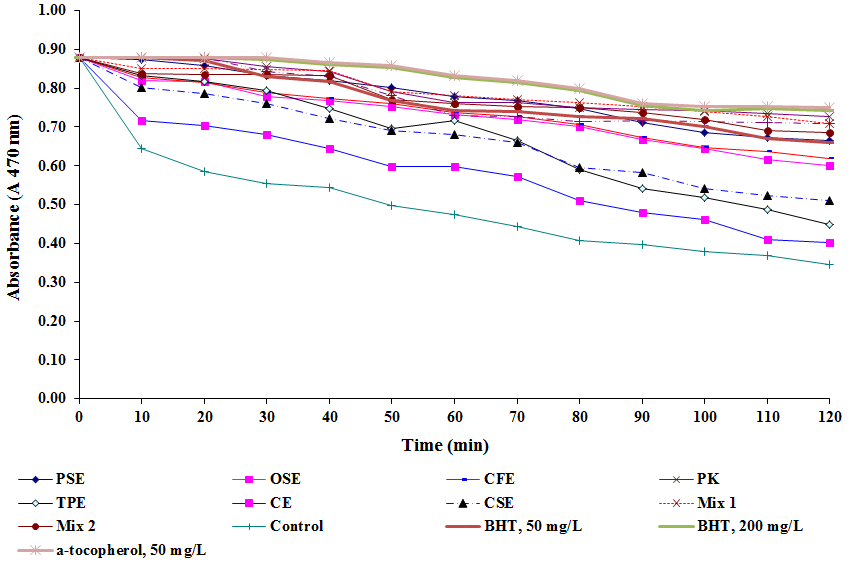
Antioxidant activity (AA) of the ethanol extracts of selected parts of plants (and their mixtures) was monitored during a 120-minute time interval by using the β-carotene-linoleic acid system Figure 1. All of these extracts started with the same absorbance value (0.879). As time progresses, the absorbance values decrease in all cases, except in the control sample into which no antioxidant is added. The rate of decrease in absorbance is faster in the control sample compared to the sample extracts and standard antioxidants. The absorbance value decreases rapidly in the control sample to 0.346 in 120 minutes, whereas in high phenolic content extracts like the carnation flower extract (CFE), the decrease in absorbance is slower (0.666 in 120 minutes). The standard antioxidants like BHT 50 mg/L and α-tocopherol 50 mg/L showed a slower rate of decrease in absorbance values compared to the control sample (e.g., α-tocopherol 50 mg/L decreases in absorbance value to 0.749 in 120 minutes). Mix1 and Mix2 showed intermediate values in absorbance in 120 minutes (~0.709 and ~0). These data indicate that the extracts do, in fact, slow the rate of β-carotene bleaching in the emulsion model, though not to the same degree. The extract from carnation flower (CFE) and rosemary (RE) have the highest levels of absorbance in the 120-minute time frame, implying the highest inhibitory activity on lipid radical formation. The other extracts, such as coriander seeds (CSE) or tomato pomace (TPE), have lower levels of absorbance in the 120-minute time frame, implying less inhibitory activity on lipid radical formation. The mixtures perform better than most of the low-activity extracts, though not as well as the best single extracts or standards.
The β-carotene bleaching assay is dependent upon the generation of linoleate-derived peroxyl radicals (ROO•) in the emulsion system, which then react with β-carotene to cause bleaching of the β-carotene chromophore. However, antioxidants can terminate the free radical chain reaction. The addition of antioxidants slows the rate of bleaching of the β-carotene over time. 53, 70 The mechanism of the β-carotene bleaching assay is: “The mechanism involves the formation of ROO• radicals from the thermal degradation of an initiator in the presence of oxygen. Antioxidants present in the sample can inhibit or slow down the oxidation process, thereby reducing the bleaching of β-carotene.” 71. As has been shown in previous research, total phenolic content has been shown to have a positive correlation with β-carotene bleaching inhibition in plant extracts. For example, in Iranian caraway and clove plant extracts, antioxidant activity in the β-carotene-linoleate emulsion system has been shown to have a very high positive correlation coefficient with total phenolic content (r ≈ 0.98) 72. Other studies have also shown that plant extracts with higher phenolic content have shown greater retention of absorbance in the β-carotene bleaching assay 73.

As can be seen in the data presented in this paper, the high-performance plant extracts (CFE, RE) have shown high levels of total phenolic content. Specifically, these extracts have shown total phenolic content levels of 174.70 ± 10.23 and 137.22 ± 12.67 mg GAE/g of extract, respectively. This lends further weight to the proposition that plant extracts with higher levels of phenolic compounds have greater antioxidant activity. Furthermore, plant extracts that have shown lower levels of total phenolic content (CSE: 23.45 ± 1.98; TPE: 16.98 ± 1.76 mg GAE/g) have shown a more rapid bleaching of β-carotene in the assay system to 0.402 and 0.511 at 120 minutes. It should also be noted, however, that there are some known drawbacks in the β-carotene bleaching assay. For example, in the β-carotene bleaching assay, the solvent system, emulsion stability, metal content, pH, and the partition of the plant extracts between oil and water have been shown to influence the measurement of antioxidant activity 74.
There are a number of mechanistic reasons why this is likely to be the case: 1) Phenolic composition: High levels of total phenolic compounds are generally associated with high levels of antioxidant activity, as they are capable of donating a hydrogen atom (H•) or electron (e⁻) to a lipid-derived peroxyl radical (ROO•), which would otherwise propagate a chain reaction, or they can act as a metal-chelating agent, which would terminate a chain reaction 71. The level of hydroxylation, conjugation, and glycosylation of phenolic compounds will also affect their antioxidant activity 75. 2) Matrix partitioning and penetration: In a system such as the β-carotene/linoleic acid system, which is a model of a lipid-based system, knowledge of how the extracts behave in this emulsion system (oil in water) is critical, as less polar compounds are likely to penetrate more effectively into the lipid phase and hence have a higher antioxidant activity, while more polar compounds are likely to stay in the water phase and hence have a lower activity in this system 74. This may explain why, in this study, some of the extracts with high levels of total phenolic compounds were less active than would have been predicted in this system, as they were less suited to this system than other extracts. 3) Synergistic and/or antagonistic interactions: When a combination of extracts is used, there may be a number of interactions, which will either enhance or reduce activity. Our mix results suggest that a combination of extracts with a wide range of activities gives a result intermediate to these two, which, in terms of using these extracts in a formula, may allow for a certain level of fine-tuning of activity at a lower cost and using agricultural by-products. 4) Factors related to the method of extraction: Although this is a similar method of extraction, with ethanol as a solvent, other factors, such as concentration of ethanol, time, temperature, and pre-treatment of plant parts, will influence the levels of phenolics in the extracts, as will the presence of interfering compounds, which may include other plant pigments, sugars, and proteins 76. 5) Kinetics of radical generation and bleaching: The β-carotene bleaching assay is also related to the kinetics, i.e., the rates at which the free radicals are generated and the rates at which the antioxidants react with the free radicals. Those extracts showing higher absorbance at longer times (60 to 120 min) indicate the capacity to scavenge the free radicals in the emulsion. From our data, the slower the rate at which the absorbance decreases over the entire 120 min period, the better the extract.

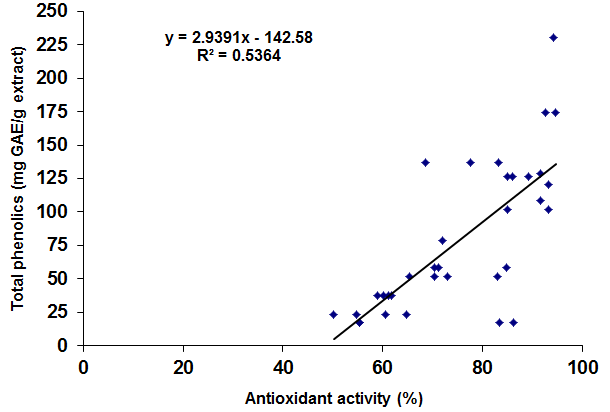
As in Figure 2, a statistically significant linear relationship was observed between the total phenolic content (TPC) of the ethanol extracts and their corresponding antioxidant activity (AA) values as follows: Total phenolics (mg GAE g⁻¹ extract) = 2.9391 × (Antioxidant activity, %) – 142.58; coefficient of determination r² = 0.5364; p < 0.05. This positive linear correlation implies that 53.6 % of the variation in TPC values among tested extracts is due to their antioxidant activities, thus confirming a significant role of phenolic compounds in the antioxidant activity of these extracts; however, a moderate level of correlation observed here suggests that some other non-phenolic compounds may also play a role in antioxidant activities, including carotenoids, vitamin C, volatile terpenoids, and/or Maillard reaction products 60, 77.
The calculated r² value, though significant, does not approach unity. This reiterates the fact that antioxidant activity is a complex phenomenon. Moderate correlation between total phenolic content and antioxidant activity has been reported in other herbal food extracts. For example, Aryal et al. 78 have reported a correlation coefficient of 0.55 between TPC and DPPH radical scavenging activity in 26 spice extracts. Similarly, Hussain et al., 79 have reported a correlation coefficient of 0.63 for total phenolic content and antioxidant activity measured by the ABTS assay in 92 plant extracts. The present results are comparable to these reports. Thus, though phenolic compounds are major contributors to antioxidant activity, the activity is also dependent on the total amount and structural variety of these compounds. The slope of the regression equation, though not very high, is significant at 2.9391. This means that for every 1 % increase in antioxidant activity, there is a predicted increase of 2.94 mg GAE g⁻¹ in TPC. Thus, there is a proportionate, though not directly linear, relationship between phenolic content and antioxidant activity. Earlier reports have shown that the structure of phenolic compounds, not the total amount of these compounds, determines the efficiency of antioxidants. The number of hydroxyl groups, their location, conjugation, glycosylation, and other structural features of phenolic compounds have been shown to influence antioxidant efficiency 80.
The observed correlation can be attributed to the mechanism of action of phenolic compounds, which have been shown to scavenge free radicals. The phenolics have been shown to exhibit antioxidant effects via hydrogen atom transfer (HAT) and single-electron transfer (SET), which neutralize reactive oxygen species (ROS) and lipid peroxyl radicals. The phenolics, which have hydroxyl groups in their aromatic rings, can easily transfer hydrogen atoms to free radicals, leading to resonance-stabilized phenoxyl radicals. This action terminates the free radicals, hence protecting the compound from oxidative degradation. The phenolic acids, flavonoids, and tannins have the ability to chelate pro-oxidant metals, which include iron and copper. This ability to chelate these metals inhibits the Fenton reaction, which leads to the formation of free radicals. The ability of phenolics to chelate these metals increases with the concentration of phenolics in the plant extracts. This explains why there is an increase in the ability to inhibit the oxidation of linoleic acid or β-carotene in emulsions with increasing phenolic concentration in plant extracts 81. However, the fact that the correlation coefficient is not perfectly linear (r² = 0.5364) indicates that other classes of antioxidants, which include lipophilic antioxidants like α-tocopherol, carotenoids, and essential oil terpenes, have a role to play in the total antioxidant activity. The fact that the correlation linearity is not perfect indicates that other antioxidants, which include lipophilic antioxidants like α-tocopherol, carotenoids, and essential oil terpenes, have a role to play in the total antioxidant activity.
A similar level of correlation has been found in other plant systems with regard to their phenolic content and antioxidant activity. To cite this, in a study conducted by Zeljli et al. 82, a value of r² = 0.52 was found in Origanum and Thymus species with regard to their TPC and β-carotene bleaching inhibition activity. Moreover, in a study conducted by , r² values ranged from 0.49 to 0.66, depending on the type of Indian medicinal plant, solvent, and method of extraction used. The aforementioned observations indicate that a similar level of correlation found in this study, with a value of r² = 0.5364, is common in studies dealing with plant extracts, where multiple mechanisms of antioxidant activity are in action.
The potential factors which may influence the level of AA-TPC relationship are as follows: 1) Phenolic compounds’ heterogeneity: Not all phenolic compounds have equal potential in exhibiting antioxidant activity. To illustrate this, in a study conducted by Taheri et al., 83, flavonoids with two hydroxyl groups in their structure, such as catechins and quercetin, are more potent antioxidants than those with a single hydroxyl group, such as resveratrol, caffeic acid, and ferulic acid. 2) Factors associated with the solvent and method of extraction: Ethanol, a medium-polarity solvent, may not extract apolar antioxidants, which would otherwise increase the value of the AA-TPC relationship. Matrix interactions and synergism: Phenolic compounds may have a synergistic or antagonistic effect on other phytochemicals, which would otherwise influence their antioxidant activity 84. 4) Assay specificity: Each antioxidant activity assay measures a particular type of free radical, in a particular environment, and hence may not reflect the total antioxidant potential of a particular type of phenolic compound .
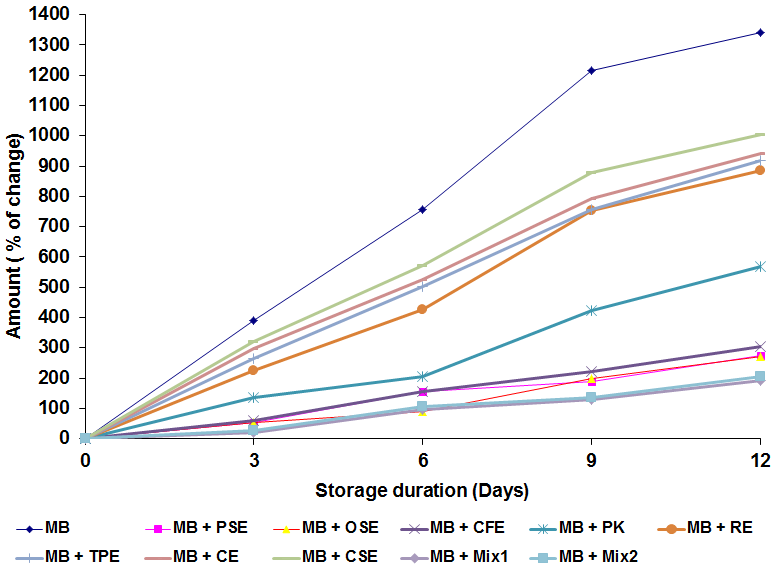
3.2. Effect of Phyto-natural and Byproduct Extracts on Beef Meatballs QualityOxidative stability of buffalo meatballs enriched with different phyto-natural and byproduct extracts was investigated during a 12-day refrigerated storage period at 4°C by determining thiobarbituric acid (TBA) values. As presented in Table 3 and Figure 3, a significant increase in TBA values in control meatballs (MB) was observed from 0.33 ± 0.08 mg/kg on day 0 to 4.71 ± 0.24 mg/kg on day 12, a 1340% increase compared to the initial values (Table 3 and Figure 3). This significant increase in TBA values in meatballs is due to the inherent lipid composition of buffalo meat, which is highly susceptible to oxidation due to high polyunsaturated fatty acid content in meat lipids 85, 86, 87. The addition of different individual plant-derived extracts significantly reduced TBA values in meatballs. Pomegranate skin extract (MB + PSE) and onion skin extract (MB + OSE) showed similar TBA values on day 12 of 1.22 ± 0.45 mg/kg and 1.21 ± 0.26 mg/kg, a 274% and 270% increase in TBA values, respectively. Carnation flower extract (MB + CFE) showed a slightly higher TBA value of 1.32 ± 0.26 mg/kg on day 12, a 303% increase in TBA values. These reductions can be explained by the phenolic and flavonoids present in the extracts, which possess antioxidative activity by donating hydrogen ions to lipid radicals, chelating metal ions, and scavenging peroxyl radicals, thus inhibiting the propagation of the lipid peroxidation chain reaction 14, 23, 27, 28 30, 88, 89. Moderate antioxidative activity was recorded with the peach kernel extract (MB + PK), which recorded a final TBA value of 2.19 ± 0.26 mg/kg with a 570% change. Rosemary (MB + RE), tomato pomace extract (MB + TPE), cumin extract (MB + CE), and coriander seed extract (MB + CSE) recorded progressive increases in their TBA values. Their final values ranged from 3.22 ± 0.35 to 3.61 ± 0.26 mg/kg, with the values showing 884 to 1004% change. It is possible that the antioxidative activity recorded with these samples is related to the polyphenolic composition, solubility, and the kinetics of the antioxidative reactions. For example, the presence of water-soluble phenolics in pomegranate and onion skin extracts might be more effective in the antioxidative reaction compared to the fat-soluble phenolics in rosemary and tomato extracts 90, 91.
Notably, the combination of these extract formulations (Mix1: PSE + CFE + RE + CE, Mix2: OSE + PK + CSE + TPE) showed enhanced antioxidative activity in suppressing rancidity development, maintaining TBA levels of 0.95 ± 0.18 mg/kg (192% increase) and 1.00 ± 0.28 mg/kg (205% increase), respectively. This synergistic activity can be attributed to the different mechanisms of actions of these plant extracts in scavenging free radicals, chelating metal ions, and inhibiting secondary oxidation products. This further supports previous research on the efficacy of plant extract supplementation in achieving antioxidative stability in meat products compared to single plant extracts 14, 60, 85.
The lipid peroxidation mechanism in meat products occurs through initiation by the abstraction of a hydrogen atom from PUFAs, propagation through peroxyl radical formation, and termination by the combination of these free radicals or through antioxidants. The plant extracts' activity in reducing rancidity development in buffalo meatballs can thus be attributed to the efficient scavenging of peroxyl radicals and the stabilizing activity of the plant extracts on MDA (malondialdehyde), the major compound measured by the TBA assay 28, 87, 92. Moreover, the percent change data in Table 5 also showed that the rate of rancidity development in control meatballs is much higher compared to all the plant extract-treated meatballs. Thus, the functional potential of these plant extracts in improving meatball quality can be further explored. The use of plant-derived extracts and byproduct extracts, in combination, has shown significant improvement in the antioxidative activity of buffalo meatballs during refrigerated storage. This further supports previous research on the efficacy of natural antioxidants in meat products, specifically those of plant origin, in maintaining meat quality by inhibiting lipid peroxidation 86, 90.

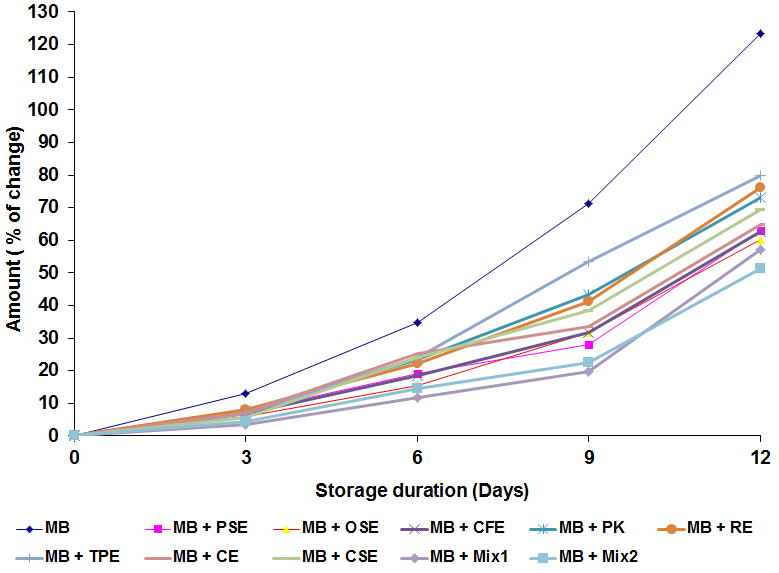
The evolution of total volatile bases-nitrogen (TVB-N) values, which are a well-established indicator of protein degradation and microbial spoilage in meat systems, was monitored over a 12-day refrigerated storage period (4 °C) (Table 4 and Figure 4). The control sample, MB, exhibited a significant increase in TVB-N values over time, from 6.79 ± 0.25 mg/100 g on day 0 to 15.16 ± 0.77 mg/100 g on day 12. This significant increase in TVB-N values is a result of continuous proteolysis and deamination reactions, which are mediated by microbial enzymes and microorganisms, leading to the accumulation of volatile bases such as ammonia, dimethylamine, and trimethylamine 64, 93, 94, 95, 96, 97. The percentage progression data in Table 7 further support these findings, indicating accelerated spoilage in the control sample, where TVB-N values were nearly doubled over time. On the other hand, all treatments containing phyto-natural and byproduct extracts significantly (p ≤ 0.05) inhibited the increase in TVB-N values in comparison with the control. Among these treatments, onion skin extract (MB + OSE) and pomegranate skin extract (MB + PSE) exhibited strong inhibitory effects on microbial spoilage, with final TVB-N values of 10.89 ± 0.84 and 11.06 ± 1.81 mg/100 g, respectively, on day 12. Carnation flower extract (MB + CFE) exhibited a similar effect, with a final TVB-N value of 11.05 ± 0.84 mg/100 g on day 12. This can be explained by the high levels of phenolic compounds, flavonoids, and tannins found in these extracts, which are known to disrupt microbial cell membrane integrity, inhibit enzyme activity, and interfere with protein degradation pathways 86, 98.
Moderate reduction in TVB-N accumulation was found with peach kernel (MB + PK), rosemary (MB + RE), cumin (MB + CE), coriander seed (MB + CSE), and tomato pomace extracts (MB + TPE), with final TVB-N values in the range of 11.19 ± 0.83 to 12.21 ± 0.60 mg/100 g. The less efficient nature of these treatments may be related to their antimicrobial activity, phenolic composition, and extract stability during storage conditions. For example, in the case of essential oil-based extracts such as rosemary, their antimicrobial activity is related to compounds such as carnosic acid and rosmarinic acid, which may vary under refrigerated conditions 99.
It is noteworthy that the mixed extract formulations, Mix1 and Mix2, showed the most significant inhibitory activity in TVB-N formation. Mix1, containing PSE, CFE, RE, and CE, and Mix2, containing OSE, PK, CSE, and TPE, resulted in final TVB-N levels of 10.67 ± 0.80 and 10.28 ± 0.91 mg/100 g, respectively, which are the lowest levels of TVB-N in all treated samples. This enhanced preservation activity may be related to the synergistic effects of individual bioactive compounds, which may result in a broader spectrum of activity and increased inhibition of enzymes responsible for TVB-N formation in meat. Synergistic effects of plant extracts in controlling microbial growth and enzyme activity have been widely documented, where a combination of plant extracts has shown increased antimicrobial activity in comparison with their individual components, which may be related to their multiple mechanisms of action on microbial cell membranes 100, 101.

From a mechanistic perspective, the reduction in TVB-N levels in treated samples may be related to the inhibition of spoilage microorganisms responsible for protein degradation in meat, which include extracellular enzymes such as proteases and deaminases, responsible for the conversion of proteins and amino acids to volatile nitrogenous compounds. Phenolic compounds in plant extracts may act on microbial metabolism by interfering with cell membrane integrity, membrane permeability, and key microbial enzymes, which may slow down TVB-N formation in meat 98, 102. Furthermore, the antioxidant activity of these extracts could also play a role in the reduction of protein degradation through the prevention of oxidative stress. Oxidative stress can cause proteins to degrade more easily. Thus, the antioxidant activity of these extracts can help in maintaining the stability of the proteins during storage 85. Overall, the results have shown that the supplementation of phyto-natural and byproduct extracts can delay the degradation of buffalo meatballs. The delay in degradation is indicated by the lower levels of TVB-N in the meatballs compared to the control. The enhanced activity of the combination of extracts has shown that these extracts can be used as natural preservatives in the preservation of meat products, which is in accordance with previous studies on the use of plant-derived compounds in food preservation 86, 100.
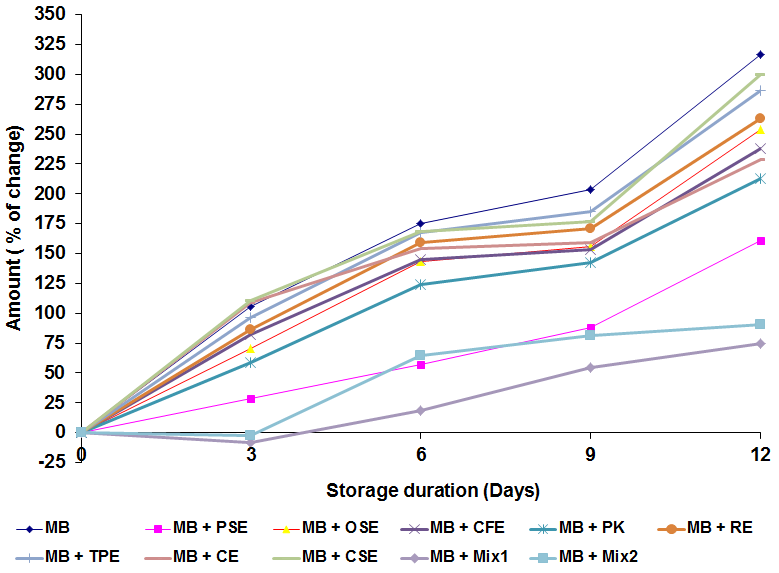
The changes in lactic acid bacteria (LAB) populations in buffalo meatballs during refrigerated storage (4 °C) are presented in Table 8. LAB populations in the control sample (MB) increased significantly (p ≤ 0.05) from 1.15 ± 0.14 log₁₀ cfu/g on day 0 to 4.79 ± 0.24 log₁₀ cfu/g on day 12. This increase represents a 316% increase over the initial LAB populations in buffalo meatballs (Table 5 and Figure 5). The growth of LAB in meat products under refrigerated conditions has already been documented, as these bacteria are psychrotrophic and are capable of utilizing nutrients in meat products, which ultimately contributes to their spoilage 102, 103. The addition of phyto-natural and byproduct extracts significantly inhibited LAB growth in buffalo meatballs in comparison with the control sample. Among these individual treatments, pomegranate skin extract (MB + PSE) exhibited a significant inhibitory effect on LAB growth, with its populations being limited to 3.00 ± 0.24 log₁₀ cfu/g on day 12, which represents a 161% increase over their initial populations in buffalo meatballs. This was followed by peach kernel extract (MB + PK) and carnation flower extract (MB + CFE), which resulted in 3.60 ± 0.11 and 3.89 ± 0.28 log₁₀ cfu/g, respectively. The antimicrobial activity of these extracts may be attributed to the high levels of phenolic and tannins compounds present in these extracts, which interfere with the cell membrane of microorganisms and lead to the leakage of intracellular components and inhibition of essential metabolic enzyme activities 27, 28, 98, 104.
Onion skin extract (MB + OSE) and rosemary extract (MB + RE) showed moderate antimicrobial activity. The LAB count after 12 days of storage resulted in 4.07 ± 0.27 and 4.17 ± 0.19 log₁₀ cfu/g, respectively. Tomato pomace extract (MB + TPE) and coriander seed extract (MB + CSE) showed relatively high levels of microorganisms (4.45 ± 0.36 and 4.60 ± 0.14 log₁₀ cfu/g), which may be due to the relatively low antimicrobial activity of these extracts. The antimicrobial activity of these extracts may be attributed to the different levels of bioactive compounds such as flavonoids, phenolic compounds, and essential oil present in these extracts 29, 100. The moderate inhibitory effect of cumin extract, designated as MB + CE, was indicated by a count of 3.78 ± 0.45 log10 cfu/g for LAB. The antimicrobial properties of cumin have been linked to active compounds such as cuminaldehyde, which interfere with bacterial cell wall formation and enzymatic processes 98. Nevertheless, efficacy could be dependent on concentration and shelf-life stability.
Interestingly, the combined treatments involving mixtures of two or more plant extracts recorded the highest suppression of LAB growth throughout the storage period. The combined mixture of PSE, CFE, RE, and CE, designated as Mix1, resulted in a reduced count of 2.01 ± 0.26 log10 cfu/g, corresponding to a 75% increase in LAB growth, whereas a higher count of 2.19 ± 0.39 log10 cfu/g, corresponding to a 90% increase, was recorded for the combined mixture of OSE, PK, CSE, and TPE, designated as Mix2. Significantly, an initial decline in LAB growth was recorded at day 3, where a decrease of 7.81% and 2.68% was recorded for mixtures Mix1 and Mix2, respectively. The enhanced efficacy of combined mixtures of plant extracts could be attributed to synergistic interactions involving active compounds in the respective plant extracts. This synergy enables a higher efficacy of the combined mixture, as multiple target sites within microbial cells are affected simultaneously, such as cell membrane, enzymes, and genetic materials, thereby reducing the probability of developing resistance to a single active compound 100, 101. The presence of both hydrophilic and lipophilic compounds in combined mixtures could also contribute to increased efficacy, as such compounds could penetrate microbial cell membranes more effectively.

From a mechanistic point of view, the inhibitory effects of plant extracts on LAB can be related to phenolic compound action, which can affect membrane permeability, dissipate proton motive force, and decrease ATP synthesis. This can eventually lead to reduced microbial growth and metabolism, slowing down the spoilage process 104. Additionally, the antioxidant capacity of plant extracts could play an indirect role in inhibiting microorganisms, considering that oxidative stress can favor bacterial growth 85.
The results shown in Table 5, which refer to the percent change in data, confirm the efficiency of the treatment, considering that all the samples containing plant extracts showed significantly reduced percent increase in LAB compared to the control. The low percent increase in Mix1 and Mix2 indicates the potential of these mixtures to be used as natural antimicrobial agents to extend the microbiological shelf life of meat products.The results showed that phyto-natural and byproduct extracts, especially in combined form, have the ability to inhibit the growth of LAB in buffalo meatballs during refrigerated storage. The results support the increasing interest in natural preservatives, which can be used instead of synthetic preservatives, considering their antimicrobial and antioxidant capacity in meat preservation systems 102, 104.
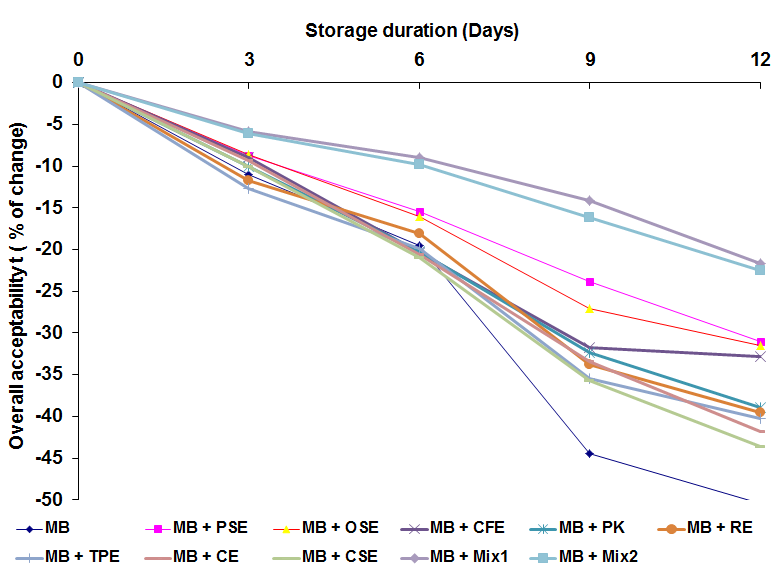
The development of overall acceptability scores of buffalo meatballs stored in a refrigerated environment (4°C for 12 days) is shown in Table (6) and Figure (6). A general decrease in sensory quality of the meatballs over time is evident in all treatments. However, the rate of decrease differed significantly depending on the nature of the extract used. This is attributed to the combined effects of lipid oxidation, microorganism development, and protein degradation, which are generally cited as the main mechanisms of sensory quality loss of meat products stored in a chilled environment 27, 28, 105, 106. At day 0, the acceptability scores for all samples were the same (6.79 ± 0.18). As the storage time increased, the control sample (MB) recorded the highest level of deterioration, reaching 15.16 ± 0.77 by the end of the storage period (day 12), which is equivalent to a 50.46% reduction in acceptability. This high level of deterioration can be explained by the lack of bioactive compounds, which allowed the process of lipid peroxidation to occur at a faster rate. Similar observations were recorded by Lund et al. 107, which showed that untreated meat systems recorded faster rates of oxidative rancidness and sensory rejection during storage.
On the other hand, all the treatments involving phyto-natural or by-product extracts exhibited significant improvement in sensory stability compared to the control. Among the single extracts, pomegranate skin extract (PSE), onion skin extract (OSE), and carnation flower extract (CFE) were found to have the highest potential in maintaining sensory stability. The acceptability scores for these extracts at the end of the storage period were found to be 11.06, 10.89, and 11.05, respectively. The percentage reduction in these extracts was found to be lower at 31.03%, 31.56%, and 32.86%, respectively. The efficacy of these extracts in maintaining sensory stability can be related to the fact that these extracts contain high levels of phenolic compounds, flavonoids, and tannins. These compounds have shown strong antioxidant and antimicrobial activities 13, 14). They have the ability to control lipid peroxidation by scavenging free radicals and chelating metal ions. In addition, these compounds have been found to control microorganisms responsible for spoilage. Moderate protection levels were recorded for samples subjected to peach kernel (PK), rosemary extract (RE), tomato pomace extract (TPE), cumin extract (CE), and coriander seed extract (CSE). Though these samples showed better resistance to quality loss compared to the control samples, the final percentage loss of these samples ranged from 38.99% to 43.55%. The disparity in the effectiveness of these plant extracts may be due to the different phenolic compounds and polarities of these extracts. For instance, rosemary is rich in carnosic and rosmarinic acids, which are potent antioxidants. However, the effectiveness of rosemary may be dependent on the concentration of these compounds in the product 20. Tomato pomace is rich in lycopene and phenolics and is a good antioxidant but may not offer protection against microorganisms compared to tannins.
Interestingly, the most pronounced protective effects were found in the mix treatments, namely Mix1 and Mix2. Mix1, which comprised a combination of PSE, CFE, RE, and CE, and Mix2, which comprised a combination of OSE, PK, CSE, and TPE, recorded the lowest percentage reduction in acceptability, with a reduction of 21.65% and 22.56%, respectively, after 12 days of storage. This indicates a potential synergistic interaction between the bioactive compounds in these mix treatments. The combination of different phenolic structures may enhance their potential as a radical scavenger, increase their antimicrobial activity, and improve their stability through a variety of mechanisms, such as a combination of their individual activities, which may act in a synergistic manner to enhance their potential as a natural antioxidant 86.
The preservation of acceptability in the treated samples may be explained by a number of mechanisms, which act in concert to extend the shelf life of meat products. These include: (i) control of lipid oxidation, which in turn minimizes off-flavor and rancid off-odors, (ii) control of microbial growth, which in turn prevents the accumulation of spoilage compounds, and (iii) preservation of color and texture through control of protein oxidation. These mechanisms are thought to work in concert to enhance acceptability over a long period 105, 106. Overall, the results clearly showed that the use of phyto-natural and agro-industrial byproduct extracts greatly improved the sensory shelf life of buffalo meatballs. The superiority of the combination of extracts over the individual ones points to the significance of the formulation approach for taking advantage of the synergistic effects of natural antioxidants. The results are consistent with the current trends in clean-label approaches for the preservation of meat products and support the use of these natural antioxidants as alternatives to synthetic preservatives.

In conclusion, the present study has shown that plant-derived extracts and agro-industrial by-products can be considered effective and promising natural alternatives to synthetic compounds in meat preservation systems, due to the significant antioxidant and antimicrobial activities of these compounds, which can improve the quality, safety, and shelf life of buffalo meatballs during refrigerated storage. Among the plant-derived extracts tested, carnation flower and rosemary extracts showed the highest total phenolic content and antioxidant activity. The results of this study have shown the significant importance of phenolic compounds in improving the antioxidant activity of meat products. Agro-industrial by-products such as pomegranate peel, onion skin, and tomato pomace have been found to be valuable, sustainable sources of phenolic compounds, which can play a significant role in food preservation and waste reduction. Although some differences in antioxidant activity were found among the plant-derived extracts tested in the present study, these differences can be mainly attributed to the differences in phenolic composition, extraction efficiency, and interactions in the food matrix. The positive correlation between total phenolic content and antioxidant activity has shown that phenolic compounds are the major contributors to the antioxidant activity of plant-derived extracts, although other non-phenolic compounds have also shown significant importance in improving the antioxidant activity of meat products. The use of these extracts in the formulation of buffalo meatballs resulted in the reduction of lipid oxidation, as evidenced by the lower TBA values; the slowing down of protein degradation, as measured by the reduced formation of TVB-N; and the inhibition of the growth of microorganisms, especially lactic acid bacteria, compared to the control samples, resulting in the improvement of sensory acceptability. It is noteworthy that the use of the combined extracts, as represented by Mix 1 and Mix 2, was found to be more effective compared to the use of the individual extracts due to the synergistic action of the bioactive compounds present in the extracts. This highlights the potential benefits of the use of multiple-component natural preservatives in order to attain the best results. In conclusion, the use of phyto-natural extracts is an effective means of producing clean-label meat products that are in line with the demands of the market for natural, safe, and sustainable food products, while at the same time ensuring the sustainability of the environment and the economy through the use of agricultural by-products. In light of the results obtained from the present study, the following recommendations are made: the optimization of the mixture of the extracts with the purpose of attaining the best results through the synergistic action of the bioactive compounds; the sensory impact of the extracts at various concentrations; the exploration of the potential for the use of advanced methods for the extraction of the bioactive compounds; the exploration of the potential for the use of the extracts in various food products; further studies on the potential for the use of the extracts in the food industry; and further studies on the potential for the use of the extracts with the purpose of attaining the best results from the viewpoint of safety.
The sensory evaluation of meatball samples in the present study was conducted in accordance with ethical regulations and was approved by the Scientific Research Ethics Committee (SREC, Approval #: 22-SREC-01-2025), Faculty of Home Economics, Menoufia University, Shebin El-Kom, Egypt.
The authors would like to express their deep appreciation to the staff of the New Bani Suef Company for Dehydration and Industratzation of Vegetables, Bani Suef El-Goudida City, Nile east, Bani Suef, Egypt for their valuable technical support.
The authors confirm that this statement is not included in the article to allow for the possibility of publication.
Yousif Elhassaneen contributed to the preparation and review of the study protocol, supervised the implementation of the experimental work, validated the results, prepared the initial manuscript draft, conducted a critical intellectual review to organize the content, and approved the final version for publication. Mai Ghreeb contributed to monitoring the experimental procedures, retrieving and developing the conceptual framework, validating the results, and assisting in manuscript drafting. Esraa ElFaramawy carried out the experimental work, collected, analyzed, and tabulated the data, and also contributed to conceptual information retrieval and manuscript preparation.
| [1] | Bekhit, A. E. A., Holman, B. W. B., Giteru, S. G., & Hopkins, D. L. (2021). Total volatile basic nitrogen and its role in meat spoilage: A review. Trends in Food Science & Technology, 109, 280-302. | ||
| In article | View Article | ||
| [2] | Met, A., & Şahin Yeşilçubuk, N. (2017). Comparison of two volatile sampling techniques based on different loading factors in determination of volatile organic compounds released from spoiled raw beef. Food Analytical Methods, 10, 2311-2324. | ||
| In article | View Article | ||
| [3] | Shamberger, R. J., Corlett, C. L., Beaman, K. D., & Kasten, B. L. (1979). Antioxidants reduce the mutagenic effect of malonaldehyde and propiolactone. Mutation Research, 66, 349. | ||
| In article | View Article PubMed | ||
| [4] | Chan, W. K. M., Hakkarainen, K., Faustman, C., Schaefer, D. M., Scheller, K. K., & Liu, Q. (1996). Dietary vitamin E effect on color stability and sensory assessment of spoilage in three beef muscles. Meat Science, 42(4), 387-399. | ||
| In article | View Article PubMed | ||
| [5] | Renerre, M., Anton, M., & Gatellier, P. (1992). Autoxidation of purified myoglobin from two bovine muscles. Meat Science, 32, 331-342. | ||
| In article | View Article PubMed | ||
| [6] | El-Saeid, M. H. (1993). Studies on storage ability and expiry date of some frozen fish for human consumption (Master’s thesis, Faculty of Agriculture, Al-Azhar University, Egypt). | ||
| In article | |||
| [7] | Elhassaneen, Y. A., & Tawfik, L. M. (1998). The presence of some carcinogens in human foods distributed in Egyptian local markets. Journal of Home Economics, 8(3), 23-38. | ||
| In article | |||
| [8] | Chastain, M. F., Huffman, D. L., Hsieh, W. H., & Cordray, J. C. (1982). Antioxidants in restructured beef/pork steaks. Journal of Food Science, 47, 1779-1782. | ||
| In article | View Article | ||
| [9] | Chen, C. C., Pearson, A. M., Gray, J. I., Fooladi, M. H., & Ku, P. (1984). Factors influencing nonheme iron in meat. Journal of Food Science, 49, 581-584. | ||
| In article | View Article | ||
| [10] | Lourenço, S. C., Moldão-Martins, M., & Alves, V. D. (2019). Antioxidants of natural plant origins: From sources to food industry applications. Molecules, 24(22), 4132. | ||
| In article | View Article PubMed | ||
| [11] | Toldrá, F., Aristoy, M. C., Mora, L., & Reig, M. (2012). Innovations in value-addition of edible meat by-products. Meat Science, 92(3), 290-296. | ||
| In article | View Article PubMed | ||
| [12] | Falowo, A. B., Fayemi, P. O., & Muchenje, V. (2014). Natural antioxidants against lipid-protein oxidative deterioration in meat and meat products: A review. Food Research International, 64, 171-181. | ||
| In article | View Article PubMed | ||
| [13] | Viuda-Martos, M., Fernández-López, J., & Pérez-Álvarez, J. A. (2010). Pomegranate and its many functional components as related to human health: A review. Comprehensive Reviews in Food Science and Food Safety, 9(6), 635-654. | ||
| In article | View Article PubMed | ||
| [14] | Peršurić, Ž., Saftić Martinović, L., Malenica, M., et al. (2020). Phenolic composition of pomegranate peel extracts. Molecules, 25, 5916. | ||
| In article | View Article PubMed | ||
| [15] | Benítez, V., Mollá, E., Martín-Cabrejas, M. A., Aguilera, Y., López-Andréu, F. J., Cools, K., et al. (2011). Characterization of industrial onion wastes. Plant Foods for Human Nutrition, 66(1), 48-57. | ||
| In article | View Article PubMed | ||
| [16] | Bains, A., Sridhar, K., Singh, B. N., Kuhad, R. C., Chawla, P., & Sharma, M. (2023). Valorization of onion peel waste: From trash to treasure. Chemosphere, 343, 140178. | ||
| In article | View Article PubMed | ||
| [17] | cai, Y., Luo, Q., Sun, M., & Corke, H. (2004). Antioxidant activity and phenolic compounds of 112 traditional Chinese medicinal plants associated with anticancer. Life Sciences, 74(17), 2157-2184. | ||
| In article | View Article PubMed | ||
| [18] | Bastos, K., de Souza, A. B., Tomé, A. C., & Souza, F. M. (2025). New strategies for the extraction of antioxidants from fruits and their by-products: A systematic review. Plants, 14(5), 755. | ||
| In article | View Article PubMed | ||
| [19] | Kim, K. J., & Kim, D. O. (2025). Phenolic profiling of peach tissues. Food Chemistry X, 30, 102946.Kim, K. J., & Kim, D. O. (2025). Phenolic profiling of peach tissues. Food Chemistry X, 30, 102946. | ||
| In article | View Article PubMed | ||
| [20] | Nieto, G., Ros, G., & Castillo, J. (2018). Antioxidant and antimicrobial properties of rosemary (Rosmarinus officinalis L.). Medicines, 5(3), 98. | ||
| In article | View Article PubMed | ||
| [21] | Nardini, M. (2022). Phenolic compounds in food: Characterization and health benefits. Molecules, 27(3), 783. | ||
| In article | View Article PubMed | ||
| [22] | Haque, A., Ahmad, S., Azad, Z. R. A. A., Adnan, M., & Ashraf, S. A. (2023). Incorporating dietary fiber from fruit and vegetable waste in meat products: A systematic approach. PeerJ, 11, e14977. | ||
| In article | View Article PubMed | ||
| [23] | Bettaieb, I., Bourgou, S., Sriti, J., Msaada, K., Limam, F., & Marzouk, B. (2011). Essential oils and fatty acids of cumin seeds. Journal of the Science of Food and Agriculture, 91(11), 2100-2107. | ||
| In article | View Article PubMed | ||
| [24] | Laribi, B., Kouki, K., M’Hamdi, M., & Bettaieb, T. (2015). Coriander bioactive constituents. Fitoterapia, 103, 9-26. | ||
| In article | View Article PubMed | ||
| [25] | Scandar, S., Zadra, C., & Marcotullio, M. C. (2023). Coriander (Coriandrum sativum) polyphenols and metabolic syndrome. Molecules, 28(10), 4187. | ||
| In article | View Article PubMed | ||
| [26] | Fernández-López, J., Zhi, N., Aleson-Carbonell, L., Pérez-Álvarez, J. A., & Kuri, V. (2005). Antioxidant and antibacterial activities of natural extracts: Application in beef meatballs. Meat Science, 69(3), 371-380. | ||
| In article | View Article PubMed | ||
| [27] | Elhassaneen, Y. A., & Esa, Z. (2015). Effect of adding natural extracts on quality properties of meat products under refrigeration. Journal of Home Economics, 25(1), 1-14. | ||
| In article | |||
| [28] | Rdwan, R., Abd El-Khalik, D., & Elhassaneen, Y. (2018). Antioxidant and antibacterial properties of phyto by-products and gum Arabic extracts in cooked beef meatballs. In Proceedings of the 5th Scientific (3rd International) Conference of the Faculty of Specific Education, Ain Shams University. | ||
| In article | |||
| [29] | Hassan, R. H. (2023). Development of natural products application in meat products to prolong shelf life and prevent foodborne diseases (Master’s thesis, Benha University, Egypt). | ||
| In article | |||
| [30] | Elhassaneen, Y. A., Nasef, A. Z., Arafa, R. S., & Bayomi, A. I. (2023). Milk thistle extract and obesity prevention. American Journal of Food Science and Technology, 11(3), 70-85. | ||
| In article | View Article | ||
| [31] | Marco, G. (1968). A rapid method for evaluation of antioxidants. Journal of the American Oil Chemists’ Soci | ||
| In article | View Article | ||
| [32] | Al-Saikhan, M. S., Howard, L. R., & Miller, J. C. (1995). Antioxidant activity in potato genotypes. Journal of Food Science, 60(2), 341-343. | ||
| In article | View Article | ||
| [33] | Marinova, E., Yanishlieva, N., & Kostova, I. (1994). Antioxidative action of ethanolic extract and hydroxycoumarins of Fraxinus ornus bark. Food Chemistry, 51, 125-132. | ||
| In article | View Article | ||
| [34] | Mallet, J. F., Cerrati, C., Ucciani, E., Gamisana, J., & Gruber, M. (1994). Antioxidant activity of plant leaves in relation to α-tocopherol content. Food Chemistry, 49, 61-65. | ||
| In article | View Article | ||
| [35] | Singleton, V. L., & Rossi, J. A. (1965). Colorimetry of total phenolics. American Journal of Enology and Viticulture, 16, 144-158. | ||
| In article | View Article | ||
| [36] | Tarladgis, B. G., Watts, B. M., & Younathan, M. T. (1960). A distillation method for the quantitative determination of malonaldehyde in rancid foods. Journal of the American Oil Chemists’ Society, 37, 44-48. | ||
| In article | View Article | ||
| [37] | Winton, A. L., & Winton, R. B. (1961). The analysis of foods. John Wiley & Sons. | ||
| In article | |||
| [38] | Gerhardt, P., Murray, R. G. E., Wood, W. A., & Krieg, N. R. (1994). Methods for general and molecular bacteriology. ASM Press. | ||
| In article | |||
| [39] | American Meat Science Association. (2015). Research guidelines for cookery, sensory evaluation, and tenderness measurements of meat. | ||
| In article | |||
| [40] | Steel, R. G. D., & Torrie, J. H. (1980). Principles and procedures of statistics: A biometrical approach. McGraw-Hill. | ||
| In article | |||
| [41] | Wang, M., Shen, Q., Pang, J., Mao, Y., Li, X., Tao, Y., Tang, W., Sun, R., & Zhou, X. (2024). Chemical constituents and antioxidant activities of Dianthus caryophyllus L. Frontiers in Plant Science, 15, 1438967. | ||
| In article | View Article PubMed | ||
| [42] | Srivastava, R. P., Kumar, S., Singh, L., Madhukar, M., Singh, N., Saxena, G., Pandey, S., Singh, A., Devkota, H. P., Verma, P. C., Shiva, S., Malik, S., & Rustagi, S. (2023). Phenolic compounds and bioactivities of Selinum carvifolia. Frontiers in Nutrition, 10, 1180225. | ||
| In article | View Article PubMed | ||
| [43] | Platzer, M., Kiese, S., Tybussek, T., Herfellner, T., Schneider, F., Schweiggert-Weisz, U., & Eisner, P. (2022). Radical scavenging mechanisms of phenolic compounds: A QSPR study. Frontiers in Nutrition, 9, 882458. | ||
| In article | View Article PubMed | ||
| [44] | Andrade, J. M., Faustino, C., Garcia, C., Ladeiras, D., Reis, C. P., & Rijo, P. (2018). Rosmarinus officinalis L.: Phytochemistry and biological activity. Future Science OA, 4(4), FSO283. | ||
| In article | View Article PubMed | ||
| [45] | Nunes, A. R., Alves, G., Falcão, A., Lopes, J. A., & Silva, L. R. (2025). Phenolic acids from fruit by-products as therapeutic agents. International Journal of Molecular Sciences, 26(8), 3834. | ||
| In article | View Article PubMed | ||
| [46] | Joković, N., et al. (2024). Onion peel as a source of antioxidants. Agronomy, 14(3), 453. | ||
| In article | View Article | ||
| [47] | Gullón, P., Astray, G., Gullón, B., Tomasevic, I., & Lorenzo, J. M. (2020). Pomegranate peel as a source of bioactives for functional meat products. Molecules, 25(12), 2859. | ||
| In article | View Article PubMed | ||
| [48] | Shams Ardekani, M. R., Khanavi, M., Hajimahmoodi, M., Jahangiri, M., & Hadjiakhoondi, A. (2010). Antioxidant activity and phenolic contents of date seeds. Iranian Journal of Pharmaceutical Research, 9(2), 141-146. | ||
| In article | |||
| [49] | Bag A, Chattopadhyay RR (2015) Evaluation of Synergistic Antibacterial and Antioxidant Efficacy of Essential Oils of Spices and Herbs in Combination. PLoS ONE 10(7): e0131321. | ||
| In article | View Article PubMed | ||
| [50] | Jamaleddine, A., Caro, P., Bouajila, J., Evon, P., Haddad, J. G., El-Kalamouni, C., Hijazi, A., & Merah, O. (2022). In vitro bioactivities of tomato pomace extracts. Frontiers in Bioscience (Landmark Edition), 27(9), 259. | ||
| In article | View Article PubMed | ||
| [51] | Halliwell, B., & Gutteridge, J. M. C. (2015). Free radicals in biology and medicine (5th ed.). Oxford University Press. | ||
| In article | View Article | ||
| [52] | Ivanova, D., Gerova, D., Chervenkov, T., & Yankova, T. (2005). Polyphenols and antioxidant capacity of medicinal plants. Journal of Ethnopharmacology, 96(1-2), 145-150. | ||
| In article | View Article PubMed | ||
| [53] | El-Wazeer, M. F. A. (2011). Technological, chemical, and nutritional studies on by-products of dehydrated food companies (Master’s thesis, Faculty of Home Economics, Minoufiya University, Egypt). | ||
| In article | |||
| [54] | El-Safty, A. (2012). Production of important nutritional and functional compounds from food processing by-products (Doctoral dissertation, Faculty of Home Economics, Minoufiya University, Egypt). | ||
| In article | |||
| [55] | Ahmed, S. K. A. (2015). Utilization of food industry by-products in production of high nutritional snacks (Doctoral dissertation, Minoufiya University, Egypt). | ||
| In article | |||
| [56] | Elhassaneen, Y. A., Ragab, S., & Saleh, A. (2016). Effect of plant extracts on liver injury induced | ||
| In article | |||
| [57] | Hegazy, W. H. (2009). Antioxidant activity of pomegranate (Punica granatum) and its relation to phenolic composition and processing technology (Master’s thesis, Minoufiya University, Egypt). | ||
| In article | |||
| [58] | Olaniyi, W. A., Makinde, O. A., & Omitogun, O. G. (2017). Comparison of proximate composition and sensory attributes of Clarias gariepinus, Heterobranchus bidorsalis, and their hybrids. Food Science & Nutrition, 5, 285-291. | ||
| In article | View Article PubMed | ||
| [59] | Elhassaneen, Y. A., Saad, H. H., & Meharm, E. B. (2025). Effect of solvent polarity on extraction of bioactive compounds from Ganoderma lucidum. Egyptian Journal of Chemistry, 68(6), 113-128. | ||
| In article | View Article | ||
| [60] | Ismail, N. S., Elhassaneen, Y. A., & Gouda, D. O. (2025). Oxidative stress, hyperglycemia, hyperlipidemia, and hemostasis impairment as risk factors for diabetes in rats: Therapeutic potential of Cleome droserifolia. Alexandria Science Exchange Journal, 46(1), 57-80. | ||
| In article | View Article | ||
| [61] | Wangensteen, H., Samuelsen, A. B., & Malterud, K. E. (2004). Antioxidant activity in extracts from coriander. Food Chemistry, 88(2), 293-297. | ||
| In article | View Article | ||
| [62] | Sewelam, S. H. (2012). Chemical and technological studies on by-products of dehydrated food companies (Master’s thesis, Minoufiya University, Egypt). | ||
| In article | |||
| [63] | Farghall, F. A. (2015). Production of nutritional and functional compounds from by-products of dehydrated food processing companies (Master’s thesis, Minoufiya University, Egypt). | ||
| In article | |||
| [64] | Younis, M. M. B. (2023). Technological, chemical, and nutritional studies on food processing by-products and their effects on obesity complicat | ||
| In article | |||
| [65] | Hatami, T., Emami, S. A., Miraghaee, S. S., & Mojarrab, M. (2014). Total phenolic contents and antioxidant activities of extracts from Artemisia biennis. Iranian Journal of Pharmaceutical Research, 13(2), 551-559. | ||
| In article | |||
| [66] | Kalpoutzakis, E., Chatzimitakos, T., Athanasiadis, V., Mitakou, S., Aligiannis, N., Bozinou, E., Gortzi, O., Skaltsounis, L. A., & Lalas, S. I. (2023). Total phenolics and antioxidant activity of plant extracts from Crete. Plants, 12(5), 1092. | ||
| In article | View Article PubMed | ||
| [67] | Parikh, B., & Patel, V. H. (2018). Total phenolic content and antioxidant capacity of Indian pulses. Journal of Food Science and Technology, 55(4), 1499-1507. | ||
| In article | View Article PubMed | ||
| [68] | Loganayaki, N., Siddhuraju, P., & Manian, S. (2013). Antioxidant activity of phenolic extracts from Helicteres isora and Ceiba pentandra. Journal of Food Science and Technology, 50(4), 687-695. | ||
| In article | View Article PubMed | ||
| [69] | Rababah, T. M., Al-U’Datt, M., Al-Mahasneh, M., Yang, W., Feng, H., Ereifej, K., Kilani, I., & Ishmais, M. A. (2014). Effect of jam processing and storage. Journal of Food Processing and Preservation, 38, 247-254. | ||
| In article | View Article | ||
| [70] | Hallabo, S. A., Helmy, S. A., Elhassaneen, Y., & Shaaban, M. (2018). Utilization of fruit and vegetable peels as bioactive compounds in biscuits. Bioscience Research, 15(4), 3647-3657. | ||
| In article | |||
| [71] | Gülçin, İ. (2025). Antioxidants: A comprehensive review. Archives of Toxicology, 99(5), 1893-1997. | ||
| In article | View Article PubMed | ||
| [72] | Bamdad, F., Kadivar, M., & Keramat, J. (2006). Evaluation of phenolic content and antioxidant activity of Iranian caraway. International Journal of Food Science & Technology, 41(Suppl. 1), 20-27. | ||
| In article | View Article | ||
| [73] | Boussebaa, W., Rahmani, Z., Mokhtar, S., Amor, S. B., Khaldoun, B., Henni, A., Abdellattif, M. H., Atoki, A. V., Zahnit, W., & Messaoudi, M. (2025). Phenolic compounds and biological activities of Paronychia arabica. Food Science & Nutrition, 13(9), e70912. | ||
| In article | View Article PubMed | ||
| [74] | Shahidi, F., & Samarasinghe, A. (2025). Assessment of antioxidant activity: Advances and limitations. Food Production, Processing and Nutrition, 7(1), 50. | ||
| In article | View Article PubMed | ||
| [75] | Dai, J., & Mumper, R. J. (2010). Plant phenolics: Extraction, analysis, and antioxidant properties. Molecules, 15(10), 7313-7352. | ||
| In article | View Article PubMed | ||
| [76] | Arya, P., Vaidya, D., Kaushal, M., Devi, S., Gupta, A., & Chand, S. (2025). Effects of solvents on phytochemicals and antimicrobial activity of Boehmeria rugulosa. Scientific Reports, 15, 29135. | ||
| In article | View Article PubMed | ||
| [77] | Elhassaneen, Y. A., et al. (2020). Food by-products and obesity complications. Journal of Home Economics, 30(2), 1-26. | ||
| In article | |||
| [78] | Aryal, S., Baniya, M. K., Danekhu, K., Kunwar, P., Gurung, R., & Koirala, N. (2019). Phenolic content and antioxidant potential of wild vegetables. Plants, 8(4), 96. | ||
| In article | View Article PubMed | ||
| [79] | Hussain, S., Sharma, M., Jarg, T., Aav, R., & Bhat, R. (2023). Natural pigments and antioxidants in gooseberry. Current Research in Food Science, 7, 100629. | ||
| In article | View Article PubMed | ||
| [80] | Cosme, P., Rodríguez, A. B., Espino, J., & Garrido, M. (2020). Plant phenolics and bioavailability. Antioxidants, 9(12), 1263. | ||
| In article | View Article PubMed | ||
| [81] | Kostić, K., Brborić, J., Delogu, G., Simić, M. R., Samardžić, S., Maksimović, Z., Dettori, M. A., Fabbri, D., Kotur-Stevuljević, J., & Saso, L. (2023). Antioxidant activity of natural phenols. Molecules, 28(6), 2646. | ||
| In article | View Article PubMed | ||
| [82] | Zejli, H., Metouekel, A., Zouirech, O., Maliki, I., El Moussaoui, A., Lfitat, A., Bousseraf, F. Z., Almaary, K. S., Nafidi, H. A., Khallouki, F., Bourhia, M., Taleb, M., & Abdellaoui, A. (2024). Phytochemical and biological activities of Origanum grosii and Thymus pallidus. Plants, 13(3), 385. | ||
| In article | View Article PubMed | ||
| [83] | Taheri, A., Ganjeali, A., Arefi-Oskouie, A., Çirak, C., & Cheniany, M. (2023). Variability of phenolics in Ziziphora clinopodioides. Physiology and Molecular Biology of Plants, 29(2), 221-237. | ||
| In article | |||
| [84] | Skroza, D., Šimat, V., Vrdoljak, L., Jolić, N., Skelin, A., Čagalj, M., Frleta, R., & Generalić Mekinić, I. (2022). Antioxidant synergisms among phenolic acids. Antioxidants, 11(9), 1784. | ||
| In article | View Article PubMed | ||
| [85] | Estévez, M. (2011). Protein carbonyls in meat systems: A review. Meat Science, 89(3), 259-279. | ||
| In article | View Article PubMed | ||
| [86] | Manessis, G., Kalogianni, A. I., Lazou, T., et al. (2020). Plant-derived antioxidants in meat products. Antioxidants, 9, 1215. | ||
| In article | View Article PubMed | ||
| [87] | Forgione, G., De Cristofaro, G. A., Sateriale, D., Pagliuca, C., Colicchio, R., Salvatore, P., & Paolucci, M. (2024). Pomegranate peel and olive leaf extracts to optimize preservation of fresh meat. Microorganisms, 12, 1303. | ||
| In article | View Article PubMed | ||
| [88] | Elhassaneen, Y. A., Sayed, R., & Farghal, F. (2015). Reduction of PAHs in grilled meatballs using onion peel extracts. In Proceedings of the 2nd International Conference on Food and Biosystems Engineering (pp. 95-104). | ||
| In article | |||
| [89] | Azmat, F., Safdar, M., Ahmad, H., Khan, M. R. J., Abid, J., Naseer, M. S., et al. (2024). Phytochemical profile of pomegranate peel. Food Science & Nutrition, 12(2), 661-674. | ||
| In article | View Article PubMed | ||
| [90] | Shahidi, F., & Ambigaipalan, P. (2015). Phenolics and polyphenolics in foods. Journal of Functional Foods, 18, 820-897. | ||
| In article | View Article PubMed | ||
| [91] | Singh, N., & Yadav, S. S. (2022). Health benefits of phenolics from spices. Current Research in Food Science, 5, 1508-1523. | ||
| In article | View Article PubMed | ||
| [92] | Hussein, M. M. Y. (2011). Effect of phytochemicals on toxic and carcinogenic compounds formed during meat processing (Doctoral dissertation, Minoufiya University, Egypt). | ||
| In article | |||
| [93] | Elhassaneen, Y. A. (1990). Tenderization of some Egyptian meat (Master’s thesis, Al-Azhar University, Egypt). | ||
| In article | |||
| [94] | Hashem, H., Saleh, A. M., Sherif, M. A., & Elhassaneen, Y. A. (1991). Tenderization of Egyptian meat: Camel meat as affected by tenderization methods. Journal of Home Economics, 1(1), 55-67. | ||
| In article | |||
| [95] | Amin, A. A., Halaby, S. M., & Elhassaneen, Y. A. (1998). Nutritional and biological evaluation of some meat organs. Journal of the Egyptian German Society of Zoology, 25(A), 373-382. | ||
| In article | |||
| [96] | Basuony, I. A. B. (1999). Effect of grilled meat consumption on health (Master’s thesis, Minoufiya University, Egypt). | ||
| In article | |||
| [97] | Bekhit, A. E. A., Hopkins, D. L., Fahri, F. T., & Ponnampalam, E. N. (2013). Oxidative processes in muscle systems and fresh meat. Comprehensive Reviews in Food Science and Food Safety, 12(5), 565-597. | ||
| In article | View Article PubMed | ||
| [98] | Burt, S. (2004). Essential oils: Antibacterial properties and applications in foods. International Journal of Food Microbiology, 94(3), 223-253. | ||
| In article | View Article PubMed | ||
| [99] | Olivas-Méndez, P., Chávez-Martínez, A., Santellano-Estrada, E., Guerrero Asorey, L., Sánchez-Vega, R., Rentería-Monterrubio, A. L., Chávez-Flores, D., Tirado-Gallegos, J. M., & Méndez-Zamora, G. (2022). Antioxidant and antimicrobial activity of rosemary and garlic oils in beef hamburgers. Foods, 11(14), 2018. | ||
| In article | View Article PubMed | ||
| [100] | Hyldgaard, M., Mygind, T., & Meyer, R. L. (2012). Essential oils in food preservation. Frontiers in Microbiology, 3, 12. | ||
| In article | View Article PubMed | ||
| [101] | Bassolé, I. H. N., & Juliani, H. R. (2012). Essential oils in combination and their antimicrobial properties. Molecules, 17(4), 3989-4006. | ||
| In article | View Article PubMed | ||
| [102] | Nychas, G. J. E., Skandamis, P. N., Tassou, C. C., & Koutsoumanis, K. P. (2008). Meat spoilage during distribution. Meat Science, 78(1-2), 77-89. | ||
| In article | View Article PubMed | ||
| [103] | Doulgeraki, A. I., Ercolini, D., Villani, F., & Nychas, G. J. (2012). Spoilage microbiota in raw meat. International Journal of Food Microbiology, 157(2), 130-141. | ||
| In article | View Article PubMed | ||
| [104] | Rivière, C. (2025). Natural products as antimicrobial agents: From extraction to therapeutic applications. Molecules, 30(11), 2393. | ||
| In article | View Article PubMed | ||
| [105] | Lund, M. N., Heinonen, M., Baron, C. P., & Estévez, M. (2011). Protein oxidation in muscle foods. Molecular Nutrition & Food Research, 55(1), 83-95. | ||
| In article | View Article PubMed | ||
| [106] | Horbańczuk, O. K., Kurek, M. A., Atanasov, A. G., Brnčić, M., & Rimac Brnčić, S. (2019). The effect of natural antioxidants on quality and shelf life of beef and beef products. Food Technology and Biotechnology, 57(4), 439-447. | ||
| In article | View Article PubMed | ||
| [107] | Falowo, A. B., Fayemi, P. O., & Muchenje, V. (2014). Natural antioxidants against lipid-protein oxidative deterioration in meat and meat products: A review. Food Research International, 64, 171-181. | ||
| In article | View Article PubMed | ||
Published with license by Science and Education Publishing, Copyright © 2026 Yousif A. Elhassaneen, Lamiaa A. Diab and Esraa S. ElFaramawy
 This work is licensed under a Creative Commons Attribution 4.0 International License. To view a copy of this license, visit
http://creativecommons.org/licenses/by/4.0/
This work is licensed under a Creative Commons Attribution 4.0 International License. To view a copy of this license, visit
http://creativecommons.org/licenses/by/4.0/
| [1] | Bekhit, A. E. A., Holman, B. W. B., Giteru, S. G., & Hopkins, D. L. (2021). Total volatile basic nitrogen and its role in meat spoilage: A review. Trends in Food Science & Technology, 109, 280-302. | ||
| In article | View Article | ||
| [2] | Met, A., & Şahin Yeşilçubuk, N. (2017). Comparison of two volatile sampling techniques based on different loading factors in determination of volatile organic compounds released from spoiled raw beef. Food Analytical Methods, 10, 2311-2324. | ||
| In article | View Article | ||
| [3] | Shamberger, R. J., Corlett, C. L., Beaman, K. D., & Kasten, B. L. (1979). Antioxidants reduce the mutagenic effect of malonaldehyde and propiolactone. Mutation Research, 66, 349. | ||
| In article | View Article PubMed | ||
| [4] | Chan, W. K. M., Hakkarainen, K., Faustman, C., Schaefer, D. M., Scheller, K. K., & Liu, Q. (1996). Dietary vitamin E effect on color stability and sensory assessment of spoilage in three beef muscles. Meat Science, 42(4), 387-399. | ||
| In article | View Article PubMed | ||
| [5] | Renerre, M., Anton, M., & Gatellier, P. (1992). Autoxidation of purified myoglobin from two bovine muscles. Meat Science, 32, 331-342. | ||
| In article | View Article PubMed | ||
| [6] | El-Saeid, M. H. (1993). Studies on storage ability and expiry date of some frozen fish for human consumption (Master’s thesis, Faculty of Agriculture, Al-Azhar University, Egypt). | ||
| In article | |||
| [7] | Elhassaneen, Y. A., & Tawfik, L. M. (1998). The presence of some carcinogens in human foods distributed in Egyptian local markets. Journal of Home Economics, 8(3), 23-38. | ||
| In article | |||
| [8] | Chastain, M. F., Huffman, D. L., Hsieh, W. H., & Cordray, J. C. (1982). Antioxidants in restructured beef/pork steaks. Journal of Food Science, 47, 1779-1782. | ||
| In article | View Article | ||
| [9] | Chen, C. C., Pearson, A. M., Gray, J. I., Fooladi, M. H., & Ku, P. (1984). Factors influencing nonheme iron in meat. Journal of Food Science, 49, 581-584. | ||
| In article | View Article | ||
| [10] | Lourenço, S. C., Moldão-Martins, M., & Alves, V. D. (2019). Antioxidants of natural plant origins: From sources to food industry applications. Molecules, 24(22), 4132. | ||
| In article | View Article PubMed | ||
| [11] | Toldrá, F., Aristoy, M. C., Mora, L., & Reig, M. (2012). Innovations in value-addition of edible meat by-products. Meat Science, 92(3), 290-296. | ||
| In article | View Article PubMed | ||
| [12] | Falowo, A. B., Fayemi, P. O., & Muchenje, V. (2014). Natural antioxidants against lipid-protein oxidative deterioration in meat and meat products: A review. Food Research International, 64, 171-181. | ||
| In article | View Article PubMed | ||
| [13] | Viuda-Martos, M., Fernández-López, J., & Pérez-Álvarez, J. A. (2010). Pomegranate and its many functional components as related to human health: A review. Comprehensive Reviews in Food Science and Food Safety, 9(6), 635-654. | ||
| In article | View Article PubMed | ||
| [14] | Peršurić, Ž., Saftić Martinović, L., Malenica, M., et al. (2020). Phenolic composition of pomegranate peel extracts. Molecules, 25, 5916. | ||
| In article | View Article PubMed | ||
| [15] | Benítez, V., Mollá, E., Martín-Cabrejas, M. A., Aguilera, Y., López-Andréu, F. J., Cools, K., et al. (2011). Characterization of industrial onion wastes. Plant Foods for Human Nutrition, 66(1), 48-57. | ||
| In article | View Article PubMed | ||
| [16] | Bains, A., Sridhar, K., Singh, B. N., Kuhad, R. C., Chawla, P., & Sharma, M. (2023). Valorization of onion peel waste: From trash to treasure. Chemosphere, 343, 140178. | ||
| In article | View Article PubMed | ||
| [17] | cai, Y., Luo, Q., Sun, M., & Corke, H. (2004). Antioxidant activity and phenolic compounds of 112 traditional Chinese medicinal plants associated with anticancer. Life Sciences, 74(17), 2157-2184. | ||
| In article | View Article PubMed | ||
| [18] | Bastos, K., de Souza, A. B., Tomé, A. C., & Souza, F. M. (2025). New strategies for the extraction of antioxidants from fruits and their by-products: A systematic review. Plants, 14(5), 755. | ||
| In article | View Article PubMed | ||
| [19] | Kim, K. J., & Kim, D. O. (2025). Phenolic profiling of peach tissues. Food Chemistry X, 30, 102946.Kim, K. J., & Kim, D. O. (2025). Phenolic profiling of peach tissues. Food Chemistry X, 30, 102946. | ||
| In article | View Article PubMed | ||
| [20] | Nieto, G., Ros, G., & Castillo, J. (2018). Antioxidant and antimicrobial properties of rosemary (Rosmarinus officinalis L.). Medicines, 5(3), 98. | ||
| In article | View Article PubMed | ||
| [21] | Nardini, M. (2022). Phenolic compounds in food: Characterization and health benefits. Molecules, 27(3), 783. | ||
| In article | View Article PubMed | ||
| [22] | Haque, A., Ahmad, S., Azad, Z. R. A. A., Adnan, M., & Ashraf, S. A. (2023). Incorporating dietary fiber from fruit and vegetable waste in meat products: A systematic approach. PeerJ, 11, e14977. | ||
| In article | View Article PubMed | ||
| [23] | Bettaieb, I., Bourgou, S., Sriti, J., Msaada, K., Limam, F., & Marzouk, B. (2011). Essential oils and fatty acids of cumin seeds. Journal of the Science of Food and Agriculture, 91(11), 2100-2107. | ||
| In article | View Article PubMed | ||
| [24] | Laribi, B., Kouki, K., M’Hamdi, M., & Bettaieb, T. (2015). Coriander bioactive constituents. Fitoterapia, 103, 9-26. | ||
| In article | View Article PubMed | ||
| [25] | Scandar, S., Zadra, C., & Marcotullio, M. C. (2023). Coriander (Coriandrum sativum) polyphenols and metabolic syndrome. Molecules, 28(10), 4187. | ||
| In article | View Article PubMed | ||
| [26] | Fernández-López, J., Zhi, N., Aleson-Carbonell, L., Pérez-Álvarez, J. A., & Kuri, V. (2005). Antioxidant and antibacterial activities of natural extracts: Application in beef meatballs. Meat Science, 69(3), 371-380. | ||
| In article | View Article PubMed | ||
| [27] | Elhassaneen, Y. A., & Esa, Z. (2015). Effect of adding natural extracts on quality properties of meat products under refrigeration. Journal of Home Economics, 25(1), 1-14. | ||
| In article | |||
| [28] | Rdwan, R., Abd El-Khalik, D., & Elhassaneen, Y. (2018). Antioxidant and antibacterial properties of phyto by-products and gum Arabic extracts in cooked beef meatballs. In Proceedings of the 5th Scientific (3rd International) Conference of the Faculty of Specific Education, Ain Shams University. | ||
| In article | |||
| [29] | Hassan, R. H. (2023). Development of natural products application in meat products to prolong shelf life and prevent foodborne diseases (Master’s thesis, Benha University, Egypt). | ||
| In article | |||
| [30] | Elhassaneen, Y. A., Nasef, A. Z., Arafa, R. S., & Bayomi, A. I. (2023). Milk thistle extract and obesity prevention. American Journal of Food Science and Technology, 11(3), 70-85. | ||
| In article | View Article | ||
| [31] | Marco, G. (1968). A rapid method for evaluation of antioxidants. Journal of the American Oil Chemists’ Soci | ||
| In article | View Article | ||
| [32] | Al-Saikhan, M. S., Howard, L. R., & Miller, J. C. (1995). Antioxidant activity in potato genotypes. Journal of Food Science, 60(2), 341-343. | ||
| In article | View Article | ||
| [33] | Marinova, E., Yanishlieva, N., & Kostova, I. (1994). Antioxidative action of ethanolic extract and hydroxycoumarins of Fraxinus ornus bark. Food Chemistry, 51, 125-132. | ||
| In article | View Article | ||
| [34] | Mallet, J. F., Cerrati, C., Ucciani, E., Gamisana, J., & Gruber, M. (1994). Antioxidant activity of plant leaves in relation to α-tocopherol content. Food Chemistry, 49, 61-65. | ||
| In article | View Article | ||
| [35] | Singleton, V. L., & Rossi, J. A. (1965). Colorimetry of total phenolics. American Journal of Enology and Viticulture, 16, 144-158. | ||
| In article | View Article | ||
| [36] | Tarladgis, B. G., Watts, B. M., & Younathan, M. T. (1960). A distillation method for the quantitative determination of malonaldehyde in rancid foods. Journal of the American Oil Chemists’ Society, 37, 44-48. | ||
| In article | View Article | ||
| [37] | Winton, A. L., & Winton, R. B. (1961). The analysis of foods. John Wiley & Sons. | ||
| In article | |||
| [38] | Gerhardt, P., Murray, R. G. E., Wood, W. A., & Krieg, N. R. (1994). Methods for general and molecular bacteriology. ASM Press. | ||
| In article | |||
| [39] | American Meat Science Association. (2015). Research guidelines for cookery, sensory evaluation, and tenderness measurements of meat. | ||
| In article | |||
| [40] | Steel, R. G. D., & Torrie, J. H. (1980). Principles and procedures of statistics: A biometrical approach. McGraw-Hill. | ||
| In article | |||
| [41] | Wang, M., Shen, Q., Pang, J., Mao, Y., Li, X., Tao, Y., Tang, W., Sun, R., & Zhou, X. (2024). Chemical constituents and antioxidant activities of Dianthus caryophyllus L. Frontiers in Plant Science, 15, 1438967. | ||
| In article | View Article PubMed | ||
| [42] | Srivastava, R. P., Kumar, S., Singh, L., Madhukar, M., Singh, N., Saxena, G., Pandey, S., Singh, A., Devkota, H. P., Verma, P. C., Shiva, S., Malik, S., & Rustagi, S. (2023). Phenolic compounds and bioactivities of Selinum carvifolia. Frontiers in Nutrition, 10, 1180225. | ||
| In article | View Article PubMed | ||
| [43] | Platzer, M., Kiese, S., Tybussek, T., Herfellner, T., Schneider, F., Schweiggert-Weisz, U., & Eisner, P. (2022). Radical scavenging mechanisms of phenolic compounds: A QSPR study. Frontiers in Nutrition, 9, 882458. | ||
| In article | View Article PubMed | ||
| [44] | Andrade, J. M., Faustino, C., Garcia, C., Ladeiras, D., Reis, C. P., & Rijo, P. (2018). Rosmarinus officinalis L.: Phytochemistry and biological activity. Future Science OA, 4(4), FSO283. | ||
| In article | View Article PubMed | ||
| [45] | Nunes, A. R., Alves, G., Falcão, A., Lopes, J. A., & Silva, L. R. (2025). Phenolic acids from fruit by-products as therapeutic agents. International Journal of Molecular Sciences, 26(8), 3834. | ||
| In article | View Article PubMed | ||
| [46] | Joković, N., et al. (2024). Onion peel as a source of antioxidants. Agronomy, 14(3), 453. | ||
| In article | View Article | ||
| [47] | Gullón, P., Astray, G., Gullón, B., Tomasevic, I., & Lorenzo, J. M. (2020). Pomegranate peel as a source of bioactives for functional meat products. Molecules, 25(12), 2859. | ||
| In article | View Article PubMed | ||
| [48] | Shams Ardekani, M. R., Khanavi, M., Hajimahmoodi, M., Jahangiri, M., & Hadjiakhoondi, A. (2010). Antioxidant activity and phenolic contents of date seeds. Iranian Journal of Pharmaceutical Research, 9(2), 141-146. | ||
| In article | |||
| [49] | Bag A, Chattopadhyay RR (2015) Evaluation of Synergistic Antibacterial and Antioxidant Efficacy of Essential Oils of Spices and Herbs in Combination. PLoS ONE 10(7): e0131321. | ||
| In article | View Article PubMed | ||
| [50] | Jamaleddine, A., Caro, P., Bouajila, J., Evon, P., Haddad, J. G., El-Kalamouni, C., Hijazi, A., & Merah, O. (2022). In vitro bioactivities of tomato pomace extracts. Frontiers in Bioscience (Landmark Edition), 27(9), 259. | ||
| In article | View Article PubMed | ||
| [51] | Halliwell, B., & Gutteridge, J. M. C. (2015). Free radicals in biology and medicine (5th ed.). Oxford University Press. | ||
| In article | View Article | ||
| [52] | Ivanova, D., Gerova, D., Chervenkov, T., & Yankova, T. (2005). Polyphenols and antioxidant capacity of medicinal plants. Journal of Ethnopharmacology, 96(1-2), 145-150. | ||
| In article | View Article PubMed | ||
| [53] | El-Wazeer, M. F. A. (2011). Technological, chemical, and nutritional studies on by-products of dehydrated food companies (Master’s thesis, Faculty of Home Economics, Minoufiya University, Egypt). | ||
| In article | |||
| [54] | El-Safty, A. (2012). Production of important nutritional and functional compounds from food processing by-products (Doctoral dissertation, Faculty of Home Economics, Minoufiya University, Egypt). | ||
| In article | |||
| [55] | Ahmed, S. K. A. (2015). Utilization of food industry by-products in production of high nutritional snacks (Doctoral dissertation, Minoufiya University, Egypt). | ||
| In article | |||
| [56] | Elhassaneen, Y. A., Ragab, S., & Saleh, A. (2016). Effect of plant extracts on liver injury induced | ||
| In article | |||
| [57] | Hegazy, W. H. (2009). Antioxidant activity of pomegranate (Punica granatum) and its relation to phenolic composition and processing technology (Master’s thesis, Minoufiya University, Egypt). | ||
| In article | |||
| [58] | Olaniyi, W. A., Makinde, O. A., & Omitogun, O. G. (2017). Comparison of proximate composition and sensory attributes of Clarias gariepinus, Heterobranchus bidorsalis, and their hybrids. Food Science & Nutrition, 5, 285-291. | ||
| In article | View Article PubMed | ||
| [59] | Elhassaneen, Y. A., Saad, H. H., & Meharm, E. B. (2025). Effect of solvent polarity on extraction of bioactive compounds from Ganoderma lucidum. Egyptian Journal of Chemistry, 68(6), 113-128. | ||
| In article | View Article | ||
| [60] | Ismail, N. S., Elhassaneen, Y. A., & Gouda, D. O. (2025). Oxidative stress, hyperglycemia, hyperlipidemia, and hemostasis impairment as risk factors for diabetes in rats: Therapeutic potential of Cleome droserifolia. Alexandria Science Exchange Journal, 46(1), 57-80. | ||
| In article | View Article | ||
| [61] | Wangensteen, H., Samuelsen, A. B., & Malterud, K. E. (2004). Antioxidant activity in extracts from coriander. Food Chemistry, 88(2), 293-297. | ||
| In article | View Article | ||
| [62] | Sewelam, S. H. (2012). Chemical and technological studies on by-products of dehydrated food companies (Master’s thesis, Minoufiya University, Egypt). | ||
| In article | |||
| [63] | Farghall, F. A. (2015). Production of nutritional and functional compounds from by-products of dehydrated food processing companies (Master’s thesis, Minoufiya University, Egypt). | ||
| In article | |||
| [64] | Younis, M. M. B. (2023). Technological, chemical, and nutritional studies on food processing by-products and their effects on obesity complicat | ||
| In article | |||
| [65] | Hatami, T., Emami, S. A., Miraghaee, S. S., & Mojarrab, M. (2014). Total phenolic contents and antioxidant activities of extracts from Artemisia biennis. Iranian Journal of Pharmaceutical Research, 13(2), 551-559. | ||
| In article | |||
| [66] | Kalpoutzakis, E., Chatzimitakos, T., Athanasiadis, V., Mitakou, S., Aligiannis, N., Bozinou, E., Gortzi, O., Skaltsounis, L. A., & Lalas, S. I. (2023). Total phenolics and antioxidant activity of plant extracts from Crete. Plants, 12(5), 1092. | ||
| In article | View Article PubMed | ||
| [67] | Parikh, B., & Patel, V. H. (2018). Total phenolic content and antioxidant capacity of Indian pulses. Journal of Food Science and Technology, 55(4), 1499-1507. | ||
| In article | View Article PubMed | ||
| [68] | Loganayaki, N., Siddhuraju, P., & Manian, S. (2013). Antioxidant activity of phenolic extracts from Helicteres isora and Ceiba pentandra. Journal of Food Science and Technology, 50(4), 687-695. | ||
| In article | View Article PubMed | ||
| [69] | Rababah, T. M., Al-U’Datt, M., Al-Mahasneh, M., Yang, W., Feng, H., Ereifej, K., Kilani, I., & Ishmais, M. A. (2014). Effect of jam processing and storage. Journal of Food Processing and Preservation, 38, 247-254. | ||
| In article | View Article | ||
| [70] | Hallabo, S. A., Helmy, S. A., Elhassaneen, Y., & Shaaban, M. (2018). Utilization of fruit and vegetable peels as bioactive compounds in biscuits. Bioscience Research, 15(4), 3647-3657. | ||
| In article | |||
| [71] | Gülçin, İ. (2025). Antioxidants: A comprehensive review. Archives of Toxicology, 99(5), 1893-1997. | ||
| In article | View Article PubMed | ||
| [72] | Bamdad, F., Kadivar, M., & Keramat, J. (2006). Evaluation of phenolic content and antioxidant activity of Iranian caraway. International Journal of Food Science & Technology, 41(Suppl. 1), 20-27. | ||
| In article | View Article | ||
| [73] | Boussebaa, W., Rahmani, Z., Mokhtar, S., Amor, S. B., Khaldoun, B., Henni, A., Abdellattif, M. H., Atoki, A. V., Zahnit, W., & Messaoudi, M. (2025). Phenolic compounds and biological activities of Paronychia arabica. Food Science & Nutrition, 13(9), e70912. | ||
| In article | View Article PubMed | ||
| [74] | Shahidi, F., & Samarasinghe, A. (2025). Assessment of antioxidant activity: Advances and limitations. Food Production, Processing and Nutrition, 7(1), 50. | ||
| In article | View Article PubMed | ||
| [75] | Dai, J., & Mumper, R. J. (2010). Plant phenolics: Extraction, analysis, and antioxidant properties. Molecules, 15(10), 7313-7352. | ||
| In article | View Article PubMed | ||
| [76] | Arya, P., Vaidya, D., Kaushal, M., Devi, S., Gupta, A., & Chand, S. (2025). Effects of solvents on phytochemicals and antimicrobial activity of Boehmeria rugulosa. Scientific Reports, 15, 29135. | ||
| In article | View Article PubMed | ||
| [77] | Elhassaneen, Y. A., et al. (2020). Food by-products and obesity complications. Journal of Home Economics, 30(2), 1-26. | ||
| In article | |||
| [78] | Aryal, S., Baniya, M. K., Danekhu, K., Kunwar, P., Gurung, R., & Koirala, N. (2019). Phenolic content and antioxidant potential of wild vegetables. Plants, 8(4), 96. | ||
| In article | View Article PubMed | ||
| [79] | Hussain, S., Sharma, M., Jarg, T., Aav, R., & Bhat, R. (2023). Natural pigments and antioxidants in gooseberry. Current Research in Food Science, 7, 100629. | ||
| In article | View Article PubMed | ||
| [80] | Cosme, P., Rodríguez, A. B., Espino, J., & Garrido, M. (2020). Plant phenolics and bioavailability. Antioxidants, 9(12), 1263. | ||
| In article | View Article PubMed | ||
| [81] | Kostić, K., Brborić, J., Delogu, G., Simić, M. R., Samardžić, S., Maksimović, Z., Dettori, M. A., Fabbri, D., Kotur-Stevuljević, J., & Saso, L. (2023). Antioxidant activity of natural phenols. Molecules, 28(6), 2646. | ||
| In article | View Article PubMed | ||
| [82] | Zejli, H., Metouekel, A., Zouirech, O., Maliki, I., El Moussaoui, A., Lfitat, A., Bousseraf, F. Z., Almaary, K. S., Nafidi, H. A., Khallouki, F., Bourhia, M., Taleb, M., & Abdellaoui, A. (2024). Phytochemical and biological activities of Origanum grosii and Thymus pallidus. Plants, 13(3), 385. | ||
| In article | View Article PubMed | ||
| [83] | Taheri, A., Ganjeali, A., Arefi-Oskouie, A., Çirak, C., & Cheniany, M. (2023). Variability of phenolics in Ziziphora clinopodioides. Physiology and Molecular Biology of Plants, 29(2), 221-237. | ||
| In article | |||
| [84] | Skroza, D., Šimat, V., Vrdoljak, L., Jolić, N., Skelin, A., Čagalj, M., Frleta, R., & Generalić Mekinić, I. (2022). Antioxidant synergisms among phenolic acids. Antioxidants, 11(9), 1784. | ||
| In article | View Article PubMed | ||
| [85] | Estévez, M. (2011). Protein carbonyls in meat systems: A review. Meat Science, 89(3), 259-279. | ||
| In article | View Article PubMed | ||
| [86] | Manessis, G., Kalogianni, A. I., Lazou, T., et al. (2020). Plant-derived antioxidants in meat products. Antioxidants, 9, 1215. | ||
| In article | View Article PubMed | ||
| [87] | Forgione, G., De Cristofaro, G. A., Sateriale, D., Pagliuca, C., Colicchio, R., Salvatore, P., & Paolucci, M. (2024). Pomegranate peel and olive leaf extracts to optimize preservation of fresh meat. Microorganisms, 12, 1303. | ||
| In article | View Article PubMed | ||
| [88] | Elhassaneen, Y. A., Sayed, R., & Farghal, F. (2015). Reduction of PAHs in grilled meatballs using onion peel extracts. In Proceedings of the 2nd International Conference on Food and Biosystems Engineering (pp. 95-104). | ||
| In article | |||
| [89] | Azmat, F., Safdar, M., Ahmad, H., Khan, M. R. J., Abid, J., Naseer, M. S., et al. (2024). Phytochemical profile of pomegranate peel. Food Science & Nutrition, 12(2), 661-674. | ||
| In article | View Article PubMed | ||
| [90] | Shahidi, F., & Ambigaipalan, P. (2015). Phenolics and polyphenolics in foods. Journal of Functional Foods, 18, 820-897. | ||
| In article | View Article PubMed | ||
| [91] | Singh, N., & Yadav, S. S. (2022). Health benefits of phenolics from spices. Current Research in Food Science, 5, 1508-1523. | ||
| In article | View Article PubMed | ||
| [92] | Hussein, M. M. Y. (2011). Effect of phytochemicals on toxic and carcinogenic compounds formed during meat processing (Doctoral dissertation, Minoufiya University, Egypt). | ||
| In article | |||
| [93] | Elhassaneen, Y. A. (1990). Tenderization of some Egyptian meat (Master’s thesis, Al-Azhar University, Egypt). | ||
| In article | |||
| [94] | Hashem, H., Saleh, A. M., Sherif, M. A., & Elhassaneen, Y. A. (1991). Tenderization of Egyptian meat: Camel meat as affected by tenderization methods. Journal of Home Economics, 1(1), 55-67. | ||
| In article | |||
| [95] | Amin, A. A., Halaby, S. M., & Elhassaneen, Y. A. (1998). Nutritional and biological evaluation of some meat organs. Journal of the Egyptian German Society of Zoology, 25(A), 373-382. | ||
| In article | |||
| [96] | Basuony, I. A. B. (1999). Effect of grilled meat consumption on health (Master’s thesis, Minoufiya University, Egypt). | ||
| In article | |||
| [97] | Bekhit, A. E. A., Hopkins, D. L., Fahri, F. T., & Ponnampalam, E. N. (2013). Oxidative processes in muscle systems and fresh meat. Comprehensive Reviews in Food Science and Food Safety, 12(5), 565-597. | ||
| In article | View Article PubMed | ||
| [98] | Burt, S. (2004). Essential oils: Antibacterial properties and applications in foods. International Journal of Food Microbiology, 94(3), 223-253. | ||
| In article | View Article PubMed | ||
| [99] | Olivas-Méndez, P., Chávez-Martínez, A., Santellano-Estrada, E., Guerrero Asorey, L., Sánchez-Vega, R., Rentería-Monterrubio, A. L., Chávez-Flores, D., Tirado-Gallegos, J. M., & Méndez-Zamora, G. (2022). Antioxidant and antimicrobial activity of rosemary and garlic oils in beef hamburgers. Foods, 11(14), 2018. | ||
| In article | View Article PubMed | ||
| [100] | Hyldgaard, M., Mygind, T., & Meyer, R. L. (2012). Essential oils in food preservation. Frontiers in Microbiology, 3, 12. | ||
| In article | View Article PubMed | ||
| [101] | Bassolé, I. H. N., & Juliani, H. R. (2012). Essential oils in combination and their antimicrobial properties. Molecules, 17(4), 3989-4006. | ||
| In article | View Article PubMed | ||
| [102] | Nychas, G. J. E., Skandamis, P. N., Tassou, C. C., & Koutsoumanis, K. P. (2008). Meat spoilage during distribution. Meat Science, 78(1-2), 77-89. | ||
| In article | View Article PubMed | ||
| [103] | Doulgeraki, A. I., Ercolini, D., Villani, F., & Nychas, G. J. (2012). Spoilage microbiota in raw meat. International Journal of Food Microbiology, 157(2), 130-141. | ||
| In article | View Article PubMed | ||
| [104] | Rivière, C. (2025). Natural products as antimicrobial agents: From extraction to therapeutic applications. Molecules, 30(11), 2393. | ||
| In article | View Article PubMed | ||
| [105] | Lund, M. N., Heinonen, M., Baron, C. P., & Estévez, M. (2011). Protein oxidation in muscle foods. Molecular Nutrition & Food Research, 55(1), 83-95. | ||
| In article | View Article PubMed | ||
| [106] | Horbańczuk, O. K., Kurek, M. A., Atanasov, A. G., Brnčić, M., & Rimac Brnčić, S. (2019). The effect of natural antioxidants on quality and shelf life of beef and beef products. Food Technology and Biotechnology, 57(4), 439-447. | ||
| In article | View Article PubMed | ||
| [107] | Falowo, A. B., Fayemi, P. O., & Muchenje, V. (2014). Natural antioxidants against lipid-protein oxidative deterioration in meat and meat products: A review. Food Research International, 64, 171-181. | ||
| In article | View Article PubMed | ||