Despite their high nutritional value, the large-scale industrial application of African palm weevil (Rhynchophorus phoenicis) larvae is hindered by limitations regarding stability and preservation. This study evaluated the effect of spontaneous fermentation on the nutritional and anti-nutritional composition, physicochemical, technofunctional characteristics and microbiological profile of Rhynchophorus phoenicis larvae paste, with a view to improving its suitability as a food ingredient. The larvae were dry-salted (15%), ground into a paste, and subjected to a two-stage fermentation (7 days + 30 days of maturation). Fermentation modified the proximate composition of the paste. The protein content increased at the beginning of the process, reaching 37.3 g/100 g (day 7), while carbohydrates significantly decreased, reflecting their consumption by microorganisms. Lipids remained the dominant fraction at the end of fermentation (up to 53.4 g/100 g), providing the paste with a high energy density (up to 616 kcal/100 g). Calcium and iron levels showed moderate fluctuations, while zinc remained stable. Oxalates and phytates remained negligible (≤ 0.04 mg/100 g), whereas saponins decreased after the 5th day. A progressive acidification was observed (pH 6.01 to 5.85), accompanied by an increase in titratable acidity (maximum 5.75 at day 30), favoring the dominance of lactic acid bacteria, which reached a load of 10.71 log CFU/g. Regarding techno-functional properties, the water absorption properties (176 %), oil absorption capacity (141%), foaming capacity (20.40%), and foaming stability (94.70%) were optimized by the end of fermentation. These results demonstrate that fermentation constitutes an effective biotransformation tool to modulate the composition, enhance functional properties, and stabilize R. phoenicis paste.
The global population is projected to increase by approximately 2 billion people by 2050, reaching a total of 9 to 10 billion, with the vast majority of this growth concentrated in developing nations 1, 2. This demographic expansion necessitates a 70% surge in global food production 1, 2, specifically requiring an additional 1 billion tonnes of cereals and 200 million tonnes of meat annually to satisfy this growing need 2, 3. To meet this growing demand, livestock intensification and diversification techniques have been implemented. However, conventional livestock farming poses significant environmental challenges, including extensive land use, high water consumption, deforestation, and greenhouse gas emissions, all of which contribute to environmental degradation 4, 5. Consequently, research has shifted toward sustainable alternative protein sources with low environmental footprints. In this context, entomophagy has emerged as an eco-friendly approach to enhance food production and global food security 6, 7. Due to their high macronutrient content (approximately 65% protein and 20% lipids on a dry matter basis) 8, rapid growth rates, and accessibility, insects are increasingly utilized as substitutes for meat and fish proteins, particularly in Africa.
Among the 2,000 documented edible insect species 9, the African palm weevil larvae (Rhynchophorus phoenicis) represent a significant potential for dietary enrichment and novel product formulation in sub-Saharan Africa. These larvae are rich in proteins (8.02–31.6 g/100 g fresh weight), lipids (17.3–56.9 g/100 g), essential fatty acids 10, and essential minerals such as iron, calcium, zinc, phosphorus, and magnesium 8, 11, 12. Despite these benefits, their large-scale industrial application is hindered by limitations regarding breeding, stability, digestibility, and techno-functional properties 13, 14, 15.
Various preservation methods have been explored to mitigate the spoilage of Rhynchophorus phoenicis larvae, including dehydration (drying, smoking), cold storage (refrigeration, freezing), and thermal treatments (boiling, roasting, grilling) 16. It has been demonstrated that smoking and cold storage (3-day refrigeration or 1-month freezing) effectively preserved larvae lipids 17. Similarly, it has been found that thermal pre-treatments (smoking, boiling, and boiling-grilling) enhanced protein solubility and water absorption capacity 16. However, these methods have certain drawbacks. Thermal treatments promote lipid oxidation, reducing the content of unsaturated fatty acids that are beneficial for cardiovascular health 18, as well as decreasing some techno-functional properties, such as water and oil absorption capacities 19. Non-thermal processes, on the other hand, are energy-intensive and often require specialized equipment 20.
To overcome these limitations, more sustainable bioprocessing methods are being investigated. Fermentation, an ancient preservation technique, has been successfully applied to edible insects such as Tenebrio molitor, Acheta domesticus, Galleria mellonella, Bombyx mori, and Locusta migratoria 21, 22, 23, 24, 25. This fermentation can occur spontaneously (lactic fermentation) or in the presence of a starter culture and will have an impact on the quality of the insect or the derived product. In general, in some of these insects, the fermentation process significantly improves their nutritional profile and food safety by modifying secondary metabolites and breaking down complex polymers such as chitin 26. This biotechnological process stimulates the release of essential nutrients, notably increasing the content of free amino acids by 1.5 to 2.0 times in fermented insect sauces produced with Aspergillus oryzae or Bacillus licheniformis 26. Beyond the enrichment in proteins and essential fatty acids observed when incorporating cricket (Acheta domesticus) or mealworm powders into bakery matrices 27, 28, lactic fermentation provides a protective barrier against foodborne pathogens. The rapid acidification induced by strains such as Pediococcus acidilactici effectively inhibits the growth of Enterobacteriaceae, bacterial spores, and sulfite-reducing clostridia, while extending the shelf life of composite doughs and flours 29. Finally, fermentation generates bioactive compounds with therapeutic properties, illustrated by the increased ACE-inhibitory activity in yogurts enriched with silkworm peptides 30 and by the anticancer effects of extracts from B. mori larvae fermented with Aspergillus kawachii 31. In addition to its impact on nutritional properties, fermentation exerts a significant influence on the physicochemical and techno-functional properties of insects and their derivatives; specifically, it modifies the pH, which in turn affects the structure, texture, and colour of the products 32, 33.
Although fermentation has demonstrated its effectiveness in improving the nutritional and technological properties of various edible insects, Rhynchophorus phoenicis larvae remain largely unexplored from this biotechnological perspective. Yet, this species stands out for its high nutritional potential and promising technological characteristics for the agri-food industry. Generating data on the impact of fermentation processes on this specific matrix could boost its industrial valorization. This study is therefore justified by the need to fill this scientific gap by exploring how fermentation can improve the nutritional and physicochemical composition and enhance the techno-functional properties of these larvae. Such an approach would not only help stabilize this perishable resource but also enable the development of innovative ingredients that meet market requirements in terms of food safety and sensory quality.
Live Rhynchophorus phoenicis larvae were collected from a local breeder in Yaoundé. After collection, the larvae were allowed to rest for 4 hours to ensure complete emptying of the digestive tract. They were then sacrificed by freezing at –18 °C for 5 hours and subsequently divided into two groups: (i) one group left untreated, and (ii) one group subjected to a two-step fermentation process.
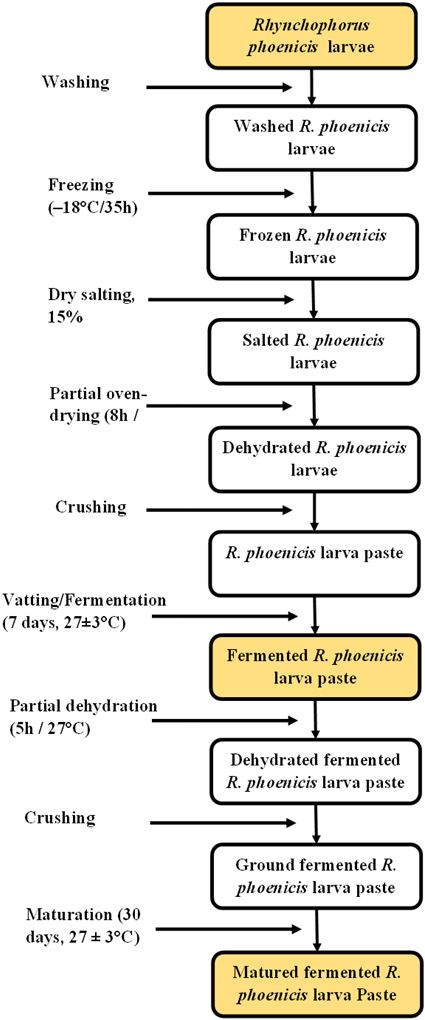
2.2. Fermentation of Rhynchophorus phoenicis LarvaeThe preparation of fermented pastes was carried out using an approach inspired by the fish paste “Belachan” process, as previously described 34 (Figure 1). After thawing, the larvae were carefully washed with distilled water and subjected to dry salting with 15% of salt. The salted larvae were then dried in an oven at 27 °C for 8 hours and ground to obtain Rhynchophorus phoenicis larvae paste. The resulting paste was placed in airtight glass jars and allowed to ferment at room temperature (25 ± 2°C) for 7 days, with daily sampling for subsequent analyses. At the end of the first fermentation phase, the paste was oven-dried at 27 °C for 5 hours and ground again. The dried fermented paste then underwent a second fermentation for 30 days, aimed primarily at product maturation. At the end of the second fermentation phase, the R. phoenicis larvae paste was stored at -20°C for further analysis.

Moisture content was determined by oven-drying samples at 105°C to constant weight 35 and calculated as the percentage weight loss. Total nitrogen was determined after sample mineralization using the Kjeldahl method 36, followed by quantification using the colorimetric technique previously described 37. The nitrogen-to-protein conversion factor of 6.19 was used to convert nitrogen content into protein content 10. Total lipids were extracted using a Soxhlet apparatus with hexane for 12 h 38 from 2 g of powder pre-dried at 105 °C. Lipid content (g/100 g) was determined by the difference in mass before and after extraction. Crude fiber content was determined according to AOAC (1999). About 2 g of Rhynchophorus phoenicis powder were digested successively with sulfuric acid and sodium hydroxide under reflux, filtered, washed, dried at 105 °C to constant weight (W₁), and then incinerated at 550 °C (W₂). Crude fiber (g/100 g) was calculated from the difference in mass before and after ashing. Ash content was quantified by incineration in a muffle furnace at 550°C for 15 hours 39. Total carbohydrates were calculated by difference: 100% minus the sum of protein, lipid, moisture, and ash percentages. The energy value was calculated using the Atwater coefficients: 16.2 kJ (4 kcal)/g for proteins and carbohydrates, and 37.62 kJ (9 kcal)/g for lipids 40.
The contents of calcium (Ca), iron (Fe), and zinc (Zn) were determined by Atomic Absorption Spectrometry (AAS) using a spectrophotometer (BUCK Scientific 205) 11.
Preparation of Stock Solutions and Working Standards
Calcium (Ca): A 1000 ppm calcium stock solution was used. For calibration, a working solution was prepared by diluting 25 mL of this stock solution in a 100 mL volumetric flask and bringing to volume with a 10.08 mmol/L strontium chloride solution. This working solution was used to prepare standard solutions with concentrations ranging from 0 to 40 ppm.
Iron (Fe) and Zinc (Zn): A mixed Fe/Zn stock solution was prepared by combining 8 mL of a 1000 ppm Fe standard solution and 2 mL of a 1000 ppm Zn standard solution in a 100 mL volumetric flask. The volume was adjusted with aqua regia solution (prepared by diluting 400 mL of concentrated HCl and 133 mL of 70% HNO₃ in deionized water and bringing to a final volume of 2 L). Calibration standards for these elements were obtained by diluting this stock solution in 50 mL tubes containing a mixture of 10 mL deionized water and 30 mL diluted aqua regia, covering concentration ranges of 0–40 ppm for Fe and 0–10 ppm for Zn. All solutions were thoroughly homogenized using a mixer IKA vortex Genius 3 (IKA, Staufen, Germany).
Sample Mineralization
Porcelain crucibles were pre-cleaned by washing with 10% nitric acid (HNO₃) and then calcined at 500°C for 3 h. For each sample, 0.5 g of defatted dry matter was placed in a crucible, with an empty crucible used as a mineralization blank. Ashing was carried out in a muffle furnace at 500°C for 24 h. After cooling in a desiccator, the ash was dissolved in 15 mL of diluted aqua regia in 50 mL polypropylene tubes. The tubes were shaken for 10 min and centrifuged at 3000 rpm for 10 min. The supernatant was collected for analysis.
Preparation of Samples for AAS Measurement
For calcium determination, 0.5 mL of the supernatant was diluted with 19.5 mL of 10.08 mmol/L strontium chloride solution. For iron and zinc determination, 10 mL of undiluted supernatant was used. For each analytical series, two reagent blanks containing the same solutions but without sample were included.
Measurement and Quantification
Absorbances of standards, samples, and blanks were measured using the atomic absorption spectrophotometer. Calibration curves were constructed for each element using the working standard solutions. Mineral concentrations in the samples, expressed as mg/100 g of dry matter, were determined by extrapolation of the measured absorbance on the corresponding calibration curve after subtraction of the blank value.
Oxalate Content: Oxalate content in the powders was determined according to the method described by 41. The method is based on the oxidation of oxalic acid by potassium permanganate in acidic medium under heating conditions. Briefly, 0.25 g of the paste of Rhynchophorus phoenicis larvae was mixed with 19 mL of 3 M sulfuric acid (H₂SO₄) and stirred for 1 h, then filtered. An aliquot of 6.25 mL of the filtrate was heated in a thermostatic water bath to 80–90 °C and maintained above 70 °C throughout the analysis. The hot solution was titrated with 0.05 M potassium permanganate (KMnO₄) until the appearance of a pale pink coloration persisting for 15 s, indicating the end point. Oxalate content was calculated assuming that 1 mL of 0.05 M KMnO₄ corresponds to 2.2 mg of oxalate and expressed as mg/100 g of sample.
Phytate Content: Phytate content was determined following the method of 42, which is based on the ability of phytates to form stable and insoluble complexes with ferric ions under acidic conditions. Approximately 2 g of sample powder was extracted with 100 mL of 2% HCl under continuous stirring for 3 h, followed by filtration. An aliquot of 25 mL of the filtrate was transferred into a 250 mL volumetric flask, to which 5 mL of 0.3% ammonium thiocyanate solution (color indicator) and 53.5 mL of distilled water were added to achieve the required acidity. The mixture was titrated with a standard ferric chloride solution (0.00195 g Fe/mL) until a yellow-brown coloration persisted for 5 min. Phytate content was calculated and expressed as mg/100 g of sample.
Saponin Content: Saponin content was determined using the method described by 43, based on the differential solubility of saponins in alkaline media compared with other antinutritional factors. Briefly, 2 g of the paste of Rhynchophorus phoenicis larvae (M₀) was extracted with 50 mL of 20% ethanol under magnetic stirring for 30 min, followed by heating in a water bath at 55 °C for 4 h. The mixture was filtered, and the extraction was repeated twice. Combined filtrates were concentrated to 40 mL at 90 °C and transferred to a separatory funnel, where 20 mL of diethyl ether was added. After phase separation, the aqueous phase was re-extracted with 60 mL of n-butanol. The butanolic extract was washed twice with 10 mL of 5% aqueous NaCl, concentrated in a water bath, and dried in an oven at 40 °C to constant weight (M₁). Saponin content was calculated as a percentage of dry matter using the following equation:
2.4. Analysis of Physicochemical PropertiesThe colour characteristics of the paste of Rhynchophorus phoenicis larvae were determined using the CIELab colour system 44. The CIELab system is based on three orthogonal coordinates: L*, representing lightness (L* = 0, black; L* = 100, white), a*, indicating the red/green component (a* > 0, red; a* < 0, green), and b*, corresponding to the yellow/blue component (b* > 0, yellow; b* < 0, blue). Individual larvae were placed on a white background and covered with a glass capsule to ensure uniform measurement conditions. Colour parameters (L*, a* and b*) were measured using a calibrated Colour Reader CR-10 (Konica Minolta, Osaka, Japan). Chroma (C*) and tone (hue angle, H*) were calculated using the following equations.
 | (1) |
 | (2) |
C∗: chroma; H∗: tone (sexagesimal degree); L∗: clarity; a∗: red/green colour component; b∗: yellow/blue colour component.
The pH of the samples was measured as previously described 45. Measurements were carried out using a calibrated digital pH meter at 25°C (Seven compact S210, Mettler Toledo, Switzerland).
Titratable acidity was determined following the AOAC method 46. Ten grams of Rhynchophorus phoenicis larvae paste were homogenised in 100 mL of distilled water and allowed to macerate for 30 min at room temperature (25 ± 2°C). The mixture was then centrifuged, and the supernatant was collected for analysis. Titratable acidity was quantified by acid–base titration to determine the total natural acid content of the samples. An aliquot of 10 mL of the supernatant was mixed with two drops of phenolphthalein indicator and titrated with 0.1 N sodium hydroxide (NaOH) solution until the appearance of a persistent pale pink colour. Titratable acidity was expressed as milliequivalents per 100 g of sample (meq/100 g) and calculated using the following equations:
 | (3) |
 | (4) |
where V₁ is the volume of the sample solution (mL), V₂ is the volume of NaOH used for titration (mL), N₁ is the normality of the sample solution, N₂ is the normality of NaOH (0.1 N), and m is the sample mass (g).
2.5. Techno-functional PropertiesBulk density was determined as previously described 47. Briefly, 50 g of Rhynchophorus phoenicis larvae powder were transferred into a 100 mL graduated cylinder. The cylinder was gently tapped repeatedly until a constant volume was reached. Bulk density, expressed in g/mL, was calculated as the ratio of sample mass to the volume occupied after compaction.
Water absorption capacity was determined as previously described 48. One gram of Rhynchophorus phoenicis larvae powder was mixed with 10 mL of distilled water and agitated for 15 min, followed by centrifugation at 2500 rpm for 30 min. The supernatant was discarded, and the wet sediment was weighed and then dried at 105 ± 2 °C for 24 h to obtain the dry mass. Water absorption capacity, expressed in %, was obtained by calculating the ratio between the mass of water absorbed and the dry sediment mass, multiplied by 100.
Oil absorption capacity was determined as previously described 49. Briefly, 0.5 g of Rhynchophorus phoenicis larvae powder was mixed with 3 mL of refined palm oil, vigorously agitated, and centrifuged at 2500 rpm for 30 min. The sediment was recovered and weighed. Oil absorption capacity, expressed in %, was obtained by calculating the ratio between the mass of oil absorbed and the mass of Rhynchophorus phoenicis larvae powder, multiplied by 100.
Emulsifying activity was evaluated according to the method described previously 50. Two grams of Rhynchophorus phoenicis larvae powder were dispersed in 10 mL of distilled water, and the initial height of the suspension (H₁) was measured. Five milliliters of refined palm oil were then added, and the mixture was homogenised and centrifuged at 1100g for 5 min. The height of the emulsified layer (H₂) was recorded. The emulsifying activity (EA), expressed as a percentage, is determined by the ratio of the height of the emulsified layer to the total height of the contents in the tube, multiplied by 100.
Foaming Capacity (FC): Foaming capacity was determined according to the method described by Coffmann and Garcia 51. Two grams of Rhynchophorus phoenicis larvae powder were dispersed in 100 mL of distilled water and homogenised for 2 min using a household blender. The volumes were recorded before (V₁) and after homogenization (V₂). Foaming capacity was expressed as the percentage increase in volume.
 | (5) |
Foam Stability (FS): Foam stability was determined according to the method of Narayana and Narsinga, with minor modifications 52. One gram of Rhynchophorus phoenicis larvae powder was dispersed in 50 mL of distilled water at 30 ± 2 °C in a graduated cylinder and homogenised for 5 min to generate foam. The foam volume was recorded 30 s after whipping. Foam stability was calculated as:
 | (6) |
A stock suspension was prepared by homogenizing 10 g of insect larvae in 90 mL of sterile buffered peptone water (BPW) using a Stomacher bag, yielding a 10⁻¹ dilution. The suspension was allowed to stand at room temperature (25 ± 2°C) for 30–45 min to enable microbial resuscitation. From this stock suspension, a series of decimal dilutions was prepared. Decimal dilutions were obtained by transferring 1 mL of the stock suspension into 9 mL of sterile BPW to obtain the 10⁻² dilution. The mixture was homogenised using a vortex mixer for 5–10 s. The procedure was repeated successively to obtain higher dilutions. Dilutions ranging from 10⁻⁴ to 10⁻⁷ were selected for microbial enumeration. Plates were incubated at 30 °C for 48 h.
Total Coliforms: Total coliform counts were determined using Violet Red Bile Lactose (VRBL) agar according to the ISO 4832:2006 standard 53. Briefly, 1 mL of the appropriate sample dilution was inoculated using the pour-plate technique. Approximately 20 mL of VRBL agar, previously cooled to 50°C in a water bath, was poured into each Petri dish. After homogenization by gentle circular movements and complete solidification of the medium, the plates were incubated in an inverted position at 30°C for 24 h. Typical red colonies were counted, and only plates containing 15–150 colonies were considered for enumeration.
Total Aerobic Mesophilic Bacteria: Total aerobic mesophilic bacteria were enumerated using the pour plate double-layer technique on Plate Count Agar (PCA), following AFNOR standard NF V08-051 54. One milliliter of the appropriate dilution was inoculated into Petri dishes and overlaid with 12–15 mL of PCA maintained at 40–45 °C. After homogenization, plates were incubated at 30 °C for 48 h, and colonies were counted.
Lactic Acid Bacteria: Lactic acid bacteria were enumerated by surface plating on de Man, Rogosa and Sharpe (MRS) agar (Pronadisa, Madrid, Spain) 55. Appropriate decimal dilutions were prepared from the stock suspension, and 0.1 mL aliquots of dilutions 10⁻⁵, 10⁻⁶ and 10⁻⁷ were aseptically spread onto the surface of solidified MRS agar plates. Plates were incubated under anaerobic conditions at 37 °C and 45 °C for 48–72 h. Colonies characteristic of lactic acid bacteria were enumerated.
2.7. Statistical AnalysisAll experiments were performed in triplicate (n = 3) for each sampling time point. The results are presented as mean values ± standard deviation (SD). Data were subjected to one-way analysis of variance (ANOVA) to assess the effects of fermentation time on the nutritional, anti-nutritional, physicochemical, and techno-functional properties of Rhynchophorus phoenicis larvae paste. When significant differences were detected (p < 0.05), pairwise comparisons between treatment means were performed using Tukey's honest significant difference (HSD) post-hoc test to identify which specific time points differed significantly from one another. All statistical analyses were conducted using GraphPad Prism version 8.3. The significance level was set at α = 0.05 for all tests.
Table 1 presents the nutritional, physicochemical, and techno-functional properties of Rhynchophorus phoenicis larva paste. The overall results highlight a concentrated and energy-dense food matrix, possessing functional properties likely to influence its technological behaviour and stability.
The proximate composition of non-fermented Rhynchophorus phoenicis larva paste is summarized in Table 1. The results show a low moisture content (10.70±0.72 g/100 g) and a high caloric density of 524.17±1.68 kcal/100 g. Lipids represent the primary macronutrient fraction (32.40 ± 0.24 g/100 g), followed by carbohydrates (31.58±0.55 g/100 g) and crude protein (26.80 ± 0.61 g/100 g). The ash content, indicating the total mineral fraction, was 7.59± 0.06 g/100 g, while the crude fiber content remained low (1.89±0.10 g/100 g). Overall, the dry matter of the pastes is dominated by lipids and proteins, resulting in a nutrient-dense profile.
The mineral content of non-fermented Rhynchophorus phoenicis larva paste is summarized in Table 1. The results reveal concentrations of 5.42±0.01 mg/100 g for iron (Fe), 14.75±0.05 mg/100 g for zinc (Zn), and 319.40±0.01 mg/100 g for calcium (Ca). These values suggest that this larva-based matrix represents a potential source of essential minerals for food fortification and the enhancement of nutritional security.
Table 1 presents the antinutritional factor content of unfermented Rhynchophorus phoenicis larva pastes. It reveals a rather contrasted profile. The oxalate and phytate contents are negligible, at 0.02 ± 0.00 and 0.03 ± 0.01 mg/100g of paste, respectively. The saponin content is 45.10 ± 0.34 mg/100 g.
The physicochemical properties of unfermented Rhynchophorus phoenicis larva pastes are summarized in Table 1. The pH value was 6.01±0.01, and the titratable acidity was 3.23±0.10 meq/100g. Regarding the colour profile, the coordinates were 19.80±1.22 for lightness (L∗), 8.33±0.67 for redness (a∗), and −2.70±0.36 for blueness (b∗).
The techno-functional properties of unfermented Rhynchophorus phoenicis larva pastes are presented in Table 1. The density was recorded at 1.11±0.02 g/mL. The water absorption capacity (WAC) and oil absorption capacity (OAC) were 158.00±12.30% and 64.80±10.20%, respectively. Regarding interfacial properties, the foaming capacity (FC) was low (3.85±0.00%), whereas the foam stability (FS) remained high (90.50±0.46%). Finally, the emulsifying capacity was measured at 5.56±0.00%. Overall, the larva pastes exhibited strong hydration and oil-binding properties but limited performance in foam and emulsion formation.
3.2. Effect of Fermentation on the Characteristics of Rhynchophorus phoenicis Larvae pasteThe changes in the proximate composition of Rhynchophorus phoenicis larva pastes over 30 days of fermentation are summarized in Table 2, with the unfermented paste (Day 0) serving as the baseline. Significant variations (p < 0.05) were observed for all parameters throughout the fermentation process. The initial moisture content of the unfermented paste was 10.70 ± 0.72 g/100 g at Day 0. During fermentation, it fluctuated significantly, initially increasing to 12.40 ± 0.43 g/100 g on Day 1, then decreasing to a minimum of 5.03 ± 0.13 g/100 g on Day 3, before gradually returning to 11.60 ± 1.81 g/100 g by Day 30. Crude protein content, which started at 26.80 ± 0.61 g/100 g in the unfermented paste, remained stable on Day 1 before showing a progressive and significant increase. It reached a peak of 37.30 ± 0.07 g/100 g on Day 7, representing a substantial enhancement compared to the initial state, followed by a decrease to 28.50 ± 0.04 g/100 g at the end of the 30-day period. Lipid content also varied during fermentation. From an initial value of 32.40 ± 0.24 g/100 g at Day 0, it increased to 50.70 ± 0.87 g/100 g on Day 1. Throughout the rest of the fermentation, it fluctuated between 42.50 ± 2.50 and 53.40 ± 0.93 g/100 g, with the highest overall value recorded on Day 30 (p < 0.05). Conversely, carbohydrate content demonstrated a significant decline. Starting at 31.58 ± 0.55 g/100 g in the unfermented paste, it decreased to 12.22 ± 0.55 g/100 g by Day 1, and continued to decrease to a minimum of 0.88 ± 0.11 g/100 g on Day 7, before slightly increasing to 3.22 ± 0.77 g/100 g on Day 30. Both ash and crude fiber contents showed progressive increases during the first week of fermentation. Ash content rose from 7.59 ± 0.06 g/100 g at Day 0 to a maximum of 13.30 ± 0.18 g/100 g on Day 7. Similarly, fiber content increased from an initial 1.89 ± 0.10 g/100 g to peak at 3.14 ± 0.06 g/100 g on Day 7. Finally, the energy value of the paste was significantly enhanced by fermentation. Starting at 524.17 ± 1.68 kcal/100 g for the unfermented paste, it jumped to 616.46 ± 0.25 kcal/100 g on Day 1. Throughout the process, it closely followed the lipid trend, remaining consistently higher than the Day 0 baseline and fluctuating between 558.15 and 616.46 kcal/100 g.
The effect of fermentation time on the mineral composition of Rhynchophorus phoenicis larva pastes is presented in Table 3, with the unfermented paste (Day 0) serving as the initial reference point. Iron (Fe) content in the unfermented paste was initially 5.42 ± 0.01 mg/100 g. During fermentation, this value significantly fluctuated (p < 0.05). It remained relatively stable during the first three days, then decreased to a minimum on Day 5 (3.97 ± 0.02 mg/100 g), before experiencing a peak concentration on Day 6 (6.48 ± 0.01 mg/100 g). By the end of the 30-day fermentation period, the iron content settled at 4.96 ± 0.02 mg/100 g, slightly lower than the initial unfermented state. Calcium (Ca) content started at 319.40 ± 0.01 mg/100 g in the unfermented paste at Day 0. It initially increased to 330.80 ± 0.06 mg/100 g on Day 1, representing its highest value during the process. Subsequently, the calcium content generally exhibited a decreasing trend with some fluctuations, eventually reaching its lowest value on Day 30 (297.80 ± 0.28 mg/100 g), which was significantly lower than the Day 0 baseline. In contrast to iron and calcium, the zinc (Zn) content demonstrated remarkable stability throughout the entire process. Starting at 14.75 ± 0.05 mg/100 g in the unfermented paste, no significant differences (p > 0.05) were observed regardless of the fermentation duration. The zinc levels remained stable, fluctuating slightly between 14.76 and 17.96 mg/100 g across all 30 days of fermentation.
Table 4 presents the evolution of antinutritional factor content in Rhynchophorus phoenicis larva pastes during fermentation, revealing distinct dynamics for each compound when compared to the unfermented paste (Day 0). Values are expressed in g/100 g of dry matter, with significant differences indicated (Tukey's test, p < 0.05). Oxalate levels in the unfermented paste (Day 0) were initially low at 0.02 ± 0.00 mg/100 g. Throughout the fermentation process, these levels remained generally stable and very low (ranging from 0.02 to 0.03 mg/100 g), with no marked upward or downward trend. This suggests that fermentation had no significant effect on oxalate content, which remained negligible. Phytate content in the unfermented paste (Day 0) was 0.03 ± 0.01 mg/100 g. During fermentation, it oscillated between 0.02 and 0.04 mg/100 g. A slight increase was observed on Day 5 (0.04 ± 0.00 mg/100 g of paste), followed by a decrease, returning to values similar to the initial state (0.02 ± 0.00 mg/100 g) after 30 days of fermentation. Similar to oxalates, the overall impact of fermentation on phytate content appears to be minimal, with levels remaining very low throughout the process. In contrast, variations in saponin content were much more pronounced. The unfermented paste (Day 0) contained a significant amount of saponins, measured at 45.10 ± 0.34 mg/100 g. Upon initiation of fermentation, the levels decreased rapidly to 26.80 ± 0.68 mg/100 g on Day 1. This was followed by a rapid increase to reach a peak on Day 3 (47.00 ± 2.16 mg/100 g), surpassing the initial Day 0 value. Subsequently, a significant decrease was observed on Day 5 (24.70 ± 1.48 mg/100 g), and levels fluctuated thereafter, ending at 35.80 ± 0.34 mg/100 g on Day 30. These results clearly show that fermentation significantly influences saponin levels, leading to an initial reduction, a temporary increase, and then a subsequent reduction from the peak, while the already negligible phytate and oxalate levels are not significantly affected. The reduction in saponins, particularly after Day 5, suggests a potential for fermentation to improve the nutritional quality by reducing this specific antinutritional factor.
The evolution of the physicochemical properties of Rhynchophorus phoenicis larvae paste during fermentation is presented in Table 5, taking into account the initial unfermented state (Day 0) and the fermented samples (Days 1–30). At Day 0, the unfermented paste exhibited a pH of 6.01±0.01 and a titratable acidity of 3.23±0.10 meq/100g, which serve as baseline values for assessing fermentation-induced changes. Following the onset of fermentation (Day 1), a slight but significant increase in pH (6.09±0.00) was observed. However, from Day 2 onwards, a gradual and significant decrease (p<0.05) in pH occurred, reaching 5.85±0.00 by Day 30. This progressive acidification reflects the metabolic activity of fermentative microorganisms, particularly the production of organic acids. Consistently, titratable acidity increased significantly throughout fermentation, from 3.23±0.10 meq/100g at Day 0 to 5.75±0.03 meq/100g at Day 30. The continuous rise in acidity confirms the establishment and dominance of acid-producing microbiota, which contributes to product stabilization and preservation.
Regarding color parameters, the initial lightness (L*) at Day 0 (19.80±1.22) increased significantly at Day 1 (21.80±0.93), suggesting structural or surface modifications immediately after fermentation onset. This was followed by a marked decrease at Day 2 (17.20±0.61), and subsequent stabilization around values close to the initial state (≈19.20–19.40) until Day 30. These fluctuations may be associated with pigment degradation, lipid oxidation, and microbial activity. The redness index (a*) showed a decrease from 8.33±0.67 at Day 0 to lower values during fermentation, reaching a minimum at Day 7 (2.67±0.23), before partially recovering by Day 30 (6.07±0.06). This trend suggests initial degradation or transformation of red pigments, followed by the formation of secondary compounds contributing to color restoration during maturation. The yellowness index (b*) exhibited pronounced variations, shifting from a negative value at Day 0 (−2.70±0.36) to positive values at Day 1 and Day 2, then returning to negative values between Day 3 and Day 7, with a minimum at Day 6 (−7.53±0.32). This indicates a transient shift toward bluish hues during intermediate fermentation stages, likely linked to biochemical transformations such as Maillard reactions or pigment oxidation. By Day 30, b* values became positive again (3.77±0.68), reflecting stabilization and maturation of the product.
Overall, fermentation induces significant physicochemical transformations, characterized by progressive acidification, increased titratable acidity, and dynamic color changes. These modifications reflect the complex biochemical and microbiological processes occurring during fermentation and contribute to the final quality attributes of the product.
The impact of fermentation time on the techno-functional properties of Rhynchophorus phoenicis larval pastes is presented in Table 6. Significant modifications (p < 0.05) were observed for all measured parameters throughout the process. Before fermentation (Day 0), the bulk density of the non-fermented paste was 1.11 ± 0.02 g/mL. During fermentation, this value fluctuated, reaching peaks on Days 2 and 4 (1.52 ± 0.05 g/mL) and a minimum on Day 1 (0.95 ± 0.02 g/mL). The water absorption capacity (WAC), initially 158.00 ± 12.30% on Day 0, first increased on Day 1 (195.00 ± 25.00%) before dropping to its lowest value on Day 3 (100.00 ± 16.70%). It then increased again and stabilized between 176% and 195% for the remainder of the study, indicating an overall improvement compared to the non-fermented paste. In contrast, the oil absorption capacity (OAC), which was 64.80 ± 10.20% on Day 0, showed a significant increase throughout the process, reaching its maximum on Day 30 (141.00 ± 13.60%). Regarding interfacial properties, the foaming capacity (FC) of the non-fermented paste was low (3.85 ± 0.00%). It remained stable until Day 2, then exhibited two notable peaks: a first marked increase on Day 3 (11.50 ± 0.00%) and a maximum value on Day 30 (20.40 ± 0.73%). Foam stability (FS), already high on Day 0 (90.50 ± 0.46%), remained at very high levels throughout fermentation, ranging between 91.90 ± 1.88% and 100.00 ± 0.00%. Finally, the emulsifying capacity (EC), initially 5.56 ± 0.00% on Day 0, remained stable on Day 1 before increasing significantly to reach a peak on Day 6 (15.80 ± 0.83%). It then declined to its lowest value on Day 30 (4.44 ± 0.00%), slightly lower than that of the non-fermented paste.
The microbial populations of Rhynchophorus phoenicis larva pastes at the beginning (T0) and after 7 days (T7) of fermentation are summarized in Table 7. All microbial groups exhibited significant growth throughout the fermentation period. Lactic Acid Bacteria (LAB) emerged as the dominant flora, increasing from 3.24×10⁶ CFU/g (6.51 log CFU/g) to 5.18×10¹⁰ CFU/g (10.71 log CFU/g), representing a growth of more than 4 decimal logarithms. The Total Aerobic Mesophilic Count (TAMC) followed a similar trend, rising from 3.63×10⁷ CFU/g (7.56 log CFU/g) to 9.27×10¹⁰ CFU/g (10.97 log CFU/g). Regarding hygiene indicators, total coliforms increased from 6.36×10⁴ CFU/g to 8.90×10⁸ CFU/g (8.95 log CFU/g). Similarly, Escherichia coli counts rose from 1.54×10⁴ CFU/g to 2.63×10⁸ CFU/g, reflecting an increase of approximately 4 log units over the 7-day period.
The Rhynchophorus phoenicis larvae paste exhibits a high nutrient density, supporting its potential as a functional ingredient for food formulations. The moisture content (10.70 ± 0.72 g/100 g) was higher than the 7.07 ± 0.02 g/100 g previously reported 56. This difference is likely due to the dry salting process used during transformation, which promotes osmotic exchange and water retention. Nevertheless, this value remains sufficiently low to inhibit microbial growth, thereby contributing to the stability and shelf-life of the food products. The protein content (26.80 g/100 g) confirms that these larvae are a substantial protein source, although it is lower than the 33.74 ± 0.72 g/100 g observed in Tenebrio molitor 57. Furthermore, the lipid content was high (32.40 g/100 g), aligning with the 31.40 g/100 g previously reported by Banjo et al. 58 (2005), yet lower than the 63.6 ± 9.0 g/100 g found by Fogang et al. 59. The carbohydrate content was 31.58 ± 0.55 g/100 g, close to previously reported values of 37.04 g/100 g. These combined levels of proteins, lipids, and carbohydrates provide the R. phoenicis paste with a significant energy value (524.17 ± 1.68 kcal/100 g), comparable to concentrated protein-lipid bases used in industrial food formulations. Indeed, the consumption of 100 g of this paste could cover more than 25% of the daily energy requirements for a healthy individual. Additionally, the high ash content (7.59 ± 0.06 g/100 g), which exceeds the 2.18 g/100 g previously reported 60, highlights the mineral richness of this larvae paste. The association of high proportions of proteins and lipids provides the paste with a concentrated and functional matrix structure. In this system, proteins likely fulfil both structural and interfacial roles, while lipids contribute to plasticity and sensory attributes. This organization, coupled with the low nutrient dilution resulting from reduced water content, gives R. phoenicis paste a distinct technological advantage, particularly for applications involving kneading, extrusion, or incorporation into enriched food systems.
Mineral analysis revealed a high calcium content of 319.4 mg/100g, significantly exceeding the 37.84 mg/100g previously reported 11. Such an intake could contribute significantly to meeting the nutritional requirements of preschool children, estimated between 250 and 450 mg/day. Meanwhile, although the iron content (5.42 mg/100g) is lower than some literature data (30.8 mg/100 g) for this species 12, it remains comparable to conventional animal sources such as fish, beef, and pork. The nutritional value of the Rhynchophorus phoenicis larvae paste is further enhanced by the low levels of antinutritional factors. Oxalate and phytate contents (< 0.05 mg/100g) are well below the established toxicity thresholds of 500 mg/100g food product 61, while the saponin content (45.10 mg/100g) remains within acceptable limits. This low concentration of antinutrients is a major asset: by limiting the chelation phenomena that typically hinder intestinal absorption, it ensures high bioavailability of essential minerals, particularly zinc and calcium. Consequently, the limited presence of antinutritional factors confirms the high nutritional potential of this resource.
The pH of the Rhynchophorus phoenicis larvae paste (6.01) indicates that this matrix is conducive to the development of lactic acid bacteria, as well as potential pathogens. These predictions are further confirmed by the subsequent microbiological study, which reveals the presence of coliforms, specifically Escherichia coli, within these pastes. This microbial load highlights the sanitary vulnerability of the matrix and underscores the importance of hygienic conditions during larvae processing. The occurrence of these microorganisms in freshly processed insects is by no means an isolated phenomenon. Analysis of freshly prepared Tenebrio molitor paste (pH 6.54) showed the presence of lactic acid bacteria, Enterobacteriaceae, and total aerobic mesophilic count 23. The titratable acidity value (3.23 meq/100g) reflects the initial presence of organic acids, likely resulting from endogenous microbial activity. Chromatically, the analysis reveals low lightness (L∗ = 19.80) and a positive red component (a∗ = 8.33), giving the paste a dark reddish-brown profile. A similar dark colouring was also noted in freshly prepared Tenebrio molitor larvae 22. This dark coloration may result from several concomitant mechanisms: post-grinding enzymatic browning (oxidation), the presence of natural larvae pigments, or the early stages of Maillard reactions and lipid oxidation within this nutrient-dense matrix 62, 63. This colorimetric signature constitutes a key technological parameter for sensory acceptability. While it may limit the use of the paste in light-colored products, it represents an asset for formulations where a dark tint is desired, such as sauces, seasoned pastes, or meat analogues 63, 64. Furthermore, processing methods such as blanching or defatting could be considered to modulate this colour intensity according to the intended food applications 65.
The technofunctional properties of food ingredients are essential for determining their behavior during processing, storage, and consumption. Table 1 presents the technofunctional parameters of Rhynchophorus phoenicis larvae pastes. The bulk density measured for the R. phoenicis paste is 1.11 ± 0.02 g/mL. This value is lower than the 1.52 g/mL previously obtained for the same species 56. However, it is higher compared to those reported for other edible insect meals, such as Tenebrio molitor or Acheta domesticus, whose densities range between 0.5 and 0.7 g/mL 66. A high density suggests low porosity and a compact structure of the paste, which is advantageous for reducing packaging and transport costs 67. In food formulation, a high bulk density is often associated with better suitability for incorporation into dense matrices such as bakery products or meat substitutes. The Water Absorption Capacity (WAC) is 158.00 ± 12.30%. This value indicates a good affinity of the larva's proteins and polysaccharides for water 32. A high WAC is crucial for maintaining the texture and succulence of processed products, such as breads 68. Comparatively, this value is higher than those obtained in other insects—Gonimbrasia belina, Hermetia illucens, and Macrotermes subhylanus—which are 130 ± 12%, 11 ± 2%, and 146 ± 6%, respectively 66. The Oil Absorption Capacity (OAC) amounts to 64.80 ± 10.20%. This is lower than that of Tenebrio molitor (151%) 22, Gonimbrasia belina (89%), Hermetia illucens (135%), and Macrotermes subhylanus (148%) 66. Although low, this capacity is essential for flavour retention and the enhancement of mouthfeel (palatability) 69. The observed value suggests that R. phoenicis paste could contribute to the juiciness of formulated products without resulting in an excessively greasy sensation. The Foaming Capacity (FC) is relatively low (3.85 ± 0.00%), which could be attributed to the high lipid content in the non-defatted paste. Lipids are known to be powerful antifoaming agents that compete with proteins at the air-water interface 69. However, the Foam Stability (FS) is remarkably high (90.50 ± 0.46%). This indicates that, although little foam is formed, the interfacial film created by the proteins is extremely robust and resistant to coalescence or drainage. This property is particularly interesting for applications where a time-stable texture is required, such as whipped cream, meringue, marshmallow, ice cream, bread, and many other formulations 69. The Emulsifying Activity (EA) is 5.56 ± 0.00%. As with foaming, this value is low compared to other insects like Tenebrio molitor (51%) 22. However, it may be influenced by the lipid content and protein solubility at the native pH of the paste. R. phoenicis proteins possess amphiphilic properties allowing them to adsorb at the oil-water interface, thereby stabilizing oil droplets 14, 15. For industrial applications requiring strong emulsions (such as mayonnaise), a pH adjustment or partial defatting could optimize this functionality.
4.2. Fermentation Duration Modulates the Nutritional, Physicochemical, and Techno-functional Properties of Rhynchophorus phoenicis Larvae PastesFermentation is an ancestral food processing technique increasingly utilized to enhance the nutritional quality, safety, and acceptability of edible insect-based products 25, 70, 71. A 30-day spontaneous fermentation of Rhynchophorus phoenicis larvae paste revealed significant modifications in its proximal composition, physicochemical properties, anti-nutritional factors, and techno-functional attributes.
The results showed variations in proximal composition throughout the fermentation process when compared to the unfermented paste (Day 0). An initial increase in crude protein content was observed, starting from 26.80 ± 0.61 g/100 g in the unfermented paste and peaking at 37.30 ± 0.07 g/100 g on Day 7. This relative increase is a phenomenon commonly observed in fermented insect-based products 21. This relative increase can be attributed to microbial proliferation—specifically lactic acid bacteria (LAB)—which synthesize cellular proteins, and to the degradation of carbohydrates and lipids, thereby concentrating the protein fraction. The significant and rapid decrease in carbohydrates—from an initial 31.58 ± 0.55 g/100 g at Day 0 to 12.22 ± 0.55 g/100 g on Day 1, and down to 0.88 ± 0.11 g/100 g on Day 7—strongly supports this hypothesis, as carbohydrates serve as the primary carbon source for fermenting microorganisms. These protein levels are lower than those obtained for Tenebrio molitor after 7 days of fermentation using starter cultures Bactoferm FLC and Lactobacillus farciminis, which ranged from 42.60±0.02 to 44.55±0.04 g/100 g, respectively 22. The decline observed after 30 days may be explained by proteolytic degradation by microorganisms following the depletion of simple carbohydrates. Regarding lipid content, the unfermented paste initially contained 32.40 ± 0.24 g/100 g. Fermentation induced an increase to 50.70 ± 0.87 g/100 g on Day 1. This was followed by a slight decrease to 48.50 ± 0.00 g/100 g by Day 7. The rapid increase in lipids between Day 0 and Day 1 is mainly due to a relative concentration effect caused by the very rapid consumption of carbohydrates by fermentative microorganisms. The subsequent decrease in lipids between Day 1 and Day 7 likely resulted from microbial lipolysis, marking an exponential metabolic phase where activity is at its maximum, thus demonstrating the positive impact of fermentation. These lipid values are higher than those recorded for mealworms (Tenebrio molitor) after 7 days of fermentation using Bactoferm FLC and Lactobacillus farciminis starters (16.61±0.23 and 20.20±0.31 g/100 g, respectively) 22. However, the lipid content reached its highest value at Day 30 (53.40 g/100 g). While slight lipid hydrolysis can occur during fermentation, the observed increase of lipid content might be the result of relative concentration due to dry matter loss or the synthesis of microbial lipids. These results are partially consistent with studies on other insects, where fermentation has shown variable effects on lipid content, ranging from no change to a slight increase 21. The high energy value, which follows the lipid trend, confirms that fermented R. phoenicis larvae paste remains a dense energy source—a key nutritional characteristic of palm weevil larvae 60. In short, compared to the unfermented state, a 7-day fermentation appears optimal for maximizing protein balance and mineral concentration (ash content), whereas prolonged fermentation (up to 30 days) promotes a further increase in lipid content and maintains a high energy value. These observations underscore the importance of controlling fermentation duration in insects to tailor the nutritional profile to specific dietary or industrial needs.
The various minerals evaluated fluctuated with varying degrees of intensity throughout the fermentation process when compared to the unfermented paste (Day 0). The Zinc (Zn) content increased slightly in fermented samples compared to non-fermented ones. This result contrasts with some studies on other fermented insects where Zn levels decreased 21; however, a similar increase in Zn was observed in Acheta domesticus after 48 hours of fermentation 72. Conversely, iron (Fe) exhibited significant fluctuations compared to its initial value of 5.42 ± 0.01 mg/100 g (Day 0), dropping to a minimum on Day 5 before spiking on Day 6. Calcium (Ca) showed an initial slight increase from 319.40 ± 0.01 mg/100 g (Day 0) to 330.80 ± 0.06 mg/100 g on Day 1, followed by a notable and progressive decrease, reaching its lowest point by Day 30 (297.80 ± 0.28 mg/100 g). The fluctuations observed in Iron and the overall decrease in Calcium throughout the prolonged fermentation period could be attributed to several physicochemical mechanisms. Primary among these are chelation phenomena and the differential solubilization of minerals triggered by the progressive acidification of the matrix (production of lactic and acetic acids by microorganisms) 73. As the pH drops, certain mineral complexes may dissociate, increasing their solubility and making them more susceptible to loss through exudation or utilization by the fermenting microflora for their own metabolic processes.
The evolution of pH and titratable acidity serves as the clearest indicator of the fermentation process 72. A progressive decrease in pH (from 6.09 to 5.85) and a continuous increase in titratable acidity (from 3.85 to 5.75 meq/100g) are typical of lactic acid fermentation, resulting from the production of organic acids by microorganisms 74, 75. These results are comparable to those obtained for Tenebrio molitor powder, which showed a pH drop (6.28 ± 0.05 to 4.64 ± 0.04) after 7 days of fermentation using starter cultures 76. This acidification is directly linked to the exponential growth of Lactic Acid Bacteria (LAB), whose load increased by more than 4 log units in 7 days (from 6.51 to 10.71 log CFU/g), establishing them as the dominant flora. However, the simultaneous increase in hygiene indicators, such as total coliforms and Escherichia coli—which also rose by approximately 4 log units in 7 days—raises a major concern regarding food safety. Although LAB dominance can potentially inhibit pathogens through the production of acids and bacteriocins 25, 29, the growth of these fecal indicators to high levels (up to 8.95 log CFU/g for coliforms) indicates a lack of process control and high initial contamination. Contrary to traditional fermentation expectations, the pH drop was insufficient to inhibit the growth of coliforms and E. coli. This suggests that the final pH (5.85) remains above the critical inhibitory threshold (generally < 4.5) required to guarantee sanitary safety. While competition for nutrients favoured LAB, the high nutritional density of the paste likely exerted a buffering effect, preventing a rapid and drastic acidification of the matrix. For industrial applications, controlled fermentation using selected starter cultures is imperative. Starters such as Lactococcus lactis, Lactobacillus plantarum, and Pediococcus acidilactici have demonstrated the ability to inhibit pathogen growth during the fermentation of Tenebrio molitor 23, 29, 77.
One of the potential benefits of fermentation is the reduction of anti-nutritional factors (ANFs), thereby improving nutrient bioavailability. The results obtained for Rhynchophorus phoenicis larvae pastes confirmed a significant impact of fermentation duration (p < 0.05), as detailed in Table 4, especially when evaluated against the unfermented baseline at Day 0.
Oxalate levels in the unfermented paste (Day 0) were initially very low (0.02 ± 0.00 mg/100 g). Throughout the 30-day process, these levels varied very little, ranging between 0.02 ± 0.00 and 0.03 ± 0.00 mg/100 g. From a biological perspective, such minor fluctuations from the Day 0 reference are not large enough to demonstrate a substantial impact of fermentation, reflecting the low initial presence of oxalates in the raw material. Importantly, all values remain far below the human safety limits for oxalate content, which are situated between 250 and 500 mg/100 g of food 61. Regarding phytate levels, the unfermented paste started at 0.03 ± 0.01 mg/100 g (Day 0). Minor fluctuations between 0.02 and 0.04 mg/100 g were observed throughout the process. Like oxalates, these values are not high enough to effectively evaluate a reductive effect of fermentation compared to the initial state. However, from a nutritional standpoint, maintaining such low levels is highly advantageous, as phytates are known to reduce the bioavailability of essential minerals such as Ca, Mg, Fe, and Zn 78. The values obtained remain well below the acceptable safety threshold of 250-500 mg/100 g 61.
In contrast, saponin content experienced the most dynamic changes when compared to the Day 0 baseline (45.10 ± 0.34 mg/100 g). Upon initiation of fermentation, levels dropped sharply to 26.80 ± 0.68 mg/100 g at Day 1, before peaking on Day 3 (47.00 ± 2.16 mg/100 g). Following this peak, a significant reduction was observed by Day 5 (24.70 ± 1.48 mg/100 g), representing a nearly 45% decrease compared to the unfermented paste. This reduction is likely due to the activity of microbial enzymes, specifically glycosidases produced during fermentation, which hydrolyze saponins into less complex compounds 79. The overall reduction of saponins achieved through fermentation is beneficial, as these compounds can negatively affect both nutrient absorption and the sensory attributes (taste) of the final product 79.
In conclusion, while the unfermented R. phoenicis larvae paste is already safe regarding oxalate and phytate levels, fermentation provides a distinct technological advantage by significantly reducing saponin content, thereby enhancing the overall nutritional quality of the paste.
The observed variations in the techno-functional properties of the fermented larvae pastes indicate a significant impact of the fermentation process, as detailed in Table 6, especially when compared to the unfermented paste at Day 0. Regarding density, the initial value of the unfermented paste was 1.11 ± 0.02 g/mL. The density decreased to reach a value of 0.95 ± 0.02 on the first day of fermentation. This decline could be explained by the production of gases, particularly CO₂, generated by microbial activity. Part of this gas becomes trapped within the paste matrix in the form of microbubbles, leading to an increase in volume without a significant change in mass, and consequently a reduction in bulk density. Microbial activity led to a modification of the medium's bulk density, with a maximum value observed between Day 2 and Day 4 (1.52 ± 0.05 g/mL). This high density could be attributed to an increased concentration of complex compounds, such as proteins and fibers, following the degradation of the matrix. It is noteworthy that this value is significantly higher than those reported for fermented mealworms (Tenebrio molitor), which range from 0.40 ± 0.01 to 0.49 ± 0.01 g/mL 76.
Water Absorption Capacity (WAC), which reflects the degree of protein hydration and depends on their nature and conformation, increased from an initial 158.00 ± 12.30% to 195.00 ± 25.00% at Day 1. Although it fluctuated, it remained high throughout the fermentation process (e.g., 195.00 ± 5.00% at Day 7). This high WAC demonstrates a favourable technological potential for incorporating fermented pastes into food formulations requiring swelling 80. The increase in WAC may result from microbial enzymatic activity inducing partial hydrolysis of cell walls, exposing more hydrophilic groups (-OH, -COOH) capable of capturing water molecules.
As for Oil Absorption Capacity (OAC), which is essential for fat retention and the improvement of texture and sensory attributes, the unfermented paste started at 64.80 ± 10.20% at Day 0. It showed a progressive and significant increase during fermentation, reaching 109.00 ± 0.83% at Day 1 and culminating at 141.00 ± 13.60% at Day 30. The rise in OAC is often linked to the exposure of non-polar sites through protein denaturation or hydrolysis 81, 82. This trend suggests that fermented R. phoenicis larvae paste could be used effectively as a binding agent in the formulation of new products.
Foaming Capacity (FC) of the unfermented paste was initially low (3.85 ± 0.00% at Day 0). It remained stable initially but experienced a notable increase peaking at Day 3 (11.50 ± 0.00%), followed by a decline until Day 7, before a spectacular rise to its maximum at Day 30 (20.40 ± 0.73%). Foam Stability (FS), already high in the unfermented paste (90.50 ± 0.46% at Day 0), remained high throughout the process, oscillating between 91.90 ± 1.88% and 100.00 ± 0.00%. The improvement in FC and FS is generally attributed to the production of low-molecular-weight peptides and increased protein solubility due to acidification and enzymatic hydrolysis 81. These properties make the fermented paste particularly suitable as a foaming or stabilizing agent in products such as whipped beverages or confectionery. Finally, Emulsifying Capacity (EC) showed significant variation over time. Starting from a low initial value of 5.56 ± 0.00% at Day 0, it remained stable at Day 1 before reaching a peak of 15.80 ± 0.83% at Day 6. This peak likely corresponding to an optimal production of surfactant peptides following moderate protein hydrolysis. A subsequent drop until Day 30 suggests that excessive hydrolysis may have degraded these peptides into fragments too small to maintain an effective emulsion, or led to their aggregation in a more acidic environment 81.
This study shows that fermentation is an effective technique to valorise Rhynchophorus phoenicis larvae paste as a nutritional and functional food ingredient. The fermentation process induced significant biochemical transformations over time, including a decrease in carbohydrate content, an increase in protein content by day 7, and a high lipid concentration by day 30, resulting in a matrix with high energy potential. The maintenance of mineral levels and the low concentrations of oxalates and phytates indicate good nutritional quality and suggest potential mineral bioavailability. The acidification observed during fermentation contributed to the physicochemical stability of the larvae paste and promoted the dominance of lactic acid bacteria, confirming the establishment of an active fermentative ecosystem. From a technological perspective, techno-functional properties were significantly modified. Water absorption properties, oil absorption capacity, foaming capacity, and emulsifying activity increased during fermentation, suggesting structural changes in paste proteins that enhanced their interfacial properties. The high foam stability represents an advantage for structured and aerated food systems. Fermentation of Rhynchophorus phoenicis larvae paste therefore enables modulation of its composition and techno-functional properties, making it more versatile for the food industry. However, the study also revealed a critical microbiological risk associated with the growth of hygiene indicator microorganisms. For this paste to be commercially viable and safe, optimization of the fermentation process is required, particularly through the use of selected starter cultures and strict control of processing conditions to inhibit undesirable microorganisms while maximizing nutritional and functional benefits.
The authors declare that they have no conflicts of interests that could have influence the present work.
a*: Red/Green coordinate
AOAC: Association of Official Analytical Chemists
AAS: Atomic Absorption Spectrometry
b*: Yellow/Blue coordinate
C*: Chroma
CFU/g: Colony Forming Units per gram
EA: Emulsifying Activity
EC: Emulsifying Capacity
FC: Foaming Capacity
FS: Foam Stability
H*: Hue angle
HCl: Hydrochloric acid
HNO₃: Nitric acid
ISO: International Organization for Standardization
L*: Lightness
LAB: Lactic Acid Bacteria
meq/100 g: Milliequivalents per 100 grams
NaOH: Sodium hydroxide
OAC: Oil Absorption Capacity
pH: Potential of hydrogen
ppm: Parts per million
TAMC: Total Aerobic Mesophilic Count
WAC: Water Absorption Capacity
| [1] | Rahman M. H., Exploring Sustainability to Feed the World in 2050. Journal of Food Microbiology 1 (1): 7–16. 2016. | ||
| In article | |||
| [2] | Ghasemzadeh A., Agrotechnology Global Issues of Food Production. Agrotechnology 1 (2): 1–2. 2012. | ||
| In article | View Article | ||
| [3] | Siegel F. R., Countering 21st Century Social- Environmental Threats to Growing Global Populations. Springer Briefs in Environmental Science: 1-120. 2015. | ||
| In article | View Article | ||
| [4] | Steinfeld H., Gerber P., Wassenaar T., Castel V., Rosales M. and de Haan C., Livestock’s long shadow: environmental issues and options. FAO Rome: 1-390. 2006. | ||
| In article | |||
| [5] | Gerber P. J., Steinfeld H., Henderson B., Mottet A., Opio C., Dijkman J., Falcucci A. and Tempio G., Tackling Climate Change Through livestock - A Global Assessment of Emissions and Mitigation Opportunities. FAO Rome: 1-115. 2013. | ||
| In article | |||
| [6] | Dobermann D., Swift J. A. and Field L. M., Opportunities and hurdles of edible insects for food and feed. Nutrition Bulletin 42 (4): 293–308. 2017. | ||
| In article | View Article | ||
| [7] | van Huis A., Van Itterbeeck H., Klunder H., Mertens E., Halloran A., Muir G. and Vantomme P., Edible insects Future: prospects for food and feed security. FAO Rome: 1-187. 2013. | ||
| In article | |||
| [8] | Rumpold B. A. and Schlüter O. K., Nutritional composition and safety aspects of edible insects. Molecular Nutrition & Food Research 57 (5): 802–823. 2013. | ||
| In article | View Article PubMed | ||
| [9] | Jongema Y., World list of edible insects. Wageningen University: 1-10. 2015. | ||
| In article | |||
| [10] | Fogang Mba A. R., Kansci G., Viau M., Ribourg L., Fogoh Muafor J., Hafnaoui N., Le Gall P. and Genot C., Growing conditions and morphotypes of African palm weevil (Rhynchophorus phoenicis) larvae influence their lipophilic nutrient but not their amino acid compositions. Journal of Food Composition and Analysis 69: 87–97. 2018. | ||
| In article | View Article | ||
| [11] | Loh A. M. B., Yisa Njowe K. and Kana Sop M., Preliminary Proximate Composition and Mineral contents of Five Edible Insects from Cameroon. International Journal of Current Microbiology and Applied Sciences 6 (3): 1984–1995. 2017. | ||
| In article | View Article | ||
| [12] | Amadi E. and Kiin-kabari D., Nutritional Composition and Microbiology of Some Edible Insects Commonly Eaten in Africa, Hurdles and Future Prospects: A Critical Review. Journal of Food Microbiology, Safety & Hygiene 1 (1): 1–7. 2016. | ||
| In article | |||
| [13] | Ekpo K. E. and Onigbinde A. O., Nutritional Potentials of the Larva of Rhynchophorus phoenicis (F). Pakistan Journal of Nutrition 4 (5): 287–290. 2005. | ||
| In article | View Article | ||
| [14] | Fogang Mba A. R., David-briand E., Viau M., Riaublanc A., Kansci G. and Genot C., Protein extraction yield, lipid composition, and emulsifying properties of aqueous extracts of Rhynchophorus phoenicis larvae extracted at pH 3.0 to 10.0. Future Foods 4: 100037. 2021. | ||
| In article | View Article | ||
| [15] | Fogang Mba A. R., Viau M., David-Briand E., Riaublanc A., Kansci G. and Genot C., Protein concentrate from Rhynchophorus phoenicis larvae: nutritional profile, protein identification, and emulsifying properties. Journal of Food Measurement and Characterization 18 (1): 240–255. 2024. | ||
| In article | View Article | ||
| [16] | Womeni H. M., Tiencheu B., Linder M., Chouatcho Nabayo E. M., Tenyang N., Tchouanguep Mbiapo F., Villeneuve P., Fanni J. and Parmentier M., Nutritional value and effect of cooking, drying and storage process on some functional properties of Rhynchophorus phoenicis. International Journal of Life Science and Pharma Research 2 (3): 203–219. 2012. | ||
| In article | |||
| [17] | Tiencheu B., Womeni H. M., Linder M., Mbiapo F. T., Villeneuve P., Fanni J. and Parmentier M., Changes of lipids in insect (Rhynchophorus phoenicis) during cooking and storage. European Journal of Lipid Science and Technology 115 (2): 186–195. 2013. | ||
| In article | View Article | ||
| [18] | Pateiro M., Domínguez R., Eduardo P., Munekata S., Barba F. J. and Lorenzo J. M., Lipids and fatty acids. Innovative Thermal and Non-Thermal Processing, Bioaccessibility and Bioavailability of Nutrients and Bioactive Compounds: 107–137. 2019. | ||
| In article | View Article | ||
| [19] | Zhang F., Xu Y., Kong B., Chen Q., Sun F., Zhang H. and Liu Q., Comparative study of two types of pre-extraction treatment (drying or non-drying) on physicochemical, structural and functional properties of extracted insect proteins from Tenebrio molitor larvae. Current Research in Food Science 5: 1570–1580. 2022. | ||
| In article | View Article PubMed | ||
| [20] | Mannozzi C., Foligni R., Mozzon M., Aquilanti L., Cesaro C., Isidoro N. and Osimani A., Nonthermal technologies affecting techno-functional properties of edible insect-derived proteins, lipids, and chitin: A literature review. Innovative Food Science & Emerging Technologies 88: 103453. 2023. | ||
| In article | View Article | ||
| [21] | Vehar A., Potocnik D., Mencin M., Korošec M., Ferjan B., Hudobivnik M. J., Jamnik P., Ota A., Kourimska L., Kulma M., Heath D. J. and Ogrinc N., Evaluation of Nutritional Quality and Oxidation Stability of Fermented Edible Insects. Journal of Insects as Food and Feed 14 (2929): 1–24. 2025. | ||
| In article | View Article PubMed | ||
| [22] | Borremans A., Bußler S., Tchewonpi Sagu S., Rawel H., Schlüter O. K. and Van Campenhout L., Effect of Blanching Plus Fermentation on Selected Functional Properties of Mealworm (Tenebrio molitor) Powders. Foods 9 (917): 1-17. 2020. | ||
| In article | View Article PubMed | ||
| [23] | Borremans A., Smets R. and Van Campenhout L., Fermentation Versus Meat Preservatives to Extend the Shelf Life of Mealworm (Tenebrio molitor) Paste for Feed and Food Applications. Frontiers in Microbiology 11: 1510. 2020. | ||
| In article | View Article PubMed | ||
| [24] | Klunder H. C., Wolkers-rooijackers J., Korpela J. M. and Nout M. J. R., Microbiological aspects of processing and storage of edible insects. Food Control 26 (2): 628–631. 2012. | ||
| In article | View Article | ||
| [25] | Kewuyemi Y. O., Kesa H., Chinma C. E. and Adebo O. A., Fermented Edible Insects for Promoting Food Security in Africa. Insects 11 (10): 1–16. 2020. | ||
| In article | View Article PubMed | ||
| [26] | Cho J., Zhao H., Kim J., Kim S. and Chung C., Characteristics of fermented seasoning sauces using Tenebrio molitor larvae. Innovative Food Science & Emerging Technologies 45: 186–195. 2018. | ||
| In article | View Article | ||
| [27] | González C. M., Garzón R. and Rosell C. M., Insects as ingredients for bakery goods. A comparison study of H. illucens, A. domestica and T. molitor flours. Innovative Food Science & Emerging Technologies 51: 205–210. 2019. | ||
| In article | View Article | ||
| [28] | Osimani A., Milanović V., Cardinali F., Garofalo C., Clementi F., Mozzon M., Foligni R., Raffaelli N., Zamporlini F. and Aquilanti L., Bread enriched with cricket powder (Acheta domesticus): A technological, microbiological and nutritional evaluation. Innovative Food Science & Emerging Technologies 48: 150–163. 2018. | ||
| In article | View Article | ||
| [29] | Borremans A., Lenaerts S., Crauwels S., Lievens B. and Van Campenhout L., Marination and fermentation of yellow mealworm larvae (Tenebrio molitor). Food Control 92: 47–52. 2018. | ||
| In article | View Article | ||
| [30] | Wang W., Wang N., Liu C. and Jin J., Effect of Silkworm pupae peptide on the fermentation and quality of Yogurt. Journal of Food Processing and Preservation 39: 1–7. 2016. | ||
| In article | View Article | ||
| [31] | Cho H., Min H., Won Y., Ahn H., Cho Y. and Seo K., Solid state fermentation process with Aspergillus kawachii enhances the cancer-suppressive potential of silkworm larva in hepatocellular carcinoma cells. BMC Complementary and Alternative Medicine 19 (241): 1–15. 2019. | ||
| In article | View Article PubMed | ||
| [32] | Maleke M. S., Adebo Ayodeji O., Wilkin J., Ledbetter M., Feng X., Gieng J., Beiri T. and Molelekoa J., Effect of fermentation, malting and ultrasonication on sorghum, mopane worm and Moringa oleifera: improvement in their nutritional, techno-functional. Frontiers in Nutrition 11: 1469960. 2024. | ||
| In article | View Article PubMed | ||
| [33] | Zhang G., Wang Y. and Wu B., Advancing sustainable food innovation with house cricket (Acheta domesticus) and mealworm (Tenebrio molitor): Nutrition, applications, and product quality. Journal of Agriculture and Food Research 25: 102565. 2026. | ||
| In article | View Article | ||
| [34] | Maas-van Berkel B., van den Boogaard B. and Heijnen C., La conservation du poisson et de la viande. Agrodok 12: 1-84. 2005. | ||
| In article | |||
| [35] | AOAC, Official Methods of Analysis the Association of official Analytical Chemists. Thirteenth Edition: 1-1018. 1980. | ||
| In article | |||
| [36] | ISO, Produits alimentaires et aliments des animaux — Lignes directrices générales pour le dosage de l’azote selon la méthode de Kjeldahl (ISO 1871:2009). Norme Internationale: 1-15. 2009. | ||
| In article | |||
| [37] | Devani M. B., Shishoo C. J., Shah S. A. and Suhagia B. N., Spectrophotometric Method for Microdetermination of Nitrogen in Kjeldahl Digest. Microchemical Journal 39 (1): 1–4. 1989. | ||
| In article | |||
| [38] | Bourely J., Observations sur le dosage de l’huile des graines de cotonnier. Coton et Fibres Tropicales 27 (2): 183–196. 1982. | ||
| In article | |||
| [39] | AOAC, Official Methods of Analysis. 16th Edition, 5th Revision. Association of Official Analytical Chemists: 1-1200. 1999. | ||
| In article | |||
| [40] | Atwater W. and Benedict F., Experiments on the metabolism of matter and energy in the human body, 1898 - 1900. USDA Bulletin 109: 1-147. 1902. | ||
| In article | View Article | ||
| [41] | Aina V. O., Barau M. M., Mamman O. A., Zakari A. and Haruna H., Extraction and Characterization of Pectin from Peels of Lemon (Citrus limon), Grape Fruit (Citrus paradisi) and Sweet Orange (Citrus sinensis). British Journal of Pharmacology and Toxicology 3 (6): 259–262. 2012. | ||
| In article | |||
| [42] | Damilola O. L., Owolabi Bodunde J., Olufemi A. A. and Amoo I. A., Chemical Composition of Red and White Cocoyam (Colocasia esculenta) Leaves. International Journal of Science and Research 2 (11): 121–126. 2013. | ||
| In article | |||
| [43] | Obadoni B. and Ochuko P., Phytochemical studies and comparative efficacy of the crude extracts of some haemostatic plants in Edo and Delta states of Nigeria. Global Journal of Pure and Applied Sciences 8 (2): 203–208. 2002. | ||
| In article | View Article | ||
| [44] | Lashkari H., Halabinejad M., Rafati A. and Namdar A., Shelf Life Extension of Veal Meat by Edible Coating Incorporated with Zataria multiflora Essential Oil. Journal of Food Quality 2020: 1–8. 2020. | ||
| In article | View Article | ||
| [45] | Moghtet S., Kadi H., Nahal B. N., Moussaoui A., Amrouche A. and Lazouni A. H., Physicochemical factors’ effect on fungal and mycotoxical contamination of french soft wheat marketed in Algeria. La Science en Liberté 4: 120802. 2012. | ||
| In article | |||
| [46] | AOAC, Official Methods of Analysis of the Association of Official Analytical Chemists. 15th edition, Volume 1: 1-684. 1990. | ||
| In article | |||
| [47] | Kinsella J. E. and Melachouris N., Functional properties of proteins in foods: A survey. Critical Reviews in Food Science and Nutrition 7 (3): 219–280. 1976. | ||
| In article | View Article | ||
| [48] | Phillips R., Chinnan M., Branch L., Miller J. and McWatters K., Effects of Pretreatment Properties on Functional and Nutritional of Cowpea Meal. Journal of Food Science 53 (3): 805–809. 1988. | ||
| In article | View Article | ||
| [49] | Beuchat L. R., Functional and Electrophoretic Characteristics of Succinylated Peanut Flour Protein. Journal of Agricultural and Food Chemistry 25 (2): 258–261. 1977. | ||
| In article | View Article | ||
| [50] | Neto V. Q., Narain N., Silva J. B. and Bora P. S., Functional properties of raw and heat processed cashew nut (Anacardium occidentale, L.) kernel protein isolates. Nahrung/Food 45 (4): 258–262. 2001. | ||
| In article | View Article PubMed | ||
| [51] | Coffmann C. and Garcia V., Functional properties and amino acid content of a protein isolate from mung bean flour. Journal of Food Technology 12: 473–484. 1977. | ||
| In article | View Article | ||
| [52] | Narayana K. and Narasinga M. S., Functional Properties of Raw and Heat Processed Winged Bean (Psophocarpus tetragonolobus) Flour. Journal of Food Science 47 (5): 1534–1538. 1982. | ||
| In article | View Article | ||
| [53] | ISO, Microbiology of food and animal feeding stuffs- Horizontal method for the enumeration of coliforms — Colony-count technique. ISO 4832:2006: 1-10. 2006. | ||
| In article | |||
| [54] | NF, Food Microbiology. Enumeration of Microorganisms by Counting the Colonies Obtained at 30°C, Routine method. NF V08-051: 1-8. 1999. | ||
| In article | |||
| [55] | de Man J., Rogosa M. and Sharpe M., A medium for the cultivation of Lactobacilli. Journal of Applied Bacteriology 23 (1): 130–135. 1960. | ||
| In article | View Article | ||
| [56] | Ngono Eyenga S. N. N., Fogang Mba A. R., Mounjouenpou P. and Kansci G., Nutritional, functional properties and estimated shelf-life of defatted Rhynchophorus phoenicis (Fabricius, 1801) larvae flours. International Journal of Biological and Chemical Sciences 17 (6): 2439–2455. 2023. | ||
| In article | View Article | ||
| [57] | De Smet J., Lenaerts S., Borremans A., Scholliers J., Van der Borght M. and Van Campenhout L., Stability assessment and laboratory scale fermentation of pastes produced on a pilot scale from mealworms (Tenebrio molitor). LWT - Food Science and Technology 102: 113–121. 2019. | ||
| In article | View Article | ||
| [58] | Banjo A., Lawal O. and Songonuga E., The nutritional value of fourteen species of edible insects in southwestern Nigeria. African Journal of Biotechnology 5 (3): 298–301. 2006. | ||
| In article | |||
| [59] | Fogang Mba A. R., Kansci G., Loisel C. and Genot C., Moisture Adsorption Isotherms, Thermodynamic Properties and Estimated Maximum Storage Time of Flours of Rhynchophorus phoenicis and Imbrasia truncata Larvae. Food Biophysics 19 (4): 895–910. 2024. | ||
| In article | View Article | ||
| [60] | Fogang Mba A. R., Kansci G., Viau M., Hafnaoui N., Meynier A., Demmano G. and Genot C., Lipid and amino acid profiles support the potential of Rhynchophorus phoenicis larvae for human nutrition. Journal of Food Composition and Analysis 60: 64–73. 2017. | ||
| In article | View Article | ||
| [61] | Gachihi A., Tanga C., Nyambaka H. and Kimiywe J., Effect of processing methods on nutrient and anti-nutrient composition of grasshopper and termites. CyTA - Journal of Food 21 (1): 745–750. 2023. | ||
| In article | View Article | ||
| [62] | Janssen R. H., Lakemond C. M. M., Fogliano V., Renzone G., Scaloni A. and Vincken J. P., Involvement of phenoloxidase in browning during grinding of Tenebrio molitor larvae. PLoS One 12 (12): 1–14. 2017. | ||
| In article | View Article PubMed | ||
| [63] | Pasini G., Cullere M., Vegro M., Simonato B. and Dalle Zotte A., Potentiality of protein fractions from the house cricket (Acheta domesticus) and yellow mealworm (Tenebrio molitor) for pasta formulation. LWT 164: 113638. 2022. | ||
| In article | View Article | ||
| [64] | Ho I., Peterson A., Madden J., Huang E., Amin S. and Lammert A., Will It Cricket? Product Development and Evaluation of Cricket (Acheta domesticus) Powder Replacement in Sausage, Pasta, and Brownies. Foods 11 (20): 3128. 2022. | ||
| In article | View Article PubMed | ||
| [65] | Tobolková B., Takáč P., Mangová B. and Kozánek M., A comparative study of colour characteristics of thermally / non-thermally treated mealworm larvae (Tenebrio molitor) by means of UV / Vis spectroscopy and multivariate analysis. Journal of Food Measurement and Characterization 15: 3791–3799. 2021. | ||
| In article | View Article | ||
| [66] | Vanqa N., Mshayisa V. V. and Basitere M., Proximate, Physicochemical, Techno-Functional and Antioxidant Properties of Three Edible Insect (Gonimbrasia belina, Hermetia illucens and Macrotermes subhylanus) Flours. Foods 11 (7): 976. 2022. | ||
| In article | View Article PubMed | ||
| [67] | Sharma A., Jana A. H. and Chavan R. S., Functionality of Milk Powders and Milk-Based Powders for End Use Applications — A Review. Comprehensive Reviews in Food Science and Food Safety 11: 518–528. 2012. | ||
| In article | View Article | ||
| [68] | Sadeghi A., Ebrahimi M., Assadpour E. and Mahdi Jafari S., Application of edible insects in bread enrichment; emerging techno-functional opportunities and potential challenges. Future Foods 11: 100638. 2025. | ||
| In article | View Article | ||
| [69] | Queiroz L. S., Nogueira Silva N. F., Jessen F., Amin Mohammadifar M., Stephani R., Fernandes A., De Carvalho A. F., Tuler Perrone I. and Casanova F., Edible insect as an alternative protein source: a review on the chemistry and functionalities of proteins under different processing methods. Heliyon 9 (4): e14831. 2023. | ||
| In article | View Article PubMed | ||
| [70] | Castro-Lopez C., Santiago-Lopez L., Vallejo-cordoba B., Gonzalez-Cordova A. F., Liceaga A. M., García H. S. and Hernandez-Mendoza A., An insight to fermented edible insects: A global perspective and prospective. Food Research International 137: 109750. 2020. | ||
| In article | View Article PubMed | ||
| [71] | Mittal R. K., Krishna G. and Sharma V., Biotechnological Advances in Enzymatic Hydrolysis and Fermentation for Edible Insects: Functionality, Acceptability, and Safety. Current Pharmaceutical Biotechnology 25: 1–16. 2024. | ||
| In article | |||
| [72] | Vasilica B. B., Chis M. S., Alexa E., Pop C., Paucean A., Man S., Igual M., Haydee K. M., Dalma K. E., Stanila S., Socaci S., Farcas A., Berbecea A., Popescu I. and Muste S., The Impact of Insect Flour on Sourdough Fermentation-Fatty Acids, Amino-Acids, Minerals and Volatile Profile. Insects 12 (576): 1–19. 2022. | ||
| In article | View Article PubMed | ||
| [73] | Gupta M., Khetarpaul N. and Chauhan B., Effect of Rabadi Fermentation on HCI-Extractability of Minerals of Wheat. Food Chemistry 42 (1): 111–117. 1991. | ||
| In article | View Article | ||
| [74] | Jamnik P., Mahnič N., Ekselenski S., Pogačnik L., Čadež N., Membrino V., Ulrih N. P., Plateis Z., Toplak N., Koren S., Kulma M., Kouřimská L., Škvorová P. and Jeršek B., Microbial and biochemical characterisation of fermented house crickets (Acheta domesticus) and mealworm larvae (Tenebrio molitor). Journal of Insects as Food and Feed 11: 1–21. 2025. | ||
| In article | View Article | ||
| [75] | Kittibunchakul S., Whanmek K. and Santivarangkna C., Physicochemical, microbiological and nutritional quality of fermented cricket (Acheta domesticus) paste. LWT - Food Science and Technology 189: 115444. 2023. | ||
| In article | View Article | ||
| [76] | Borremans A., Bußler S., Tchewonpi Sagu S., Rawel H., Schlüter O. K. and Van Campenhout L., Effect of Blanching Plus Fermentation on Selected Functional Properties of Mealworm (Tenebrio molitor) Powders. Foods 9 (7): 917. 2020. | ||
| In article | View Article PubMed | ||
| [77] | Borremans A., Crauwels S., Vandeweyer D., Ruben S., Verreth C., Van Der Borght M., Lievens B. and Van Campenhout L., Comparison of Six Commercial Meat Starter Cultures for the Fermentation of Yellow Mealworm (Tenebrio molitor) Paste. Microorganisms 7 (11): 540. 2019. | ||
| In article | View Article PubMed | ||
| [78] | Isabelle L., Christèle I., Christian P. and Serge T., Effets du trempage de graines et de farines de céréales et de légumineuses sur leur teneur en phytates et leurs rapports molaires Phy/Fe et Phy/Zn. 2nd International Workshop: 23–28. 2003. | ||
| In article | |||
| [79] | Sharma K., Kaur R., Kumar S., Kumar R., Sharma S., Pawde S. V. and Kumar V., Saponins: A concise review on food related aspects, applications and health implications. Food Chemistry Advances 2: 100191. 2023. | ||
| In article | View Article | ||
| [80] | Fadeyibi B., Omojola A. and Awodoyin O., Potential application of differently processed edible African Palm Weevil larvae (Rhynchophorus phoenicis) as a fat replacer in sausage production. Tropical Agricultural Research and Extension 28 (2): 189–207. 2025. | ||
| In article | View Article | ||
| [81] | Demirhan E. and Özbek B., Influence of Enzymatic Hydrolysis on the Functional Properties of Sesame Cake Protein. Chemical Engineering Communications 200 (5): 655–666. 2013. | ||
| In article | View Article | ||
| [82] | Vioque J., Sánchez-vioque R., Clemente A., Pedroche J. and Millán F., Partially Hydrolyzed Rapeseed Protein Isolates with Improved Functional Properties. Journal of the American Oil Chemists' Society 77 (4): 447–450. 2000. | ||
| In article | View Article | ||
Published with license by Science and Education Publishing, Copyright © 2026 Nina Natacha Sophie NGONO EYENGA, Ornela Ingrid TIENTCHEU PATIPE, Aymar Rodrigue FOGANG MBA, Adelaide DEMASSE MAWAMBA, Nicolas POLICARPE NOLLA, Fabrice Fabien DONGHO DONGMO, Pauline MOUNJOUENPOU and Germain KANSCI
 This work is licensed under a Creative Commons Attribution 4.0 International License. To view a copy of this license, visit
http://creativecommons.org/licenses/by/4.0/
This work is licensed under a Creative Commons Attribution 4.0 International License. To view a copy of this license, visit
http://creativecommons.org/licenses/by/4.0/
| [1] | Rahman M. H., Exploring Sustainability to Feed the World in 2050. Journal of Food Microbiology 1 (1): 7–16. 2016. | ||
| In article | |||
| [2] | Ghasemzadeh A., Agrotechnology Global Issues of Food Production. Agrotechnology 1 (2): 1–2. 2012. | ||
| In article | View Article | ||
| [3] | Siegel F. R., Countering 21st Century Social- Environmental Threats to Growing Global Populations. Springer Briefs in Environmental Science: 1-120. 2015. | ||
| In article | View Article | ||
| [4] | Steinfeld H., Gerber P., Wassenaar T., Castel V., Rosales M. and de Haan C., Livestock’s long shadow: environmental issues and options. FAO Rome: 1-390. 2006. | ||
| In article | |||
| [5] | Gerber P. J., Steinfeld H., Henderson B., Mottet A., Opio C., Dijkman J., Falcucci A. and Tempio G., Tackling Climate Change Through livestock - A Global Assessment of Emissions and Mitigation Opportunities. FAO Rome: 1-115. 2013. | ||
| In article | |||
| [6] | Dobermann D., Swift J. A. and Field L. M., Opportunities and hurdles of edible insects for food and feed. Nutrition Bulletin 42 (4): 293–308. 2017. | ||
| In article | View Article | ||
| [7] | van Huis A., Van Itterbeeck H., Klunder H., Mertens E., Halloran A., Muir G. and Vantomme P., Edible insects Future: prospects for food and feed security. FAO Rome: 1-187. 2013. | ||
| In article | |||
| [8] | Rumpold B. A. and Schlüter O. K., Nutritional composition and safety aspects of edible insects. Molecular Nutrition & Food Research 57 (5): 802–823. 2013. | ||
| In article | View Article PubMed | ||
| [9] | Jongema Y., World list of edible insects. Wageningen University: 1-10. 2015. | ||
| In article | |||
| [10] | Fogang Mba A. R., Kansci G., Viau M., Ribourg L., Fogoh Muafor J., Hafnaoui N., Le Gall P. and Genot C., Growing conditions and morphotypes of African palm weevil (Rhynchophorus phoenicis) larvae influence their lipophilic nutrient but not their amino acid compositions. Journal of Food Composition and Analysis 69: 87–97. 2018. | ||
| In article | View Article | ||
| [11] | Loh A. M. B., Yisa Njowe K. and Kana Sop M., Preliminary Proximate Composition and Mineral contents of Five Edible Insects from Cameroon. International Journal of Current Microbiology and Applied Sciences 6 (3): 1984–1995. 2017. | ||
| In article | View Article | ||
| [12] | Amadi E. and Kiin-kabari D., Nutritional Composition and Microbiology of Some Edible Insects Commonly Eaten in Africa, Hurdles and Future Prospects: A Critical Review. Journal of Food Microbiology, Safety & Hygiene 1 (1): 1–7. 2016. | ||
| In article | |||
| [13] | Ekpo K. E. and Onigbinde A. O., Nutritional Potentials of the Larva of Rhynchophorus phoenicis (F). Pakistan Journal of Nutrition 4 (5): 287–290. 2005. | ||
| In article | View Article | ||
| [14] | Fogang Mba A. R., David-briand E., Viau M., Riaublanc A., Kansci G. and Genot C., Protein extraction yield, lipid composition, and emulsifying properties of aqueous extracts of Rhynchophorus phoenicis larvae extracted at pH 3.0 to 10.0. Future Foods 4: 100037. 2021. | ||
| In article | View Article | ||
| [15] | Fogang Mba A. R., Viau M., David-Briand E., Riaublanc A., Kansci G. and Genot C., Protein concentrate from Rhynchophorus phoenicis larvae: nutritional profile, protein identification, and emulsifying properties. Journal of Food Measurement and Characterization 18 (1): 240–255. 2024. | ||
| In article | View Article | ||
| [16] | Womeni H. M., Tiencheu B., Linder M., Chouatcho Nabayo E. M., Tenyang N., Tchouanguep Mbiapo F., Villeneuve P., Fanni J. and Parmentier M., Nutritional value and effect of cooking, drying and storage process on some functional properties of Rhynchophorus phoenicis. International Journal of Life Science and Pharma Research 2 (3): 203–219. 2012. | ||
| In article | |||
| [17] | Tiencheu B., Womeni H. M., Linder M., Mbiapo F. T., Villeneuve P., Fanni J. and Parmentier M., Changes of lipids in insect (Rhynchophorus phoenicis) during cooking and storage. European Journal of Lipid Science and Technology 115 (2): 186–195. 2013. | ||
| In article | View Article | ||
| [18] | Pateiro M., Domínguez R., Eduardo P., Munekata S., Barba F. J. and Lorenzo J. M., Lipids and fatty acids. Innovative Thermal and Non-Thermal Processing, Bioaccessibility and Bioavailability of Nutrients and Bioactive Compounds: 107–137. 2019. | ||
| In article | View Article | ||
| [19] | Zhang F., Xu Y., Kong B., Chen Q., Sun F., Zhang H. and Liu Q., Comparative study of two types of pre-extraction treatment (drying or non-drying) on physicochemical, structural and functional properties of extracted insect proteins from Tenebrio molitor larvae. Current Research in Food Science 5: 1570–1580. 2022. | ||
| In article | View Article PubMed | ||
| [20] | Mannozzi C., Foligni R., Mozzon M., Aquilanti L., Cesaro C., Isidoro N. and Osimani A., Nonthermal technologies affecting techno-functional properties of edible insect-derived proteins, lipids, and chitin: A literature review. Innovative Food Science & Emerging Technologies 88: 103453. 2023. | ||
| In article | View Article | ||
| [21] | Vehar A., Potocnik D., Mencin M., Korošec M., Ferjan B., Hudobivnik M. J., Jamnik P., Ota A., Kourimska L., Kulma M., Heath D. J. and Ogrinc N., Evaluation of Nutritional Quality and Oxidation Stability of Fermented Edible Insects. Journal of Insects as Food and Feed 14 (2929): 1–24. 2025. | ||
| In article | View Article PubMed | ||
| [22] | Borremans A., Bußler S., Tchewonpi Sagu S., Rawel H., Schlüter O. K. and Van Campenhout L., Effect of Blanching Plus Fermentation on Selected Functional Properties of Mealworm (Tenebrio molitor) Powders. Foods 9 (917): 1-17. 2020. | ||
| In article | View Article PubMed | ||
| [23] | Borremans A., Smets R. and Van Campenhout L., Fermentation Versus Meat Preservatives to Extend the Shelf Life of Mealworm (Tenebrio molitor) Paste for Feed and Food Applications. Frontiers in Microbiology 11: 1510. 2020. | ||
| In article | View Article PubMed | ||
| [24] | Klunder H. C., Wolkers-rooijackers J., Korpela J. M. and Nout M. J. R., Microbiological aspects of processing and storage of edible insects. Food Control 26 (2): 628–631. 2012. | ||
| In article | View Article | ||
| [25] | Kewuyemi Y. O., Kesa H., Chinma C. E. and Adebo O. A., Fermented Edible Insects for Promoting Food Security in Africa. Insects 11 (10): 1–16. 2020. | ||
| In article | View Article PubMed | ||
| [26] | Cho J., Zhao H., Kim J., Kim S. and Chung C., Characteristics of fermented seasoning sauces using Tenebrio molitor larvae. Innovative Food Science & Emerging Technologies 45: 186–195. 2018. | ||
| In article | View Article | ||
| [27] | González C. M., Garzón R. and Rosell C. M., Insects as ingredients for bakery goods. A comparison study of H. illucens, A. domestica and T. molitor flours. Innovative Food Science & Emerging Technologies 51: 205–210. 2019. | ||
| In article | View Article | ||
| [28] | Osimani A., Milanović V., Cardinali F., Garofalo C., Clementi F., Mozzon M., Foligni R., Raffaelli N., Zamporlini F. and Aquilanti L., Bread enriched with cricket powder (Acheta domesticus): A technological, microbiological and nutritional evaluation. Innovative Food Science & Emerging Technologies 48: 150–163. 2018. | ||
| In article | View Article | ||
| [29] | Borremans A., Lenaerts S., Crauwels S., Lievens B. and Van Campenhout L., Marination and fermentation of yellow mealworm larvae (Tenebrio molitor). Food Control 92: 47–52. 2018. | ||
| In article | View Article | ||
| [30] | Wang W., Wang N., Liu C. and Jin J., Effect of Silkworm pupae peptide on the fermentation and quality of Yogurt. Journal of Food Processing and Preservation 39: 1–7. 2016. | ||
| In article | View Article | ||
| [31] | Cho H., Min H., Won Y., Ahn H., Cho Y. and Seo K., Solid state fermentation process with Aspergillus kawachii enhances the cancer-suppressive potential of silkworm larva in hepatocellular carcinoma cells. BMC Complementary and Alternative Medicine 19 (241): 1–15. 2019. | ||
| In article | View Article PubMed | ||
| [32] | Maleke M. S., Adebo Ayodeji O., Wilkin J., Ledbetter M., Feng X., Gieng J., Beiri T. and Molelekoa J., Effect of fermentation, malting and ultrasonication on sorghum, mopane worm and Moringa oleifera: improvement in their nutritional, techno-functional. Frontiers in Nutrition 11: 1469960. 2024. | ||
| In article | View Article PubMed | ||
| [33] | Zhang G., Wang Y. and Wu B., Advancing sustainable food innovation with house cricket (Acheta domesticus) and mealworm (Tenebrio molitor): Nutrition, applications, and product quality. Journal of Agriculture and Food Research 25: 102565. 2026. | ||
| In article | View Article | ||
| [34] | Maas-van Berkel B., van den Boogaard B. and Heijnen C., La conservation du poisson et de la viande. Agrodok 12: 1-84. 2005. | ||
| In article | |||
| [35] | AOAC, Official Methods of Analysis the Association of official Analytical Chemists. Thirteenth Edition: 1-1018. 1980. | ||
| In article | |||
| [36] | ISO, Produits alimentaires et aliments des animaux — Lignes directrices générales pour le dosage de l’azote selon la méthode de Kjeldahl (ISO 1871:2009). Norme Internationale: 1-15. 2009. | ||
| In article | |||
| [37] | Devani M. B., Shishoo C. J., Shah S. A. and Suhagia B. N., Spectrophotometric Method for Microdetermination of Nitrogen in Kjeldahl Digest. Microchemical Journal 39 (1): 1–4. 1989. | ||
| In article | |||
| [38] | Bourely J., Observations sur le dosage de l’huile des graines de cotonnier. Coton et Fibres Tropicales 27 (2): 183–196. 1982. | ||
| In article | |||
| [39] | AOAC, Official Methods of Analysis. 16th Edition, 5th Revision. Association of Official Analytical Chemists: 1-1200. 1999. | ||
| In article | |||
| [40] | Atwater W. and Benedict F., Experiments on the metabolism of matter and energy in the human body, 1898 - 1900. USDA Bulletin 109: 1-147. 1902. | ||
| In article | View Article | ||
| [41] | Aina V. O., Barau M. M., Mamman O. A., Zakari A. and Haruna H., Extraction and Characterization of Pectin from Peels of Lemon (Citrus limon), Grape Fruit (Citrus paradisi) and Sweet Orange (Citrus sinensis). British Journal of Pharmacology and Toxicology 3 (6): 259–262. 2012. | ||
| In article | |||
| [42] | Damilola O. L., Owolabi Bodunde J., Olufemi A. A. and Amoo I. A., Chemical Composition of Red and White Cocoyam (Colocasia esculenta) Leaves. International Journal of Science and Research 2 (11): 121–126. 2013. | ||
| In article | |||
| [43] | Obadoni B. and Ochuko P., Phytochemical studies and comparative efficacy of the crude extracts of some haemostatic plants in Edo and Delta states of Nigeria. Global Journal of Pure and Applied Sciences 8 (2): 203–208. 2002. | ||
| In article | View Article | ||
| [44] | Lashkari H., Halabinejad M., Rafati A. and Namdar A., Shelf Life Extension of Veal Meat by Edible Coating Incorporated with Zataria multiflora Essential Oil. Journal of Food Quality 2020: 1–8. 2020. | ||
| In article | View Article | ||
| [45] | Moghtet S., Kadi H., Nahal B. N., Moussaoui A., Amrouche A. and Lazouni A. H., Physicochemical factors’ effect on fungal and mycotoxical contamination of french soft wheat marketed in Algeria. La Science en Liberté 4: 120802. 2012. | ||
| In article | |||
| [46] | AOAC, Official Methods of Analysis of the Association of Official Analytical Chemists. 15th edition, Volume 1: 1-684. 1990. | ||
| In article | |||
| [47] | Kinsella J. E. and Melachouris N., Functional properties of proteins in foods: A survey. Critical Reviews in Food Science and Nutrition 7 (3): 219–280. 1976. | ||
| In article | View Article | ||
| [48] | Phillips R., Chinnan M., Branch L., Miller J. and McWatters K., Effects of Pretreatment Properties on Functional and Nutritional of Cowpea Meal. Journal of Food Science 53 (3): 805–809. 1988. | ||
| In article | View Article | ||
| [49] | Beuchat L. R., Functional and Electrophoretic Characteristics of Succinylated Peanut Flour Protein. Journal of Agricultural and Food Chemistry 25 (2): 258–261. 1977. | ||
| In article | View Article | ||
| [50] | Neto V. Q., Narain N., Silva J. B. and Bora P. S., Functional properties of raw and heat processed cashew nut (Anacardium occidentale, L.) kernel protein isolates. Nahrung/Food 45 (4): 258–262. 2001. | ||
| In article | View Article PubMed | ||
| [51] | Coffmann C. and Garcia V., Functional properties and amino acid content of a protein isolate from mung bean flour. Journal of Food Technology 12: 473–484. 1977. | ||
| In article | View Article | ||
| [52] | Narayana K. and Narasinga M. S., Functional Properties of Raw and Heat Processed Winged Bean (Psophocarpus tetragonolobus) Flour. Journal of Food Science 47 (5): 1534–1538. 1982. | ||
| In article | View Article | ||
| [53] | ISO, Microbiology of food and animal feeding stuffs- Horizontal method for the enumeration of coliforms — Colony-count technique. ISO 4832:2006: 1-10. 2006. | ||
| In article | |||
| [54] | NF, Food Microbiology. Enumeration of Microorganisms by Counting the Colonies Obtained at 30°C, Routine method. NF V08-051: 1-8. 1999. | ||
| In article | |||
| [55] | de Man J., Rogosa M. and Sharpe M., A medium for the cultivation of Lactobacilli. Journal of Applied Bacteriology 23 (1): 130–135. 1960. | ||
| In article | View Article | ||
| [56] | Ngono Eyenga S. N. N., Fogang Mba A. R., Mounjouenpou P. and Kansci G., Nutritional, functional properties and estimated shelf-life of defatted Rhynchophorus phoenicis (Fabricius, 1801) larvae flours. International Journal of Biological and Chemical Sciences 17 (6): 2439–2455. 2023. | ||
| In article | View Article | ||
| [57] | De Smet J., Lenaerts S., Borremans A., Scholliers J., Van der Borght M. and Van Campenhout L., Stability assessment and laboratory scale fermentation of pastes produced on a pilot scale from mealworms (Tenebrio molitor). LWT - Food Science and Technology 102: 113–121. 2019. | ||
| In article | View Article | ||
| [58] | Banjo A., Lawal O. and Songonuga E., The nutritional value of fourteen species of edible insects in southwestern Nigeria. African Journal of Biotechnology 5 (3): 298–301. 2006. | ||
| In article | |||
| [59] | Fogang Mba A. R., Kansci G., Loisel C. and Genot C., Moisture Adsorption Isotherms, Thermodynamic Properties and Estimated Maximum Storage Time of Flours of Rhynchophorus phoenicis and Imbrasia truncata Larvae. Food Biophysics 19 (4): 895–910. 2024. | ||
| In article | View Article | ||
| [60] | Fogang Mba A. R., Kansci G., Viau M., Hafnaoui N., Meynier A., Demmano G. and Genot C., Lipid and amino acid profiles support the potential of Rhynchophorus phoenicis larvae for human nutrition. Journal of Food Composition and Analysis 60: 64–73. 2017. | ||
| In article | View Article | ||
| [61] | Gachihi A., Tanga C., Nyambaka H. and Kimiywe J., Effect of processing methods on nutrient and anti-nutrient composition of grasshopper and termites. CyTA - Journal of Food 21 (1): 745–750. 2023. | ||
| In article | View Article | ||
| [62] | Janssen R. H., Lakemond C. M. M., Fogliano V., Renzone G., Scaloni A. and Vincken J. P., Involvement of phenoloxidase in browning during grinding of Tenebrio molitor larvae. PLoS One 12 (12): 1–14. 2017. | ||
| In article | View Article PubMed | ||
| [63] | Pasini G., Cullere M., Vegro M., Simonato B. and Dalle Zotte A., Potentiality of protein fractions from the house cricket (Acheta domesticus) and yellow mealworm (Tenebrio molitor) for pasta formulation. LWT 164: 113638. 2022. | ||
| In article | View Article | ||
| [64] | Ho I., Peterson A., Madden J., Huang E., Amin S. and Lammert A., Will It Cricket? Product Development and Evaluation of Cricket (Acheta domesticus) Powder Replacement in Sausage, Pasta, and Brownies. Foods 11 (20): 3128. 2022. | ||
| In article | View Article PubMed | ||
| [65] | Tobolková B., Takáč P., Mangová B. and Kozánek M., A comparative study of colour characteristics of thermally / non-thermally treated mealworm larvae (Tenebrio molitor) by means of UV / Vis spectroscopy and multivariate analysis. Journal of Food Measurement and Characterization 15: 3791–3799. 2021. | ||
| In article | View Article | ||
| [66] | Vanqa N., Mshayisa V. V. and Basitere M., Proximate, Physicochemical, Techno-Functional and Antioxidant Properties of Three Edible Insect (Gonimbrasia belina, Hermetia illucens and Macrotermes subhylanus) Flours. Foods 11 (7): 976. 2022. | ||
| In article | View Article PubMed | ||
| [67] | Sharma A., Jana A. H. and Chavan R. S., Functionality of Milk Powders and Milk-Based Powders for End Use Applications — A Review. Comprehensive Reviews in Food Science and Food Safety 11: 518–528. 2012. | ||
| In article | View Article | ||
| [68] | Sadeghi A., Ebrahimi M., Assadpour E. and Mahdi Jafari S., Application of edible insects in bread enrichment; emerging techno-functional opportunities and potential challenges. Future Foods 11: 100638. 2025. | ||
| In article | View Article | ||
| [69] | Queiroz L. S., Nogueira Silva N. F., Jessen F., Amin Mohammadifar M., Stephani R., Fernandes A., De Carvalho A. F., Tuler Perrone I. and Casanova F., Edible insect as an alternative protein source: a review on the chemistry and functionalities of proteins under different processing methods. Heliyon 9 (4): e14831. 2023. | ||
| In article | View Article PubMed | ||
| [70] | Castro-Lopez C., Santiago-Lopez L., Vallejo-cordoba B., Gonzalez-Cordova A. F., Liceaga A. M., García H. S. and Hernandez-Mendoza A., An insight to fermented edible insects: A global perspective and prospective. Food Research International 137: 109750. 2020. | ||
| In article | View Article PubMed | ||
| [71] | Mittal R. K., Krishna G. and Sharma V., Biotechnological Advances in Enzymatic Hydrolysis and Fermentation for Edible Insects: Functionality, Acceptability, and Safety. Current Pharmaceutical Biotechnology 25: 1–16. 2024. | ||
| In article | |||
| [72] | Vasilica B. B., Chis M. S., Alexa E., Pop C., Paucean A., Man S., Igual M., Haydee K. M., Dalma K. E., Stanila S., Socaci S., Farcas A., Berbecea A., Popescu I. and Muste S., The Impact of Insect Flour on Sourdough Fermentation-Fatty Acids, Amino-Acids, Minerals and Volatile Profile. Insects 12 (576): 1–19. 2022. | ||
| In article | View Article PubMed | ||
| [73] | Gupta M., Khetarpaul N. and Chauhan B., Effect of Rabadi Fermentation on HCI-Extractability of Minerals of Wheat. Food Chemistry 42 (1): 111–117. 1991. | ||
| In article | View Article | ||
| [74] | Jamnik P., Mahnič N., Ekselenski S., Pogačnik L., Čadež N., Membrino V., Ulrih N. P., Plateis Z., Toplak N., Koren S., Kulma M., Kouřimská L., Škvorová P. and Jeršek B., Microbial and biochemical characterisation of fermented house crickets (Acheta domesticus) and mealworm larvae (Tenebrio molitor). Journal of Insects as Food and Feed 11: 1–21. 2025. | ||
| In article | View Article | ||
| [75] | Kittibunchakul S., Whanmek K. and Santivarangkna C., Physicochemical, microbiological and nutritional quality of fermented cricket (Acheta domesticus) paste. LWT - Food Science and Technology 189: 115444. 2023. | ||
| In article | View Article | ||
| [76] | Borremans A., Bußler S., Tchewonpi Sagu S., Rawel H., Schlüter O. K. and Van Campenhout L., Effect of Blanching Plus Fermentation on Selected Functional Properties of Mealworm (Tenebrio molitor) Powders. Foods 9 (7): 917. 2020. | ||
| In article | View Article PubMed | ||
| [77] | Borremans A., Crauwels S., Vandeweyer D., Ruben S., Verreth C., Van Der Borght M., Lievens B. and Van Campenhout L., Comparison of Six Commercial Meat Starter Cultures for the Fermentation of Yellow Mealworm (Tenebrio molitor) Paste. Microorganisms 7 (11): 540. 2019. | ||
| In article | View Article PubMed | ||
| [78] | Isabelle L., Christèle I., Christian P. and Serge T., Effets du trempage de graines et de farines de céréales et de légumineuses sur leur teneur en phytates et leurs rapports molaires Phy/Fe et Phy/Zn. 2nd International Workshop: 23–28. 2003. | ||
| In article | |||
| [79] | Sharma K., Kaur R., Kumar S., Kumar R., Sharma S., Pawde S. V. and Kumar V., Saponins: A concise review on food related aspects, applications and health implications. Food Chemistry Advances 2: 100191. 2023. | ||
| In article | View Article | ||
| [80] | Fadeyibi B., Omojola A. and Awodoyin O., Potential application of differently processed edible African Palm Weevil larvae (Rhynchophorus phoenicis) as a fat replacer in sausage production. Tropical Agricultural Research and Extension 28 (2): 189–207. 2025. | ||
| In article | View Article | ||
| [81] | Demirhan E. and Özbek B., Influence of Enzymatic Hydrolysis on the Functional Properties of Sesame Cake Protein. Chemical Engineering Communications 200 (5): 655–666. 2013. | ||
| In article | View Article | ||
| [82] | Vioque J., Sánchez-vioque R., Clemente A., Pedroche J. and Millán F., Partially Hydrolyzed Rapeseed Protein Isolates with Improved Functional Properties. Journal of the American Oil Chemists' Society 77 (4): 447–450. 2000. | ||
| In article | View Article | ||