In Cameroon, despite the use of various drying devices (natural solar drying, improved solar drying and artificial drying), cocoa is mostly sold as grade II or lower. This lack of sales is mainly due to the poor water content of dried cocoa beans (TE<8%) and their high acidity (pH<5.5). The objectives of this study were to evaluate the influence of these drying devices on moisture content and acidity; to increase the knowledge in the field of cocoa bean drying; and to identify a drying process that would result in good quality dried cocoa beans. To carry out this work, the drying kinetics of cocoa beans in five (05) drying devices were observed during an experimental study. The results showed that the drying process has an influence on the water content and acidity of the dried cocoa beans and that the drying process that gives a good triplet, drying time/water content/pH, is the mixed solar-improved/Artificial drying at 50°C.
The coffee and cocoa sectors are vital to the economies of tropical countries. They account for more than 46% of export earnings and employ more than 2/3 of the population 1. In Cameroon, cocoa production has been booming. Cameroon is the 4th largest cocoa producing country in the world and the 3rd largest in Africa, with 290,000 tonnes of cocoa produced in the last 2021-2022. The country's ambition is to increase production to 640,000 tonnes per year by 2030 2. Cocoa plays a critical role in the country's economy as it is the second largest export product, with an average of US$2 billion in export sales per year according to Cameroon's Ministry of Trade. However, over the past two decades, the quality of Cameroonian cocoa has declined, with almost 95% of the production sold as grade II cocoa, resulting in a significant loss of earnings for farmers of about 152 billion CFA francs. This poor quality of Cameroonian cocoa is due to post-harvest treatments whose primary objective is to transform the harvested products into marketable or directly consumable products. To this end, the simplest succession of treatments is: picking or harvesting, shelling, fermentation 3 and drying 4. All these operations affect the characteristics of the product and are highly dependent on each other. They contribute to the quality of the final product 5. It is possible to intervene in any of the links of this chain and adapt the whole according to the product that one wishes to obtain.
Studies have shown that drying is a very important step as it has an influence on the quality of marketable cocoa beans 6. Indeed, drying aims to reduce the water content of the beans from 55% to about 7% 7 and to reduce the acids produced during fermentation to an acceptable level (pH>5.5) 8 and 9. Several authors have contributed on the drying of cocoa beans, including 10 and 11 and 12 on drying in an improved solar dryer; 13 and 14 on artificial drying in a wood dryer. It can be seen that despite these various works, which focus on the drying device, African cocoa is still underpriced on the international market. A survey to identify and characterise local cocoa drying practices in southern Cameroon was conducted 15. The survey revealed that the main problems encountered by producers were related to post-harvest treatments, particularly the drying process. It is therefore in the wake of all this that this work will focus on the establishment of an innovative process for drying cocoa in the humid tropics.
The aim is to study the drying kinetics of cocoa beans by using five (05) processes, in order to determine the drying process best suited to our context. This experimental part is carried out at the Laboratory of Energetics and Applied Thermics (LETA) of the National School of Agro-Industrial Sciences of the University of Ngaoundéré.
Vegetable material
The vegetable material used consists of fresh cocoa beans (Theobroma cacao) harvested in the department of Mbam and Inoubou (Bafia) and fermented for six (06) days before being packaged in banana leaves and stored at 5°C. These beans are of the Forastero variety. Their average moisture content in wet basis is 59.72 ± 1% for a pH of 5.14 ± 0.1.
Experimental equipment
- Natural solar dryer
It is a 50×50cm tray placed on a concrete slab.
- Improved solar dryer
The device used is a direct solar dryer with forced convection, which consists of a single room that acts as both a drying chamber and a solar collector. The interior of the dryer is completely covered with polished aluminium sheets to act as a collector/reflector of solar radiation. 16
- Stropikade dryer
The dryer used in this section is the STROPIKADE electric dryer, which is located at the Laboratory of Energetics and Applied Thermics (LETA) of the National School of Agro-Industrial Sciences of the University of Ngaoundéré. 17
Measuring instruments
- Digital display scale, brand ADAM, type Nymbus Max = 2600 g with an accuracy of 0.01g;
- Solarimeter, brand AMR, type FLA613-GS with a measurement range of 0 to 1800 w/m2 and an accuracy of 0.01 w/m2;
- Almemo data acquisition unit, series 2590, equipped with k-type temperature probes, an FH A646 humidity sensor and a hot wire anemometer.
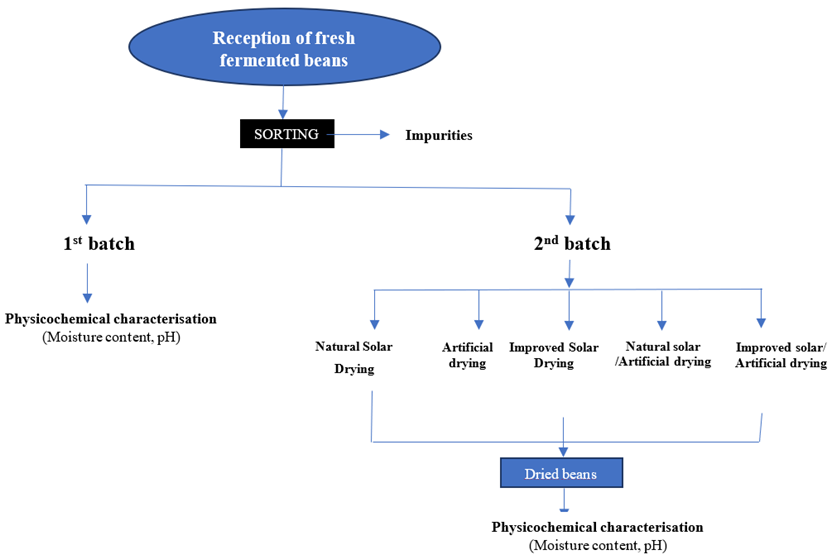
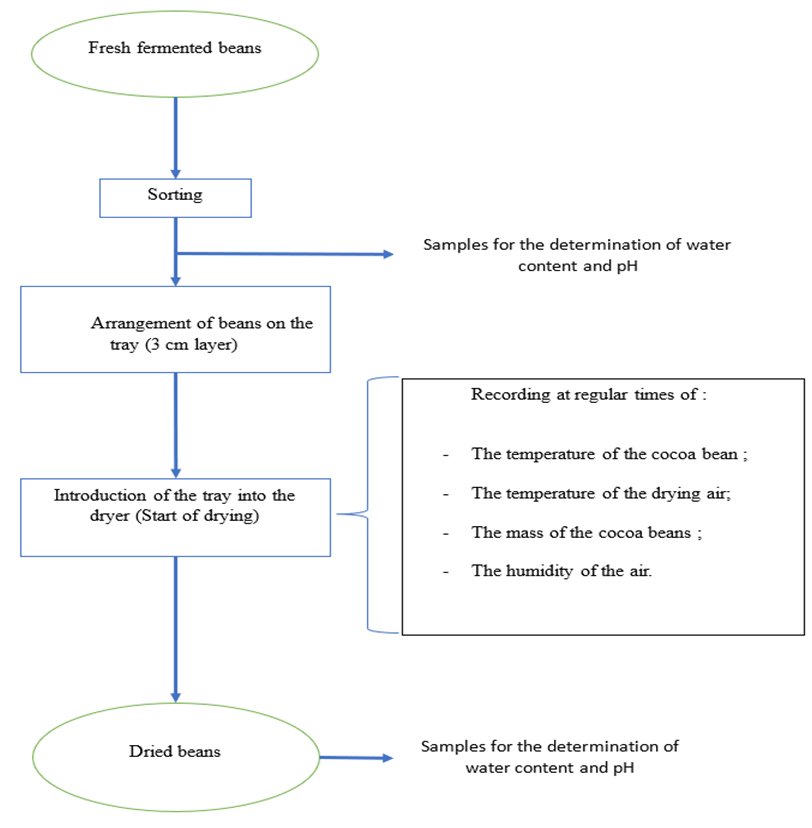
2.2. MethodsOn arrival at the laboratory, a sample of beans is taken for analysis of moisture content and pH. For each experiment, a 1000g sample is used. Each experiment has to be carried out three times in order to guarantee the reliability of the results. Figure 1 shows the overview of the experimental procedure. We will start with an open air drying, then drying in a direct solar dryer with forced convection, then drying in an electric dryer and finally we will do two couplings.
The tests were carried out with an ambient temperature varying from 27 to 35°C during the drying period. The initial moisture content of the cocoa beans is 51.79%, with an initial pH of 5.14.

During the tests, the drying parameters are continuously varied over time. Weather parameters, mass and product temperature are measured during this operation. These parameters are measured every 60 minutes, from the beginning to the end of the drying process. The beans are left for 30 minutes in the open air in order to equalise their temperature to that of the laboratory before the start of drying.
In order to ensure a better stability of the drying conditions and a homogenisation of the temperature inside the dryer, all the equipment must be running at least half an hour before the loaded trays are introduced into the drying chamber. The weighing of the trays is carried out outside the dryer. The duration of a weighing is 30 to 40 seconds and is deducted from the total drying time. The measurement at time t gives us the wet mass of the product M(t). The drying experiment is stopped when the moisture content is 8% or less.

The moisture content was determined using AOAC method 981.12. Three empty crucibles were oven dried for 35 min at 105 ± 2 °C and then tared after cooling in a desiccator. 2.000 ± 0.001g of cocoa powder were weighed into each of the crucibles and then placed in the oven at 105°C for 24 hours until the sample was constant weight. The crucibles were removed from the oven and weighed after cooling in a desiccator. The analysis was done in triplicate, the initial and final water contents of the samples are calculated according to equation 1:
 | (1) |
With:
TE: Moisture content (% kgwater/kMS)
M1: Mass of the crucible containing the fresh sample before steaming (g)
M2: Mass of crucible containing dry sample after steaming (g)
M0: Mass of crucible in empty condition (g)
The pH was measured according to the method described in AOAC 981.12. A 5g sample of cocoa powder dry matter was taken and mixed with 20 ml of distilled water in a beaker. The resulting suspension was stirred with a magnetic stirrer for 5 min and then left to stand for 10 min. The pH of the aqueous phase was measured using a pH meter calibrated at pH 4 and 7, at a temperature of 25.03± 0.22 °C.
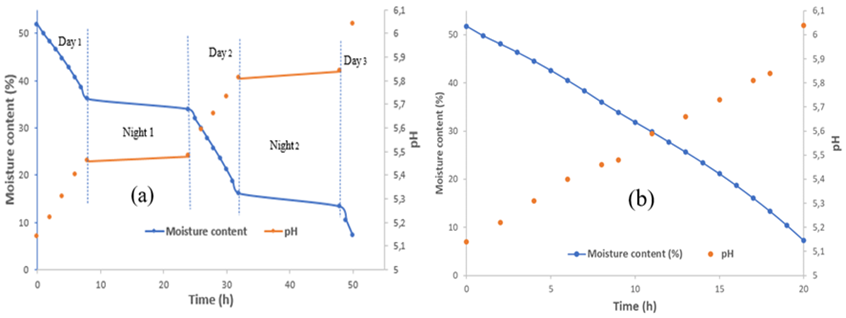
Figure 3a and Figure 3b show the evolution of water content and pH as a function of time for natural solar drying with and without intermittence.

We note that during the day the moisture content decreases significantly with time, whereas during the night it decreases very slightly and that the drying time is 50h for an average drying temperature of 32°C. We also note that the decrease in moisture content is greater on day 2 (-17.84%), than on day 1 (-15.75%). This could be explained by the fact that during the night moisture migrates to the periphery of the bean and thus facilitates its extraction on day 2. This finding is in agreement with the work of 18, on mango. Finally, a comparison between Figure 3a and Figure 3b shows us that the 30h intermittence period is greater than the 20h actual drying period. The pH of the beans increases with time during the day, and decreases very slightly during the night, to reach a final pH of 6.04. However we can see in Figure 3a that its increase is greater on day 2 (+0.33) than on day 1 (+0.32), this could be due to the temperature change period. The results obtained show that the drying rate decreases with time.
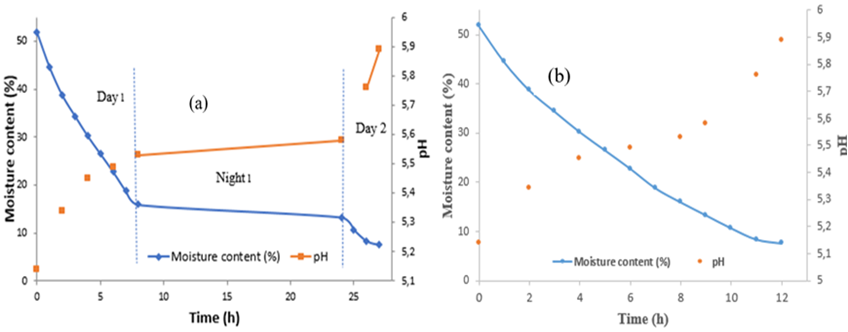
Figure 4a and Figure 4b show the evolution of moisture content and pH as a function of time for improved solar drying, with and without intermittence.
We note that the drying time in this case is shorter (27h) than in the natural dryer. The moisture content decreases very significantly on day 1 since the average drying temperature is 41°C. During the day the moisture content decreases significantly with time, while at night it decreases very slightly. Finally, a comparison between Figure 4a and Figure 4b shows that the 15 hour intermittent period is longer than the 12 hour real drying period. The pH of the beans increases with time during the day, and decreases very slightly during the night. However, we can see that at the end of the drying process it is 5.89, which is lower than the natural solar drying process. The maximum drying speed is 132.10-3 kgwater/kgMS.h, which is more than three times the drying speed of the natural solar dryer.

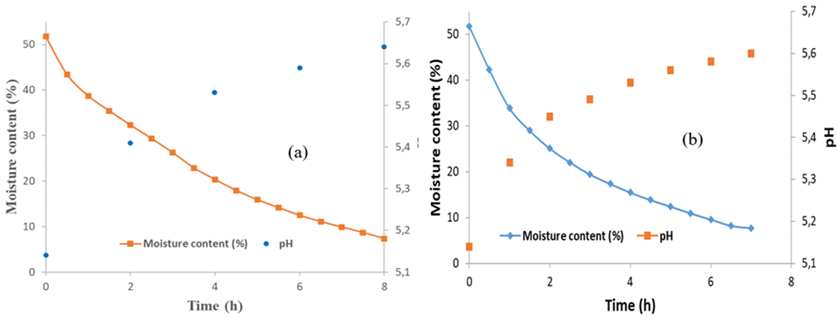
Figure 5a and Figure 5b show the evolution of moisture content and pH as a function of time for artificial drying at 50 and 60°C.
These figures show us that the moisture content decreases rapidly to reach the desired moisture content in 8 hours for drying at 50°C and in 7 hours for drying at 60°C. We note that the pH at the end of drying is 5.64 for drying at 50°C and 5.60 for drying at 60°C, which is approximately equal. However, this pH is lower than the pH of the previous devices (6.04 and 5.89 respectively). The drying speed is higher than the drying speed of the previous devices.

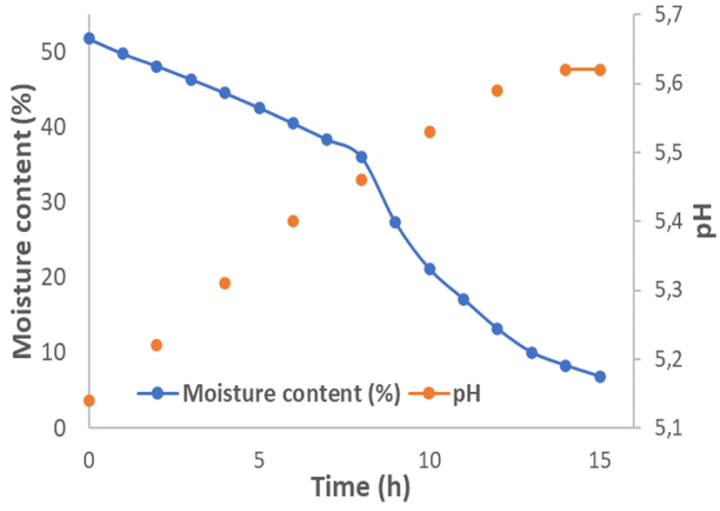
Figure 6 shows the evolution of moisture content and pH as a function of time for natural drying coupled with artificial drying at 50°C.

The drying time for this experiment is 15 hours, with a final pH of 5.62. It can be seen that the moisture content decreases faster during the artificial drying, which is normal because the drying temperature increases from about 32°C to 50°C. The maximum drying rate is 90.3*10-3 kgwater/kgMS.h.
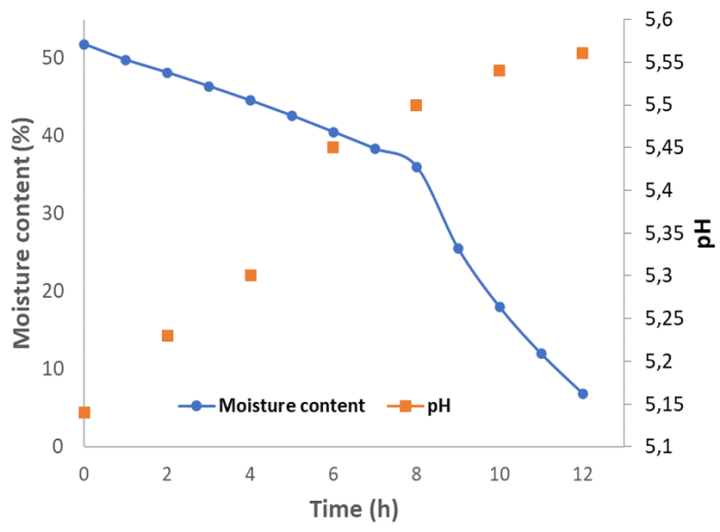
Figure 7 shows the evolution of moisture content and pH as a function of time for natural solar drying coupled with artificial drying at 60°C. Vair= 0.5 m/s.
The drying time for this experiment is 12 hours, with a final pH of 5.56. It can be seen that the moisture content decreases more rapidly during artificial drying, which is normal because the drying temperature increases from approximately 32°C to 60°C. The maximum drying rate is 106.4.10-3 kgeau/kgMS.h.

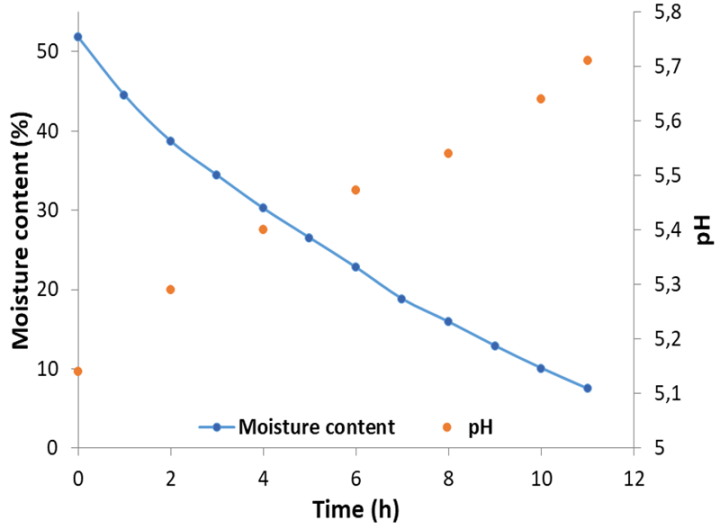
Figure 8 shows the evolution of moisture content and pH as a function of time for improved solar drying coupled with artificial drying at 50°C.
The drying time for this experiment is 11 hours, with a final pH of 5.71. It can be seen that the moisture content decreases almost constantly, which can be explained by the fact that the average drying temperature remains approximately the same during the drying process, about 50 ± 2°C. The maximum drying rate of 130.10-3 kgeau/kgMS.h.

The curves are marked by an ever decreasing moisture content of the product until the end of the drying process. They highlight the drying phase with decreasing speed, which reflects the evaporation of moisture linked to a greater or lesser extent to the dry matter of the product. In the case of organic products, several authors reveal that it is difficult to locate the first drying phase.
It can be seen that as the air temperature increases, the drying speed increases. This is the result of the increase in the heat flux brought by the air to the product on the one hand, and the acceleration of the internal migration of moisture on the other. The increase in product temperature not only modifies the activity of moisture but also influences the diffusion coefficient and to a lesser extent the enthalpy of vaporisation. On the other hand, it can be observed that the pH decreases when the drying temperature increases. This is due to the fact that when the drying temperature is high the moisture, being less bound to the structure than the acids, leaves the beans more quickly, leaving a medium with concentrated acidity. Therefore, in order to remove the acidity from the cocoa beans, the drying should be done in a way that allows a balanced extraction of moisture and acids.
This paper reported on the comparative study of five hot air drying processes (artisanal solar drying, improved solar drying, electric drying, mixed artisanal solar+electric drying, mixed improved solar + electric drying). The results obtained showed that the drying process that allows to obtain the best triplet of drying time/ moisture content/PH, is the mixed solar/electric drying at 50°C, which allowed for 1000g of fresh beans, to obtain a drying time of 11h for a moisture content of 7.46% and a pH of 5.71. For the first time in a scientific study, the evolution of pH as a function of moisture content and/or time during the drying of cocoa beans was demonstrated. These results are very important for the design of a dryer adapted to cocoa drying in the context of producers in the humid tropics.
| [1] | Kanmogne A., Jannot Y. et Nganhou 2012: Description concise et analyse des systems utilisés dans la région sud du Cameroun pour le séchage du cacao. TROPICULTURA, 30, 94-102. | ||
| In article | |||
| [2] | ONCC (office National de Cacao et Café) 2022: Etat des ventes de cacao pour la saison 2020/2021, dans investir au Cameroun. Pp 15. | ||
| In article | |||
| [3] | Barel M., 1998: Première transformation du cacao. In : Cacao et Chocolat, Collection Sciences et Techniques Agroalimentaires, Lavoisier, Tec & Doc, Paris, PP 95-116. | ||
| In article | |||
| [4] | Nogbou A., Akmel D., Brou K., Assidjo N., 2015: Modélisation de la cinétique de séchage des fèves de cacao par des modèles semi-empiriques et par un réseau de neurones artificiels récurrent : cas du séchage microonde par intermittence. European Scientific Journal, Mar 2015. | ||
| In article | |||
| [5] | Cros E. et Jeanjean N. 1995: Qualité du cacao. Influence de la fermentation et du séchage. Plantation, Recherche et Développement, 2(3): 21-27. | ||
| In article | |||
| [6] | Kouakou B., Irie B., Dick E., Nemlin G., Bomisso L., 2013: Caractérisation des techniques de séchage du cacao dans les principales zones de production en Côte d’Ivoire et détermination de leur influence sur la qualité des fèves commercialisées. Journal of Applied Biosciences 64: 4797-4812. | ||
| In article | View Article | ||
| [7] | Nogbou A., Akmel D., Brou K., Assidjo N., 2015: Modélisation de la cinétique de séchage des fèves de cacao par des modèles semi-empiriques et par un réseau de neurones artificiels récurrent : cas du séchage microonde par intermittence. European Scientific Journal, Mar 2015. | ||
| In article | |||
| [8] | Guéhi T., Dabonne S., Ban-koffi L., Kedjebo D., Irié B., 2010: Effect of Turning Beans and Fermentation Method on the Acidity and Physical Quality of Raw Cocoa Beans. Journal of Food Science and Technology 2(3): 163-171. | ||
| In article | |||
| [9] | Barel, M., 2013: Qualité du cacao: l’impact du traitement post-récolte, Savoir-faire, Editeur Quae, Paris, 2013. | ||
| In article | |||
| [10] | Kanmogne A., 2003: Contribution à l’étude du séchage du cacao au Cameroun, conception, réalisation et modélisation d’un séchoir adapté aux conditions locales. Thèse de Doctorat/PhD, Université de Yaoundé I, 142 p. | ||
| In article | |||
| [11] | Ching L Hii, R Abdul Rahman, S Jinap, YB Che Man 2006: Quality of cocoa beans dried using a direct solar dryer at different loadings. In journal of the science of food and agricultural, 02 may 2006. | ||
| In article | |||
| [12] | Oke D., Omotayo K., 2012: Effect of forced-air artificial intermittent drying on cocoa beans in South-Western Nigeria, Journal of Cereals and Oil seeds Vol. 3, 1, pp. 1-5. | ||
| In article | |||
| [13] | Kamenan Blaise Koua, Ekoun Paul Magloire et Prosper Gbaha 2018: Séchage des fèves de cacao dans un séchoir solaire indirect à circulation forcée d’air. In Revue du CAMES – Sciences Appliquées et de l’Ingénieur Vol. 2(2), pp. 15-19, Online January 2018. | ||
| In article | |||
| [14] | Musa, N. A., 2012. Drying characteristics of cocoa bean using an artificial dryer. Journal of Engineering and Applied Science, vol. 7, 2, pp. 194-197. | ||
| In article | View Article | ||
| [15] | Gnepie N., Kewou S., Edoun M., Kuitche A., Zeghmati B.: Practice of Drying Cocoa in Humid Tropical Zone: Case of Southern Cameroon. Journal of Engineering Research and Application ISSN: 2248-9622 Vol. 9, Issue 7 (Series-V) July 2019, pp 50-56. | ||
| In article | |||
| [16] | Edoun M., Kuitche A., Ahmat T., Meukam P., 2007: Analyse conceptuelle d’un séchoir solaire adapté à la production du kilichi; Poster présenter au séminaire régional organisé par GP3A-UCAD-ESP du 21 au 23 Novembre à Dakar sur «la Transformation, Conservation et Qualité des aliments: Nouvelle approche de lutte contre la pauvreté». | ||
| In article | |||
| [17] | Edoun M., Kuitche A., Marouzé C., Giroux F., Kapseu C., 2010: Etat de la pratique du séchage de quelques fruits et légumes à petite échelle dans le Sud Cameroun. Fruits, 66(1), 1-12; French. | ||
| In article | View Article | ||
| [18] | Tetang A., 2018. Modélisation des transferts de chaleur et de matière lors du séchage en régime intermittent des fruits à forte teneur en eau: application à la mangue “Amélie”, thèse de doctorat soutenue à l’ENSAI de l’université de Ngaoundéré-Cameroun, 182 p. | ||
| In article | |||
Published with license by Science and Education Publishing, Copyright © 2023 Gnepie Nicolas, Matuam Balbine, Tetang Abraham, Edoun Marcel and Kuitche Alexis
 This work is licensed under a Creative Commons Attribution 4.0 International License. To view a copy of this license, visit
http://creativecommons.org/licenses/by/4.0/
This work is licensed under a Creative Commons Attribution 4.0 International License. To view a copy of this license, visit
http://creativecommons.org/licenses/by/4.0/
| [1] | Kanmogne A., Jannot Y. et Nganhou 2012: Description concise et analyse des systems utilisés dans la région sud du Cameroun pour le séchage du cacao. TROPICULTURA, 30, 94-102. | ||
| In article | |||
| [2] | ONCC (office National de Cacao et Café) 2022: Etat des ventes de cacao pour la saison 2020/2021, dans investir au Cameroun. Pp 15. | ||
| In article | |||
| [3] | Barel M., 1998: Première transformation du cacao. In : Cacao et Chocolat, Collection Sciences et Techniques Agroalimentaires, Lavoisier, Tec & Doc, Paris, PP 95-116. | ||
| In article | |||
| [4] | Nogbou A., Akmel D., Brou K., Assidjo N., 2015: Modélisation de la cinétique de séchage des fèves de cacao par des modèles semi-empiriques et par un réseau de neurones artificiels récurrent : cas du séchage microonde par intermittence. European Scientific Journal, Mar 2015. | ||
| In article | |||
| [5] | Cros E. et Jeanjean N. 1995: Qualité du cacao. Influence de la fermentation et du séchage. Plantation, Recherche et Développement, 2(3): 21-27. | ||
| In article | |||
| [6] | Kouakou B., Irie B., Dick E., Nemlin G., Bomisso L., 2013: Caractérisation des techniques de séchage du cacao dans les principales zones de production en Côte d’Ivoire et détermination de leur influence sur la qualité des fèves commercialisées. Journal of Applied Biosciences 64: 4797-4812. | ||
| In article | View Article | ||
| [7] | Nogbou A., Akmel D., Brou K., Assidjo N., 2015: Modélisation de la cinétique de séchage des fèves de cacao par des modèles semi-empiriques et par un réseau de neurones artificiels récurrent : cas du séchage microonde par intermittence. European Scientific Journal, Mar 2015. | ||
| In article | |||
| [8] | Guéhi T., Dabonne S., Ban-koffi L., Kedjebo D., Irié B., 2010: Effect of Turning Beans and Fermentation Method on the Acidity and Physical Quality of Raw Cocoa Beans. Journal of Food Science and Technology 2(3): 163-171. | ||
| In article | |||
| [9] | Barel, M., 2013: Qualité du cacao: l’impact du traitement post-récolte, Savoir-faire, Editeur Quae, Paris, 2013. | ||
| In article | |||
| [10] | Kanmogne A., 2003: Contribution à l’étude du séchage du cacao au Cameroun, conception, réalisation et modélisation d’un séchoir adapté aux conditions locales. Thèse de Doctorat/PhD, Université de Yaoundé I, 142 p. | ||
| In article | |||
| [11] | Ching L Hii, R Abdul Rahman, S Jinap, YB Che Man 2006: Quality of cocoa beans dried using a direct solar dryer at different loadings. In journal of the science of food and agricultural, 02 may 2006. | ||
| In article | |||
| [12] | Oke D., Omotayo K., 2012: Effect of forced-air artificial intermittent drying on cocoa beans in South-Western Nigeria, Journal of Cereals and Oil seeds Vol. 3, 1, pp. 1-5. | ||
| In article | |||
| [13] | Kamenan Blaise Koua, Ekoun Paul Magloire et Prosper Gbaha 2018: Séchage des fèves de cacao dans un séchoir solaire indirect à circulation forcée d’air. In Revue du CAMES – Sciences Appliquées et de l’Ingénieur Vol. 2(2), pp. 15-19, Online January 2018. | ||
| In article | |||
| [14] | Musa, N. A., 2012. Drying characteristics of cocoa bean using an artificial dryer. Journal of Engineering and Applied Science, vol. 7, 2, pp. 194-197. | ||
| In article | View Article | ||
| [15] | Gnepie N., Kewou S., Edoun M., Kuitche A., Zeghmati B.: Practice of Drying Cocoa in Humid Tropical Zone: Case of Southern Cameroon. Journal of Engineering Research and Application ISSN: 2248-9622 Vol. 9, Issue 7 (Series-V) July 2019, pp 50-56. | ||
| In article | |||
| [16] | Edoun M., Kuitche A., Ahmat T., Meukam P., 2007: Analyse conceptuelle d’un séchoir solaire adapté à la production du kilichi; Poster présenter au séminaire régional organisé par GP3A-UCAD-ESP du 21 au 23 Novembre à Dakar sur «la Transformation, Conservation et Qualité des aliments: Nouvelle approche de lutte contre la pauvreté». | ||
| In article | |||
| [17] | Edoun M., Kuitche A., Marouzé C., Giroux F., Kapseu C., 2010: Etat de la pratique du séchage de quelques fruits et légumes à petite échelle dans le Sud Cameroun. Fruits, 66(1), 1-12; French. | ||
| In article | View Article | ||
| [18] | Tetang A., 2018. Modélisation des transferts de chaleur et de matière lors du séchage en régime intermittent des fruits à forte teneur en eau: application à la mangue “Amélie”, thèse de doctorat soutenue à l’ENSAI de l’université de Ngaoundéré-Cameroun, 182 p. | ||
| In article | |||