The objective of this study is to evaluate the organoleptic qualities of Mbala-pinda formulated by substituting retted cassava paste for fermented corn and fermented taro pastes while adding spices and fish in certain cases. To do this, several types of Mbala-pinda were formulated from basic foods (cassava, corn and taro) consumed in Congo. Thus, nine (9) Mbala-pinda were formulated at the rate of three (3) formulations per basic food. A rating test was carried out on the Mbala-pinda formulated by a panel made up of 50 tasters on a scale of 1 to 4. The results of the test on the formulations of cassava (E1, E2 and E3), corn (E4, E5 and E6) and taro (E7, E8 and E9) revealed that E3, E1 and E9 were more appreciated with a respective average of 3.2; 2.86 and 2.74 followed by E2 (2.56), E6 and E8 have the same appreciation 2.54, followed by E5 (2.50) and E7 (2.06) but E4 was the least appreciated either 1.94. In short, all the Mbala-pinda were well appreciated, because all the averages are above 2 except the E4 which could not reach the average.
Malnutrition is a condition characterized by an imbalance, that is to say an insufficiency or excess in the intake of essential nutrients. Acute malnutrition (AM) is a global challenge, affecting 45 million children under 5 years of age and is an underlying cause of 800,000 deaths annually. A third of children under 5 were stunted and 5.7% suffered from acute malnutrition (AM) in 2022, with large disparities in Africa 1. Despite progress in some areas of health in recent decades, the persistent prevalence of malnutrition in many parts of the continent hampers efforts to improve the well-being and quality of life of millions of people. This complex condition results from multiple interacting factors, including dietary habits, socioeconomic conditions, access to food resources, and physical and cultural environments. To compensate for this malnutrition, we are witnessing the improvement of dietary pathways which can consist of the formulation of dishes from a mixture of a starchy food and a legume in order to increase the biological values of proteins: This is the case of couscous enriched with soy 2, yam porridges enhanced with squash, soy and Urera trinervis leaves 3, corn-based porridges, soy, peanut and fry 4.
In Congo, the inhabitants of the departments of greater Niari (Bouenza, Niari, Lékoumou), use a traditional food called Mbala-pinda obtained by combining retched cassava paste with peanut paste. This product, rich in energy and proteins 5, 6, plays a crucial role in the food and nutritional security of local populations. The Congo, having a diversity of starches and legumes, can take advantage of it to make other Mbala-pinda from these foods. Our choice was oriented towards starchy foods such as cassava, taro and corn as cereals as well as legumes including peanuts. This choice is justified by the availability of these foods at the national level. However, the creation of a new product requires that it be accepted by consumers while taking into account their eating habits. The question we ask ourselves is the following: could the formulation of Mbala-pinda based on cassava, corn, taro, peanut paste, spices and fish improve the organoleptic characteristics of this dish traditional?
Thus, our study aims to describe the organoleptic profile of formulated Mbala-pinda. This is specifically about:
v Formulate Mbala-pinda with other foods of the same nature as cassava (corn and taro) while adding spices and fish;
v Determine the organoleptic qualities of these formulated Mbala-pinda.
Material
Target population
The target population consisted of students from the Faculty of Science and Technology, Marien NGOUABI University.
Food material
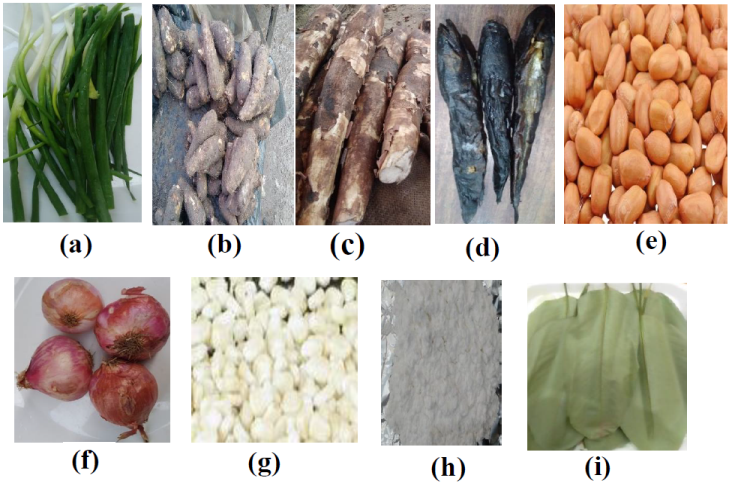
The food material used consisted of chives (a), taro tubers (b), cassava roots (c), Channa striata fish (d), peanut seeds (e), onion (f), corn seeds (g) and salt (h). These different foods were used in the making of the different Mbala-pinda and the leaves of Megaphrynium macrostachyum (i) were used for the packaging of the Mbala-pinda (Figure 1).

Didactic material
It consisted of a sensory evaluation sheet in which information relating to the organoleptic quality of Mbala-pinda was mentioned.
Formulation of Mbala-pinda
Mbala-pinda were formulated from retted cassava paste, fermented corn paste and fermented taro.
Pasta production
Production of cassava retted paste
The cassava roots were retted following the methods described by 7, 8, with some modifications. They were purchased at the total market in Brazzaville then transported to the INRSIIT Agro-Food Technology laboratory where they were peeled, cut into small slices and soaked in water for 4 days. These retted cassava roots were defibrated, sifted and decanted. The supernatant was discarded and the deposit at the bottom was poured into a muslin cloth for draining to obtain a retted cassava paste.
Production of retted corn dough
The white variety corn seeds called Nzanzaku (Lari) purchased at the Total market in Brazzaville were transported to the Agro-Food Technology laboratory of INRSIIT for the production of fermented corn paste 9, 10.
Production of retched taro paste
The taros were purchased at the Brazzaville total market and transported to the laboratory for the production of fermented taro paste. The taros were washed, peeled and soaked in water for 5 days to obtain the retted taros. The red taros were manually crushed, sifted, decanted and drained to obtain the fermented taro paste.
Peanut paste production
The white variety peanut seeds were purchased at the Total market in Brazzaville and then transported to the INRSIIT Agri-Food Technology laboratory. The sorted, roasted, peeled and winnowed peanut seeds were crushed in a mill to obtain peanut paste.
Description of Mbala-pinda production processes
After the production of the pastes, Mbala-pinda based on retted cassava, maize and taro paste was formulated by adding spices and fish (Channa striata) according to table (1). Considering the manufacturing process of Mbala-pinda 11, nine (9) Mbala-pinda were formulated by improving the cassava-based Mbala-pinda by adding spices and fish (Table 1) and replacing cassava with maize and taro with the addition of spices and fish (Table 2 and Table 3).The proportions of the different ingredients used in the making of Mbala-pinda formulated with cassava (E1, E2, E3), corn (E4, E5, E6) and taro (E7, E8, E9) are presented respectively in the table 1, table 2 and table 3
Sensory analysis of Mbala-pinda
An organoleptic test was carried out on a panel of 50 tasters. Indeed, nine (9) Mbala-pinda E1 to E9 were submitted to tasters, in order to identify the organoleptic characteristics of these formulated products. The tasters were placed in boxes to avoid communication between them. An acceptability test by rating was carried out and the assessments were recorded using a sensory assessment sheet including the following rating:
1= I don't like it, 2= I like it a little, 3= I like it, 4= I like it a lot.
The numbers from 1 to 4 were noted in a table for each Mbala-pinda, which allowed us to classify these Mbala-pinda ;
The reasons which justified the rating of each Mbala-pinda by the taster were collected through the following criteria:
1= taste, 2= smell, 3= consistency, 4= nothing
The taster was asked, according to the number he assigned to a Mbala-pinda, to say what he likes and what he does not like in this Mbala-pinda.
The tasters were provided with a single-use fork, a paper towel, a disposable plastic glass in which the mineral water was served to allow the evaluator to rinse their mouth after the tasting of each Mbala-pinda. The nine (9) Mbala-pinda were distributed in nine (9) single-use plates per taster.
The tasters appreciated the Mbala-pinda using their sense organs. Indeed, the smell was appreciated by the nostrils, the taste and consistency by the mouth.
Treatment of data
The processing of the data collected as well as the entry and production of the raw tables were carried out using the epi-infos 6 fr, Minitab and Word software. The quantitative and qualitative variables were expressed as numbers and percentages. They are sometimes accompanied by extreme values (minimum; maximum). The significant difference perceived between two percentages is verified through classic tests of differential statistics. The comparison of more than two percentages is carried out using the Student test (1995), represented by the comparison value χ²; with a significance threshold set at 5%. It makes it possible to decide whether the difference observed between the two movements is attributable to a systematic cause or whether it can be considered as the effect of a fluctuation due to chance.
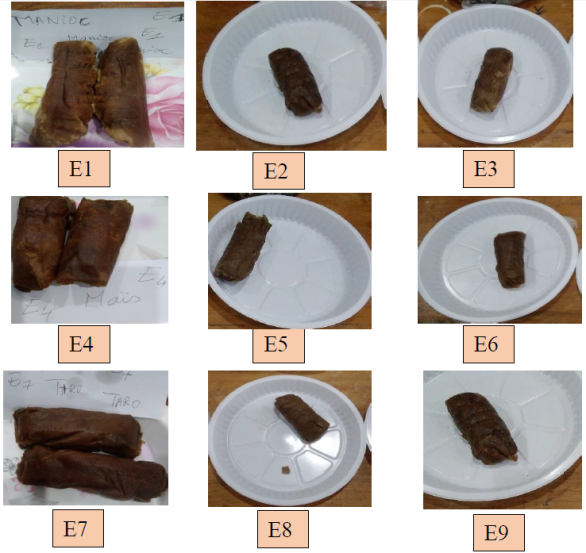
Figure 2 presents the different Mbala-pinda formulated during this study.
Organoleptic characteristics of Mbala-pinda made from cassava
Table 4 shows the tasters' assessments of Mbala-pinda made from cassava. It follows from this table that all the Mbala-pinda were well appreciated because the average appreciation of the Mbala-pinda is above two (2). Mbala-pinda E3 (3.20), is more appreciated than E1 (2.86) which is more appreciated than E2 (2.56). According to the assessment criterion; the tasters appreciated the taste of these Mbala-pinda more following the order E3 (80%), E1 (70%) and E2 (60%). The other classes are poorly represented. The difference is very significant in all cases, because, p<0.001.
Organoleptic characteristics of Mbala-pinda made from corn
The organoleptic qualities of Mbala-pinda made from corn are presented in Table 5. It follows from this table that Mbala-pinda E6 (2.54) and E5 (2.50) were well appreciated because their average is higher at 2.00. On the other hand, E4 was poorly appreciated with an average of 1.94. According to the assessment criterion, the tasters appreciated the taste of E6 and E5 more, respectively 56%. On the other hand, the tasters did not distinguish anything in E4 (70%) because no criterion attracted them. The difference is very significant in all cases, because, p<0.001.
Organoleptic characteristics of taro-based Mbala-pinda
Table 6 shows the evaluations of Mbala-pinda made from taro. It follows from this table that all the Mbala-pinda were well appreciated, because they all have an average above two (2), following the order of appreciation below: E9 (2.74), E8 (2.54) and E7 (2.06). According to the appreciated criterion, the tasters appreciated the taste of E9 and E8 more, 66% and 52% respectively. On the other hand, the tasters did not distinguish anything in E7 (60%). The difference is very significant in all cases, because, p<0.001.

Overall appreciation of Mbala-pinda
Table 7 reveals the classification of the Mbala-pinda into distinct groups. It appears from this table that four (4) groups were designated by the letters A, B, C and D, the means sharing the same letter in a column do not reveal any significant difference. Thus, Mbala-pinda E3, E1, E9 and E2 are grouped in class A and do not present any significant difference between them. Mbala-pinda E1, E9, E2, E8, E6 and E5 are grouped in class B without significant difference. Similarly, Mbala-pinda E2, E8, E6, E5 and E7 constitute class C without significant difference, while E2, E8, E6, E5, E7 and E4 form class D, also without significant difference. However, a significant difference is observed between E3 and Mbala-pinda E8, E6, E5, E7 and E4. In addition, a significant difference is noted between E1, E9 and Mbala-pinda E7 and E4.
This study was carried out with a view to making our contribution to improving the organoleptic quality of these Mbala-pinda. To do this, retted cassava paste and peanut paste were used to make Mbala-pinda. The retted cassava paste was substituted with corn and taro. In order to determine the proportions of starches and peanut paste to use to obtain a Mbala-pinda whose quality is close to that of traditional Mbala-pinda, different mixtures were tested.
The products used in the production of Mbala-pinda provide information on the starchy-legume combination 12, 13.
The sensory evaluation of the nine (9) improved Mbala-pinda allowed consumers to express their appreciation.
Concerning the improved cassava-based Mbala-pinda (E1, E2 and E3), the results showed that these were well appreciated, as the difference was not significant (p < 0.001). The tasters mainly based their appreciation on the taste of Mbala-pinda E1, E2 and E3, with respective percentages of 70%, 60% and 80%. Overall, E3 was the most appreciated, garnering 80% approval. The preference tests, based on the ratings, revealed that all Mbala-pinda obtained a rating above the average of 2. However, the addition of legumes in cereal dishes improves the taste 14. These results are in agreement with the study on kluiklui where this product is appreciated for its taste at 88% by buyers 15. This could be explained by the diversity of spices added.
Regarding corn-based Mbala-pinda (E4, E5 and E6), the evaluations showed that E5 (2.56) and E6 (2.52) have averages greater than 2, unlike E4 which was less appreciated with an average of 1.94, thus justifying the improvement of this Mbala-pinda by E5 and E6. The appreciation is essentially based on taste with a percentage of 56. Thus, spices improve and modify the taste of food 16. These results are comparable to the study that was conducted on the formulation of composite flours, one based on rice (Oryza Sativa) and the other based on corn (Zea mays) for children of weaning age and found an acceptability score of 7.33 FRSHS and 6.33 FMHHS. With FRSHS the flour composed of rice and soybeans enriched with palm oil and sugar and FMHHS the flour composed of corn and beans enriched with palm oil and sugar 17.
Concerning the taro-based Mbala-pinda (E7, E8 and E9), the tasters most appreciated the E9 (2.74) followed by the E8 (2.54) and finally the E7 (2.06). These three Mbala-pinda have an average greater than 2. They most appreciated the taste of the E9 (66%) followed by the E8 (52%). These results are not in agreement with the studies on fermented yam flour enriched with soybeans which increased the nutritional quality of the flours but the porridges were slightly accepted 18, 19. This difference could be explained by the fact that soybeans differ from peanuts in terms of taste. On the other hand, these results are comparable to the study on composite flours FT25 (flour containing taro, roasted soybean and baobab pulp in the respective ratio of 70/25/5) and FT35 (flour containing taro, roasted soybean and baobab pulp in the ratio of 60/35/5) where the FT35 formulation was more appreciated than FT25 20.
Overall, the Mbala-pinda E3, E1, E9 and E2 are the most popular. The Mbala-pinda made from corn and taro, namely E4 and E7, are identified as different from E1 because the tasters immediately noticed a change with E4, believing that it was lighter and did not respond sufficiently to E1, reason for which they did not like well in E4 but the change was not very noticeable with E7, despite the substitution of cassava by taro.
The participants estimated that these Mbala-pinda were more similar to the first ones (E1, E2 and E3). This difference could be explained by the starchy nature of each starch.
This study revealed that Mbala-pinda can be formulated not only with cassava but also with corn and taro. Likewise, the addition of spice and fish to Mbala-pinda contributed to its improvement and appreciation.
We would like to thank the Faculty of Science and Technology of Marien NGOUABI University and the National Institute of Research in Engineering Sciences, Innovation and Technology who provided the necessary conditions for carrying out this study.
The authors declare no conflict of interest.
| [1] | Daures, M. Evaluation of a simplified management strategy for acute malnutrition in children aged 6 to 59 months in Sub-Saharan Africa as part of a research program co-constructed between humanitarians and researchers (Doctoral dissertation, University of Bordeaux, 2024, 198p. | ||
| In article | |||
| [2] | Hama-Ba, Fatoumata, Pierre, Silga, and Bréhima Diawara. Evaluation of the quality and acceptability of couscous based on three formulations of composite flours enriched with soy (Glycine max) and moringa (Moringa oleifera). Int. J. Biol. Chem. Sci., 2016, 10(6): 2497-2510. | ||
| In article | View Article | ||
| [3] | Elenga, M., Tchimbakala, M. S., Nkokolo, S. A. Improvement of the nutritional quality of yam porridges and their effectiveness in wistar strain rats. Journal of Applied Biosciences, 2016, 103:9819-9828. | ||
| In article | |||
| [4] | Fogny, N. F., Madode, E. Y., Laleye, F. F., Amoussou-Lokossou, Y., Kayode, A. P. (2017). Formulation of fonio flour enriched with local food resources for the complementary feeding of young children in Benin. Int. J. Biol. Chem. Sci., 2017; 11(6): 2745-2755. | ||
| In article | View Article | ||
| [5] | Nguimbi-Tsati, P.R., Kayath, C.A., Mokemiabeka, N.S., Baloki Ngoulou, T., Moutali Lingouangou, T., Okouakoua, Y. et Ahombo, G. Production of biosurfactants and hydrolytic enzymes by bacteria of the genus Bacillus isolated from Mbala Pinda, traditional food, Republic of Congo. American Journal of Microbiological Research; 2021, 10(3): 76-83. | ||
| In article | View Article | ||
| [6] | Miantoko Zébita G. R. Consumption Evaluation, Formulation and Nutrient Characterization of Mbala Mpinda, a traditional food from Congo. Dissertation, Marien NGOUABI University. 2021, 50p. | ||
| In article | |||
| [7] | Massamba J, Trèche S., Agbor Egbe A. Brauman D, Griffon and S. Trèche, ed. (1995). Cassava consumption in Congo. Cassava food processing. Orstom, Paris, pp: 37-54. | ||
| In article | |||
| [8] | Gami, N. (1992). Transformations of the food system of the Bakété Kukuya of Congo linked to their migration from rural to urban areas| Thesis in science, University of Law, Economics and Science of Aix-Marseille 3. | ||
| In article | |||
| [9] | Elenga, M. Improvement of the nutritional quality and energy density of fermented corn porridge and yam flour used as complementary food for infants, Doctoral dissertation, Doctoral Thesis of the University of Marien Ngouabi, 2012, 104p. | ||
| In article | |||
| [10] | Louembé, D., Kéléké, S., Kobaliwa, S. C., & Nzouzi, J. P. Lactic acid bacteria from fermented corn dough in Congo. Tropicultura, 2003, 21(1), 3-9. | ||
| In article | |||
| [11] | Miantoko Zebita G. R., Elenga M., Lebonguy A. A., Stève, Moulengo Massamba S., Mananga V. Hygienic Quality of Mbala-pinda, a Fermented Food Formulated from Local Products of Congo. European Journal of Nutrition & Food Safety, 2023; 15(11), 63-75. | ||
| In article | View Article | ||
| [12] | Delpech, Barbara. Production and marketing of traditional manioc and corn-based processed products in North Gabon. Cahiers de la Recherche Développement, 1995, 40: 43-58. | ||
| In article | |||
| [13] | Agbor Egbe T, Brauman D, Massamba J., and Trèche, S. Griffon. Cassava, Food Processing. Consumption and culinary preparations of cassava in Madagascar, 1995: 103-105. | ||
| In article | |||
| [14] | Houssou, P. A., Padonou, S. W., Vodouhe, M. C., Djivoh, H., Dansou, V., Hotegni, A. B., Metohoue, R. Improvement of the quality of yêkè-yêkè (corn based couscous) by its enrichment with different vegetable seeds in Benin. International Journal of Innovation and Applied Studies, 2016, 16(3), 573. | ||
| In article | |||
| [15] | Videgla, E. G., Floquet, A., Mongbo, R., Garba, K., Tossou, H. S., & Toukourou, F. Links to the origin and specific quality of an agri-food craft product from Benin – the Agonlin kluiklui. Cahiers Agricultures, 2016, 25(3), 35003. | ||
| In article | View Article | ||
| [16] | Cahuzac-Picaud, M. Spices, herbs and aromatics: culinary uses and recipes. Phytotherapy, 2012, 10(2), pp: 109-116. | ||
| In article | View Article | ||
| [17] | Euphrasie, L. S., Brice, G. J., Appolinaire, K. K., Albarin, G. G., & Kouakou, B. Compound Flour Formulations, One of which is Rice-Based (Oryza Sativa) and The Other is Corn-Based (Zea Mays) For Children of Weaning Age. European Scientific Journal. 2019 ;15(33): 100-116. | ||
| In article | View Article | ||
| [18] | Soro S, Konan G, Elleingand E, N’guessan D and E Koffi. Formulation of infant foods based on yam flour enriched with soy. African Journal of Food agriculture nutrition and development, 2013, 3(5): 8313-8339. | ||
| In article | View Article | ||
| [19] | Achi, O. K. Quality attributes of fermented yam flour supplemented with processed soy flour. Plant Foods for Human Nutrition, 1999, 54: 151-158. | ||
| In article | View Article PubMed | ||
| [20] | Chabi, N. W., Bahou, G., Kouton, E. S., Agbangnan, D. P., Hounkpatin, W. A., Konfo, T. C., ... & Baba-Moussa, L. Rheological and nutritional characteristics of infant flours prepared from mixed flours of taro (Colocasia esculenta (L.) Schott), soybean and baobab pulp. International Journal of Bioscience, 2019, 14: 328-338. | ||
| In article | View Article | ||
Published with license by Science and Education Publishing, Copyright © 2025 Miantoko Zébita Gedellevie Ryssie, Elenga Michel and Moulengo Massamba Stève
 This work is licensed under a Creative Commons Attribution 4.0 International License. To view a copy of this license, visit
http://creativecommons.org/licenses/by/4.0/
This work is licensed under a Creative Commons Attribution 4.0 International License. To view a copy of this license, visit
http://creativecommons.org/licenses/by/4.0/
| [1] | Daures, M. Evaluation of a simplified management strategy for acute malnutrition in children aged 6 to 59 months in Sub-Saharan Africa as part of a research program co-constructed between humanitarians and researchers (Doctoral dissertation, University of Bordeaux, 2024, 198p. | ||
| In article | |||
| [2] | Hama-Ba, Fatoumata, Pierre, Silga, and Bréhima Diawara. Evaluation of the quality and acceptability of couscous based on three formulations of composite flours enriched with soy (Glycine max) and moringa (Moringa oleifera). Int. J. Biol. Chem. Sci., 2016, 10(6): 2497-2510. | ||
| In article | View Article | ||
| [3] | Elenga, M., Tchimbakala, M. S., Nkokolo, S. A. Improvement of the nutritional quality of yam porridges and their effectiveness in wistar strain rats. Journal of Applied Biosciences, 2016, 103:9819-9828. | ||
| In article | |||
| [4] | Fogny, N. F., Madode, E. Y., Laleye, F. F., Amoussou-Lokossou, Y., Kayode, A. P. (2017). Formulation of fonio flour enriched with local food resources for the complementary feeding of young children in Benin. Int. J. Biol. Chem. Sci., 2017; 11(6): 2745-2755. | ||
| In article | View Article | ||
| [5] | Nguimbi-Tsati, P.R., Kayath, C.A., Mokemiabeka, N.S., Baloki Ngoulou, T., Moutali Lingouangou, T., Okouakoua, Y. et Ahombo, G. Production of biosurfactants and hydrolytic enzymes by bacteria of the genus Bacillus isolated from Mbala Pinda, traditional food, Republic of Congo. American Journal of Microbiological Research; 2021, 10(3): 76-83. | ||
| In article | View Article | ||
| [6] | Miantoko Zébita G. R. Consumption Evaluation, Formulation and Nutrient Characterization of Mbala Mpinda, a traditional food from Congo. Dissertation, Marien NGOUABI University. 2021, 50p. | ||
| In article | |||
| [7] | Massamba J, Trèche S., Agbor Egbe A. Brauman D, Griffon and S. Trèche, ed. (1995). Cassava consumption in Congo. Cassava food processing. Orstom, Paris, pp: 37-54. | ||
| In article | |||
| [8] | Gami, N. (1992). Transformations of the food system of the Bakété Kukuya of Congo linked to their migration from rural to urban areas| Thesis in science, University of Law, Economics and Science of Aix-Marseille 3. | ||
| In article | |||
| [9] | Elenga, M. Improvement of the nutritional quality and energy density of fermented corn porridge and yam flour used as complementary food for infants, Doctoral dissertation, Doctoral Thesis of the University of Marien Ngouabi, 2012, 104p. | ||
| In article | |||
| [10] | Louembé, D., Kéléké, S., Kobaliwa, S. C., & Nzouzi, J. P. Lactic acid bacteria from fermented corn dough in Congo. Tropicultura, 2003, 21(1), 3-9. | ||
| In article | |||
| [11] | Miantoko Zebita G. R., Elenga M., Lebonguy A. A., Stève, Moulengo Massamba S., Mananga V. Hygienic Quality of Mbala-pinda, a Fermented Food Formulated from Local Products of Congo. European Journal of Nutrition & Food Safety, 2023; 15(11), 63-75. | ||
| In article | View Article | ||
| [12] | Delpech, Barbara. Production and marketing of traditional manioc and corn-based processed products in North Gabon. Cahiers de la Recherche Développement, 1995, 40: 43-58. | ||
| In article | |||
| [13] | Agbor Egbe T, Brauman D, Massamba J., and Trèche, S. Griffon. Cassava, Food Processing. Consumption and culinary preparations of cassava in Madagascar, 1995: 103-105. | ||
| In article | |||
| [14] | Houssou, P. A., Padonou, S. W., Vodouhe, M. C., Djivoh, H., Dansou, V., Hotegni, A. B., Metohoue, R. Improvement of the quality of yêkè-yêkè (corn based couscous) by its enrichment with different vegetable seeds in Benin. International Journal of Innovation and Applied Studies, 2016, 16(3), 573. | ||
| In article | |||
| [15] | Videgla, E. G., Floquet, A., Mongbo, R., Garba, K., Tossou, H. S., & Toukourou, F. Links to the origin and specific quality of an agri-food craft product from Benin – the Agonlin kluiklui. Cahiers Agricultures, 2016, 25(3), 35003. | ||
| In article | View Article | ||
| [16] | Cahuzac-Picaud, M. Spices, herbs and aromatics: culinary uses and recipes. Phytotherapy, 2012, 10(2), pp: 109-116. | ||
| In article | View Article | ||
| [17] | Euphrasie, L. S., Brice, G. J., Appolinaire, K. K., Albarin, G. G., & Kouakou, B. Compound Flour Formulations, One of which is Rice-Based (Oryza Sativa) and The Other is Corn-Based (Zea Mays) For Children of Weaning Age. European Scientific Journal. 2019 ;15(33): 100-116. | ||
| In article | View Article | ||
| [18] | Soro S, Konan G, Elleingand E, N’guessan D and E Koffi. Formulation of infant foods based on yam flour enriched with soy. African Journal of Food agriculture nutrition and development, 2013, 3(5): 8313-8339. | ||
| In article | View Article | ||
| [19] | Achi, O. K. Quality attributes of fermented yam flour supplemented with processed soy flour. Plant Foods for Human Nutrition, 1999, 54: 151-158. | ||
| In article | View Article PubMed | ||
| [20] | Chabi, N. W., Bahou, G., Kouton, E. S., Agbangnan, D. P., Hounkpatin, W. A., Konfo, T. C., ... & Baba-Moussa, L. Rheological and nutritional characteristics of infant flours prepared from mixed flours of taro (Colocasia esculenta (L.) Schott), soybean and baobab pulp. International Journal of Bioscience, 2019, 14: 328-338. | ||
| In article | View Article | ||