The current study aims to determine the nutrients and nutraceuticals content and in vitro biological activities of suggested poly-plant parts formulae. Formula I contains milk thistle, black seeds, tomato pomace, ginseng, cinnamon, eucalyptus, marjoram, molokhia, sweet fennel, black pepper, turmeric and gum arabic, while Formula II contains milk thistle, spearmint leaves, marjoram leaves, sweet fennel, lemon peels, potato peels, orange peels, onion skin, apricot kernels, turmeric, gum arabic. Data of the nutrients composition of the suggested formulae powder indicated that carbohydrates (49.87 to 51.50 g.100g-1) was the largest compound followed by crude fat (17.45 to 18.32 g.100g-1), total protein (15.08 to 16.23 g.100g-1), ash (10.06 to 12.86 g.100g-1) and crude fiber (3.87 to 4.76 g.100g-1). Also, suggested formulae powder is rich in different estimated elements (Na, Fe, Zn, Mn, Ca, Cu, P, Mg, K and Se) and vitamins (A, B2, B6, B9, C and E). Furthermore, nutraceuticals (bioactive compounds) content of suggested formulae powder indicated that phenolics were the largest compound followed by polysaccharides, terpenoids, flavonoids, saponin, triterpenoids, oxalate, kaempherol and lycopene. Also, the content of these compounds except terpenoids, triterpenoids, and oxalate are higher in formula I than formula II. The different extracts of the suggested formulae samples particularly ethanolic and methanolic also recorded several strong biological activities including antioxidant and scavenging activities, inhibition of low density lipoprotein oxidation (anti-atherosclerotic) and as antibacterial and antifungal activitis.. Such important biological effects could play important roles in strategies to combat/ prevent/treat many diseases, especially those for which oxidative stress is one of the mechanisms for its occurrence i.e. diabetes, cancer, atherosclerosis, cardiovascular diseases etc. Therefore, the present study recommended like of these formulae powder and/or extracts to be included in our daily diets, drinks, food supplementation and pharmaceuticals.
Currently, many countries in the world including Egypt, are suffering from a large food gap, which means a disproportion between the quantities of necessary food and the number of inhabitants 1. This food gap leads the state to import food from abroad to compensate for this shortage in order to avoid the emergence of diseases of under/malnutrition among some different segments of society. One of the proposed solutions in this regard, which has gained great popularity locally and globally, is to search for new sources of food, especially plant parts, due to their large number and diversity of sources, their presence in various climatic conditions, and their important nutrient groups such as protein, high-quality fats, vitamins and minerals 2 3 4 5 6 7 8 9 10. On the other hand, they are rich in different groups of bioactive compounds with important biological activities, which play a major role as natural sources of medicine instead of expensive synthetic chemical treatments and medicines, in addition to the health complications and serious side effects that result from their use 11 12 13 14 15 16 17 18 19 20 21 22. All of these factors and more make plant parts an affordable source of nutritional ingredients, as well as a promising source of pharmaceutical compounds. In light of the above, and taking into account some economic and environmental aspects, the current study was designed to benefit from plant parts produced during food manufacturing processes as by-products or waste, as well as some parts of medicinal and aromatic plants by making combinations/formulae of them that have many nutritional and medicinal benefits.
Onion skin and potato peel are producing in large quantities in food-processing plants. The major by-products resulting from industrial peeling of onion (Allium cepa L.) bulbs are brown skin, the outer two fleshy leaves and the top and bottom bulbs. The outer dry layers of onion bulbs (Onion skin), which are not edible and removed before processing, have been shown to contain a wide spectrum of polyphenolic components 23. Also, it is a source of flavour components and fiber compounds and particularly rich in flavonoids including quercetin glycosides 24 25. Since quercetin from onions and their skins is rapidly absorbed and slowly eliminated, it could contribute significantly to antioxidant defense system 26. Also, several studies have been established for using the onion skin in different food processing applications include pectin production, pigments extraction, natural antioxidants and anticarcinogenic, vingare production, biogas productions, natural fertilizers, protection of ultraviolet adverse effects etc 27 28 29 30 31 32 33 34 35 36.
Potato is the largest vegetable crop worldwide, amounting to approximately 320 million metric tons annually 27. Producing of potato (Solanum tuberosum, L.) products mainly chips, French fries, and powder has presented a steady increase during the last decades, exceeding considerably the amount of the vegetable consumed as fresh. Solid waste generated during processing consists mostly of potato peels and amounts to 10% depending on the procedure applied. Some investigations suggested the use of water extracts from potato processing waste for the recovery of antioxidants 37. Others reported that potato skin due to containing compounds mainly phenolics with highly antioxidant properties, can play potential roles in several food technology and therapeutic nutratio applications 17 35 38, 39 40, 41
Marjoram, (Origanum marjorana L., Family Labiatae is a perennial herb, cultivated around the world 42. Quantitative composition of the essential oil, volatile compounds, bioactive compounds and the antioxidant activity of marjoram were reported by 43 44 45 46.
Fennel (Foeniculum vulgare) is a plant species in the genus Foeniculum and a member of the family Apiaceae (formerly the Umbelliferae). It is a widely distributed plant in most tropical and subtropical countries and has long been used in folk medicines to treat obstruction of the liver, spleen and gall bladder and for digestive complaints such as colic, indigestion, nausea and flatulence. In recent years the interest in this plant has increased considerably with substantial progress on its chemical and pharmacological properties 47. Several compounds including trans-anethole, estragole, fenchone and polyphenolics were isolated from this plant and some of these interact with potential mechanisms of the body including antioxidant, antimicrobial and inhibition of lipid peroxidation 48.
Black seed (Nigella sativa) seed is variously called fennel flower, nutmeg flower, Roman coriander, black seed or black caraway. It is used as part of the spice mixture in food processing, most recognizably in bread. Several studies also indicated that black seed contains different classes of bioactive compounds so used as antioxidants, immunostimulant and antibacterial drugs 49.
Cinnamon (Cinnamomun verum) is a famous beverage a long history and is one of the world's most. It was imported to Egypt from China as early as 2000 BC. Cinnamon is principally employed in cookery as a and flavouring material, being largely used in the preparation of some desserts, chocolate, spicy candies and liqueurs, and meat products 50. It contains condensed tanins, oil, coumarins, cinnamaldehyde and flavonoids which have been shown potent antioxidant and anticarcinogenic activities 51, 52. Extracts of cinnamon have also been shown to have antioxidant effects in part through activating antioxidant enzymes, prevent free radical formation, remove radicals before damage can occur, repair oxidative damage, eliminate damaged molecules, inhibit lipid peroxidation 53, 54 55, 56, 57.
Milk thistle Silybum marianum L.) belongs to the Asteraceae family is an annual/biennial plant native of Mediterranean area and now growing and cultivated worldwide including Egypt 58, 59. Silybum marianum has been used for centuries in medicine, mainly to treat kidney, spleen, liver, and gallbladder diseases 60. Plant fruits/seeds contain a mixture of flavonolignans collectively known as silymarin. Traditional Silybum marianum extract is made from the seeds, which contain approximately 4–6% silymarin 61.The extract consists of about 65–80% silymarin and 20–35% fatty acids, including linoleic acid. Regarding the beneficial properties of S. marianum and main constituent, silymarin in the treatment of dyslipidemia, diabetes, coronary heart disease and obesity 62, 63, 64. Also, different pharmacological functions of silymarin were reported in liver diseases: antioxidant, antifibrotic regenerative (stimulate hepatic regeneration, choleretic, hepatoprotective, immunostimulating, and anti-inflammatory) 65, 66, 67.
Turmeric (Curcuma longa L.) belongs to the Zingiberaceae family along with the other noteworthy members like ginger, cardamom and galangal. Plants are gathered each year for their rhizomes, some for propagation in the following season and some for consumption 68. Turmeric contains a wide variety of bioactive compounds including curcumin, demethoxycurcumin, bisdemethoxycurcumin, zingiberene, curcumenol, curcumol, eugenol, tetrahydrocurcumin, triethylcurcumin, turmerin, turmerones, and turmeronols 69. Also, it contains 2-8% curcumin 70. Since the time of 1900 BC numerous therapeutic activities have been assigned to turmeric for a wide variety of diseases and conditions, including those of the skin, pulmonary, and gastrointestinal systems, aches, pains, wounds, sprains, and liver disorders, and inhibition of tumors formation and promotion as cancer initiation 71, 72, 73, 74.
Tomato (Lycopersicon esculentum L.) juice is the most important vegetable juice with respect to per capita consumption. About 3–7% of the raw material is lost as waste during tomato juice pressing 75. Tomato pomace consists of the dried and crushed skins and seeds of the fruit 76. Lycopene is the principal carotenoid causing the characteristic red hue of tomatoes. Most of the lycopene is associated with the water-insoluble fraction and the skin 77. Therefore, skin extracts are especially rich in lycopene. Baysal et al., 78 clearly stated that a large quantity of carotenoids is lost as waste in tomato processing. Lycopene is associated with antioxidant status, gap-junction formation, inhibition of cholesterol synthesis and prevent cancer and heart diseases 79, 80. Also, the antioxidant defense system of other bioactive compounds found in tomato pomace includes vitamins (C, E), minerals (selenium, copper), phytonutrients (β-carotene, lutein), and biological products (bilirubin, coenzyme Q10) that protect tissues from oxidative damage 34.
Eucalyptus (Eucalyptus globules; Family: Myrtaceae) is a large tree with smooth, pale or ash-grey bark, becoming 3 to 20 m high. The leaves of young trees and the first leaves of young shoots are opposite, sessile, oval-oblong, with a cordate base, farinaceous-glaucous, and the older leaves are dangling, spirally arranged, lanceolate-falcate and up to 30 cm long 81. The leaves contain 1 to 3 % volatile oil, depending on provenience 82. The native oil contains 45 to 75% 1,8-cineole. Additionally, myrtenole, a-pinene, p-pinene, pinocarvone, y-terpinene, a-phellandrene, several aldehydes and the sesquiterpenes alloaromadendrene, aromadendrene, globulole, camphor and a-grujunene 83. Eucalyptus oil (EO) and its major component, 1,8-cineole, have antimicrobial effects against many bacteria, viruses, and fungi. Surprisingly for an antimicrobial substance, there are also immune-stimulatory, anti-inflammatory, antioxidant, analgesic, and spasmolytic effects. Of the white blood cells, monocytes and macrophages are most affected, especially with increased phagocytic activity 84.
Molokhia (Corchorus olitorius) is a leafy, green, summer vegetable. A traditional dish in Egypt and Sudan, some people believe it originated among Egyptian during the time of the Pharaohs. Molokhia contains phenolics, tannins, saponins and carotenoids 8, 14 22, 85. Such compounds showed many biological properties including antidiabetic, anti-obesity, anticarcinogenic and sedative 8, 14 22, 85, 86.
Ginseng (Panax ginseng, Family: Araliaceae ) is an herb used in traditional medicine for thousands of years 87. It contains multiple active constituents including ginsenosides, polysaccharides, peptides, phytosterols, polyacetylenes, polyacetylenic alcohols, flavonoids, volatile compounds and fatty acids that have been shown to have different effects on carbohydrate and lipid metabolism, cognition and angiogenesis as well as on the function of neuroendocrine, immune, cardiovascular and central nervous systems 88, 89, 90. Also, ginseng exhibit prevention of free radical damage and support of cardiovascular health, enhanced immunity and mental capacity 55 91, 92 93, 94.
Apricot (Prunus armeniaca L.; Family: Rosaceae) is a fruit or the tree that bears the fruit of several species in the genus Prunus. Fruits kernels contain alkaloids and phenolic compounds 95. Such compounds showed antioxidant, antitumorigenic and anticarcinogenic in experimental animals 95. Gum Arabic (GA) or Acacia gum is an edible biopolymer obtained as exudates of mature trees of Acacia senegal and Acacia seyal which grow principally in the African region of Sahe in Sudan. The exudate is a non-viscous liquid, rich in soluble fibers, and its emanation from the stems and branches usually occurs under stress conditions such as drought, poor soil fertility, and injury 96. Regarding the GA structure, it is a neutral or slightly acidic salt of a complex polysaccharide composed of galactose, arabinose, rhamnose, glucuronic acid, 4-O-methylglucuronic acid, calcium, magnesium, and potassium 97. In the last two decades, the effective biological roles of GA has been confirmed including reduction in plasma cholesterol level 98, anticarcinogenic effect 99 and antioxidant effect 100 101 102 103 with a protective role against hepatic and cardiac toxicities. In addition to that, it has been claimed that GA alleviates effects of chronic renal failure 104 105 106. GA (dietary fiber> 80%), is associated with beneficial effects on fat metabolism 107 108. It can serve to reduce obesity and therefore prevent associated complications in humans including coronary heart disease, stroke and diabetes. Although all previous studies and others dealt with many of the biological effects of the aforementioned plant parts and herbs, most, if not all, of these studies that were conducted in this regard were tested on these substances individually. For that reason, there was a need to bring some of these materials together in the form of combinations, in the hope that this would lead to positive interfering effects that would result in bringing together the biological activities of these plant parts and increasing their concentration.
Therefore, the current study aims to determine the nutrients and nutraceuticals content and in vitro biological activities of suggested poly-plant parts formulae. Formula I contains milk thistle, black seeds, tomato pomace, ginseng, cinnamon, eucalyptus, marjoram, molokhia, sweet fennel, black pepper, turmeric and gum arabic, while Formula II contains milk thistle, spearmint leaves, marjoram leaves, sweet fennel, lemon peels, potato peels, orange peels, onion skin, apricot kernels, turmeric, gum arabic.
Plant parts used in formulae preparation were purchased from the herbs merchandize, local markets, Egypt. Plant parts include: Marjoram "Origanum majorana " leaves, Molokheiya "Corchorus capsularis Linn" leaves, Sweet fennel "Foeniculum vulgare ", Ginseng "Panax ginseng ", Black seeds "Nigella sativa L. ", Eucalyptus "Eucalyptus globules " leaves, Cinnamon "Cinnamomum verum ", Spearmint "Mentha spicata " leaves Lemon peels "Citrus limon", Orange "Citrus sinensis" peels, turmeric (Curcuma longa L.) rhizomes were purchased from Agricultural Seeds, Spices and Medicinal Plants Company (Harraz), El-Darb El-Ahmar, Cairo Governorate, Egypt. Onion skin "Allium Cepa L" and tomato (Lycopersicon esculentum L.) pomace were obtained as a donation from New Bani Suef Company for Prsevation, Dehydration and Industratzation of Vegetables, Bani Suef El-Goudida City, Nile east, Bani Suef, Egypt. Potato peels "Solanum tuberosum" was obtained as a donation from Safco Company, El-Nigella Village, Beheira Governorate, Egypt. Apricot "Prunus armeniaca" kernels were obtained from Amar Village, Al-Qalyubia Governorate, Egypt. Milk thistle (Silybum marianum L.), dried fruits of wild plant populations growing in public irrigation canals were obtained with special arrangements from Mit Ghoarb Village of, Sinbillawin, Dakahlia Governorate, Egypt.Gum arabic "Acacia senegal L." was obtained from the SAVANNA Companies Group (Processing Gums, Juices and Confectionery), Khartoum, Sudan (Specification: appearance colouroff white, appearance form- powder, purity, 98.34±0.67%). Taxonomic confirmation of the all plant parts were achieved by the plant taxonomy scientist in the Faculty of Agriculture, Menoufia University, Shebin El-Kom, Egypt.
Bioactive compounds standard [gallic acid (GA), catechine (CA), lycopene, kaempherol, catechin and oxalic acid], represent vitamins standard (β-carotene, ascorbic acid, α-tocopherol, riboflavin, pyridoxine and folate), butylated hydroxytoluene (BHT), DPPH (2,2-diphenyl-1-picrylhydrazyl), AAPH [2,2′-Azobis(2-methylpropionamidine) dihydrochloride], CuSO4 and dimethyle sulfoxide (DMSO) were purchased from Sigma Chemical Co., St. Louis, MO. All other chemicals (except as mentioned elsewhere), reagents and solvents were of analytical grade were purchased from El-Ghomhorya Company for Trading Drug, Chemicals and Medical Instruments, Cairo, Egypt.
Throughout this study absorbance (Abs) for different assays were measured using UV-160A; Shimadzu Corporation, Kyoto, Japan. Also, atomic absorption spectrophotometer, type Perkin – Elmer, Model 2380, Waltham, MA, USA was used for mineral determination. Furthermore, SP Thermo Separation Products Liquid Chromatography (Thermo Separation products, San Jose, CA, USA) was used with a Consta Metvic 4100 pump, a Spectra Series AS100, Spectra System UV 1000 UV/Visible Spectrophotometer Detector, Spectra System FL 3000 and a PC 1000 system software. The columns used (Alltech, Deerfield, IL, USA) were a reversed-phase water Adsorbosil C18 (5 µM, 100 mm × 4.6 mm I.d.) for water-soluble vitamins; and normal Ultrasphere Si (5 µM, 250 mm × 4.6 mm I.d.) for analysis of fat-soluble vitamins.
Adult male albino rats (160 g per each) were obtained by special arrangement from Helwan Station, Ministry of Health and Population, Cairo, Egypt. Rats were housed, maintained, kept under normal healthy conditions in accordance with the National Research Council's Institute of Laboratory Animal Resources, Commission on Life Sciences rules 109. The basic diet for rats feeding protocol and the components of the salt mixture and vitamins that were used were prepared in accordance with AIN 110.
2.2. MethodsAll plant parts used in formulae preparation were manually sorted to remove foreign materials and broken and damaged parts. The parts were dried in a hot air oven (Horizontal Forced Air Drier, Proctor and Schwartz Inc., Philadelphia, PA) at 45-65 0C (According to the type of plant part)( until arriving by the moisture in the final product to about 8%. The dried parts were ground into a fine powder in high mixer speed (Toshiba ElAraby, ElAraby Co., Benha, Egypt). The material that passed through an 80 mesh sieve was retained for the formulae preparation and analysis.
The suggested formulae were prepared by weighing the components of each blend separately according to mentioned in Table 1, then mixing them together and homogenizing them using a high-speed blender (Toshiba ElAraby, ElAraby Co., Benha, Egypt). The resulting formulae were placed in glass jars and stored in refrigerators at 4°C until used for study purposes.
According to the method mentioned by Gharib et al., 20, 20 gram of each formula dried powder were extracted with 80% aqueous solvents i.e. methanol and ethanol as well as water (180 ml) on an orbital shaker (Unimax 1010, Heidolph Instruments GmbH & Co. KG, Germany) for 120 min at 700C for the organic solvents and 120 min at 1000C for the water. The mixture was subsequently filtered (Whatman No. 5) on a Buchner funnel. The residual solvents were removed under reduced pressure at 55°C for water and 400C for organic solvents using a rotary evaporator (Laborata 4000; Heidolph Instruments GmbH & Co. KG, Germany). The obtained extracts were stored at 40C before use.
Suggested formulae samples were analyzed for proximate chemical composition including moisture, protein (T.N. × 6.25, micro - kjeldahl method using semiautomatic apparatus, Velp company, Italy), fat (soxhelt miautomatic apparatus Velp company, Italy, petroleum ether solvent), ash, fiber and dietary fiber contents were determined using the methods described in the A.O.A.C. 111. Carbohydrates calculated by differences: Carbohydrates (%) = 100 - (% moisture + % protein + % fat + % Ash + % fiber).
Total energy (Kcal/100 g) of the suggested formula powder samples was calculated according to Insel et al, (2002) using the following equation: Total energy value (Kcal/100 g) = 4 (Protein % + carbohydrates %) + 9 (Fat %)
Grams consumed (G.D.R. g) of the suggested formulae powder (dry weight basis) to cover the daily requirements of adult man (63 g) in protein was calculated using the RDA values 112. Percent satisfaction of the daily requirement of adult man in protein (P.S., %) when consuming the possibly commonly used portions in Egypt i.e. one bag (100 g weight), was also calculated.
Grams consumed of the suggested formulae powder (dry weight basis) to cover the daily requirements of man in energy ( G.D.R. g ) were calculated using the RDA ( Recommended dietary allowances ) which are 2900 Kcal /day for man as given by RDA 112. The percent satisfaction ( P.S., % ) of the daily needs of adult man (25 -50 year old, 79 Kg weight and 176 cm height ) in energy upon consumption the commonly used portion at homes in Egypt, i.e. i.e. one bag (100 g weight), was also calculated.
Minerals content of the suggested formula powder samples were determined according to the method mentioned by Singh et al., 113. In brief, 0.5 g of defatted sample were transferred into a digested glass tube of Kjeldahl digestion unit and 6 ml of tri-acids mixture (containing nitric acid: perchloric acid : sulfuric acid in the ratio of 20 : 4 : 1 v/v respectively) were added to each tube. The tubes content were digested gradually as follow, 30 min at 70°C; 30 min at 180 0C and 30 min at 220°C. After digestion, the mixture was cooled, dissolved in distilled water, and the volume was increased to 50 ml in volumetric beaker. After filtration in ashless filter paper, aliquots were analyzed for minerals (K, Na, Mg, Zn, Fe, Cu, Mn, Ca, Se and P) using of atomic absorption spectrophotometer.
Fat soluble vitamins (A and E) were extracted from the suggested formula powder samples according to the methods described by Epler et al., 114 and Hung et al., 115 while water soluble vitamins (B and C) according to Moeslinger et al., 116, and analyzed by HPLC techniques. Under the chromatographic conditions used in those methods, mean values ±SD of vitamins A, C, B2, B6, B9 and E recoveries were 89.54± 1.79, 87.11 ±0.98, 84.90± 1.84, 86.73±1.12, 89.34±1.54%, and 90.16±0.94%, respectively.
Total phenolics in the suggested formulae extracts were determined using Folin-Ciocalteu reagent according to Singleton and Rossi 117 and Wolfe et al., 118. Results are expressed as gallic acid and equivalents (GAE). Lycopene was determined such as described by Gordon and Diane 119 and was expressed as µg/g of dry extract. Total flavonoids contents were estimated using colorimetric assay described by Zhishen et al., [120[ and expressed as catechin equivalent, CAE (standard curve equation: y = 0.0003x - 0.0117, r2 = 0.9827), mg of CA/g of dry extract. Total polysaccharides were extracted and measured according to the method of Vazirian et al., 121. Starch was used as a standard and the results were expressed as mg of starch equivalents per g of dw. Total terpenoids were extracted and measured according to the method of Ghorai et al., Ghorai et al., 122. Triterpenoids were extracted and measured according to the method of Schneider et al., 123 and was expressed as mg ursolic acid/100 g of dry extract. Saponin content was determined according to the method of Fenwick et al., 124 Gallic acid was used as a standard to establish the standard curve, from which the saponin content of sample was determined. Oxalate was determined such as described by Oke 125. Kaempherol was measured according to the method mentioned in Fouda et al., 126.
Antioxidant activity (AA) of the suggested formulae extracts and standards (α-tocopherol and BHT) was determined according to the β-carotene bleaching (BCB) assay following a modification of the procedure described by Marco 127. The AA was all calculated as percent inhibition (bleaching rates of β-carotene in reactant tested formulae extracts) relative to control (bleaching rates of β-carotene in reactant mixture of without tested formulae extracts) such as described by Al-Saikhan 128.
Free radical scavenging ability of the suggested formulae extracts was detected by DPPH radical scavenging assay as mentioned by Desmarchelier et al., 129. In brief, a solution was prepared, and 2.4 mL of DPPH (0.1 mM in MeOH) was mixed with 1.6 mL of the tested formulae at different concentrations (12.5–150 μg/mL). The reaction mixture was mixed and left in the dark at room temperature for 30 min. The Abs of the mixture was measured spectrophotometrically at 517 nm. BHT was used as reference. Percentage of DPPH radical scavenging activity was calculated by the following equation: DPPH radical scavenging activity (%) = [(A0− A1)/A0]×100. where A0, Abs of the control, and A1, Abs of the BA / BHT. Then inhibition (%) was plotted against concentration, and IC50 was calculated from the graph.
According to the method of Princen et al., 130, inhibition of LDL oxidation was determined in the suggested formulae extracts. In brief, serum of adult male white albino rat, Sprague Dawley strain, was collected and diluted by phosphate buffer (50 mM, pH 7.4) to the concentration of 0.6%. Amounts of 5.0 ml diluted serum were mixed with 10 µl DMSO or 10 µl DMSO containing various concentrations of the tested extracts. A 20 µl of CuSO4 solution (2.5 mM) was added to initiate the reaction and the Abs at 234 nm was recorded then was taken every 20 min thereafter for 140 min at room temperature. The final results were expressed by calculation the net area under the curve.
Escherichia coli, Staphylococcus aureus and Candida albicans (from the collection of the Microbiology Department, Faculty of Agriculture, Damietta University, Damietta, Egypt) were used as test microorganisms. Antibacterial and antifungal activities for the suggested formulae extracts were elucidated by the agar cup methods described by Spooner et al., 131.
2.3. Statistical AnalysisAll tests/measurements were done in triplicates and presented as mean± standard deviations (SD). Statistical analysis was performed using Student t-test and MINITAB 12 computer program (Minitab Inc., State College, PA).
Proximate composition of the suggested formulae powder is presented in Table 2. From such data it could be noticed that carbohydrates (49.87 to 51.50 g.100g-1) was the largest compound followed by crude fat (17.45 to 18.32 g.100g-1), total protein (15.08 to 16.23 g.100g-1), ash (10.06 to 12.86 g.100g-1) and crude fiber (3.87 to 4.76 g.100g-1). These results show that the suggested formulae are close to each other with regard to the components indicating the chemical composition. These data are partly consistent with some formulae (Formula I contains black seeds, ginseng, cinnamon, eucalyptus, marjoram, molokhia and sweet fennel, and Formula II contains black seeds, spearmint leaves, marjoram leaves, sweet fennel, lemon peels, potato peels, orange peels, onion skin, apricot kernels and gum arabic) proposed for improving carbon tetrachloride-induced liver disorders in rats 132, 133. The results of the current study also partially match some of the formulae studied by El-Safty, 14 for producing food supplements for various therapeutic purposes including sedative (Azzcalm) contains spearmint leaves, chamomile flowers, anise seeds, lemon peels, orange peels, potato peels and gum arabic, diet (Azzdiet) contains katona seeds, moloukhia leaves, fenugreek seeds, cinnamon, ginger, maramia, cinameki, onion skin and gum arabic, and strengthen immunity (Azzimune) contains black seeds, spearmint leaves, marjoram leaves, sweet fennel, lemon peels, potato peels, orange peels, onion skin, apricot kernels and gum arabic. All of these previous studies, along with others, concluded that the variation observed in the chemical composition of the suggested formulae could be mainly due to the nutritional or medicinal purpose of preparing the formula and therefore the difference in the plant parts that make it up, the proportions of each component, and the technological conditions surrounding the preparation and mixing of the components.
On the other side, the nutritional evaluation of the suggested formulae powder is shown in Table 2. From such date it could be noticed that the total energy were 427.97 and 424.68 kcal/100g, G.D.R. (g) for protein (63 g) were 388.17 and 417.77 g, G.D.R. (g) for energy (2900 Kcal) were 677.62 and 682.87 Kcal,, P.S./ 100 g for protein (63g) were 25.76 and 23.94 % and P.S./100 g for energy (2900 Kcal) were 14.76 and 14.64% for Formulae I and II, respectively. The nutritional evaluation reported was partially accordance with some formulae proposed for improving carbon tetrachloride-induced liver disorders in rats 132, 133. In general, the results of the chemical analysis and nutritional evaluation of the suggested formulae also showed some important evidence, namely, the low moisture content recorded in formulae is an indicator that may not support the growth of microorganisms and thus keep it without spoilage i.e. microbial growth for a long period of time. Also, the high fat content of the suggested formulae indicates that it could be a potential source of oil for different nutritional and therapeutic purpose but such a matter requires many future studies. Furthermore, the ash and protein contents of suggested formulae show that they are better sources of dietary minerals and protein eespecially when compared to the formulae of some other studies.The same behavior was recorded for carbohydrates content of the formulae. Therefore, the richness of these combinations in most nutritional components (proteins, fats, minerals, fibers and carbohydrates) adds to them an important nutritional characteristic in addition to their functional properties, which is their ability to meet the recommended dietary values to a large extent for children and adults.
Data in Table 3 indicated the minerals content of the suggested formulae powder. Such data indicated that the formulae are rich in different estimated elements. With the exception of Zn, formula II recorded higher values for the rest of all estimated elements than formula I. The trend of the abundance of mineral concentration in the suggested formulae in decreasing order is as follows Na> Fe> Zn> Mn> Ca> Cu> P> Mg>K> Se. The high levels of minerals in the suggested formulae may be due to the high concentration of minerals in their constituent plant parts 134, 135, 136, 137, 138. In general, there is a general public interest in the availability of both macro and micro elements in the foods consumed daily. Such elements are necessary for normal physiological function, the deficiency of which causes serious metabolic abnormalities and the increase of which leads to toxicity 139. Their presence of determined elements in suggested formulae show they are good source for essential minerals in particular the micro/trace elements (Fe, Zn, Cu, Mn, and Se) and were quite comparable with their recommended daily intake (RDI) Cu (2.2 mg/day), Fe (28–30 mg/day), Zn (15.5 mg/day) and Mn (5.5 mg/day) 140. Such elements are biologically very important to the human through prevention and/or fighting several diseases including diabetes, anemia, immunodeficiency, cancer, atherosclerosis, heart diseases and aging 141, 142. Zn has a vital roles in different biological functions such as cell growth, division and maturation, cell membrane stabilization, and in DNA and RNA synthesis 143, 144. Cu participates in several important roles including the process of erythropoiesis, maturation, signal-mediated activity of immune cells, contributes to iron resorption in the digestive tract, catalyzes hemoglobin biosynthesis, and helping to incorporate heme iron 145. Fe plays major roles in the synthesis of hemoglobin, the transport of oxygen from the lungs to the tissues of all organs of the body, and the synthesis of DNA and its function in the human immune system 146. Se is a constituent of sveral selenoproteins, including thioredoxin reductases, glutathione peroxidases, and selenoprotein P. Selenoproteins play critical roles in thyroid hormone metabolism, DNA synthesis and reproduction. They also critically participate in the antioxidant defense systems inside and outside red blood cells, which fight free radicals (oxidative stress) that cause cell damage and exacerbate diseases of the brain and nervous system such as Parkinson's disease, Alzheimer's disease, and multiple sclerosis, in addition to cancer and heart disease 139, 147. Mn is found mostly in bones, the liver, kidneys, and pancreas. It has an important role in the metabolism of lipids and helps the body to form connective tissue, bones, blood clotting factors, and sex hormones 148. On the other side, suggested formulae recorded high levels of macro elements including Ca, Mg and P subsequently may be a good source of minerals for bone formation. Also, the following can be noted in the present study Na/K ratio for formulae I and II are 105.68 and 115.10, respectively. According to the study of 149 when the ratio of Na/K is higher than one in diet, such diets have been linked with increased risk of hypertension and heart disease-related mortality. To address this problem, the Na/K ratio required for the suggested formulae must be supplemented with other K-rich nutrients. Also, formulae I and II analyzed for minerals have Ca/P ratio of 4.44 and 4.88, respectively. According to the study of 150 when the Ca/P ratio is higher than one in the diet, this diet is considered a good source of minerals needed for bone formation but with a ratio less than 0.5 it is considered a poor source.
The vitamins concentration of suggested formulae is given in Table 4. Vitamin B2 was the most abundant vitamins in such formulae, followed by vitamins B9, B6, A, E and C. Vitamins including A, B2, B6 and B9 found in high concentration in formulae and were good comparable with their Dietary Reference Intake (DRI) in male by the rate of 59.95, 154.62, 67.06 and 85.45%, and 50.19, 114.62, 74.71 and 67.16% for formula I and II, respectively. These values were increased with their Dietary Reference Intake (DRI) in female to 77.08, 182.73, 76.00 and 85.45%; and 64.53, 135.46, 84.67 annd 67.16% for formula I and II, respectively. While other vitamins such C and E were found in moderate concentration and were partially comparable with their DRI. The high levels of vitamins in the suggested formulae may be due to the high concentration of vitamins in their constituent plant parts 66 134, 135 151, 152. In nutritional point of view, vitamins are essential for life because we need them for good health and for growth. Vitamin A plays vital roles through protects the eyes from night blindness and age-related decline, may lower the risk of certain cancers, supports a healthy immune system, promotes healthy growth and reproduction, and supports bone health 153. Vitamin C is essential for the development and maintenance of connective tissues, and plays an important role in bone formation and immune function, and and improves the absorption of nonheme iron i.e. the form of iron present in plant-based foods 154. Vitamin E is important for reproductive health and central nervous system working properly. Also, it acts as an antioxidant during lipid peroxidation i.e. reacts with the peroxyl radical before it can attack the PUFA but generates a tocopheroxyl radical that must be reduced by other antioxidants, such as vitamin C. On the ther side, suggested formulae are good source of almost member of vitamin B including B2, b6 and B9 (folate). Vitamin B9 is involve in the metabolism of several amino acids, including, serine, methionine, glycine and histidine. The roles of folate and vitamin B12 in converting homocysteine to methionine, along with the role of vitamin B6 (pyridoxine) in converting homocysteine to cystathionine, continue to receive significant attention due to the low intake of these three vitamins (B6, B9, B12) especially vitamin B9 (folate), is inversely related to plasma homocysteine concentrations, and elevated plasma homocysteine concentrations (>15 μM) are associated with several serious diseases including premature coronary artery disease, premature occlusive vascular disease and cerebral or peripheral vascular disease 155, 156 157, 158. Another condition being investigated as possibly linked to poor folate status is dementia, including Alzheimer’s dementia 159. Folate deficiency is also suspected in the development (initiation) of some cancers, especially colon and colorectal cancers 160, 161.
Bioactive/ antinutrient compounds contents in suggested formulae powder were shown in Table 5. Such data indicated that phenolics were the largest compound followed by polysaccharides, terpenoids, flavonoids, saponin, triterpenoids, oxalate, kaempherol and lycopene. Also, the content of these compounds except terpenoids, triterpenoids, and oxalate are higher in formula I than formula II. The high levels of bioactive compounds in the suggested formulae may be due to the high concentration of these compounds in their constituent plant parts. For example, onion skin and potato peel contain a wide spectrum of polyphenolic components and flavonoids including quercetin glycosides 17 23 25 28 35, 135 162, 163. Marjoram contains essential oil, phenolics and volatile compounds, 44, 45, 46. Several bioactive compounds including trans-anethole, estragole, fenchone and polyphenolics were isolated from fennel 48. Phenolic constituents and volatile compounds were determined in black seed 49. Cinnamon contains condensed tanins, oil, coumarins, cinnamaldehyde and flavonoids 52, 56. Milk thistle fruits/seeds contain a mixture of flavonolignans collectively known as silymarin i.e. complex mixture of polyphenolic molecules, including seven closely related flavonolignans (silybin A, silybin B, isosilybin A, isosilybin B, silychristin, isosilychristin, silydianin) and one flavonoid (taxifolin), and kaempferol, flavonoid phytoestrogen 66, 85 164, 165. Turmeric contains a wide variety of bioactive compounds including curcumin, demethoxycurcumin, bisdemethoxycurcumin, zingiberene, curcumenol, curcumol, eugenol, tetrahydrocurcumin, triethylcurcumin, turmerin, turmerones, and turmeronols 69, 74. Molokhia contains phenolics, tannins, saponins and carotenoids 8, 14 22, 85, Apricot kernels contains alkaloids and phenolic compounds 95. Gum arabic contains polysaccharide composed of galactose, arabinose, rhamnose, glucuronic acid and 4-O-methylglucuronic acid, phenolics and dietary fiber 15 99 103 105 Tomato pomace is rich in lycopene i.e. the principal carotenoid causing the characteristic red hue of tomatoes 34 77, 78. In general, phenolics and flavonoids are playing several important biological effets including antioxidant and scavenging activities and inhibiting the low density lipoprotein oxidation 20 134 166, 167, 168. Polysaccharides exhibited different biological activities including anticoagulant, anti- inflammatory, anti-obesity, anti-osteoporosis, antioxidant, hypocholesterolemic, hypolipidemic and antimicrobial activities 65 168 169, 170 171, 172. Lycopene is associated with antioxidant status, gap-junction formation, inhibition of cholesterol synthesis and prevent cancer and heart diseases 79, 80. Saponins, triterpene glycosides possess chemopreventive roles such lowers blood cholesterol, inhibits the growth of cancerous cells and enhances immune system 173, 174. Triterpenoids such as ursolic acid can serve as a starting material for synthesis of more potent bioactive derivatives, such as experimental antitumor agents 175. Also, several studies indicated that polysaccharides and triterpenoids exhibit protective activities against liver injuries induced xenobiotics 176, 177. Finally, Kaempferol reduces the risk of chronic diseases, especially cancer, augments human body's antioxidant defense against free radicals, and modulates apoptosis, angiogenesis, inflammation and metastasis 178.

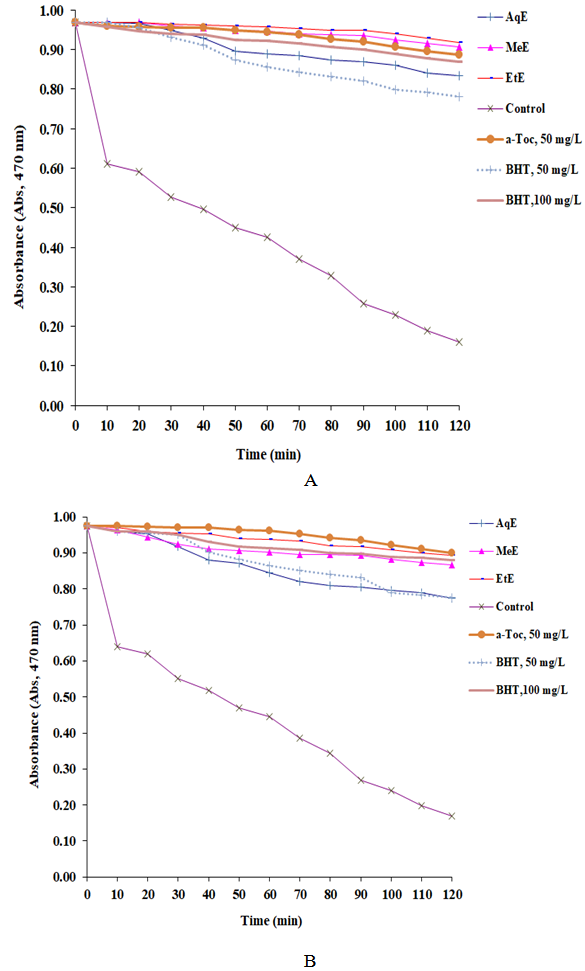
The antioxidant activity of suggested formulae extracts was assayed by β-carotene bleaching (BCB). This assay is based on the coupled oxidation of β-carotene and linoleic acid which estimates the relative ability of antioxidants to scavenge the radical of linoleic acid peroxide (LOO) that oxidizes β-carotene (lost the double bonds) in the emulsion phase. The decrease in absorbance of β-carotene in the presence of different suggested formulae extracts and references/standards antioxidants with the oxidation of β-carotene and linoleic acid is shown in Figure 1. The suggested formulae extracts showed considerable signifficat differences in antioxidant activity (AA ). The trend of antioxidant activity score of formula I extracts in descending order is as follows: EtE> MeE> α-toc> BHT(100 mg/ml)>AqE> BHT(50 mg/ml). For formula II extracts as follow: α-toc> EtE> BHT(100 mg/ml)>MeE> BHT(50 mg/ml) >AqE. Thus, the extracts of formula I showed higher antioxidant activity than the formula II which exceeded the standard materials (α-toc and BHT) in its activity. Perhaps this difference in the degree of antioxidant activity between the suggested formulae may be due to the difference in the components included in the composition of each formula in terms of their type and concentration. Our previous studies with the others proved that the BCB method has been also used successively to evaluate the antioxidant activity in various plant parts including used in the suggested formulae preparation 9, 10 11, 12 18, 19 20, 21, 22 66 179, 180. All of these studies reported that the content of polyphenols, flavonoids, carotenoids, tannins, saponins, lycopene, kaempferol and polysaccharides, such as those found in a highly content in extracts of the proposed formulae, are highly correlated with the antioxidant activities. Finally, results of the present study propose that all the extracts from suggested formulae showed antioxidant activity through radicals scavenging.
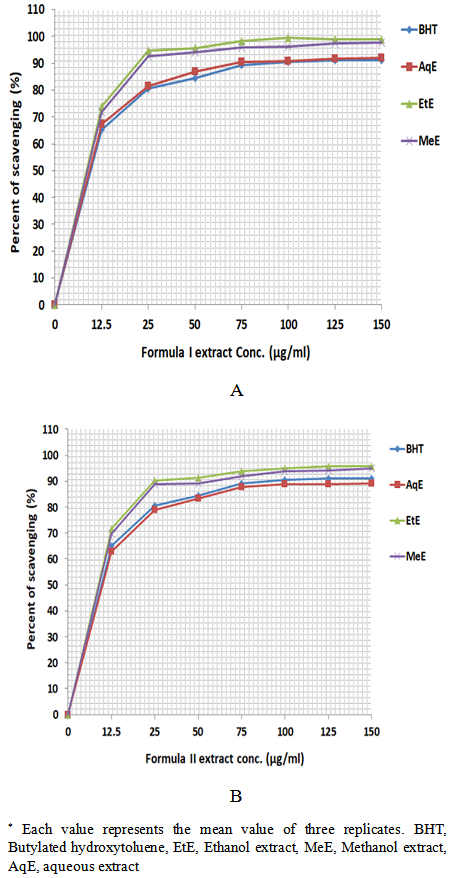
The free radical scavenging activity of the suggested formulae and butalyted hydroxyl toluene (BHT) as a standard are illustrated in Figure 2 and Table 6. From such data it could be noticed that ethanol extracts possessed the highest activity followed by methanol and aquatic ones. At a concentration of 100 μg/mL, the radicals scavenging activity of aquatic, ethanol and methanol extracts for formula I were 90.65, 99.56 and 96.07%, respectively, and for formula II were 88.83, 94.92 and 93.93%, respectively, whereas, BHT standard was 90.53%. For the IC50, the aquatic, ethanol and methanol extracts for formula I were recorded 9.26, 8.46 and 8.68 μg/mL, respectively and for formula II were 9.94, 8.71 and 8.97 μg/mL, respectively, while, BHT standard was.9.60 μg/mL. Therefore, the free radical scavenging activity of formulae extracts and standard was in the following order: ethanol extract > methanol extract > aquatic extract > standard (BHT) for formula I and ethanol extract > methanol extract > standard (BHT) > aquatic extract for formula II. The theory of the DPPH radicals scavenging activity test is based on measurement of the a absorption of diene conjugation in the presence of DPPH 181. Numerous previous studies revealed that DPPH assay has been used successfully to evaluate the scavenging activity of several plant parts including used in the suggested formulae preparation 20 34 133, 168 171, 182 183, 184, 185. Thus, data of the present study propose that all the suggested formulae extracts showed free radical scavenging activity which due to their rich in different categories of bioactive compounds knowing as antioxidants including phenolics, polysaccharides, carotenoids, Kaempherol, lycopene, tannins, flavonoids etc. Such data are in accordance with that observed by 132, 133 186. Finally, present study data suppose that all suggested formulae extracts showed radical scavenging activity through electron transfer or hydrogen donating ability.

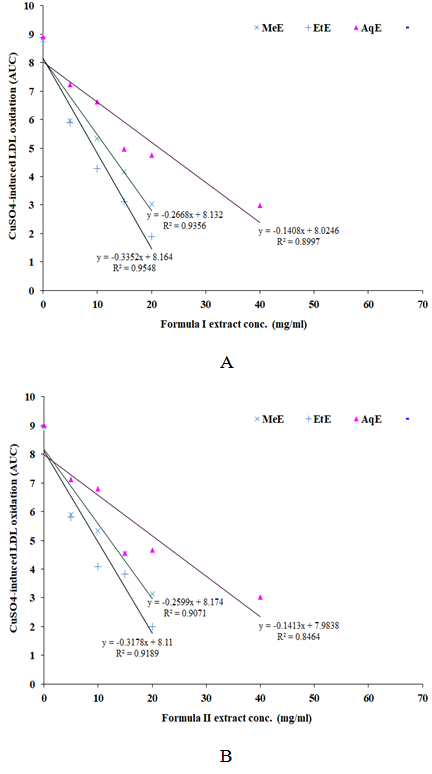
Data illustrated in Figure 3 shown the dose-dependent inhibition of CuSO4-induced LDL oxidation in vitro by suggested formulae extracts. Such data indicated that the inhibitive action of suggested formulae extracts against CuSO4-induced LDL oxidation, as evidenced by decreased conjugated dienes production in a dose-dependent behavior. The comparative study amongst suggested formulae extracts showed that the aquatic, ethanol and methanol extracts acted more dramatically in protecting LDL against oxidation. The protecting LDL against oxidation activity of formulae extracts was in the following order: ethanol extract > methanol extract > aquatic extract. Such data with the others indicated that such protecting effect could be attributed to the various bioactive constituents as antioxidants/scavengers (phenolics, polysaccharides, carotenoids, Kaempherol, lycopene, tannins, flavonoids etc.) contained in such suggested formulae extracts 34 132, 133 168, 171, 186. In general, ROS cause cellular damage membranes (cell wall, mitochondria, lysosomes etc.) by peroxiding lipid moieties, particularly the polyunsaturated fatty acids in a chain reaction known as lipid peroxidation 187. Thus, the inhibition of lipid peroxidation is considered the most important parameter of antioxidant activity. Data of the current study show lipid peroxidation inhibition activity of all suggested formulae extracts. These results indicated that suggested formulae extracts can prevent cellular damage caused by free radicals through slump the chain reactions responsible for lipid peroxidation. With the same context, several authors noticed that phenolic compounds such as detected in formulae extracts exhibited a protecting LDL against oxidation through increasing the levels of reduced glutathione (GSH) and inhibition of NADPH-dependent lipid peroxidation in liver 171, 184, 188. Also, several studies reported that the oxidative modification of lipoproteins hypothesis postulates that LDL oxidation plays a key role in early atherosclerosis 189, 190. The oxidized LDL is atherogenic due to its cytotoxic roles toward arterial cells and stimulates the monocytes to be adhesive to the endothelium which leads to the development of atheromatous plaques 191 Our present data proved that the formulae extracts could be used successfully as a promising agents in atherosclerosis prevention through inhibiting LDL oxidation process.

The correlation coefficients (r2) between bioactive compounds content and biological activities [β-carotene bleaching rate, free radical scavenging efficiency and inhibition of LDL oxidation] of suggested formulae were illustrated in Table 7. Total phenolics, polysaccharides, saponin content of the extracts showed significant (p≤0.05) and strong positive correlation with the antioxidant activity [β-carotene bleaching assays]. The rest of bioactive compounds (Flavonoids, triterpenoids, terpenoids, lycopene kampherol and oxalate) content showed significant (p≤0.05) and moderate positive correlation for the same relationship. For scavenging activity assay, all bioactive compounds except oxalate exhibited significant (p≤0.05) and strong positive correlation. The results also showed that the effectiveness of inhibiting LDL oxidation depends to a large extent on both antioxidant and scavenging activities, in addition to other factors that were not addressed in this study. Data of the present study are according with that reported by 192 for DPPH radical scavenging, even though the authors performed a different extraction procedure (methanol :water, 80:20, v/v). Thus, it could be proposed that bioactive compounds determined in the suggesting formulae play a more prominent role in biological activates i.e. antioxidant and scavenging activities and lipid peroxidation inhibition.
3.7. Antibacterial and Antifungal Activities of Suggested Formulae ExtractsThe antibacterial and antifungal activities of suggested formulae extracts were illustrated in Table 8. From such data it could be noticed that the highest activity (inhibition zones) against the Gram-negative bacteria Escherichia coli was recorded for ethanol extract (10.88- 11.03) with no activity for aquatic extract. For gram-positive bacteria Staphylococcus aureus the highest activity (20.09 – 21.88 mm) was recorded for ethanol extract followed by methanol extract (18.45- 20.16 mm) and aquatic extract (15.09-15.17 mm). The same behavior was observed for the antifungal activity against Candida albicans. Also, formula I is higher in all microorganisms inhibition than formula II. Such variations recorded in the amount of the antibacterial and antifungal activities measured (inhibition zones) for the suggested formulae extracts could be mainly due to the difference in polarities of extracting solvents. The ethanol and methanol solvent are higher in improving the recovery of the bioactive compounds in suggested formulae than water, subsequently increases their efficiency in inhibiting bacteria and fungi. Such data are relatively accordance with that reported by several authors have been working in various plant parts contained the same bioactive compounds found in the suggested formulae 20 168. With this context, Kamenarska et al., 193 reported that the toluene (non-polar compounds, including volatile compounds) and methanol:chloroform (1:1) extracts (compounds with average polarity) showed a moderate activity only against the gram-positive bacteria. Also, the ethanol extract (more polar compounds) showed not only a moderate activity against gram-positive bacteria but also a moderate antifungal activity. Finally, all the previous data confirmed the potential use of suggested formulae as good sources of antibacterial and antifungal agents.
Data of the current study supported our hypothesis that the suggested formula of plant parts contains several classes of bioactive compounds including phenolics, polysaccharides flavonoids, terpenoids, triterpenoids, lycopene, kaempherol, saponins, oxalate, etc., with other compounds that are responsible for their different biological activities. The biological activities studied enhanced here including antioxidant and scavenging activities, inhibition of LDL oxidation and antibacterial and antifungal activities. Such important biological activities could be played important roles in strategies to prevent/combat/treat several diseases, especially those for which oxidative stress is one of the mechanisms for its occurrence. Therefore, the present study recommended like of these suggested formulae powders and/or extracts to be included in our daily diets, drinks, food supplementation and pharmaceuticals.
The authors are pleased to extend their sincere thanks to Prof Mai Gharib and Associate Prof Mohamed Mahran, Department of Nutrition and Food Sciences, Faculty of Home Economics, Minoufiya University, Egypt, for their great assistance. Also, appreciations were also extended to the professors of Plant Taxonomy, Faculty of Agriculture, Menoufia University, Egypt for the great effort they put in examining and confirming the plant parts. Finally, the assistance of microbiology technician's staff, Faculty of Science, Menoufia University, was also appreciated.
Authors declared no competing of interest whatsoever.
The ethical issues of the current work was reviewed and approved by the Scientific Research Ethics Committee, Faculty of Home Economics, Menoufia University, Shebin El-Kom, Egypt (Approval # 23- SREC- 05-2022).
Yousif Elhassaneen cooperated in proposing and improving the study protocol, following up on the laboratory experimental part, retrieving conceptual information, reviewing and validating the results and statistical analyses, preparing a draft of the manuscript, conducting a critical review to intellectually organize the content and granting approval to publish the final version of the manuscript. Eman Aram conducted the laboratory experiments, collected, tabulated, analyzed and interpreted the results. She was also involved in retrieving conceptual information and preparing the draft of the manuscript. Ghada ELBassouny cooperated in proposing the study protocol, retrieving conceptual information, validating the study results, and preparing the draft manuscript. Omar Emam cooperated in improving the study protocol, retrieving conceptual information, and submitting contributions to the concept and design of the work.
AA: antioxidant activity, AAPH: 2,2′-Azobis(2-methylpropionamidine) dihydrochloride, Abs: absorbance, AqE: aqueous extract, BHT: butalyted hydroxyl toluene, BCB: β-carotene bleaching, CA: catechine, DMSO: dimethyle sulfoxide, DNA: deoxyribonucleic acid, DPPH: 2,2-diphenyl-1-picrylhydrazyl, DW: dry weight, EtE: ethanol extract, GA: gallic acid, GAE, gallic acid and equivalents, G.D.R.: grams consumed of food ( wet weight basis ) to cover the daily requirements of adult man ( 63 g) in protein and energy, GSH: reduced glutathione, LDL: low density lipoprotein, MtE: methanol extract, P.S: percent satisfaction of the daily requirement of adult man in protein and energy, RNA: ribose nucleic acid, SD: standard deviation, T.N.: total nitrogen.
orcid ID: orcid.org/0000-0003-1391-3653
| [1] | Madi, O.M. 2014. Measuring the food gap in Egypt during the period (2010: 2020). The Scientific Journal of Commercial and Environmental Studies, 4 (1): 287-312. | ||
| In article | |||
| [2] | Ibrahim, D. E. 2008. Chemical, technological and nutritional studies on medical plant extracts distributed in Egyptian markets. M. Sc. Thesis in Nutrition and Food Science, Faculty of Home Economics, Menoufia University, Egypt. | ||
| In article | |||
| [3] | Mashal, R. M. 2009. Chemopreventive activity of cruciferous vegetables (Cauliflower) for suppression of hypercholesterolemia in rats " M.Sc. Thesis in Nutrition and Food Science, Faculty of Home Economics, Menoufia University, Egypt. | ||
| In article | |||
| [4] | Elhassaneen, Y. Sherif R., Alaa E. & Emad, A. 2013. Mango peel powder: A potential source of phenolics, carotenoids and dietary fiber in Biscuits preparations. 2nd International-16th Arab Conference of Home Economics "Home Economics in the Service of Industry" 10-11 September, 2013, Faculty of Home Economics. Menoufia University, Egypt. Journal of Home Economics (Special issue), 23(4): 1-16. | ||
| In article | |||
| [5] | Shalaby, H. 2015. The effect of some food products mixed with plant parts on blood sugar levels of rats. Ph.D. Thesis in Nutrition and Food Science, Faculty of Home Economics, Minoufiya University, Egypt. | ||
| In article | |||
| [6] | Sayed Ahmed, S. 2016. Nutritional and technological studies on the effect of phytochemicals on obesity injuries and their related diseases by using experimental animals" Ph.D. Thesis in Home Economics (Nutrition and Food Science), Faculty of Specific Education, Port Said University, Egypt. | ||
| In article | |||
| [7] | Mashal, R. M. 2016. Technological and chemical studies on the fortification of bakery products with phytochemicals. Ph.D. Thesis in Nutrition and Food Science, Faculty of Home Economics, Minoufiya University, Egypt. | ||
| In article | |||
| [8] | Tekram, K. A. 2016. Technological and nutritional studies on some food formulae prepaered for kidney and digestive system disease patients. M.Sc. Thesis in Nutrition and Food Science, Faculty of Home Economics, Menoufia University, Egypt. | ||
| In article | |||
| [9] | Ahmed, M. S. 2019. Utilization of by-products of food industries in biscuits production. M.Sc. Thesis in Food Science, Faculty of Agriculture, Cairo University, Cairo, Egypt. | ||
| In article | |||
| [10] | Marzouk, E., Elhassaneen, Y., ElKhamisy, A. & Sayed-Ahmed, R. 2020. Using of Egyptian herbs extracts in food processing and therapeutic nutrition applications. Port Saied Specific Research Journal (PSSRJ), 11 (1): 229-240. | ||
| In article | |||
| [11] | Ghaly, H. 2004. Biochemical and microbiological studies on some spices distributed in Egyptian local markets. M. Sc. Thesis in Nutrition and Food Science, Faculty of Home Economics, Minoufiya University, Egypt. | ||
| In article | |||
| [12] | Elhassaneen, Y. A. 2009. Phenolic compounds, sweetness and amino acids content of onion cultivars distributed in Egyptian local markets and their relationship with antioxidant activities. J. Product. & Dev., 11(2): 297- 315 [ISSN 1110-2643]. | ||
| In article | View Article | ||
| [13] | Khoneem, A. S. 2009. Antioxidant activity of some vegetables, spices and herbs distributed in Egyptian local markets " M.Sc. Thesis in Nutrition and Food Science, Faculty of Home Economics, Menoufia University, Egypt. | ||
| In article | |||
| [14] | El-Safty, A. 2012. Production of some important nutritional and functional compounds from the by-products of food processing companies. Ph.D. Thesis in Nutrition and Food Science, Faculty of Home Economics, Minoufiya University, Egypt. | ||
| In article | |||
| [15] | Elhassaneen, Y., Mohamed M. & Hassan H. 2014. The effect of some food products mixed with plant parts on blood sugar levels of rats. 3rd International-17th Arab Conference of Home Economics "Home Economics in the Service of Science, Industry and Society Issues" 9-11 September, 2014, Faculty of Home Economics. Minoufiya University, Egypt. Journal of Home Economics (Special issue), 24(4): 85-109. | ||
| In article | |||
| [16] | Elhassaneen, Y. & Esa, Z. 2015. Effect of adding natural extracts on quality properties of meat products subjected to refrigeration process. Journal of Home Economics, 25 (1): 1-14. | ||
| In article | |||
| [17] | Elhassaneen, Y. Sherif R. & Mashal, R. 2016. Improvement of Bioactive Compounds Content and Antioxidant Properties in Crackers with the Incorporation of Prickly Pear and Potato Peels Powder. International Journal of Nutrition and Food Sciences, vol. 5 (1), pp. 53-61. | ||
| In article | View Article | ||
| [18] | Rdwan, H., Abd El-Khalik, D. & Elhassaneen, Y. 2018. Studies on the Antioxidant and Antibacterial Properties of Phyto By-products and Gum Arabic Extracts in Cooked Beef Meatballs. Proceeding of the 5th Scientific (3rd International) Conference of the Faculty of Specific Education, Ain Shamas University, “The Modern Global Orientations and the Development of the Specific Education” 20-22 February, 2018, El-Ain ElSohna, Egypt. | ||
| In article | |||
| [19] | Marzouk, E. M. 2019. Antioxidant activities in some Egyptian herbs: technological and nutritional studies. PhD Thesis in Nutrition and Food Science, Faculty of Specific Education, Port Saied University, Port Saied, Egypt. | ||
| In article | |||
| [20] | Gharib, M. A., Radwan, H. A. & Elhassaneen, Y. A 2022. Nutrients and Nutraceuticals Content and In Vitro Biological Activities of Reishi Mushroom (Ganoderma lucidum) Fruiting Bodies. Alexandria Science Exchange Journal, 43, (2): 301-316. | ||
| In article | View Article | ||
| [21] | Aboraya, A. O., Elhassaneen, Y. A., & Nassar, O. M. (2022). Reishi Mushroom (Ganoderma lucidum) intervension improves lipids profile and paraoxonase/arylesterase activitiesin serum as well as enhances haemostatic effects in streptozotocin-induced diabetic rats. Alexandria Science Exchange Journal, 43, (4): 593-608. | ||
| In article | View Article | ||
| [22] | Nour ElDeen, A.. A. 2023. Potential effects of refrigeration processes on bioactive compounds content and biological activities of leafy vegetables. MSc. Thesis in Nutrition and Food Science, Faculty of Home Economics, Menoufia University, Shebin El-Kom, Egypt. | ||
| In article | |||
| [23] | Singh, R. P., Murthy, K. N.C. & Jayaprakasha, G. K. 2002. Studies on the antioxidant activity of pomegranate peel and seed extracts using in vitro models. Journal of Agricultural and Food Chemistry, 50, 81–86. | ||
| In article | View Article PubMed | ||
| [24] | Hertog M.G., Hollman P.C. and Venema D.P. 1992. Optimization of a quantitative HPLC determination of potentially anticarcinogenic flavonoids in vegetables and fruits. J Agric Food Chem, 40:1591-1598. | ||
| In article | View Article | ||
| [25] | Waldron, K. 2001. "Useful ingredients from onion waste". Food Science and Technology, 15: 38-39. | ||
| In article | |||
| [26] | Hollman, P., Van Trijp, J., Buysman, M., Gaag, M. Mengelers, M., de Vries, J., & Katan, M. 1997. Relative bioavailability of the antioxidant flavonoid quercetin from various foods in man. FEBS Letters. 418: 152-156. | ||
| In article | View Article PubMed | ||
| [27] | Schieber, A.; Stintzing, F. & Carle, R. 2001. By-products of plant food processing as a source of functional compounds - recent developments. Trends in Food Science & Technology, 12: 401-413. | ||
| In article | View Article | ||
| [28] | Badawy, F. E. 2008. The influence of some chemical, physical and industrial treatments on the antioxidant activity of onion" M. Sc. Thesis in Nutrition and Food Science, Faculty of Home Economics, Minoufiya University, Egypt. | ||
| In article | |||
| [29] | Elhassaneen, Y. & Abd Elhady, Y. 2014. Onion peel powder alleviate acrylamide-induced cytotoxicity and immunotoxicity in liver cell culture. Life Sci J., 11(7): 381-388. | ||
| In article | |||
| [30] | Hussein, A. & Elhassaneen, Y. 2014. Natural Dye from Red Onion Skins and Applied In Dyeing Cotton Fabrics for the Production of Women's Headwear Resistance to Ultraviolet Radiation (UVR), J Am Sci., 10(3): 129-139. | ||
| In article | |||
| [31] | Elhassaneen Y & Sayed R., 2015. Polycyclic aromatic hydrocarbons formation in charcoal broiled meatballs are reduced by addition of onion peel extracts to ground beef. Proceeding of 2nd International Conference on Food and Biosystems Engineering (2nd I.C. FABE2015), 28-31 May, 2015), [Vol. II, PP. 95-104], Mykonos, Greece. | ||
| In article | |||
| [32] | Elhassaneen, Y., Sabry, S. & Reham, B. 2016-a. Antioxidant activity of methanol extracts from various plant parts and their potential roles in protecting the liver disorders induced by benzo(a)pyrene. Public Health International, 2 (1): 38-50. | ||
| In article | |||
| [33] | Elhassaneen, Y; Ragab, S. and Badawy, R. 2016. Antioxidant activity of methanol extracts from various plant parts and their potential roles in protecting the liver disorders induced by benzo(a)pyrene. Public Health International, 2 (1): 38-50. | ||
| In article | |||
| [34] | Aly, A. S., Elbassyouny, G. M. & Elhassaneen, Y. A., 2017. Studies on the antioxidant properties of vegetables processing by-products extract and their roles in the alleviation of health complications caused by diabetes in rats. Proceeding of the 1st International Conference of the Faculty of Specific Education, Kafrelsheikh University, “Specific Sciences, their Developmental Role and Challenges of Labor Market” PP 1-24, 24-27 October, 2017, Sharm ElSheikh, Egypt. | ||
| In article | |||
| [35] | Hallabo, S., Helmy, S. A., Elhassaneen, Y. and Shaaban, M. 2018. Utilization of mango, onion and potato peels as sources of bioactive compounds in biscuits processing. BIOSCIENCE RESEARCH, 15(4), 3647-3657. | ||
| In article | |||
| [36] | Mahran, M. Z., Elbassyouny, G. M. & Elhassaneen, Y. 2018. Preventive effects of onion skin powder against hepatotoxicity in rats treated with benzo(a)pyrene. Proceeding of the Annual Conference (13th Arab; 10th International), 11-12 April, Faculty of Specific Education, Mansoura University, "Higher Education in Egypt and the Arab World in the Light of Sustainable Development Strategies", Mansoura, Egypt. | ||
| In article | |||
| [37] | Rodriguez de Sotillo, D., Hadley, M., & Holm, E. T. 1994. Potato peel waste: stability and antioxidant activity of a freeze-dried extract. Journal of Food Science, 59, 1031–1033. | ||
| In article | View Article | ||
| [38] | El-Din, M. F. 2001. Analysis, occurrence and formation of some toxic compounds in some edible oils as the result of cooking and processing. M. Sc. Thesis in Nutrition and Food Science, Faculty of Home Economics, Menoufia University, Egypt. | ||
| In article | |||
| [39] | Dewan, N. E. 2003. Removal of some toxic, carcinogenic and mutagenic compounds from edible oils that affected by deep-fat frying. M. Sc. Thesis in Nutrition and Food Science, Faculty of Home Economics, Menoufia University, Egypt. | ||
| In article | |||
| [40] | Elhassaneen, Y. A.; El-Fadaly, H. A. & Dewan, N.E. 2003. Bioremoval of toxic substances from edible oils as affected by deep-fat frying process. Pakistan J. of Biological Science, 6 (24): 1979 - 1990. | ||
| In article | View Article | ||
| [41] | El-Saadany, M. A. 2001. The effect of dietary phytochemicals on the prevention of liver cancer initiation induced by some chemical carcinogenesis. M. Sc. Thesis in Nutrition and Food Science, Faculty of Home Economics, Menofia University, Egypt. | ||
| In article | |||
| [42] | Chevallier, A. 1996. The Encyclopedia of Medicinal Plants. Dorling Kindersley Book, London, UK., ISBN-13: 9780789410672, Page: 227. | ||
| In article | |||
| [43] | Komaitis M. E.; Ifanti-PapatragiannL N. and Melissari-Panagiotou E. 1992. "Composition of the essential oil of marjoram (Origanum majorana L.)". Food Chemistry, 45, 117-118. | ||
| In article | View Article | ||
| [44] | Baser, H. C.; Kirimer, N. and Tuemen, G. (1993): Composition of the essential oil of Origanum majorana L. from Turkey. J. oil essential-Oil-Res.; (5): 577- 579. | ||
| In article | View Article | ||
| [45] | Novak, J.; Langbehn. J.; Pank, F.: and Franz, C., M. 2002. Essential oil compounds in a historical sample of marjoram (Origanum majorana L.) Lamiaceae. Flavour and Fragrance J. 17(3), 175-180. | ||
| In article | View Article | ||
| [46] | El-Safty, A. 2008. Chemical, technological and nutritional studies on Marjoram (Majorana Hortensis). M. Sc. Thesis in Nutrition and Food Science, Faculty of Home Economics, Minoufiya University, Egypt. | ||
| In article | |||
| [47] | Garga, C., Khan, S., Ansari, S., Suman, A. & Garg, M. 2009. Chemical composition, therapeutic potential and perspectives of Foeniculum vulgare". Phcog. Rev., 3(6): 346-352. | ||
| In article | |||
| [48] | Badgujar, S.B., Patel, V.V. & Bandivdekar, A.H. 2014. "Foeniculum vulgare Mill: a review of its botany, phytochemistry, pharmacology, contemporary application, and toxicology". Biomed Res Int. 84, 26-74. | ||
| In article | View Article PubMed | ||
| [49] | Aber, A. H. B. & Afa, A. H. M. 2011. Immunostimulant Effect of Different Fractions of Nigella sativa L. Seeds against Rabies Vaccine". National Organization for Drug Control and Research. (NODCAR), Giza 12553, Egypt. | ||
| In article | |||
| [50] | Stavric, B., Matula, T. L, Klassen, R., Downie, R. H., Huang, M. T. and Lee, C. Y. 1992. "Phenolic compounds in food and their effects on health". II (ASC symposium series, no. 507). (Editors) rlmericao Chemical Sociem, Washington, DC. p. 239. | ||
| In article | View Article | ||
| [51] | Nair, S.; Nagar, R. and Gupta, R. 1998. Antioxidant phenolics and Flavonoids in conunonly consumed Indian Foods. J. Assoc. Physicians. India., 46(8): 708-10. | ||
| In article | |||
| [52] | Lee, C. W, Hong, D. H., Han, S. B., park, S. H., Kim H. K.; Kwon. B.,N1. & Kim, H. M. 1999. Inhibition of Human tumor growth by 2'- hydroxyland 2' benzoyloxycinnamaldehydes. Planta Med., vol. 65(3): 263-266. | ||
| In article | View Article PubMed | ||
| [53] | Dhuley, J. N. 1999. Anti-oxidant effects of cinnamon (Cinnamomum verum) bark and greater cardamom (Amomum subulatum) seeds in rats fed high fat diet. Indian. J. Exp. Biol., 37: 238-42. | ||
| In article | |||
| [54] | Anilakumar, K. R., Nagaraj, N. S. & Santhanam, K. 2001. Effect of coriander seeds on hexachlorocyclohexane induced lipidperoxidation in rat liver, Nutr Res., 21: 1455-1462. | ||
| In article | View Article | ||
| [55] | Lee, S.J., Ahn, J.K., Khanh, T.D., Chun, S.C., Kim, S.L., Ro, H.M., Song, H.K. & Chung, I.M. 2007. Comparison of isoflavone concentrations in soybean (Glycine max (L.) Merrill) sprouts grown under two different light conditions. J. Agric. Food Chem., 55(23): 9415-9421. | ||
| In article | View Article PubMed | ||
| [56] | El-Nashar, N.G. 2007. Development of primary liver cell culture from fish as a valuable tool in nutrition and biotechnology research. Ph.D. Thesis, Faculty of Home Economics, Minoufiya University, Egypt. | ||
| In article | |||
| [57] | Oras, Y. and Mohammed, M. T. 2020. Effects of Cinnamon and Their Beneficial Content on Treatment of Oxidative Stress. Systematic Reviews in Pharmacy, 11(9): 661-665. | ||
| In article | |||
| [58] | Abenavoli, L., Capasso, R., Milic, N., Capasso, F. 2010. Milk thistle in liver diseases: past, present, future. Phytother Res. 24(10): 1423-1432. | ||
| In article | View Article PubMed | ||
| [59] | Bijak, M. 2017. Silybin, a Major Bioactive Component of Milk Thistle (Silybum marianum L. Gaernt.)-Chemistry, Bioavailability, and Metabolism. Molecules 10; 22(11): 1942. | ||
| In article | View Article PubMed | ||
| [60] | Flora K, Hahn M, Rosen H, Benner K 1998. Milk thistle (Silybum marianum) for the therapy of liver disease. The American Journal of Gastroenterology, 93: 139–143. | ||
| In article | View Article PubMed | ||
| [61] | Greenlee, H., Abascal, K., Yarnell, E., Ladas, E. 2007. Clinical Applications of Silybum marianum in Oncology. Integrative Cancer Therapies, 6 (2): 158–65. | ||
| In article | View Article PubMed | ||
| [62] | Sayin, F. K., Buyukbas, S., Basarali, M. K., Alp, H., Toy, H., Ugurcu, V. 2016. Effects of Silybum marianum extract on high-fat diet-induced metabolic disorders in rats. Polish J Food Nutr Sci 66: 43– 49. | ||
| In article | View Article | ||
| [63] | Famouri F, Salehi M M, Rostampour N, Hashemi E. & Shahsanaee A 2017. The effect of silymarin on the non-alcoholic fatty liver disease of children. J Herbmed Pharmacol., 6: 16– 20. | ||
| In article | |||
| [64] | Tajmohammadi, A., Bibi, M. & Hossein, H. 2018. Silybum marianum (milk thistle) and its main constituent, silymarin, as a potential therapeutic plant in metabolic syndrome: A review. Phytotheray research, 32 (10): 1933-1949. | ||
| In article | View Article PubMed | ||
| [65] | Elhassaneen, Y., Ragab, S., Abd El-Rahman, A. and Arafa, S. 2021. Vinca (Catharanthus roseus) Extracts Attenuate Alloxan-Induced Hyperglycemia and Oxidative Stress in Rats. American Journal of Food Science and Technology, 9 (4): 161-172. | ||
| In article | |||
| [66] | Mahran, M. Z. and Elhassaneen, Y. A. 2023. A Study of the Physical, Chemical, Phytochemical and Nutritional Properties of Wild Silybum marianum L. Seeds Oil to Investigate Its Potential Use to Boost Edible Oil Self-Sufficiency in Egypt. Alexandria Science Exchange Journal, 44, (1): 81-91. | ||
| In article | View Article | ||
| [67] | Elhassaneen, Y. A., Afifi, T.A., Elhefny, M.A., Bayomi, A. I. 2024. Effect of Silybum marianum Seeds Extract Intervention on Biochemical Parameters, Histological Changes, and Apoptosis and Cell Cycle of Liver Tissue in Benzo[a]pyrene Injected Rats. American Journal of Food and Nutrition, 12 (1), 1-15. | ||
| In article | View Article | ||
| [68] | Peter, K. V. 2008. Underutilized and Underexploited Horticultural Crops, Volume 2. New India Publishing. India, pp. 341. | ||
| In article | View Article | ||
| [69] | Chattopadhyay, I.; Biswas, K.; Bandopadhyay, U. & Banerjee, R. K. 2004. Turmeric and curcumin: Biological actions and medicinal applications. Curr Sci., 87: 44-53. | ||
| In article | |||
| [70] | Payton, F.; Sandusky, P., & Alworth, W.L. 2007. NMR study of the solution structure of curcumin. J. Nat.Prod., 70 (2): 143-146. | ||
| In article | View Article PubMed | ||
| [71] | Aggarwal, B. B., Sundaram, C., Malani, N. & Ichikawa, H. 2007. Curcumin the Indian solid gold. Adv. Exp. Med. Biol., 595: 1–75. | ||
| In article | View Article PubMed | ||
| [72] | Fayez, S. A. 2016. The effect of turmeric and curcumin on liver cancer induced by benzo[a]pyrene in rats. M.Sc. Thesis in Nutrition and Food Science, Faculty of Specific Education, Port Saied University, Egypt. | ||
| In article | |||
| [73] | Hewlings S.J. & Kalman D.S. 2017. Curcumin: A Review of Its Effects on Human Health. Foods. 6(10): 92. | ||
| In article | View Article PubMed | ||
| [74] | Elhassaneen, Y., El-Kholie, E., Zaki, A. and Yassen, H. 2018. Potential Effects of Cauliflower Leaves Powder on obese rats. Proceeding of the Annual Conference (13th Arab; 10th International), 11-12 April, Faculty of Specific Education, Mansoura University, " Higher Education in Egypt and the Arab World in the Light of Sustainable Development Strategies", Mansoura, Egypt. | ||
| In article | |||
| [75] | Otto, K., and Sulc, D. 2001. Herstellung von Gemusesaften. In U. Schobinger (Ed.), Frucht und Gemusesafte (pp. 278–297). Stuttgart: Ulmer. | ||
| In article | |||
| [76] | Avelino, A., Avelino, H. T., Roseiro, J. C., & Collaco, M. T. A. 1997. Saccharification of tomato pomace for the production of biomass. Bioresource Technology, 61, 159–162. | ||
| In article | View Article | ||
| [77] | Sharma, S. K., & Maguer, M. L. 1996. Lycopene in tomatoes and tomato pulp fractions. Italian Journal of Food Science, 2, 107–113. | ||
| In article | |||
| [78] | Baysal, T., Ersus, S., & Starmans, D. A. J. 2000. Supercritical CO2 extraction of b-carotene and lycopene from tomato paste waste. Journal of Agricultural and Food Chemistry, 48, 5507–5511. | ||
| In article | View Article PubMed | ||
| [79] | Weisburger, J.H. 1998. Evaluation of the evidence on the role of tomato products in disease prevention, Proc. Soc. Exp. Biol. Med., 218: 140-143. | ||
| In article | View Article PubMed | ||
| [80] | Betty, J. (2002). Lycopene and Human Health In: Phytocemicals in nutrition and health. Edited by: Mark S., Wayne R., Audra J. and Stanley T., CRC Press LLC, N.W. | ||
| In article | |||
| [81] | WHO, (2002): Folilum Eucalypti. In: WHO Monographs on Selected Medicinal Plants. World Health Organization, Geneva, pp. 106-113. | ||
| In article | |||
| [82] | Brand, N. 1993. Eucalyptus. In: Hansel, H., Keller, K., Rimpler, H., Schneider, G (Eds.): Hager's Handbuch der Pharmazeutischen Praxis. Springer Verlag, Berlin, Heidelberg. 5: 115-130. | ||
| In article | |||
| [83] | EAB, 2005. Eucalyptus oil - Eucalypti aetheroleum. In: Pharmacopoea Europea, 5th edition. European Medicines Agency, Amsterdam, The Netherlands. | ||
| In article | |||
| [84] | Angela, E., Sadlon, N. D., Davis, W. and Lamson, M. S. 2010. Immune-Modifying and Antimicrobial Effects of Eucalyptus Oil and Simple Inhalation Devices, Altem. Med. Rev.15 (1): 33-A7. | ||
| In article | |||
| [85] | Elhassaneen, Y. A., Nasef, A. Z., Arafa, R. S. & Bayomi, A. I. 2023. Bioactive compounds and antioxidant activities of milk thistle (Silybum marianum) extract and their potential roles in the prevention of diet-induced obesity complications. American Journal of Food Science and Technology, 11(3): 70-85. | ||
| In article | View Article | ||
| [86] | Nishiumi, S., Miyamoto, S., Kawabata, K., Ohnishi, K., Mukai, R., Murakami, A., Ashida, H. & Terao, J. 2011. Dietary flavonoids as cancer-preventive and therapeutic biofactors. Front Biosci., 3:1332-1362. | ||
| In article | View Article PubMed | ||
| [87] | Kaneko, 2004. Kaneko Heart Clinic, Proof of the Mysterious Efficacy of Ginseng., J. Pharm. Sci., 95(2): 158-62. | ||
| In article | View Article PubMed | ||
| [88] | Gillis, C.N. 1997. Panax ginseng pharmacology: A nitric oxide link? Biochem. Pharmacol., 54: 1-8. | ||
| In article | View Article PubMed | ||
| [89] | Attele, A.S.; Wu, J.A. & Yuan, C.S. 1999. Ginseng pharmacology: Multiple constituents and multiple actions. Biochem. Pharmacol., 58: 1685-1693. | ||
| In article | View Article PubMed | ||
| [90] | Ang-Lee, M. K., Moss, J. & Yuan, C. S. 2001. Herbal medicines and perioperative care. JAMA, 286(2):208-216. | ||
| In article | View Article PubMed | ||
| [91] | Huang, Y. S. 1989. Effect of Ginsenosides Rb1 and Rg1 on Lipid Peroxidation of Rat In Vitro. Chung Kuo I Hsueh Ko Hsueh Yuan Hsueh Pao. 11(6): 460-2. | ||
| In article | |||
| [92] | Wang, H. X. & Ng, T.B. 2000. Quinqueginsin, A Novel Protein with Anti-human Immunodeficiency Virus, Antifungal, Ribonuclease and Cell-free Translation-inhibitory Activities from American Ginseng Roots. Biochem. Biophys. Res. Commun. 269(1): 203-8. | ||
| In article | View Article PubMed | ||
| [93] | Blumenthal, M. 2003. The ABC Clinical Guide to Herbs. New York, NY: Theime. 211-225. | ||
| In article | |||
| [94] | Kiefer, D. & Pantuso, T. 2003. Panax ginseng. Am. Fam. Physician, 68(22): 1539-1542. | ||
| In article | |||
| [95] | Hassan, A. A. 2011. The effect of phytochemicals on prevention and/or treatment of liver cancer induced by some food pollutants. Ph.D. Thesis in Nutrition and Food Science, Faculty of Home Economics, Minoufiya University, Egypt. | ||
| In article | |||
| [96] | Williams, P. A.& Phillips, G. O. 2000. In Handbook of Hydrocolloids; Williams, P. A., Phillips, G. O., Eds.; CRC Press: Cambridge, p 155-168. | ||
| In article | |||
| [97] | Anderson, D. & Dea, I., 1971. Recent advances in the chemistry of Acacia gums. J. Soc. Cosmet. Chem. 2: 61-73. | ||
| In article | |||
| [98] | Tiss, A., Carrière, F. & Verger, R., 2001. Effects of gum arabic on lipase interfacial binding and activity. Anal. Biochem. 294, 36–43. | ||
| In article | View Article PubMed | ||
| [99] | Nasir, O., Wang, K., & Föller, M., 2010. Downregulation of angiogenin transcript levels and inhibition of colonic carcinoma by Gum Arabic (Acacia senegal). Nutr Cancer, 62(6): 802-810. | ||
| In article | View Article PubMed | ||
| [100] | Al-Majed, A.A.; Mostafa, A.M.; Al-Rikabi, A.C. & Al-Shabanah, O.A. 2002. Protective effects of oral arabic gum administration on gentamicin-induced nephrotoxicity in rats. Pharmacological Research, 46, (5): 445–451. | ||
| In article | View Article PubMed | ||
| [101] | Ali, B.H., Al-Qarawi, A.A., Haroun, E.M., Mousa, H.M. 2003. The effect of treatment with Gum Arabic on gentamicin nephrotoxicity in rats: a preliminary study. Ren Fail, 25(1):15-20.  | ||
| In article | View Article PubMed | ||
| [102] | Ali, B.H. &Al Moundhri, M.S. 2006. Agents ameliorating or augmenting the nephrotoxicity of cisplatin and other platinum compounds: a review of some recent research. Food and Chemical Toxicology, 44 (8): 1173–1183. | ||
| In article | View Article PubMed | ||
| [103] | Domma, M. B., Elhassaneen, Y. A., Ibrahim, F.Y. & El-Agooze, S. A. 2016. Biological effects of gum Arabic on rat's chronic kidney disease. J. Biol. Chem. Environ. Sci., 11(3): 163-184-13. [ISSN: 1687-5478; http://www.acepsag.org]. | ||
| In article | |||
| [104] | Ali, B.H., Al-Salam, S., & Al-Husseni, I., 2010. Effects of Gum Arabic in rats with adenine-induced chronic renal failure. Exp Biol Med (Maywood), 235(3):373-382. | ||
| In article | View Article PubMed | ||
| [105] | ElSamoty, S. M. 2021. Potential biological effects for the Gam Arabic on kidney disorders in rats induced by arginine. M.Sc. Thesis in Nutrition and Food Science, Faculty of Specific Education, Port Saied University, Port Saied, Egypt. | ||
| In article | |||
| [106] | Elhassaneen, Y., ElKhamisy, A., Sayed-Ahmed, R. & EL-Sokoty, S. 2022. Potential biological effects of gum Arabic on kidney disorders induced by arginine in rats. Port Saied Specific Research Journal (PSSRJ), 15 (1): 1016-1035. | ||
| In article | |||
| [107] | Slavin J. 2003. Why whole grains are protective: biological mechanisms. Proc Nutr Soc., 62(1):129-134. | ||
| In article | View Article PubMed | ||
| [108] | Ali, B.H., Ziada, A., Blunden, G. 2009. Biological effects of Gum Arabic: a review of some recent research. Food Chem Toxicol, 47(1):1-8. | ||
| In article | View Article PubMed | ||
| [109] | NRC, National Research Council, 1996. Guide for the Care and Use of Laboratory Animals Washington: National Academy Press. | ||
| In article | |||
| [110] | AIN. American Institute of Nutrition. 1993. Purified diet for laboratory Rodent, Final report. J. Nutrition. 123:1939-1951. | ||
| In article | View Article PubMed | ||
| [111] | A.O.A.C. 1995. Official Methods of the Association of Official analytical Chemists. 16th Ed. Published by the Association of Official Analytical Chemists. Arlington, Virginia, VA. | ||
| In article | |||
| [112] | RDA 1989. Recommended Dietary Allowances, Food and Nutrition Board, National Academy of Series, National Research Council, U.S.A. | ||
| In article | |||
| [113] | Singh, K., Sundarro, K., Tinkerame, J., Kaluwin, C. & Matsuoka, T. 1991. Lipid content fatty acid and mineral composition of Mud Crabs (Seylla serrata) from Papua new Guinea. Journal of Food Composition and Analysis, 4 (3): 276 – 280. | ||
| In article | View Article | ||
| [114] | Epler, K.S., Zeigler, R.G. & Craft, N.E. 1993. Liquid chromatographic method for the determination of carotenoids, retinoids and tocopherols in human serum and in food. J Chromatog, 619:37–48. | ||
| In article | View Article PubMed | ||
| [115] | Hung, S.S., Cho, Y.C. & Slinger, S.J. 1980. High performance liquid chromatographic determination of alpha-tocopherol in fish liver, J. Assoc. Off. Anal. Chem., 63 (4): 889 - 893. | ||
| In article | View Article | ||
| [116] | Moeslinger, T., Brunner, M. & Spieckermann, G. 1994, Spectrophotometric determination of dehydroascorbic acid in biological samples. Analytical Biochemistry. 221(2):290-6. | ||
| In article | View Article PubMed | ||
| [117] | Singleton, V.L. & Rossi, J.A. 1965. Colorimetry of total phenolics with phosphomolybdic-phosphotungstic acid reagents. Am. J. Enol. Vitic., 16: 144-158. | ||
| In article | View Article | ||
| [118] | Wolfe, K.; Wu, X. & Liu, R.H. 2003. Antioxidant activity of apple peels. J. Agric. Food Chem. 51:609-614. | ||
| In article | View Article PubMed | ||
| [119] | Gordon, A. & Diane, B. 2007. Standardization of a rapid spectrophotometric method for lycopene analysis. Acta Horticulturae, 758: 111-128. | ||
| In article | View Article | ||
| [120] | Zhishen, J., Mengcheng, T. & Jianming, W. 1999. The determination of flavonoid contents in mulberry and their scavenging effects on superoxide radicals, Food Chemistry, 64(4): 555-559. | ||
| In article | View Article | ||
| [121] | Vazirian, M., Dianat, S., Manayi, A., Ziari, R., Mousazadeh, A., Emran, H., Saeidnia, S. & Amanzadeh, Y. 2014. Anti-inflammatory effect, total polysaccharide, total phenolics content and antioxidant activity of the aqueous extract of three basidiomycetes. Research Journal of Pharmacognosy, 1: 13-19. | ||
| In article | |||
| [122] | Ghorai, N., Chakraborty, S., Guchhait, S., Saha, S. & Biswas, S., 2012. Estimation of total Terpenoids concentration in plant tissues using a monoterpene, Linalool as standard reagent: Protocol Exchange. pp. 1-6. | ||
| In article | View Article | ||
| [123] | Schneider, P., Hosseiny, S.S., Szczotka, M., Jordan, V. & Schlitter, K. 2009. Rapid solubility determination of the triterpenes oleanolic acid and ursolic acid by UV-spectroscopy in different solvents. Phytochemistry Letters, 2 (2), 85-87. | ||
| In article | View Article | ||
| [124] | Fenwick, D.E. & 0akenfuI1, D. 1981. Saponin content offood plants and some prepared foods. Journal of the Science of Food and Agriculture, 34, 186-191. | ||
| In article | View Article PubMed | ||
| [125] | Oke, O.L. 1966. Chemical Studies of Some Nigerian Vegetables. ExperimentalAgriculture.1(2), 125-129. | ||
| In article | View Article | ||
| [126] | Fouda, W., Wael, M., Ibrahim, A., Ellamie1, M. & Gamal, R. 2019. Biochemical and mineral compositions of six brown seaweeds collected from Red Sea at Hurghada Coast. Indian Journal of Geo Marine Sciences. 48 (04), 484-491. | ||
| In article | |||
| [127] | Marco, G. 1968. A rapid method for evaluation of antioxidants. J. Am. Oil Chem. Soc., 45: 594-598. | ||
| In article | View Article | ||
| [128] | Al-Saikhan, M., Howard, L. & Miller, J. 1995. Antioxidant activity and total phenolics in different genotypes of potato (Solanum tuberosum, L.). J. Food Sci., 60 (2): 341-343. | ||
| In article | View Article | ||
| [129] | Desmarchelier, C., Bermudez, M.J.N.; Coussio, J.; Ciccia, G. & Boveris, A. 1997. Antioxidant and prooxidant activities in aqueous extract of Argentine plants. Int. J. Pharmacogn. 35:116-120. | ||
| In article | View Article | ||
| [130] | Princen, H. M. G., Van Poppel, G., Vogelezang, C., Buytenhek, R., & Kok, F. J. 1992. Supplementation with vitamin E but not β-carotene in vivo protects low-density lipoprotein from lipid peroxidation in vitro. Arteriosclerosis and Thrombosis, 12, 554–562. | ||
| In article | View Article PubMed | ||
| [131] | Spooner, F.D. & Sykes, G. 1972. Laboratory assessment of antibacterial activity. In: (J.R. Norris and D.W. Ribbons, eds) Methods in Microbiology 7B. Academic Press, London. P. 216-217. | ||
| In article | View Article | ||
| [132] | Hamza, R. A. 2020. Effect of phytochemical combinations on liver disorders induced by carbon tetrachloride in rats. PhD. Thesis in Nutrition and Food Science, Faculty of Specific Education, Port Saied University, Port Saied, Egypt. | ||
| In article | |||
| [133] | Elhassaneen, Y., Elkamisy, A., Sayed, R. and Hamza, R. 2021. The bioactive compounds content and antioxidant activities of some plant parts formulae distributed in Egyptian local markets. Port Said Specific Research Journal (PSSRJ), 14 (2): 585-608. | ||
| In article | |||
| [134] | Elhassaneen, Y. and Sanad, M. I. 2009. Phenolics, Selenium, Vitamin C, Amino Acids and Pungency Levels and Antioxidant Activities of Two Egyptian Onion Varieties. American J. of Food Technology. vol.4(6), pp. 241-254. [ISSN 1557- 4571] [http://direct.bl.uk/bld/SearchResults.do]. | ||
| In article | View Article | ||
| [135] | El-Abasy, H. M. 2013. Technological and chemical studies on new methods of Onion Dehydration and Their Effects on the antioxidant properties. M.Sc. Thesis in Nutrition and Food Science, Faculty of Home Economics, Minoufiya University, Egypt. | ||
| In article | |||
| [136] | Endalamaw FD, Chandravanshi BS 2015. Levels of major and trace elements in fennel (Foeniculum vulgari Mill.) fruits cultivated in Ethiopia. Springerplus. 2015 Jan 3; 4(1): 5. | ||
| In article | View Article PubMed | ||
| [137] | Mokhless A. M. Abd EL-Rahman1, S. D., Hamada K. H. and Hassan I. A. 2019. Characterization of β-carotene Extracted from Orange Peels andits Use as a Natural Colorant and Antioxidant in Ice Cream. Egypt. J. Food. Sci. 47(2):173 - 185. | ||
| In article | |||
| [138] | Arafa, R. S. 2023. The content of bioactive compounds and the biological effects of milk thistle (Sallimum marinum) and their potential effects on the complications of obesity in rats. MSc. Thesis in Nutrition and Food Science, Faculty of Home Economics, Minoufiya University, Shebin El-Kom, Egypt. | ||
| In article | |||
| [139] | Bogden, J.D., Klevay, L. M. 2000. Clinical Nutrition of the Essential Trace Elements and Minerals: The Guide for Health Professionals (Nutrition and Health). Humana Press, Publisher by Springer; First Edition. pp.415, Berlin, Germany. ISBN-10: 0896035980. | ||
| In article | View Article PubMed | ||
| [140] | ICMR, 1990. Indian Council of Medical Research. V. Ramalingaswami Bhawan, Ansari Nagar, New Delhi, India. | ||
| In article | |||
| [141] | Forrest, H.N. 2000. Importance of making dietary recommendations for elements designated as nutritionally beneficial, pharmacologically beneficial, or conditioinally essentia. In: Special Issue:Trace Elements in Human Health and Disease: An Update, The Journal of Trace Elements in Experimental Medicine, 13 (1): 113-129. | ||
| In article | View Article | ||
| [142] | Lipinski, B. 2005. Rationale for the treatment of cancer with sodium selenite,” Medical Hypotheses, 64 (4): 806-810. | ||
| In article | View Article PubMed | ||
| [143] | Osredkar, J. & Sustar, N. 2011. Copper and zinc, biological role and significance of copper/zinc imbalance. J. Clinic Toxicol. S. S3:001. | ||
| In article | View Article | ||
| [144] | Nazanin, R., Richard, H., Roya, K. & Rainer, S. 2013. Zinc and its importance for human health: An integrative review. J Res Med Sci. 18(2): 144-157. | ||
| In article | |||
| [145] | Danks, D. 1988. Copper deficiency in humans. Annu. Rev. Nutr. 8(1):235-257. | ||
| In article | View Article PubMed | ||
| [146] | Nazanin, A., Richard, H. & Roya, K. 2014. Review on iron and its importance for human health. J. Res. Med. Sci. 19(2):164-174. | ||
| In article | |||
| [147] | Julia, B., Carlos, H. & Sagrario, G. 2008. A brief study of the role of Selenium as antioxidant. Electronic Journal of Environmental, Agricultural and Food Chemistry, 7(7):3151-3155. | ||
| In article | |||
| [148] | Daiana, S., Robson, L. & Mchael, A. 2013. Manganese in Health and Disease. Met. Ions Life Sci. 13, 199-227. | ||
| In article | View Article PubMed | ||
| [149] | Zhou, J. & Han, D. 2006. Proximate, amino acid and mineral composition of pupae of the silkworm Antheraea pernyi in China, J. Food Comp. Anal., 19, 850–853. | ||
| In article | View Article | ||
| [150] | Cockell, K.A., L’Abbe, M.R. & Belonje, B. 2002. The concentrations and ratio of dietary calcium and phosphorus influence development of nephrocalcinosis in female rats, J. Nutr., 132, 252–256. | ||
| In article | View Article PubMed | ||
| [151] | Ahmed A., Hayam M. I., Ibrahim M. H., Abdel Fattah, A. & Marwa H. M. 2016. Peels of Lemon and Orange as Value-Added Ingredients: Chemical and Antioxidant Properties. Int.J.Curr.Microbiol.App.Sci., 5(12): 777-794. | ||
| In article | View Article | ||
| [152] | Shahzadi, M., Rizwan, B., Tufail, T., Basharat, S., & Shehzadi, S. 2021. Functional and nutraceutical characterization of Cinnamon. Pakistan BioMedical Journal, 4(2).187-191. | ||
| In article | View Article | ||
| [153] | Huang, Z., Lium, Y. & Qi G, 2018. Brand D, Zheng SG. Role of Vitamin A in the Immune System. J Clin Med. 7(9):258. | ||
| In article | View Article PubMed | ||
| [154] | Chambial S, Dwivedi S, Shukla KK, John PJ, Sharma P. 2013.Vitamin C in disease prevention and cure: an overview. Indian J Clin Biochem. 28(4):314-28. | ||
| In article | View Article PubMed | ||
| [155] | Verhaar, M.C. Stroes, E. &Rabelink, T.J. 2002. Folates and cardiovascular disease. Arteriosclerosis, Thrombosis & Vascular Biology.22:6-13. | ||
| In article | View Article PubMed | ||
| [156] | Kilmer, S. & Kilmer, S. 2004. Homocysteine, Vitamins, and Prevention of Vascular Disease. Military Medicine, 169, 4:325-329. | ||
| In article | View Article PubMed | ||
| [157] | Meltem, U., Neslihan, Ş., Ekin, Ş., Aslıhan, K., Didem, K., Cengiz, G., Karaman, G. & İmran, K. 2017. Blood homocysteine, folic acid, vitamin B12 and vitamin B6 levels in psoriasis patients. Turkderm-Turk Arch. Dermatol. Venereology, 51:92-97. | ||
| In article | View Article | ||
| [158] | Theresa O. S. & William G. J., 2000. Folic acid: influence on the outcome of pregnancy. Am J Clin Nutr 71(suppl):1295S–303S. | ||
| In article | View Article PubMed | ||
| [159] | Ravaglia, G., Forti, P., Maioli, F., Martelli, M., Servadei, L., Brunetti, N., Porcellini, E., Licastro, F. 2005. Homocysteine and folate as risk factors for dementia and Alzheimer disease. Am. J. Clin. Nutr. 82(3):636-643. | ||
| In article | View Article PubMed | ||
| [160] | Mason, J.B. & Levesque, T. 1996. Folate: Effects on carcinogenesis and the potential for cancer chemoprevention. Oncology, 10:1727-1743. | ||
| In article | |||
| [161] | Yacong, B., Yongjian, Z., Yuchang, T., Xue, L., Desheng, Z., Yongjun, B., Zhongxiao, W., Ling, W., Yuming, W. & Zengli, Y. 2020. Association Between Folate and Health Outcomes: An Umbrella Review of Meta-Analyses. Front Public Health. 8: 550753. | ||
| In article | View Article PubMed | ||
| [162] | El-Wazeer, M. F. 2011. Technological, chemical and nutritional studies on by-products of dehydrated food companies. M.Sc. Thesis in Nutrition and Food Science, Faculty of Home Economics, Minoufiya University, Egypt. | ||
| In article | |||
| [163] | Elhassaneen, Y., Ragab, S. & Farghal, F. 2015. Nutritional and functional properties of some by-products of dehydrated food companies. Journal of Home Economics, 25 (1): 83-104. | ||
| In article | |||
| [164] | Kvasnička, F., Bıba, B., Ševčı́k, R., Voldřich, M., & Kratka, J. 2003. Analysis of the active components of silymarin. Journal of Chromatography A, 990(1-2): 239-245.\ | ||
| In article | View Article PubMed | ||
| [165] | Kroll, D.J,, Shaw, H. S., Oberlies, N. H. 2007. Milk Thistle Nomenclature: Why It Matters in Cancer Research and Pharmacokinetic Studies. Integrative Cancer Therapies 6 (2): 110–9. | ||
| In article | View Article PubMed | ||
| [166] | Elhassaneen, y. El-Waseef, S. Fathy, N. & Sayed Ahmed, S. 2016. Bioactive compounds and antioxidant potential of food industry by-products in Egypt. American Journal of Food and Nutrition, 4 (1): 1-7. | ||
| In article | |||
| [167] | Elhassaneen, Y., Mekawy, S., Khder, S. and Salman, M. 2019. Effect of Some Plant Parts Powder on Obesity Complications of Obese Rats. Journal of Home Economics, 29 (1): 83-106. | ||
| In article | |||
| [168] | Abd Elalal, N. S., Ghada M. El Seedy and Elhassaneen, Y. 2021. Chemical Composition, Nutritional Value, Bioactive Compounds Content and Biological Activities of the Brown Alga (Sargassum Subrepandum) Collected from the Mediterranean Sea, Egypt. Alexandria Science Exchange Journal, vol. 42, (4), pp. 893-906. | ||
| In article | View Article | ||
| [169] | Burtin, P. 2003. Nutritional value of seaweeds. Electron. J. Environ. Agric. Food Chem. 2, 498–503. | ||
| In article | |||
| [170] | Nagaoka, M., Shibata, H., Kimura-Takagi, I., Hashimoto, S., Aiyama, R., Ueyama, S. & Yokokura, T. 2000. Anti-ulcer effects and biological activities of polysaccharides from marine algae. Biofactors.12(1-4):267-74. | ||
| In article | View Article PubMed | ||
| [171] | El-Gamal, N., El-Dashlouty, M. & Elhassaneen, Y. 2020. Effects of brown algae (Sargassum subrepandum) consumption on obesity induced changes in oxidative stress and bone indices. Journal of Home Economics, 30 (4):687-708. | ||
| In article | |||
| [172] | Elhassaneen, Y., Ragab, S. & Essa, E. 2020. Chemical and nutritional studies on extracts of food processing by-products and their effects on obesity complications in rats. Journal of Home Economics, 30 (2): 1-26. | ||
| In article | |||
| [173] | Lewu, M.N., Adebola, P.O. & Afolayan, A.J. 2010. Effect of cooking on the mineral contents and anti-nutritional factors in seven accessions of Colocasia esculenta (L.) Schott growing in South Africa, J. Food Comp. Anal., 2010, 23, 389–393. | ||
| In article | View Article | ||
| [174] | Jukanti, A.K.P.M., Gaur, C.L., Gowda, L. & Chibbar, R.N. 2012. Nutritional quality and health benefits of chickpea (Cicer arietinum L.): a review,Brit. J. Nutr., 108, 11-26. | ||
| In article | View Article PubMed | ||
| [175] | Ma, C.M., Cai, S.Q., Cui, J.R., Wang, R.Q., Tu, P.F. Hattori, M. and Daneshtalab, M. 2005. The cytotoxic activity of ursolic acid derivatives. Eur J Med Chem. 40 (6): 582-9. | ||
| In article | View Article PubMed | ||
| [176] | Liu, G.T. 1999. Recent advances in research of pharmacology and clinical applications of Ganoderma P. Karst. species (Aphyllophoromycetideae) in China. Int. J. Med. Mushrooms, 1 (1), 63-68. | ||
| In article | View Article | ||
| [177] | Zhou, Sh., Gao, Y., Chen, G., Dai, X., Ye, J. & Gao, H. 2002. A phase I=II study of a Ganoderma lucidum (Curt.: Fr.) P. Karst. (Ling Zhi, reishi mushroom) extract in patients with chronic hepatitis B. Int. J. Med. Mushrooms, 4 (4):321-328. | ||
| In article | View Article | ||
| [178] | Allen, Y. C. & Yi, C. C. 2013. A review of the dietary flavonoid, kaempferol on human health and cancer chemoprevention, Food Chem., 138(4): 2099–2107. | ||
| In article | View Article PubMed | ||
| [179] | Khoneem, A. (2009).Antioxidant activity of some vegetables, spices and herbs distributed in Egyptian local markets " M.Sc. Thesis in Nutrition and Food Science, Faculty of Home Economics, Minoufiya University, Egypt. | ||
| In article | |||
| [180] | El-Nassag, D., Ghamry, H. & Elhassaneen, Y., 2019. Stevia (Stevia rebaudiana) leaves: chemical composition, bioactive compounds, antioxidant activities, antihyperglycemic and antiatherogenic effects. Journal of Studies and Searches of Specific Education, 5 (1): 157-180 [http://www.jse.zu. edu.eg/ index.php/jse/article/view/97/96]. | ||
| In article | |||
| [181] | Baliyan, S., Mukherjee, R., Priyadarshini, A., Vibhuti, A., Gupta, A., Pandey, R.P., & Chang, C.M. 2022. Determination of Antioxidants by DPPH Radical Scavenging Activity and Quantitative Phytochemical Analysis of Ficus religiosa. Molecules. 16;27(4):1326. | ||
| In article | View Article PubMed | ||
| [182] | Aaby, K., Hvattum, E. & Skrede, G. 2004. Analysis of flavonoids and other phenolic compounds using high-performance liquid chromatography with coulometric array detection: relationship to antioxidant activity. J. Agric. Food Chem. 52(15):4595-4603. | ||
| In article | View Article PubMed | ||
| [183] | Laura, A., Emilio, A. & Gustavo, A. 2010. Fruit and Vegetable Phytochemicals: Chemistry, Nutritional Value, and Stability. 1st Ed., Blackwell Publishing, New Delhi, India. | ||
| In article | |||
| [184] | Elbasouny, G. Shehata, N. & Elhassaneen, Y. 2019. Feeding of some selected food industries by-products induced changes in oxidants/antioxidant status, lipids profile, glucose and immunological parameters of blood obese rats. The 6th Scientific and 4th International Conference "The Future of Specific Education and people with Special Needs in Light of the Concept of Quality ", 24-26 February 2019, Faculty of Specific Education, Ain Sokhna University, El-Ain El-Soghna, Egypt. | ||
| In article | |||
| [185] | Fayez, S. Sayed-Ahmed, S. & Elhassaneen, Y. 2021. Bioactive compounds and antioxidant activities of brown algae collected from the shores of the Egyptian seas. Port Saied Specific Research Journal (PSSRJ), 14 (2): 645-665. | ||
| In article | |||
| [186] | Elhassaneen, Y., Elkamisy, A., Sayed, R. & Hamza, R. 2021. The effect of some phytochemical combinations on liver disorders induced by carbon tetrachloride in rats. Port Said Specific Research Journal (PSSRJ), 14 (2): 609-643. | ||
| In article | |||
| [187] | Lien A., Hua H. & Chuong P. 2008. Free Radicals, Antioxidants in Disease and Health. Int J Biomed Sci. 4(2): 89–96. | ||
| In article | View Article | ||
| [188] | Majid, S., Khanduja, K.L., Gandhi, R.K., Kapur, S. & Sharma, R.R. 1991. Influence of ellagic acid on antioxidant defense system and lipid peroxidation in mice. Biochem. Pharmacol, 42 (7): 1441-1445. | ||
| In article | View Article PubMed | ||
| [189] | Aviram, M., Dornfeld, L., Rosenblat, M., Volkova, N., Kaplan, M., Coleman, R. 2000. Pomegranate juice consumption reduces oxidative stress, atherogenic modifications to LDL, and platelet aggregation: studies in humans and in atherosclerotic apolipoprotein E-deficient mice. American Journal of Clinical Nutrition, 71: 1062–1076. | ||
| In article | View Article PubMed | ||
| [190] | Chisolm, G. & Steinberg, D. 2000. The oxidative modification hypothesis of atherogenesis: an overview. Free Radical and Biological Medicine, 28: 1815–1826. | ||
| In article | View Article PubMed | ||
| [191] | Hong, W. & Cam, P. 2015. Atherosclerosis: Risks, Mechanisms, and Therapies, Published by John Wiley & Sons, Inc., Hoboken, NJ. | ||
| In article | |||
| [192] | Oludemi, T., Sandrina, A., Ricardo, C., Maria, J., Lillian, B., Ana, M., Gonz, A., Maria, F., Isabel, C., 2017. The potential of Ganoderma lucidum extracts as bioactive ingredients in topical formulations, beyond its nutritional benefits. Food and Chemical Toxicology, 108: 139-147. | ||
| In article | View Article PubMed | ||
| [193] | Kamenarska, Z., Gasic, M. J., Zlatovic, M., Rasovic, A., Sladic, D., Kljajic, Z. & Popov, S., 2002. Chemical composition of the brown alga Padina pavonia (L.) Gaill from the Adriatic Sea. Botanica Marina. 45:339-345. | ||
| In article | View Article | ||
Published with license by Science and Education Publishing, Copyright © 2024 Yousif A. Elhassaneen, Ghada M. ElBassouny, Omar A. Emam and Eman I. Aram
 This work is licensed under a Creative Commons Attribution 4.0 International License. To view a copy of this license, visit
https://creativecommons.org/licenses/by/4.0/
This work is licensed under a Creative Commons Attribution 4.0 International License. To view a copy of this license, visit
https://creativecommons.org/licenses/by/4.0/
| [1] | Madi, O.M. 2014. Measuring the food gap in Egypt during the period (2010: 2020). The Scientific Journal of Commercial and Environmental Studies, 4 (1): 287-312. | ||
| In article | |||
| [2] | Ibrahim, D. E. 2008. Chemical, technological and nutritional studies on medical plant extracts distributed in Egyptian markets. M. Sc. Thesis in Nutrition and Food Science, Faculty of Home Economics, Menoufia University, Egypt. | ||
| In article | |||
| [3] | Mashal, R. M. 2009. Chemopreventive activity of cruciferous vegetables (Cauliflower) for suppression of hypercholesterolemia in rats " M.Sc. Thesis in Nutrition and Food Science, Faculty of Home Economics, Menoufia University, Egypt. | ||
| In article | |||
| [4] | Elhassaneen, Y. Sherif R., Alaa E. & Emad, A. 2013. Mango peel powder: A potential source of phenolics, carotenoids and dietary fiber in Biscuits preparations. 2nd International-16th Arab Conference of Home Economics "Home Economics in the Service of Industry" 10-11 September, 2013, Faculty of Home Economics. Menoufia University, Egypt. Journal of Home Economics (Special issue), 23(4): 1-16. | ||
| In article | |||
| [5] | Shalaby, H. 2015. The effect of some food products mixed with plant parts on blood sugar levels of rats. Ph.D. Thesis in Nutrition and Food Science, Faculty of Home Economics, Minoufiya University, Egypt. | ||
| In article | |||
| [6] | Sayed Ahmed, S. 2016. Nutritional and technological studies on the effect of phytochemicals on obesity injuries and their related diseases by using experimental animals" Ph.D. Thesis in Home Economics (Nutrition and Food Science), Faculty of Specific Education, Port Said University, Egypt. | ||
| In article | |||
| [7] | Mashal, R. M. 2016. Technological and chemical studies on the fortification of bakery products with phytochemicals. Ph.D. Thesis in Nutrition and Food Science, Faculty of Home Economics, Minoufiya University, Egypt. | ||
| In article | |||
| [8] | Tekram, K. A. 2016. Technological and nutritional studies on some food formulae prepaered for kidney and digestive system disease patients. M.Sc. Thesis in Nutrition and Food Science, Faculty of Home Economics, Menoufia University, Egypt. | ||
| In article | |||
| [9] | Ahmed, M. S. 2019. Utilization of by-products of food industries in biscuits production. M.Sc. Thesis in Food Science, Faculty of Agriculture, Cairo University, Cairo, Egypt. | ||
| In article | |||
| [10] | Marzouk, E., Elhassaneen, Y., ElKhamisy, A. & Sayed-Ahmed, R. 2020. Using of Egyptian herbs extracts in food processing and therapeutic nutrition applications. Port Saied Specific Research Journal (PSSRJ), 11 (1): 229-240. | ||
| In article | |||
| [11] | Ghaly, H. 2004. Biochemical and microbiological studies on some spices distributed in Egyptian local markets. M. Sc. Thesis in Nutrition and Food Science, Faculty of Home Economics, Minoufiya University, Egypt. | ||
| In article | |||
| [12] | Elhassaneen, Y. A. 2009. Phenolic compounds, sweetness and amino acids content of onion cultivars distributed in Egyptian local markets and their relationship with antioxidant activities. J. Product. & Dev., 11(2): 297- 315 [ISSN 1110-2643]. | ||
| In article | View Article | ||
| [13] | Khoneem, A. S. 2009. Antioxidant activity of some vegetables, spices and herbs distributed in Egyptian local markets " M.Sc. Thesis in Nutrition and Food Science, Faculty of Home Economics, Menoufia University, Egypt. | ||
| In article | |||
| [14] | El-Safty, A. 2012. Production of some important nutritional and functional compounds from the by-products of food processing companies. Ph.D. Thesis in Nutrition and Food Science, Faculty of Home Economics, Minoufiya University, Egypt. | ||
| In article | |||
| [15] | Elhassaneen, Y., Mohamed M. & Hassan H. 2014. The effect of some food products mixed with plant parts on blood sugar levels of rats. 3rd International-17th Arab Conference of Home Economics "Home Economics in the Service of Science, Industry and Society Issues" 9-11 September, 2014, Faculty of Home Economics. Minoufiya University, Egypt. Journal of Home Economics (Special issue), 24(4): 85-109. | ||
| In article | |||
| [16] | Elhassaneen, Y. & Esa, Z. 2015. Effect of adding natural extracts on quality properties of meat products subjected to refrigeration process. Journal of Home Economics, 25 (1): 1-14. | ||
| In article | |||
| [17] | Elhassaneen, Y. Sherif R. & Mashal, R. 2016. Improvement of Bioactive Compounds Content and Antioxidant Properties in Crackers with the Incorporation of Prickly Pear and Potato Peels Powder. International Journal of Nutrition and Food Sciences, vol. 5 (1), pp. 53-61. | ||
| In article | View Article | ||
| [18] | Rdwan, H., Abd El-Khalik, D. & Elhassaneen, Y. 2018. Studies on the Antioxidant and Antibacterial Properties of Phyto By-products and Gum Arabic Extracts in Cooked Beef Meatballs. Proceeding of the 5th Scientific (3rd International) Conference of the Faculty of Specific Education, Ain Shamas University, “The Modern Global Orientations and the Development of the Specific Education” 20-22 February, 2018, El-Ain ElSohna, Egypt. | ||
| In article | |||
| [19] | Marzouk, E. M. 2019. Antioxidant activities in some Egyptian herbs: technological and nutritional studies. PhD Thesis in Nutrition and Food Science, Faculty of Specific Education, Port Saied University, Port Saied, Egypt. | ||
| In article | |||
| [20] | Gharib, M. A., Radwan, H. A. & Elhassaneen, Y. A 2022. Nutrients and Nutraceuticals Content and In Vitro Biological Activities of Reishi Mushroom (Ganoderma lucidum) Fruiting Bodies. Alexandria Science Exchange Journal, 43, (2): 301-316. | ||
| In article | View Article | ||
| [21] | Aboraya, A. O., Elhassaneen, Y. A., & Nassar, O. M. (2022). Reishi Mushroom (Ganoderma lucidum) intervension improves lipids profile and paraoxonase/arylesterase activitiesin serum as well as enhances haemostatic effects in streptozotocin-induced diabetic rats. Alexandria Science Exchange Journal, 43, (4): 593-608. | ||
| In article | View Article | ||
| [22] | Nour ElDeen, A.. A. 2023. Potential effects of refrigeration processes on bioactive compounds content and biological activities of leafy vegetables. MSc. Thesis in Nutrition and Food Science, Faculty of Home Economics, Menoufia University, Shebin El-Kom, Egypt. | ||
| In article | |||
| [23] | Singh, R. P., Murthy, K. N.C. & Jayaprakasha, G. K. 2002. Studies on the antioxidant activity of pomegranate peel and seed extracts using in vitro models. Journal of Agricultural and Food Chemistry, 50, 81–86. | ||
| In article | View Article PubMed | ||
| [24] | Hertog M.G., Hollman P.C. and Venema D.P. 1992. Optimization of a quantitative HPLC determination of potentially anticarcinogenic flavonoids in vegetables and fruits. J Agric Food Chem, 40:1591-1598. | ||
| In article | View Article | ||
| [25] | Waldron, K. 2001. "Useful ingredients from onion waste". Food Science and Technology, 15: 38-39. | ||
| In article | |||
| [26] | Hollman, P., Van Trijp, J., Buysman, M., Gaag, M. Mengelers, M., de Vries, J., & Katan, M. 1997. Relative bioavailability of the antioxidant flavonoid quercetin from various foods in man. FEBS Letters. 418: 152-156. | ||
| In article | View Article PubMed | ||
| [27] | Schieber, A.; Stintzing, F. & Carle, R. 2001. By-products of plant food processing as a source of functional compounds - recent developments. Trends in Food Science & Technology, 12: 401-413. | ||
| In article | View Article | ||
| [28] | Badawy, F. E. 2008. The influence of some chemical, physical and industrial treatments on the antioxidant activity of onion" M. Sc. Thesis in Nutrition and Food Science, Faculty of Home Economics, Minoufiya University, Egypt. | ||
| In article | |||
| [29] | Elhassaneen, Y. & Abd Elhady, Y. 2014. Onion peel powder alleviate acrylamide-induced cytotoxicity and immunotoxicity in liver cell culture. Life Sci J., 11(7): 381-388. | ||
| In article | |||
| [30] | Hussein, A. & Elhassaneen, Y. 2014. Natural Dye from Red Onion Skins and Applied In Dyeing Cotton Fabrics for the Production of Women's Headwear Resistance to Ultraviolet Radiation (UVR), J Am Sci., 10(3): 129-139. | ||
| In article | |||
| [31] | Elhassaneen Y & Sayed R., 2015. Polycyclic aromatic hydrocarbons formation in charcoal broiled meatballs are reduced by addition of onion peel extracts to ground beef. Proceeding of 2nd International Conference on Food and Biosystems Engineering (2nd I.C. FABE2015), 28-31 May, 2015), [Vol. II, PP. 95-104], Mykonos, Greece. | ||
| In article | |||
| [32] | Elhassaneen, Y., Sabry, S. & Reham, B. 2016-a. Antioxidant activity of methanol extracts from various plant parts and their potential roles in protecting the liver disorders induced by benzo(a)pyrene. Public Health International, 2 (1): 38-50. | ||
| In article | |||
| [33] | Elhassaneen, Y; Ragab, S. and Badawy, R. 2016. Antioxidant activity of methanol extracts from various plant parts and their potential roles in protecting the liver disorders induced by benzo(a)pyrene. Public Health International, 2 (1): 38-50. | ||
| In article | |||
| [34] | Aly, A. S., Elbassyouny, G. M. & Elhassaneen, Y. A., 2017. Studies on the antioxidant properties of vegetables processing by-products extract and their roles in the alleviation of health complications caused by diabetes in rats. Proceeding of the 1st International Conference of the Faculty of Specific Education, Kafrelsheikh University, “Specific Sciences, their Developmental Role and Challenges of Labor Market” PP 1-24, 24-27 October, 2017, Sharm ElSheikh, Egypt. | ||
| In article | |||
| [35] | Hallabo, S., Helmy, S. A., Elhassaneen, Y. and Shaaban, M. 2018. Utilization of mango, onion and potato peels as sources of bioactive compounds in biscuits processing. BIOSCIENCE RESEARCH, 15(4), 3647-3657. | ||
| In article | |||
| [36] | Mahran, M. Z., Elbassyouny, G. M. & Elhassaneen, Y. 2018. Preventive effects of onion skin powder against hepatotoxicity in rats treated with benzo(a)pyrene. Proceeding of the Annual Conference (13th Arab; 10th International), 11-12 April, Faculty of Specific Education, Mansoura University, "Higher Education in Egypt and the Arab World in the Light of Sustainable Development Strategies", Mansoura, Egypt. | ||
| In article | |||
| [37] | Rodriguez de Sotillo, D., Hadley, M., & Holm, E. T. 1994. Potato peel waste: stability and antioxidant activity of a freeze-dried extract. Journal of Food Science, 59, 1031–1033. | ||
| In article | View Article | ||
| [38] | El-Din, M. F. 2001. Analysis, occurrence and formation of some toxic compounds in some edible oils as the result of cooking and processing. M. Sc. Thesis in Nutrition and Food Science, Faculty of Home Economics, Menoufia University, Egypt. | ||
| In article | |||
| [39] | Dewan, N. E. 2003. Removal of some toxic, carcinogenic and mutagenic compounds from edible oils that affected by deep-fat frying. M. Sc. Thesis in Nutrition and Food Science, Faculty of Home Economics, Menoufia University, Egypt. | ||
| In article | |||
| [40] | Elhassaneen, Y. A.; El-Fadaly, H. A. & Dewan, N.E. 2003. Bioremoval of toxic substances from edible oils as affected by deep-fat frying process. Pakistan J. of Biological Science, 6 (24): 1979 - 1990. | ||
| In article | View Article | ||
| [41] | El-Saadany, M. A. 2001. The effect of dietary phytochemicals on the prevention of liver cancer initiation induced by some chemical carcinogenesis. M. Sc. Thesis in Nutrition and Food Science, Faculty of Home Economics, Menofia University, Egypt. | ||
| In article | |||
| [42] | Chevallier, A. 1996. The Encyclopedia of Medicinal Plants. Dorling Kindersley Book, London, UK., ISBN-13: 9780789410672, Page: 227. | ||
| In article | |||
| [43] | Komaitis M. E.; Ifanti-PapatragiannL N. and Melissari-Panagiotou E. 1992. "Composition of the essential oil of marjoram (Origanum majorana L.)". Food Chemistry, 45, 117-118. | ||
| In article | View Article | ||
| [44] | Baser, H. C.; Kirimer, N. and Tuemen, G. (1993): Composition of the essential oil of Origanum majorana L. from Turkey. J. oil essential-Oil-Res.; (5): 577- 579. | ||
| In article | View Article | ||
| [45] | Novak, J.; Langbehn. J.; Pank, F.: and Franz, C., M. 2002. Essential oil compounds in a historical sample of marjoram (Origanum majorana L.) Lamiaceae. Flavour and Fragrance J. 17(3), 175-180. | ||
| In article | View Article | ||
| [46] | El-Safty, A. 2008. Chemical, technological and nutritional studies on Marjoram (Majorana Hortensis). M. Sc. Thesis in Nutrition and Food Science, Faculty of Home Economics, Minoufiya University, Egypt. | ||
| In article | |||
| [47] | Garga, C., Khan, S., Ansari, S., Suman, A. & Garg, M. 2009. Chemical composition, therapeutic potential and perspectives of Foeniculum vulgare". Phcog. Rev., 3(6): 346-352. | ||
| In article | |||
| [48] | Badgujar, S.B., Patel, V.V. & Bandivdekar, A.H. 2014. "Foeniculum vulgare Mill: a review of its botany, phytochemistry, pharmacology, contemporary application, and toxicology". Biomed Res Int. 84, 26-74. | ||
| In article | View Article PubMed | ||
| [49] | Aber, A. H. B. & Afa, A. H. M. 2011. Immunostimulant Effect of Different Fractions of Nigella sativa L. Seeds against Rabies Vaccine". National Organization for Drug Control and Research. (NODCAR), Giza 12553, Egypt. | ||
| In article | |||
| [50] | Stavric, B., Matula, T. L, Klassen, R., Downie, R. H., Huang, M. T. and Lee, C. Y. 1992. "Phenolic compounds in food and their effects on health". II (ASC symposium series, no. 507). (Editors) rlmericao Chemical Sociem, Washington, DC. p. 239. | ||
| In article | View Article | ||
| [51] | Nair, S.; Nagar, R. and Gupta, R. 1998. Antioxidant phenolics and Flavonoids in conunonly consumed Indian Foods. J. Assoc. Physicians. India., 46(8): 708-10. | ||
| In article | |||
| [52] | Lee, C. W, Hong, D. H., Han, S. B., park, S. H., Kim H. K.; Kwon. B.,N1. & Kim, H. M. 1999. Inhibition of Human tumor growth by 2'- hydroxyland 2' benzoyloxycinnamaldehydes. Planta Med., vol. 65(3): 263-266. | ||
| In article | View Article PubMed | ||
| [53] | Dhuley, J. N. 1999. Anti-oxidant effects of cinnamon (Cinnamomum verum) bark and greater cardamom (Amomum subulatum) seeds in rats fed high fat diet. Indian. J. Exp. Biol., 37: 238-42. | ||
| In article | |||
| [54] | Anilakumar, K. R., Nagaraj, N. S. & Santhanam, K. 2001. Effect of coriander seeds on hexachlorocyclohexane induced lipidperoxidation in rat liver, Nutr Res., 21: 1455-1462. | ||
| In article | View Article | ||
| [55] | Lee, S.J., Ahn, J.K., Khanh, T.D., Chun, S.C., Kim, S.L., Ro, H.M., Song, H.K. & Chung, I.M. 2007. Comparison of isoflavone concentrations in soybean (Glycine max (L.) Merrill) sprouts grown under two different light conditions. J. Agric. Food Chem., 55(23): 9415-9421. | ||
| In article | View Article PubMed | ||
| [56] | El-Nashar, N.G. 2007. Development of primary liver cell culture from fish as a valuable tool in nutrition and biotechnology research. Ph.D. Thesis, Faculty of Home Economics, Minoufiya University, Egypt. | ||
| In article | |||
| [57] | Oras, Y. and Mohammed, M. T. 2020. Effects of Cinnamon and Their Beneficial Content on Treatment of Oxidative Stress. Systematic Reviews in Pharmacy, 11(9): 661-665. | ||
| In article | |||
| [58] | Abenavoli, L., Capasso, R., Milic, N., Capasso, F. 2010. Milk thistle in liver diseases: past, present, future. Phytother Res. 24(10): 1423-1432. | ||
| In article | View Article PubMed | ||
| [59] | Bijak, M. 2017. Silybin, a Major Bioactive Component of Milk Thistle (Silybum marianum L. Gaernt.)-Chemistry, Bioavailability, and Metabolism. Molecules 10; 22(11): 1942. | ||
| In article | View Article PubMed | ||
| [60] | Flora K, Hahn M, Rosen H, Benner K 1998. Milk thistle (Silybum marianum) for the therapy of liver disease. The American Journal of Gastroenterology, 93: 139–143. | ||
| In article | View Article PubMed | ||
| [61] | Greenlee, H., Abascal, K., Yarnell, E., Ladas, E. 2007. Clinical Applications of Silybum marianum in Oncology. Integrative Cancer Therapies, 6 (2): 158–65. | ||
| In article | View Article PubMed | ||
| [62] | Sayin, F. K., Buyukbas, S., Basarali, M. K., Alp, H., Toy, H., Ugurcu, V. 2016. Effects of Silybum marianum extract on high-fat diet-induced metabolic disorders in rats. Polish J Food Nutr Sci 66: 43– 49. | ||
| In article | View Article | ||
| [63] | Famouri F, Salehi M M, Rostampour N, Hashemi E. & Shahsanaee A 2017. The effect of silymarin on the non-alcoholic fatty liver disease of children. J Herbmed Pharmacol., 6: 16– 20. | ||
| In article | |||
| [64] | Tajmohammadi, A., Bibi, M. & Hossein, H. 2018. Silybum marianum (milk thistle) and its main constituent, silymarin, as a potential therapeutic plant in metabolic syndrome: A review. Phytotheray research, 32 (10): 1933-1949. | ||
| In article | View Article PubMed | ||
| [65] | Elhassaneen, Y., Ragab, S., Abd El-Rahman, A. and Arafa, S. 2021. Vinca (Catharanthus roseus) Extracts Attenuate Alloxan-Induced Hyperglycemia and Oxidative Stress in Rats. American Journal of Food Science and Technology, 9 (4): 161-172. | ||
| In article | |||
| [66] | Mahran, M. Z. and Elhassaneen, Y. A. 2023. A Study of the Physical, Chemical, Phytochemical and Nutritional Properties of Wild Silybum marianum L. Seeds Oil to Investigate Its Potential Use to Boost Edible Oil Self-Sufficiency in Egypt. Alexandria Science Exchange Journal, 44, (1): 81-91. | ||
| In article | View Article | ||
| [67] | Elhassaneen, Y. A., Afifi, T.A., Elhefny, M.A., Bayomi, A. I. 2024. Effect of Silybum marianum Seeds Extract Intervention on Biochemical Parameters, Histological Changes, and Apoptosis and Cell Cycle of Liver Tissue in Benzo[a]pyrene Injected Rats. American Journal of Food and Nutrition, 12 (1), 1-15. | ||
| In article | View Article | ||
| [68] | Peter, K. V. 2008. Underutilized and Underexploited Horticultural Crops, Volume 2. New India Publishing. India, pp. 341. | ||
| In article | View Article | ||
| [69] | Chattopadhyay, I.; Biswas, K.; Bandopadhyay, U. & Banerjee, R. K. 2004. Turmeric and curcumin: Biological actions and medicinal applications. Curr Sci., 87: 44-53. | ||
| In article | |||
| [70] | Payton, F.; Sandusky, P., & Alworth, W.L. 2007. NMR study of the solution structure of curcumin. J. Nat.Prod., 70 (2): 143-146. | ||
| In article | View Article PubMed | ||
| [71] | Aggarwal, B. B., Sundaram, C., Malani, N. & Ichikawa, H. 2007. Curcumin the Indian solid gold. Adv. Exp. Med. Biol., 595: 1–75. | ||
| In article | View Article PubMed | ||
| [72] | Fayez, S. A. 2016. The effect of turmeric and curcumin on liver cancer induced by benzo[a]pyrene in rats. M.Sc. Thesis in Nutrition and Food Science, Faculty of Specific Education, Port Saied University, Egypt. | ||
| In article | |||
| [73] | Hewlings S.J. & Kalman D.S. 2017. Curcumin: A Review of Its Effects on Human Health. Foods. 6(10): 92. | ||
| In article | View Article PubMed | ||
| [74] | Elhassaneen, Y., El-Kholie, E., Zaki, A. and Yassen, H. 2018. Potential Effects of Cauliflower Leaves Powder on obese rats. Proceeding of the Annual Conference (13th Arab; 10th International), 11-12 April, Faculty of Specific Education, Mansoura University, " Higher Education in Egypt and the Arab World in the Light of Sustainable Development Strategies", Mansoura, Egypt. | ||
| In article | |||
| [75] | Otto, K., and Sulc, D. 2001. Herstellung von Gemusesaften. In U. Schobinger (Ed.), Frucht und Gemusesafte (pp. 278–297). Stuttgart: Ulmer. | ||
| In article | |||
| [76] | Avelino, A., Avelino, H. T., Roseiro, J. C., & Collaco, M. T. A. 1997. Saccharification of tomato pomace for the production of biomass. Bioresource Technology, 61, 159–162. | ||
| In article | View Article | ||
| [77] | Sharma, S. K., & Maguer, M. L. 1996. Lycopene in tomatoes and tomato pulp fractions. Italian Journal of Food Science, 2, 107–113. | ||
| In article | |||
| [78] | Baysal, T., Ersus, S., & Starmans, D. A. J. 2000. Supercritical CO2 extraction of b-carotene and lycopene from tomato paste waste. Journal of Agricultural and Food Chemistry, 48, 5507–5511. | ||
| In article | View Article PubMed | ||
| [79] | Weisburger, J.H. 1998. Evaluation of the evidence on the role of tomato products in disease prevention, Proc. Soc. Exp. Biol. Med., 218: 140-143. | ||
| In article | View Article PubMed | ||
| [80] | Betty, J. (2002). Lycopene and Human Health In: Phytocemicals in nutrition and health. Edited by: Mark S., Wayne R., Audra J. and Stanley T., CRC Press LLC, N.W. | ||
| In article | |||
| [81] | WHO, (2002): Folilum Eucalypti. In: WHO Monographs on Selected Medicinal Plants. World Health Organization, Geneva, pp. 106-113. | ||
| In article | |||
| [82] | Brand, N. 1993. Eucalyptus. In: Hansel, H., Keller, K., Rimpler, H., Schneider, G (Eds.): Hager's Handbuch der Pharmazeutischen Praxis. Springer Verlag, Berlin, Heidelberg. 5: 115-130. | ||
| In article | |||
| [83] | EAB, 2005. Eucalyptus oil - Eucalypti aetheroleum. In: Pharmacopoea Europea, 5th edition. European Medicines Agency, Amsterdam, The Netherlands. | ||
| In article | |||
| [84] | Angela, E., Sadlon, N. D., Davis, W. and Lamson, M. S. 2010. Immune-Modifying and Antimicrobial Effects of Eucalyptus Oil and Simple Inhalation Devices, Altem. Med. Rev.15 (1): 33-A7. | ||
| In article | |||
| [85] | Elhassaneen, Y. A., Nasef, A. Z., Arafa, R. S. & Bayomi, A. I. 2023. Bioactive compounds and antioxidant activities of milk thistle (Silybum marianum) extract and their potential roles in the prevention of diet-induced obesity complications. American Journal of Food Science and Technology, 11(3): 70-85. | ||
| In article | View Article | ||
| [86] | Nishiumi, S., Miyamoto, S., Kawabata, K., Ohnishi, K., Mukai, R., Murakami, A., Ashida, H. & Terao, J. 2011. Dietary flavonoids as cancer-preventive and therapeutic biofactors. Front Biosci., 3:1332-1362. | ||
| In article | View Article PubMed | ||
| [87] | Kaneko, 2004. Kaneko Heart Clinic, Proof of the Mysterious Efficacy of Ginseng., J. Pharm. Sci., 95(2): 158-62. | ||
| In article | View Article PubMed | ||
| [88] | Gillis, C.N. 1997. Panax ginseng pharmacology: A nitric oxide link? Biochem. Pharmacol., 54: 1-8. | ||
| In article | View Article PubMed | ||
| [89] | Attele, A.S.; Wu, J.A. & Yuan, C.S. 1999. Ginseng pharmacology: Multiple constituents and multiple actions. Biochem. Pharmacol., 58: 1685-1693. | ||
| In article | View Article PubMed | ||
| [90] | Ang-Lee, M. K., Moss, J. & Yuan, C. S. 2001. Herbal medicines and perioperative care. JAMA, 286(2):208-216. | ||
| In article | View Article PubMed | ||
| [91] | Huang, Y. S. 1989. Effect of Ginsenosides Rb1 and Rg1 on Lipid Peroxidation of Rat In Vitro. Chung Kuo I Hsueh Ko Hsueh Yuan Hsueh Pao. 11(6): 460-2. | ||
| In article | |||
| [92] | Wang, H. X. & Ng, T.B. 2000. Quinqueginsin, A Novel Protein with Anti-human Immunodeficiency Virus, Antifungal, Ribonuclease and Cell-free Translation-inhibitory Activities from American Ginseng Roots. Biochem. Biophys. Res. Commun. 269(1): 203-8. | ||
| In article | View Article PubMed | ||
| [93] | Blumenthal, M. 2003. The ABC Clinical Guide to Herbs. New York, NY: Theime. 211-225. | ||
| In article | |||
| [94] | Kiefer, D. & Pantuso, T. 2003. Panax ginseng. Am. Fam. Physician, 68(22): 1539-1542. | ||
| In article | |||
| [95] | Hassan, A. A. 2011. The effect of phytochemicals on prevention and/or treatment of liver cancer induced by some food pollutants. Ph.D. Thesis in Nutrition and Food Science, Faculty of Home Economics, Minoufiya University, Egypt. | ||
| In article | |||
| [96] | Williams, P. A.& Phillips, G. O. 2000. In Handbook of Hydrocolloids; Williams, P. A., Phillips, G. O., Eds.; CRC Press: Cambridge, p 155-168. | ||
| In article | |||
| [97] | Anderson, D. & Dea, I., 1971. Recent advances in the chemistry of Acacia gums. J. Soc. Cosmet. Chem. 2: 61-73. | ||
| In article | |||
| [98] | Tiss, A., Carrière, F. & Verger, R., 2001. Effects of gum arabic on lipase interfacial binding and activity. Anal. Biochem. 294, 36–43. | ||
| In article | View Article PubMed | ||
| [99] | Nasir, O., Wang, K., & Föller, M., 2010. Downregulation of angiogenin transcript levels and inhibition of colonic carcinoma by Gum Arabic (Acacia senegal). Nutr Cancer, 62(6): 802-810. | ||
| In article | View Article PubMed | ||
| [100] | Al-Majed, A.A.; Mostafa, A.M.; Al-Rikabi, A.C. & Al-Shabanah, O.A. 2002. Protective effects of oral arabic gum administration on gentamicin-induced nephrotoxicity in rats. Pharmacological Research, 46, (5): 445–451. | ||
| In article | View Article PubMed | ||
| [101] | Ali, B.H., Al-Qarawi, A.A., Haroun, E.M., Mousa, H.M. 2003. The effect of treatment with Gum Arabic on gentamicin nephrotoxicity in rats: a preliminary study. Ren Fail, 25(1):15-20. | ||
| In article | View Article PubMed | ||
| [102] | Ali, B.H. &Al Moundhri, M.S. 2006. Agents ameliorating or augmenting the nephrotoxicity of cisplatin and other platinum compounds: a review of some recent research. Food and Chemical Toxicology, 44 (8): 1173–1183. | ||
| In article | View Article PubMed | ||
| [103] | Domma, M. B., Elhassaneen, Y. A., Ibrahim, F.Y. & El-Agooze, S. A. 2016. Biological effects of gum Arabic on rat's chronic kidney disease. J. Biol. Chem. Environ. Sci., 11(3): 163-184-13. [ISSN: 1687-5478; http://www.acepsag.org]. | ||
| In article | |||
| [104] | Ali, B.H., Al-Salam, S., & Al-Husseni, I., 2010. Effects of Gum Arabic in rats with adenine-induced chronic renal failure. Exp Biol Med (Maywood), 235(3):373-382. | ||
| In article | View Article PubMed | ||
| [105] | ElSamoty, S. M. 2021. Potential biological effects for the Gam Arabic on kidney disorders in rats induced by arginine. M.Sc. Thesis in Nutrition and Food Science, Faculty of Specific Education, Port Saied University, Port Saied, Egypt. | ||
| In article | |||
| [106] | Elhassaneen, Y., ElKhamisy, A., Sayed-Ahmed, R. & EL-Sokoty, S. 2022. Potential biological effects of gum Arabic on kidney disorders induced by arginine in rats. Port Saied Specific Research Journal (PSSRJ), 15 (1): 1016-1035. | ||
| In article | |||
| [107] | Slavin J. 2003. Why whole grains are protective: biological mechanisms. Proc Nutr Soc., 62(1):129-134. | ||
| In article | View Article PubMed | ||
| [108] | Ali, B.H., Ziada, A., Blunden, G. 2009. Biological effects of Gum Arabic: a review of some recent research. Food Chem Toxicol, 47(1):1-8. | ||
| In article | View Article PubMed | ||
| [109] | NRC, National Research Council, 1996. Guide for the Care and Use of Laboratory Animals Washington: National Academy Press. | ||
| In article | |||
| [110] | AIN. American Institute of Nutrition. 1993. Purified diet for laboratory Rodent, Final report. J. Nutrition. 123:1939-1951. | ||
| In article | View Article PubMed | ||
| [111] | A.O.A.C. 1995. Official Methods of the Association of Official analytical Chemists. 16th Ed. Published by the Association of Official Analytical Chemists. Arlington, Virginia, VA. | ||
| In article | |||
| [112] | RDA 1989. Recommended Dietary Allowances, Food and Nutrition Board, National Academy of Series, National Research Council, U.S.A. | ||
| In article | |||
| [113] | Singh, K., Sundarro, K., Tinkerame, J., Kaluwin, C. & Matsuoka, T. 1991. Lipid content fatty acid and mineral composition of Mud Crabs (Seylla serrata) from Papua new Guinea. Journal of Food Composition and Analysis, 4 (3): 276 – 280. | ||
| In article | View Article | ||
| [114] | Epler, K.S., Zeigler, R.G. & Craft, N.E. 1993. Liquid chromatographic method for the determination of carotenoids, retinoids and tocopherols in human serum and in food. J Chromatog, 619:37–48. | ||
| In article | View Article PubMed | ||
| [115] | Hung, S.S., Cho, Y.C. & Slinger, S.J. 1980. High performance liquid chromatographic determination of alpha-tocopherol in fish liver, J. Assoc. Off. Anal. Chem., 63 (4): 889 - 893. | ||
| In article | View Article | ||
| [116] | Moeslinger, T., Brunner, M. & Spieckermann, G. 1994, Spectrophotometric determination of dehydroascorbic acid in biological samples. Analytical Biochemistry. 221(2):290-6. | ||
| In article | View Article PubMed | ||
| [117] | Singleton, V.L. & Rossi, J.A. 1965. Colorimetry of total phenolics with phosphomolybdic-phosphotungstic acid reagents. Am. J. Enol. Vitic., 16: 144-158. | ||
| In article | View Article | ||
| [118] | Wolfe, K.; Wu, X. & Liu, R.H. 2003. Antioxidant activity of apple peels. J. Agric. Food Chem. 51:609-614. | ||
| In article | View Article PubMed | ||
| [119] | Gordon, A. & Diane, B. 2007. Standardization of a rapid spectrophotometric method for lycopene analysis. Acta Horticulturae, 758: 111-128. | ||
| In article | View Article | ||
| [120] | Zhishen, J., Mengcheng, T. & Jianming, W. 1999. The determination of flavonoid contents in mulberry and their scavenging effects on superoxide radicals, Food Chemistry, 64(4): 555-559. | ||
| In article | View Article | ||
| [121] | Vazirian, M., Dianat, S., Manayi, A., Ziari, R., Mousazadeh, A., Emran, H., Saeidnia, S. & Amanzadeh, Y. 2014. Anti-inflammatory effect, total polysaccharide, total phenolics content and antioxidant activity of the aqueous extract of three basidiomycetes. Research Journal of Pharmacognosy, 1: 13-19. | ||
| In article | |||
| [122] | Ghorai, N., Chakraborty, S., Guchhait, S., Saha, S. & Biswas, S., 2012. Estimation of total Terpenoids concentration in plant tissues using a monoterpene, Linalool as standard reagent: Protocol Exchange. pp. 1-6. | ||
| In article | View Article | ||
| [123] | Schneider, P., Hosseiny, S.S., Szczotka, M., Jordan, V. & Schlitter, K. 2009. Rapid solubility determination of the triterpenes oleanolic acid and ursolic acid by UV-spectroscopy in different solvents. Phytochemistry Letters, 2 (2), 85-87. | ||
| In article | View Article | ||
| [124] | Fenwick, D.E. & 0akenfuI1, D. 1981. Saponin content offood plants and some prepared foods. Journal of the Science of Food and Agriculture, 34, 186-191. | ||
| In article | View Article PubMed | ||
| [125] | Oke, O.L. 1966. Chemical Studies of Some Nigerian Vegetables. ExperimentalAgriculture.1(2), 125-129. | ||
| In article | View Article | ||
| [126] | Fouda, W., Wael, M., Ibrahim, A., Ellamie1, M. & Gamal, R. 2019. Biochemical and mineral compositions of six brown seaweeds collected from Red Sea at Hurghada Coast. Indian Journal of Geo Marine Sciences. 48 (04), 484-491. | ||
| In article | |||
| [127] | Marco, G. 1968. A rapid method for evaluation of antioxidants. J. Am. Oil Chem. Soc., 45: 594-598. | ||
| In article | View Article | ||
| [128] | Al-Saikhan, M., Howard, L. & Miller, J. 1995. Antioxidant activity and total phenolics in different genotypes of potato (Solanum tuberosum, L.). J. Food Sci., 60 (2): 341-343. | ||
| In article | View Article | ||
| [129] | Desmarchelier, C., Bermudez, M.J.N.; Coussio, J.; Ciccia, G. & Boveris, A. 1997. Antioxidant and prooxidant activities in aqueous extract of Argentine plants. Int. J. Pharmacogn. 35:116-120. | ||
| In article | View Article | ||
| [130] | Princen, H. M. G., Van Poppel, G., Vogelezang, C., Buytenhek, R., & Kok, F. J. 1992. Supplementation with vitamin E but not β-carotene in vivo protects low-density lipoprotein from lipid peroxidation in vitro. Arteriosclerosis and Thrombosis, 12, 554–562. | ||
| In article | View Article PubMed | ||
| [131] | Spooner, F.D. & Sykes, G. 1972. Laboratory assessment of antibacterial activity. In: (J.R. Norris and D.W. Ribbons, eds) Methods in Microbiology 7B. Academic Press, London. P. 216-217. | ||
| In article | View Article | ||
| [132] | Hamza, R. A. 2020. Effect of phytochemical combinations on liver disorders induced by carbon tetrachloride in rats. PhD. Thesis in Nutrition and Food Science, Faculty of Specific Education, Port Saied University, Port Saied, Egypt. | ||
| In article | |||
| [133] | Elhassaneen, Y., Elkamisy, A., Sayed, R. and Hamza, R. 2021. The bioactive compounds content and antioxidant activities of some plant parts formulae distributed in Egyptian local markets. Port Said Specific Research Journal (PSSRJ), 14 (2): 585-608. | ||
| In article | |||
| [134] | Elhassaneen, Y. and Sanad, M. I. 2009. Phenolics, Selenium, Vitamin C, Amino Acids and Pungency Levels and Antioxidant Activities of Two Egyptian Onion Varieties. American J. of Food Technology. vol.4(6), pp. 241-254. [ISSN 1557- 4571] [http://direct.bl.uk/bld/SearchResults.do]. | ||
| In article | View Article | ||
| [135] | El-Abasy, H. M. 2013. Technological and chemical studies on new methods of Onion Dehydration and Their Effects on the antioxidant properties. M.Sc. Thesis in Nutrition and Food Science, Faculty of Home Economics, Minoufiya University, Egypt. | ||
| In article | |||
| [136] | Endalamaw FD, Chandravanshi BS 2015. Levels of major and trace elements in fennel (Foeniculum vulgari Mill.) fruits cultivated in Ethiopia. Springerplus. 2015 Jan 3; 4(1): 5. | ||
| In article | View Article PubMed | ||
| [137] | Mokhless A. M. Abd EL-Rahman1, S. D., Hamada K. H. and Hassan I. A. 2019. Characterization of β-carotene Extracted from Orange Peels andits Use as a Natural Colorant and Antioxidant in Ice Cream. Egypt. J. Food. Sci. 47(2):173 - 185. | ||
| In article | |||
| [138] | Arafa, R. S. 2023. The content of bioactive compounds and the biological effects of milk thistle (Sallimum marinum) and their potential effects on the complications of obesity in rats. MSc. Thesis in Nutrition and Food Science, Faculty of Home Economics, Minoufiya University, Shebin El-Kom, Egypt. | ||
| In article | |||
| [139] | Bogden, J.D., Klevay, L. M. 2000. Clinical Nutrition of the Essential Trace Elements and Minerals: The Guide for Health Professionals (Nutrition and Health). Humana Press, Publisher by Springer; First Edition. pp.415, Berlin, Germany. ISBN-10: 0896035980. | ||
| In article | View Article PubMed | ||
| [140] | ICMR, 1990. Indian Council of Medical Research. V. Ramalingaswami Bhawan, Ansari Nagar, New Delhi, India. | ||
| In article | |||
| [141] | Forrest, H.N. 2000. Importance of making dietary recommendations for elements designated as nutritionally beneficial, pharmacologically beneficial, or conditioinally essentia. In: Special Issue:Trace Elements in Human Health and Disease: An Update, The Journal of Trace Elements in Experimental Medicine, 13 (1): 113-129. | ||
| In article | View Article | ||
| [142] | Lipinski, B. 2005. Rationale for the treatment of cancer with sodium selenite,” Medical Hypotheses, 64 (4): 806-810. | ||
| In article | View Article PubMed | ||
| [143] | Osredkar, J. & Sustar, N. 2011. Copper and zinc, biological role and significance of copper/zinc imbalance. J. Clinic Toxicol. S. S3:001. | ||
| In article | View Article | ||
| [144] | Nazanin, R., Richard, H., Roya, K. & Rainer, S. 2013. Zinc and its importance for human health: An integrative review. J Res Med Sci. 18(2): 144-157. | ||
| In article | |||
| [145] | Danks, D. 1988. Copper deficiency in humans. Annu. Rev. Nutr. 8(1):235-257. | ||
| In article | View Article PubMed | ||
| [146] | Nazanin, A., Richard, H. & Roya, K. 2014. Review on iron and its importance for human health. J. Res. Med. Sci. 19(2):164-174. | ||
| In article | |||
| [147] | Julia, B., Carlos, H. & Sagrario, G. 2008. A brief study of the role of Selenium as antioxidant. Electronic Journal of Environmental, Agricultural and Food Chemistry, 7(7):3151-3155. | ||
| In article | |||
| [148] | Daiana, S., Robson, L. & Mchael, A. 2013. Manganese in Health and Disease. Met. Ions Life Sci. 13, 199-227. | ||
| In article | View Article PubMed | ||
| [149] | Zhou, J. & Han, D. 2006. Proximate, amino acid and mineral composition of pupae of the silkworm Antheraea pernyi in China, J. Food Comp. Anal., 19, 850–853. | ||
| In article | View Article | ||
| [150] | Cockell, K.A., L’Abbe, M.R. & Belonje, B. 2002. The concentrations and ratio of dietary calcium and phosphorus influence development of nephrocalcinosis in female rats, J. Nutr., 132, 252–256. | ||
| In article | View Article PubMed | ||
| [151] | Ahmed A., Hayam M. I., Ibrahim M. H., Abdel Fattah, A. & Marwa H. M. 2016. Peels of Lemon and Orange as Value-Added Ingredients: Chemical and Antioxidant Properties. Int.J.Curr.Microbiol.App.Sci., 5(12): 777-794. | ||
| In article | View Article | ||
| [152] | Shahzadi, M., Rizwan, B., Tufail, T., Basharat, S., & Shehzadi, S. 2021. Functional and nutraceutical characterization of Cinnamon. Pakistan BioMedical Journal, 4(2).187-191. | ||
| In article | View Article | ||
| [153] | Huang, Z., Lium, Y. & Qi G, 2018. Brand D, Zheng SG. Role of Vitamin A in the Immune System. J Clin Med. 7(9):258. | ||
| In article | View Article PubMed | ||
| [154] | Chambial S, Dwivedi S, Shukla KK, John PJ, Sharma P. 2013.Vitamin C in disease prevention and cure: an overview. Indian J Clin Biochem. 28(4):314-28. | ||
| In article | View Article PubMed | ||
| [155] | Verhaar, M.C. Stroes, E. &Rabelink, T.J. 2002. Folates and cardiovascular disease. Arteriosclerosis, Thrombosis & Vascular Biology.22:6-13. | ||
| In article | View Article PubMed | ||
| [156] | Kilmer, S. & Kilmer, S. 2004. Homocysteine, Vitamins, and Prevention of Vascular Disease. Military Medicine, 169, 4:325-329. | ||
| In article | View Article PubMed | ||
| [157] | Meltem, U., Neslihan, Ş., Ekin, Ş., Aslıhan, K., Didem, K., Cengiz, G., Karaman, G. & İmran, K. 2017. Blood homocysteine, folic acid, vitamin B12 and vitamin B6 levels in psoriasis patients. Turkderm-Turk Arch. Dermatol. Venereology, 51:92-97. | ||
| In article | View Article | ||
| [158] | Theresa O. S. & William G. J., 2000. Folic acid: influence on the outcome of pregnancy. Am J Clin Nutr 71(suppl):1295S–303S. | ||
| In article | View Article PubMed | ||
| [159] | Ravaglia, G., Forti, P., Maioli, F., Martelli, M., Servadei, L., Brunetti, N., Porcellini, E., Licastro, F. 2005. Homocysteine and folate as risk factors for dementia and Alzheimer disease. Am. J. Clin. Nutr. 82(3):636-643. | ||
| In article | View Article PubMed | ||
| [160] | Mason, J.B. & Levesque, T. 1996. Folate: Effects on carcinogenesis and the potential for cancer chemoprevention. Oncology, 10:1727-1743. | ||
| In article | |||
| [161] | Yacong, B., Yongjian, Z., Yuchang, T., Xue, L., Desheng, Z., Yongjun, B., Zhongxiao, W., Ling, W., Yuming, W. & Zengli, Y. 2020. Association Between Folate and Health Outcomes: An Umbrella Review of Meta-Analyses. Front Public Health. 8: 550753. | ||
| In article | View Article PubMed | ||
| [162] | El-Wazeer, M. F. 2011. Technological, chemical and nutritional studies on by-products of dehydrated food companies. M.Sc. Thesis in Nutrition and Food Science, Faculty of Home Economics, Minoufiya University, Egypt. | ||
| In article | |||
| [163] | Elhassaneen, Y., Ragab, S. & Farghal, F. 2015. Nutritional and functional properties of some by-products of dehydrated food companies. Journal of Home Economics, 25 (1): 83-104. | ||
| In article | |||
| [164] | Kvasnička, F., Bıba, B., Ševčı́k, R., Voldřich, M., & Kratka, J. 2003. Analysis of the active components of silymarin. Journal of Chromatography A, 990(1-2): 239-245.\ | ||
| In article | View Article PubMed | ||
| [165] | Kroll, D.J,, Shaw, H. S., Oberlies, N. H. 2007. Milk Thistle Nomenclature: Why It Matters in Cancer Research and Pharmacokinetic Studies. Integrative Cancer Therapies 6 (2): 110–9. | ||
| In article | View Article PubMed | ||
| [166] | Elhassaneen, y. El-Waseef, S. Fathy, N. & Sayed Ahmed, S. 2016. Bioactive compounds and antioxidant potential of food industry by-products in Egypt. American Journal of Food and Nutrition, 4 (1): 1-7. | ||
| In article | |||
| [167] | Elhassaneen, Y., Mekawy, S., Khder, S. and Salman, M. 2019. Effect of Some Plant Parts Powder on Obesity Complications of Obese Rats. Journal of Home Economics, 29 (1): 83-106. | ||
| In article | |||
| [168] | Abd Elalal, N. S., Ghada M. El Seedy and Elhassaneen, Y. 2021. Chemical Composition, Nutritional Value, Bioactive Compounds Content and Biological Activities of the Brown Alga (Sargassum Subrepandum) Collected from the Mediterranean Sea, Egypt. Alexandria Science Exchange Journal, vol. 42, (4), pp. 893-906. | ||
| In article | View Article | ||
| [169] | Burtin, P. 2003. Nutritional value of seaweeds. Electron. J. Environ. Agric. Food Chem. 2, 498–503. | ||
| In article | |||
| [170] | Nagaoka, M., Shibata, H., Kimura-Takagi, I., Hashimoto, S., Aiyama, R., Ueyama, S. & Yokokura, T. 2000. Anti-ulcer effects and biological activities of polysaccharides from marine algae. Biofactors.12(1-4):267-74. | ||
| In article | View Article PubMed | ||
| [171] | El-Gamal, N., El-Dashlouty, M. & Elhassaneen, Y. 2020. Effects of brown algae (Sargassum subrepandum) consumption on obesity induced changes in oxidative stress and bone indices. Journal of Home Economics, 30 (4):687-708. | ||
| In article | |||
| [172] | Elhassaneen, Y., Ragab, S. & Essa, E. 2020. Chemical and nutritional studies on extracts of food processing by-products and their effects on obesity complications in rats. Journal of Home Economics, 30 (2): 1-26. | ||
| In article | |||
| [173] | Lewu, M.N., Adebola, P.O. & Afolayan, A.J. 2010. Effect of cooking on the mineral contents and anti-nutritional factors in seven accessions of Colocasia esculenta (L.) Schott growing in South Africa, J. Food Comp. Anal., 2010, 23, 389–393. | ||
| In article | View Article | ||
| [174] | Jukanti, A.K.P.M., Gaur, C.L., Gowda, L. & Chibbar, R.N. 2012. Nutritional quality and health benefits of chickpea (Cicer arietinum L.): a review,Brit. J. Nutr., 108, 11-26. | ||
| In article | View Article PubMed | ||
| [175] | Ma, C.M., Cai, S.Q., Cui, J.R., Wang, R.Q., Tu, P.F. Hattori, M. and Daneshtalab, M. 2005. The cytotoxic activity of ursolic acid derivatives. Eur J Med Chem. 40 (6): 582-9. | ||
| In article | View Article PubMed | ||
| [176] | Liu, G.T. 1999. Recent advances in research of pharmacology and clinical applications of Ganoderma P. Karst. species (Aphyllophoromycetideae) in China. Int. J. Med. Mushrooms, 1 (1), 63-68. | ||
| In article | View Article | ||
| [177] | Zhou, Sh., Gao, Y., Chen, G., Dai, X., Ye, J. & Gao, H. 2002. A phase I=II study of a Ganoderma lucidum (Curt.: Fr.) P. Karst. (Ling Zhi, reishi mushroom) extract in patients with chronic hepatitis B. Int. J. Med. Mushrooms, 4 (4):321-328. | ||
| In article | View Article | ||
| [178] | Allen, Y. C. & Yi, C. C. 2013. A review of the dietary flavonoid, kaempferol on human health and cancer chemoprevention, Food Chem., 138(4): 2099–2107. | ||
| In article | View Article PubMed | ||
| [179] | Khoneem, A. (2009).Antioxidant activity of some vegetables, spices and herbs distributed in Egyptian local markets " M.Sc. Thesis in Nutrition and Food Science, Faculty of Home Economics, Minoufiya University, Egypt. | ||
| In article | |||
| [180] | El-Nassag, D., Ghamry, H. & Elhassaneen, Y., 2019. Stevia (Stevia rebaudiana) leaves: chemical composition, bioactive compounds, antioxidant activities, antihyperglycemic and antiatherogenic effects. Journal of Studies and Searches of Specific Education, 5 (1): 157-180 [http://www.jse.zu. edu.eg/ index.php/jse/article/view/97/96]. | ||
| In article | |||
| [181] | Baliyan, S., Mukherjee, R., Priyadarshini, A., Vibhuti, A., Gupta, A., Pandey, R.P., & Chang, C.M. 2022. Determination of Antioxidants by DPPH Radical Scavenging Activity and Quantitative Phytochemical Analysis of Ficus religiosa. Molecules. 16;27(4):1326. | ||
| In article | View Article PubMed | ||
| [182] | Aaby, K., Hvattum, E. & Skrede, G. 2004. Analysis of flavonoids and other phenolic compounds using high-performance liquid chromatography with coulometric array detection: relationship to antioxidant activity. J. Agric. Food Chem. 52(15):4595-4603. | ||
| In article | View Article PubMed | ||
| [183] | Laura, A., Emilio, A. & Gustavo, A. 2010. Fruit and Vegetable Phytochemicals: Chemistry, Nutritional Value, and Stability. 1st Ed., Blackwell Publishing, New Delhi, India. | ||
| In article | |||
| [184] | Elbasouny, G. Shehata, N. & Elhassaneen, Y. 2019. Feeding of some selected food industries by-products induced changes in oxidants/antioxidant status, lipids profile, glucose and immunological parameters of blood obese rats. The 6th Scientific and 4th International Conference "The Future of Specific Education and people with Special Needs in Light of the Concept of Quality ", 24-26 February 2019, Faculty of Specific Education, Ain Sokhna University, El-Ain El-Soghna, Egypt. | ||
| In article | |||
| [185] | Fayez, S. Sayed-Ahmed, S. & Elhassaneen, Y. 2021. Bioactive compounds and antioxidant activities of brown algae collected from the shores of the Egyptian seas. Port Saied Specific Research Journal (PSSRJ), 14 (2): 645-665. | ||
| In article | |||
| [186] | Elhassaneen, Y., Elkamisy, A., Sayed, R. & Hamza, R. 2021. The effect of some phytochemical combinations on liver disorders induced by carbon tetrachloride in rats. Port Said Specific Research Journal (PSSRJ), 14 (2): 609-643. | ||
| In article | |||
| [187] | Lien A., Hua H. & Chuong P. 2008. Free Radicals, Antioxidants in Disease and Health. Int J Biomed Sci. 4(2): 89–96. | ||
| In article | View Article | ||
| [188] | Majid, S., Khanduja, K.L., Gandhi, R.K., Kapur, S. & Sharma, R.R. 1991. Influence of ellagic acid on antioxidant defense system and lipid peroxidation in mice. Biochem. Pharmacol, 42 (7): 1441-1445. | ||
| In article | View Article PubMed | ||
| [189] | Aviram, M., Dornfeld, L., Rosenblat, M., Volkova, N., Kaplan, M., Coleman, R. 2000. Pomegranate juice consumption reduces oxidative stress, atherogenic modifications to LDL, and platelet aggregation: studies in humans and in atherosclerotic apolipoprotein E-deficient mice. American Journal of Clinical Nutrition, 71: 1062–1076. | ||
| In article | View Article PubMed | ||
| [190] | Chisolm, G. & Steinberg, D. 2000. The oxidative modification hypothesis of atherogenesis: an overview. Free Radical and Biological Medicine, 28: 1815–1826. | ||
| In article | View Article PubMed | ||
| [191] | Hong, W. & Cam, P. 2015. Atherosclerosis: Risks, Mechanisms, and Therapies, Published by John Wiley & Sons, Inc., Hoboken, NJ. | ||
| In article | |||
| [192] | Oludemi, T., Sandrina, A., Ricardo, C., Maria, J., Lillian, B., Ana, M., Gonz, A., Maria, F., Isabel, C., 2017. The potential of Ganoderma lucidum extracts as bioactive ingredients in topical formulations, beyond its nutritional benefits. Food and Chemical Toxicology, 108: 139-147. | ||
| In article | View Article PubMed | ||
| [193] | Kamenarska, Z., Gasic, M. J., Zlatovic, M., Rasovic, A., Sladic, D., Kljajic, Z. & Popov, S., 2002. Chemical composition of the brown alga Padina pavonia (L.) Gaill from the Adriatic Sea. Botanica Marina. 45:339-345. | ||
| In article | View Article | ||