The efficiency of a wind turbine depends on the aerodynamic efficiency of its blade’s airfoil geometry. In this study, we numerically investigate the influence of static extended trailing edges (SETEs) and gurney flaps (GFs) on the aerodynamic characteristics of the NACA 0012 airfoil at a low Reynolds number (Re = 2 × 10⁵). The analysis was conducted using computational fluid dynamics (CFD) based on the 2-dimensional steady and unsteady Reynolds-Averaged Navier-Stokes (RANS/URANS) with the k-ω Shear Stress Transport (SST) model. Three different-sized SETE flap lengths of 10%c, 20%c, and 30%c and three Gurney flaps with heights of 1%c, 2%c, and 3%c were tested at various angles of attack (-4° to 20°). Measurements used the same baseline airfoil at the same Reynolds number to ensure direct comparison between SETE and Gurney flaps. Results show that while the GF 2%c produces high lift, it also causes greater instability beyond stall. SETE 20%c provides superior lift-to-drag ratios, delays separation, and reduces unsteady wake structures, making it an ideal configuration for small-scale wind turbine applications.
An airfoil is the shape of a wind turbine blade’s cross-section that creates aerodynamic force when moving through the air. Airfoils produce lift, control drag, and influence a wind turbine’s overall aerodynamic performance 1, 2.
Unlike Horizontal Axis Wind Turbines (HAWTs), whose blades move through relatively steady and uniform airflow, Vertical Axis Wind Turbines (VAWTs) face a unique challenge of encountering wind that’s constantly changing direction due to the turbine’s rotation. This unsteady environment causes flow curvature, a phenomenon where the air flow bends around the rotating blades, resulting in fluctuations in pressure and velocity distribution along the blade surface 3. Another significant challenge is the cyclical change in the angle of attack (AoA). As the blades rotate, they continuously experience shifting AoA, some of which can become excessively high, leading to early flow separation. This results in a sharp increase in drag and a corresponding decrease in aerodynamic efficiency 4, 5.
To address these challenges, various strategies have been proposed, including modifications to airfoil design and the implementation of active control mechanisms. For instance, thicker airfoil profiles are more resilient to pressure and flow changes, allowing them to handle higher pressure loads. Twisting the blade geometry can help maintain a favorable AoA throughout the rotation, improving performance, and leveraging computational fluid dynamics (CFD) simulations. Over the past four decades, researchers have relied on CFD as a complementary tool to experimental and theoretical approaches 6, 7. CFD simulations enable researchers to visualize and analyze complex, unsteady flow patterns around VAWT blades. These insights help optimize airfoil shapes for better performance under different wind conditions. Understanding the intricate relationship between pressure, velocity, and flow behavior is crucial for designing efficient and resilient VAWT blades 8.
Modern small Vertical Axis Wind Turbines (VAWTs) typically operate at low wind speeds, corresponding to low Reynolds numbers, where the flow characteristics differ considerably from those at higher Reynolds numbers. Under these conditions, airfoils are prone to early flow separation and stall, which reduces lift and increases drag, ultimately decreasing the aerodynamic efficiency of lift-based turbines. Due to the low wind speeds and predominantly laminar flow, it is crucial to study airfoil behavior under low Reynolds number conditions. The flow in low Reynolds numbers is unique and has drawn significant research interest. Straight-bladed VAWTs typically employ symmetric or low-camber airfoils, such as the NACA 0012, which offer limited lift at low Reynolds numbers. Passive flow-control devices can modify the camber and pressure distribution to enhance lift and delay stall. Two such devices are the static extended trailing edge and the Gurney flap.
To meet the demand for high-lift airfoils and self-starting, efficient vertical-axis wind turbines, the aerodynamic features of the airfoils need to be improved. Trailing-edge modifications have long been explored as a means to enhance airfoil performance. The static extended trailing edge (SETE) and Gurney flaps (GFs) are widely regarded as effective devices for enhancing lift, as shown in numerous related studies 9, 10, 11. The SETE is a thin, static extension attached to the airfoil's trailing edge, while Gurney flaps are small, flat tabs mounted vertically on the trailing edge of an airfoil, which can effectively improve the airfoil's aerodynamic performance. Among other studies, the initial research on SETEs and GFs for lift enhancement was conducted by Maynard and Evans 12 and by Liebeck 13.
Extended trailing-edge flaps have been extensively studied due to their significant impact on lift generation in aircraft wings. According to Liu et al., 9, extended trailing edge flaps improve an airfoil’s lift with minimal drag increase, leading to enhanced airfoil performance 14. This is achieved by modifying the pressure distribution, transforming the adverse pressure gradient into a plateau, which delays flow separation and enhances lift, especially in the post-stall region 15. The adverse pressure gradient is the primary cause of flow separation. SETE flaps help delay stall by delaying flow separation, which is critical for improving lift at higher angles of attack 16.
According to Zhao et al., 17, trailing-edge flaps show a nonlinear relationship between driving pressure and the flap’s deflection angle. While extending the trailing edge can enhance lift, the effectiveness diminishes with high pressures. This phenomenon is further supported by Jami et al., 18. Experimental studies by Livya and Pillai 15 show that the SETE can outperform the base airfoil model in lift, especially under high turbulent flow regimes, which further supports its role in delaying flow separation. Boral et al., 19 found that static extended trailing edges reduce the fluctuations in the lift coefficient when analyzing the flow past a circular cylinder with a splitter plate. Adding a trailing edge flap to a static airfoil can significantly improve lift, with increases of over 38% compared to the baseline airfoil 20, particularly at positive angles of attack 21. Neigapula et al., 22 observed that an extended trailing edge increases the lift coefficient by over 100% at a given angle of attack, enhancing the aerodynamic performance of aircraft wings.
Gurney flaps enhance lift by deflecting the airflow downwards over the lower surface, creating a stronger low-pressure region 11. Studies on various airfoils have shown that Gurney flaps significantly increase lift coefficients 23, 24, 25, 26. The height and position of the flap, as well as the angle of attack, influence the generation of lift and drag, with higher Gurney flap heights resulting in increased lift and drag. The presence of Gurney flaps enhances aerodynamic efficiency and reduces laminar flow separation, mainly in low-pressure turbine blades 26, 27.
Most studies in the literature focus on high Reynolds numbers and steady-state behavior. However, real-world conditions often involve unsteady flow environments where periodic shedding, wake dynamics, and temporal variations influence performance. Few papers explore the unsteady behavior of SETE and Gurney flaps together under consistent simulation parameters. This study fills that gap by analyzing both devices on the NACA0012 airfoil under identical flow conditions, therefore offering a comprehensive understanding of their effects in both steady and unsteady flows.
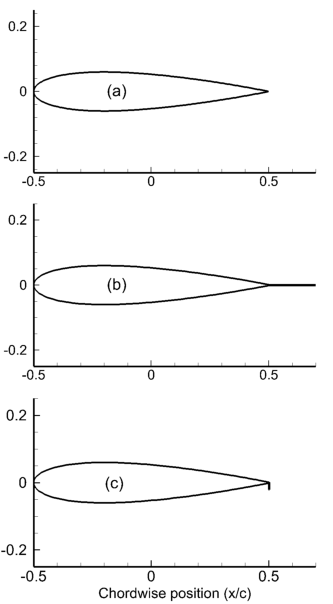
In this study, the NACA 0012 airfoil, a symmetric profile with a maximum thickness of 12% of the chord, is investigated. Owing to its well-documented aerodynamic characteristics, it serves as a widely accepted benchmark in aerodynamic research. 28. The SETE flaps were generated by linearly extending the trailing edge of the NACA 0012 airfoil by 10%, 20%, and 30% of the chord length, while maintaining alignment with the original camber line. The Gurney flaps were modeled as small tabs mounted perpendicular to the pressure surface at 99% of the chord, with tested heights of 1%, 2%, and 3% of the chord. Figure 1 shows the baseline NACA 0012 airfoil, the SETE, and the Gurney flap profiles, respectively. All simulations were performed with a normalized chord length of c = 1m.

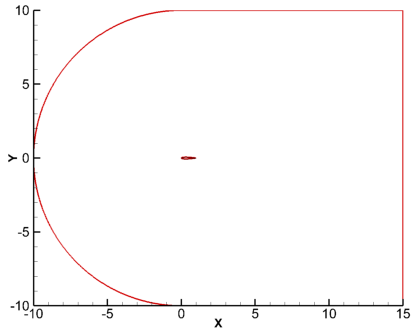
A 2D C-type computational domain was created around the airfoil to accurately capture the flow field and wake effects while minimizing boundary interference. To ensure an adequate computational domain, the upstream boundary extends 10 times the chord length, and the downstream boundary extends 15 times the chord length, as shown in Figure 2, which aligns with the recommendations of Athadkar and Desai 29.

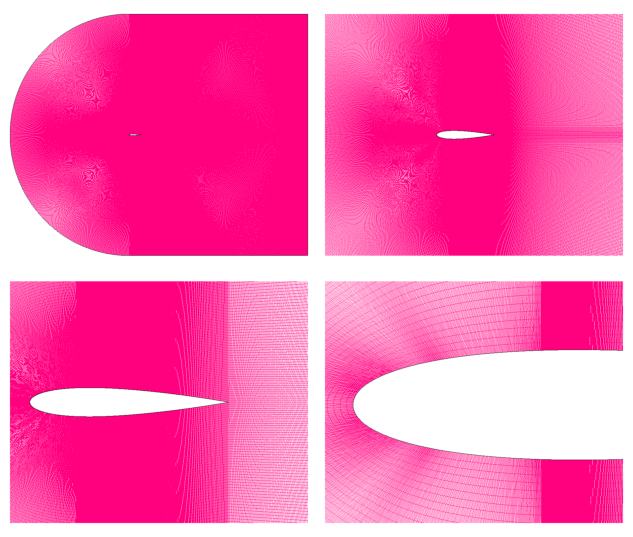
A hybrid mesh approach was implemented, using a structured mesh for the outer flow domain and an unstructured mesh near the airfoil to capture flow details more accurately. For both 2D steady and unsteady cases, 20 inflation layers are employed with a growth rate of 1.2, and the first inflation layer thickness starts at 0.27 mm. Additionally, mesh refinement techniques such as edge sizing and adaptive refinement near the leading edge, trailing edge, and wake region were utilized. The following figure illustrates domain discretization and the mesh around the airfoil.

The Reynolds-Averaged Navier-Stokes (RANS) equations are solved using ANSYS 2024 at a low Reynolds number (Re = 2 × 10⁵). The flow is assumed incompressible based on the airfoil chord length, and the angles of attack range from -4° to 20° in 2° steps. Both steady and unsteady simulations are conducted. For turbulence modeling, the Shear Stress Transport (SST) k-ω model is used, as it is particularly effective for providing better accuracy across various flow conditions, including flow separation and adverse pressure gradients 30, 31. The RANS equations are shown below in Equations (1) and (2), followed by the turbulence model equations in Equations (3) and (4).
 | (1) |
Momentum Equation:
 | (2) |
Where:  is the time-averaged velocity component in the
  -direction,
  is the time-averaged pressure,
  is the fluid density,
  is the kinematic viscosity, and
  is the turbulent viscosity (calculated by the SST
  model).
Turbulent Kinetic Energy (k) Equation:
 | (3) |
Where:  is the turbulent kinetic energy,
  is the specific dissipation rate, and
  is the production of turbulent kinetic energy
Specific Dissipation Rate (ω) Equation
 | (4) |
Where:  are model constants,
  blending function (switches between
  and
and  models), and
  model constant
 .
.
The governing equations (continuity, momentum, k, and ω) are integrated over the control volume for each mesh element. The working fluid is air at 25°C, and all relevant thermophysical properties are set accordingly. Turbulence modeling uses the SST k-ω model, known for its robustness in predicting separation and adverse pressure gradients 30. Steady-state simulations employ the SIMPLE (Semi-Implicit Method for Pressure-Linked Equations) algorithm for pressure-velocity coupling, while unsteady cases use a second-order implicit scheme for time discretization. All residuals were set to converge below 1e-6. For the steady-state case, the simulation runs until convergence is achieved, monitored by the drag and lift coefficients. Once these values stabilize, the simulation is considered complete. For the unsteady case, a time step of 0.001 seconds was used, with 50 iterations per time step. The total simulation time varies, typically ranging from 20,000 to 50,000 time-steps, ensuring accurate capture of transient flow behavior.
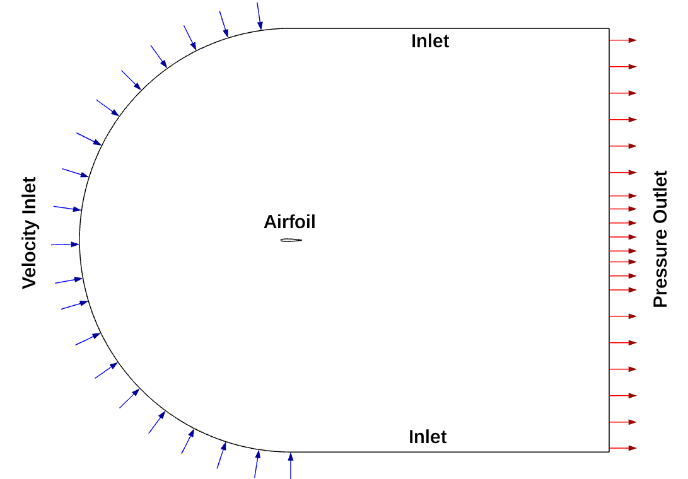
2.5. Inputs and Boundary ConditionsThe boundary conditions used in the simulation are summarized in Figure 4. The airfoil surface was defined as a stationary wall with a no-slip condition. The inlet and outlet were specified as a velocity inlet and a pressure outlet, respectively. The flow was assumed to be incompressible, with a constant density of 1.225 kg/m³ and dynamic viscosity of 1.7894 × 10⁻⁵ kg/(m·s).

A mesh independence study was performed at Re = 6 × 10⁶ and AoA = 5° using coarse (56,406 elements), medium (324,915 elements), and fine (1,270,616 elements) meshes. The fine mesh was chosen based on its convergence in CL, CD, and CM. To establish the credibility of the numerical model, a validation case was performed using a clean NACA0012 airfoil at the same Reynolds number and angle of attack. The results were compared with benchmark data provided by NASA LaRC experimental data 32, which includes data from Abbott and Von Doenhoff 33. The predicted CL and CD closely matched the benchmark values within the expected experimental uncertainty, confirming the fidelity of the simulation approach. The simulations employed the SST k-ω turbulence model under steady-state conditions. Table 1 presents the mesh variation among the three mesh densities.
This section compares the aerodynamic performance of the baseline NACA 0012 airfoil with SETE (10%, 20%, 30% chord length) and Gurney flap (1%, 2%, 3% chord length) configurations. Steady and unsteady results are discussed in parallel, focusing on lift (CL), drag (CD), lift-to-drag ratio (L/D), moment coefficient (CM), and pressure coefficient (CP). The findings highlight both the benefits and trade-offs of these trailing-edge devices.
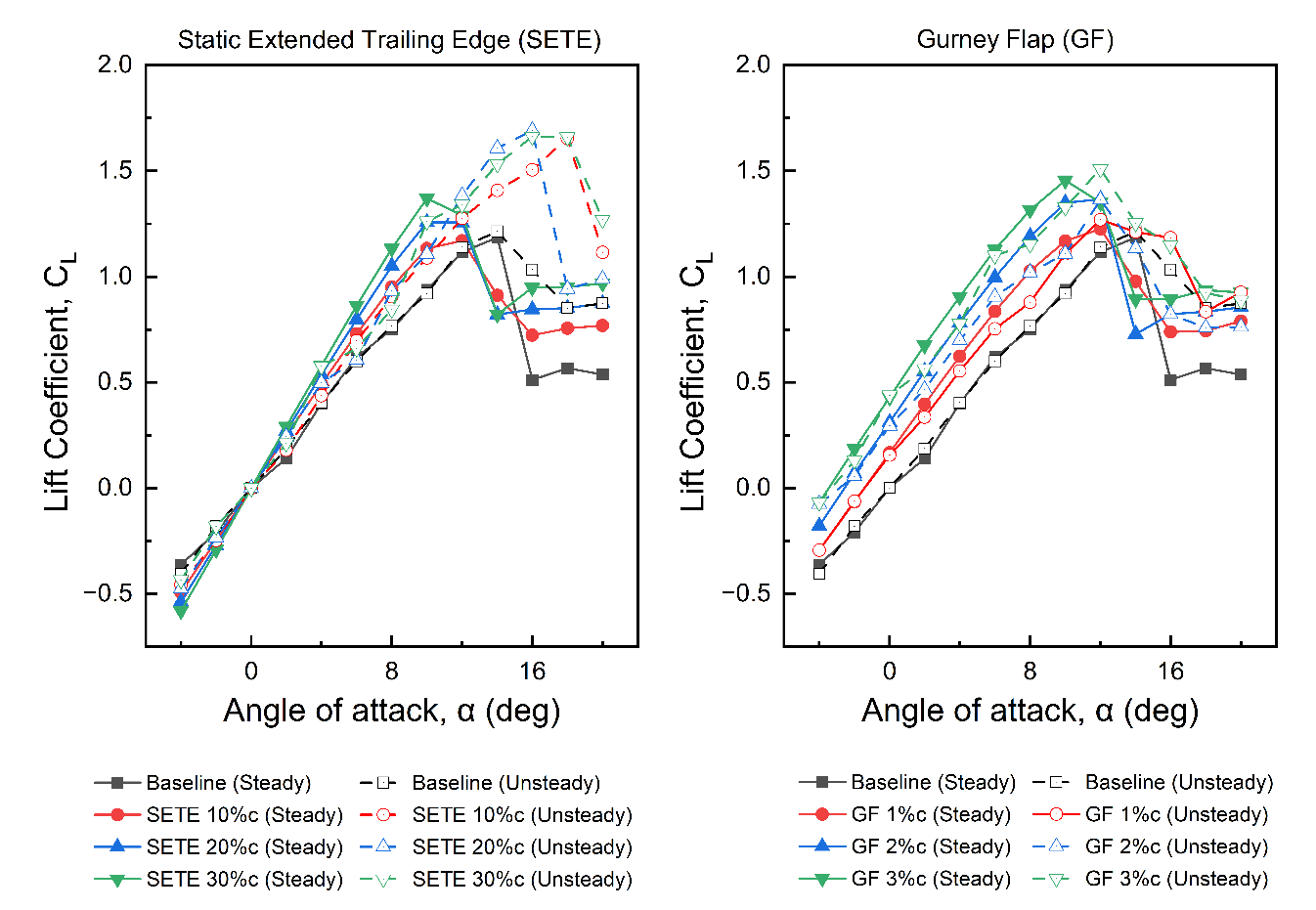
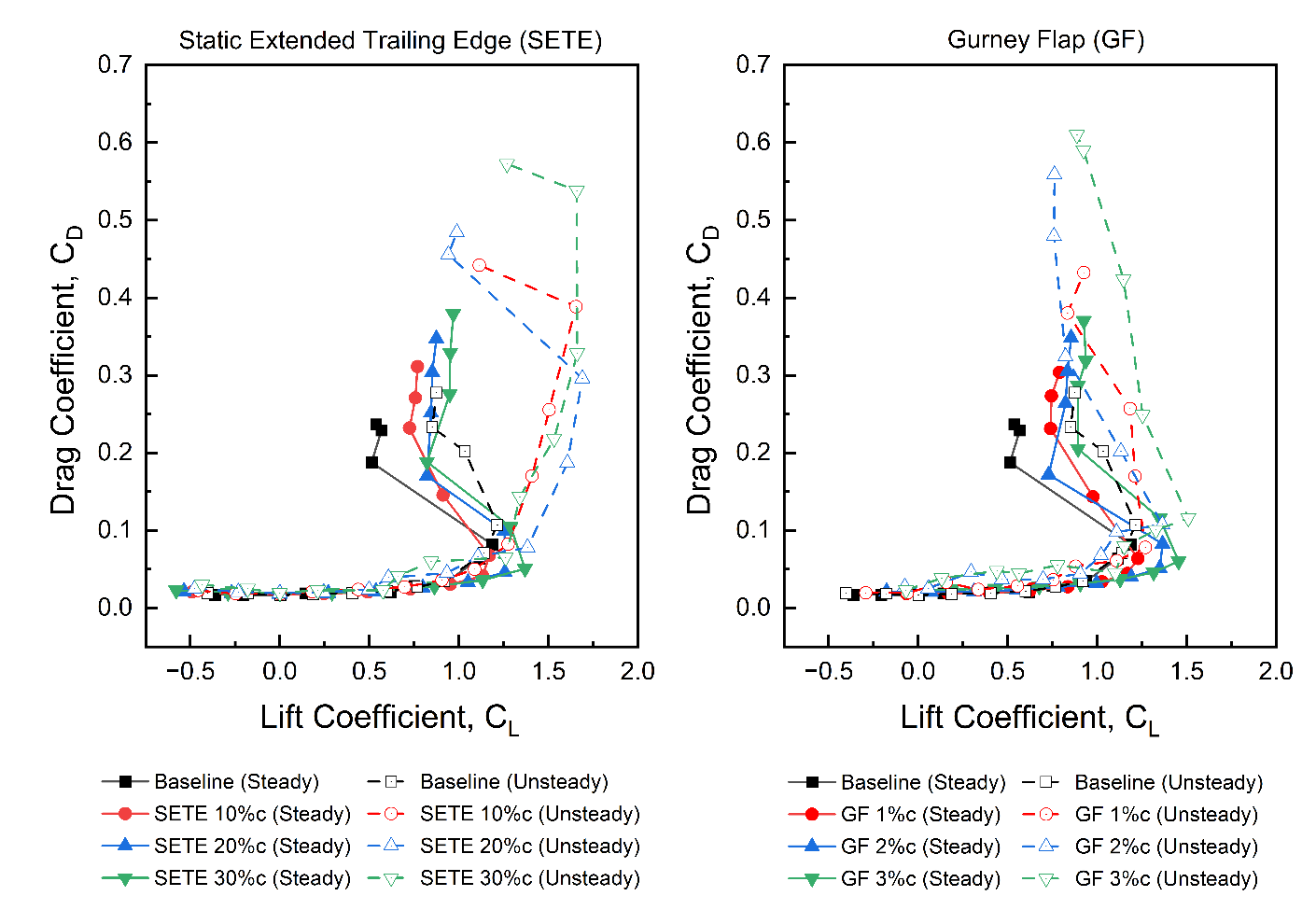
3.1. Lift and Drag CoefficientsThe lift characteristics of the baseline and modified NACA0012 airfoils, under both steady and unsteady flow conditions, are shown in Figure 5. The baseline showed a nearly linear increase in lift coefficient (CL) with angle of attack up to 14°, after which stall occurred, accompanied by either a reduction in lift or a plateau. In this study, the steady-flow maximum was CL,max = 1.116 at AoA = 14°, while under unsteady flow conditions, the peak increased to CL,max = 1.214 at the same angle of attack. This behavior strongly agrees with Ladson’s static measurements 34 and the dynamic-stall investigations by McAlister 35 and Tsang et al., 36, all of whom reported comparable load excursions and vortex-induced lift amplification for NACA0012 under unsteady flow. All three SETE configurations showed progressive lift improvements compared to the baseline NACA0012 airfoil. Under steady flow, SETE 10%c, SETE 20%c, and SETE 30%c achieved CL,max values of 1.170 (+4.8%), 1.257 (+12.7%), and 1.370 (+22.8%), respectively, indicating better pressure recovery and delayed flow separation at moderate angles of attack. Under unsteady conditions, this trend continued, with SETE 20%c reaching CL,max = 1.690 at 16° (+39.2% versus baseline peak at 14°), while SETE 30%c further increased the post-stall lift plateau to 1.65. These findings align with Liu et al., 9, who demonstrated that thin trailing-edge extensions on NACA0012 effectively shift the lift curve upward, reduce abrupt stall onset, and incur only modest drag penalties. The current data also indicate that SETE devices benefit disproportionately from unsteady effects, with post-stall lift decaying more gradually than for the baseline airfoil.
Gurney flaps produced more immediate and pronounced lift increases across the entire AoA range. Under steady flow, GF 1%c reached CL,max = 1.227 (+5.2%), GF 2%c = 1.366 (+17.1%), and GF 3%c = 1.456 (+24.8%). In unsteady flow, peak values occurred earlier and higher than the baseline’s dynamic-stall maximum, with GF 1%c at


1.269 (+4.5%), GF 2%c at 1.363 (+12.3%), and GF 3%c at 1.509 (+24.3%), yet still delivered significantly higher pre-stall lift. These lift–drag trade-offs closely match the results of Jang et al., 37, Li et al., 38, Jain et al., 27, and Aminiet al., 39, who reported lift enhancements of 15-40%, along with increased drag and intensified trailing-edge vortex formation when applying Gurney flaps to symmetric profiles. Notably, this study confirms that unsteady flow increases the peak CL by about 0.1-0.2 units for both SETE and GF configurations, while also reducing the post-stall decline.
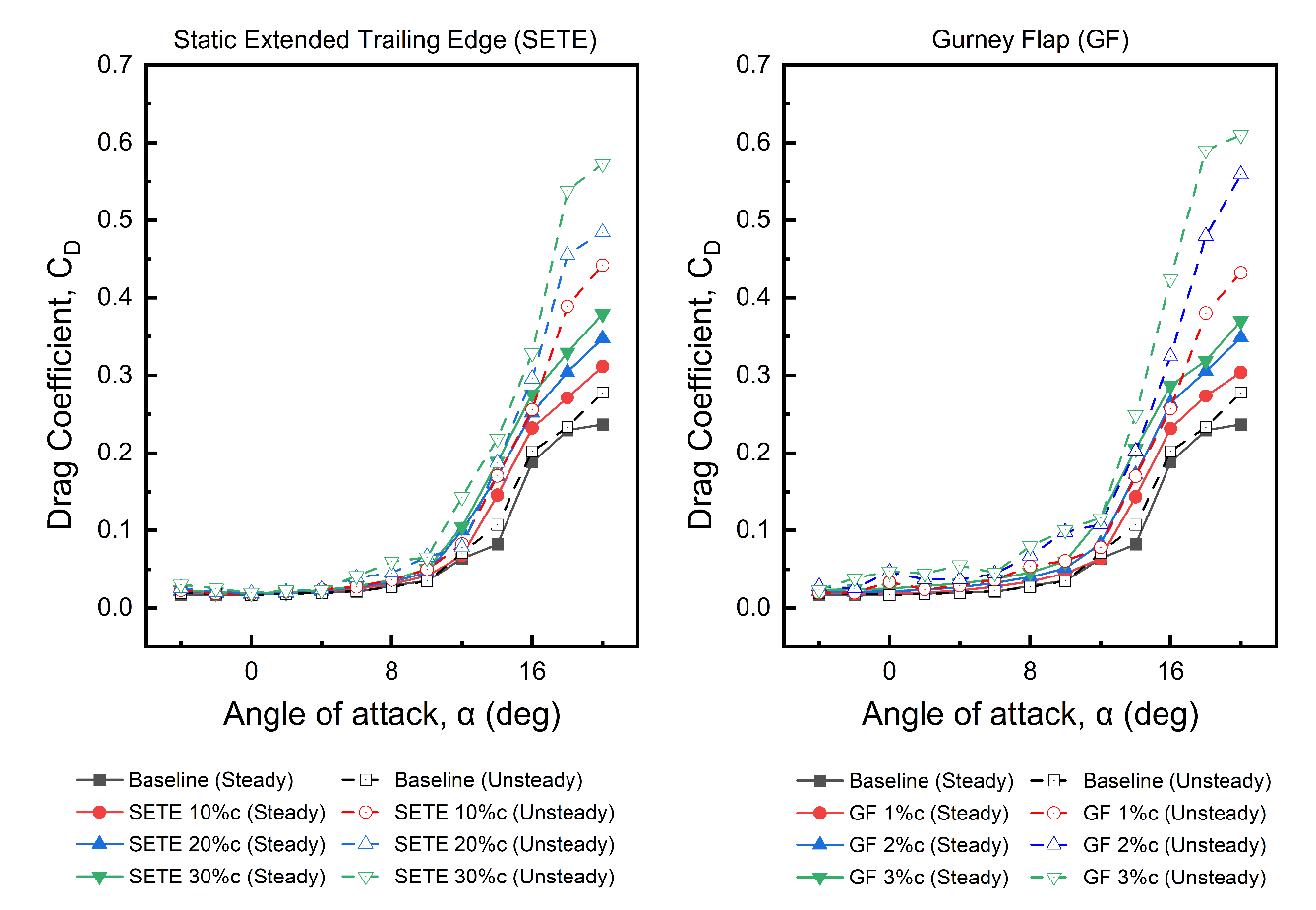
Figure 6 displays the drag coefficient versus the angles of attack for SETEs and GFs under both steady and unsteady flow conditions. Under steady flow, at the angles of attack corresponding to each airfoil configuration’s CL,max, the baseline airfoil’s drag coefficient was 0.082. Adding Static Extended Trailing Edge reduced the drag to 0.068 (−17.5%), 0.046 (−43.8%), and 0.051 (−38.3%) for SETE 10%c, 20%c, and 30%c, respectively, compared to the baseline. Gurney flaps showed a similar trend, with GF 1%c at 0.064 (-22.2%), GF 2%c at 0.083 (+0.8%), and GF 3%c at 0.06 (-26.6%). In unsteady flow, the baseline’s drag at peak lift increased slightly to 0.087, while the SETEs and GFs reached their peaks at lower angles of attack, with drag coefficients at their respective CL,max, significantly different from the steady-state values. For example, SETE 20%c at 0.176 (+101.6%) and GF 2%c at 0.108 (+23.7%). This contrast between steady and unsteady conditions was also noted by Liu et al., 9, and Jang et al., 37, who observed that trailing-edge devices shift performance toward higher lift at the cost of increased drag under steady flow; however, during dynamic stall, the altered flow development causes earlier peaks and different drag behavior at CL, max.
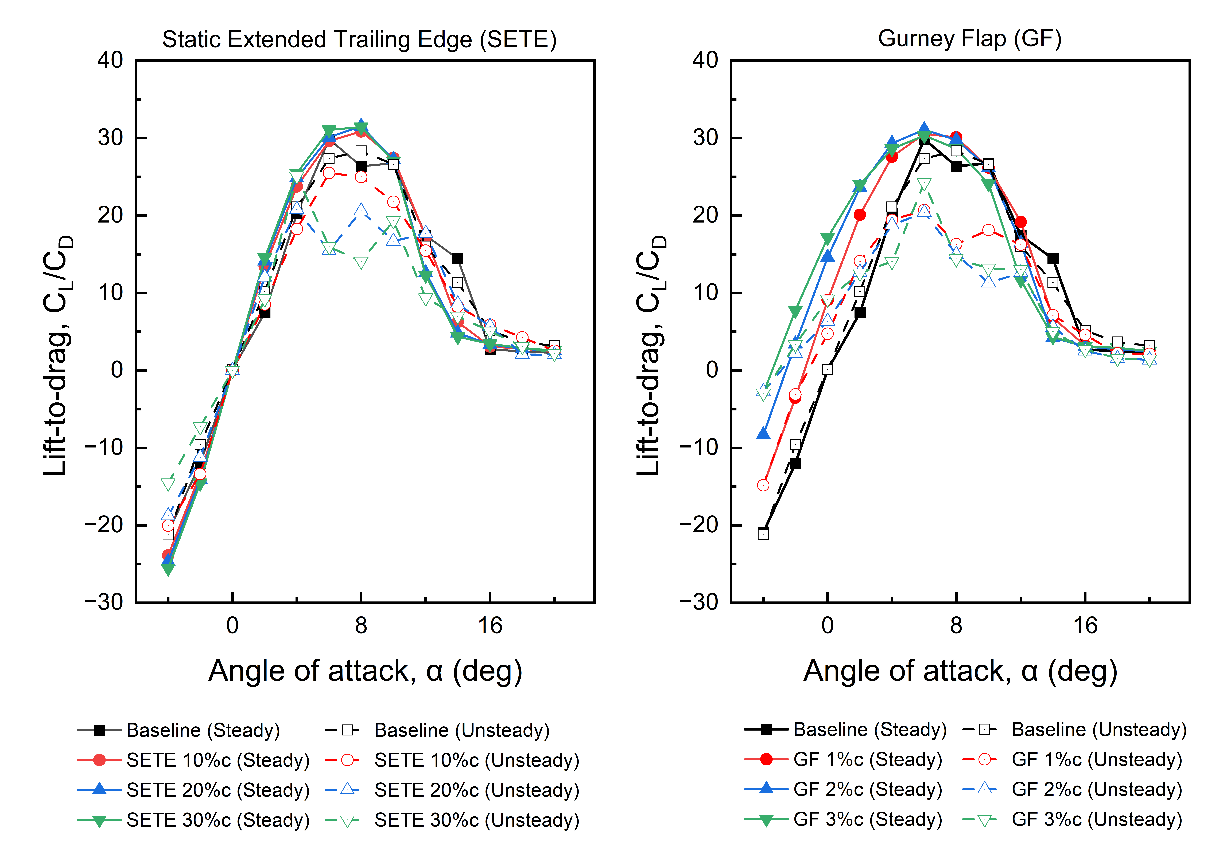
3.2. Lift-to-drag RatioFigure 7 shows the variation in lift-to-drag ratio (CL/CD) with angle of attack for the baseline and modified configurations. The baseline NACA0012 profile showed the expected behavior, with aerodynamic efficiency steadily increasing with the angle of attack, peaking at AoA = 6°, then dropping sharply. Under steady conditions, the baseline reached a maximum L/D of 29.9 at AoA = 6°, while under unsteady conditions, the peak shifted to L/D = 28.3 at AoA = 8°. This pattern matches typical data for NACA0012 34, 36, which typically exhibits peak efficiency at moderate angles before experiencing a rapid stall. The SETE extensions improved aerodynamic efficiency over a wide AoA range under steady flow. SETE 20%c achieved the highest L/D of 31.5 (+5.6% compared to baseline), followed closely by SETE 30%c at 31.4 (+5.2%). These improvements are likely due to delayed stall onset, smoother pressure recovery, and reduced wake losses, mechanisms previously discussed by Liu et al., 4. However, under unsteady flow, the efficiency benefits decreased: SETE 20%c dropped to L/D = 20.8 (–26.6% compared to baseline peak), even though it maintained higher lift beyond AoA = 10°. Under steady conditions, moderate Gurney flaps also increased peak efficiency; GF 2%c achieved L/D = 31.1 (+4.1%) at its optimal angle. But all flap heights experienced rapid efficiency drops beyond AoA = 6°, and under unsteady flow, the decline was more noticeable and irregular. For example, GF 2%c fell to L/D = 20.4 (–28.1% compared to baseline) at its dynamic-stall peak. These results support the findings of Li et al., 38 and Jain et al., 27, who observed that Gurney flaps improve lift before but cause higher drag and stronger vortex shedding under unsteady inflow


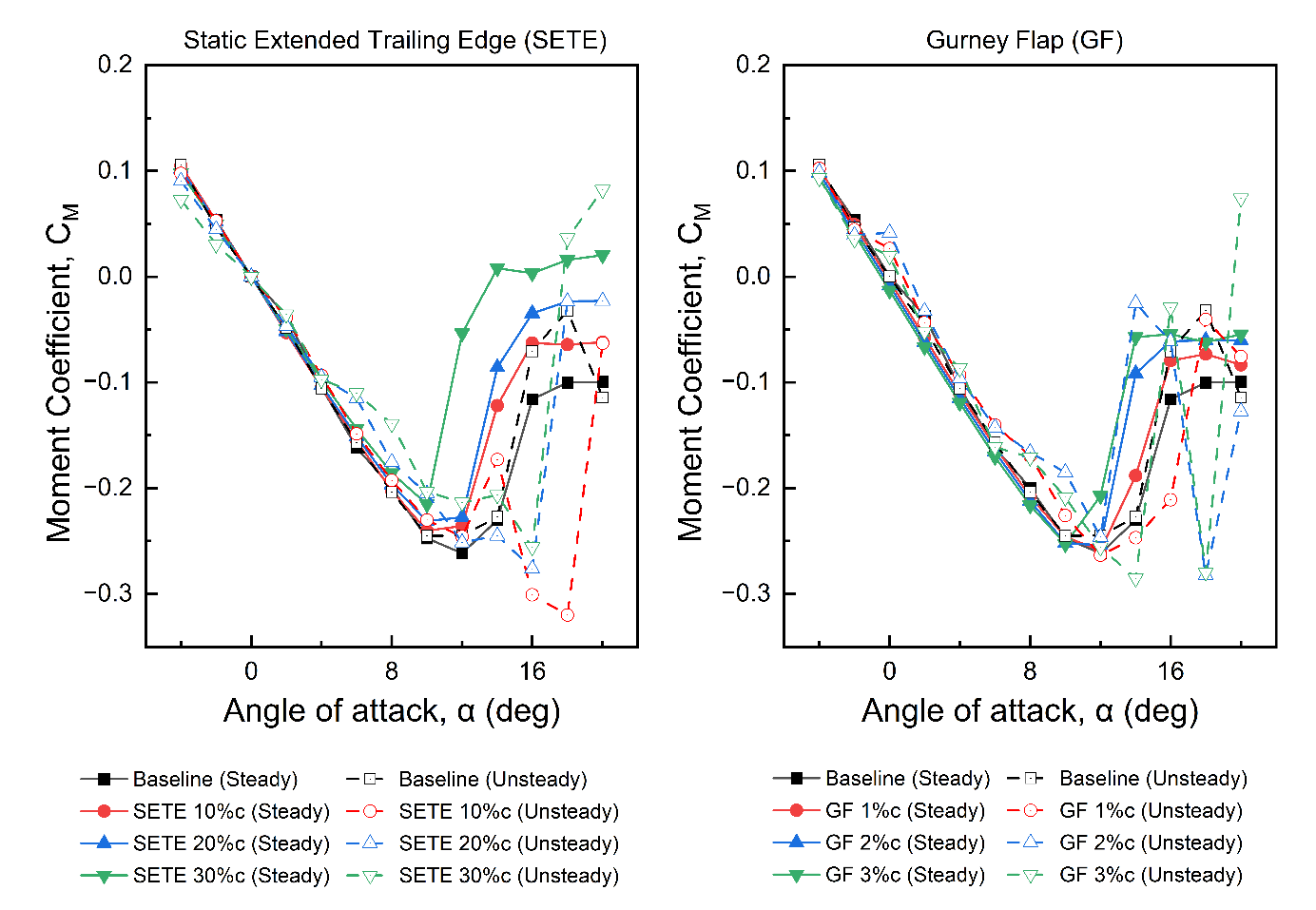
The pitching moment behavior of the baseline NACA 0012 airfoil, SETEs, and GFs is illustrated in Figure 8. The baseline airfoil followed the expected trend of a gradual decrease in CM as the angle of attack (AoA) increased, indicating the forward shift of the aerodynamic center and the resulting nose-down pitching moment. With the addition of Static Extended Trailing Edges (SETE), this nose-down tendency becomes noticeable, especially at moderate to high AoA, as increased lift and a rearward shift of the center of pressure strengthen the negative CM values. These observations match published results for symmetric airfoils 34. SETEs kept smooth and predictable CM curves under steady and unsteady conditions. Gurney flaps also increased the magnitude of negative CM, with the effect growing as flap height increases; the GF 3%c shows the most noticeable nose-down moment. However, unsteady results reveal unpredictable behavior beyond 10° AoA. While both trailing edge modifications increased the nose-down moment, SETE provided a more stable and predictable response, whereas Gurney flaps caused greater unsteadiness at high AoA. From 10° AoA onward, the unsteady moment coefficient curves showed non-linear and unpredictable trends, compared to the steady-state results, which varied more smoothly. This behavior likely results from the start of dynamic stall, where vortex formation and shedding significantly change the pressure distribution over the airfoil. Additionally, the unsteady interaction between the flap-induced wake and the oscillating boundary layer can enhance these effects, leading to the observed irregularities.
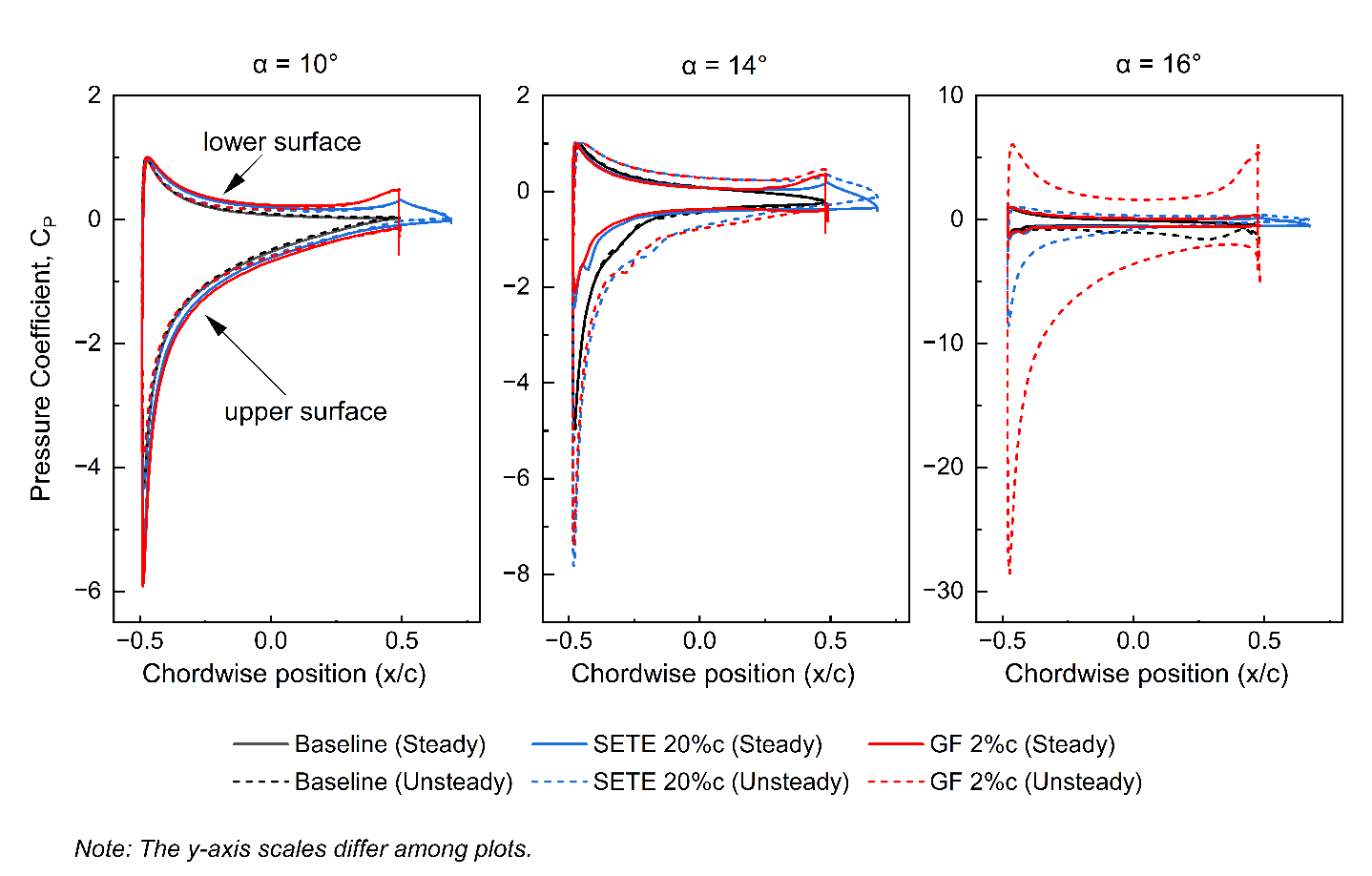
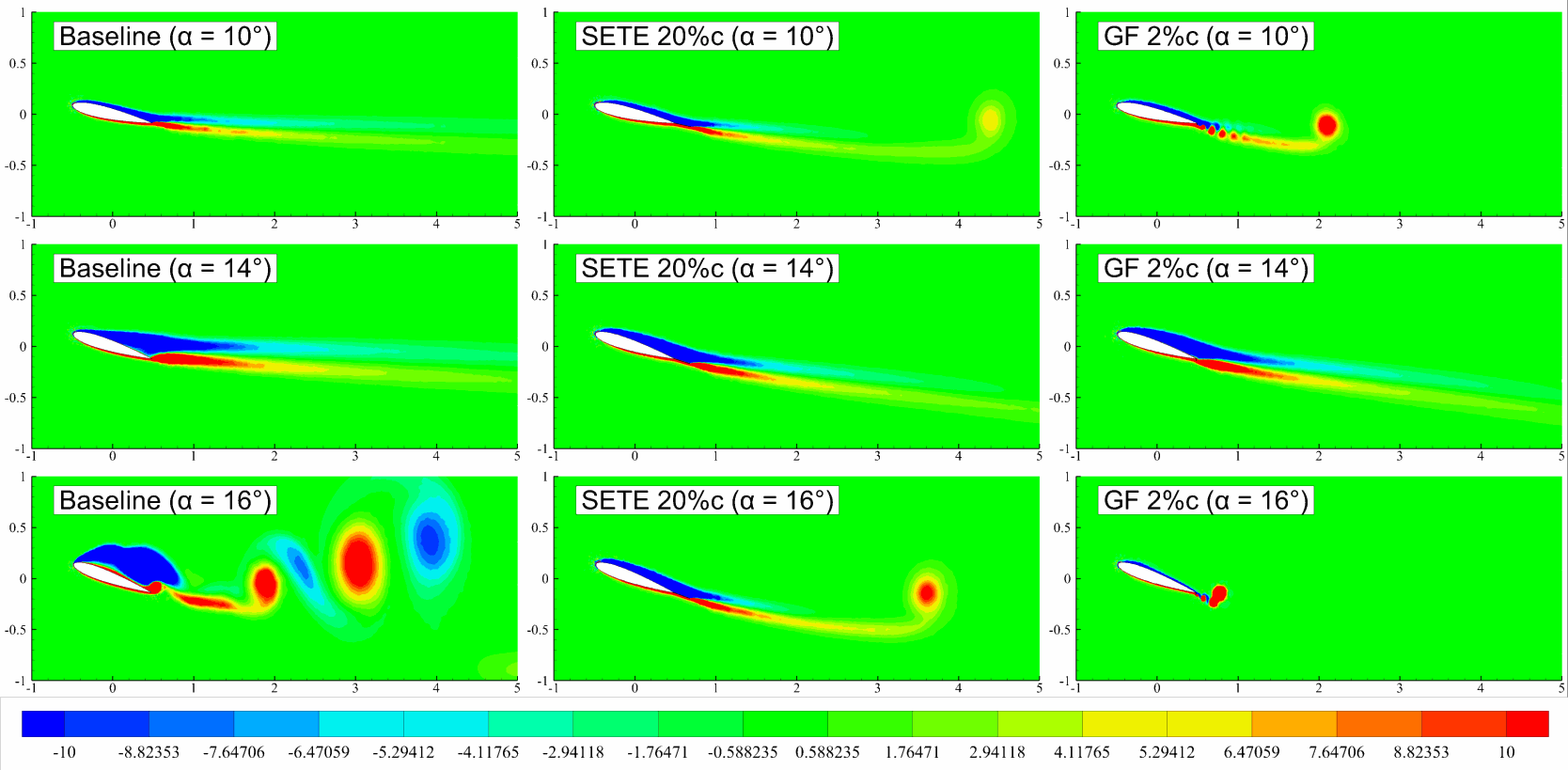
3.4. Overall Performance and Optimal BalanceWhen evaluating lift, drag, efficiency, and moment characteristics together, SETE 20%c and GF 2%c consistently stand out as the most balanced airfoil modifications. The SETE 20%c offers high lift, controlled drag increase, competitive efficiency, and stable pitching behavior, while GF 2%c provides similar benefits among Gurney flaps, delivering significant lift enhancement and efficiency without the severe penalties seen in GF 3%c. Therefore, although SETE 30%c and GF 3%c represent maximum lift designs, SETE 20%c and GF 2%c emerge as the optimal choices, providing the overall balance across all aerodynamic parameters. To understand the flow mechanisms behind the aerodynamic performance of the baseline airfoil and the two top performers, SETE 20%c and GF 2%c, the surface pressure distributions and unsteady vorticity fields were analyzed at AoA = 10°, 14°, and 16° as shown below.
3.5. Pressure DistributionFigure 10 displays the pressure coefficient distribution over the baseline, SETE 20%c, and GF 2%c at AoA of 10°, 14°, and 16°, respectively. Negative CP values indicate suction. The SETE and Gurney flaps shift the suction peak and influence the pressure recovery region near the trailing edge, affecting lift generation and stall delay. At AoA = 10°, the baseline airfoil shows a typical suction peak near the leading edge, accompanied by smooth pressure recovery. The SETE 20%c causes a slight aftward shift in the suction peak while improving the pressure gradient near the trailing edge, leading to increased lift. The GF 2%c produces a steeper suction peak, indicating a higher lift coefficient at this angle. However, at AoA = 14°, both SETE and GF show a flattened CP profile near the trailing edge, confirming early separation and reduced control over the adverse pressure gradient, especially for GF 2%c. SETE 20%c, on the other hand, maintains a more favorable gradient, resulting in better flow attachment and delayed stall onset. The CP plots show stronger suction peaks for GFs but more gradual and stable pressure recovery for SETE devices. Vorticity contours confirmed early separation and intense vortex shedding for GF 20%c beyond 14°, while SETE 20%c maintained attached flow and organized wakes even at 16° AoA. These effects align with those of Liu et al., 40 and Ethiraj and Pillai 41, who demonstrated that trailing edge modifications enhance lift through pressure recovery, while Gurney flaps act through vortex augmentation.
3.6. Vorticity ContoursFigure 11 displays the vorticity contours at AoA = 10°, 14°, and 16° for the baseline, SETE 20%c, and GF 2%c under unsteady flow. At 10° AoA, the baseline already shows the start of weak shear-layer vortices, while the SETE 20% and GF 2%c setups exhibit delayed vortex formation and smaller wake thickness. At 14° and 16° AoA, the baseline airfoil produces large, disorganized vortical structures, indicating unsteady separation and lift breakdown. The SETE setup effectively suppresses some of this chaotic vorticity, promoting a more stable flow in both steady and unsteady conditions. The Gurney flap displays intense, periodic vortex shedding, consistent with its known behavior of energizing the wake but potentially increasing oscillatory forces.
This study evaluated the aerodynamic performance of the NACA 0012 airfoil with trailing-edge modifications under steady and unsteady flow conditions at a Reynolds number of 2 × 10⁵. Seven configurations were examined: the baseline, three Static Extended Trailing Edges (SETEs of 10%, 20%, and 30% chord length), and three Gurney flaps (GFs of 1%, 2%, and 3% chord height). Numerical simulations utilized both Reynolds-Averaged Navier–Stokes (RANS) and Unsteady RANS (URANS) formulations, with validation against NASA benchmark data at Re = 6 × 10⁶ and AoA = 5°.
The baseline NACA 0012 served as the control case, showing typical lift behavior of a symmetric airfoil. There were distinct aerodynamic mechanisms involving static extended trailing edges and Gurney flaps. Gurney flaps maximize lift across the AoA spectrum and maintain post-stall lift. However, their steep drag penalties, unstable L/D performance, and erratic pitching moments limit their use in efficiency-driven systems. The SETEs, on the other hand, offer smoother and more balanced aerodynamic improvements. Among the tested cases, the SETE20%c and GF2%c consistently stand out as the most balanced designs, providing significant lift gains while maintaining efficiency levels similar to the baseline. The 20%c SETE delivered the best combination of high lift, low drag, delayed stall, and stable moment behavior. These characteristics make the SETE 20%c extension very promising for small-scale vertical-axis wind turbines (VAWTs).

| [1] | T. Liu, “Evolutionary understanding of airfoil lift,” Adv. Aerodyn., vol. 3, no. 1, Art. no. 1, 2021. | ||
| In article | View Article | ||
| [2] | J. Li et al., “Low-Reynolds-number airfoil design optimization using deep-learning-based tailored airfoil modes,” Aerosp. Sci. Technol., vol. 121, p. 107309, 2022. | ||
| In article | View Article | ||
| [3] | S. van der Horst, J. E. van de Wiel, C. Simao Ferreira, and N. Ramos García, “Flow curvature effects for VAWT: A review of virtual airfoil transformations and implementation in xfoil,” in 34th Wind Energy Symposium, 2016, p. 1734. | ||
| In article | View Article | ||
| [4] | B. Hand, G. Kelly, and A. Cashman, “Numerical simulation of a vertical axis wind turbine airfoil experiencing dynamic stall at high Reynolds numbers,” Comput. Fluids, vol. 149, pp. 12–30, 2017. | ||
| In article | View Article | ||
| [5] | M. Islam, D. S.-K. Ting, and A. Fartaj, “Aerodynamic models for Darrieus-type straight-bladed vertical axis wind turbines,” Renew. Sustain. Energy Rev., vol. 12, no. 4, pp. 1087–1109, 2008. | ||
| In article | View Article | ||
| [6] | H. Wang et al., “Recent advances on machine learning for computational fluid dynamics: A survey,” ArXiv Prepr. ArXiv240812171, 2024. | ||
| In article | |||
| [7] | S. ed-Dîn Fertahi et al., “Insights from the Last Decade in Computational Fluid Dynamics (CFD) Design and Performance Enhancement of Darrieus Wind Turbines,” Processes, vol. 13, no. 2, p. 370, 2025. | ||
| In article | View Article | ||
| [8] | J. Chen, L. Chen, H. Xu, H. Yang, C. Ye, and D. Liu, “Performance improvement of a vertical axis wind turbine by comprehensive assessment of an airfoil family,” Energy, vol. 114, pp. 318–331, 2016. | ||
| In article | View Article | ||
| [9] | T. Liu, J. Montefort, W. Liou, S. Pantula, and Q. A. Shams, “Lift enhancement by static extended trailing edge,” J. Aircr., vol. 44, no. 6, Art. no. 6, 2007. | ||
| In article | View Article | ||
| [10] | M. S. Islam, “Improvement of aerodynamic characteristics of an airfoil by static extended trailing edge,” PhD Thesis, Khulna University of Engineering & Technology (KUET), 2017. | ||
| In article | |||
| [11] | J. Wang, Y. Li, and K.-S. Choi, “Gurney flap—Lift enhancement, mechanisms and applications,” Prog. Aerosp. Sci., vol. 44, no. 1, pp. 22–47, 2008. | ||
| In article | View Article | ||
| [12] | J. D. Maynard and A. J. Evans, “Tests of Four Full-scale Propellers to Determine the Effect of Trailing-edge Extensions on Propeller Aerodynamic Characteristics,” 1945. | ||
| In article | |||
| [13] | R. H. Liebeck, “Design of subsonic airfoils for high lift,” J. Aircr., vol. 15, no. 9, pp. 547–561, 1978. | ||
| In article | View Article | ||
| [14] | R. Mustak, M. H.-O.-R. Molla, and M. Mashud, “Improvement of aerodynamic characteristics of an airfoil by surface modification,” Am. J. Eng. Res. AJER, vol. 6, no. 3, pp. 07–14, 2017. | ||
| In article | |||
| [15] | E. Livya and S. N. Pillai, “Aerodynamic Analysis of Stretched Trailing Edge Over NACA 0020 Airfoil at Various Turbulence Intensities,” in Conference on Fluid Mechanics and Fluid Power, Springer, 2022, pp. 475–487. | ||
| In article | View Article | ||
| [16] | L. Ramesh, V. Mugendiran, and G. Sivaraj, “Increasing L/D Ratio of Wing by Delaying Flow Separation for Better Aerodynamic Performance,” J. Appl. Fluid Mech., vol. 17, no. 12, pp. 2720–2733, 2024. | ||
| In article | View Article | ||
| [17] | S. Zhao, D. Li, J. Zhou, and E. Sha, “Numerical and experimental study of a flexible trailing edge driving by pneumatic muscle actuators,” in Actuators, MDPI, 2021, p. 142. | ||
| In article | View Article | ||
| [18] | R. Jami, F. Samara, and D. Johnson, “Numerical Study using RANS model to Predict Loading of a Wind Turbine Blade with a Trailing Edge Flap,” in Journal of Physics: Conference Series, IOP Publishing, 2022, p. 042077. | ||
| In article | View Article | ||
| [19] | A. Boral et al., “Drag reduction for flow past circular cylinder using static extended trailing edge,” ASME Open J. Eng., vol. 2, 2023. | ||
| In article | View Article | ||
| [20] | A. A. Abdalkarem, A. F. Abdullah, K. Sopian, L. C. Haw, W. K. Muzammil, and K. H. Wong, “The effect of trailing-edge wedge-tails on the aerodynamic characteristics of wind turbine airfoil,” in IOP Conference Series: Materials Science and Engineering, IOP Publishing, 2023, p. 012011. | ||
| In article | View Article | ||
| [21] | P. Fz-Retana-Amescua, I. Aramendia, A. Ballesteros-Coll, U. Fernandez-Gamiz, I. Bidaguren, and J. M. Blanco Ilzarbe, “Numerical study of high lift devices to improve airfoil aerodynamic performance,” Energy Sources Part Recovery Util. Environ. Eff., vol. 44, no. 4, pp. 9135–9155, 2022. | ||
| In article | View Article | ||
| [22] | S. N. V. Neigapula, S. P. Maddula, and V. B. Nukala, “A study of high lift aerodynamic devices on commercial aircrafts,” Aviation, vol. 24, no. 3, pp. 123–136, 2020. | ||
| In article | View Article | ||
| [23] | B. Genest and G. Dumas, “Numerical Investigation into Single and Double Gurney Flaps for Improving Airfoil Performance,” J. Aircr., vol. 60, no. 6, Art. no. 6, 2023. | ||
| In article | View Article | ||
| [24] | I. J. Ooda, “Numerical Investigation of Aerodynamic Characteristics of Supercritical RAE2822 Airfoil with Gurney Flap,” J. Eng., vol. 28, no. 6, Art. no. 6, 2022. | ||
| In article | View Article | ||
| [25] | H. Chen and B. Chen, “Lift enhancement of tiltrotor wing using a gurney flap,” Int. J. Aerosp. Eng., vol. 2022, pp. 1–9, 2022. | ||
| In article | View Article | ||
| [26] | F. M. Catalano, E. Ceron, and P. Greco, “Trailing edge treatment to enhance high lift system performance,” in 28th International Congress of the Aeronautical Sciences (ICAS). Brisbane, Australia, 2012. | ||
| In article | |||
| [27] | S. Jain, N. Sitaram, and S. Krishnaswamy, “Computational investigations on the effects of Gurney flap on airfoil aerodynamics,” Int. Sch. Res. Not., vol. 2015, 2015. | ||
| In article | View Article PubMed | ||
| [28] | R. E. Sheldahl and P. C. Klimas, “Aerodynamic characteristics of seven symmetrical airfoil sections through 180-degree angle of attack for use in aerodynamic analysis of vertical axis wind turbines,” Sandia National Lab. (SNL-NM), Albuquerque, NM (United States), 1981. | ||
| In article | View Article PubMed | ||
| [29] | M. Athadkar and S. Desai, “Importance of the extent of far-field boundaries and of the grid topology in the CFD simulation of external flows,” Int J Mech Prod Eng, vol. 2, pp. 69–72, 2014. | ||
| In article | |||
| [30] | F. Ridzuan, B. Manshoor, M. H. Omar, D. H. Didane, M. A. Abdelaal, and A. Amin, “Aerodynamic Performance of NACA S809 Wind Turbine Blade Airfoil Using SST K-omega and K-epsilon Turbulence Models,” J. Des. Sustain. Environ., vol. 6, no. 2, pp. 36–42, 2024. | ||
| In article | |||
| [31] | F. R. Menter, “Two-equation eddy-viscosity turbulence models for engineering applications,” AIAA J., vol. 32, no. 8, pp. 1598–1605, 1994. | ||
| In article | View Article | ||
| [32] | E. Vogel and C. Pederson, 2D NACA 0012 Airfoil Validation Case. 2014. [Online]. Available: https://turbmodels.larc.nasa.gov/naca0012_val.html | ||
| In article | |||
| [33] | I. Abbott and A. Von Doenhoff, “Aerodynamic Characteristics of Wing Sections,” Theory Wing Sect. Summ. Airfoil Data, pp. 449–688, 1949. | ||
| In article | |||
| [34] | C. L. Ladson, Effects of independent variation of Mach and Reynolds numbers on the low-speed aerodynamic characteristics of the NACA 0012 airfoil section, vol. 4074. National Aeronautics and Space Administration, Scientific and Technical …, 1988. | ||
| In article | |||
| [35] | K. W. McAlister, L. W. Carr, and W. J. McCroskey, “Dynamic stall experiments on the NACA 0012 airfoil,” 1978. | ||
| In article | |||
| [36] | K. Tsang, R. So, R. Leung, and X. Wang, “Dynamic stall behavior from unsteady force measurements,” J. Fluids Struct., vol. 24, no. 1, pp. 129–150, 2008. | ||
| In article | View Article | ||
| [37] | C. Jang, J. Ross, and R. Cummings, “Computational evaluation of an airfoil with a Gurney flap,” in 10th Applied Aerodynamics Conference, 1992, p. 2708. | ||
| In article | View Article | ||
| [38] | Y. Li, J. Wang, and P. Zhang, “Effects of Gurney flaps on a NACA0012 airfoil,” Flow Turbul. Combust., vol. 68, pp. 27–39, 2002. | ||
| In article | View Article | ||
| [39] | Y. Amini, M. Liravi, and E. Izadpanah, “The effects of Gurney flap on the aerodynamic performance of NACA 0012 airfoil in the rarefied gas flow,” Comput. Fluids, vol. 170, pp. 93–105, 2018. | ||
| In article | View Article | ||
| [40] | T. Liu, W. W. Liou, S. R. Pantula, Q. A. Shams, and others, “Static Extended Trailing Edge for Lift Enhancement: Experimental and Computational Studies,” in 3rd International Symposium on Integrating CFD and Experiments in Aerodynamics, 2007. | ||
| In article | |||
| [41] | L. Ethiraj and S. N. Pillai, “Effect of trailing-edge modification over aerodynamic characteristics of NACA 0020 airfoil,” Wind Struct., vol. 33, no. 6, Art. no. 6, 2021. | ||
| In article | |||
Published with license by Science and Education Publishing, Copyright © 2025 Tiberius S. Gikenyi, Churchill O. Saoke and Joseph N. Kamau
 This work is licensed under a Creative Commons Attribution 4.0 International License. To view a copy of this license, visit
http://creativecommons.org/licenses/by/4.0/
This work is licensed under a Creative Commons Attribution 4.0 International License. To view a copy of this license, visit
http://creativecommons.org/licenses/by/4.0/
| [1] | T. Liu, “Evolutionary understanding of airfoil lift,” Adv. Aerodyn., vol. 3, no. 1, Art. no. 1, 2021. | ||
| In article | View Article | ||
| [2] | J. Li et al., “Low-Reynolds-number airfoil design optimization using deep-learning-based tailored airfoil modes,” Aerosp. Sci. Technol., vol. 121, p. 107309, 2022. | ||
| In article | View Article | ||
| [3] | S. van der Horst, J. E. van de Wiel, C. Simao Ferreira, and N. Ramos García, “Flow curvature effects for VAWT: A review of virtual airfoil transformations and implementation in xfoil,” in 34th Wind Energy Symposium, 2016, p. 1734. | ||
| In article | View Article | ||
| [4] | B. Hand, G. Kelly, and A. Cashman, “Numerical simulation of a vertical axis wind turbine airfoil experiencing dynamic stall at high Reynolds numbers,” Comput. Fluids, vol. 149, pp. 12–30, 2017. | ||
| In article | View Article | ||
| [5] | M. Islam, D. S.-K. Ting, and A. Fartaj, “Aerodynamic models for Darrieus-type straight-bladed vertical axis wind turbines,” Renew. Sustain. Energy Rev., vol. 12, no. 4, pp. 1087–1109, 2008. | ||
| In article | View Article | ||
| [6] | H. Wang et al., “Recent advances on machine learning for computational fluid dynamics: A survey,” ArXiv Prepr. ArXiv240812171, 2024. | ||
| In article | |||
| [7] | S. ed-Dîn Fertahi et al., “Insights from the Last Decade in Computational Fluid Dynamics (CFD) Design and Performance Enhancement of Darrieus Wind Turbines,” Processes, vol. 13, no. 2, p. 370, 2025. | ||
| In article | View Article | ||
| [8] | J. Chen, L. Chen, H. Xu, H. Yang, C. Ye, and D. Liu, “Performance improvement of a vertical axis wind turbine by comprehensive assessment of an airfoil family,” Energy, vol. 114, pp. 318–331, 2016. | ||
| In article | View Article | ||
| [9] | T. Liu, J. Montefort, W. Liou, S. Pantula, and Q. A. Shams, “Lift enhancement by static extended trailing edge,” J. Aircr., vol. 44, no. 6, Art. no. 6, 2007. | ||
| In article | View Article | ||
| [10] | M. S. Islam, “Improvement of aerodynamic characteristics of an airfoil by static extended trailing edge,” PhD Thesis, Khulna University of Engineering & Technology (KUET), 2017. | ||
| In article | |||
| [11] | J. Wang, Y. Li, and K.-S. Choi, “Gurney flap—Lift enhancement, mechanisms and applications,” Prog. Aerosp. Sci., vol. 44, no. 1, pp. 22–47, 2008. | ||
| In article | View Article | ||
| [12] | J. D. Maynard and A. J. Evans, “Tests of Four Full-scale Propellers to Determine the Effect of Trailing-edge Extensions on Propeller Aerodynamic Characteristics,” 1945. | ||
| In article | |||
| [13] | R. H. Liebeck, “Design of subsonic airfoils for high lift,” J. Aircr., vol. 15, no. 9, pp. 547–561, 1978. | ||
| In article | View Article | ||
| [14] | R. Mustak, M. H.-O.-R. Molla, and M. Mashud, “Improvement of aerodynamic characteristics of an airfoil by surface modification,” Am. J. Eng. Res. AJER, vol. 6, no. 3, pp. 07–14, 2017. | ||
| In article | |||
| [15] | E. Livya and S. N. Pillai, “Aerodynamic Analysis of Stretched Trailing Edge Over NACA 0020 Airfoil at Various Turbulence Intensities,” in Conference on Fluid Mechanics and Fluid Power, Springer, 2022, pp. 475–487. | ||
| In article | View Article | ||
| [16] | L. Ramesh, V. Mugendiran, and G. Sivaraj, “Increasing L/D Ratio of Wing by Delaying Flow Separation for Better Aerodynamic Performance,” J. Appl. Fluid Mech., vol. 17, no. 12, pp. 2720–2733, 2024. | ||
| In article | View Article | ||
| [17] | S. Zhao, D. Li, J. Zhou, and E. Sha, “Numerical and experimental study of a flexible trailing edge driving by pneumatic muscle actuators,” in Actuators, MDPI, 2021, p. 142. | ||
| In article | View Article | ||
| [18] | R. Jami, F. Samara, and D. Johnson, “Numerical Study using RANS model to Predict Loading of a Wind Turbine Blade with a Trailing Edge Flap,” in Journal of Physics: Conference Series, IOP Publishing, 2022, p. 042077. | ||
| In article | View Article | ||
| [19] | A. Boral et al., “Drag reduction for flow past circular cylinder using static extended trailing edge,” ASME Open J. Eng., vol. 2, 2023. | ||
| In article | View Article | ||
| [20] | A. A. Abdalkarem, A. F. Abdullah, K. Sopian, L. C. Haw, W. K. Muzammil, and K. H. Wong, “The effect of trailing-edge wedge-tails on the aerodynamic characteristics of wind turbine airfoil,” in IOP Conference Series: Materials Science and Engineering, IOP Publishing, 2023, p. 012011. | ||
| In article | View Article | ||
| [21] | P. Fz-Retana-Amescua, I. Aramendia, A. Ballesteros-Coll, U. Fernandez-Gamiz, I. Bidaguren, and J. M. Blanco Ilzarbe, “Numerical study of high lift devices to improve airfoil aerodynamic performance,” Energy Sources Part Recovery Util. Environ. Eff., vol. 44, no. 4, pp. 9135–9155, 2022. | ||
| In article | View Article | ||
| [22] | S. N. V. Neigapula, S. P. Maddula, and V. B. Nukala, “A study of high lift aerodynamic devices on commercial aircrafts,” Aviation, vol. 24, no. 3, pp. 123–136, 2020. | ||
| In article | View Article | ||
| [23] | B. Genest and G. Dumas, “Numerical Investigation into Single and Double Gurney Flaps for Improving Airfoil Performance,” J. Aircr., vol. 60, no. 6, Art. no. 6, 2023. | ||
| In article | View Article | ||
| [24] | I. J. Ooda, “Numerical Investigation of Aerodynamic Characteristics of Supercritical RAE2822 Airfoil with Gurney Flap,” J. Eng., vol. 28, no. 6, Art. no. 6, 2022. | ||
| In article | View Article | ||
| [25] | H. Chen and B. Chen, “Lift enhancement of tiltrotor wing using a gurney flap,” Int. J. Aerosp. Eng., vol. 2022, pp. 1–9, 2022. | ||
| In article | View Article | ||
| [26] | F. M. Catalano, E. Ceron, and P. Greco, “Trailing edge treatment to enhance high lift system performance,” in 28th International Congress of the Aeronautical Sciences (ICAS). Brisbane, Australia, 2012. | ||
| In article | |||
| [27] | S. Jain, N. Sitaram, and S. Krishnaswamy, “Computational investigations on the effects of Gurney flap on airfoil aerodynamics,” Int. Sch. Res. Not., vol. 2015, 2015. | ||
| In article | View Article PubMed | ||
| [28] | R. E. Sheldahl and P. C. Klimas, “Aerodynamic characteristics of seven symmetrical airfoil sections through 180-degree angle of attack for use in aerodynamic analysis of vertical axis wind turbines,” Sandia National Lab. (SNL-NM), Albuquerque, NM (United States), 1981. | ||
| In article | View Article PubMed | ||
| [29] | M. Athadkar and S. Desai, “Importance of the extent of far-field boundaries and of the grid topology in the CFD simulation of external flows,” Int J Mech Prod Eng, vol. 2, pp. 69–72, 2014. | ||
| In article | |||
| [30] | F. Ridzuan, B. Manshoor, M. H. Omar, D. H. Didane, M. A. Abdelaal, and A. Amin, “Aerodynamic Performance of NACA S809 Wind Turbine Blade Airfoil Using SST K-omega and K-epsilon Turbulence Models,” J. Des. Sustain. Environ., vol. 6, no. 2, pp. 36–42, 2024. | ||
| In article | |||
| [31] | F. R. Menter, “Two-equation eddy-viscosity turbulence models for engineering applications,” AIAA J., vol. 32, no. 8, pp. 1598–1605, 1994. | ||
| In article | View Article | ||
| [32] | E. Vogel and C. Pederson, 2D NACA 0012 Airfoil Validation Case. 2014. [Online]. Available: https://turbmodels.larc.nasa.gov/naca0012_val.html | ||
| In article | |||
| [33] | I. Abbott and A. Von Doenhoff, “Aerodynamic Characteristics of Wing Sections,” Theory Wing Sect. Summ. Airfoil Data, pp. 449–688, 1949. | ||
| In article | |||
| [34] | C. L. Ladson, Effects of independent variation of Mach and Reynolds numbers on the low-speed aerodynamic characteristics of the NACA 0012 airfoil section, vol. 4074. National Aeronautics and Space Administration, Scientific and Technical …, 1988. | ||
| In article | |||
| [35] | K. W. McAlister, L. W. Carr, and W. J. McCroskey, “Dynamic stall experiments on the NACA 0012 airfoil,” 1978. | ||
| In article | |||
| [36] | K. Tsang, R. So, R. Leung, and X. Wang, “Dynamic stall behavior from unsteady force measurements,” J. Fluids Struct., vol. 24, no. 1, pp. 129–150, 2008. | ||
| In article | View Article | ||
| [37] | C. Jang, J. Ross, and R. Cummings, “Computational evaluation of an airfoil with a Gurney flap,” in 10th Applied Aerodynamics Conference, 1992, p. 2708. | ||
| In article | View Article | ||
| [38] | Y. Li, J. Wang, and P. Zhang, “Effects of Gurney flaps on a NACA0012 airfoil,” Flow Turbul. Combust., vol. 68, pp. 27–39, 2002. | ||
| In article | View Article | ||
| [39] | Y. Amini, M. Liravi, and E. Izadpanah, “The effects of Gurney flap on the aerodynamic performance of NACA 0012 airfoil in the rarefied gas flow,” Comput. Fluids, vol. 170, pp. 93–105, 2018. | ||
| In article | View Article | ||
| [40] | T. Liu, W. W. Liou, S. R. Pantula, Q. A. Shams, and others, “Static Extended Trailing Edge for Lift Enhancement: Experimental and Computational Studies,” in 3rd International Symposium on Integrating CFD and Experiments in Aerodynamics, 2007. | ||
| In article | |||
| [41] | L. Ethiraj and S. N. Pillai, “Effect of trailing-edge modification over aerodynamic characteristics of NACA 0020 airfoil,” Wind Struct., vol. 33, no. 6, Art. no. 6, 2021. | ||
| In article | |||