Wind farm design increasingly demands careful balancing of energy yield, wake effects, and economic costs to meet renewable energy targets affordably. This study develops a simulation-based optimization framework tailored to the Ngong Hills wind farm in Kenya. Using a Python-based genetic algorithm paired with the Jensen wake model, we evaluate four layout scenarios: homogeneous layouts of Vestas V52 (850 kW) and NREL 5 MW turbines, as well as mixed configurations combining these or mid-sized Vestas V66 (1.75 MW) and V90 (3.0 MW) turbines, across 800,000 m² site with realistic wind speed and direction distributions. The genetic algorithm optimized turbine placements while enforcing minimum rotor-diameter-based spacing and varying hub heights in the same wind farm to mitigate wake interactions. Results showed that homogeneous V52 and NREL layouts achieved comparable LCOE of $52/MWh, but required trade-offs between the number of turbines and spacing. A hybrid layout mixing V52 and NREL turbines achieved the lowest LCOE of $37/MWh and reduced wake losses by 18.2%, highlighting the value of integrating heterogeneous turbines with staggered hub heights. In contrast, the V66+V90 layout, despite its higher AEP potential, suffered from increased wake interactions and capital costs, leading to an LCOE of $58/MWh. These findings show that a comprehensive economic evaluation, beyond assessing power output alone, proved essential to identifying truly optimal layouts. The mixed V52 + NREL configuration exemplifies how combining high-capacity turbines with densely packed smaller units can mitigate wake effects and minimize LCOE, outperforming homogeneous arrangements. These insights support a strategic layout and turbine design philosophy that considers site-specific wind characteristics, varied turbine types, and cost metrics to create more cost-effective and sustainable wind farms.
Wind energy has experienced rapid global growth, with onshore installations accounting for more than 90% of total wind power capacity. At the same time the global weighted-average Levelized Cost of Energy (LCOE) for new onshore wind projects have fallen dramatically to approximately, $0.033 /kWh by 2021 1, making design efficiency increasingly important. However, wind farm output can be significantly reduced by wake effects which lowers the capacity factor of downwind turbines and thus energy yield. Managing these wake interactions through optimal placement is therefore crucial and can be done through turbine spacing as a critical design factor to avoid 10–20% wake-induced losses 2.In practice, wind farm planners must choose turbine types, hub heights, and inter-turbine distances to maximize capture of the available wind resource while minimizing wake losses and costs.
Recent research has applied metaheuristic algorithms like the genetic algorithms (GA), particle swarm, etc. to optimize wind farm layouts under various objectives. Most studies focus on maximizing annual energy production (AEP) or minimizing cost metrics 3. Early work assumed uniform farms with identical turbines; however, more recent studies consider multi-type (“hybrid”) layouts. Reference 4 showed that non-uniform offshore farms, with multiple turbine models and hub heights, can reduce LCOE if smaller turbines have lower capital cost per MW. Similarly, 5 found that layouts with larger turbines yield higher output but also higher cost per unit area. These insights suggest that larger turbines of high rated power and larger rotor diameters, capture more energy individually but create stronger wakes and entail higher capital expenditure (CAPEX) per unit, whereas smaller turbines allow tighter spacing and a greater number of turbines.
Moreover, optimizing both hub height and number of turbines is also important. For example, studies have found that increasing hub height and rotor size can improve capacity factor, which will however in turn increase cost and wake effects if not balanced by the number of turbines 3, 6. Incorporating LCOE into layout optimization has been shown to favor designs that balance high energy with moderate cost; for instance, adding more smaller turbines may improve capacity factor thus lowering lost energy; however, can increase overall LCOE if capital costs grow faster than AEP 4.
Recent advancements in wind farm layout optimization have increasingly emphasized the integration of heterogeneous wind turbines; varying in hub heights, rotor diameters, and models; to enhance energy production and reduce costs. This approach diverges from traditional homogeneous layouts by strategically leveraging turbine diversity to mitigate wake effects and optimize land use. For instance, 7 demonstrated that varying hub heights in the Manjil wind farm in Iran effectively reduced wake interactions, leading to improved AEP and lower electricity generation costs. Similarly, 8 introduced a computational fluid dynamics (CFD)-based Kriging model for wind farm layout optimization, enabling efficient evaluation of various turbine configurations, including different rotor diameters and hub heights, ultimately enhancing AEP while minimizing computational resources. In the offshore context, 4 investigated design optimization involving multiple types of wind turbines with varying rotor sizes, rated power values, and hub heights, demonstrating that heterogeneous turbine configurations could lead to more cost-effective offshore wind farm designs. Moreover, 9 developed a joint optimization model that simultaneously considered turbine placement and cooperative control mechanisms, indicating that such integrated approaches could significantly increase energy yields compared to traditional separate optimizations. Collectively, these studies emphasize the advantages of incorporating heterogeneous turbines in wind farm layouts, highlighting that strategic variation in turbine specifications and the integration of advanced optimization techniques can effectively mitigate wake effects, enhance AEP, and reduce the LCOE, leading to more efficient and cost-effective wind energy solutions.
This paper builds on these concepts by explicitly comparing homogeneous and heterogenous layouts in an onshore case. We focus on the Ngong Hills wind farm site (800,000 m²) and four scenarios: (a) all Vestas V52 850-kW turbines, (b) all NREL 5-MW turbines (c) a mixture of NREL-5MW and V52, and (d) a mixture of Vestas V66 (1.75 MW) and V90 (3.0 MW) turbines. We use a GA with the Jensen wake model, a widely used analytic wake model for layout studies 2, to find optimal turbine placements. The study then compares energy yield and estimated LCOE across layouts, highlighting practical trade-offs in turbine selection and farm design.
Wind speed in the surface layer typically increases with height. Wind shear, or the variation of wind speed with altitude, is a critical factor in wind energy assessment and turbine design, significantly influencing the power output and structural loads experienced by wind turbines 10. One of the models used for the vertical wind profile extrapolation, is the power law, an empirical relation that extrapolates wind speeds between two heights using a shear exponent 11. It is given by equation 1:
 | (1) |
where u(z) is the wind speed at height z, ur is the reference wind speed at reference height zr, and α is the wind shear exponent.
Accurate modelling of wind shear is essential for predicting turbine performance and optimizing wind farm layouts. Because α is constant, the power law does not explicitly account for stability or thermal stratification 12. Empirically applied up to hub heights of approximately, 100–200 m 13, it tends to work reasonably in near-neutral or mildly unstable conditions, but can misestimate in strongly stable or complex terrain. Using a fixed α can introduce errors; therefore, many authors recommend using site- and time-specific α rather than a constant value 12. Therefore, shear exponent value, α, used for the extrapolation of wind speed in this study is 0.2, since the site has tall vegetation cover 14.
2.2. Wind Power GenerationThe power available in the wind passing through the swept area of a turbine is given by the kinetic energy flux and is directly proportional to the cube of the wind velocity 1, as expressed in Equation 2:
 | (2) |
where, A is the cross-sectional area of the turbines, V is the wind velocity and 𝜌 is the air density.
However, only a fraction of this power can be extracted by a wind turbine. The total extractable power, Pi of the ith turbine is represented by equation 3:
 | (3) |
where, ρ is the air density, Ai is rotor swept area of the ith turbine, Cp (λ,β), power coefficient, which depends on the tip speed ratio λ and the blade pitch angle β, and vi is wind speed at the ith turbine. Cp is known as the Betz coefficient which defines the highest efficiency of any rotor disk type energy extracting device that is placed in the path of flow of a fluid. Using the concepts of conservation of mass, momentum, and energy, Albert Betz, postulated 59.3% of energy as the maximum extractable power for an ideal rotor from a mass of air that is incident at the turbine 15. Relating equation 2 and 3, Cp is defined as shown in equation 4:
 | (4) |
The Annual Energy Production (AEP) of the wind farm is calculated by summing the energy produced by all turbines over their respective operating times, as shown in Equation (5):
 | (5) |
Pi is the power output of the i-th turbine and Ti is the operating time of the i-th turbine.
2.3. Wake ModellingWake effects significantly impact wind farm performance by reducing wind velocity downstream of turbines, leading to notable power losses. Accurate modeling of these effects is essential for effective wind farm layout design and energy yield estimation. Wake models can broadly be categorized into computational (e.g., computational fluid dynamics) and analytical approaches. Computational models, while accurate, are often resource-intensive and less suited for iterative layout optimization due to their high computational demands 16.
This study employs the analytical Jensen wake model, also referred to as the park model, for evaluating power losses induced by wake interactions. The Jensen model is a mass-conserving, empirical wake model that estimates velocity deficits downstream of a wind turbine using a linear expansion of the wake radius and a simplified momentum balance 17, as illustrated in equation 6:
 | (6) |
where Vin (m/s) is the free stream incoming wind speed, Vx (m/s) is the velocity deficit, Ct is thrust coefficient,  and k is waking decreasing constant. In a farm, wake interaction reduces the wind velocity at downwind turbines, which we model using the Jensen “top-hat” wake model. In Jensen’s model the velocity deficit of a wake grows linearly with downstream distance; it is widely used for its simplicity and reasonable accuracy in layout optimization 18. When compared to alternative analytical models, the Jensen wake model strikes an effective balance between simplicity and accuracy. It tends to underestimate wake intensity, leading to slightly optimistic power predictions, but remains sufficiently reliable for relative layout comparison 19. The Frandsen model, which incorporates added turbulence, generally provides more conservative, yet computationally heavier, estimates tailored for structural-load analysis rather than energy optimization 20, 21. Meanwhile, the Bastankhah (Gaussian) model better captures near-wake structures and wake merging, offering higher fidelity in wake representation, albeit at a greater computational cost and requiring careful 18, 5, 22. Given the compromise among model complexity, computational efficiency, and predictive accuracy, the Jensen model is well-suited for the current study.
In this study the turbine cost is estimated at $1.3M per MW rated capacity and the Operation Cost per year is estimated at $0.02 per kWh produced or $48,000 23.
To simulate the annual energy generated and the levelized cost of energy, four different layout scenarios were considered.
The present layout at the Ngong windfarm was considered as the baseline. The annual energy generated and the levelized cost of energy was computed for the four scenarios. LCOE represents the present value of total lifetime costs, comprising capital expenditure (CAPEX), fixed and variable operational and maintenance costs (O&M), divided by the total discounted energy generated over the facility’s lifespan. For economic evaluation, we compute the LCOE as 1:
 |
Annualized CAPEX converts the initial capital expenditure into a constant annual cost (using AEP), estimated as:
 |
where CF is capacity factor (the fraction of rated power realized on average). Combining these, a common approximate formula is
 |
where CRF is the capital recovery factor. In our analysis, we use a detailed cost model (including turbine and balance-of-plant costs) to compute LCOE for each layout scenario 1. This enables direct comparison of the economic viability of different turbine configurations and spacings.
This study aims to optimize wind farm layout at the Ngong Hills site to maximize AEP while simultaneously minimizing both wake losses and LCOE. It extends conventional layout studies by integrating turbine heterogeneity, including variations in hub heights and rotor diameters.
3.1. Scenario Design and Turbine SpecificationsThe existing layout at Ngong hills windfarms consists of 14 -Vestas (V52/850 kW) installed at 49 m; and 16-Gamessa (G52/850 kW) at 55 m. The first scenario consists of a homogeneous array of Vestas V52 turbines (850 kW, 52 m rotor diameter), representing compact installations optimized for high density and moderate efficiency. In the second scenario, a homogeneous layout of NREL 5 MW turbines with 126 m rotor diameter explores large-scale units positioned for broad spacing and high per-unit energy yield. The third scenario, a heterogeneous layout, which combines both turbine types used in the first and second scenario, i.e., V52 and NREL, leveraging the high energy capture of larger turbines and the density benefits of smaller ones. The fourth scenario features mid-sized Vestas V66 (1.75 MW, 66 m rotor) alongside larger Vestas V90 (3 MW, 90 m rotor) turbines, offering a further variant in turbine power and geometry without combining extremes.
In these four scenarios the hub heights for all the layouts were varied. In selecting the optimal layout among the four scenarios, we prioritized configurations that demonstrated the best balance between high AEP, minimal wake-induced losses, and the lowest LCOE. Thus, for each scenario, the layout exhibiting high AEP, reduced wake deficits, and a favorable LCOE was chosen as the best-performing design.
Incorporating turbine diversity, both in rotor diameter and consistently aligned hub heights, enabled exploration of vertical and horizontal staggering strategies. Such heterogeneity has been demonstrated in recent GA-based optimization studies to markedly reduce wake interference and improve farm-level AEP 7, 24.
By uniformly applying GA-driven micro siting for each scenario, with consistent constraints and resource data, we directly evaluated the impact of turbine specification variations on performance metrics and economic viability.
3.2. Genetic Algorithm FrameworkA Python-based GA was implemented to optimize turbine placements and heights, which followed the process presented in the following section.
Each candidate layout in our GA is represented as a “genome” that specifies the (x, y) coordinates of each turbine and, when using mixed layouts, the turbine model and hub height. This structured encoding allowed the algorithm to adjust positions, select turbine types, and vary heights all within one unified framework.
Initially, the algorithm creates 20 randomized layout designs, each represented as a unique "individual" in the population. As these layouts are generated, a rule is applied that enforces a minimum spacing, between turbines to prevent excessive wake interaction. This initial population evolves over successive generations, gradually improving as better-performing layouts were selected and bred. The GA was set to run for 20 iterations and the best layout with high AEP, low LCOE and minimum loses was selected as the best layout from each of the scenarios.
A composite fitness score which balances AEP, was modelled via the Jensen wake model, and LCOE. Wake losses were quantified using the Jensen wake model, summing the wakes of individual turbines. The LCOE was calculated by annualizing capital and operational expenditures per megawatt and dividing by the AEP. Each optimized layout was evaluated against the current layout at Ngong Hills to assess improvements in energy yield and cost effectiveness.
In a GA, crossover and mutation are essential for balancing exploration to find new layouts and exploitation which is done for the purpose of refining promising layouts. Their parameter settings significantly influence performance. We use single-point or uniform crossover with a high probability between 0.8 and 0.9, meaning that in each generation, 80–90% of offspring are generated by combining traits (coordinates, turbine type, hub height) from two parents. This high crossover rate enhanced genetic mixing and accelerates convergence toward high-performing layouts. This aligns with best practices in layout optimization studies and software recommendations, for instance, the windfarm GA package suggests a crossover rate of 0.9 for effective turbine layout refinement 25.
Mutation was applied at a low rate of 1% (0.01), adapted from 26. This involved randomly altering turbine coordinates and hub heights to introduce small random variations. This low mutation rate helped maintain diversity within the population, reducing the risk of premature convergence to suboptimal solutions.
In each generation of the genetic algorithm, tournament selection was used to choose parents for crossover. This was done by selecting a small number of candidate layouts, in this case we randomly selected between 3 to 5 layouts from the current population to "compete." Within each tournament, the layout with the highest fitness, which had the criteria of being able to balance the variables of interest in this study, i.e., higher AEP, lower LCOE, and reduced wake losses was chosen as a parent 27.
This process repeated until 20 parent layouts were selected to generate the next generation. This method helped maintain selection pressure, with stronger candidates more likely to be chosen, while still allowing some chance for moderately fit layouts to contribute to genetic diversity. Studies show that tournament sizes in this range offer a good balance: too small leads to slow progress, while too large can cause premature convergence 28.
To preserve the best-found designs, elitism was employed: the top 5–10% of layouts in this case the best one or two were carried over unchanged into the next generation. This guaranteed that superior solutions were never lost, providing stable evolutionary progress. Though elitism improves convergence speed, excessive elitism can reduce diversity and risk algorithmic stagnation. We ensured we kept elitism modest in order to strike the right balance 29.
Together, tournament selection and elitism, ensured that each generation evolved stronger layouts while still retaining enough variety to explore new configurations.
3.3. Wake Loss and Energy SimulationFor each layout generated by the genetic algorithm, the model calculated the wake-induced velocity deficit for every turbine in relation to its upstream neighbors. These deficits were then cumulatively applied across all wind directions using a superposition method, allowing calculation of the effective wind speed at each turbine hub. AEP was subsequently estimated using the rotor power curve integrated over the probabilistic wind direction and speed distribution for the site.
Ultimately, the Jensen-based AEP estimates fed into the economic model, enabling calculation of key performance metrics like wake losses and energy yield. These outputs then informed the algorithm’s fitness function and were used for comparative evaluation of layouts, keeping the methodology both rigorous and efficient.
3.4. Economic Analysis and LCOE CalculationTo accurately compare the economic viability of the various layout scenarios, this study employs the LCOE as a comprehensive metric. This normalized approach allows meaningful comparisons between configurations differing in number of turbines, rotor size, and overall capacity.
By summing annualized costs and dividing them by AEP, LCOE captures the true cost per megawatt-hour of delivered energy. This enabled a fair comparison across turbine types and layouts, such as homogeneous V52 arrays versus mixed V52+NREL configurations.
3.5. Comparative Performance EvaluationThe optimized layouts were rigorously benchmarked against the existing Ngong Hills configuration using key performance indicators: percentage improvement in AEP, reduction in wake losses, and changes in LCOE. AEP gain aimed to quantify the enhanced electricity generation potential, while wake loss reduction indicates improved aerodynamic efficiency through better turbine spacing or staggering. LCOE comparison reflects the economic impact of layout adjustments by evaluating annualized costs per megawatt-hour across scenarios. These metrics facilitated a comprehensive assessment of layout performance.
This evaluation framework follows the approach of 8, who optimized offshore wind layouts by correlating turbine placement with AEP and cost outcomes, and 32, who validated heterogeneous layout strategies using similar metrics within their CFDKriging genetic algorithm framework papers. By adopting these rigorous, site-specific measures, our study provides a robust analysis of how heterogeneity in rotor diameter, hub height, and turbine type affects both energy yield and cost efficiency in the wind farms.
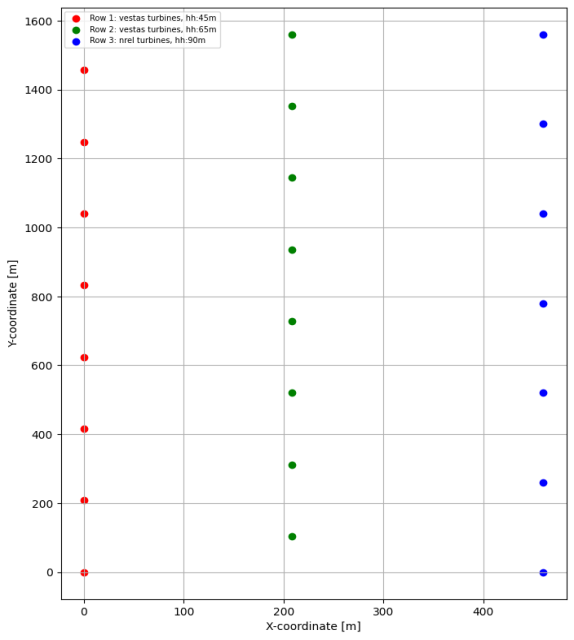
Downstream turbines were strategically elevated above upstream turbines, enabling the GA’s adaptive search to exploit vertical wind shear and minimize wake-induced energy losses. Through this evolutionary process, the algorithm converged on a vertically staggered hub-height configuration, positioning turbines at progressively greater elevations to optimize performance. Over 20 generations, the GA converged on a refined layout, featuring 16 Vestas V52 turbines; eight installed at 45 m and another eight at 45 m, as well as seven NREL 5 MW turbines placed at 90 m. The final optimized arrangement, which balances turbine type, placement, and hub height to maximize AEP and minimize wake and cost, is depicted in Figure 1.

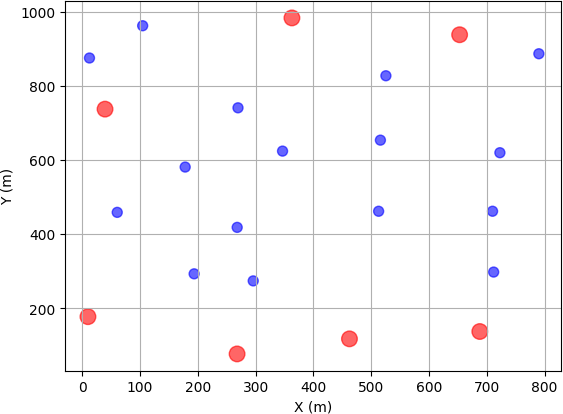
When the optimized layout, comprising 16 Vestas V52 turbines plus seven NREL 5 MW turbines, was repositioned from rigid rows into a staggered pattern, the GA revealed a noticeable AEP improvement of 3.7%. The resulting layout is illustrated in Figure 2.
The improvement in the AEP could be attributed with geometrical reordering which introduced alternating horizontal offsets between turbines, increasing wind exposure for downstream turbines. Based on comparative studies, staggered arrangements typically yield between 1.2% and 8.7% AEP gains, relative to aligned layouts with identical turbine types and spacing 32. Specifically, vertically and horizontally staggered farms, similar to our mixed hub-height layout presented, have shown to outperform uniform row configurations by approximately 5.4% in AEP in controlled simulations 33 The hub height of wind turbines plays a critical role in determining both energy production and power losses due to wake effects in wind farms. Taller hub heights typically access stronger and more consistent wind speeds, which can increase AEP. However, they also influence wake interactions between turbines, potentially amplifying power losses in downstream turbines.
The optimized performance of various turbine configurations is summarized in Table 1.

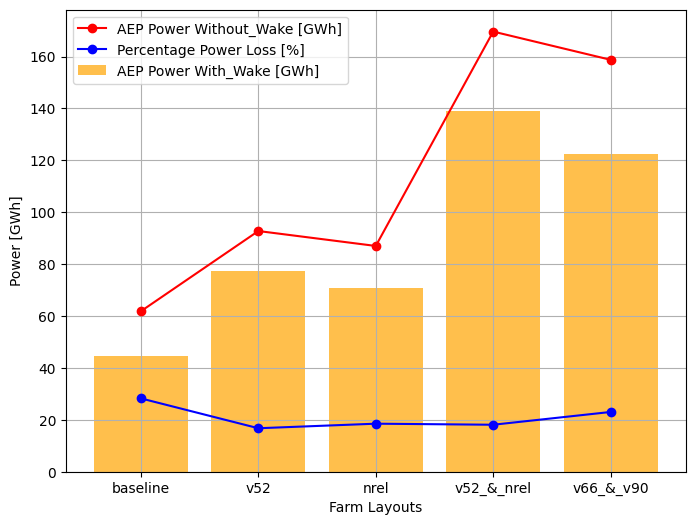
Simulation of the turbine layout was conducted under the assumption that all the turbines were operational, enabling an evaluation of the annual energy yield. The optimization significantly reduced wake losses across all modelled scenarios compared to the existing layout. Figure 3 illustrates the results from the simulation.
The current Ngong Hills configuration suffered from a 28% wake-related loss, yielding an AEP of 60 GWh and an LCOE of $62/MWh. When replaced with a homogeneous Vestas V52 layout (850 kW, 52 m rotor), wake losses dropped to 18.3%, boosting AEP to 92 GWh and reducing LCOE to $52/MWh. This trend aligns with findings by 7, who reported that layouts with uniform hub heights and tighter spacing still benefitted when optimized for turbine placement. Further, these findings align with broader industry observations where, reducing wake interaction effectively increases AEP, especially when turbines are uniformly sized and optimized for precise spacing, as shown in various layout optimization studies 8, 34. In the V52 layout, enhanced inter-turbine spacing and alignment with prevailing wind directions significantly diminished wake overlap, thus increasing energy capture and reducing overall cost per unit energy.
Similarly, the homogeneous NREL 5 MW layout exhibited 18.5% wake losses and achieved AEP of 86 GWh, with an LCOE equivalent to that of the V52 layout. The marginally lower AEP compared to the V52 only highlights the tradeoff between turbine scale and spacing constraints, larger turbines extract more power per unit but create stronger wakes, as also observed by 4.

The most striking outcome emerged from the hybrid configuration combining Vestas V52 and NREL 5 MW turbines, this design drastically reduced wake losses to 18.2%, increased AEP to 170 GWh, and achieved the lowest LCOE of $37/MWh. This result demonstrates the value of vertical staggering and mixed turbine sizing in wake mitigation; confirming similar conclusions by 8, who employed CFD-based surrogate models to show heterogeneous layouts yielded significantly higher energy capture compared to uniform alternatives.
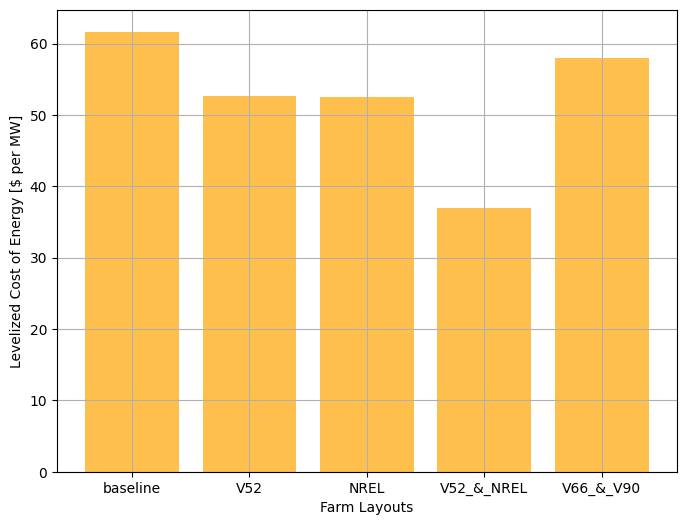
4.4. Levelized Cost of Energy ImplicationsThe LCOE for the different layouts was calculated and the results are presented in the Figure 4. The layout with Vestas V-52 and NREL-5MW, showed low annual levelized cost of energy.

When comparing layout scenarios by incorporating LCOE, AEP, and wake losses, LCOE reductions across scenarios point to compelling economic benefits from layout optimization. The homogeneous V52 and NREL layouts each achieved a LCOE of $52/MWh, representing about a 16% reduction from the existing layout’s $62/MWh. Most notably, the V52 + NREL scenario saw a dramatic LCOE reduction, by ~40%, emphasizing, how strategic turbine diversity and intelligent placement can significantly improve cost-efficiency. This aligns with global trends in wind farm design, where blended turbine strategies yield 10–15% LCOE reductions 7.
The results illustrate a clear interplay between the number of turbines, layout design, and cost-effectiveness. Homogeneous arrays of small turbines, such as 45 Vestas V52 turbines, offered the highest AEP by leveraging the high number of turbines. However, this increased turbine density also resulted in elevated capital expenditure per megawatt (CAPEX), ultimately leading to a relatively high LCOE. Conversely, the homogeneous NREL 5 MW layout, despite having fewer turbines, achieved nearly similar AEP with significantly lower installed capacity, indicating superior per-turbine energy capture and reduced capital cost intensity.
The mixed V52 + NREL layout emerged as the most cost-efficient configuration, achieving the lowest LCOE of $37/MWh while maintaining moderate wake losses (~18%). This hybrid design illustrates how mixing turbine models and rotor sizes can yield both high energy output and minimized cost, balancing generation and economic metrics effectively. In contrast, the mixed V66 + V90 layout incurred higher wake losses (22%) and recorded a higher LCOE of $58/MWh. This was driven by the premium cost of V90 turbines and increased wake-induced deficits, showing that larger turbines only yield economic benefits when mitigated by spacing and optimized placement.
These findings are consistent with prior research indicating that heterogeneous turbine arrangements, especially combining differing rotor diameters and hub heights, can reduce LCOE by approximately 5–10%, particularly in compact configurations 7. In complex terrain, mixed layouts have outperformed uniform designs by optimizing wake recovery and energy capture 35. Fundamentally, while homogeneous layouts offer simplicity in implementation, they often cannot exploit synergies between energy output and cost savings. Mixed configurations, though logistically more complex to design and maintain, enable more efficient space utilization and wake mitigation.
Rotor size also plays a crucial role in wake dynamics. Larger rotors like those on NREL 5 MW and V90 turbines generate broader wakes, necessitating wider spacing that increases land use and implementation cost. Smaller rotors, such as those on V52 and V66 turbines, enable denser placements but lead to cumulative wake interactions, which, if not properly optimized, can erode performance gains. The results suggest a hybrid placement strategy: positioning larger turbines in high-wind corridors and smaller units in upwind-interstitial zones, solidifying the advantage of mixed layouts when turbine cost ratios favor smaller units 35.
The incorporation of an explicit LCOE model proved critical: while maximizing AEP remains important, cost-effective designs may diverge, particularly since the homogeneous V52 layout slightly outperformed NREL in energy yield but resulted in significantly worse LCOE. Similarly, past studies emphasize that maximizing AEP alone, without accounting for cost, can mislead layout decisions 4, 8.
This study presented a simulation-driven analysis of wind farm layout optimization at Kenya’s Ngong Hills site, with a focus on maximizing AEP, minimizing wake losses, and reducing LCOE. Employing a Python-based GA, in conjunction with the Jensen wake model, four distinct layout scenarios: homogeneous layouts of small (Vestas V52) and large (NREL 5 MW) turbines, and two heterogeneous layouts (V52 + NREL, and V66 + V90), were evaluated over an 800,000 m² site.
Optimization results demonstrated that the heterogeneous V52 + NREL layout delivered the best economic and performance outcomes, achieving the lowest LCOE at approximately $37/MWh, while maintaining wake losses around 18% and yielding an AEP of approximately 170 GWh/year. The V66 + V90 configuration, though offering competitive AEP (158 GWh), encountered higher wake losses, illustrating the impact of turbine cost and aerodynamic spacing. These findings show that while homogeneous configurations simplify planning, mixing turbines of differing rotor diameters and hub heights provides a valuable mechanism to reduce wake interference and improve cost-efficiency.
Ultimately, the incorporation of economic metrics, rather than focusing solely on power yield, proved essential to identifying truly optimal layouts. The mixed V52 + NREL scenario demonstrates that blending turbine types allows farms to exploit the advantages of large turbines’ high per-unit output and small turbines’ density, while mitigating downsides of wake interference and high per-unit cost.
From a policy and design perspective, these results support a design philosophy that assesses site-specific wind regimes and cost structures, incorporates heterogeneous turbine mixes, and prioritizes economic performance alongside energy yield. For wind energy development in Kenya and other emerging regions with constrained land or capital, such an integrative approach could significantly improve the viability and sustainability of future wind projects.
The authors wish to thank Kenya Electricity Generating Company (KenGen) for providing wind data used in this study.
| [1] | Tumse, S., Bilgili, M., Yildirim, A., & Sahin, B. (2024). Comparative analysis of global onshore and offshore wind energy characteristics and potentials. Sustainability, 16(15), 6614. | ||
| In article | View Article | ||
| [2] | Baptista, J., Jesus, B., Cerveira, A., & Solteiro Pires, E. J. (2023). Offshore wind farm layout optimisation considering wake effect and power losses. Sustainability, 15(13), 9893. | ||
| In article | View Article | ||
| [3] | Liang, Z., & Liu, H. (2023). Layout optimization algorithms for the offshore wind farm with different densities using a full-field wake model. Energies, 16(16), 5916. | ||
| In article | View Article | ||
| [4] | Feng, J., & Shen, W. Z. (2017). Design optimization of offshore wind farms with multiple types of wind turbines. Applied Energy, 205, 1283–1297. | ||
| In article | View Article | ||
| [5] | Charhouni, N., Sallaou, M., & Mansouri, K. (2019). Realistic wind farm design layout optimization with different wind turbines types. International Journal of Energy and Environmental Engineering, 10(3), 307–318. | ||
| In article | View Article | ||
| [6] | Dykes, K. (2020). Optimization of Wind Farm Design for Objectives Beyond LCOE. Journal of Physics: Conference Series, 1618(4), Article 042039. | ||
| In article | View Article | ||
| [7] | Stanley, A. P., & Ning, A. (2019). Coupled wind turbine design and layout optimization with nonhomogeneous wind turbines. Wind Energy Science, 4(1), 99-114. | ||
| In article | View Article | ||
| [8] | Wang, Z., Tu, Y., Zhang, K., Han, Z., Cao, Y., & Zhou, D. (2024). An optimization framework for wind farm layout design using CFD-based Kriging model. Ocean Engineering, 293, 116644. | ||
| In article | View Article | ||
| [9] | Chen, K., Lin, J., Qiu, Y., Liu, F., & Song, Y. (2022). Joint optimization of wind farm layout considering optimal control. Renewable Energy, 182, 787-796. | ||
| In article | View Article | ||
| [10] | Balasubramanian, K., Thanikanti, S. B., Subramaniam, U., & Sichilalu, S. (2020). A novel review on optimization techniques used in wind farm modelling. Renewable Energy Focus, 35, 84-96. | ||
| In article | View Article PubMed | ||
| [11] | Lopez-Villalobos, C. A., Martinez-Alvarado, O., Rodriguez-Hernandez, O., & Romero-Centeno, R. (2022). Analysis of the influence of the wind speed profile on wind power production. Energy Reports, 8, 8079-8092. | ||
| In article | View Article | ||
| [12] | Machidon, D., Istrate, M., & Beniuga, R. (2024). Wind Shear Coefficient Estimation Based on LIDAR Measurements to Improve Power Law Extrapolation Performance. Remote Sensing, 17(1), 23. | ||
| In article | View Article | ||
| [13] | Schelbergen, M., Kalverla, P. C., Schmehl, R., & Watson, S. J. (2020). Clustering wind profile shapes to estimate airborne wind energy production. Wind Energy Science Discussions, 2020, 1-34. | ||
| In article | View Article | ||
| [14] | Manwell, J. F., McGowan, J. G., & Rogers, A. L. (2009). Wind Energy Explained: Theory, Design and Application. 705. | ||
| In article | View Article | ||
| [15] | Jain, P. (2011). Wind energy engineering. McGraw-Hill. http:// accessengineeringlibrary.com/browse/wind-energy-engineering. | ||
| In article | |||
| [16] | Stevens, R. J., & Meneveau, C. (2017). Flow structure and turbulence in wind farms. Annual review of fluid mechanics, 49(1), 311-339. | ||
| In article | View Article | ||
| [17] | Hwang, C., Jeon, J. H., Kim, G. H., Kim, E., Park, M., & Yu, I. K. (2015). Modelling and simulation of the wake effect in a wind farm. Journal of International Council on Electrical Engineering, 5(1), 74-77. | ||
| In article | View Article | ||
| [18] | Bastankhah, M., & Porté-Agel, F. (2014). A new analytical model for wind-turbine wakes. Renewable energy, 70, 116-123. | ||
| In article | View Article | ||
| [19] | Triantafyllou, P., & Kaldellis, J. K. (2021). Wind turbine wake models' evaluation for different downstream locations. Renewable Energy and Environmental Sustainability, 6, 40. | ||
| In article | View Article | ||
| [20] | Frandsen, S. T. (2007). Turbulence and turbulence-generated structural loading in wind turbine clusters. | ||
| In article | |||
| [21] | Gao, X., Li, Y., Zhao, F., & Sun, H. (2020). Comparisons of the accuracy of different wake models in wind farm layout optimization. Energy Exploration & Exploitation, 38(5), 1725-1741. | ||
| In article | View Article | ||
| [22] | Zhan, L., Letizia, S., & Iungo, G. V. (2020). Optimal tuning of engineering wake models through lidar measurements. Wind Energy Science, 5(4), 1601-1622. | ||
| In article | View Article | ||
| [23] | Wind Turbine Cost: Worth The Million-Dollar Price In 2022? (2024, June 3). https://weatherguardwind.com/how-much-does-wind-turbine-cost-worth-it/. | ||
| In article | |||
| [24] | Reddy, S. R. (2020). Wind Farm Layout Optimization (WindFLO): An advanced framework for fast wind farm analysis and optimization. Applied Energy, 269, 115090. | ||
| In article | View Article | ||
| [25] | Khanali, M., Ahmadzadegan, S., Omid, M., Keyhani Nasab, F., & Chau, K. W. (2018). Optimizing layout of wind farm turbines using genetic algorithms in Tehran province, Iran. International Journal of Energy and Environmental Engineering, 9(4), 399-411. | ||
| In article | View Article | ||
| [26] | Gatscha, S. (2016). Generic Optimization of a Wind Farm Layout using a Genetic Algorithm (Masters thesis). University of Natural Resources and Life Science, Vienna. | ||
| In article | |||
| [27] | Valotta Rodrigues, R., Pedersen, M. M., Schøler, J. P., Quick, J., & Réthoré, P. E. (2024). Speeding up large-wind-farm layout optimization using gradients, parallelization, and a heuristic algorithm for the initial layout. Wind Energy Science, 9(2), 321-341. | ||
| In article | View Article | ||
| [28] | Lee, S., Soak, S., Kim, K., Park, H., & Jeon, M. (2008). Statistical properties analysis of real world tournament selection in genetic algorithms. Applied intelligence, 28(2), 195-205. | ||
| In article | View Article | ||
| [29] | Bhargava, S. (2013). A Note on Evolutionary Algorithms and Its Applications. Adults Learning Mathematics, 8(1), 31-45. | ||
| In article | |||
| [30] | Ma, Y., Archer, C. L., & Vasel-Be-Hagh, A. (2022). The Jensen wind farm parameterization. Wind Energy Science, 7(6), 2407-2431. | ||
| In article | View Article | ||
| [31] | Shakoor, R., Hassan, M. Y., Raheem, A., & Wu, Y.-K. (2016). Wake effect modelling: A review of wind farm layout optimization using Jensen’s model. Renewable and Sustainable Energy Reviews, 58, 1048–1059. | ||
| In article | View Article | ||
| [32] | Hendrawati, D., Soeprijanto, A., & Ashari, M. (2019). Turbine wind placement with staggered layout as a strategy to maximize annual energy production in onshore wind farms. International Journal of Energy Economics and Policy, 9(2), 334-340. | ||
| In article | |||
| [33] | Yeghikian, M., Ahmadi, A., Dashti, R., Esmaeilion, F., Mahmoudan, A., Hoseinzadeh, S., & Garcia, D. A. (2021). Wind farm layout optimization with different hub heights in manjil wind farm using particle swarm optimization. Applied Sciences, 11(20), 9746. | ||
| In article | View Article | ||
| [34] | Ziyaei, P., & Khorasanchi, M. (2025). Effect of cost elements on optimum layout of an offshore wind farm. Applied Ocean Research, 158, 104537. | ||
| In article | View Article | ||
| [35] | Tang, X., Yang, Q., Wang, K., Stoevesandt, B., & Sun, Y. (2018). Optimisation of wind farm layout in complex terrain via mixed‐installation of different types of turbines. IET Renewable Power Generation, 12(9), 1065-1073. | ||
| In article | View Article | ||
Published with license by Science and Education Publishing, Copyright © 2025 Omboto J.K, Kamau J.N, Saoke C.O and Wekesa D.W
 This work is licensed under a Creative Commons Attribution 4.0 International License. To view a copy of this license, visit
http://creativecommons.org/licenses/by/4.0/
This work is licensed under a Creative Commons Attribution 4.0 International License. To view a copy of this license, visit
http://creativecommons.org/licenses/by/4.0/
| [1] | Tumse, S., Bilgili, M., Yildirim, A., & Sahin, B. (2024). Comparative analysis of global onshore and offshore wind energy characteristics and potentials. Sustainability, 16(15), 6614. | ||
| In article | View Article | ||
| [2] | Baptista, J., Jesus, B., Cerveira, A., & Solteiro Pires, E. J. (2023). Offshore wind farm layout optimisation considering wake effect and power losses. Sustainability, 15(13), 9893. | ||
| In article | View Article | ||
| [3] | Liang, Z., & Liu, H. (2023). Layout optimization algorithms for the offshore wind farm with different densities using a full-field wake model. Energies, 16(16), 5916. | ||
| In article | View Article | ||
| [4] | Feng, J., & Shen, W. Z. (2017). Design optimization of offshore wind farms with multiple types of wind turbines. Applied Energy, 205, 1283–1297. | ||
| In article | View Article | ||
| [5] | Charhouni, N., Sallaou, M., & Mansouri, K. (2019). Realistic wind farm design layout optimization with different wind turbines types. International Journal of Energy and Environmental Engineering, 10(3), 307–318. | ||
| In article | View Article | ||
| [6] | Dykes, K. (2020). Optimization of Wind Farm Design for Objectives Beyond LCOE. Journal of Physics: Conference Series, 1618(4), Article 042039. | ||
| In article | View Article | ||
| [7] | Stanley, A. P., & Ning, A. (2019). Coupled wind turbine design and layout optimization with nonhomogeneous wind turbines. Wind Energy Science, 4(1), 99-114. | ||
| In article | View Article | ||
| [8] | Wang, Z., Tu, Y., Zhang, K., Han, Z., Cao, Y., & Zhou, D. (2024). An optimization framework for wind farm layout design using CFD-based Kriging model. Ocean Engineering, 293, 116644. | ||
| In article | View Article | ||
| [9] | Chen, K., Lin, J., Qiu, Y., Liu, F., & Song, Y. (2022). Joint optimization of wind farm layout considering optimal control. Renewable Energy, 182, 787-796. | ||
| In article | View Article | ||
| [10] | Balasubramanian, K., Thanikanti, S. B., Subramaniam, U., & Sichilalu, S. (2020). A novel review on optimization techniques used in wind farm modelling. Renewable Energy Focus, 35, 84-96. | ||
| In article | View Article PubMed | ||
| [11] | Lopez-Villalobos, C. A., Martinez-Alvarado, O., Rodriguez-Hernandez, O., & Romero-Centeno, R. (2022). Analysis of the influence of the wind speed profile on wind power production. Energy Reports, 8, 8079-8092. | ||
| In article | View Article | ||
| [12] | Machidon, D., Istrate, M., & Beniuga, R. (2024). Wind Shear Coefficient Estimation Based on LIDAR Measurements to Improve Power Law Extrapolation Performance. Remote Sensing, 17(1), 23. | ||
| In article | View Article | ||
| [13] | Schelbergen, M., Kalverla, P. C., Schmehl, R., & Watson, S. J. (2020). Clustering wind profile shapes to estimate airborne wind energy production. Wind Energy Science Discussions, 2020, 1-34. | ||
| In article | View Article | ||
| [14] | Manwell, J. F., McGowan, J. G., & Rogers, A. L. (2009). Wind Energy Explained: Theory, Design and Application. 705. | ||
| In article | View Article | ||
| [15] | Jain, P. (2011). Wind energy engineering. McGraw-Hill. http:// accessengineeringlibrary.com/browse/wind-energy-engineering. | ||
| In article | |||
| [16] | Stevens, R. J., & Meneveau, C. (2017). Flow structure and turbulence in wind farms. Annual review of fluid mechanics, 49(1), 311-339. | ||
| In article | View Article | ||
| [17] | Hwang, C., Jeon, J. H., Kim, G. H., Kim, E., Park, M., & Yu, I. K. (2015). Modelling and simulation of the wake effect in a wind farm. Journal of International Council on Electrical Engineering, 5(1), 74-77. | ||
| In article | View Article | ||
| [18] | Bastankhah, M., & Porté-Agel, F. (2014). A new analytical model for wind-turbine wakes. Renewable energy, 70, 116-123. | ||
| In article | View Article | ||
| [19] | Triantafyllou, P., & Kaldellis, J. K. (2021). Wind turbine wake models' evaluation for different downstream locations. Renewable Energy and Environmental Sustainability, 6, 40. | ||
| In article | View Article | ||
| [20] | Frandsen, S. T. (2007). Turbulence and turbulence-generated structural loading in wind turbine clusters. | ||
| In article | |||
| [21] | Gao, X., Li, Y., Zhao, F., & Sun, H. (2020). Comparisons of the accuracy of different wake models in wind farm layout optimization. Energy Exploration & Exploitation, 38(5), 1725-1741. | ||
| In article | View Article | ||
| [22] | Zhan, L., Letizia, S., & Iungo, G. V. (2020). Optimal tuning of engineering wake models through lidar measurements. Wind Energy Science, 5(4), 1601-1622. | ||
| In article | View Article | ||
| [23] | Wind Turbine Cost: Worth The Million-Dollar Price In 2022? (2024, June 3). https://weatherguardwind.com/how-much-does-wind-turbine-cost-worth-it/. | ||
| In article | |||
| [24] | Reddy, S. R. (2020). Wind Farm Layout Optimization (WindFLO): An advanced framework for fast wind farm analysis and optimization. Applied Energy, 269, 115090. | ||
| In article | View Article | ||
| [25] | Khanali, M., Ahmadzadegan, S., Omid, M., Keyhani Nasab, F., & Chau, K. W. (2018). Optimizing layout of wind farm turbines using genetic algorithms in Tehran province, Iran. International Journal of Energy and Environmental Engineering, 9(4), 399-411. | ||
| In article | View Article | ||
| [26] | Gatscha, S. (2016). Generic Optimization of a Wind Farm Layout using a Genetic Algorithm (Masters thesis). University of Natural Resources and Life Science, Vienna. | ||
| In article | |||
| [27] | Valotta Rodrigues, R., Pedersen, M. M., Schøler, J. P., Quick, J., & Réthoré, P. E. (2024). Speeding up large-wind-farm layout optimization using gradients, parallelization, and a heuristic algorithm for the initial layout. Wind Energy Science, 9(2), 321-341. | ||
| In article | View Article | ||
| [28] | Lee, S., Soak, S., Kim, K., Park, H., & Jeon, M. (2008). Statistical properties analysis of real world tournament selection in genetic algorithms. Applied intelligence, 28(2), 195-205. | ||
| In article | View Article | ||
| [29] | Bhargava, S. (2013). A Note on Evolutionary Algorithms and Its Applications. Adults Learning Mathematics, 8(1), 31-45. | ||
| In article | |||
| [30] | Ma, Y., Archer, C. L., & Vasel-Be-Hagh, A. (2022). The Jensen wind farm parameterization. Wind Energy Science, 7(6), 2407-2431. | ||
| In article | View Article | ||
| [31] | Shakoor, R., Hassan, M. Y., Raheem, A., & Wu, Y.-K. (2016). Wake effect modelling: A review of wind farm layout optimization using Jensen’s model. Renewable and Sustainable Energy Reviews, 58, 1048–1059. | ||
| In article | View Article | ||
| [32] | Hendrawati, D., Soeprijanto, A., & Ashari, M. (2019). Turbine wind placement with staggered layout as a strategy to maximize annual energy production in onshore wind farms. International Journal of Energy Economics and Policy, 9(2), 334-340. | ||
| In article | |||
| [33] | Yeghikian, M., Ahmadi, A., Dashti, R., Esmaeilion, F., Mahmoudan, A., Hoseinzadeh, S., & Garcia, D. A. (2021). Wind farm layout optimization with different hub heights in manjil wind farm using particle swarm optimization. Applied Sciences, 11(20), 9746. | ||
| In article | View Article | ||
| [34] | Ziyaei, P., & Khorasanchi, M. (2025). Effect of cost elements on optimum layout of an offshore wind farm. Applied Ocean Research, 158, 104537. | ||
| In article | View Article | ||
| [35] | Tang, X., Yang, Q., Wang, K., Stoevesandt, B., & Sun, Y. (2018). Optimisation of wind farm layout in complex terrain via mixed‐installation of different types of turbines. IET Renewable Power Generation, 12(9), 1065-1073. | ||
| In article | View Article | ||