Soil-transmitted helminth infections are widespread neglected tropical diseases targeted for elimination in Cameroon according to a road map set by health decisionmakers to scale up from control to elimination of STH by 2030. However, precision mapping remained a main limitation to achieve this goal. This study aimed to assess the prevalence and intensity of infections of soil-transmitted helminth infections in three health districts of three ecological zones of Cameroon. This was a community-based cross-sectional study undergone from April 2024 to August 2024. Fresh stool samples provided by consenting residents were analyzed using duplicate Kato-katz smears technique for detection and counting of helminth eggs. Prevalence of specific helminth infection was determined, then parasitic loads and density of infection were estimated. Data were statistically analyzed considering statistical difference significant if p-value < 0.05. A total of 658 participants were included in the study. Three STH species were detected namely Ascaris lumbricoides, Trichuris trichiura, and hookworm. Overall prevalence of STH ranged between 18.7% (40/214) in the savannah area and 24.9% (57/229) in the forestry area. STH monospecific infection represented 95.6%. Ascaris lumbricoides infections had the highest prevalence and hookworm infections the lowest irrespective of ecological area. A. lumbricoides infections showed significant higher prevalence in 5 to 9 years old children in Kekem health district (p=0.019). All A. lumbricoides infections were of light intensity of infections, while whipworm and hookworm infections were of light to moderate intensities. Prevalence of STH infections remained over the threshold for chemoprevention in the forestry area. None of the factors assessed significantly influenced the prevalence of any of the detected STH infections. Intensities of infections were predominantly light, with occurrence of moderate intensities of infections due to hookworm and whipworm. This study highlighted for evaluation of STH prevalence in sentinel sites before launching the next control strategy campaign.
Soil-transmitted helminth (STH) infections are among most widespread neglected tropical diseases (NTDs) which have health impact in resource-limited rural and urban areas of sub-Saharan Africa 1, 2. Main STH are Ascaris lumbricoides, Trichuris trichiura, hookworms (Ancylostoma duodenale and Necator americanus) and Strongyloides stercoralis 3, 4. Human acquires soil-transmitted helminth infections either by ingesting uncooked food containing embryonated eggs of A. lumbricoides or T. trichiura, or through skin penetration of filariform larva contained in moistened soils contaminated by hookworm eggs or first stage larvae of S. stercoralis 4, 5. STH infections are perpetuated by poor hygiene, and reinforce social determinants of poverty, illiteracy, poor nutrition, and a lack of access to health education as well as safe water, sanitation and hygiene 3, 4. STH-related health impact includes nutritional status and cognitive development impairment in children, diarrhea and blood in stools usually reported among school-aged children who harbor moderate to heavy parasites loads 1, 3, 5. The World Health Organization (WHO) estimates that 820 million people are infected with roundworms, 460 million with whipworms, 440 million with hookworms and 300–600 million with Strongyloides stercoralis worldwide 1, 4. In Cameroon, STH infections are endemic with moderate to high prevalence in all regions of the country 5, 6, 7.
Cameroon public health ministry implements the recommended integrated approach to control and eliminate STH as a public health problem since 2003 through the National Program for Control of STH and Schistosomiasis (NPCSIH) 5. This integrated approach recommended by 54th World Health Assembly held in 2001 to all STH endemic countries included regular mass treatment to high-risk groups also termed preventive chemotherapy or chemoprevention with anthelminthic drugs particularly school-aged children complemented by simultaneous implementation of plans for basic sanitation and adequate safe water supplies through improvement of water, sanitation and hygiene (WASH) and behavior change 1, 3, 8. A guideline for preventive chemotherapy against Strongyloides stercoralis infections was published in 2024 which recommends in all endemic settings where the prevalence of S. stercoralis infection among school-aged children is 5% and above annual mass drug administration with single dose ivermectin 200 µg/kg in all age groups from 5 years 3, 4.
Recent impact assessments of the STH chemoprevention in Cameroon reported significant decreased of prevalence as well intensity of infections of STH among school-aged children in 2019 reaching up to 90% overall reduction for STH under a national preventive chemotherapy 87% coverage 5. The decrease of STH prevalence and intensity of infections urged the National Program for Control of STH and Schistosomiasis (NPCSIH) to endorse the WHO roadmap elaborated and published in 2021 for elimination of STH by 2030 which recommends a shift from control to elimination of STH by decreasing the threshold of prevalence of any STH needed for chemoprevention intervention and extending chemoprevention to other at-risk groups 5. The WHO roadmap published in 2021 recommended elimination of morbidity due to STH as public health problem in endemic countries by 2030 through extension of preventive chemotherapy of STH in areas where baseline prevalence of soil-transmitted helminths is 20% or higher in pre-school children, school-aged children, adolescent girls, women of reproductive age and pregnant women, including those coinfected with HIV 1, 3, 9. Cameroon public health ministry via the National Program for Control of STH and Schistosomiasis (NPCSIH) therefore also published a road map in 2021 which advocates complete mapping precision of STH transmission settings as the cornerstone of the new approach as well as scale-up and expand access to treatment to all populations in need namely preschool-aged children and adults 5. However, in Cameroon precision mapping remains the least available data and a gap to achieve this goal in Cameroon as an estimated 83% of health areas were yet to be mapped in the latest surveys 5. Therefore, updated assessments of prevalence and intensities of STH infections are required to recommend appropriate measures to public health decisionmakers to achieve “Sustainable Development Goal 3 of the universal health coverage by 2030 which aims to ensure healthy lives and promote well-being for all at all ages”. Epidemiological studies focused only on school-aged children may be missing information on the true level of these helminth infections. Community-based assessments of the prevalence and intensities of infections of these diseases are required to recommend the elimination paradigm by 2030.
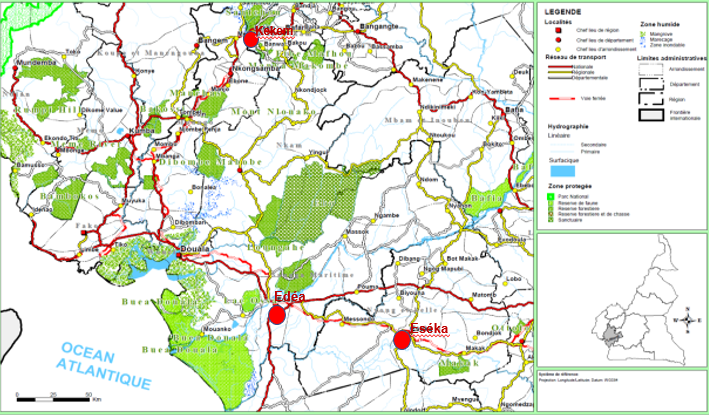
This study was therefore designed to evaluate and update the prevalence and intensities of infections of soil-transmitted helminth infections in three health districts situated in different ecological zones of Cameroon namely Edea HD in the Littoral region, Eseka HD in a clearing of the center region and Kekem HD the savannah area of western region.
This was a cross-sectional and analytical study undergone between April 2024 and August 2024 in three health districts of three regions of Cameroon namely Edéa HD in the Littoral region, Eséka HD in the Center region and Kekem HD in the West region.
Edéa is the headquarter of the Sanaga Maritime division in the Littoral region of Cameroon. Its geographical coordinates are 3°48'0" N and 10°7'60" E. Edea is an urban area made of two subdivisions namely Edea 1 and Edea2 10, 11. The National Institute of Statistics estimated in 2021 the population of Edea1 at 64761 inhabitants a population density of 46 inhabitants/km2 11. Housing is mainly precarious in most quarters of the town. Sanitation conditions are poor in large parts of the three districts.
Eseka is the headquarter of the Nyong-Ekelle division in the Center region of . Its geographic coordinates are 3°39'0" N and 10°46'0" E. Eseka is a semi-urban area with an estimated 23 772 inhabitants 10.
Kekem HD is a subdivision of the Haut-Nkam division in the savannah area in West region of Cameroon. Geographic coordinates of Kekem are 5°7'60" N et 10°3'0" E. Kekem is a semi-urban area with an estimate population of 489000 inhabitants.
Main occupations of residents in the three health districts are farming and few civil servants. The hydrological network varies between study areas, being dominated by the Sanaga river and its tributaries at Edea 1 HD 11, river Nyong and tributaries at Eseka HD 10, the river Nkam and tributaries at Kekem HD.

The study protocol was approved by the Institutional review board of the Faculty of Medicine and Pharmaceutical of the University of Douala, the Institutional Ethic Committee of the University of Douala hosted by the Faculty of Medicine and Pharmaceutical Sciences, and the Regional Delegations of Public Health of the Littoral region in Douala and the center region in Yaoundé and the National Ethic Committee. The Institutional Ethic Committee of the University of Douala and the National Ethic Committee and the Institutional Ethic Committee of the University of Douala granted the ethical clearances N°4023CEI-Udo/10/2023/M and N°2024/02/143/CE/CNERSH/SP respectively for this study. The Regional Delegations of Public Health of the Littoral region as well as the center region granted each a research authorization to undertake the study. The district medical officer of each of the health district was approached to seek an authorization to access the population and waterbody sites. The study investigators collected data on the field with assistance of community health workers (CHW).
Then the local administrative head, the medical head of the health district, the local traditional head of each quarter and the community health workers were met for presentation and explanation of the study protocol. After their acceptance to undergo the study, a meeting was held at the local traditional head to explain the aim of the study and ask for their consent to participate to the study. Each person who filled the study criteria and volunteered to participate in the study or who agree to let his child participate in the study was asked to sign the study inform consent before its enrollment.
2.3. Study CriteriaAll inhabitants aged at least 5 years of each selected quarter of the Edea 1 HD, the Eseka HD or the Kekem HD who was resident in the area since at least six months and: i) have not taken any anthelminthic treatment during the preceding four weeks; ii) have signed the study informed consent; iii) have given an appropriate quantity of stool sample. For under 15 years person, its parent or legal guardian should have signed the study informed consent.
The minimum sample size per ecological area was calculated using the Cochrane’s formula N= z²xp (1-p)/d². where N is the minimum sample size; P is the prevalence of STH among school aged children in the region; d is the margin error (d=0.05, 95% CI); z is the Z-score (z=1.96; 95% CI). Therefore, according to more recent mapping data, the respective prevalence for the Littoral region, Center region and West region are 13%, 25.12% and 10.4% 6, 7. After calculation, the minimum sample size for each health district was N=174 participants in Edea 1 (Littoral region); 289 participants in Eseka HD (Centre region) and 144 participants in Kekem HD (West region).
2.4. Data CollectionRandom sample technique was used to select the representative sample size in each HD. In each study area, samples were collected with the guidance of community health workers. Samples collection took place in four quarters at Edea 1 namely Edea Gare, Amour, Nkongmondo and Pongo. At Eseka, samples were collected in seven quarters namely Adna, Aviation, Likabo, Lycée, Pk3, Tetem and Village; and at Kekem HD, samples were collected in three quarters namely Quartier 14, Mbafam and Mboebo.
Each volunteer who agreed (or who allowed his child) to participate in the study, was questioned to collect sociodemographic data following a pre-tested questionnaire notably sex, age, residence, duration in the area, occupation, ownership of latrine facility, use of latrines, open air defecation, washing hands before eating, walking barefooted. Then he was handled a labeled clean plastic container with a plastic spoon to provide a stool sample in the following morning at the nearest health facility.
Fresh stool samples collected were preserved each with 0.5 ml of 37% formol, then immediately transported to the laboratory of the Faculty of Medicine and Pharmaceutical Sciences of the University of Douala for analysis. Stool samples were analyzed using Kato-katz techniques by microscopically examining duplicate stool smears for detection and count of helminth eggs according to routine laboratory procedures 12, 13. Eggs loads were expressed per gram of feces using a 41.67 mg molded stool sample then classified as intensity of infection according to WHO classification 2. This classification of intensity of infection is as follow: 1) for A. lumbricoides infections, light infections between 1 and 4999 epg, moderate between 5000 and 49 999 epg, and heavy infections if parasite load ≥ 50 000 epg; 2) for T. trihiura infections, light infections between 1 and 999 epg, moderate between 1000 and 9 999 epg, and heavy infections if parasite load ≥ 10 000 epg; for hookworms infections, light infections between 1 and 1999 epg, moderate between 2000 and 3 999 epg, and heavy infections if parasite load ≥ 4 000 epg.
2.5. Data AnalysisData gathered were statistically analyzed using SPSS.20 software and the Fisher Exact test to compare quantitative data and for any association of prevalence of helminth infection and any sociodemographic factor. Difference was considered significant for any p-value less than 0.05.
A total of 658 residents participated in the study including 215 (32.7%) at Edea (Littoral region), 229 (34.8%) at Eseka (Center region) and 214 (32.5%) at Kekem (West region). The sex ratio was 0.86 (304/354) in the overall sample study but varies within health district with an almost predominance of females.
3.1. Biodiversity and Prevalence of Soil-helminth Species DetectedThree main soil-transmitted helminths were detected in stool samples in each of the health district including roundworm (Ascaris lumbricoides), whipworm (Trichuris trichiura) and hookworm eggs. Helminth species detected were found as monospecific or combination of two parasite species. STH infections were found as monospecific in 151 participants (95.6%), and as multiple infection by A. lumbricoides and T. trichiura in 7 participants (4.4%).
The three soil-transmitted helminth species detected in each of the ecological zone were in line with previous studies in each of the three regions of Cameroon as well as in other health districts of the Littoral region 6, 7, 14, 15, 16. However, more helminth species could have been detected with an additional technique like the Baermann flotation technique which detects specifically Strongyloides stercoralis first stage larva as well as formol ether concentration technique as reported at Loum in the Littoral region earlier [17]. Examination of duplicate stool smears using the Kato-katz technique has increased the sensitivity to enable detection of maximum helminth eggs.
Regarding prevalence of helminth infection, the prevalence recorded was close to previous reports in health districts of the Littoral region including Melong HD 14, Mambanda, Dibombari, Abo and Dibombari HD 15. However, prevalence between the latest health district varied significantly from each other 15. Prevalence recorded in this study were higher than previous report ten years ago in quarters of Douala metropolis, the chief town of the Littoral region of Camerron as well as report on global prevalence of STH in each of the three regions 6, 7, 16.
Prevalence recorded at Edea and Eseka were over the threshold indicated for chemoprevention with specific anthelminthic drugs in to risk groups 1, 3, 5. Persistence of almost moderate prevalence of these poor hygiene-related helminth infections indicates persistence of poor respect of handwashing practice before meal and persistence of open-air defecation. This trend indicates an urgent need to improve sanitation conditions and hygiene practices in the three health districts investigated in this study to complement any ongoing anthelminthic chemoprevention campaign.
3.2. Prevalence of Specific Soil-transmitted Helminth According to Ecological AreaAccording to Table 1, both prevalence of overall STH infection and prevalence of each specific STH infection showed similar trend between the HD. There was not significant variation of the prevalence of overall STH between health districts (p=0.23) as well as for each of the specific STH infection including A. lumbricoides (p=0.39), T. trichiura (p=1.42) or hookworm (p=0.32). However, the lowest prevalence of overall STH infections was recorded in the savannah HD at Kekem (18.7%) and the highest prevalence in the forestry health district at Eseka (24.9%). This indicated almost similar transmission pattern of STH in the forestry urban area, the urban area at Edea and the semi-urban area in the savannah zone at Kekem.
Ecological zone did not significantly influence prevalence of any of the specific soil-transmitted helminth detected in the study. However, the prevalence of each of the specific STH infection was highest in the forestry area at Eseka HD and lowest in the savannah area at Kekem HD. The overall prevalence of A. lumbricoides was however highest in every health district followed by T. trichiura and hookworm.
Monospecific infections and multiple helminth infections represented 95.6% and 4.4% of the STH infections recorded respectively. The only multiple helminth infection recorded was A. lumbricoides and T. trichiura in each of the HD.
Concerning prevalence of specific STH infection recorded in this study, prevalence of A. lumbricoides infections were higher than previous reports in the respective regions whereas prevalence of T. trichiura infections were low than previous reports in those regions 6, 7 as well as reports previous in other health districts of the Littoral region namely Melong HD 14, Loum HD [17]. Prevalence of hookworm infections recorded in each of the study area was however low compared to reports in a Melong health district in the Littoral region of Cameroon 14. The difference is due the almost focus data gathered in this study whereas the latest studies referred to mean prevalence of many health districts. Although differences were noticed among prevalence recorded between ecological areas, the transmission trend seem similar since the differences were not significant. Control strategies need therefore to be strengthened to achieve elimination as stated in the road map by the ministry of public health 5.
3.3. Influence of Residence Area on Prevalence of Specific STH Infection in Each HDAs shown in Table 2, there was no significant variation of prevalence of either A. lumbricoides, T. trichiura or hookworm between quarters in either health district. This indicted similar transmission trends or habits of residents in the same health district.
As indicated in Table 3, sex did not significantly influence the prevalence of specific soil-transmitted helminth in health districts. However, female had higher prevalence in the overall study population. Trends in prevalence of specific STH infection varied between health districts. For A. lumbricoides infections, prevalence was higher though not significant among females in Eseka HD and Kekem HD as well in the population study, whereas males had higher prevalence in Edea HD. Concerning T. trichiura infections, higher prevalence among females in the overall population study and Eseka HD. Hookworm infections showed higher though not significant prevalence in the health districts of the center and Littoral regions (Eseka HD and Edea HD) and the overall population study.
Regrading influence of age, Table 3 indicates that age had no significant influence on prevalence of hookworm or T. trichiura in any of the health district. the infection by any of the soil-transmitted helminth specie in Edea and Eseka health districts. The only significant influence of age was recorded at Kekem HD for A. lumbricoides infections with higher prevalence recorded in 5 to 9 years old children (p=0.019). However, the prevalence recorded in either health district among anti-helminthic treatment target (school-aged children) indicated a low transmission of infection in the areas.
As indicated in Table 4, distribution of specific STH infections parasite loads varied between parasites and health district with an almost predominance of low parasite loads. Parasite loads of A. lumbricoides and hookworms were low in all health districts, all infected cases harboring light infections. There were few cases of moderate intensities of infection for T. trichiura in the three health districts.
Parasitic load ranged between 48 epg of feces and 4560 epg of feces for A. lumbricoides at Edea1 with an arithmetic mean range between 1155.5±502.7 epg of feces in Kekem HD and 1838.4±60.1 epg of feces in Eseka HD. For T. trichiura infections, mean egg loads ranged between 955.2±480.3 in Edea HD and 1432.8±842.1 epg of feces at Kekem. Mean egg loads recorded were lowest for hookworm with a range between 702±259.9 epg of feces in the forest area at Eseka and 740.6±356.3 epg of feces at Edea1.
As shown in Table 4, all intensities of infection were light for A. lumbricoides and hookworm infections irrespective of ecological zone, whereas intensities of infection of T. trichiura infections varied between light and moderate with a predominance of light intensities of infection. For hookworm infections, the three categories of intensities of infection s were recorded in the three ecological areas. Moderate intensities of infections by T. trichiura represented 1.4%, 2.2% and 1.9% of the study population at Edea1, Eseka and Kekem respectively. Moderate to heavy intensities of infections by hookworm represented 1.4%, 2.2% and 1.4% of the study populations at Edea1, Eseka and Kekem respectively. Persistence of moderate infections by T. trichiura as well as persistence of moderate to heavy intensities of hookworm infection in the three ecological areas called for a need to intensify ongoing chemoprevention with anthelminthic drug and complement improvement sanitation infrastructure to impede environmental contamination with human excreta. This persistence of moderate to heavy infections of hookworm and T. trichiura infections STH over 2% at Eseka might hamper implementation of the STH elimination phase in the three ecological zones investigated. In a previous study in communities of the Littoral region of Cameroon, all A. lumbricoides and T. trichiura infections were of light intensity and only hookworms had moderate intensity of infection 15. Persisting occurrence of moderate to heavy hookworm intensities of infection might also predict a possible occurrence of a STH-associated morbidity like anemia as reported previously in Melong health district, a nearest community to Kekem health district where hookworm infections were found associated to occurrence of moderate to severe anemia 14. Considering risk of STH related morbidity in the investigated study areas, improved sanitation as well as awareness to hygienic practices should be continued together with regular deworming through the integrated elimination plan in both children and adults.
Ascaris lumbricoides, Trichuris trichiura and hookworm transmission persist in the three health districts at moderate prevalence. Intensities of infection are predominantly but moderate to heavy intensities of infection still occur in the three ecological for T. trichiura and hookworm infections. Prevalence of overall STH infections as well as prevalence of specific STH infection was not influenced significantly by ecological zone. Data from this study indicated an increasing need to intensify chemoprevention strategy associated with improvement of water, sanitation and hygiene practice in all age groups to foresee the STH elimination in Cameroon.
The authors of this study particularly thank the personnel of the Edea, Eseka and Kekem health districts for having during collection of study samples. They also thank the laboratory technicians of the Faculty of Medicine and Pharmaceutical Sciences of the University of Douala for their help in management of study samples.
The authors of this manuscript declared that they had no conflict of interests regarding this study. The study was financed by the authors.
TK designed the study, collected and analyzed data, and wrote the manuscript. CBM collected and analyzed data. CLK collected and analyzed data. LGL analyzed data and revised the manuscript.
| [1] | World Health Organization. Assessing schistosomiasis and soil-transmitted helminthiases control programmes: monitoring and evaluation framework. Geneva: World Health Organization; 81 pages. 2024. Licence: CC BY-NC SA 3.0 IGO. | ||
| In article | |||
| [2] | World Health Organization, “Schistosomiasis and soil-transmitted helminthiases: progress report, 2023,” “Weekly Epidemiological Record”, 48: 707-717. November 2024. | ||
| In article | |||
| [3] | World Health Organization, “Guidelines: preventive chemotherapy to control soil-transmitted helminth infections in at-risk population groups,” “World Health Organization”, 87 pages. 2017. Licence: CC BY-NC SA 3.0 IGO. | ||
| In article | |||
| [4] | World Health Organization, “WHO guidelines on preventive chemotherapy for public health control of strongyloidiasis,” “Geneva: World Health Organization”, 74 pages. 2024. Licence: CC BY-NC-SA 3.0 IGO. | ||
| In article | |||
| [5] | Ministry of Public Health, Cameroon/National Programme for the Control of Schistosomiasis and Intestinal Helminthiases, “Towards elimination of schistosomiasis and soil-transmitted helminthiases in Cameroon. A road map for paradigm shifts 2021-2030. National Programme for the Control of Schistosomiasis and Intestinal Helminthiasis, 68 pages. March 2021. | ||
| In article | |||
| [6] | Tchuem Tchuente,´L.-A., Kamwa Ngassam, R. I., Sumo, L., Ngassam, P., Dongmo Noumedem, C., Luogbou Nzu, D., Dankoni, E., Kenfack, C. M., Feussom Gipwe, N., Akame, J., Tarini, A., Zhang, Y., Angwafo III, F., “Mapping of schistosomiasis and soil-transmitted helminthiasis in the regions of Centre, East and West Cameroon”, “PLoS Negl Trop Dis” 6(3): e1553. March 2012. | ||
| In article | View Article PubMed | ||
| [7] | Tchuem Tchuente, L.-A., Dongmo Noumedem, C., Ngassam, P., Kenfack, C. M., Feussom Gipwe, N., Dankoni, E., Tarini, A., Zhang, Y., “Mapping of schistosomiasis and soil-transmitted helminthiasis in the regions of Littoral, North-West, South and South-West Cameroon and recommendations for treatment”, “BMC Infectious Diseases”, 13:602. December 2013. | ||
| In article | View Article PubMed | ||
| [8] | World Health Organization, “Schistosomiasis and soil-transmitted helminth infections. The fifty-fourth World Health Assembly, WHA54.19 Agenda item 13.3 22, 2 pages. May 2001. | ||
| In article | |||
| [9] | World Health Organization, “Ending the neglect to attain the Sustainable Development Goals: a road map for neglected tropical diseases 2021–2030”, “Geneva: World Health Organization”; 16 pages. 2020. Licence: CC BY-NC-SA 3.0 IGO. . | ||
| In article | |||
| [10] | Nsangou Ngapna, M., Owona, S., Ateba, C.B., Manga, Tsimi V., Ondoa, J.M. and Ekodeck G., “Assessment of relative active tectonics in Edea-Eseka region (SW Cameroon, Central Africa)”, Geology, Environmental Sciences, 2020. | ||
| In article | View Article | ||
| [11] | National Institute of Statistics / Regional Office of the National Institute of Statistics, “Statistical yearbook of theLittoral region: collection of statistical information series on economic, social, political and cultural activities of the region until 2021”, 516 pages. 2022 Edition. | ||
| In article | |||
| [12] | World Health Organization. “Basic laboratory methods in medical parasitology”, “World Health Organization”, 1991. | ||
| In article | |||
| [13] | Cheesbrough, M., “District Laboratory Practice in Tropical Countries. Part 2”, “Second Edition. Cambridge University Press, The Edinburgh Building, Cambridge CB2 8RU, UK,” 442 pages. 2005. | ||
| In article | |||
| [14] | Tofel, H.K., Abongwa, L.E., Fri Ndifor, R., Ngum Ntonifor, H., “Intestinal helminthiasis, anaemia and associated risk factors in a crosssection of the population of Melong, Littoral region of Cameroon” “Scientific Reports”, 14:649. 2024. | ||
| In article | View Article PubMed | ||
| [15] | Fetema, A., Mogo, C.B., Essangui Same, G.E., Kuete, T., “Prevalence, intensities of infections and associated factors of intestinal helminth infections after chemoprevention campaign in four health districts of the Littoral Region, Cameroon”. “International Journal of Tropical Disease & Health”, 46 (8): 53– 65. 2025. | ||
| In article | View Article | ||
| [16] | Kuete, T., Yemeli Fomefret, L.S., Essono Move, E., Nkoa, T., Moyou Somo, R., Same Ekobo, A., “Prevalence and risk factors of intestinal helminth and protozoa infections in an urban setting of Cameroon:the case of Douala”. “American Journal of Epidemiology and Infectious Disease”, 3(2): 36-44. 2015. | ||
| In article | |||
Published with license by Science and Education Publishing, Copyright © 2026 Cyrille Bruno MOGO, Cyrille Levis KOUNTCHOU, Leopold Gustave LEHMAN and Thomas KUETE
 This work is licensed under a Creative Commons Attribution 4.0 International License. To view a copy of this license, visit
http://creativecommons.org/licenses/by/4.0/
This work is licensed under a Creative Commons Attribution 4.0 International License. To view a copy of this license, visit
http://creativecommons.org/licenses/by/4.0/
| [1] | World Health Organization. Assessing schistosomiasis and soil-transmitted helminthiases control programmes: monitoring and evaluation framework. Geneva: World Health Organization; 81 pages. 2024. Licence: CC BY-NC SA 3.0 IGO. | ||
| In article | |||
| [2] | World Health Organization, “Schistosomiasis and soil-transmitted helminthiases: progress report, 2023,” “Weekly Epidemiological Record”, 48: 707-717. November 2024. | ||
| In article | |||
| [3] | World Health Organization, “Guidelines: preventive chemotherapy to control soil-transmitted helminth infections in at-risk population groups,” “World Health Organization”, 87 pages. 2017. Licence: CC BY-NC SA 3.0 IGO. | ||
| In article | |||
| [4] | World Health Organization, “WHO guidelines on preventive chemotherapy for public health control of strongyloidiasis,” “Geneva: World Health Organization”, 74 pages. 2024. Licence: CC BY-NC-SA 3.0 IGO. | ||
| In article | |||
| [5] | Ministry of Public Health, Cameroon/National Programme for the Control of Schistosomiasis and Intestinal Helminthiases, “Towards elimination of schistosomiasis and soil-transmitted helminthiases in Cameroon. A road map for paradigm shifts 2021-2030. National Programme for the Control of Schistosomiasis and Intestinal Helminthiasis, 68 pages. March 2021. | ||
| In article | |||
| [6] | Tchuem Tchuente,´L.-A., Kamwa Ngassam, R. I., Sumo, L., Ngassam, P., Dongmo Noumedem, C., Luogbou Nzu, D., Dankoni, E., Kenfack, C. M., Feussom Gipwe, N., Akame, J., Tarini, A., Zhang, Y., Angwafo III, F., “Mapping of schistosomiasis and soil-transmitted helminthiasis in the regions of Centre, East and West Cameroon”, “PLoS Negl Trop Dis” 6(3): e1553. March 2012. | ||
| In article | View Article PubMed | ||
| [7] | Tchuem Tchuente, L.-A., Dongmo Noumedem, C., Ngassam, P., Kenfack, C. M., Feussom Gipwe, N., Dankoni, E., Tarini, A., Zhang, Y., “Mapping of schistosomiasis and soil-transmitted helminthiasis in the regions of Littoral, North-West, South and South-West Cameroon and recommendations for treatment”, “BMC Infectious Diseases”, 13:602. December 2013. | ||
| In article | View Article PubMed | ||
| [8] | World Health Organization, “Schistosomiasis and soil-transmitted helminth infections. The fifty-fourth World Health Assembly, WHA54.19 Agenda item 13.3 22, 2 pages. May 2001. | ||
| In article | |||
| [9] | World Health Organization, “Ending the neglect to attain the Sustainable Development Goals: a road map for neglected tropical diseases 2021–2030”, “Geneva: World Health Organization”; 16 pages. 2020. Licence: CC BY-NC-SA 3.0 IGO. . | ||
| In article | |||
| [10] | Nsangou Ngapna, M., Owona, S., Ateba, C.B., Manga, Tsimi V., Ondoa, J.M. and Ekodeck G., “Assessment of relative active tectonics in Edea-Eseka region (SW Cameroon, Central Africa)”, Geology, Environmental Sciences, 2020. | ||
| In article | View Article | ||
| [11] | National Institute of Statistics / Regional Office of the National Institute of Statistics, “Statistical yearbook of theLittoral region: collection of statistical information series on economic, social, political and cultural activities of the region until 2021”, 516 pages. 2022 Edition. | ||
| In article | |||
| [12] | World Health Organization. “Basic laboratory methods in medical parasitology”, “World Health Organization”, 1991. | ||
| In article | |||
| [13] | Cheesbrough, M., “District Laboratory Practice in Tropical Countries. Part 2”, “Second Edition. Cambridge University Press, The Edinburgh Building, Cambridge CB2 8RU, UK,” 442 pages. 2005. | ||
| In article | |||
| [14] | Tofel, H.K., Abongwa, L.E., Fri Ndifor, R., Ngum Ntonifor, H., “Intestinal helminthiasis, anaemia and associated risk factors in a crosssection of the population of Melong, Littoral region of Cameroon” “Scientific Reports”, 14:649. 2024. | ||
| In article | View Article PubMed | ||
| [15] | Fetema, A., Mogo, C.B., Essangui Same, G.E., Kuete, T., “Prevalence, intensities of infections and associated factors of intestinal helminth infections after chemoprevention campaign in four health districts of the Littoral Region, Cameroon”. “International Journal of Tropical Disease & Health”, 46 (8): 53– 65. 2025. | ||
| In article | View Article | ||
| [16] | Kuete, T., Yemeli Fomefret, L.S., Essono Move, E., Nkoa, T., Moyou Somo, R., Same Ekobo, A., “Prevalence and risk factors of intestinal helminth and protozoa infections in an urban setting of Cameroon:the case of Douala”. “American Journal of Epidemiology and Infectious Disease”, 3(2): 36-44. 2015. | ||
| In article | |||