sciepub.com
 Quick Submission

Design and Performance Evaluation of Microstrip Antenna for Ultra-Wideband Applications Using Microstrip Feed
Gourav Misra1, , Arun Agarwal1, Kabita Agarwal2
1Department of ECE, Faculty of Engineering & Technology, Siksha ‘O’ Anusandhan University, Khandagiri Sqare, Bhubaneswar, Odisha, India
2CV Raman College of Engineering, Department of ETC, Bhubaneswar, Odisha, India
Abstract
In the modern days the development in communication systems engineering requires the development of low profile antennas that are capable of maintaining high performance over a wide spectrum of frequencies. In this review, we have designed an elementary Microstrip patch Antenna for ultra-wideband application. This technological trend has focused much effort on the basic concepts, characteristics and design of a Microstrip patch antenna. This paper explains the pattern of designs of the Microstrip patch antenna along with detailed study. A thorough analysis and observations of the problem begins with the application of the equivalence principle that introduces the unknown electric and magnetic surface current densities on the dielectric surface. Here in this technical review, our main goal is to design an elementary Microstrip antenna, which will work in the ultra-wide band range and also it should work in the desired operating frequency. Ansoft High Frequency Structured Simulations (HFSS) software is used for the elementary design of a rectangular patch Microstrip antenna and also some of the basic calculations has been done by using MATLAB. This review paper also comprises of basic parameters, types of antenna, working, fundamental concepts and characteristics as well as feeding techniques and simulation, results of Microstrip patch antenna.
Keywords: low profile, microstrip patch antenna, electric and magnetic surface current densities, radiation problems, HFSS, MATLAB, feeding techniques, simulations, results
Received August 05, 2015; Revised August 10, 2015; Accepted September 13, 2015
Copyright © 2015 Science and Education Publishing. All Rights Reserved.Cite this article:
- Gourav Misra, Arun Agarwal, Kabita Agarwal. Design and Performance Evaluation of Microstrip Antenna for Ultra-Wideband Applications Using Microstrip Feed. American Journal of Electrical and Electronic Engineering. Vol. 3, No. 4, 2015, pp 93-99. http://pubs.sciepub.com/ajeee/3/4/2
- Misra, Gourav, Arun Agarwal, and Kabita Agarwal. "Design and Performance Evaluation of Microstrip Antenna for Ultra-Wideband Applications Using Microstrip Feed." American Journal of Electrical and Electronic Engineering 3.4 (2015): 93-99.
- Misra, G. , Agarwal, A. , & Agarwal, K. (2015). Design and Performance Evaluation of Microstrip Antenna for Ultra-Wideband Applications Using Microstrip Feed. American Journal of Electrical and Electronic Engineering, 3(4), 93-99.
- Misra, Gourav, Arun Agarwal, and Kabita Agarwal. "Design and Performance Evaluation of Microstrip Antenna for Ultra-Wideband Applications Using Microstrip Feed." American Journal of Electrical and Electronic Engineering 3, no. 4 (2015): 93-99.
| Import into BibTeX | Import into EndNote | Import into RefMan | Import into RefWorks |
At a glance: Figures
1. Introduction
An Antenna is an impedance matching device or in other words we can say that an Antenna is a transitional structure between free space and guiding device. The transmission line may take the form of a coaxial line or a hollow pipe i.e. called a wave guide, and it is used to transport electromagnetic energy from the transmitting source to the antenna or from the antenna to the receiver. Antenna converts electrical signal to electromagnetic waves or radio waves. So we can also say that antenna is a microwave transducer because it deals with microwave frequencies (300MHz-300GHz). In transmission, a radio transmitter supplies an electric current oscillating at radio frequency i.e. a high frequency alternating current to the antenna's terminals. The antenna emits the energy from the current as electromagnetic waves or radio waves or microwaves. In reception, an antenna intercepts some of the power of an electromagnetic wave in order to produce a voltage at its terminals.
Antennas are very much essential components of all equipment that are using radio. They are widely used in different types of communication systems such as TV broadcasting, radar, cellphones, and satellite communications, as well as other devices.
Antenna consists of an arrangement of number of conductors and they are connected electrically to the transmitter or receiver. An oscillating current of electrons imposed through the antenna by a transmitter will create an oscillating magnetic field around the antenna elements, while the charge of the electrons will also create an oscillating electric field along the elements and these time-varying fields discharge away from the antenna into space as a moving transverse electromagnetic field wave. Again at the time of reception, the oscillating electric fields and magnetic fields of an incoming radio wave or microwave apply force on the electrons in the antenna elements, prompting them to move back and forward, creating oscillating currents in the antenna [1].
Antennas could be designed to transmit or receive radio waves or microwaves or electromagnetic waves in all horizontal directions equally or partially in a distinct direction. In the next step, it may happen that the antenna may include some supplementary elements or surfaces with no any kind of electrical connection to the transmitter or receiver and this will serve to direct the electromagnetic waves into a beam or other desired radiation pattern. In [1], the authors have described that an antenna is defined by Webster’s Dictionary as “a usually metallic device (as a rod or wire) for radiating or receiving radio waves.” In this review paper, we have mentioned some of the basic parameters, types of antenna as well as basic characteristics and simulations, results of an elementary Microstrip patch antenna which has been designed by using HFSS software.
2. Basic Parameters of Antenna
2.1. IntroductionTo explain the performance and characteristics of an antenna, various fundamental parameters are required. Some of the parameters are affiliated and not all of them need be specified for complete explanation of the antenna performance. Parameter definitions will be given in this chapter. Many of those in citation marks are from the IEEE Standard Definitions of Terms for Antennas (IEEE Std 145-1983). This is a revision of the IEEE standard 145-1973. Beamwidth, Directivity, Gain, Radiation Pattern, Return loss etc. are some if the basic or fundamental parameters of an Antenna.
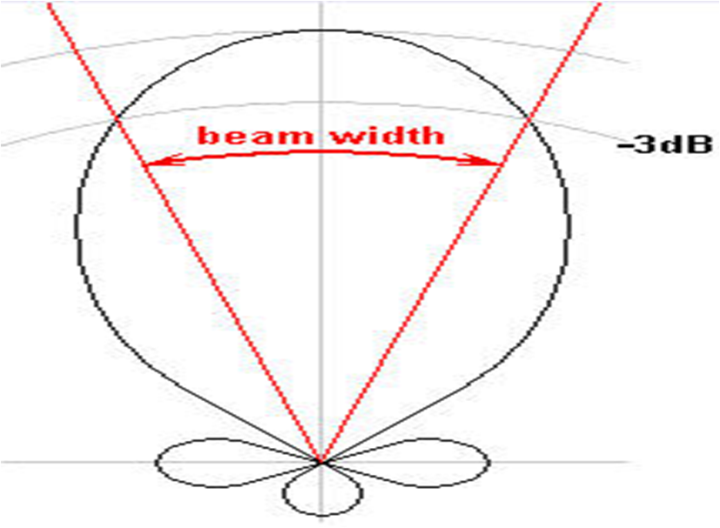
2.2. BeamwidthThe beamwidth of a pattern is defined as the angular separation between two identical points on opposite side of the maximum pattern of the lobe. In an antenna pattern, there are a number of beamwidths. One of the most commonly used beamwidths is the Half-Power Beamwidth (HPBW). Another important beamwidth is the angular separation between the first nulls of the pattern, and it is known as the First-Null Beamwidth (FNBW). In a radio antenna pattern, the half power beamwidth is an angel between the half-power points of the main lobe. In below Figure 1 the beamwidth of an antenna’s mentioned.

 Download as

Directivity of an antenna is defined as the ratio of the radiation intensity in a given direction from the antenna to the radiation intensity averaged over all directions. The radiation intensity is equal to the total power radiated by the antenna divided by 4π. Directivity is the figure of merit of an antenna. It measures the power density an antenna radiates in the direction of its powerful or robust emission versus the power density radiated by a faultless or supreme isotropic radiator radiating the same total power.
2.4. GainA comparative measure of an antenna’s ability to direct radio frequency energy in a particular direction. Basically the measurement is done in dB
2.5. Radiation PatternRadiation pattern is a graphical illustration of the relative field strength transmitted from the antenna or received by the antenna. The radiation patterns of Antennas are taken at one frequency, one polarization, and one cut.
2.6. Return LossIn [1], it is mentioned that the return loss is the loss of signal power resulting from the reflection caused at a disruption in a transmission line. This disruption can be miss-match with the terminating load or with a device inserted in the line.
3. Types of Antenna
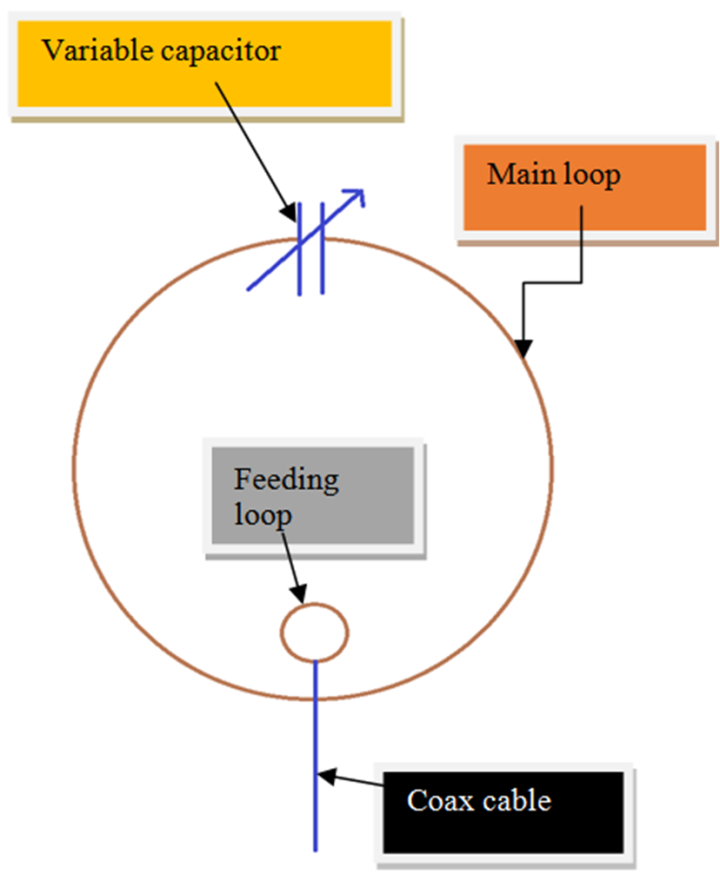
3.1. Wire AntennaWire antennas are very much well known to the layman because they are seen effectively everywhere— on automobiles, buildings, aircraft, various spacecraft, and so on. There are various shapes of wire antennas such as a straight wire (dipole), loop, and helix. Loop antennas need not only be circular. The circular loop is the most common because of its simplicity in design. A wire antenna (loop antenna) is drawn below (Figure 2).
 Download as
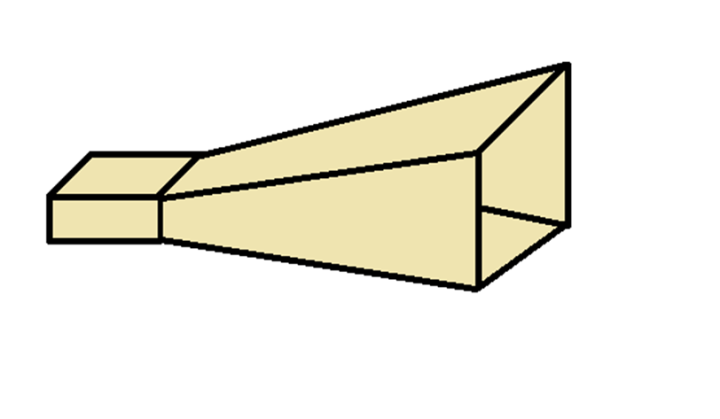
Aperture antenna (mentioned below in Figure 3) may be more accustomed to the common man today than in the past because of the increasing demand for more enlightened forms of antennas and the utilization of very high frequencies. Antennas of this type are very useful for Aircraft and spacecraft applications, because they can be mounted on the skin of the aircraft or spacecraft. In addition, they are covered with a dielectric material to protect them from various hazardous conditions.
 Download as
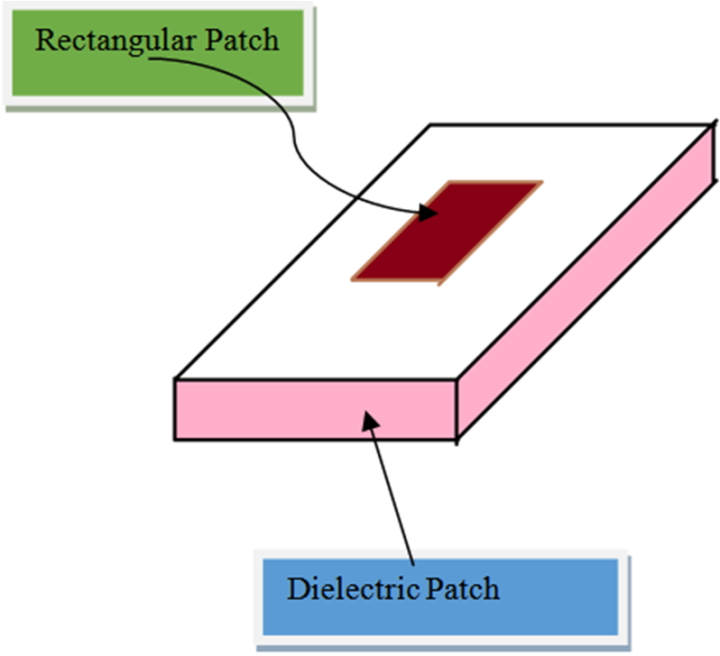
In [1], it is mentioned that these antennas consist of a metallic patch on a grounded substrate. The micro strip antennas are low profile, compatible to planar and non-planar surfaces, simple and very less expensive to manufacture using modern printed-circuit technology, mechanically strong and long-lasting when scaled on hard or inflexible surfaces, well matched with MMIC designs. The Microstrip antennas (mentioned below in Figure 4) can be scaled on the surface of very high-performance spacecraft, satellites, missiles, cars, and even handheld mobile phones or cellphones.
 Download as
Many applications require radiation characteristics that may not be achievable by a single element. Array antenna (mentioned below in Figure 5) is the combination of multiple antennas. The arrangement of the array may be such that the radiation from the elements sums up to give a radiation maximum in a particular direction, minimum in other directions.
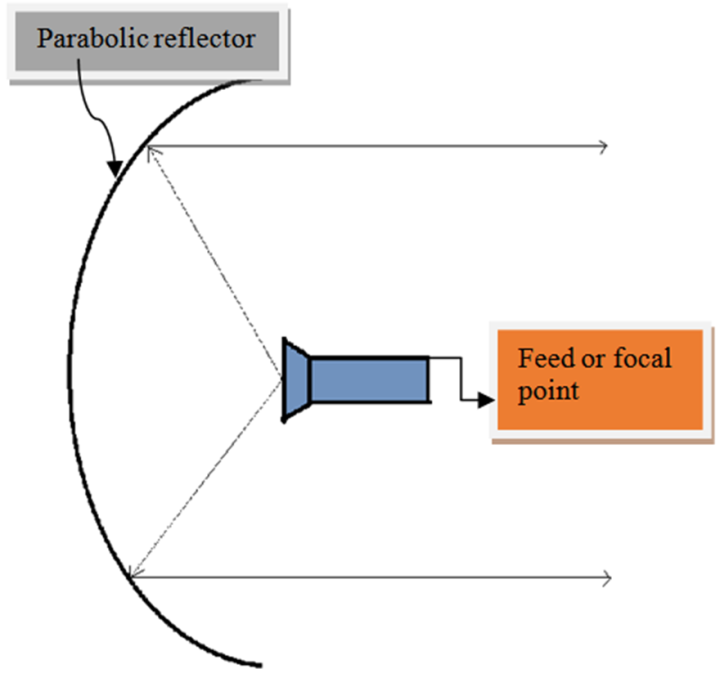
3.5. Reflector AntennaReflector antennas or parabolic reflector antennas (mentioned below in Figure 6) has largest applications. Reflector antenna is the combination of a feed antenna and a metallic plate which is parabolic in structure, in which the metallic plate acts as the primary antenna and the feed antenna or horn antenna acts as the secondary antenna. These antennas are mainly used in TV broadcasting, radio broadcasting, satellite communications etc.
 Download as
 Download as
4. Microstrip Patch Antenna
The microstrip antenna concept was first proposed in the 1950s. Due to the development of printed-circuit board (PCB) technology, many practical applications of microstrip antennas scaled on missiles and aircraft were indicated in the early 1970s. In [2] it is mentioned that, Microstrip antennas can be used to meet some specific requirements in commercial applications, for example in the field of wireless communication and mobile radio etc. Since then, the study of microstrip antennas has resonated, giving birth to a new antenna industry.
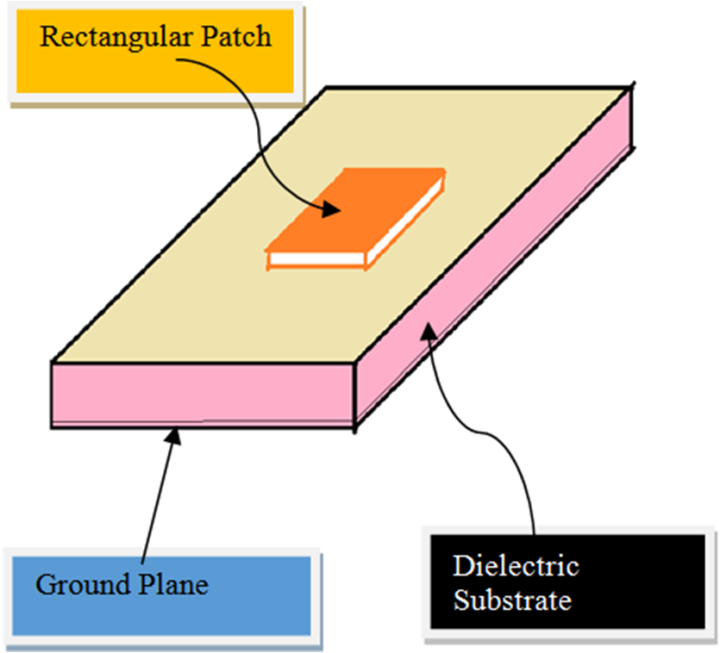
Figure 7 shows the basic geometry of a microstrip antenna: a metallic patch is printed on a grounded dielectric substrate. The metallic patch could be of any shape or size, but in practical applications, rectangular and circular patches are most common. Because of its simple geometry, the microstrip antenna offers many striking advantages, such as low profile, and easy manufacturing etc.
Some major disadvantages of microstrip patch antennas are their low efficiency, low power, high Q, poor polarization purity, poor scan performance, false feed radiation and very narrow frequency bandwidth, which is typically only a fragment of a percent.
 Download as
5. Working, Fundamental Concepts, and Characteristics of Micropstrip Antenna
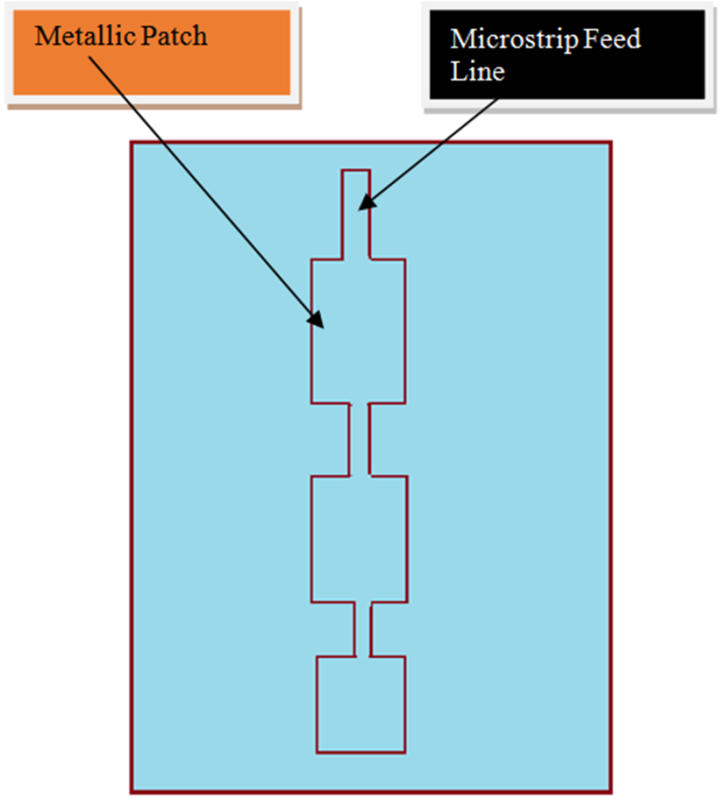
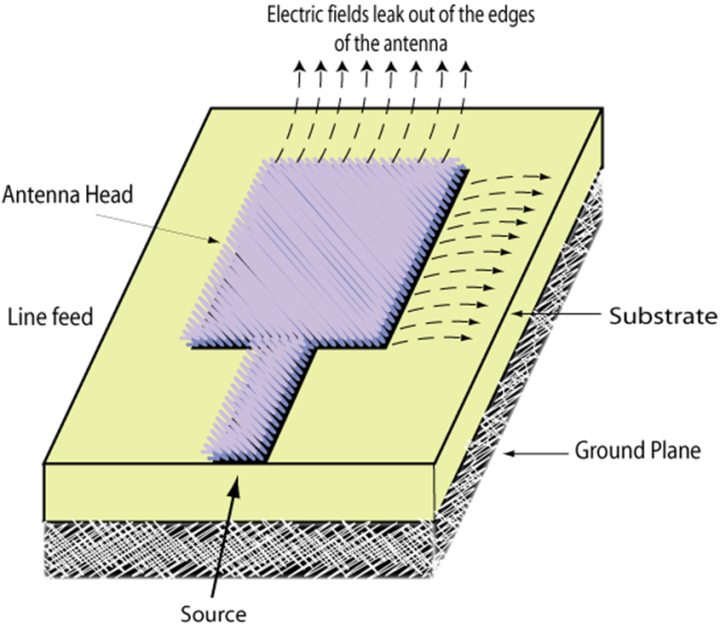
The working of Microstrip patch antenna includes a simple concept. In Micristrip antennas the microstrip feed lines are used for feeding purpose. So when we give a supply (current) through the feed, the electrons or current is accelerated in the feed line and reach in the metallic patch. After that they are radiated in the edge of the metallic plate because there is a property of electron is that, electron will start radiating after the breaking of path i.e. after a discontinuity in the conducting surface, it will radiate. So here also after breaking of path (at the edge) the electrons are radiating (as shown in the Figure 8 which is mentioned below).
 Download as
Figure 8 consists of very thin (t << λ0) metallic patch placed a small fraction of wavelength above the ground plane. Here λ0 is the free space wavelength. The microstrip antenna is designed so its radiation pattern maximum is perpendicular to the patch and in the rectangular patch antenna, the length L of the rectangular patch should be with in λ0/3 < L < λ0/2.
The patch and the ground plane are separated by a dielectric sheet or substrate. The dielectric substrate is the electrical insulators and they are serving as a base for other materials. There are a lot of substrates that can be used for the design or manufacturing of micro-strip patch antennas. Their dielectric constants are in the range of 2.2 to 12. In [4], it is written that if the dielectric constant will be low i.e. it ranges in the lower range then a thick substrate will be required. If the dielectric constant will be high i.e. it ranges in the higher range then a thin substrate will be needed and if the substrate is thick then it will produce large bandwidth and also it will produce good efficiency. Thin substrates with higher dielectric constants are sensible for microwave circuitry because they need tightly bound fields to minimize unacceptable or unwanted radiation and coupling, and it will lead to smaller element sizes; and also because of their various losses, they are very less efficient and also comparatively they have smaller bandwidths [4]. Patches could be of many shapes that means it could be of any shape and size but practically rectangular and circular patches are used because of easy fabrication on the substrate.
6. Feeding Techniques
In [9], the authors have mentioned that microstrip patch antenna has many feeding methodologies. As these antennas are having dielectric substrate on one side and the radiating element on the other side. So these feeding techniques are being put as two different classifications contacting and non-contacting technique. Non-contacting is a technique or method where an electromagnetic magnetic coupling is done to transfer the power between the Microstrip line and the radiating patch. There are many new methods of feed techniques are available but some of the common techniques are
A)Microstrip line
B)Coaxial probe
C)Aperture coupling
D)Proximity coupling
E)Co planner wave guide feed etc.
7. Simulation and Results (12 GHz Operating Frequency)
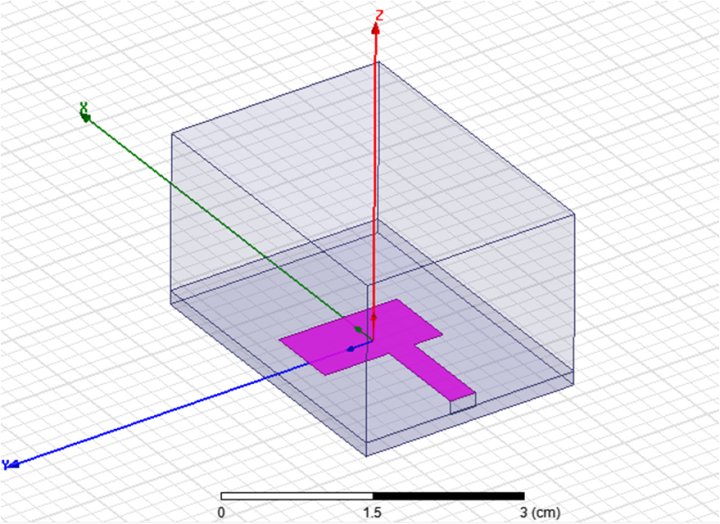
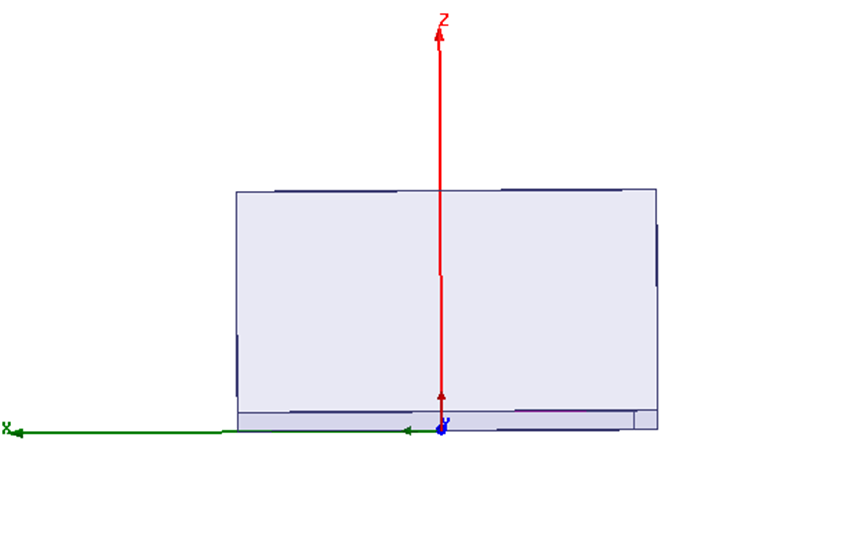
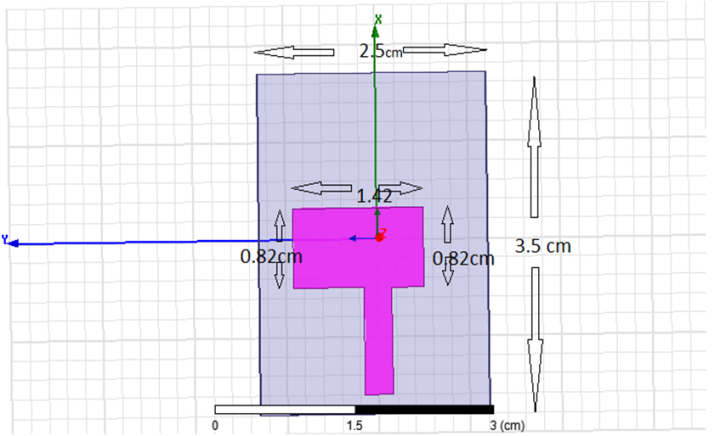
In this topic the HFSS design model of Microstrip Antennas has been mentioned below in Figure 9 and also the side view as well as the top view of Microstrip patch antenna is mentioned below in Figure 10 and Figure 11 respectively.
Simulation and results are one of the most important things in our research. Here in this research in order to design a Microstrip antenna we have used two software and those are such as-: Ansoft High Frequency Structured Simulations (HFSS), and MATLAB. Here we HFSS has been used for the designing of the Microstrip antenna and for MATLAB has been used for the calculations like length, breath etc. of a patch. Here we have designed an Antenna which will operate at 12 GHz. That means here the cut-off frequency is 12 GHz.
So below the computer aided design has been mentioned.
 Download as
 Download as
 Download as
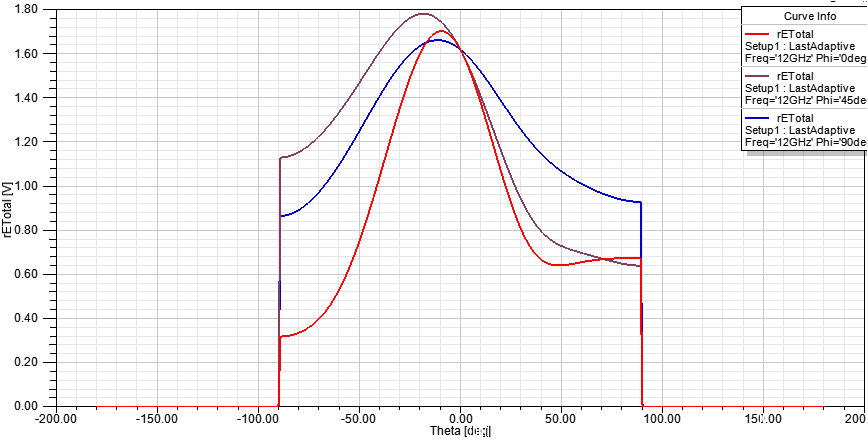
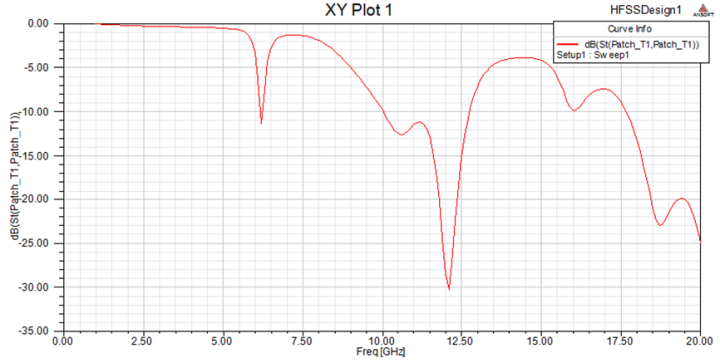
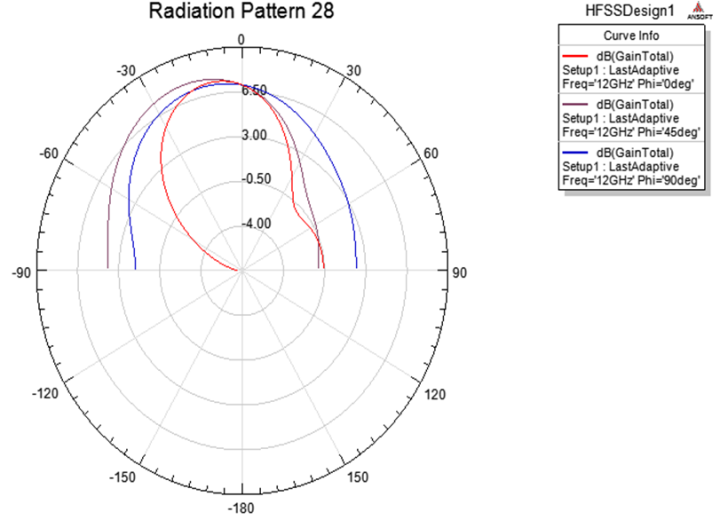
Now below in Figure 12, we have mentioned the s11 plot or frequency response and in Figure 13, Figure 14 we have mentioned the radiation pattern as well as the 2D rectangular plot of the Microstrip antenna respectively.
 Download as
 Download as
 Download as
Here in this design first we decided the operating frequency and here the operating frequency is 12 GHz. After that we used some design equations to calculate the length, breath of the rectangular patch.
Here we have taken the height or thickness of the substrate as 0.16 cm. here we calculated the length, breath by using MATLAB that means here we wrote a MATLAB code to find out these parameters. Below some design equations have been mentioned.
Formula for effective dielectric constant [1]:
 | (1) |
Where  = effective dielectric constant
 = dielectric constant= 2.2
 = thickness of the substrate
 = width of the patch
Due to fringing fields the change in dimensions in length is given by [1]
 | (2) |
Where  = effective dielectric constant
 = thickness of the substrate
 = width of the patch.
Formula for the width of the patch is [3]
 | (3) |
Formula for the length of the patch is [3]
 | (4) |
So here in our review, the above design equations are used for the designing of an elementary Microstrip Antenna. Now below we have mentioned the calculated values of the above parameters and these calculated values are calculated by using MATLAB.
 =2.1960
 =2.2
=2.2
 =12 GHz
 =0.16 cm
 = 0.6738 cm,
  = 1.42 cm,
  (Substrate) = 3.5 cm,
 (Substrate) = 2.5 cm
Now we have mentioned the coordinate of the patch, substrate, and port of the Microstrip Antenna below.
The coordinates of the substrate is: (-1.8,-1.2, 0)
The coordinates of the patch is: (-0.5,-0.5, 0.16)
The coordinates of the port is: (-1.6,-0.15, 0)
Here in this fundamental design theoretically we got the length of the patch as 0.6738 cm. but when we designed our antenna by putting this value we didn’t get the frequency response exactly at 12 GHz. So in order to get our desire output that means the frequency response at 12 GHz, we tuned the length because while designing the Microstrip patch antenna we have neglected many losses like fringing losses, current losses, capacitive losses, and metal loss. So here we tuned the length up to 0.82 cm. and after putting the tuned value we got the response at 12 GHz which is our desired output. Generally we consider the operating frequency below 10 dB line in the s11 plot because 10 dB is approximately equal to 90% that means, 90% of total power should be delivered from the generator to the antenna through the transmission line. It would be better if more power will be transmitted to the antenna because our objective is to transmit more information in the form of energy from the transmitter to the receiver. The s11 plot (Figure 12) is otherwise called as return loss of an antenna i.e. because of reflection, the loss of signal power occurred due to the discontinuity in the transmitted line. In this case we got our desired output with minimum tuning that means the tuning was from 0.6738 cm to 0.82 cm. Here also the material of the substrate that we have used is Rogers RT/ duroid 5880 (tm).
We consider the frequency response below 10 dB and also here the bandwidth is nearly about 2.7 GHz that means it is in ultra-wide band range i.e. the antenna that we have designed is an ultra-wide band antenna and also here also we got a radiation pattern which shows a positive result. In the radiation pattern (Figure 13), the radiations of the elementary antenna was in the broader side and also here any kind of side lobes does not appear in the graph. So the radiation pattern is good in this case.
8. Conclusion
In this paper the design and simulation of an elementary Rectangular patch Microstrip antenna with microstrip feed technique was presented. The objective or goal was to design an antenna for ultra-wide band range and the antenna should work in the target operating frequency (12 GHz), which was calculated by using MATLAB. In order to achieve target operating frequency (12 GHz) with the calculated value, the length of the rectangular patch was increased and after that the design was simulated again by Ansoft HFSS and simulation result gave a large bandwidth which is in the ultra-wide band range. The rectangular patch antenna was designed by changing the feed position, size of the substrate, and shape of the patch to get our objective or target output. This elementary design was based on changing the dimension of length because here various losses are not considered.
Microstrip antenna has founded many applications in the real world due to its low profile feature. Some of the applications are GPS, Bluetooth, Wi-Fi, missiles, and also in radio communication system etc. Many other applications are under research like multiband antenna, array antenna etc.
References
| [1] | Constatine A. Balanis, “Antenna Theory – Analysis and Design”, John Wiley & Sons. Inc. 1997. | ||
 In article In article | |||
| [2] | G.A. Deschamps, “Microstrip Microwave Antennas,” Presented at the third USAF Symposium on Antennas, 1953. | ||
| In article | |||
| [3] | Kin-Lu Wong, Compact and Broadband Microstrip Antennas, Jon Wiley & Sons, Inc., 2002. | ||
| In article | |||
| [4] | D. M. Pozar, “Microstrip Antennas,” Proc. IEEE, Vol. 80, No. 1, pp. 79_81, January 1992. | ||
| In article | View Article | ||
| [5] | T. Taga and K, Tsuna Kawa , “Performance Analysis of a Built-Planar Inverted-F Antennafor 800 MHz Band Portable Radio Units”, IEEE Journal on selected areas in communication, Vol.5, Nop.5, pp. 921-29, June 1987. | ||
| In article | |||
| [6] | Caver K, and Mini J, “Microstrip Antenna Technology”, IEEE transactions on antenna and propagation, vol .29, no 1, January 1981. | ||
| In article | |||
| [7] | J.Q Howll, “Microstrip Antennas”, IEEE trans. antenna propagation, vol .ap-23, no.1, pp.90-9, Jan 1975. | ||
| In article | |||
| [8] | Lee, H.M. Electron. Eng. Dept., Kyonggi Univ., Suwon, South Korea, “Pattern reconfigurable microstrip patch array antenna using switchable feed-network”, Microwave Conference Proceedings (APMC), Issue Date : 7-10 Dec. 2010. | ||
| In article | |||
| [9] | T. Durga Prasad, et.al.,“comparisons of Circular and Rectangular Microstrip Patch Antennas” International Journal of Communication Engineering Applications-IJCEA, Vol. 02, Issue 04; pp. 187-97, July 2011 | ||
| In article | |||
| [10] | J. T. Aberle and F. Zavosh, “Analysis of Probe-Fed Circular Microstrip Patches Backed by Circular Cavities,” Electromagnetics, Vol. 14, pp. 239-58, 1994. | ||
| In article | View Article | ||
| [11] | H. F. Pues and A. R. Van de Capelle, “An Impedance Matching Technique for Increasing the Bandwidth of Microstrip Antennas,”IEEE Trans. Antennas Propagat., Vol. AP-37, No. 11, pp. 1345-1354, November 1989. | ||
| In article | View Article | ||
| [12] | R. E. Munson, “Conformal Microstrip Antennas and Microstrip Phased Arrays,” IEEE Trans. Antennas Propagat, Vol. AP-22, No. 1, pp. 74-78, January 1974. | ||
| In article | View Article | ||
| [13] | J. W. Howell, “Microstrip Antennas,” IEEE Trans. Antennas Propagat., Vol. AP-23, No. 1, pp. 90-93, January 1975. | ||
| In article | View Article | ||
| [14] | L. C. Shen, S. A. Long, M. R. Allerding, and M. D. Walton, “Resonant Frequency of a Circular Disc, Printed-Circuit Antenna,” IEEE Trans. Antennas Propagat, Vol. AP-25, No. 4, pp. 595-96, July 1977. | ||
| In article | View Article | ||
| [15] | A. G. Derneryd, “Analysis of the Microstrip Disk Antenna Element,” IEEE Trans. Antennas Propagat., Vol. AP-27, No. 5, pp. 660_4, September 1979. | ||
| In article | |||
| [16] | S. A. Long and M. D. Walton, “A Dual-Frequency Stacked Circular-Disc Antenna,” IEEE Trans. Antennas Propagat., Vol. AP-27, No. 2, pp. 270-273, March 1979. | ||
| In article | View Article | ||
| [17] | I. J. Bahl and P. Bhartia, Microstrip Antennas, Artech House, Dedham, MA, 1980. | ||
| In article | PubMed | ||
| [18] | E. H. Newman and P. Tylyathan, “Analysis of Microstrip Antennas Using Moment Methods,”IEEE Trans. Antennas Propagat, Vol. AP-29, No. 1, pp. 47-53, January 1981. | ||
| In article | View Article | ||
| [19] | D. C. Chang, “Analytical Theory of an Unloaded Rectangular Microstrip Patch,” IEEE Trans. Antennas Propagat., Vol. AP-29, No. 1, pp. 54-62, January 1981. | ||
| In article | View Article | ||
| [20] | T. Itoh and W. Menzel, “A Full-Wave Analysis Method for Open Microstrip Structures,” IEEE Trans. Antennas Propagat, Vol. AP-29, No. 1, pp. 63-68, January 1981. | ||
| In article | View Article | ||
| [21] | P. B. Katehi and N. G. Alexopoulos, “On the Modeling of Electromagnetically Coupled Microstrip Antennas-The Printed Strip Dipole,” IEEE Trans. Antennas Propagat, Vol. AP- 32, No. 11, pp. 1179-86, November 1984. | ||
| In article | |||
| [22] | C. C. Liu, A. Hessel, and J. Shmoys, “Performance of Probe-Fed Rectangular Microstrip Patch Element Phased Arrays,” IEEE Trans. Antennas Propagat, Vol. AP-36, No. 11, pp. 1501-09, November 1988. | ||
| In article | View Article | ||
| [23] | E. O. Hammerstad, “Equations for Microstrip Circuit Design,” Proc. Fifth European Microwave Conf., pp. 268-72, September 1975. | ||
| In article | View Article | ||
| [24] | R. E. Collinan d F. J. Zucker, Antenna Theory, Part I, Chapter 5, McGraw-Hill Book Co.,New York, 1969. | ||
| In article | |||
| [25] | N.T. Markad, Dr. D.G. Wakade,” Probe Feed Microstrip Patch Antenna Computer Aided Design Methodology” International Journal of Scientific and Research Publications, Volume 2, Issue 5, pp. 1-6, May 2012. | ||
| In article | |||
| [26] | http://www.wirelesstut.com/images/knowledge/beamwidth.jpg. | ||
| In article | |||
| [27] | http://www.amitsingh.co.in/blog/wp-content/uploads/2012/10/new.jpg. | ||
| In article | |||
 CiteULike
 Mendeley
 StumbleUpon
 Delicious
 Facebook
 Twitter
 LinkedIn

)


)



)
)
)
)
)
)