 OPEN ACCESS
  PEER-REVIEWED
AFLISR Algorithm Distribution Reliability Fault

1Editorial Board Member, AJEEE
2Arya Engineering College, Jaipur, India
Abstract
Advanced Fault Location Isolation and Supply Restoration (AFLISR) is describing as the smart brain at the control center, using remotely controllable devices to execute the smart decisions. AFLISR application can improve reliability intensely deprived of compromising safety and asset protection. AFLISR systems that automatically detect faults, isolate the impaired portion of the feeder, and restore as plentiful facility as conceivable within seconds as part of their strategy to accomplish a “self-healing” grid. One problem with these systems is that service restoration is often blocked due to heavy loading on backup feeders. The next generation of automatic restoration systems will yield improvement of further advanced control services that are existence installed as part of the smart grid. After encountering a load transfer limit, the automatic restoration system may initiate schedules to free up capacity on the pretentious feeders so enabling the load transfer to continue. Capacity issue strategies can embrace instigation of petition response schedules, initiation of CVR, and impermanent reduction of fast charging actions for electric vehicles.
At a glance: Figures
Keywords: distribution automation, AFLISR, circuit indicator, voltage/current constraints, multi-agent system
American Journal of Electrical and Electronic Engineering, 2015 3 (1),
pp 17-21.
DOI: 10.12691/ajeee-3-1-4
Received December 09, 2014; Revised March 03, 2015; Accepted March 17, 2015
Copyright © 2015 Science and Education Publishing. All Rights Reserved.Cite this article:
- Sachan, Amit, and Ashish Ranjan. "AFLISR Algorithm Distribution Reliability Fault." American Journal of Electrical and Electronic Engineering 3.1 (2015): 17-21.
- Sachan, A. , & Ranjan, A. (2015). AFLISR Algorithm Distribution Reliability Fault. American Journal of Electrical and Electronic Engineering, 3(1), 17-21.
- Sachan, Amit, and Ashish Ranjan. "AFLISR Algorithm Distribution Reliability Fault." American Journal of Electrical and Electronic Engineering 3, no. 1 (2015): 17-21.
| Import into BibTeX | Import into EndNote | Import into RefMan | Import into RefWorks |
1. Introduction
AFLISR is flattering a progressively key factor in designing today's intricate systems and in today's competitive edges for operating an efficient plant or interplanetary system with minimal downtime. In any business, downtime or delays may cost millions of dollars a year in addition to operating costs, simply because AFLISR was a design afterthought by implementing AFLISR design topographies, efficient, and sustainable system.When faults occur on the distribution network, service protection and control systems usually shut down power on the feeder thus disrupting service to several customers. The size of area affected by the outage will directly decode into the number of consumers inconvenienced and some degree of economic loss. Many distribution efficacies are measured as to how well they are serving their customers and may be subjected to regulatory consequences if the regulators feel their routine is not as good as it must be.
2. Fault Location and Isolation Mechanism
AFLISR should individual operate subsequent a shortcircuit (fault) on the feeder itself or the services that generally supply the feeder. AFLISR should not operate after a feeder converts de-energized due to manual switching actions or due to a system wide backup that triggers below frequency or voltage load shedding. To encounter this condition, one or additional fault detectors are needed to trigger AFLISR operation when fault-level currents are detected mutual practice is to routine a protective relay intelligent line switch (ILS) in the substation or a line reclose with self-contained protection services to regulate that a fault occurred in the distribution feeder protection zone and then deliver a signal to trigger AFLISR operation [1]. The phase is to regulate the "subdivision" of the feeder that contains the fault. AFLISR "divisions" are portions of the feeder that are bounded by remotely controlled switches. All switches include a Faulted Circuit Indicator (FCI) that regulates if fault current has just accepted through the switch. This would specify that around is a fault located "downstream" (auxiliary from the substation) of the switch. AFLISR uses the FCI status indications and information of the as Operated feeder topology to regulate what section is faulted. The faulted division islimited by one FCI that has a fault indication and one or additional FCIs that did not "see" the fault. AFLISR then concerns control commands to open the switches required to completely detach the faulted division of the feeder based on the Fault Location breakdown. It is common repetition for AFLISR to accede these control arrangements until the regular automatic reclosing sequence is implementation. This safeguards that feeder reconfiguration by AFLISR is only implemented subsequent a permanent fault (should not reconfigure the feeder if fault is a self-clearing "temporary" fault) [1].
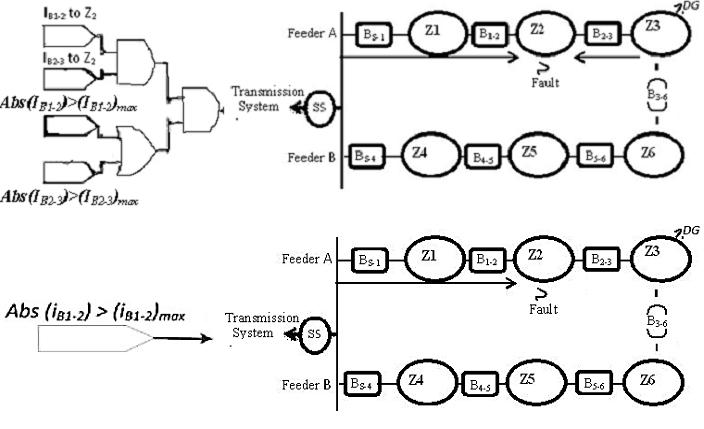
Once a permanent fault occurs in a distribution feeder, the feeder circuit breaker is tripped in real-time operation. The fault location detection and isolation algorithm is then applied in order to locate and isolate the faulty section from both directions. As soon as the faulty section is isolated, the upstream out-of-service loads are restored through the closing of the feeder circuit breaker. A restoration algorithm is applied to restore the downstream out-of-service loads. When the faulty section is repaired, the reverse switching sequence is applied so that the distribution system is returned to its normal configuration. Due to the radial topology of the distribution feeders, the occurrence of a fault in a distribution feeder affects only its sections [i.e., sections between the substation and the faulty section as well as the downstream sections, when distributed generation units (DGs) are present]. Therefore, only the control agents of the feeder that has the faulty section will participate at this stage. Due to the voltage potential difference, the normal power flows being from the source to the grid. However, the introduction of DG units may change the direction of power flows from unidirectional to bidirectional. [2] When a fault occurs somewhere in the distribution system, the power flow magnitude and direction change. Fault current flows from the substation and DG units to the lowest potential point at the fault location. Therefore, when a fault occurs in one of the zones between the substation and other zones that involve DG units, the following two conditions apply. a. The fault is fed by both the substation and the DG units in the downstream zones. The current in both boundary breakers of this zone will thus flow into the zone b. The current in at least one of its breakers will exceed its limit. The former condition means that there is no fault outside this zone. The latter condition always applies because the former one can be implemented under normal conditions (i.e., a reverse power flow due to a high generation level produced from DG units in the downstream zones). On the other hand, when a fault occurs in a zone that has no downstream zones containing DGs, its entrance breaker current will exceed its limit. Based on these conditions for fault occurrence and on the proposed control structure in Figure 1 the fault location detection and isolation algorithm for a single fault at a time.


 PowerPoint Slide
 Larger image(png format)

a). Monitoring devices using direction and over-current relays provide two signals to indicate a change in the status of the current flow. One signal indicates that the magnitude of the current exceeds its limit, and the other indicates the direction of the current. b) Zone agents utilize these signals in a logic circuit to generate simplified binary status signals. c) They then send these binary signals to their feeder agent through inform messages. The feeder agent determines which zone is the faulty zone. a) If it receives a binary signal with a value of one from a type 1 zone, it sends a request message to this zone agent asking it to open its boundary breakers. b) If it receives a binary signal with a value of one from a type 2 zone, it sends a request message to this zone agent asking it to open its boundary breakers. c) If it receives a binary signal with a value of one from more than one type 2 zones, it sends a request message to the last zone agent (i.e., the zone at the feeder end side) asking it to open its boundary breakers. If it receives a binary signal with a value of zero, no action is taken.
3. Service Restoration Mechanism
Once the damaged subdivision of the feeder is isolated, AFLISR attempts to restore service to as several "vigorous" sections of the feeder as possible via the presented sources. Presented sources comprise the ordinary source of supply to the feeder as well as any existing backup sources that are connected to the faulted feeder via normally-open, remotely controlled tie switches that have spare capacity to carry supplementary load any feeder division that is “upstream” of the faulted feeder division (closer to the substation) can be restored from the innovative source with no substantiation of accessible capacity. Yet, to restore feeder divisions that are “downstream” of the faulted feeder division (further away from the substation), the feeder must have at least one backup source with adequate capacity to carry the supplementary load being transferred. If suitable backup sources do not exist [2], AFLISR delivers no other benefit beyond what can be expanded through regular line recloses without supervisory control and AFLISR software. AFLISR determines the “pre-fault” load on each “vigorous” feeder division, and then associates that load with the spare capacity on backup sources. If appropriate capacity exists, then the tie switch is closed to restore facility. If sufficient capacity does not exist, then the section in question will remain de-energized until field crews attain on the scene. With modern application software and sufficient communication bandwidth, all of the above actions can be completed in less than one minute with no manual intervention. AFLISR arrangements will effort to restore this portion of the feeder by executing demand response to issue specific existing capacity or perform secondary load transfers [3]. AFLISR applications may also use Microgrid technology to restore this section of the feeder using distributed energy resources. (Maintain service done fault isolation and re-routing of power, Improved efficiency due to decrease in repair/ restoration, Rapidly sense fault location and communication suitable work crews, Improved reliability as measured through efficacy keys, Senses that a feeder fault has occurred; Locates the damaged portion of the feeder amid two remote controlled line switches) Isolates the damaged portion of the feeder by opening appropriate remote controlled line switches; Re-energizes undamaged portions of the feeder via the primary feeder source and one or more backup sources using remote controlled tie switches [4]. The fault is isolated, the downstream zones are isolated. The affected zones communicate with their feeder agent (initiator), as shown in Figure 1, in order to build a restoration plan. The details of the proposed architecture are as follows: a) each zone agent in the out-of-service area sends a request message to the initiator, including its load demand and priority.
 |
b) The originator control agent starts consultations using a contract net protocol (CNP) by sending call for proposal (CFP) messages to the responder feeder agents. c) After the responder feeder agents reply with their proposalmessages, which contain their available remaining capacity (ARC), the initiator agent sends these two input items to its result creator. The input consists of the load demands and priorities from the out-of-service zone agents, and the ARCs from the responder agents. d) The decision maker component in the initiator agent uses expert based rules along with the input it has received in order to determine its output. e)The initiator system compares the maximum ARC with the total demand from the out-of-service zone.
 |
Where Si: Load demand of zone i, nz : The total number of out-of-service zones, nBF1: The total number of responder agents. f) If the above equation is satisfied, the initiator decides to initiate group restoration by restoring all out-of-service zones through one switching operation. g) The actions of the initiator agent are therefore to send an accept-proposal message to the responder agent that has the highest ARC and to send a request message to its zone agent that is the neighbor of the selected backup feeder asking it to close its tie switch for the completion of the restoration process. h) If the equation is not satisfied, the initiator decides to initiate zone restoration by building a zone/switch relationship table. i) Based on the zone/switch Relationship table and the ARCs communicated from the responder agents, the initiator agent searches for possible combinations of zone restoration. It compares the ARCs with the elements of zone combination, which are listed in descending order based on their priority indices. j) After checking for the available restoration possibilities, the initiator agent actions are: I) To send accept-proposal messages to those responders that will be used in the restorations. II) To place tie switches between the feeder agents that have accepted proposals and the selected combinations for the restoration in a switch-to-be-closed list (SCL) III) To place the bounded sectionalizing switches of the selected combinations for restoration in a switch-to-be-opened list (SOL) in order to satisfy the radial constraint. IV) To update the zone/switch relation table. k) It then checks to determine whether the table is empty (i.e., whether all zones have been restored). If the table is empty, the initiator sends request messages to the appropriate zone agents asking them to open their sectionalizing switches that are included in the SOL list in order to partition the outage area and then to close their tie switches that are included in the SCL list. L) If the table is not empty, the initiator sends request messages to the responder feeder agents that are neighbors of the remaining unrestored zone combinations. This request prompts these responders to start negotiations with their neighbors (subcontractors) to find load transfers that can provide additional ARC. The request message includes the load demand required for the remaining unrestored zone combinations. m) After these responders reply with their ARC, the initiator agent repeats steps i – k. n) If the table is empty, the initiator sends request messages to the appropriate zone agents to open their sectionalizing switches included in the final SOL list and then to close their tie switches included in the final SCL list. o) If the table is not empty, the initiator determines the necessity for load shedding of the lowest priority load (i.e., the lowest priority zone index) in the remaining unrestored zone combinations. It then checks to determine whether all zones have been restored, as in step i. p) the initiator agent repeats step 0 until the zone/switch relationship table becomes empty, when it then executes step n in order to implement the switching actions required for the completion of the restoration process.
4. Backup Feeder Mechanism
The operating mechanism of each level-1 backup feeder (responder) agent will be as follows: A) After the responder agent receives a CFP message from the initiator, it starts to build its proposal. B) It sends query messages to its appropriate zone agents about their spare capacities and bus voltage values. C) Each zone agent replies by sending an inform message that includes the spare capacity of its branch and/or the bus voltage magnitude of its bus:
 |
Where IM (k): Represents the available capacity of each zone before it becomes overloaded and before its protection device operates Imax (k): Upper bound current in branch K and I(k) : Magnitude of the current flow in branch k. D) If any zone has more than one branch, it sends the minimum spare capacity of its branches, and a zone with more than one bus sends the lower voltage magnitude of its buses. E) After the responder agent receives these replies, it calculates its ARC as follows
 |
 |
 |
Where j: Zones along the restoration path, Vw : The lowest bus voltage magnitude of the values received from zone agents, Vmin : Minimum allowable voltage magnitude in the network (i.e., 0.9 p.u.), Zpath : Series impedance of the path between the substation and the node closest to node w on the restoration path. This impedance could be determined by carrying out offline simulation if the forecasted load is available (i.e., to determine which point among the points located at the end of the feeder will have minimum voltage, hence, its Zpath will be used). Another option is to determine Zpath for those possible points in advance and based on the received minimum voltage value, the appropriate impedance is used. IC : Maximum spare capacity of the restoration path without overloading (current limit constraint), IV : Maximum spare capacity of the restoration path to avoid under-voltage at any node (voltage limit constraint), Iavailable : Maximum spare capacity of the restoration path without violating operating constraints. F) If this spare capacity Iavailable from this supporting feeder will be used to restore an out-of-service load SL=PL+jQL at voltage VL
 |
To include the voltage limit VL ≥ 0.9 pu. This ARC guarantees that voltage limits will not be violated for the restored zones. G) The responder sends to the initiator agent a propose message that includes this ARC. H) If the responder receives an accept-proposal message from the initiator, it replies to the initiator by sending an inform message to indicate that it is committed to the completion of the task. I) If the responder receives from the initiator a request message for additional ARC through load transfer, it begins negotiations by sending CFP messages to its neighboring feeders, if available (i.e., level-2 backup feeders or subcontractor agents). J) This load transfer from a level-1 backup feeder to a level -2 backup feeder would involve the responder securing a margin that could enable it to restore the remaining out-of-service zone combinations. The best amount of the transferred load (TL) is then TL = (load of remaining unrestored zone combinations) - (remaining ARC of this level-1 backup feeder) K) Due to the discrete nature and possibly the limited ARC of the level-2 backup feeders, the TL cannot be exactly the same as what is required. The responder thus selects its zones to be transferred to the level-2 backup feeder as follows:
 |
L) After the responder determines the zones to be transferred, it sends a propose message to the initiator with its new ARC. M) If the responder receives an accept-proposal message from the initiator, it sends a confirm message to the subcontractor agent and request messages to the appropriate zone agents asking them to open the bounded sectionalizing switches for the selected zones to be transferred and to close the tie switch to complete the load transfer to the subcontractor.These formulas assume that customers are evenly distributed over the length of the feeder, faults are equally likely to occur anywhere and there is a suitable alternative source that is located downstream of the switch. - No reclosers initially and Have reclosers to start with:
 |
 |
Where NSW = # of normally closed DA switches.
5. AFLISR Architecture
The word “data” is plural, not singular. The subscript for the permeability of vacuum µ0 is zero, not a lowercase letter The AFLISR has to satisfy constraints regarding processing resources, real-time performance, and quality. However, additional problems are caused by the goal of reusability. One problem is that some AFLISR methods are very simple to program, for example the checking of sensor values against min/max limits. Advanced Fault Location Isolation and Supply Restoration methods have a complex interface to the inputs and outputs. The "glue code" needed to reuse an encapsulated component may be complex, An AFLISR subsystem interacts with both low-level aspects such as sensor sampling, and high-level aspects such as spacecraft configuration and mode. The interface of the AFLISR components must adapt to the spacecraft's peculiar constraints on data availability, unequal sampling periods, skewed and jittered sample times, units of measurement, etc.The architecture chosen for the AFLISR addresses these problems in two ways. Firstly, the AFLISR is divided into several levels, starting from the simpler mathematical algorithms such as Kalman filters, and ending with the advanced BN and CN levels. Each level depends only on the lower levels, and so the AFLISR user has some flexibility in which parts of the AFLISR to reuse. Secondly, each AFLISR level is divided into two layers: An algorithm layer that contains purely callable subprograms, and places no constraints on the software architecture of the caller, and a structure layer that implements a declarative interface to the AFLISR. This simplifies the programming, as long as the AFLISR architecture is followed. To avoid the architectural constraints, the user can access the AFLISR via the algorithm layers, but the interface is then procedural and more complex. The chief data-structure of the structure layers is the signal-processing network. It is similar to the "block diagrams" used with MATLAB and other tools, and consists of signals and signal-operators that are connected into a data-flow network. A signal represents a stream of values that can be sampled or continuous. A signal-operator is a processing function that takes some signals as inputs and produces some signals as outputs. The AFLISR provides predefined types of "source" signals for sampled sensor data and software variables, and predefined signal-operators for scaling, resampling, interpolating, filtering, and so on.
There are also generic signal-operators into which an AFLISR user can program any type of signal-processing function. A signal-processing network for a correlation test. The signals S and R are synchronized, subtracted and normalized, and finally it is checked if the norm is below a threshold. The correlation test result is an input for a BN. All the AFLISR failure-detection and diagnosis methods are provided as signal-operators. To construct a signal processing network, the AFLISR user writes declarative that create signals with specific parameters and instantiate signal-operators with specific input signals and parameters.
6. Result
The proposed control structure consists of two main types of controllers: zone and feeder. The operating mechanism of each controller has been designed based on the concept of a multi agent system. An expert-based decision maker has been proposed for each agent in order to achieve its objectives and satisfy its constraints. The proposed algorithm is programmed using C Programming and executed successfully. The results show that cooperation among agents through two-way communication provides a good solution for fault location, isolation and service restoration.
References
| [1] | Zhu Min-jie, Li Ming, (2012), The study of distribution grid distributed self-healing under dynamic operating modes, Electricity Distribution (CICED), 2012 China International Conference, pp. 1-4. | ||
 In article In article | |||
| [2] | Tsai. M and Pan. Y, (2011), “Application of BDI-based intelligent multi-agent systems for distribution system service restoration planning,” Euro. Trans. Electr. Power, pp. 1783-1801. | ||
| In article | CrossRef | ||
| [3] | Z. Chen. W, (Feb. 2010) “Quantitative decision-making model for distribution system restoration,” IEEE Trans. Power Syst., vol. 25, no. 1, pp. 313-321. | ||
| In article | CrossRef | ||
| [4] | Song. B, Li. P, Wang. T and Wang. W, (2010), “Multi-agent approach for service restoration of microgrid,” in Proc. 5th IEEE Conf. Indust. Electron. Appl., Taichung, Taiwan, pp. 962-966. | ||
| In article | |||

 CiteULike
 Mendeley
 StumbleUpon
 Delicious
 Facebook
 Twitter
 LinkedIn
 Print
Print