With millions of people killed and billions affected worldwide, the coronavirus disease 2019 (COVID-19), which is brought on by the novel severe acute respiratory syndrome coronavirus 2 (SARS-CoV-2), has created a disastrous situation. Through mutations, the virus is persistently propagating as different strains, sustaining its resurgence. Since vaccine development was accelerated, concerns have persisted regarding the vaccinations' efficacy and safety. Even though the COVID-19 pandemic has been contained, concerns regarding vaccines and the effects of SARS-CoV-2 infections have surfaced, casting doubt on their potential role in sudden death (SD) or sudden unnatural death (SUD). This is mostly because more and more young and middle-aged persons who were previously healthy are dying of sudden cardiac death. The scientific community should be made aware of this so that they may start investigating it and determine the causes of these changes, which will either contradict or demonstrate how SARS-CoV-2 infection, COVID-19 vaccinations, or both, contribute to SUD or SD. We report a case of SD in a person who was leading an active life until before the episode.
Although public health applications have attempted to define sudden death (SD) in a larger context, the idea and clinical assignment of SD and sudden unnatural death (SUD) remain complex and challenging. Coronary artery disease has always been the leading cause of unexpected mortality. The coronavirus disease 2019 (COVID-19), caused by the novel severe acute respiratory syndrome coronavirus 2 (SARS-CoV-2), has had a profoundly devastating impact on people's lives worldwide. Between 2017 and 2021, there was a slight decline in life expectancy at birth in India. Higher death rates were caused by the COVID-19 pandemic, which was responsible for a 26% increase in mortality rates after 2020 1. Furthermore, people have been impacted by the pandemic's aftereffects, which include Long COVID, post-COVID functional health status (PCFHS), and known and undiscovered side effects of the COVID-19 vaccine.
Recent incidents of sudden cardiac deaths among young adults-such as a 26yearold collapsing during badminton and a 22yearold in the gym-have heightened concern about heart health in younger populations 2, 3. Cardiac risk factors include nonmodifiable ones like age and genetics, and modifiable ones such as hypertension, diabetes, smoking, alcohol use, inactivity, poor diet, stress, and obesity. Several Indian actors have also died of cardiac arrest, including Puneeth Rajkumar, who suffered a fatal episode after a workout months after COVID19 vaccination 4, 5. These cases have fueled speculation that SARSCoV2 infection and vaccination may contribute to sudden death, though evidence remains inconclusive 6.
An Australian registry study examined out-of-hospital cardiac arrest (OHCA) in individuals aged 1-50 between 2019 and 2022 to assess possible links with COVID-19 vaccination. Researchers compared OHCA rates before the pandemic, during the pandemic but before vaccines, and after widespread vaccination. Across 4.2 million people and nearly 9 million vaccine doses, 2,242 OHCAs occurred, including 13 due to myocarditis and 223 of unascertained cause. Statistical analysis found no increase in OHCA rates, myocarditis-related OHCA, or unexplained OHCA during vaccination rollout. Among 38 sudden deaths within 30 days of vaccination, causes aligned with pre-pandemic patterns. The study concludes that COVID-19 vaccination did not raise OHCA incidence in young people, though results are limited by ecological design and short-term mortality focus 7. COVID19 vaccines are highly effective, but rare cases of myocarditis and sudden cardiac death have been reported, particularly in young men. Case series highlight instances of outofhospital cardiac arrest linked to silent myocarditis and abnormal electrocardiogram (ECG) findings such as J waves, which can trigger ventricular fibrillation. While most myocarditis cases are mild, fatal outcomes remain possible though extremely rare. The incidence is far lower than myocarditis caused by COVID19 infection itself. Researchers suggest AIassisted ECG analysis could help identify atrisk individuals before vaccination, improving surveillance and prevention strategies while maintaining the overall benefits of vaccination 8.
Most case reports do not provide conclusive evidence linking prior SARSCoV2 infection or COVID19 vaccination to SD or SUD. Epidemiological studies have documented some instances of SD or SUD following vaccination, but these findings are based on shortterm observations and limited datasets. Crucially, there is no current evidence of longterm consequences of infection or vaccination leading to SD or SUD. The available data underscores the importance of extended monitoring and comprehensive studies to better understand potential risks, while highlighting that no definitive causal relationship has been established.
We present a case report of a 53-year-old male person and a law practitioner leading a healthy life who suffered cardiac arrest and had a previous history of SARS-CoV-2 infection and COVID-19 vaccination
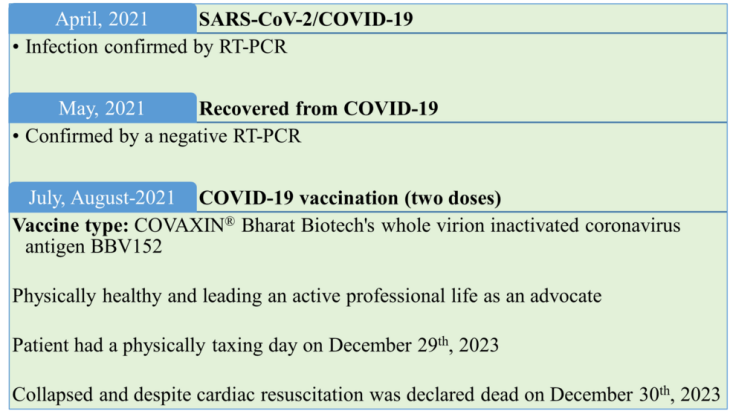
A 53-year-old man who worked as an advocate was the subject of our investigation. He was being treated to manage metabolic diseases like diabetes and hypertension for the past twelve years. He has been using glimepiride and metformin for eight of those years, and for the past two years, he was switched to glimepiride very slow release (VSR). He also took 40 mg telmisartan once day for ten years to manage hypertension. The patient did not report any prior travel or direct encounter, nor did they participate in large gatherings. On April 14, 2021, he abruptly started experiencing coughing symptoms that were ineffective, progressive, and worsened by his sleeping position. Lethargy and a sore throat were further symptoms. After that, a reverse transcription-polymerase chain reaction (RT-PCR) test revealed that, he was positive. After that, he was placed in quarantine, isolated, and treated by a doctor who was consulted online. Over the course of a week, he then acquired a fever and persistent cough. Lung consolidation was revealed by the computed tomography (CT) scan. His fever decreased with ongoing treatment, regular steaming, and nebulization with easy-breathing capsules. After two weeks, the patient's productive cough and painful throat subsided, and on May 10, 2021, the test came back negative. However, the dry cough continued for a few more days before gradually going away.
After receiving a 0.5 ml dose of the whole-virion inactivated coronavirus vaccine COVAXIN® BBV152 on July 1, 2021, and for the next four weeks until the second dose on July 30, 2021, the patient showed no clinical symptoms. He then continued to lead an extremely active lifestyle with a healthy body, exhibiting no signs of fatigue upon exertion, bowel movements, or appetite, nor any symptoms suggestive of cardiac distress. The patient had a very physically taxing day on December 29, 2023, the day before the event. On his own, he traveled to and from Warangal, arriving home late at night. He did not show any particular symptoms, although he did express bodily aches and widespread lethargy, which were initially thought to be related to travel exhaustion. He even appeared to have a restless night's sleep. The patient seemed to be in excellent health on the day of the occurrence. He went alone to the temple as part of his usual habit. But while he was there, he unexpectedly collapsed. Before he passed out, he was unable to communicate or show any signs of distress.
About fifteen minutes after the incident, paramedics arrived at the scene after emergency medical services were called. As soon as they arrived, cardiopulmonary resuscitation (CPR) started, and an ECG was taken. CPR was continually administered in the ambulance as resuscitation efforts persisted during the hospital journey. However, when they arrived at the hospital, the medical staff evaluated his condition and pronounced him dead. His eyes were enlarged, and his lips and eyelids had a bluish tint. In light of the situation, no additional medical procedures were performed and was declared "brought dead”. (Figure 1)

RT-PCR: reverse transcription-polymerase chain reaction; SARS-CoV-2: severe acute respiratory syndrome coronavirus 2; COVID-19: coronavirus disease 2019
Despite having comorbidities like diabetes and hypertension, which are common among people of all ages, we have enough evidence to conclude that the patient was leading an active life. We did not find any prior abnormalities, such as hospitalization or laboratory results, including ECG findings, cardiac biomarkers, and imaging, among others. The family also declined to perform an autopsy, which is typical in this part of the world.
Although millions of individuals died as a result of COVID-19, it is interesting to notice the deaths of well-known people around the world, including politicians, artists, and athletes. This investigation is critical since these people had access to the best healthcare facilities available, and the vast majority of them came from high-income countries. It is worth noting that COVID-19-related mortality has been associated with older age groups compared to data obtained during the initial pandemic years 9. This suggests that the COVID-19 pandemic is likely to have subsided as a result of protection established through immunization or exposure to viruses circulating in the environment. Furthermore, this study demonstrates the association between COVID-19 and increased mortality, which reduces life expectancy. A comparison of the recorded fatalities of well-known high-income group people due to COVID-19 has been detailed in Table 1.
Although age appears to be a significant factor in the progression of the illness, other factors that have been demonstrated to influence COVID-19 clinical outcomes include gender, co-morbidities, and several other genetic, physiological, and immunological characteristics of persons who are affected 10, 11, 12, 13. This illustrates even more how complex the COVID-19 pandemic is as compared to past influenza outbreaks.
Before his untimely SD, the patient in this case had completed the COVID-19 vaccination, demonstrated a history of SARS-CoV-2 infection, and led a busy and healthy life. The co-morbid illnesses of the patient, such as diabetes and hypertension, were managed with medication for a decade. Even with some evidence, a causal relationship between SD, COVID-19 vaccines, and SARS-CoV-2 infection cannot be confirmed or disproved. The scientific plausibility of vaccine-related causation is significantly limited by the roughly 2-year gap between SARS-CoV-2 infection and COVID-19 vaccination, as observed in this instance. It should be noted that this extended time frame limits the ability to link immunization or infection to SD. Furthermore, attributing SD to any mechanism is methodologically constrained due to the lack of autopsy, toxicological, cardiac biomarkers, or imaging data. The long-term effects that this case is predicting should be viewed as one of its kind that serves as an example for delving into the long-term effects of SARS-CoV-2 infection and COVID-19 vaccinations, since earlier epidemiological studies have also failed to directly link SARS-CoV-2 infection and/or COVID-19 vaccination with SD and have only concentrated on the short-term effects 7, 8.
Since there is insufficient evidence to support or refute the occurrence of SD after SARS-CoV-2 infections and/or COVID-19 vaccinations, particularly over an extended period of time, we address the possible contribution of COVID-19 vaccines and SARS-CoV-2 infection/COVID-19 to SD development.
Vaccine effects
Adenovirus-based COVISHIELDTM (ChAdOx1) vector vaccines contain RNA encoded with the spike protein, which penetrates human cells during immunization and causes them to produce the spike protein. Both humoral immunity (HI) and cell-mediated immunity (CMI) are improved by this technique. By inducing HI, the vaccine stimulates bone marrow-derived plasma cells to generate antibodies against the spike protein, thereby neutralizing the virus. Vaccination-induced CMI generates CD4+T cells, which target and eliminate contaminated cells while controlling immunological responses. After COVAXIN® is administered, the body releases inactivated virus particles. This exposure causes an immunological response via the same mechanisms as COVISHIELDTM. Once the HI has identified the inactivated virus, it produces neutralizing antibodies. The CMI activates CD4+T cells, which then eliminate any cells that were infected with live virus particles 14, 15.
A previous study discovered numerous myocarditis-related deaths following COVID-19 immunization, which were confirmed by autopsies, to provide the medical community with a more complete understanding of fatal COVID-19 vaccine-induced myocarditis. The results of the study indicate a high likelihood of a link between myocarditis mortality and COVID-19 vaccines. This may also be the case in some cases where a vaccinated person passed away unexpectedly and suddenly. In order to reduce the prevalence of COVID-19 vaccine-induced myocarditis in the community, assuming the vaccines are maintained for widespread use, immediate study is required for risk evaluation and mitigation 16.
SARS-CoV-2 infection/COVID-19
Despite being primarily a respiratory disease, COVID-19 has been connected to a number of heart issues. Cardiac injury is one of the most frequent outcomes of the condition. Myocarditis, arrhythmia, heart failure, and ischemic heart disease are among the long-term cardiac effects following COVID-19. Acute cardiac injury caused by COVID-19 and underlying cardiovascular disease (CVD) in COVID-19 patients is consistently associated with significantly worse outcomes, according to research 17. In the history of transmissible diseases, no infection has been more closely associated with acute cerebrovascular disease than the new SARS-CoV-2. Despite established associations between the risk of stroke and other viral diseases, including influenza and Human Immunodeficiency virus (HIV), SARS-CoV-2 presents an unprecedented risk of ischemic and hemorrhagic stroke. Fast fibrinogen turnover, endothelial dysfunction, inflammation, elevated thromboxane production with associated platelet activation, and thrombus formation following cardiac failure can all account for the unique association between SARS-CoV-2 and stroke 18, 19, 20.
This case report details the SD of a 53yearold male, a lawyer by profession, with diabetes and hypertension, who had previously contracted SARSCoV2 and later received the COVAXIN® vaccine. Despite living an active lifestyle and showing no recent cardiac symptoms, he collapsed unexpectedly and could not be revived. The report situates this event within broader concerns about SD and SUD among younger and middleaged individuals in the context of COVID19 infection and vaccination. Although isolated cases have been noted, epidemiological studies generally show no rise in SD rates following vaccination, and vaccinerelated myocarditis remains rare compared to infectionrelated complications. The absence of autopsy or biomarker data prevents establishing causality in this case. Current evidence does not confirm a direct link between infection or vaccination and SD/SUD, underscoring the importance of longterm monitoring and comprehensive studies to clarify potential risks.
Human subjects: Informed consent for treatment and open access publication was waived by all participants in this study.
Conflicts of interest: None
Acknowledgements: I acknowledge the patients' kin, for having given verbal consent, so that this case was communicated and published.
| [1] | How COVID cut India's life expectancy. (2025). Accessed: August 20, 2025: https://www.rediff.com/news/report/how-covid-cut-indias-life-expectancy/20250519.htm. | ||
| In article | |||
| [2] | 26-year-old Hyderabad man's death highlights rising heart risks among youth; here's what doctors advise. (2025). Accessed: August 20, 2025: https://www.msn.com/en-in/health/health-news/26-year-old-hyderabad-man-s-death-highlights-rising-heart-risks-among-yo.... | ||
| In article | |||
| [3] | Bengal cricketer Priyajit Ghosh tragically dies at 22 during gym session. (2025). Accessed: August 20, 2025: https:// www.msn.com/en-in/sports/cricket/bengal-cricketer-priyajit-ghosh-tragically-dies-at-22-during-gym-session/ar-.... | ||
| In article | |||
| [4] | Vivek to Mayilsamy: Tamil stars who passed away recently due to a heart attack. (2025). Accessed: August 20, 2025: https://timesofindia.indiatimes.com/entertainment/tamil/movies/news/vivek-to-mayilsamy-tamil-stars-who-passed-away-re.... | ||
| In article | |||
| [5] | 'Fear not, stay confident': Complete story of Power Star Puneeth Rajkumar's contributions to fight against Covid-19. https:// www.indiatoday.in/movies/regional-cinema/story/complete-story-power-star-puneeth-rajkumar-fight-against-covid.... | ||
| In article | |||
| [6] | Potluri S, Chittiprol N, Varaganti V, et al.: The Association of SARS-CoV-2 Infection and COVID-19 Vaccination With Sudden Death: An Explorative Review. Cureus. 2025, 17:89527. 10.7759/cureus.89527 | ||
| In article | View Article | ||
| [7] | List of deaths due to COVID-19. (2025). Accessed: August 20, 2025: https:// en.wikipedia.org/ wiki/ List_ of_ deaths_ due_ to_ COVID-19. | ||
| In article | |||
| [8] | Vadakedath S, Kandi V, Mohapatra RK, et al.: Immunological aspects and gender bias during respiratory viral infections including novel Coronavirus disease-19 (COVID- 19): a scoping review. J Med Virol. 2021, 93:5295-5309. 10.1002/jmv.27081. | ||
| In article | View Article PubMed | ||
| [9] | Kandi VR, Suvvari TK, Kutikuppala LV, et al.: Comorbidities and vaccination significantly influence on post-coronavirus disease 19 functional and health status: a single-center experience from South India. Indian J Respir Care. 2022, 11:321-326. 10.4103/ ijrc.ijrc_57_22. | ||
| In article | View Article | ||
| [10] | Cappadona C, Rimoldi V, Paraboschi EM, Asselta R: Genetic susceptibility to severe COVID-19. Infect Genet Evol. 2023, 110:105426. 10.1016/j.meegid.2023.105426. | ||
| In article | View Article PubMed | ||
| [11] | Samans B, Rosselló Chornet M, Rosselló Chornet A, et al.: Epigenetic immune monitoring for COVID-19 disease course prognosis. Front Immunol. 2023, 14:1107900. 10.3389/fimmu.2023.1107900. | ||
| In article | View Article PubMed | ||
| [12] | Folegatti PM, Ewer KJ, Aley PK, et al.: Safety and immunogenicity of the ChAdOx1 nCoV-19 vaccine against SARS-CoV- 2: a preliminary report of a phase 1/2, single-blind, randomised controlled trial. Lancet. 2020, 396:467-78. 10.1016/S0140-6736(20)31604-4. | ||
| In article | |||
| [13] | Ahmed TI, Rishi S, Irshad S, Aggarwal J, Happa K, Mansoor S: Inactivated vaccine Covaxin/BBV152: a systematic review. Front Immunol. 2022, 13:863162. 10.3389/fimmu.2022.863162. | ||
| In article | View Article PubMed | ||
| [14] | Hulscher N, Hodkinson R, Makis W, McCullough PA: Autopsy findings in cases of fatal COVID-19 vaccine-induced myocarditis (online ahead of print). ESC Heart Fail. 2024, 10.1002/ehf2.14680. | ||
| In article | View Article | ||
| [15] | Basu-Ray I, Almaddah Nk, Vaqar S, Soos MP: Cardiac manifestations of coronavirus (COVID-19). StatPearls. StatPearls Publishing, Treasure Island, FL; 2024. | ||
| In article | |||
| [16] | Cocco N, Leibundgut G, Pelliccia F, et al.: Arrhythmias after COVID-19 vaccination: have we left all stones unturned?. Int J Mol Sci. 2023, 24:10405. 10.3390/ijms241210405. | ||
| In article | View Article PubMed | ||
| [17] | Fan H, Tang X, Song Y, Liu P, Chen Y: Influence of COVID-19 on cerebrovascular disease and its possible mechanism. Neuropsychiatr Dis Treat. 2020, 16:1359-67. 10.2147/ NDT.S251173. | ||
| In article | View Article PubMed | ||
| [18] | Kazemi S, Pourgholaminejad A, Saberi A: Stroke associated with SARS-CoV-2 infection and its pathogenesis: a systematic review. Basic Clin Neurosci. 2021, 12:569-86. 10.32598/bcn.2021.3277.1 | ||
| In article | View Article PubMed | ||
| [19] | Paratz ED, Nehme Z, Stub D, La Gerche A: No Association Between Out-of-Hospital Cardiac Arrest and COVID-19 Vaccination. Circulation. 2023, 147:1309-1311. 10.1161/ CIRCULATIONAHA.122.063753. | ||
| In article | View Article PubMed | ||
| [20] | Maruyama T, Uesako H: Lessons learnt from case series of out-of-hospital cardiac arrest and unexpected death after COVID-19 vaccination. Intern Med. 2023, 62:3267-3275. 10.2169/ internalmedicine.2298-23. | ||
| In article | View Article PubMed | ||
Published with license by Science and Education Publishing, Copyright © 2026 Venkataramana Kandi
 This work is licensed under a Creative Commons Attribution 4.0 International License. To view a copy of this license, visit
http://creativecommons.org/licenses/by/4.0/
This work is licensed under a Creative Commons Attribution 4.0 International License. To view a copy of this license, visit
http://creativecommons.org/licenses/by/4.0/
| [1] | How COVID cut India's life expectancy. (2025). Accessed: August 20, 2025: https://www.rediff.com/news/report/how-covid-cut-indias-life-expectancy/20250519.htm. | ||
| In article | |||
| [2] | 26-year-old Hyderabad man's death highlights rising heart risks among youth; here's what doctors advise. (2025). Accessed: August 20, 2025: https://www.msn.com/en-in/health/health-news/26-year-old-hyderabad-man-s-death-highlights-rising-heart-risks-among-yo.... | ||
| In article | |||
| [3] | Bengal cricketer Priyajit Ghosh tragically dies at 22 during gym session. (2025). Accessed: August 20, 2025: https:// www.msn.com/en-in/sports/cricket/bengal-cricketer-priyajit-ghosh-tragically-dies-at-22-during-gym-session/ar-.... | ||
| In article | |||
| [4] | Vivek to Mayilsamy: Tamil stars who passed away recently due to a heart attack. (2025). Accessed: August 20, 2025: https://timesofindia.indiatimes.com/entertainment/tamil/movies/news/vivek-to-mayilsamy-tamil-stars-who-passed-away-re.... | ||
| In article | |||
| [5] | 'Fear not, stay confident': Complete story of Power Star Puneeth Rajkumar's contributions to fight against Covid-19. https:// www.indiatoday.in/movies/regional-cinema/story/complete-story-power-star-puneeth-rajkumar-fight-against-covid.... | ||
| In article | |||
| [6] | Potluri S, Chittiprol N, Varaganti V, et al.: The Association of SARS-CoV-2 Infection and COVID-19 Vaccination With Sudden Death: An Explorative Review. Cureus. 2025, 17:89527. 10.7759/cureus.89527 | ||
| In article | View Article | ||
| [7] | List of deaths due to COVID-19. (2025). Accessed: August 20, 2025: https:// en.wikipedia.org/ wiki/ List_ of_ deaths_ due_ to_ COVID-19. | ||
| In article | |||
| [8] | Vadakedath S, Kandi V, Mohapatra RK, et al.: Immunological aspects and gender bias during respiratory viral infections including novel Coronavirus disease-19 (COVID- 19): a scoping review. J Med Virol. 2021, 93:5295-5309. 10.1002/jmv.27081. | ||
| In article | View Article PubMed | ||
| [9] | Kandi VR, Suvvari TK, Kutikuppala LV, et al.: Comorbidities and vaccination significantly influence on post-coronavirus disease 19 functional and health status: a single-center experience from South India. Indian J Respir Care. 2022, 11:321-326. 10.4103/ ijrc.ijrc_57_22. | ||
| In article | View Article | ||
| [10] | Cappadona C, Rimoldi V, Paraboschi EM, Asselta R: Genetic susceptibility to severe COVID-19. Infect Genet Evol. 2023, 110:105426. 10.1016/j.meegid.2023.105426. | ||
| In article | View Article PubMed | ||
| [11] | Samans B, Rosselló Chornet M, Rosselló Chornet A, et al.: Epigenetic immune monitoring for COVID-19 disease course prognosis. Front Immunol. 2023, 14:1107900. 10.3389/fimmu.2023.1107900. | ||
| In article | View Article PubMed | ||
| [12] | Folegatti PM, Ewer KJ, Aley PK, et al.: Safety and immunogenicity of the ChAdOx1 nCoV-19 vaccine against SARS-CoV- 2: a preliminary report of a phase 1/2, single-blind, randomised controlled trial. Lancet. 2020, 396:467-78. 10.1016/S0140-6736(20)31604-4. | ||
| In article | |||
| [13] | Ahmed TI, Rishi S, Irshad S, Aggarwal J, Happa K, Mansoor S: Inactivated vaccine Covaxin/BBV152: a systematic review. Front Immunol. 2022, 13:863162. 10.3389/fimmu.2022.863162. | ||
| In article | View Article PubMed | ||
| [14] | Hulscher N, Hodkinson R, Makis W, McCullough PA: Autopsy findings in cases of fatal COVID-19 vaccine-induced myocarditis (online ahead of print). ESC Heart Fail. 2024, 10.1002/ehf2.14680. | ||
| In article | View Article | ||
| [15] | Basu-Ray I, Almaddah Nk, Vaqar S, Soos MP: Cardiac manifestations of coronavirus (COVID-19). StatPearls. StatPearls Publishing, Treasure Island, FL; 2024. | ||
| In article | |||
| [16] | Cocco N, Leibundgut G, Pelliccia F, et al.: Arrhythmias after COVID-19 vaccination: have we left all stones unturned?. Int J Mol Sci. 2023, 24:10405. 10.3390/ijms241210405. | ||
| In article | View Article PubMed | ||
| [17] | Fan H, Tang X, Song Y, Liu P, Chen Y: Influence of COVID-19 on cerebrovascular disease and its possible mechanism. Neuropsychiatr Dis Treat. 2020, 16:1359-67. 10.2147/ NDT.S251173. | ||
| In article | View Article PubMed | ||
| [18] | Kazemi S, Pourgholaminejad A, Saberi A: Stroke associated with SARS-CoV-2 infection and its pathogenesis: a systematic review. Basic Clin Neurosci. 2021, 12:569-86. 10.32598/bcn.2021.3277.1 | ||
| In article | View Article PubMed | ||
| [19] | Paratz ED, Nehme Z, Stub D, La Gerche A: No Association Between Out-of-Hospital Cardiac Arrest and COVID-19 Vaccination. Circulation. 2023, 147:1309-1311. 10.1161/ CIRCULATIONAHA.122.063753. | ||
| In article | View Article PubMed | ||
| [20] | Maruyama T, Uesako H: Lessons learnt from case series of out-of-hospital cardiac arrest and unexpected death after COVID-19 vaccination. Intern Med. 2023, 62:3267-3275. 10.2169/ internalmedicine.2298-23. | ||
| In article | View Article PubMed | ||