sciepub.com
 Quick Submission

A Comparative Analysis of Codes Prediction of Shear Resistance in Beams without Shear Reinforcement
Ofonime A. Harry1, , Ifiok E. Ekop2
1Institute for Infrastructure and Environment, University of Edinburgh, UK
2Department of Building and Quantity Surveying, Joseph Ayo Babalola University, Ikeji Arakeji, Nigeria
Abstract
Shear provisions in codes are based on empirical equations derived from experimental test results without any rational theory to explain its behavior. Some of these expressions, for example BS 8110, ACI 318 and Eurocode 2 takes into account the effect of reinforcement ratio, effective depth and concrete compressive strength while Canadian code considers the shear strength to be a function of concrete compressive strength only. The new Model code 2010 considers the shear strength of beams as a function of longitudinal strain in the web. This brings about disparity in shear strength prediction from different codes. This paper examines the accuracy of shear strength predictions in beams without shear reinforcement. The study involves a comparative analysis of shear strength predictions from five different codes: BS 8110, Eurocode 2, Canadian code, ACI code 318 and Model code 2010. A total of 435 experimental test results from database of shear critical beams in literature were used for the study. The results shows that Model code 2010 shear strength prediction is the most conservative among the five codes shear provisions considered in this study. This may be due to the assumed linear elastic state of the flexural reinforcement at the point of failure in shear. BS 8110 and Eurocode 2 predictions gave the least variation compared to other codes predictions. The highest number of unsafe shear strength predictions was obtained from Canadian code followed by prediction s from ACI 318.
Keywords: shear strength, concrete compressive strength, database, effective depth, reinforcement ratio, shear reinforcement, longitudinal strain
Copyright © 2016 Science and Education Publishing. All Rights Reserved.Cite this article:
- Ofonime A. Harry, Ifiok E. Ekop. A Comparative Analysis of Codes Prediction of Shear Resistance in Beams without Shear Reinforcement. American Journal of Civil Engineering and Architecture. Vol. 4, No. 1, 2016, pp 39-43. http://pubs.sciepub.com/ajcea/4/1/6
- Harry, Ofonime A., and Ifiok E. Ekop. "A Comparative Analysis of Codes Prediction of Shear Resistance in Beams without Shear Reinforcement." American Journal of Civil Engineering and Architecture 4.1 (2016): 39-43.
- Harry, O. A. , & Ekop, I. E. (2016). A Comparative Analysis of Codes Prediction of Shear Resistance in Beams without Shear Reinforcement. American Journal of Civil Engineering and Architecture, 4(1), 39-43.
- Harry, Ofonime A., and Ifiok E. Ekop. "A Comparative Analysis of Codes Prediction of Shear Resistance in Beams without Shear Reinforcement." American Journal of Civil Engineering and Architecture 4, no. 1 (2016): 39-43.
| Import into BibTeX | Import into EndNote | Import into RefMan | Import into RefWorks |
At a glance: Figures
1. Introduction
Reinforced concrete have been used in the construction industries in buildings, bridges, tunnels, dams and many other structures. This is due to its ability to resist corrosion, resistance to fire, low cost when compared with material such as steel amongst others. To effectively utilize concrete in any construction, its behavior from initial loading up to failure must be known and predicted accurately. These behavior can be classified into two: flexural and shear. While the flexural behavior of reinforced concrete beam can be predicted with reasonable accuracy, prediction of shear behavior of reinforced concrete beam is still marked with disparity in the research community. For instance, the provisions for flexural behavior of beams in different codes are similar. This is due to the fundamental theory of ‘plain section remain plain’ which govern the flexural behavior of reinforced concrete beams. On the other hand, the shear behavior is based on empirical equations derived from experimental test result without any rational theory to describe its behavior. This cause notable disparity between predicted shear strength from different codes.
The problem is more complicated in reinforced concrete beams without shear reinforcement in which the shear resistance is said to depend on the uncracked concrete compression zone, shear span-to-depth ratio and reinforcement ratio [1]. Until the advent of Modified Compression Field Theory [2], the shear strength of concrete members without shear reinforcement was believed to depend on the reinforcement ratio. This led to the inclusion of the effect of reinforcement ratio, concrete compressive strength and effective depth in shear provisions in some codes like BS 8110, Eurocode 2 and ACI code 318. On the contrary, the new Model code 2010 which is based on Modified Field Compression Theory (MCFT) considers the shear strength of beam to be a function of the longitudinal strain in the web rather than the reinforcement ratio. This brings about disparity in the predicted shear resistance from different codes.
Several researches aim at investigating the adequacy of shear provisions in different codes have been conducted in the past decades [3-9][3]. Sudheer et al [7] compared ACI, Canadian and CEP-FIP model codes shear strength predictions in beams without shear reinforcement. Their result showed that both ACI and Canadian codes under estimated the shear strength of beams for different shear span-to-depth ratio. CEP-FIB predicted shear strength were all lower than the experimental test results. Reineck et al [10] compared the ACI predicted shear strength with 784 experimental test results of reinforced concrete beams failing in shear. They concluded that ACI 318 code shear provisions are unconservative with about 15% of predictions resulting in unsafe prediction. In experimental studies [5] comparing the shear strength of high strength concrete (HSC) beam having different shear span-to-depth ratio with predictions from ACI, Canadian code and Zsutty’s equation for shear, it was shown that both ACI and Canadian code underestimated the shear strength of beams. Underestimation of shear strength from Canadian code was more pronounced at lower shear span-to-depth ratio.
Most of the research in this field focused on comparing one or two different codes prediction with experimental test results. To understand the accuracy of shear predictions in different codes, it is apparent to compare the predictions among these codes with experimental test results. This paper is therefore aimed at comparing the shear provisions in five different codes: Eurocode 2, BS 8110, Canadian code, ACI code 318 and Model code 2010 with the experimental test results from the literature. A database of shear critical beams without shear reinforcement compiled by Reineck et al [10] is used for the study.
2. Review of Shear Provisions in Different Codes
2.1. BS 8110The shear resistance in beam without shear reinforcement is given as;
 | (1) |
where 0.79 is a factor accounting for other parameters influencing the shear strength not considered in equation (1). 100As/bd is the reinforcement ratio which should be greater than 0.15 but less than 3. 400/d takes into account the size effect and should be not less than 0.67 for members without web reinforcement. ɣm is the concrete partial factor of safety. For concrete compressive strength (fcu) greater than 25N/mm2, equation (1) is multiplied by (fcu/25)1/3 to account for the influence of higher compressive strength on the shear strength. Increase in shear strength which occur in deep beams due to arching action is considered by multiplying the calculated shear strength by 2d/av for beams with shear span-to-depth ratio a/d<2-2.5.
2.2. Eurocode 2Shear resistance of beams without shear reinforcement is similar to that of BS 8110 in that it takes into account the concrete compressive strength, effective depth and reinforcement ratio. The shear resistance is given as;
 | (2) |
In equation (2), fck is the cylinder compressive strength of concrete in MPa, d is the effective depth in mm,  is the longitudinal reinforcement ratio given as As/bd. ɣc is the concrete partial factor of safety and bw is the beam width in mm. For beams with short shear span-to-depth ratio (
 ), the calculated shear resistance is multiplied by av/2d to account for the influence of arching action.
The shear resistance of nonprestressed concrete members without shear reinforcement is given as;
 | (3) |
For detailed analysis, the shear resistance can be determined from;
 | (4) |
where  are the concrete compressive strength, flexural reinforcement ratio, width and effective depth of beam respectively.
  is a factor that account for light weight concrete. For normal concrete,
  is taken as 1. Vu and Mu are factored shear force and bending moment occurring simultaneously in the critical section considered. In any case Vud/Mu should not be greater than 1.
The Canadian code considers shear strength of beams without web reinforcement to be a function of compressive strength of concrete only. The shear resistance in beam without shear reinforcement is given as;
 | (5) |
where f’c, d and bw are the concrete compressive strength in MPa, effective depth and width of beam respectively.
2.5. Model Code 2010Model code 2010 shear design provision is much more complex than other codes considered in this study. It has different levels of approximation. The shear resistance of reinforced concrete beams without transverse reinforcement is given as;
 | (6) |
where fck is the characteristic compressive strength of concrete in MPa, b is the width of the section in mm and z is the effective shear span depth and is assumed to be 0.95d in reinforced concrete members.  is the concrete partial factor of safety. The term kv considers the influence of strain in the web and the aggregate size. Model code 2010 offers two level of approximation to determine kv in beams without shear reinforcement. These include level I and II. For level II approximation,
 | (7) |
where
 | (8) |
 is the longitudinal strain in the web and kdg is a factor that account for the size of aggregate. For level I approximation, equation (7) is further simplified with the assumption that strain in the reinforcement remains elastic at the point of failure in shear. As such the strain in the web is assumed to be one-half the yield strain of the flexural reinforcement. Also the maximum aggregate size can be assumed to be 9.6mm, making equation (8) equals 1.25. In this paper, level I approximation is used to calculate the shear resistance of beams.
3. Criteria for Selecting Experimental Test Results for the Study

 Download as

 Download as
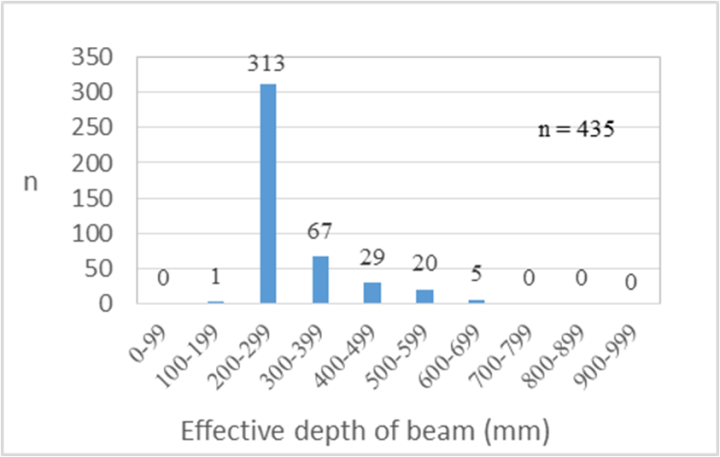
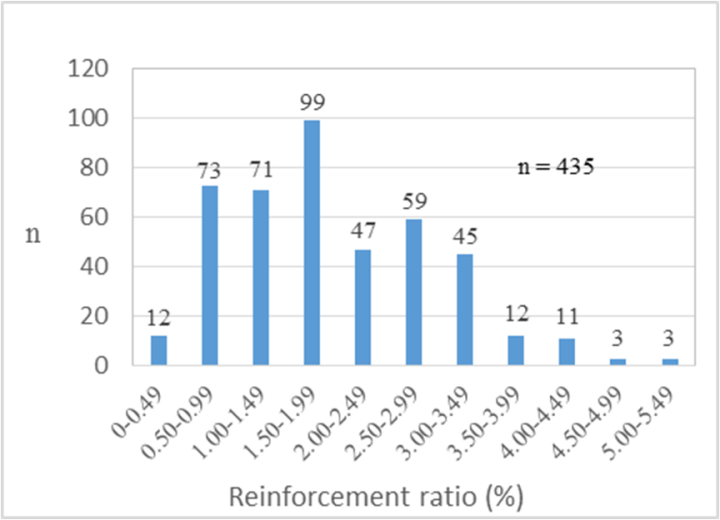
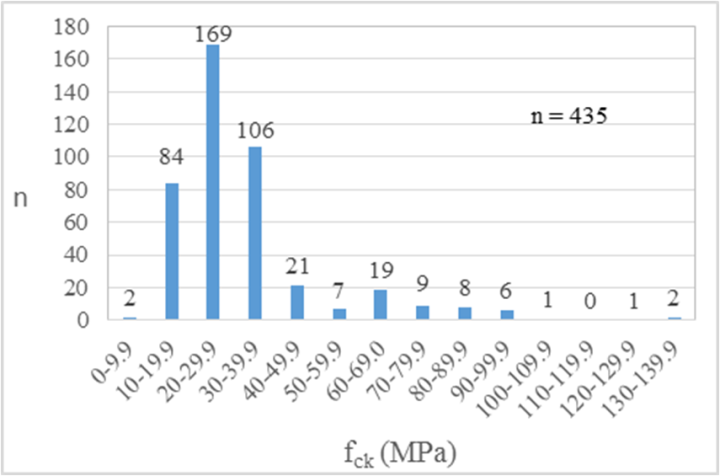
A total of 435 experimental test result on shear critical simply supported beams were selected from the database of Karl-Heinz Reineck [10] which contains 784 experimental test result of reinforced concrete beams without shear reinforcement. Only beams subjected to concentrated loads were considered. In order to avoid the effect of arching action, beams with shear span-to-depth ratio  were not considered. The distribution of the effective depth, reinforcement ratio and concrete compressive strength of beams used in this study is shown in Figure 1-Figure 3. It can be observed from Figure 1 that the effective depth between 200-299mm has the highest frequency of about 72% of the total number of test result considered followed by effective depth between 300-399mm. Similarly, reinforcement ratio between the range of 1.5-1.99 and concrete compressive strength between the range of 20-29.99 has the highest frequencies of 23% and 39% respectively. These reflect the range of values commonly used for effective depth, reinforcement ratio and concrete compressive strength in most of the reinforced concrete design and construction.
 Download as
4. Result and Discussion
 Download as
 Download as
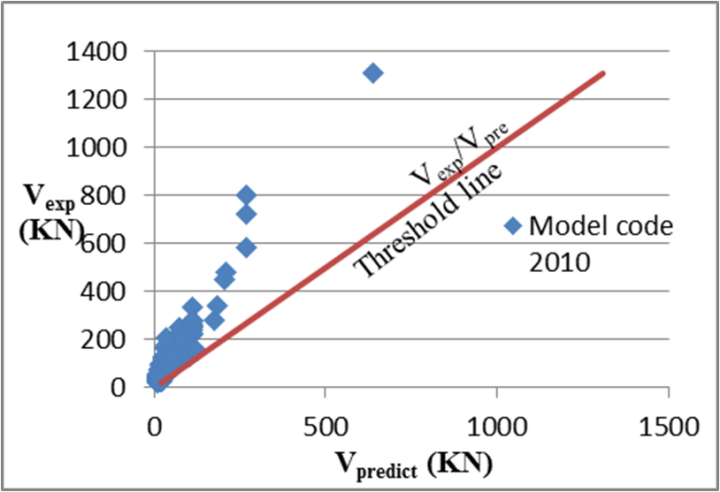
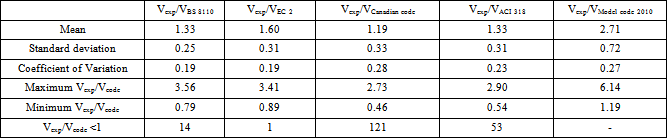
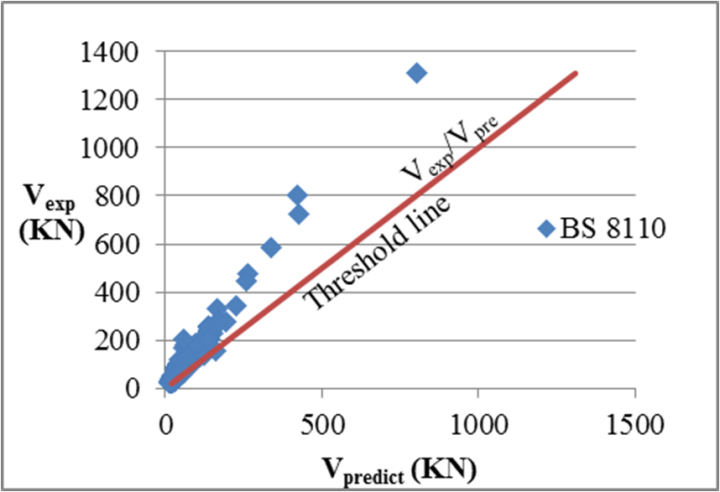
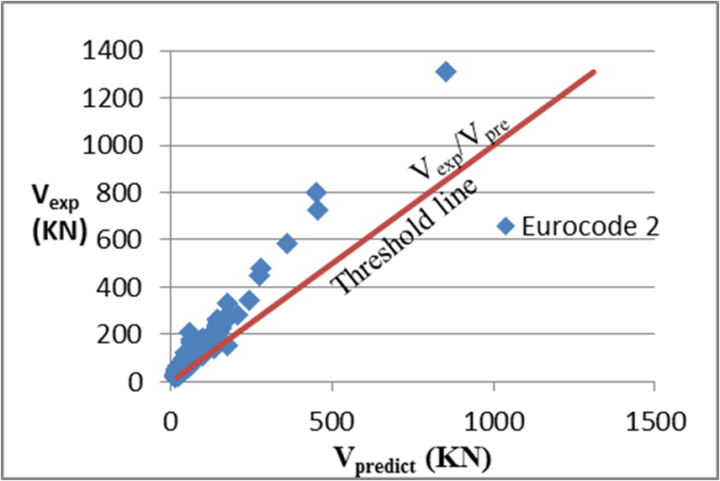
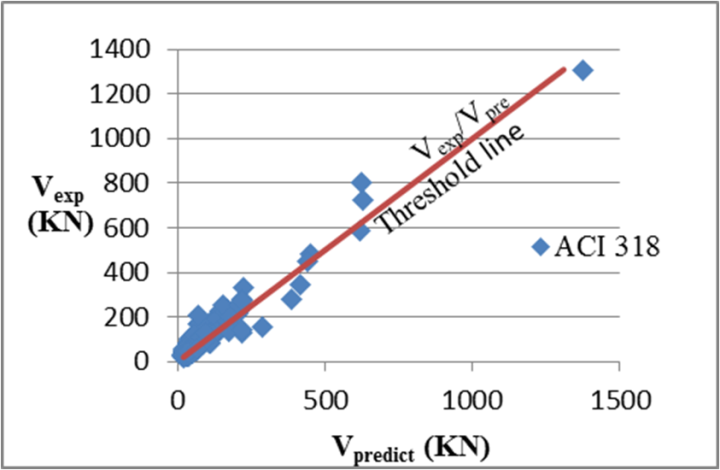
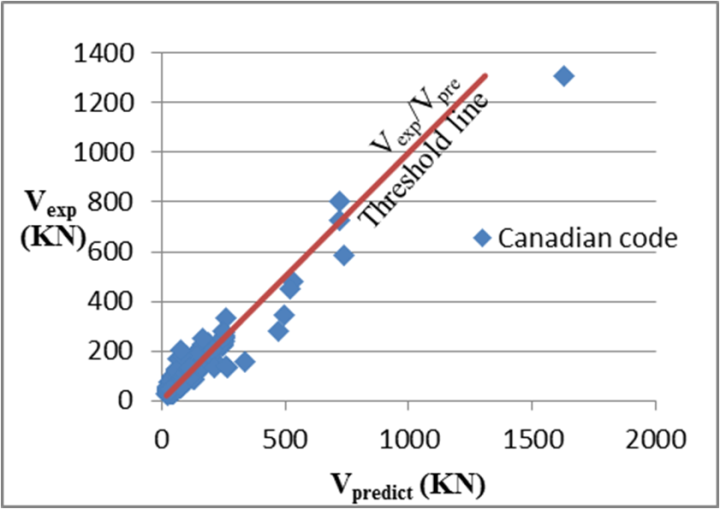
Figure 4-Figure 8 shows plots of experimental shear force versus predicted shear force from different codes. The threshold of Vresult/Vpre= 1 is also plotted in these graphs. A look at these figures shows that Model code 2010 has the most scattered data points with respect to the threshold line (Vresult/Vpre= 1). BS 8110 and EC 2 follows the same trend in predicting the shear resistance of beams. A detailed analysis of the predicted shear resistance from different codes using regression analysis is presented in Table 1. From this table, it can be seen that BS 8110 gave the lowest standard deviation of 0.25 while the lowest coefficient of variation of 0.19 occurred in BS 8110 and Eurocode 2 predictions. These results especially the predictions from BS8110, ACI 318, EC 2 and Canadian codes are in close agreement with the works of [11] and [12]. The minimum and maximum value of Vexp/Vcode for Model code 2010 are both greater than 1 which shows that Model code 2010 prediction is the most conservative when compared with predictions from BS 8110, EC 2, Canadian code and AC1 318 code. This may be due to the simplifying assumption of half the yield strain in the level I approximation adopted in this study. In experimental test on reinforced concrete slabs failing in shear [13] it was shown that strain in the reinforcement was either closed to or reached the yield strain at failure. This therefore implies that Model code 2010 assumption of elastic strain in the reinforcement at failure is overly conservative. Canadian code had the highest number of unsafe predictions (i.e. predictions with Vexp/Vcode <1).
 Download as




 Download as
 Download as
5. Summary and Conclusion
This study investigated the accuracy of shear strength predictions from five different codes. From this comparative analysis, the main conclusions can be summarised as follows;
1) Model code 2010 under estimate the shear strength of beams when compared to predictions from BS 8110, Euro code 2, ACI code 318 and Canadian code.
2) BS 8110, Eurocode 2 and ACI 318 code can fairly predict shear strength of beams without web reinforcement better than Model code 2010 and Canadian code.
3) Model code predictions are less than experimental test results for all the 435 experimental test results considered in this study.
4) Canadian code shear prediction had the highest percentage of unsafe design which is about 27.8% followed by prediction from ACI 318 code with 12.2%.
References
| [1] | J. K. Kim and Y. D. Park, ‘Prediction of Shear Strength of Reinforced Concrete Beams wihout Web Reinforcement’, ACI Material. Journal., vol. 93, no. 3, pp. 213-222, 1996. | ||
 In article In article | |||
| [2] | F. J. Vecchio and M. P. Collins, ‘The Modified Compression-Field Theory for Reinforced Concrete Element Subjected to Shear’, ACI Journal., vol. 83, pp. 219-231, 1986. | ||
| In article | |||
| [3] | A. B. Shuraim, ‘A novel approach for evaluating the concrete shear strength in reinforced concrete beams’, Latin American Journal of Solids Strucures, vol. 11, pp. 93-112, 2014. | ||
| In article | View Article | ||
| [4] | S. H. Ahmad, S. F. A. Rafeeqi, and S. Fareed, ‘Shear Strength of Normal and Light Weight Reinforced Concrete Deep Beams without Web Reinforcement’, Journal of Emergng Trends in Engineering and Applied Sciences, vol. 2, no. 6, pp. 967-971, 2011. | ||
| In article | |||
| [5] | A. R. Mardookhpour, ‘Evaluation of codes and equation for prediction shear capacity in HSC beams without shear. reinforcements’, World Journal of Engineering, vol. 9, no. 1, pp. 57-62, 2012. | ||
| In article | View Article | ||
| [6] | J. Amani and R. Moeini, ‘Prediction of shear strength of reinforced concrete beams using adaptive neuro-fuzzy inference system and artificial neural network’, Scientia Iranica A., vol. 19, no. 2, pp. 242-248, 2012. | ||
| In article | View Article | ||
| [7] | Sudheer Reedy L., Ramana Rao V., and Gunneswara Rao D., ‘Shear Resistance of High Strength Concrete Beams Without Shear Reinforcement’, International Journal of Civil and Structural Engineering vol. 1, no. 1, pp. 101-113, 2010. | ||
| In article | |||
| [8] | S. H. Ahmad, S. F. A. Rafeeqi, and S. Fareed, ‘Shear Predictions of Eurocode EC2’, American Journal of Civil Engineering and Architecture, vol. 1, no. 2, pp. 43-46, 2013. | ||
| In article | View Article | ||
| [9] | G. Arslan, ‘Shear strength of reinforced concrete slender beams’, Proceedings of the Institutes of Civil Engineers - Structures and Buildings, vol. 163, no. 3, pp. 195-205, 2010. | ||
| In article | View Article | ||
| [10] | O. Reineck, K.-H.; Bentz, Evans C.; Fitik, Birol; Kuchma, Daniel A. and Bayrak, ‘ACI-DAfStb Database of Shear Tests on Slender Reinforced Concrete Beams without Stirrups’, ACI Structural Journal, vol. no. 5, pp. 867-875, 2013. | ||
| In article | |||
| [11] | G. Arslan, ‘Shear Strngth of Reinofrced Concrete Slender', Proceedings of Instituiton of Civil Engineers, Structures and Buildings 163, issue SB3, pp. 195-205, 2010. | ||
| In article | View Article | ||
| [12] | Ali Hussein Ali Al-Ahmed and Thaar Saud Al-Gasham, 'Alternative Cracking Shear Strength Equation for Reinforced Concrete Normal Beams without stirrups', Iraqi Journal of Civil Engineering vol 8, no 1, pp. 44-49, 2011. | ||
| In article | |||
| [13] | Rui Vaz Rodrigues, Aurelio Muttoni and Miguel Fernandez Ruiz, 'Influence of Shear on Rotation Capacity of Reinforced Concrete Members without Shear Reinforcement' ACI Structural Journal, Vol 107, no 5, pp. 516-525, 2010. | ||
| In article | |||
| [14] | British Standards Institution.( 1985), Code of Practice and Design and Construction (BS 8110: Part 1:1985), British Standards Institution, London. | ||
| In article | |||
| [15] | CEN (2004) Eurocode 2: Design of concrete structures, Part 1-1: General rules and rules for buildings. CEN, Brussels, EN 1992-1-1:2004. | ||
| In article | |||
| [16] | ACI (American Concrete Institute) (2005) Building Code Requirements for Reinforced Concrete (ACI 318-05) and Commentary (ACI 318R-05). American Concrete Institute, Detroit, ACI Committee 318-05. | ||
| In article | |||
| [17] | CSA Committee A23.3 (2004). Design of Concrete Structures, Canadian Standards Association, Mississauga, Ontario, Canada, 214 pp. | ||
| In article | |||
| [18] | Model Code 2010, First Draft Volume 1 and 2, Fib Bulletins 55, 56, Geneva, Switzerland, 2010. | ||
| In article | |||
 CiteULike
 Mendeley
 StumbleUpon
 Delicious
 Facebook
 Twitter
 LinkedIn



)
)
)
)
)