With a view to improving road materials, particularly low-bearing-capacity laterites, fly ash and cement are effective binders for enhancing their geotechnical and mechanical properties. This study aims to valorize low-bearing-capacity laterites for use as base courses in the construction of high-performance pavements. To this end, a laterite from the quarry located in the village of Thianguel, in the district of Oréfondé (Matam Region, northeastern Senegal), was treated with 4% silico-aluminous fly ash from the Senegal Chemical Industries (ICS) in Mboro and CEM II/B-LL 32.5R Portland limestone cement manufactured by Dangote Cement Senegal S.A. The methodology adopted is based on an experimental study of mixtures of laterite, fly ash and cement. Geotechnical laboratory tests were conducted to evaluate the influence of these additives on the physical and mechanical characteristics of the material. The results show a significant improvement in the performance of the treated laterite. The mixture containing 4% fly ash and 5% cement exhibited the best performance, with the CBR index increasing from 52 for the raw laterite to 252 after treatment. These results confirm the technical feasibility of this stabilization method. The combined use of local laterite, fly ash, and cement constitutes a sustainable, economical, and environmentally friendly solution, providing a relevant alternative to conventional soil stabilization techniques and contributing to the development of more efficient road infrastructure in Senegal.
Senegal has undertaken an extensive program to modernize its transport infrastructures, with the aim of enhancing the quality, efficiency, and accessibility of mobility services while supporting the country’s sustainable economic development. The road network, of which the State is the principal owner and operator, constitutes one of the country's most significant public assets. As such, it must be adequately maintained, upgraded, modernized, and preserved to ensure its long-term sustainability.
In this context, the preservation of pavement structures is a major challenge, particularly for roads subjected to heavy traffic. Improving pavement durability is therefore a priority for the road sector, as it ensures satisfactory service levels, reduces maintenance costs, and extends the lifespan of road infrastructure. The performance of the materials used in pavement construction plays a crucial role in achieving these objectives.
Fly ash is a by-product of electricity generation in pulverized-coal-fired thermal power plants 1. Rich in silica and alumina, silico-aluminous fly ash possesses pozzolanic properties that enable it to react with water and form stronger cementitious compounds. This reaction contributes to improving the physical and mechanical characteristics of lateritic soils, such as bearing capacity, compressive strength, and durability.
CEM II/B-LL 32.5 R is a limestone Portland cement that complies with the EN 197-1 standard. It contains:
• 65 to 79% clinker;
• 21 to 35% limestone containing a total organic carbon content of less than or equal to 0.20% by mass;
• 0 to 5% secondary constituents (fillers).
This study demonstrates that incorporating fly ash and cement into lateritic soils significantly improves their geotechnical performance. The results obtained generally depend on the percentages of fly ash and cement added. With the addition of 4% fly ash and 5% cement, the California Bearing Ratio (CBR) increased from 52 to 252. This improvement opens up promising prospects for the construction of roads, embankments, and civil engineering structures at lower cost in developing countries 2.
Thus, the stabilization of laterite with fly ash and cement constitutes an effective and sustainable solution for improving the engineering properties of construction soils while contributing to industrial waste management.
The fly ash used in this study comes from the Senegal Chemical Industries (ICS) in Mboro, a town located approximately 119 km from Dakar, Senegal.
2.2. CementThe CEM II/B-LL 32.5 R cement used is a Portland limestone cement manufactured by Dangote Cement Senegal S.A. located in Pout, a town in Thiès Region, approximately 29 km from Dakar.
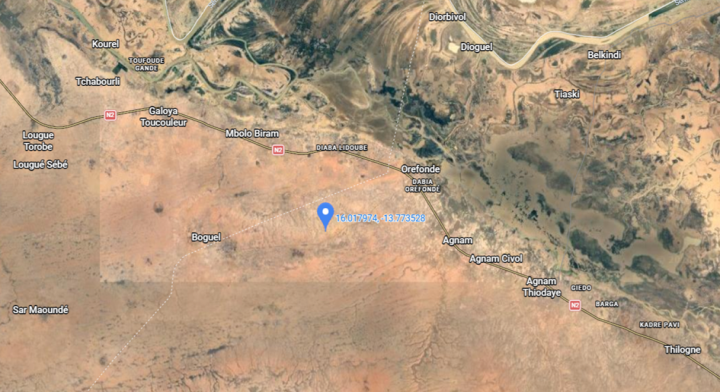
2.3. Thianguel LateriteThe lateritic soil used in this study was extracted from Thianguel quarry, located in the village of Thianguel (Matam) approximately 589 km from Dakar, Senegal.
Table 1 and Figure 1 present the geographical location of the Thianguel quarry.

The collected laterite samples were analyzed in the laboratory according to the following testing program:
• Particle size analysis (by Sieving) 3;
• Modified Proctor compaction test 4;
• Atterberg limits (AL) test 5;
• CBR test 6.
Subsequently, a series of samples was treated with different cement contents and 4% fly ash to determine the most effective dosage. Each CBR value was determined at the Optimum Moisture Content (W) and Maximum Dry Density (δd max), followed by 3 days of air curing and 4 days of soaking 7, 8, 9, 10, 11, 12. The California Bearing Ratio (CBR) of each mixture was determined at the Maximum Dry Density and Optimum Moisture Content after 3 days of air curing followed by 4 days of soaking 7, 8, 9, 10, 11, 12.
The tests carried out made it possible to characterize the raw and improved laterite treated with 1% to 5% cement and 4% fly ash. The results obtained are summarized in Table 2.
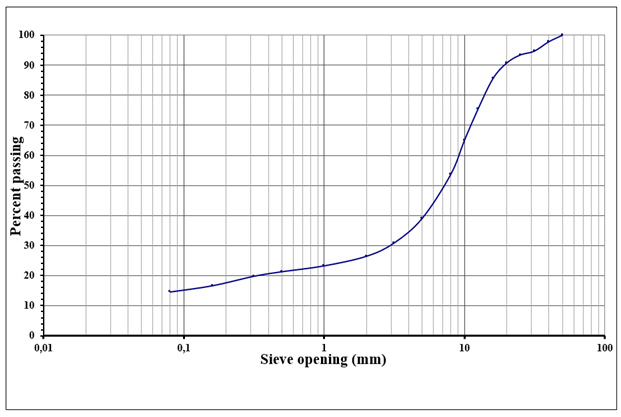
The particle size analysis showed that 14.6% of the sample passed through the 80 µm sieve (Figure 2). It also showed that the sample consists of 9.3% cobbles, 64.2% pebbles and gravel, and 8.5% coarse sand.
Figure 2 illustrates the results of the particle size distribution analysis.

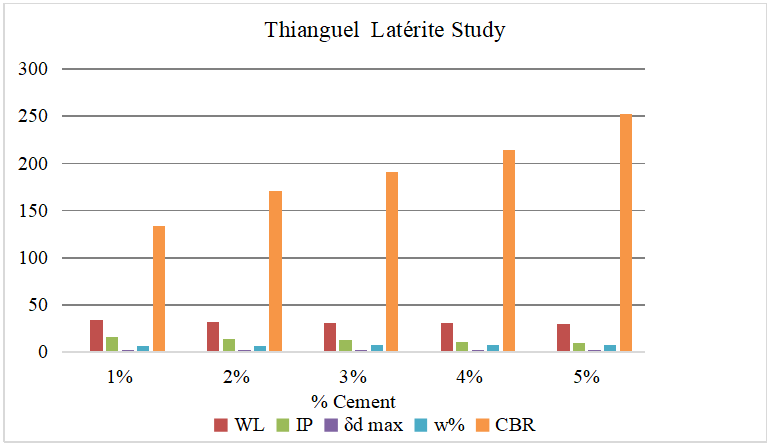
Figure 3 presents the evolution of the main geotechnical characteristics of Thianguel laterite as a function of increasing cement content, while maintaining a constant fly ash content of 4%. It highlights the evolution of the CBR bearing capacity, which progressively increases with the cement content. This trend reflects the significant improvement in the bearing capacity of the laterite following stabilization.

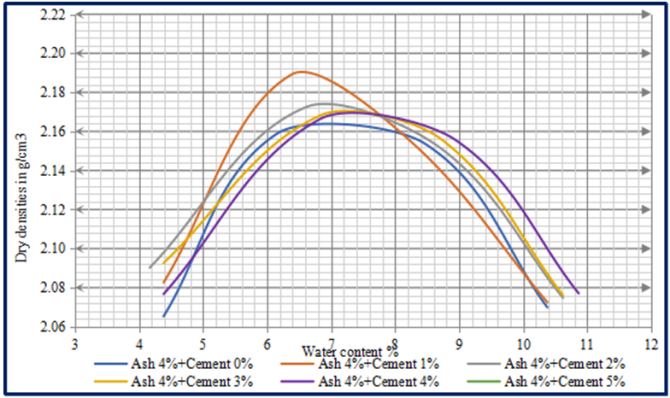
Figure 4 presents, for each curve, a maximum value of the dry density of the soil obtained at a specific moisture content, referred to as the Optimum Moisture Content. These two values constitute the Modified Proctor compaction characteristics.

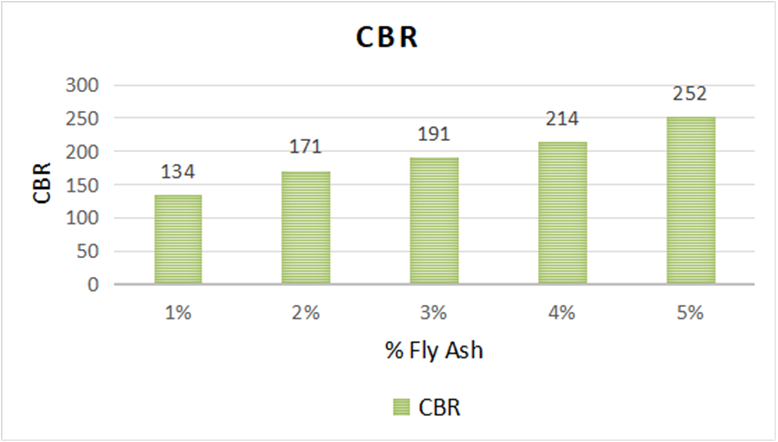
Figure 5 shows the bearing capacity of each sample, expressed as the California Bearing Ratio (CBR), which is used to assess the resistance of the material to penetration and its load-bearing capacity.

We observe that the California Bearing Ratio (CBR), which was 52 for the raw laterite and 82 for the laterite treated with 4% fly ash 10, increased as follows:
• 134 with 4% ash and 1% cement;
• 171 with 4% ash and 2% cement;
• 191 with 4% ash and 3% cement;
• 214 with 4% ash and 4% cement;
• 252 with 4% ash and 5% cement.
These results demonstrate a significant improvement in the bearing capacity of the laterite treated with 4% fly ash and increasing cement contents. The CBR reached a maximum value of 252 with the addition of 5% cement, corresponding to the optimum mechanical performance of the treated material.
The combined incorporation of 4% fly ash and 5% cement significantly enhanced the mechanical performance of the laterite up to the optimum dosage.
The optimum mixture consists of 4% fly ash and 5% cement, as it provides:
• the highest bearing capacity (CBR = 252);
• good stability;
• satisfactory compaction characteristics;
• an overall improvement in geotechnical properties of the laterite.
The geotechnical study carried out on the Thianguel laterite stabilized with fly ash and cement demonstrates that the addition of these two binders significantly improves the mechanical characteristics of the material. The test results revealed a slight and progressive decrease in Atterberg limits with increasing cement content.
The results indicate that the most significant improvement is in the material's bearing capacity, as reflected by the increase in the California Bearing Ratio (CBR).
The CBR increased from 52 for the raw laterite to a maximum value of 252 with the addition of 4% fly ash and 5% cement, indicating a substantial improvement in the material's strength and stability.
Therefore, the optimum mixture consists of 4% fly ash and 5% cement, providing the best compromise between compaction characteristics and mechanical performance. This mixture is recommended for use in pavement layers, particularly as a base course material for high-performance pavements.
| [1] | Laetitia D’Aloia-Schwartzentruber et Jean-Michel Torrenti, Le Grand Livre des Bétons, Groupe Moniteur (Editions du Moniteur), 17, rue d’Uzés, 75002 Paris, 2014. | ||
| In article | |||
| [2] | Ministère des Infrastructures Terrestres et du Désenclavement, Catalogue de structures de chaussées neuves et Guide de dimensionnement des chaussées au Sénégal, 2015, 66-75. | ||
| In article | |||
| [3] | NF P94-056, Sols: reconnaissance et essais - Analyse granulométrique - Méthode par tamisage à sec après lavage, 1996. | ||
| In article | |||
| [4] | NF P94-093, Sols: reconnaissance et essais - Détermination des références de compactage d'un matériau - Essai Proctor Normal - Essai Proctor modifié, 1999. | ||
| In article | |||
| [5] | NF P94-051, Sols: reconnaissance et essais - Détermination des limites d'Atterberg - Limite de liquidité à la coupelle - Limite de plasticité au rouleau, 1993. | ||
| In article | |||
| [6] | NF P94-078, Sols: reconnaissance et essais - Indice CBR après immersion. Indice CBR immédiat. Indice Portant Immédiat - Mesure sur échantillon compacté dans le moule CBR, 1997. | ||
| In article | |||
| [7] | NF P 98-114-3, Assises de chaussées - Méthodologie d'étude en laboratoire des matériaux traités aux liants hydrauliques - Partie 3: Sols traités aux liants hydrauliques et pouzzolaniques éventuellement associés à la chaux, 2001. | ||
| In article | |||
| [8] | Centre Expérimental de Recherches et d’Etudes du Bâtiment et des Travaux Publics (CEBTP), Utilisation des graveleux latéritiques en technique routière, Institut des Sciences et des Techniques de l’Equipement et de l’Environnement pour le Développement (ISTED), 38, rue Liancourt 75014 Paris (France). | ||
| In article | |||
| [9] | Eba, F. Z., Lo, M. L., & Sow, D, Improving geotechnical characteristics of low bearing materials for use in a base layer, Journal of Scientific and Engineering Research, 9(12), 13–20, 2022. | ||
| In article | |||
| [10] | Diop, M., & Sow, D, Improvement of Thianguel laterite by adding fly ash for high-performance pavement design, Journal of Scientific and Engineering Research, 13(5), 190–194, 2026. | ||
| In article | View Article | ||
| [11] | Diop, S., Sall, O. A., Diouf, D., & Ba, M, Characterization of the influence of fly ash on the mechanical behavior of compressed earth bricks, International Journal of Research and Review, 12(7), 2025, 108–110. | ||
| In article | View Article | ||
| [12] | Mbaye Wade, Macodou Thiam, Makhaly Ba, and Mapathé Ndiaye, “Influence of Sand on the Mechanical Strengths of Compressed Earth Blocks Based on Sindia Laterite Stabilized with Cement.” American Journal of Civil Engineering and Architecture, vol. 13, no. 1 (2025): 1-4. | ||
| In article | View Article | ||
Published with license by Science and Education Publishing, Copyright © 2026 Mor DIOP, Djibril SOW, Astou DIOKHANE and Mory COULIBALY
 This work is licensed under a Creative Commons Attribution 4.0 International License. To view a copy of this license, visit
http://creativecommons.org/licenses/by/4.0/
This work is licensed under a Creative Commons Attribution 4.0 International License. To view a copy of this license, visit
http://creativecommons.org/licenses/by/4.0/
| [1] | Laetitia D’Aloia-Schwartzentruber et Jean-Michel Torrenti, Le Grand Livre des Bétons, Groupe Moniteur (Editions du Moniteur), 17, rue d’Uzés, 75002 Paris, 2014. | ||
| In article | |||
| [2] | Ministère des Infrastructures Terrestres et du Désenclavement, Catalogue de structures de chaussées neuves et Guide de dimensionnement des chaussées au Sénégal, 2015, 66-75. | ||
| In article | |||
| [3] | NF P94-056, Sols: reconnaissance et essais - Analyse granulométrique - Méthode par tamisage à sec après lavage, 1996. | ||
| In article | |||
| [4] | NF P94-093, Sols: reconnaissance et essais - Détermination des références de compactage d'un matériau - Essai Proctor Normal - Essai Proctor modifié, 1999. | ||
| In article | |||
| [5] | NF P94-051, Sols: reconnaissance et essais - Détermination des limites d'Atterberg - Limite de liquidité à la coupelle - Limite de plasticité au rouleau, 1993. | ||
| In article | |||
| [6] | NF P94-078, Sols: reconnaissance et essais - Indice CBR après immersion. Indice CBR immédiat. Indice Portant Immédiat - Mesure sur échantillon compacté dans le moule CBR, 1997. | ||
| In article | |||
| [7] | NF P 98-114-3, Assises de chaussées - Méthodologie d'étude en laboratoire des matériaux traités aux liants hydrauliques - Partie 3: Sols traités aux liants hydrauliques et pouzzolaniques éventuellement associés à la chaux, 2001. | ||
| In article | |||
| [8] | Centre Expérimental de Recherches et d’Etudes du Bâtiment et des Travaux Publics (CEBTP), Utilisation des graveleux latéritiques en technique routière, Institut des Sciences et des Techniques de l’Equipement et de l’Environnement pour le Développement (ISTED), 38, rue Liancourt 75014 Paris (France). | ||
| In article | |||
| [9] | Eba, F. Z., Lo, M. L., & Sow, D, Improving geotechnical characteristics of low bearing materials for use in a base layer, Journal of Scientific and Engineering Research, 9(12), 13–20, 2022. | ||
| In article | |||
| [10] | Diop, M., & Sow, D, Improvement of Thianguel laterite by adding fly ash for high-performance pavement design, Journal of Scientific and Engineering Research, 13(5), 190–194, 2026. | ||
| In article | View Article | ||
| [11] | Diop, S., Sall, O. A., Diouf, D., & Ba, M, Characterization of the influence of fly ash on the mechanical behavior of compressed earth bricks, International Journal of Research and Review, 12(7), 2025, 108–110. | ||
| In article | View Article | ||
| [12] | Mbaye Wade, Macodou Thiam, Makhaly Ba, and Mapathé Ndiaye, “Influence of Sand on the Mechanical Strengths of Compressed Earth Blocks Based on Sindia Laterite Stabilized with Cement.” American Journal of Civil Engineering and Architecture, vol. 13, no. 1 (2025): 1-4. | ||
| In article | View Article | ||