Delhi's urban history has been shaped by its unique historic water architecture which is embedded in an interdependent ecological, built and cultural system. This system is illegible today in the urbanscape owing to historic water structures being viewed as isolated monuments. Our understanding of water architecture is informed by the shifting view of water as a commodity rather than a shared cultural resource. The paper uses a case study of Delhi's Hauz Khas to define a conceptual framework of positioning historic water architecture as a cultural resource and use it as a tool to achieve heritage- led sustainability. The study identifies agents and patterns of transformation of site and surroundings of Hauz Khas that impacts historic urban development trajectories. The study employs qualitative research methods and uses archival research, historical studies, field-work, community interviews and documentation to analyse the cultural associations in the past and the present. This makes a case for why and how historic water architecture should be conserved by taking into account both its morphology and its spirit- of-the-place, leading to cultural regeneration as a process to inform sustainable development.
The water architecture of historic Delhi is evident in the urban landscape in the form of various historic water structures, or as this study would also refer to them as ‘units of the water system’. Majority of these units are now perceived as monuments with very few of them being considered as ‘living heritage’- such as Nizamuddin Baoli and Gandhak ki Baoli. There are some structures which have been or are being revived in the recent times, such as Hauz Khas and Satpula. There are many other units such as ‘Bundh’, ‘Nahar’, ‘Baolis’, ‘Pul’ which are either part of protected monument complexes such as Mehrauli Archaeological Park (Rajon ki Baoli), Dinpanah (Baoli), Red Fort (Baoli, water channels, moat system), Firoz Shah Kotla (Baoli), Wazirpur Complex at RK Puram (Baoli) among others; or have become part of built and landscape complexes such as Talkatora Garden (Bundh at Talkatora), Teen Murti Bhavan (Kushak Mahal), Lodi Garden (Athpula). There are many structures that are in derelict state due to neglect such as Barapulla and Mahipalpur Bundh. Some of these water structures have become well- known tourist destinations such as, Agrasen ki Baoli and Surajkund (now part of Haryana).
With the catchment areas of these water structures being built up, the functioning of these structures is severely impacted. The reason for this is majorly dependent on the trajectory of urban history of Delhi. However, a very significant reason is the illegibility of the how these water structures work within a holistic system. This system takes into account the topography, geology, soil, hydrology, vegetation, in addition to the response of the historic settlements to the natural and cultural landscape of the city.
It is imperative to note that most of the development of the historic water architecture of Delhi occurred before the British period. The British interpreted the landscape of the city differently and this is evident in the way the new imperial capital of Delhi was designed. The water works introduced by the British in India consisted of an elaborate infrastructure built to supply water. While it is a boon for the people to have water available at the turn of a tap, the understanding of where the water is coming from is lost. Water was part of the cultural resource of community in the form of water architecture in the past, whereas now it is considered as a commodity. This study brings out the aspect of cultural association of water as being an important factor in the way the historic water architecture of the city has evolved over the years and how it can be a driving as well as catalysing force in sustainability today.
The study is anchored on the understanding of holistic water system, which requires a macro level study of Delhi’s historic water system and micro level study of the selected site of Hauz Khas 1. The rationale for selection of the site is owing to the fact that Hauz Khas (erstwhile Hauz-i-Alai) is among the earliest examples of a city level Hauz typology of Sultanate Delhi (next to Hauz-i-Shamsi in Mehrauli, which predated it). Hauz Khas has had continued, albeit transformed associations with the settlement around it. It is an ASI protected site and a significant landmark of the city today. This provides opportunities to ascertain and define a methodological approach to heritage- led sustainability, which can be studied in this case example.
While the site is an independent historic hauz (human-made water tank) situated in the Hauz Khas village, it is a part of the immediate cultural water network of historic city of Siri, established in the Khilji Dynasty in circa 1303 CE 2, which in turn is part of a larger Barapullah nadi network, acting as a sub- system in the larger historic water system of Delhi. Thus, a secondary study of the archives, historical studies and primary site studies through observation at the scale of Aravalli watershed region of Delhi, historic city of Siri and site and surrounding of Hauz Khas were done to ascertain the role of this as a unit in the larger system. This also established the significance of the site as part of the historic water system as well as a ‘place’ with localised history, associations and cultural identity.
The cultural identity associated with the hauz was evaluated through interviews with the direct and indirect users around the site. This helped in understanding agents and patterns of transformation of the site. This has been detailed in the relevant section further in the paper.
The study has also examined current discourses on sustainable development and regeneration as linked to cultural heritage. These are critically discussed by contextualising the role of cultural heritage- in this case, Hauz Khas- from the point of view of heritage-led regenerative action. This has helped to suggest a conceptual framework that can demonstrate an approach for the hauz to utilise its cultural attributes in addressing notion of sustainability in the urban context.
The scope of this study limits itself to the historic Delhi which is bounded by the Aravalli Ridge and the Yamuna River. Delhi is known to have pre-historic sites, indicating presence of settlements. Lal Kot was the earliest known historic city during the period of Tomars and Rajputs 2. Anangtal and Surajkund were important water structures of this period. The city later became a part of Dilli-i-Kuhna in the Sultanate period. The Sultanate-period settlements developed in the south and the south- central ridge regions due to strategic proximity of the ridge and presence of water through tributaries to Yamuna which were tapped by making water structures. The presence of quartzite bedrock allowed making of surface water reservoirs or taals, kunds and hauz; as well as baolis which tapped groundwater and surface water 3. The bundhs helped in controlling the flow of water 4 and some of them also developed as Shikargahs such as Malcha Mahal, Bhooli Bhatiyari Mahal, and Kushak Mahal among others.
The development of imperial capital towards north can be seen for the first time in Feroze Shah Kotla, which was made possible due to building of canal Ju-i-Firozeabad from Hisar. The same was developed further during Shahjahan’s reign which helped the imperial city of Shahjahanabad.
These water structures have not only been sources of water for the community but acted as strong cultural water networks. This ‘nature-culture-built nexus’ can be seen traditions, customs and associations in many of these water structures. Phoolwalon ki Sair is associated with Hauz Shamsi. Baoli at Dargah of Qutubuddin Bakhtiyar Kaki and Nizamuddin Baoli are associated with history of Sufism in Delhi 5.
The current issues of water scarcity, urban flooding and exploitation of resources in Delhi have been raising the debates on inadequate response of the city to its ecological context. This presents a paradoxical scenario of present-day Delhi which has historically had evident correlation of water architecture, community and the city.
From responding to the landscape in pre- British layers 4, 6 to modification of landscape during the British intervention 4, 6, 7, the points of continuity and discontinuity are important as they have impacted the development of the city.
In 1912, with Delhi becoming the Imperial Capital and formation of the new city on the southwest of Shahjahanabad, the water streams were reinterpreted as roadways and the nallahs (term for Nadis) were diverted outside the periphery of the city 8. Some of these were the Nizamuddin Nallah, the Kushak Nallah, the Talkatora Nallah, and Nallah along Khilauli Bagh. The nallahs and the greens on the periphery of the city were part of the buffer from the old city and settlements.
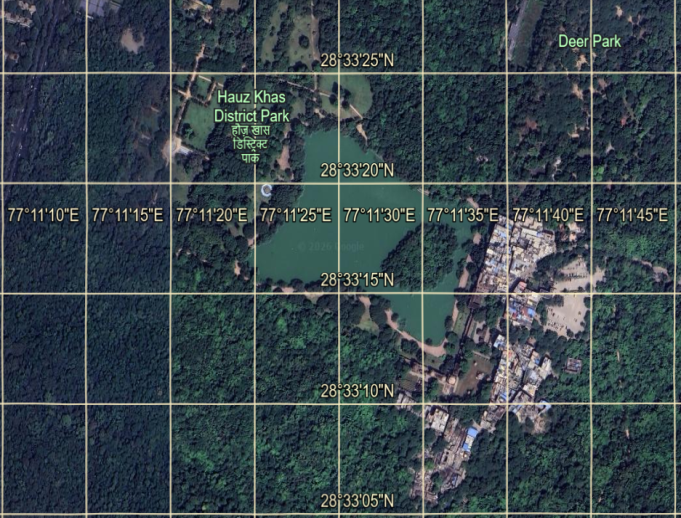
The field work for the case study was done to assess agents and patterns of transformation. First component of the field work focused on site studies to understand the relation of Hauz Khas to the monument complex. The second major component of study was the community interviews conducted in November 2024. This was to understand any continuing, transformed or lost linkages (Figure 1).
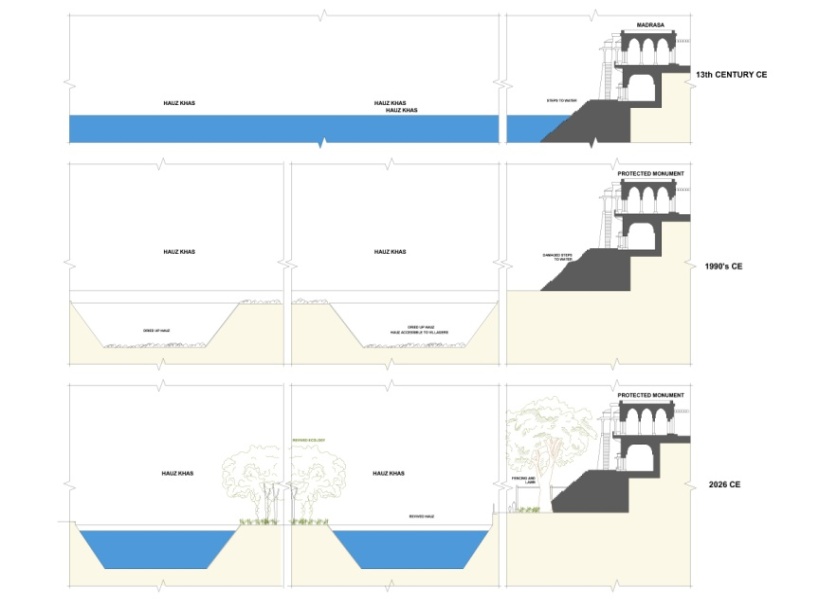
4.1. Site StudiesAs discussed in the previous sections, the hauz came up along with the timeline of establishment of the city of Khilji- Siri. In Firoze Shah Tughlaq’s time period, we see the madrasa complex built in physical and symbolic response to the hauz in circa 1352 CE. According to Welch’s seminal work on the topic, madrasa was the renowned centre of Muslim theological learning in 14th century CE in the then- northern India, drawing scholars internationally. The complex was built on the southern and eastern sides of the reservoir that lends its name to both the site and the village. According to Welch, the hauz measured 600 x 700 meters. It was over 4 meters deep. It could have held over 800,000 cubic meters of water after monsoons back then 9.

An interesting aspect to consider here is that the water was considered pious and in fact the royal entourage would enter the madrasa through the steps at the junction of the complex. The steps of the madrasa complex leading down to the hauz mirrored the indigenous Indian understanding of ghats and stepwells as interface to the water body. It is ironic that now the current entrance to the monument complex is actually the rear of the complex as it was envisaged. The access from the hauz is cut- off by pathways as now it has been restored as an urban pond.
The response of the built environment to the hauz over the years also brings about the aspect of linkages between ideas of cultural network and sustainability. In the historic timeline various structures, including many tombs in the Tughlaq, Lodi and Sayyid period were found in the vicinity to the hauz. The hauz was also revived and considered important by the subsequent political dispensations until the British period. The continuity of sacred architecture in the area was because of continued cultural allegiance to the hauz and its associated mosque and madrasa.
The Hauz Khas group of monuments complex was protected under the Archaeological Survey of India in 1914 CE 10. Around this time, approximately 85 farming families which resided inside the monument walls were settled outside the boundary. Post the 1947 CE partition and the migration, demographic change happened in the area 11.
In the decade of the 1960s, the village of Hauz Khas and several other such villages got the status of ‘urban villages’ by the Delhi Development Authority. This exempted the aabadi area from stringent bye-laws and regulations. The village continued to be untouched by the fragmented development around the city till most of the 1980’s.


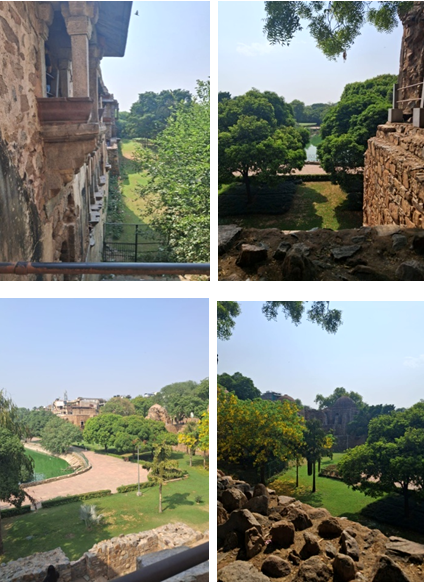
In the 1987 CE, the beginning of rapid transformation of the village was seen as it transformed into boutique stores and garment shops of well-known fashion designers. The village was conveniently a cost-effective alternative to open such a market within the affluent South Delhi neighbourhood. The beginning of this intended collaboration of retail commerce and indigenous village culture has now spiralled into intense commodification and transformation of the village street leading to Hauz Khas. Now the identity of the village is known by its upbeat cafes, boutiques and stores, leading to the recently ticketed entry of Hauz Khas and its monuments complex at the end of the street (Figure 2).
In the 1990’s, the hauz was revived over a period of several attempts by the INTACH natural heritage division 12. The revival of the water tank was a success in the sense that remaining part of the hauz was revived as an urban lake, albeit with modified water channel network. The revival also led to ecological regeneration of flora and fauna in the area and became a significant green lung to the larger Hauz Khas enclave. Several prime residential colonies also developed in the vicinity (Figure 3).
4.2. Community InterviewsThe study of collective memory, associations and experiences of the people were done through interviews, conducted in-person for all the respondents in November 2025. The focused and in-depth interviews were conducted at the site of the Hauz Khas and the Hauz Khas village market street. The primary observations on the site helped the author to identify various users- both direct and indirect. To counter the limitation of subjectivity in the sampling process, a diversity in age groups, educational backgrounds, occupations and gender was ensured. The number of the interviewees for each sub-group of users was determined through purposive sampling as well as snow-balling sampling, ascertained by data saturation. The age profile was between 18-75 years.
The in-depth interview consisted of semi- structured questions for more factual or objective components, which were primarily- understanding of the use of the hauz- both past and present; historicity; contextual changes in the past few decades; linkages with other historic water structures and/or other historic structures in the vicinity. These were done to employ data triangulation to counter the limitation of generalizability of purposive sampling. Additionally, open-ended questions were asked to understand subjective components such as- local histories; anecdotes/ experiences; associations; activities; legibility of site (physically and culturally); issues and potential of the site.
From the community interviews, the major inferences were that the awareness and legibility of the site of Hauz Khas was high among the direct and indirect users in and around the site. The local histories from local residents of the village bring to light the fact that the commercialisation of the village market street changed the character of the street completely. Earlier, the villagers would access the open grounds around the hauz as well as within the complex quite freely. However, first the ASI protection and then later the coming up of the market hampered their access to the hauz. The increasing tourist gaze impacted the daily life of the villagers. Eventually the higher rental income was a push that made people transform their residential buildings by adding floors or letting out spaces. The hauz is now part of the ticketed monument complex which has led to gentrification of the site. Now the major footfall in the monument complex is of the students or tourists. The café and restaurants overlooking the hauz have premium rental. However, it is just the view of the hauz that is monetised. The adjacent Deer Park is accessed by the residents of nearby affluent colonies for walks and leisure.
Another important takeaway from the older residents of the erstwhile village also brings forth the point that earlier there were many wells in the vicinity- pointing to a network of water structures of hauz (surface water structure) and wells (groundwater structures). Many of those wells are lost over a period of time due to rampant construction.
Most of the tourists and visitors refer to the place as “Hauz Khas fort”, which is a misnomer. The history and function of the different spaces of the site is largely unclear to the tourists, who are primarily drawn to the hauz for its aesthetic value and/ or the popularity of the market. The hauz gained popularity after being featured in some popular Hindi movies, before which the catchment of visitors was mostly local.
Several respondents in the market area referred to how the identity of the market is now largely due to the upscale cafes and the association with the erstwhile village and the hauz is quite lost. It is almost unimaginable to many visitors about the recent history of the hauz with a very different built environment.
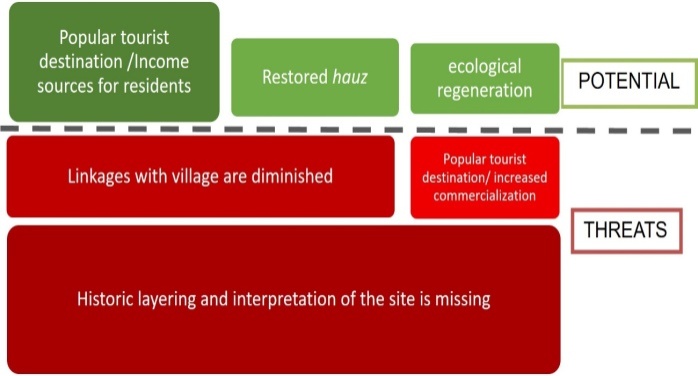
Overall, the idea of lost cultural identity of the place is an idea that strongly resonates with the direct users of the place, despite the economic boom. However, they do agree largely on the potential of the site for a stronger cultural association. With regards to how the cultural association may be achieved, the respondents could not articulate the responses strongly, which leads to a need for situation analysis at a larger scale to identify potential use (Figure 4).

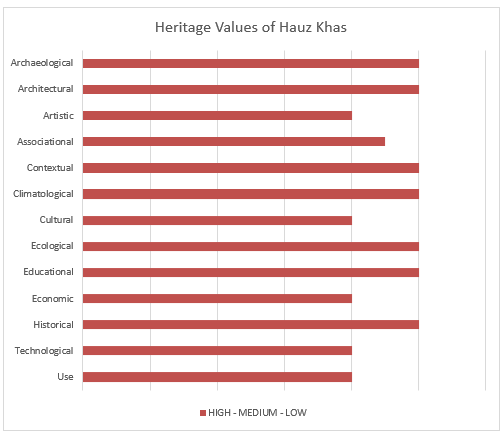
Hauz Khas and its larger cultural water network in itself becomes a catalysing agent to achieve the goals of culture-led sustainability. The values which the Hauz holds which are worth conserving has been summarised as below (Figure 5).
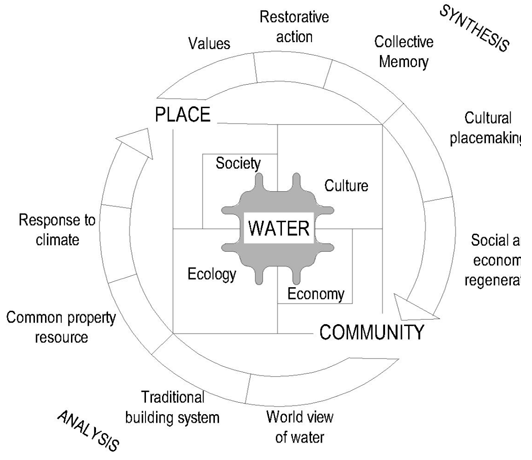
The theoretical framework of Regenerative Lens by Buckton et.al. emphasises on restorative and regenerative processes being lesser energy demanding process, which is rightly applicable to the architecture industry as well 13. Using this premise, the author proposes a lens of water to understand and intervene in the historic water architecture.

The study proposes that instead of looking at ecology, culture, social and economic factors to achieve sustainable development goals as separate verticals, one may look at it like a jigsaw puzzle with the water holding the key to all of these interconnected aspects of ecology, culture, society and economy 14. Figure 6 shows the framework for studying historic water architecture for heritage-led sustainability.

The generative process of the ‘place’ needs to be analysed looking at the factors of:
a)World view of Water- this takes into account the various attributes of water. In the case of Hauz Khas, they include cultural connotation, sacredness of water, sustenance of community, collective memory as well as sustenance of community’s water needs.
b)Traditional building system: The traditional building systems as well as the hauz are examples to study and apply as they respond to the local climate. Even today, the site of Hauz Khas is cooler in temperatures with traditional understanding of massing of volumes, ventilation as well as light and shadow.
c)Common property resource: The idea of decentralized community management system as well as mechanisms of repairs and maintenance done historically needs to be studied to adapt to present situation with the current stakeholders.
d)Response to climate: this study requires the understanding of the site with respect to the hydrology traditionally
e)Building use: the use of the building traditionally for different purposes- water access, religious rituals, bathing, drinking, social space- need to be understood to understand the spirit of the place.
The cultural regeneration with the aim of heritage- led sustainability of the place requires a process of synthesis of the information, which includes:
a)Values: A through assessment of the values of the place, contextualized for the hauz as part of a larger cultural water network, owing to its multi-layered history and use.
b)Restorative action: The restoration of the physical structure needs to be amplified by the conservation of the spirit of the place as well as a cultural re-integration.
c)Collective memory: This also corresponds to defining the spirit of the place with historical and colloquial narratives of the hauz.
d)Cultural Placemaking: The sense of arrival to the hauz as well as its connection to other cultural and social linkages in the vicinity is necessary for its viability for use as a public place in contemporary times.
e)Social and economic regeneration: this emphasizes on community being the custodian in the cultural placemaking exercise which improves the quality of life.
To conclude, the study has highlighted how a cultural reading of water architecture is necessary for a better understanding of the built environment. Due to dominance of land over water in modern perception of the people, we often overlook this aspect how water hold the land, the built, the unbuilt, the people and their interactions 15. The cultural connotations assigned to water structures and water bodies in traditional society was a way to revere and protect water as it assumes multiple roles in the cultural ecosystem- it is significant in the foreground, the background and the liminal. In the case of Hauz Khas cultural water network the ramifications of this neglect are broken down in the spectres of memory, aesthetics and sustenance of the place, at different spatial and temporal scales. An attempt is made to introduce the perspective which may define methodology of architectural studies to understand issues of built environment by being a part of the system, rather than viewing the system from a distance like a laboratory experiment. A way forward from this study could be to develop a model of embedding intangible parameters in tangible issue analysis of built environment with respect to water architecture.
Due to the scope of research employing qualitative research methods, the idea is to identify the theoretical gap of linkage of cultural associations to the issue and solutions for revival of water architecture. Further research can be done in the direction of testing the parameters got generalizability in other examples of historic water architecture embedded in the place identity of the urban realm.
The authors would like to thank the respondents of the community surveys for their participation and time. We also acknowledge the support provided by our respective institutions.
| [1] | Batuta, I., The Travels of Ibn Battutah. abridged, illustrated, reprint ed. s.l.:Pan Macmillan, 2003. | ||
| In article | |||
| [2] | Hearn, G. R., The Seven Cities of Delhi. s.l.:W. Thacker & Company, 1906. | ||
| In article | |||
| [3] | Shah, S., Unlocking the Potential of Water Architecture in Urban Realm of Delhi, India. Doha, Qatar, 57th ISOCARP World Planning Congress, 2021 . | ||
| In article | View Article | ||
| [4] | Cherian, D., Pairing Mega Events and Hydrological Systems for Urban Sustainability: Strategy Framework for Delhi beyond the Commonwealth Games 2010. Ph.D. Dissertation, Massachusetts Institute of Technology, USA, 2004. | ||
| In article | |||
| [5] | Aquil, R., Hazrat-I-Dehli: The Making of the Chishti Sufi Centre and the Stronghold of Islam. South Asia Research, 28, 23-48, 2008. | ||
| In article | View Article | ||
| [6] | Broich, J., Engineering the Empire: British Water Supply Systems and Colonial Societies, 1850--1900. Journal of British Studies, 46, 346-365, 2007. | ||
| In article | View Article | ||
| [7] | D’Souza, R., Water in British India: The Making of a ‘Colonial Hydrology’. History Compass, 4, 621-628, 2006. | ||
| In article | View Article PubMed | ||
| [8] | Wescoat, J. L., From Nallah to Nadi, Stream to Sewer to Stream. Water Histories of South Asia, 135-157, 2019. | ||
| In article | View Article | ||
| [9] | Welch, A., A Medieval Center of Learning in India: The Hauz Khas Madrasa in Delhi. Muqarnas Online, 13, 165-190, 1996. | ||
| In article | View Article | ||
| [10] | National Monuments Authority- Categorization of Delhi Circle Monuments- available at https:// www.nma.gov.in/ WriteReadData/ RTF1984/ 1682685196.pdf. | ||
| In article | |||
| [11] | Bernroider L., Dynamics of Social Change in South Delhi’s Hauz Khas Village. SOAS South Asia Institute Working Papers, 1:1-6, 2015. | ||
| In article | |||
| [12] | Roy D., Revival of Hauz Khas Lake in Delhi: Approaches to Urban Water Resource Management in India. Journal Management & Sustainability, 6:73, 2016. | ||
| In article | View Article | ||
| [13] | Buckton, e. a., The Regenerative Lens: A conceptual framework for regenerative social-ecological systems. One Earth, 824-842, 2023. | ||
| In article | View Article | ||
| [14] | Kamal Arif M., Maheshwari S., Warsi T. R., Critical Assessment of Water with Reference to Sustainable Development in India, American Journal of Civil Engineering and Architecture, 8(4), 131-135, 2020. | ||
| In article | View Article | ||
| [15] | Garg R., Kumar A., Pankaj, Kamal Arif M. Determining Water Footprint of Buildings During Construction Phase: An Activity-based Approach. Civil Engineering and Architecture, 11(2), 773 – 783, 2023. doi: 10.13189/cea.2023.110218. | ||
| In article | View Article | ||
Published with license by Science and Education Publishing, Copyright © 2026 Suruchi Shah, Tejwant Singh Brar and Mohammad Arif Kamal
 This work is licensed under a Creative Commons Attribution 4.0 International License. To view a copy of this license, visit
http://creativecommons.org/licenses/by/4.0/
This work is licensed under a Creative Commons Attribution 4.0 International License. To view a copy of this license, visit
http://creativecommons.org/licenses/by/4.0/
| [1] | Batuta, I., The Travels of Ibn Battutah. abridged, illustrated, reprint ed. s.l.:Pan Macmillan, 2003. | ||
| In article | |||
| [2] | Hearn, G. R., The Seven Cities of Delhi. s.l.:W. Thacker & Company, 1906. | ||
| In article | |||
| [3] | Shah, S., Unlocking the Potential of Water Architecture in Urban Realm of Delhi, India. Doha, Qatar, 57th ISOCARP World Planning Congress, 2021 . | ||
| In article | View Article | ||
| [4] | Cherian, D., Pairing Mega Events and Hydrological Systems for Urban Sustainability: Strategy Framework for Delhi beyond the Commonwealth Games 2010. Ph.D. Dissertation, Massachusetts Institute of Technology, USA, 2004. | ||
| In article | |||
| [5] | Aquil, R., Hazrat-I-Dehli: The Making of the Chishti Sufi Centre and the Stronghold of Islam. South Asia Research, 28, 23-48, 2008. | ||
| In article | View Article | ||
| [6] | Broich, J., Engineering the Empire: British Water Supply Systems and Colonial Societies, 1850--1900. Journal of British Studies, 46, 346-365, 2007. | ||
| In article | View Article | ||
| [7] | D’Souza, R., Water in British India: The Making of a ‘Colonial Hydrology’. History Compass, 4, 621-628, 2006. | ||
| In article | View Article PubMed | ||
| [8] | Wescoat, J. L., From Nallah to Nadi, Stream to Sewer to Stream. Water Histories of South Asia, 135-157, 2019. | ||
| In article | View Article | ||
| [9] | Welch, A., A Medieval Center of Learning in India: The Hauz Khas Madrasa in Delhi. Muqarnas Online, 13, 165-190, 1996. | ||
| In article | View Article | ||
| [10] | National Monuments Authority- Categorization of Delhi Circle Monuments- available at https:// www.nma.gov.in/ WriteReadData/ RTF1984/ 1682685196.pdf. | ||
| In article | |||
| [11] | Bernroider L., Dynamics of Social Change in South Delhi’s Hauz Khas Village. SOAS South Asia Institute Working Papers, 1:1-6, 2015. | ||
| In article | |||
| [12] | Roy D., Revival of Hauz Khas Lake in Delhi: Approaches to Urban Water Resource Management in India. Journal Management & Sustainability, 6:73, 2016. | ||
| In article | View Article | ||
| [13] | Buckton, e. a., The Regenerative Lens: A conceptual framework for regenerative social-ecological systems. One Earth, 824-842, 2023. | ||
| In article | View Article | ||
| [14] | Kamal Arif M., Maheshwari S., Warsi T. R., Critical Assessment of Water with Reference to Sustainable Development in India, American Journal of Civil Engineering and Architecture, 8(4), 131-135, 2020. | ||
| In article | View Article | ||
| [15] | Garg R., Kumar A., Pankaj, Kamal Arif M. Determining Water Footprint of Buildings During Construction Phase: An Activity-based Approach. Civil Engineering and Architecture, 11(2), 773 – 783, 2023. doi: 10.13189/cea.2023.110218. | ||
| In article | View Article | ||