Human relationships are shaped in great part by the physical environment, especially in gendered societies where spatial structure reflects and upholds social conventions. Architectural and urban planning in rural Haryana still heavily rely on patriarchal structures, which results in gendered spatial separation impacting women's access to public areas, social involvement, and mobility. The fundamental spatial hierarchies remain intact despite modernizing and infrastructure improvements, therefore restricting women's autonomy and involvement in community life. Focusing on how architectural design, spatial organization, and socio-cultural traditions affect human interactions, this study looks at the interplay between gender and the built environment in Rural Haryana. The study uses participatory mapping, ethnographic fieldwork, and qualitative interviews to investigate how created environments either limit or allow gendered experiences. The results show that although home designs have changed to incorporate enclosed courtyards, separate kitchens, and private sanitation facilities, these additions have not appreciably changed women's spatial mobility. Structural obstacles still exist for women that limit their visibility in public places including marketplaces, town centers, and communal gathering places. The paper also emphasizes the loss of female-centric communal spaces- such as village wells, temple courtyards, and unofficial gathering places that historically gave women chances for social contact and community involvement. Their absence has added further social isolation for women, therefore supporting patriarchal control over space. Furthermore, results show that urbanization has affected rural architecture but not always resulted in more gender inclusiveness in spatial design. This paper emphasizes how urgently gender-sensitive architecture and urban planning projects are needed to solve women's spatial marginalization in rural Haryana. Among the recommendations are rejuvenating public spaces, including gender-sensitive design into public areas, and making sure that contemporary infrastructure investments support inclusivity instead of aggravating already existing inequality. To conceptualize the space from a gender-equal viewpoint will help legislators and urban designers to create settings that encourage more mobility, involvement, and agency for women in rural communities.
Human relationships, social behavior, movement patterns, and resource access are all shaped in great part by the built environment. In rural communities, where cultural traditions are firmly ingrained in daily life, architecture reflects society norms and ideals as well as a practical need. In rural communities, historical traditions, economic systems, and power dynamics typically determine the spatial arrangement of homes, streets, markets, and public places. The gendered division of spaces, where men and women inhabit and interact with various areas of the built environment in somewhat different ways is one of the most important features of this spatial organization. This study examines how gender-based spatial segregation shapes human interaction with the built environment in rural Haryana, therefore influencing women's mobility, social inclusion, and agency.
In Haryana, a state noted for its strong patriarchal customs and gender inequalities, the physical environment still supports conventional gender norms. Rural homes and communities are set up such that men's presence in public places is given top priority while women are confined to private, home environments. Although architectural alterations, sanitation, and mobility networks have come from modernization and infrastructure enhancements, these advances have not always reflected gender-equal spatial layouts. Women's engagement in social, political, and economic life is still greatly limited by their still greatly limited access to community venues, marketplaces, and jobs. The continuation of these spatial hierarchies begs serious issues regarding the function of architecture and urban planning in either supporting or destroying patriarchal systems.
Traditionally, public space design and conventional house layouts in rural Haryana have helped to support gender spatial separation. Central to social and economic decision-making, the ‘Baithak’ (male seating area) and chaubara (top rooms used for men's meetings) guarantee that males stay in charge of community affairs. On the other hand, women have been mostly confined to inner courtyards, kitchens, and home stores, places meant to restrict their interaction with the outside world. The basic gendered arrangement of space has not changed even in communities where modernism has brought separate sanitary facilities, enclosed courtyards, and concrete homes. These spatial configurations are not just random; they are part of a long-standing cultural framework that controls where and how men and women interact with their environment.
Women's limited access to public areas is one of the fundamental features of gendered spatial organization in rural Haryana. Many towns still have male-dominated communal gathering places such town halls, market squares and ‘Chaupals’. Often limited by family obligations, safety concerns, and social conventions discouraging women from occupying public areas autonomously, women's movement in public settings is conditional. Men, on the other hand, welcome free access to public life and use common areas for business, government, and social networking. The elimination of female-centric public areas- such as village wells, temple courtyards, and shared meeting spaces, which historically gave women access to communicate outside their homes helps to underline these constraints even more. The loss of such environments has further isolated women inside home environments, therefore limiting their capacity to create autonomous social networks or access economic possibilities.
Gendered spatial inequities remain despite infrastructure upgrades including better roads, enhanced public transportation, and renovated homes, proving that physical changes by themselves are not enough to destroy patriarchal dominance over space. Separate kitchens, private rooms, and specialized baths have improved women's comfort in houses but have not greatly changed their autonomy over travel. This contradiction emphasizes the need of considering spatial design from a gender-equal standpoint going beyond architectural modifications.
Although urbanization has affected rural architectural methods, it has not always produced more mobility or spatial freedom for women. In semi-urbanized communities where modernism is more evident, family and community standards still define women's access to public areas. Although the urban influence has resulted in structural changes, the ingrained social conventions controlling women's spatial access and movement remain mostly unbroken. Therefore, this study intends to investigate the degree to which modernization has affected gendered spatial layouts in rural Haryana and if new architectural trends are increasing inclusion or so strengthening already existing obstacles.
Leveraging ideas from architecture, urban planning, feminist geography, and rural sociology, the study takes a multidisciplinary approach to examine how gendered environments still impact human interactions in rural Haryana. This study investigates the structural, cultural, and financial elements causing spatial gender inequalities by including ethnographic fieldwork, participatory mapping, and qualitative interviews. To guide future development and policy actions aiming at building more inclusive rural settings, one must first grasp these processes.
The importance of this study is found in its ability to support conversations on rural and urban planning with consideration for gender. Although most of the conversation on gendered spaces and mobility has centered on metropolitan settings, rural communities remain mostly understudied even if they are so important in determining women's everyday experiences and long-term possibilities. This study intends to underline the need of including gender-sensitive design concepts into rural planning policy by examining how built environments either enable or impede gender inclusiveness.
This study begs important issues regarding the way constructed surroundings shape social interactions, power relations, and gender experiences. It looks at whether spatial segregation is still firmly ingrained even with infrastructure developments or whether modernity in rural Haryana has resulted in a significant change in gender relations. By looking at these issues, the study hopes to provide understanding of how gender-equal planning techniques may be carried out to guarantee more spatial justice and inclusivity for women living in rural regions.
Ultimately, the built environment is an active agent influencing social behaviors, mobility, and access to opportunities rather than being a passive background to human interactions. Gendered spatial hierarchies still dictate that can access, control, and engage in public areas in rural Haryana, therefore supporting conventional power systems that disadvantage women. Although modern architecture and infrastructure have changed physical environments, they have not fundamentally questioned the patriarchal reasoning guiding spatial arrangement. This project thus aims to investigate in rural Haryana the interaction between gender, space, and modernization, thereby providing understanding of how spatial planning may become more inclusive and fairer.
Urban sociology, feminist geography, architecture, and rural studies among other fields have all extensively explored the link between human interaction and the built environment. Particularly in patriarchal civilizations where gender roles are firmly ingrained, academics have studied how spatial layouts reflect and support society standards. Particularly for women, the built environment significantly influences accessibility, mobility, and social involvement in the setting of rural Haryana. The historical, theoretical, and modern viewpoints on gendered spaces, rural architectural changes, and the effects of modernization and urban planning on spatial inclusiveness are investigated in this survey of the literature.
2.1. Social Structures and Gendered SpacesFeminist geography and architectural theory have examined the idea of gendered spaces in detail, stressing how often physical environments are created to mirror current power relations. Scholars like Weisman (1994) contend that patriarchal societies naturally arrange space to give male power top priority, therefore limiting women's access to areas or underlining conditions. This division is clear in the spatial arrangement of homes, villages, and public spaces in rural Haryana, where men predominate in public spheres while women's roles are essentially limited to private spheres.
Bhattacharya's research on how social conventions enforce spatial limits, therefore restricting women's mobility, the study shows that women need male escorts to access public spaces including marketplaces, town halls, and educational institutions even in modernized communities. Women's autonomy, financial involvement, and social interaction are impacted by this architectural and cultural separation. Siwach explores gendered mobility in Haryana in more detail 1, stressing how social expectations define women's movements and hence limit their presence in unofficial gathering places like ‘Chaupals’ (village meeting venues). Feminist urban studies argue, among other things, that historical, economic, and cultural context shapes spatial arrangement rather than renders it neutral. Through control of where and how people move within these environments, the built environment not only reflects society ideals but also actively promotes gender norms. This paper expands on these ideas to look at how modernization is influencing conventional gendered spatial distinctions in rural Haryana.
2.2. Rural Architecture of Haryana: Historical TransformationsRural Haryana's architecture has changed dramatically over the past century under the impact of historical transitions, shifting building materials, and socioeconomic changes. Rural dwellings historically had a hierarchical spatial plan, with courtyards, kitchens, and storage spaces set apart as female spaces and ‘Chaubaras’ reserved for male activities. These areas represented gendered power hierarchies inside the house in addition to being functionally distinct. Research on the development of Haryana's vernacular architecture clarifies that pre-independence homes built on open courtyards and shared common areas 2. Women's social contacts were mostly confined to female-centric settings including separate kitchens, inner courtyards, and wells. But with urban influences and modern building methods, traditional dwellings started including separate rooms, dedicated bathrooms, and enclosed courtyards, so providing women greater solitude but also highlighting their physical confinement inside homes.
Mehta explores how modern sanitation, better infrastructure, and brick-and-cement homes have changed rural towns. Though these developments have raised physical comfort and hygiene, they have not always increased women's mobility or civic involvement. Rather, urbanization has resulted in the loss of social areas where women once gathered, therefore isolating them in private spheres 3.
Mihkelson et al. researched that on planned cities and built-environment stocks in Chandigarh, provide insights on how urban development shapes rural architectural patterns 4. The results imply that although urbanization offers infrastructure advantages, it does not always convert into gender inclusiveness for rural areas. This study is especially pertinent to Haryana, where women's spatial inclusiveness has been divided as urban growth into rural periphery results.
2.3. Effects of Spatial Modernism and UrbanizationThough its effects on rural spatial layouts and gender dynamics are complicated, urbanization is sometimes linked with progress and modernization. While better infrastructure increases connectivity, academics contend that they do not always destroy conventional gender roles. Sharma and Kumar, researched on urbanization trends in Haryana shows that although not always for women, rising urban centers usually result in higher mobility for men. This results from patriarchal rules still in place over women's movement even as physical infrastructure gets better 5.
Arguing that modernization has not adequately addressed women's limited access to public areas. Kumar and Khunger, explains how rural development and gender dynamics are profoundly linked 6. Their research shows that cultural restrictions still prevent women in rural Haryana from accessing facilities even with better roads, schools, and healthcare centers. This captures what feminist academics refer to as "spatial patriarchy," in which mobility and access remain uneven even with improvements in infrastructure.
Losing traditional female-centric social spaces presents a major obstacle in rural spatial design. Women used earlier informal gathering places including wells, temple courtyards, and common communal halls. Modern innovations have not, however, replaced these with comparable public areas where women feel comfortable and involved. Notwithstanding advancements in physical infrastructure, this has resulted in less women's visibility in public life.
2.4. The Requirement of Urban Planning Sensibly Gender-BasedIncreasing amounts of studies support gender-sensitive design and architectural interventions to guarantee that modernism fairly benefits all social groups. Mihkelson et al. contend that in rural development initiatives, sustainability and inclusiveness must be fundamental values since public areas should be built to meet the demands of every gender.
Ho studied that on including circular economy ideas into built settings point to inclusive architectural design helping to correct gender inequalities in spatial access. Rural planning can improve women's involvement in public life by including mixed-use community centers, child-friendly areas, and safe mobility networks 7.
Revival of architectural sites with a community center is one suggested intervention. Wells and courtyards have vanished, therefore depriving women of customary social settings. Scholars advise revamping public areas including parks, marketplaces, and bus stations with gender-sensitive infrastructure, so guaranteeing security, access, and inclusive seating arrangements
With an eye on how architectural design, spatial organization, and socio-cultural standards impact human interactions, this study uses a qualitative research methodology to investigate the interplay between gender and the built environment in rural Haryana. A case study research approach was used to enable an in-depth investigation of rural communities, their architectural development, and the lived realities of their citizens given the firmly ingrained gendered spatial hierarchy in rural towns. Three Haryana villages were selected. A total of 289 participants were interviewed, including 187 women, 91 men, and 11 panchayat leaders including other representatives These Haryana villages were chosen for the study based on their diverse degrees of urban influence and modernization, therefore guaranteeing a comparison of spatial gender dynamics in several rural environments. Participants from many demographic groups, including women from different age groups, male household heads, elderly community members, and local government officials including panchayat leaders, were sought using a purposeful sample technique. Potential social desirability bias was mitigated by conducting interviews in private, female-only settings to encourage honest reporting of mobility constraints. This varied participant pool allowed the study to record multi-generational viewpoints on spatial experiences, mobility restrictions, and the change of gendered environments across time. By means of anthropological research, semi-structured interviews, participatory mapping, and architectural analysis, data was gathered so enabling a thorough knowledge of how constructed settings either support or oppose gendered spatial separation. Emphasizing how men and women negotiate public and private environments, ethnographic field observations revealed gendered disparities in public gathering spaces, home layouts, and access to community services. Men offered thoughts on the cultural and historical explanations for spatial segregation whereas women were asked about their experiences of mobility, limits on public space use, and changes in spatial autonomy over the years in interviews. Using participatory mapping as a visual tool, the mobility patterns of men and women within village areas were recorded, therefore exposing clear variations in spatial access and movement paths. Men's maps showed free access to ‘Chaupals’, markets, and public roadways; women's maps mostly showed limited movement between home, wells, and temple courtyards. A spatial and architectural study was also done to track the historical development of rural house designs, contrasting modern enclosed buildings that give seclusion but nevertheless support gendered domestic confinement with traditional open-plan layouts. Examined were archival data, historical images, village plans to better understand how industrialization has affected geographical organization and if these developments have resulted in increased inclusivity or strengthened patriarchal spatial layouts. Using a thematic analytic technique, data was examined and interpreted with an eye toward reoccurring themes on mobility restrictions, geographical hierarchy, gendered access to public spaces, and the function of modernization in either preserving or changing spatial separation. Digital versions of the participatory maps were examined using spatial data visualization methods to assess degree of mobility constraints and spot trends in female movement paths. Ethical issues were closely followed to make sure that every participant gave informed permission and that interviews were carried out in a culturally sensitive way, therefore preventing any direct challenge to patriarchal norms that would jeopardize participant safety. Given that women's mobility is a delicate topic in rural environments, particular care was made to structure questions to inspire participants to consider slow changes instead of viewing the research as challenging to current customs as such. Although the study offers insightful analysis of gendered spatial experiences in rural Haryana, it also notes its limitations, such the context-specific character of results that might not be generalizable to all rural environments and the possible influence of social desirability bias in participant responses, especially concerning restrictions on women's movement. Notwithstanding these constraints, this methodological approach enables a sophisticated and contextualized knowledge of how built environments still shape gender roles, access to space, and public participation in rural Haryana, so providing insightful analysis of how gender-sensitive architectural and urban planning interventions might foster more inclusiveness in rural environments.
The results of this study show that patriarchal societal systems still govern the physical environment in rural Haryana, therefore affecting the way men and women interact with different settings. Traditional gender spatial divides endure despite architectural modernizations and urban influences, therefore limiting women's mobility and public involvement. The study emphasizes the continuation of gendered hierarchies, changing home architecture, transportation difficulties, and the elimination of public areas for women. Although contemporary infrastructure and urbanization clearly show significant advances, these developments have not always produced more gender inclusiveness in rural spatial layouts.
4.1. Spatial Hierarchies and Gendered Segregation in Rural HomesMen inhabit public areas and women mostly limited to residential interiors, therefore reflecting historical gender differences in the spatial arrangement of homes in rural Haryana. According to the study, classic home designs still feature walled courtyards where everyday activities of women take place, ‘Chaubaras’ (top rooms for men), and ‘Baithaks’ (male sitting places). Often limited from using the baithaks, which serve as male social hubs, women help to reinforce the public-private division between sexes.
Home architecture has changed over the years to include separate kitchens, enclosed courtyards, and dedicated sanitary facilities, therefore giving women greater privacy but not necessarily more choice over space. While kitchens and storage rooms remain female-centric in many contemporary homes, guest quarters and family rooms still reflect male dominance.
The Table 1 shows how house configurations have evolved throughout time, therefore stressing the influence of industrialization on gender spatial interactions.
Notwithstanding these developments, the basic gendered hierarchy still permeates spatial design, hence supporting men's dominance over public areas and women's limitation to home environments.
4.2. Women’s Mobility and Access to Public SpacesAccording to the study, architectural design and societal conventions still greatly limit women's movement in rural Haryana. Men wander freely in public areas, markets, and ‘Chaupals’, women's movement is mostly limited to their homes and nearby surrounds. Women's daily paths are generally restricted to household-related activities, such collecting water or visiting temples, but hardly ever span male-dominated environments.

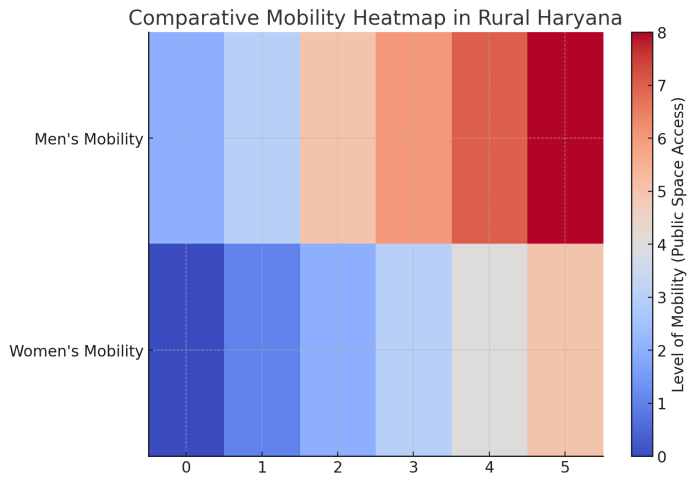
The mobility heat map above graphically shows the clear differences in men's and women's movement habits in rural Haryana (Figure 1). Men's great mobility in public places-including marketplaces, community halls, and roadside meetings, is reflected in the higher color intensity in the top row. Women's mobility is much less, limited to homes, surrounding wells and places of worship (Table 2).
According to the results of ethnographic interviews, women's limited mobility is not just the outcome of physical infrastructure but also strongly ingrained in cultural standards. The fear of judgment, harassment, and social rejection still limits women's presence in public areas even in towns where roads and public transportation have developed.
4.3. Architectural Evolution and the Changing Role of Women in Domestic SpacesThe study revealed that although conventional house designs supported women's limited mobility, modern houses produce a mixed result. From shared household spaces to more enclosed, private rooms during the past few decades, women now have more personal space within houses but not always more access to public life.

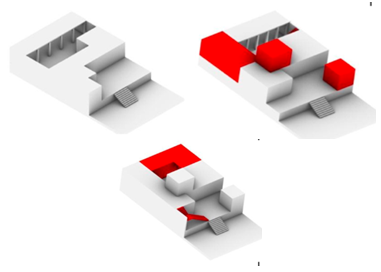
The conceptual map above shows how rural Haryana's home designs have evolved and emphasizes how spatial changes have affected gender roles and interactions inside homes (Figure 2). Particularly with separate kitchens, private bedrooms, and enclosed courtyards, the results show that modern home designs give women more privacy and convenience. These developments have not, however, greatly changed the social expectations that limit women's activity outside of homes. Though it has produced physical modifications, modernism has not destroyed the cultural barriers restricting women's public life access.
4.4. The Decline of Communal Spaces and Social Inclusion for WomenThe study also reveals the slow decline of female-centric communal places including shared gathering areas, temple courtyards, and village wells. Historically, these locations provided women with significant social and interactive venues where they might socialize outside of their homes. But infrastructure projects and urbanization have replaced these unofficial meeting places with controlled public areas still mostly dominated by men. Table 3 shows that conventional female-friendly public places have gradually decreased, therefore lowering chances for women's social interaction outside of the home.
The results show that even if contemporary public venues including markets, transit hubs, and town centers exist, they remain male-dominated, therefore deterring women from using them freely. This change has helped women experience more social isolation, therefore supporting home confinement.
According to the results of this study, gendered environments in rural Haryana still influence human interactions, therefore limiting women's mobility and supporting patriarchal norms even with architectural development. Though housing designs have changed to give women more private areas, ongoing socio-cultural obstacles limit their access to public life. Furthermore, less chance for women's social interaction have resulted from the disappearance of conventional female-centric public venues.
The results of this study demonstrate that gendered spatial hierarchies still firmly ingrained in the built environment of rural Haryana shape human interactions, mobility, and resource availability. The fundamental ideas of spatial separation based on gender endure despite modernity, infrastructure upgrades, and changes in house design. Women's access to public areas is still rather limited; their movements mostly take place in homes. These developments have not fundamentally changed spatial autonomy even in circumstances when architectural modernity has brought greater private areas for women within homes 8. Rather, they have sometimes supported domestic confinement rather than more public involvement for women.
According to the study, rural Haryana's home designs have changed from open, communal buildings to more enclosed, private living quarters with separate kitchens, bathrooms, and private bedrooms including separate kitchens, specialized sanitation facilities and private bedrooms. Still, these advances have mostly improved comfort rather than changed conventional roles for women. Maintaining male authority over public interactions and community decision-making, the Baithak (male sitting area) and chaubara (upstream male-dominated rooms) remain. Conversely, women are required to negotiate environments fit for their social roles, that of kitchens, courtyards, and storage rooms. Thus, the built environment acts as a physical and metaphorical mirror of patriarchal systems, so supporting gender inequities by spatial arrangement.
Among the most important points underlined in this research are women's limited mobility and limited access to public life. Men freely negotiate public areas including markets, ‘Chaupals’ and administrative centers; women's movements are under constant observation and restriction by society expectations. The interactive mapping study amply demonstrated the differences in spatial access and the fact that women's everyday movement is sometimes limited to paths connecting to activities connected to their homes. The survey also revealed that since public areas remain dominated by men, modernity has not appreciably changed this dynamic. Women are further discouraged from occupying and using public areas independently by security issues, cultural standards, and lack of gender-sensitive infrastructure.
The elimination of female-centric common spaces, such as village wells, temple courtyards, and unofficial gathering places, which formerly gave women chances to interact socially and economically outside of their homes, finds great significance in this study. The loss of these venues has led to more social isolation for women since there are less chance for unofficial meetings, support groups, and group projects. These areas lost have undermined a fundamental component of women's social agency, hence increasing their reliance on domestic environments. These often stay gender-exclusive even when infrastructure improvements create additional communal venues, therefore supporting male domination in public environments. The results imply that although urbanization and infrastructure improvements have brought structural changes, they have not really challenged the social hierarchies ingrained in spatial organization. While modernization has mostly changed physical buildings, it has not addressed the deeper socio-cultural standards guiding who owns and uses space. Modernism by itself cannot destroy patriarchal spatial configurations without intentional attempts to build gender-inclusive settings. Policy interventions and architectural planning with an eye on gender-sensitive spatial design clearly have a place.
This study emphasizes the need of including gender-sensitive design ideas into plans for rural development. Important first steps toward spatial justice and gender equity are building more inclusive public places that meet women's needs, guaranteeing safe and accessible mobility options, and reinvigorating common areas where women might interact freely. Working together, architects, urban designers, and legislators may make sure that modernization actively supports inclusive spatial practices rather than merely reinforces current structures.
Beyond rural Haryana, this study has wider ramifications that provide understanding of how physical environments still reflect and support social disparities in patriarchal countries. Emphasizing not only infrastructure development but also the requirement of cultural changes in spatial accessibility and gendered mobility, the paper urges a review of rural planning policies. Women's voices must be deliberately included in architectural design, policy-making, and urban-rural development projects if they are to reach actual spatial and social agency.
Ultimately, space is not a neutral element; it is profoundly political, created and molded by social systems. In rural Haryana, the built environment still serves as a site of gendered power conflicts whereby patriarchal conventions govern architecture, mobility, and public access. According to the results of this research, just enhancing infrastructure without tackling spatial inequality will help to accentuate the current gender disparity. Reevaluating public places, redefining access to built environments, and questioning the socio-cultural conventions limiting women's mobility and involvement would help gender-equal spatial planning's future to be realized.
| [1] | Siwach, P., "Mapping gendered spaces and women’s mobility: A case study of Mitathal Village, Haryana, The Oriental Anthropologist, 20(1), 33-48, 2020. | ||
| In article | View Article | ||
| [2] | Singh, H. and Kikon, Z. T., Blueprint for sustainable development of urban villages: A case study of Alipur Village, Haryana, Urbanism. Architecture. Constructions, 15(2), 2024. | ||
| In article | |||
| [3] | Mehta, V., Developing framework for assessing carrying capacity in urban Himalayan areas: A case study of Solan, Himachal Pradesh (Doctoral dissertation), SPA Bhopal, 2025. [Online]. Available: http://dspace.spab.ac.in/handle/123456789/2543. | ||
| In article | |||
| [4] | Mihkelson, W., Arbabi, H., Hincks, S. and Tingley, D. D., Built-environment stocks in the context of a master-planned city: A case study of Chandigarh, India, Journal of Industrial Ecology, 28(3), 573-588, 2024. | ||
| In article | View Article PubMed | ||
| [5] | Sharma, M. and Kumar, S., The pattern of urbanization and fluctuations in the urban hierarchy of Haryana, India, in Urban Environment and Smart Cities in Asian Countries: Insights for Social, Ecological, and Technological Sustainability, Springer International Publishing, 85-104. [Online]. Available: https:// link.springer.com/chapter/10.1007/978-3-031-25914-2_4. | ||
| In article | View Article | ||
| [6] | Kumar, V. and Khunger, S., Rural development in Haryana: Gender dynamics, infrastructure, and agricultural progress, Dynamics of Rural Society Journal, 3(1), 61-76, 2025. | ||
| In article | View Article | ||
| [7] | Ho, O., Iyer-Raniga, U., Sadykova, C., Balasooriya, M., Sylva, K., Dissanayaka, M. and Sivapalan, S., A conceptual model for integrating circular economy in the built environment: An analysis of literature and local-based case studies, Journal of Cleaner Production, 449, 2024. | ||
| In article | View Article | ||
| [8] | Kamal Arif M. and Brar T. S., Analyzing the Built Form for Accommodating Cultural Diversity in Housing: Adaptation and Design Flexibility, Architecture Engineering and Science, 4(2), 11-120, 2023. | ||
| In article | View Article | ||
Published with license by Science and Education Publishing, Copyright © 2026 Namita Singh, Suruchi Modi and Mohammad Arif Kamal
 This work is licensed under a Creative Commons Attribution 4.0 International License. To view a copy of this license, visit
http://creativecommons.org/licenses/by/4.0/
This work is licensed under a Creative Commons Attribution 4.0 International License. To view a copy of this license, visit
http://creativecommons.org/licenses/by/4.0/
| [1] | Siwach, P., "Mapping gendered spaces and women’s mobility: A case study of Mitathal Village, Haryana, The Oriental Anthropologist, 20(1), 33-48, 2020. | ||
| In article | View Article | ||
| [2] | Singh, H. and Kikon, Z. T., Blueprint for sustainable development of urban villages: A case study of Alipur Village, Haryana, Urbanism. Architecture. Constructions, 15(2), 2024. | ||
| In article | |||
| [3] | Mehta, V., Developing framework for assessing carrying capacity in urban Himalayan areas: A case study of Solan, Himachal Pradesh (Doctoral dissertation), SPA Bhopal, 2025. [Online]. Available: http://dspace.spab.ac.in/handle/123456789/2543. | ||
| In article | |||
| [4] | Mihkelson, W., Arbabi, H., Hincks, S. and Tingley, D. D., Built-environment stocks in the context of a master-planned city: A case study of Chandigarh, India, Journal of Industrial Ecology, 28(3), 573-588, 2024. | ||
| In article | View Article PubMed | ||
| [5] | Sharma, M. and Kumar, S., The pattern of urbanization and fluctuations in the urban hierarchy of Haryana, India, in Urban Environment and Smart Cities in Asian Countries: Insights for Social, Ecological, and Technological Sustainability, Springer International Publishing, 85-104. [Online]. Available: https:// link.springer.com/chapter/10.1007/978-3-031-25914-2_4. | ||
| In article | View Article | ||
| [6] | Kumar, V. and Khunger, S., Rural development in Haryana: Gender dynamics, infrastructure, and agricultural progress, Dynamics of Rural Society Journal, 3(1), 61-76, 2025. | ||
| In article | View Article | ||
| [7] | Ho, O., Iyer-Raniga, U., Sadykova, C., Balasooriya, M., Sylva, K., Dissanayaka, M. and Sivapalan, S., A conceptual model for integrating circular economy in the built environment: An analysis of literature and local-based case studies, Journal of Cleaner Production, 449, 2024. | ||
| In article | View Article | ||
| [8] | Kamal Arif M. and Brar T. S., Analyzing the Built Form for Accommodating Cultural Diversity in Housing: Adaptation and Design Flexibility, Architecture Engineering and Science, 4(2), 11-120, 2023. | ||
| In article | View Article | ||