Roads are public assets whose pavement condition directly influences safety, mobility, and sustainability. Corridors in steep, high‑rainfall terrain with heavy truck traffic deteriorate quickly, requiring systematic evaluation. This study assesses a 51.541-km section of the Kapalong–Talaingod–Valencia (Bukidnon) Road (K1538+(-687) to K1588+854) using the Department of Public Works and Highways (DPWH) Visual Condition Index (VCI) . Multi‑year VCI records (2021–2024) were analyzed alongside a 2025 field survey to classify current conditions, identify distress types, and derive maintenance implications. Results show that Poor segments exhibit mixed cracking and surface wear, while Bad segments combine wide cracking, shattered slabs, and slope/road‑slip indicators . Five‑year trends reveal untreated sections sliding from Fair/Poor to Bad, whereas targeted interventions restored selected stretches to Good. Quarry haul traffic and geohazards emerged as key accelerants of deterioration. Prioritized treatment guidance is proposed: reconstruction for short failing stretches with structural distress; rehabilitation overlays for longer Poor sections; and preventive maintenance for Fair/Good corridors . Currently, 41.44% of the corridor is rated Fair, while 10.12% is rated Poor/Bad. Strategic implementation of preventive maintenance on Good/Fair sections, coupled with rehabilitation and reconstruction of isolated Bad spots, could by 2027 raise Good >50% and reduce Poor+Bad <5%, while closing the 4.27% data gap. These findings highlight the importance of proactive asset management in sustaining serviceability under challenging terrain and traffic conditions.
Road infrastructure underpins regional productivity, safety, and social connectivity, especially in archipelagic, agricultural regions where terrain and weather amplify maintenance challenges. In Mindanao, the Kapalong–Talaingod–Valencia (Bukidnon) Road serves as a strategic inter-provincial corridor linking Davao del Norte and Bukidnon across mountainous topography subject to intense rainfall 2 3. The route functions as an alternative to the Sayre Highway and has recently supported a new Cagayan de Oro–Mati intercity bus service, cutting end-to-end travel times from roughly 10–12 hours to 7–8 hours. These mobility gains, however, coincide with increased traffic frequency and axle-load exposure from buses and heavy trucks, elevating the risk of accelerated surface and structural distress along steep gradients and geohazard-prone slopes. Similar pavement condition evaluations in Philippine contexts, such as the cluster barangays of Tuburan, Cebu, demonstrate the importance of localized pavement management systems 8. Moreover, recent expert reviews of the Philippine Visual Condition Index (VCI) confirm its validity and applicability for national and regional assessments 9. The focus corridor for stations K1538 + (-687) to K1588+854 extends 51.541 km, traversing segments that experience recurring deterioration and frequent maintenance demands. Visual inspections consistently report distress modes typical of high-load mountain roads, including narrow and wide cracking, wearing surface defects, spalling and faulting in rigid sections 2, and localized base failures and shattered slabs in critical short stretches. These failures degrade ride quality and safety and can render spot repairs short-lived when underlying structural or drainage issues persist.
To support systematic decision-making, Philippine national assessments rely on the Visual Condition Index (VCI) as defined by the Department of Public Works and Highways (DPWH) 4. VCI maps observed defect types and severities to a 1–100 scale and classifies segments as Good (>70–100), Fair (>40–70), Poor (>20–40), or Bad (1–20) 4, corresponding treatments range from routine maintenance to rehabilitation and full reconstruction 1 2. While the method enables practical, network-scale screening, mountainous corridors with concentrated heavy haul and recurrent geohazards can exhibit short, failure-prone segments that are easy to under-prioritize if assessments are not trended over multiple years or linked to mechanistic concerns such as base/subgrade instability and slope movement. This study evaluates the pavement condition of the Kapalong–Talaingod–Valencia Road over 2021–2025 using VCI, integrating the 2025 field survey with official DPWH inventories to ensure comparable, year-over-year analysis. The approach (i) segments the corridor at surface-type and lane-configuration breaks and at distinct condition transitions; (ii) logs distress type/severity following DPWH measurement rules for concrete and asphalt; (iii) computes VCI via defect weightings (with SDWf capped at 300) for each segment; and (iv) consolidates results into a multi-year, station-aligned table and visual summaries. By pairing a 2025 snapshot with longitudinal comparison, the analysis identifies persistent “hot spots,” short sections that regress to Bad without timely structural intervention, and longer Poor runs suitable for rehabilitation overlays.
The contribution is threefold. First, it furnishes an up-to-date, corridor-wide 2025 condition showing that most of the length remains serviceable (Fair/Good) while delineating targeted Poor/Bad segments where reconstruction or rehabilitation is warranted 1. Second, it provides a five-year trend demonstrating two consistent patterns, untreated Fair/Poor sections sliding into Bad, and treated stretches recovering to Good evidence that prioritization materially shifts network condition 2. Third, it frames an actionable treatment agenda for mountainous, high-load corridors, full-depth reconstruction with slope/drainage protection at short failure clusters (e.g., shattered slabs with slips) 2 3, rehabilitation overlays for longer functionally distressed sections, and preventive maintenance elsewhere together with load-management coordination where quarry haul concentrates axle loads 5.
This section outlines the systematic approach used to evaluate the pavement condition of the Kapalong–Talaingod–Valencia (Bukidnon) Road. The study integrates field data collection with the Visual Condition Index (VCI) mathematical framework 1.
2.1. Research FrameworkThe study followed a quantitative evaluation framework to determine the pavement health of the Kapalong-Talaingod-Valencia (Bukidnon) Road. The methodology is structured into three distinct phases: field survey, distress quantification, and VCI calculation.
A total road length of 51.541 kilometers was surveyed. During the visual inspection, the researchers identified surface defects based on the DPWH Department Order 120, series 2019, standards. Each distress type was evaluated for Good, Fair, Bad, and Poor 1. The surveyed corridor alignment K1538+(-687) to K1588+854 was verified using Google Maps 12 to ensure accuracy of stationing and location references.
To translate subjective visual data into an objective engineering metric, the Visual Condition Index (VCI) was utilized. The VCI model uses a non-linear deduction system to represent the exponential nature of pavement failure 1. The governing equation is:
 | (1) |
Where SDWf is the adjusted sum of deduct weights for all observed distresses. The corresponding defect weight factors for various pavement distresses are detailed in Table 1 and Table 2 1. This index ranges from 1 (Bad) to 100 (Good), providing a standardized scale for maintenance prioritization.
The VCI framework applied here is consistent with DPWH standards 1 and aligns with international best practices, particularly ASTM D6433‑07, which defines pavement condition index surveys for roads and parking lots 11. This ensures comparability of results with both national and global pavement evaluation methods.
The final results were benchmarked against a five-tier rating system to prioritize maintenance interventions, as shown in Table 3.
The systematic evaluation of the 51.541-km Kapalong–Talaingod–Valencia Road 6 reveals a corridor facing significant structural challenges due to its unique environmental and operational context. Aligning with the primary objectives, the results are detailed as follows:
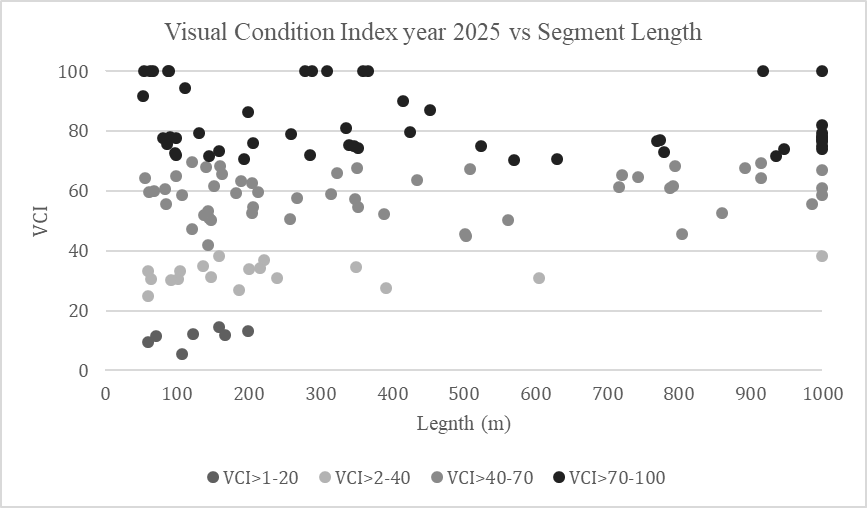
3.1. Visual Condition Index (VCI) in Year 2025Figure 3.1 plots each assessed station’s Visual Condition Index (VCI) 1 against its segment length and, after removing “No Assessment” entries (bridges, <50 m), shows no strong overall correlation between length and condition. The most visible pattern is that very low VCIs (Bad, 1–20) cluster at short segments (~50–200 m), consistent with localized structural failures such as shattered slabs, base problems, or road slips. Poor (>20–40) values are dispersed from roughly 60–600 m, pointing to functional distress that tends to extend over longer runs and is typically addressed by rehabilitation rather than full reconstruction. Fair (>40–70) appears across short to long segments, indicating generally serviceable but watch-list sections, while Good (>70–100) including several cases at VCI = 100 occurs across the full length range up to about 1,000 m, implying that well-treated or structurally sound reaches can maintain high condition regardless of length 10. In practical terms, the scatter supports prioritizing short, failure-prone stretches for structural fixes (reconstruction with slope/drainage protection), managing longer Poor runs with rehabilitation overlays, and keeping Fair/Good corridors under preventive maintenance 3 5 14. Comparative evaluations of pavement assessment models confirm that combining VCI with other frameworks such as PCI and MCDM can strengthen prioritization accuracy 14.

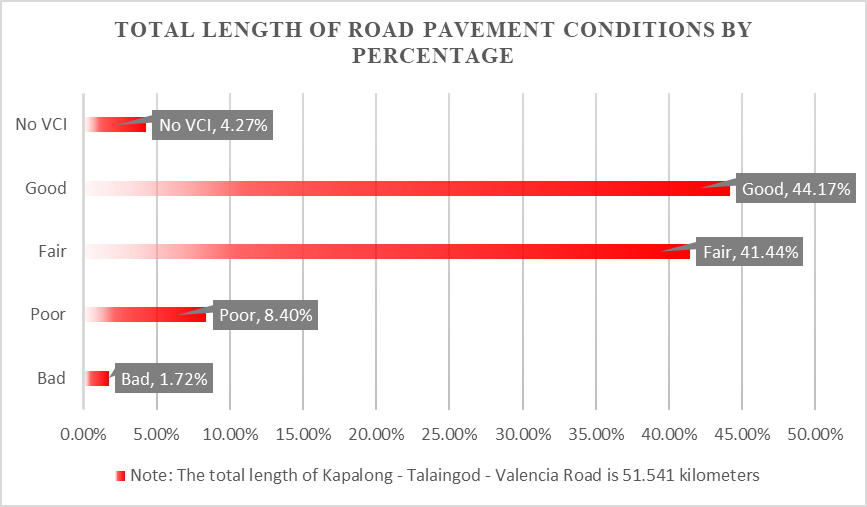
Figure 3.2 summarizes the 51.541 km corridor’s 2025 condition by length. Good accounts for 22.765 km (44.17%), indicating nearly half of the road needs only routine or preventive maintenance 1. Fair covers 21.360 km (41.44%), which remains serviceable but should receive timely preservation to prevent regression. Poor totals 4.331 km (8.40%), suited to rehabilitation rather than piecemeal repairs, while Bad is 0.885 km (1.72%), reflecting short but critical stretches with structural failures where full-depth reconstruction and slope or drainage works are warranted 2 3. The remaining 2.200 km (4.27%) are No Assessment (very short segments, bridges, or works in progress) and were excluded from condition scoring. This distribution shows a predominantly serviceable network with a small but high-priority set of failure-prone sections. The longitudinal analysis confirms that untreated sections rapidly decline from Fair to Bad, validating the need for the proposed three-tier intervention framework 4 10.

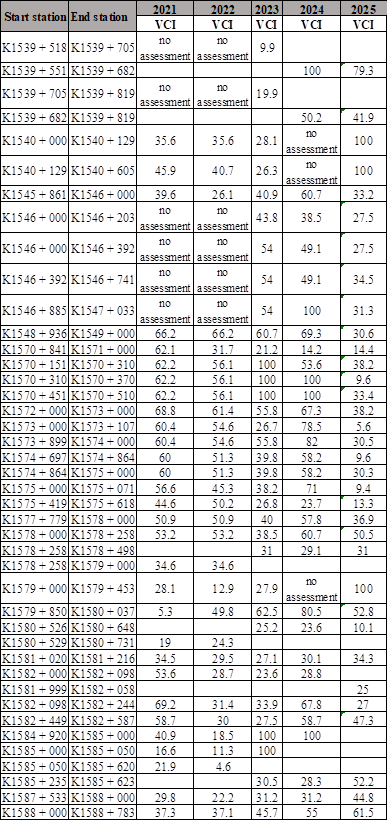
Figure 3.3 compiles five years of VCI scores (2021–2025) for each station along the Kapalong–Talaingod–Valencia Road, enabling side-by-side tracking of segment performance and treatment effects 1. Some rows span all five years, others show “No assessment” where segments were very short, bridge approaches, or under/committed works. Read across, several short but critical stations deteriorated to Bad by 2025, e.g., K1580+526–K1580+648 (VCI 10.1), K1570+310 K1570+370 (9.6), and K1575+419–K1575+618 (13.3), with field notes citing cracked/shattered slabs, base failure, and road slips. In contrast, treated sections recovered, notably K1579+000–K1579+453, which reached VCI 100 in 2025. Longer corridors generally stayed Fair–Good (e.g., K1588+000 K1588+783 improving into the 60s), while some mid-length segments clustered in the Poor range, indicating a need for rehabilitation rather than routine maintenance 4. Using DPWH thresholds (Good >70, Fair >40–70, Poor >20–40, Bad 1–20), two patterns emerge, untreated segments slide from Fair/Poor to Bad 1, while targeted works lift segments back to Good. These findings align with national monitoring practices 10 and comparative model evaluations 14, reinforcing the importance of integrating VCI with broader pavement management frameworks.
The 2025 assessment of the Kapalong–Talaingod–Valencia corridor indicates that the pavement remains predominantly functional, with 44.17% rated as Good and 41.44% as Fair. However, the identification of localized Poor (8.40%) and Bad (1.72%) segments highlights critical areas of structural concern 4. The five-year longitudinal analysis (2021–2025) confirms a clear trend, segments lacking timely intervention regress rapidly toward failure, while programmed maintenance effectively restores sections to Good condition, validating the VCI-based management approach 2. Based on these findings, a strategic three-tier intervention framework is recommended to optimize life-cycle costs and network durability;
High-priority, short segments (~50–200 m) exhibiting base failure, shattered slabs, or road slips should undergo full-depth reconstruction. These works must be integrated with drainage upgrades including ditch regrading and culvert upsizing and geohazard-specific slope protection to prevent recurring structural damage 1 2.
Longer corridors rated as Poor, characterized by extensive cracking and surface wear, should receive bonded concrete or asphalt overlays. This transition from reactive patching to structural rehabilitation is necessary to restore functional serviceability 3 4.
Fair and Good segments should be maintained through routine crack sealing, joint repairs, and pre-monsoon drainage clearing to arrest regression 1. Furthermore, institutionalizing annual VCI surveys and enforcing axle-load limits on heavy-haul quarry routes are essential to preserving the structural integrity of the pavement and ensuring long-term corridor reliability 5 7. In addition, exploring automated image‑based pavement assessment methods 15 could enhance monitoring efficiency and reduce reliance on manual inspections, strengthening the sustainability of future maintenance programs.
I would like to acknowledge the support of the University of Science and Technology of Southern Philippines and Department of Public Works and Highways.
| [1] | Department of Public Works and Highways (DPWH), "Updating of the Road Network Definition and Inventory Update Manual and Visual Road Condition Assessment Manual under the Road and Bridge Information Application (Department Order No. 120, s. 2019)," DPWH, 2019. Available: https:// www.dpwh.gov.ph/ dpwh/sites/default/files/issuances/do_120_s2019.pdf. [Accessed Feb. 9, 2026]. | ||
| In article | |||
| [2] | M. Isradi, "Analysis of the damage of rigid pavement road by using Pavement Condition Index (PCI)," Journal of Applied Science, Engineering, Technology, and Education, 1 (2), 2019. | ||
| In article | View Article | ||
| [3] | M. Isradi, A.D. Hedianto, A.I. Rifai, A. Mufhidin, and J. Prasetijo, "Comparison of PCI (Pavement Condition Index) and SDI (Surface Distress Index) in identification of urban road damage," ADRI International Journal of Engineering and Natural Science, 6 (1), 2021. | ||
| In article | View Article | ||
| [4] | A. Setyawan, J. Nainggolan, and A. Budiarto, "Predicting the remaining service life of road using pavement condition index," Procedia Engineering, 125, 417–423, 2015. | ||
| In article | View Article | ||
| [5] | Y.U. Shah, S.S. Jain, D. Tiwari, and M.K. Jain, "Development of overall pavement condition index for urban road network," Procedia - Social and Behavioral Sciences, 104, 332–341, Dec. 2013. | ||
| In article | View Article | ||
| [6] | Department of Public Works and Highways (DPWH), "Revised guidelines on the functional classification of roads (Department Order No. 133, s. 2018)," DPWH, 2018. Available: https:// www.dpwh.gov.ph. [Accessed Feb. 9, 2026]. | ||
| In article | |||
| [7] | M. Isradi, H. Dwiatmoko, A. Subhana, J. Prasetijo, and N. Hartatik, "Evaluation of the road pavement damage with Bina Marga method and Pavement Condition Index method," in Proceedings of the International Conference on Industrial Engineering and Operations Management (IEOM), IEOM Society International, Detroit, USA, 2020. | ||
| In article | |||
| [8] | J.J.L. Montebon, J.P.Y. Yape, M.C.Y. Abaquita, and A.J.Q. Gabuya, "Pavement condition evaluation of the cluster barangays of Poblacion, Tuburan, Cebu: A pavement management system," SSRG International Journal of Recent Engineering Science, 11 (4), 31–40, 2024. | ||
| In article | View Article | ||
| [9] | L.B. Bronuela-Ambrocio, J.A.B. Ramos, H.S.O. Palmiano, J.P.T. Dacanay, L.V. Torio-Kaimo, P. Padre Jr., and K. Tactac, "A review of the Philippine Visual Condition Index by experts’ validation," International Journal of Structural and Civil Engineering Research, 13 (4), 114–120, 2024. | ||
| In article | |||
| [10] | J.A.B. Ramos, J.P.T. Dacanay, and L.B. Bronuela-Ambrocio, "A review of the current practices in the pavement surface monitoring in the Philippines," in Proceedings of the 28th Annual Conference of the Transportation Science Society of the Philippines, 2022. Available: https://ncts.upd.edu.ph/tssp/archives/2213. | ||
| In article | |||
| [11] | ASTM International, Standard practice for roads and parking lots pavement condition index surveys (ASTM D6433-07), ASTM International, 2007. | ||
| In article | |||
| [12] | Google, "Route from K1538+(-687) to Salolong Bridge K1588+854, Bukidnon, Philippines," Google Maps, 2025. Available: https:// www.google.com/ maps. [Accessed Apr. 27, 2025]. | ||
| In article | |||
| [13] | N.J. Garber and L.A. Hoel, Traffic and Highway Engineering, 4th ed., Cengage, 2009. | ||
| In article | |||
| [14] | M. Elmansouri, A. Abuhamida, and A. Elfergani, "Comparative evaluation of pavement assessment models: PCI and MCDM," Journal of Transportation Engineering, Part B: Pavements, 148 (4), 04022045, Dec. 2022. | ||
| In article | |||
| [15] | S. Chambon and J.-M. Moliard, "Automatic road pavement assessment with image processing: Review and comparison," International Journal of Geophysics, 2011, Article ID 989354, 2011. | ||
| In article | View Article | ||
Published with license by Science and Education Publishing, Copyright © 2026 Neil Ian O. Tagaan and Jonathan B. Calibara
 This work is licensed under a Creative Commons Attribution 4.0 International License. To view a copy of this license, visit
http://creativecommons.org/licenses/by/4.0/
This work is licensed under a Creative Commons Attribution 4.0 International License. To view a copy of this license, visit
http://creativecommons.org/licenses/by/4.0/
| [1] | Department of Public Works and Highways (DPWH), "Updating of the Road Network Definition and Inventory Update Manual and Visual Road Condition Assessment Manual under the Road and Bridge Information Application (Department Order No. 120, s. 2019)," DPWH, 2019. Available: https:// www.dpwh.gov.ph/ dpwh/sites/default/files/issuances/do_120_s2019.pdf. [Accessed Feb. 9, 2026]. | ||
| In article | |||
| [2] | M. Isradi, "Analysis of the damage of rigid pavement road by using Pavement Condition Index (PCI)," Journal of Applied Science, Engineering, Technology, and Education, 1 (2), 2019. | ||
| In article | View Article | ||
| [3] | M. Isradi, A.D. Hedianto, A.I. Rifai, A. Mufhidin, and J. Prasetijo, "Comparison of PCI (Pavement Condition Index) and SDI (Surface Distress Index) in identification of urban road damage," ADRI International Journal of Engineering and Natural Science, 6 (1), 2021. | ||
| In article | View Article | ||
| [4] | A. Setyawan, J. Nainggolan, and A. Budiarto, "Predicting the remaining service life of road using pavement condition index," Procedia Engineering, 125, 417–423, 2015. | ||
| In article | View Article | ||
| [5] | Y.U. Shah, S.S. Jain, D. Tiwari, and M.K. Jain, "Development of overall pavement condition index for urban road network," Procedia - Social and Behavioral Sciences, 104, 332–341, Dec. 2013. | ||
| In article | View Article | ||
| [6] | Department of Public Works and Highways (DPWH), "Revised guidelines on the functional classification of roads (Department Order No. 133, s. 2018)," DPWH, 2018. Available: https:// www.dpwh.gov.ph. [Accessed Feb. 9, 2026]. | ||
| In article | |||
| [7] | M. Isradi, H. Dwiatmoko, A. Subhana, J. Prasetijo, and N. Hartatik, "Evaluation of the road pavement damage with Bina Marga method and Pavement Condition Index method," in Proceedings of the International Conference on Industrial Engineering and Operations Management (IEOM), IEOM Society International, Detroit, USA, 2020. | ||
| In article | |||
| [8] | J.J.L. Montebon, J.P.Y. Yape, M.C.Y. Abaquita, and A.J.Q. Gabuya, "Pavement condition evaluation of the cluster barangays of Poblacion, Tuburan, Cebu: A pavement management system," SSRG International Journal of Recent Engineering Science, 11 (4), 31–40, 2024. | ||
| In article | View Article | ||
| [9] | L.B. Bronuela-Ambrocio, J.A.B. Ramos, H.S.O. Palmiano, J.P.T. Dacanay, L.V. Torio-Kaimo, P. Padre Jr., and K. Tactac, "A review of the Philippine Visual Condition Index by experts’ validation," International Journal of Structural and Civil Engineering Research, 13 (4), 114–120, 2024. | ||
| In article | |||
| [10] | J.A.B. Ramos, J.P.T. Dacanay, and L.B. Bronuela-Ambrocio, "A review of the current practices in the pavement surface monitoring in the Philippines," in Proceedings of the 28th Annual Conference of the Transportation Science Society of the Philippines, 2022. Available: https://ncts.upd.edu.ph/tssp/archives/2213. | ||
| In article | |||
| [11] | ASTM International, Standard practice for roads and parking lots pavement condition index surveys (ASTM D6433-07), ASTM International, 2007. | ||
| In article | |||
| [12] | Google, "Route from K1538+(-687) to Salolong Bridge K1588+854, Bukidnon, Philippines," Google Maps, 2025. Available: https:// www.google.com/ maps. [Accessed Apr. 27, 2025]. | ||
| In article | |||
| [13] | N.J. Garber and L.A. Hoel, Traffic and Highway Engineering, 4th ed., Cengage, 2009. | ||
| In article | |||
| [14] | M. Elmansouri, A. Abuhamida, and A. Elfergani, "Comparative evaluation of pavement assessment models: PCI and MCDM," Journal of Transportation Engineering, Part B: Pavements, 148 (4), 04022045, Dec. 2022. | ||
| In article | |||
| [15] | S. Chambon and J.-M. Moliard, "Automatic road pavement assessment with image processing: Review and comparison," International Journal of Geophysics, 2011, Article ID 989354, 2011. | ||
| In article | View Article | ||