This paper investigates the socio-demographic changes that have occurred in Delhi's Dwarka Sector 21 since it became a significant transportation hub. It makes the case that the Airport Express Line's operationalization has sparked a unique kind of gentrification brought on by transit, changing the socioeconomic makeup of the region. The analysis uses a mixed-methods strategy to look into changes in land use and demographics, guided by the 3P framework People, Place, and Policy. Results reveal a large influx of younger, highly educated migrants, signalling rapid demographic churn and status upgrading. Urban restructuring has increased as land use has changed from mostly residential and unoccupied parcels to commercial and high-density residential construction. The results also show growing affordability challenges and socio-spatial gaps, even while transit-oriented development has boosted economic activity. In order to reduce exclusionary consequences and match growth with equitable goals, the study makes the need for proactive, gender-sensitive policy initiatives.
Dwarka Sub-City, conceived as one of Asia's largest planned residential areas stands as a testament to state-led efforts to decongest central Delhi. Originally characterized by its vast sectors of plotted housing and institutional zones, its meticulously planned fabric has been profoundly reconfigured by the expansion of the Delhi Metro Rail Corporation (DMRC) network. The commissioning of the Delhi Airport Express Line (AEL), with Sector 21 as its western terminal, has fundamentally reshaped the area's accessibility and economic geography 1. This high-speed connection to the Indira Gandhi International Airport and New Delhi's central business districts has positioned Sector 21 as a critical node for Transit-Oriented Development (TOD), accelerating a process of gentrification that exhibits both global patterns and distinctly Indian urban dynamics 2, 3.
The transformation unfolding in Sector 21 can be critically examined through the evolution of gentrification theory. The process resonates with the classic formulation of gentrification as the "rehabilitation of working-class housing and the consequent displacement of working-class residents" by a more affluent cohort 4. However, aligning with contemporary scholarship, the primary drivers in Dwarka are less about individual "pioneers" and more intrinsically linked to large-scale infrastructural investment and state-sanctioned planning; illustrating what scholars terms”geography of gentrification" 5. This is not an organic, bottom-up neighbourhood change but a calculated, top-down transformation where, as observed in cities worldwide, marginalized communities often become "victims of a process over which they have no control" 6. The Airport Express Line acts as a direct catalyst, exemplifying how public investment in infrastructure frequently serves as a primary driver for private capital inflow, leading to socio-economic displacement and a reconfiguration of urban space that prioritizes exchange-value over its use-value for existing communities 7, 8.
This paper situates itself within this complex urban context, investigating the transition of Dwarka Sector 21 from a quiet residential periphery to a vibrant, high-density urban hub. The study employs the 3P Model (People, Place, Policy) as a structured analytical framework to dissect this multifaceted transformation 9. This model facilitates a holistic investigation that moves beyond purely economic metrics to encompass the intricate interplay between demographics, physical space, and governance. The People dimension examines shifting demographics and the potential for what Harvey 10 frames as a loss of the "right to the city" for original inhabitants. The Place dimension analyses the physical and symbolic transformation of the built environment, considering how new infrastructure reconfigures urban space in ways that can be exclusionary 11. Finally, the Policy dimension scrutinizes the governance mechanisms that facilitate this transition. By applying this integrated framework, this study aims to dissect the nuanced realities of gentrification in a contemporary Indian context, contributing to a broader understanding of how global urban processes are locally reconfigured (Figure 1).
This research adopted a mixed-methods strategy to investigate the phenomenon of gentrification in Dwarka Sector 21. The investigation commenced with a comprehensive literature review to establish a theoretical foundation and identify critical research gaps, particularly the scarcity of micro-level studies on metro-induced gentrification within planned sub-cities like Dwarka.
Subsequently, primary data was gathered through structured survey forms and Focus Group Discussions (FGDs) with residents. To ensure a representative sample, the Taro Yamane formula was applied. With an estimated resident population of 12,000 in the immediate study area surrounding the metro station 1, a sample size of 98 respondents was determined at a 95% confidence level. The survey was administered digitally using the Kobo Toolbox platform, which also facilitated GPS tagging of responses for spatial analysis.
The qualitative data derived from FGDs and open-ended survey responses were analysed using a systematic, two-phase process. First, a thematic analysis was conducted to code the data and identify recurring concepts and patterns. Second, a Framework Analysis was employed to organize and interpret these emergent themes within the pre-established 3P (People, Place, Policy) framework, allowing for a structured exploration of the interconnections between socio-demographic, spatial, and governance factors.
The discourse on gentrification in India has progressively challenged the direct application of Western theoretical models. As scholars like Doshi 2 and Ghertner 3 argue, urban transformation in India is often propelled by state-led planning, large-scale infrastructure projects, and complex informal land markets, rather than the small-scale, market-driven housing dynamics typical of the Global North. This aligns with a global recognition of the state's powerful role in shaping urban landscapes, often facilitating processes of what has been termed "green" or in this case, "transit" gentrification 11.
The case of Dwarka provides a compelling illustration of this nuanced Indian model. Saha 1 documents a dramatic land-use shift between 2003 and 2023, marked by a 28.3% decrease in vacant land and a corresponding 21.3% increase in built-up area, accompanied by a 30.3% surge in population density. Crucially, this transformation was not organic but was "primarily influenced by the establishment of the metro station and the subsequent rise of commercial and residential complexes" 1, underscoring a distinctly state-driven, transit-induced gentrification process. Such rapid urban change carries significant implications, with research increasingly linking gentrification to adverse health outcomes and social stress among displaced and marginalized populations 12.
A critical research gap persists in understanding the socio-demographic corollaries of this physical and policy-driven change, particularly regarding gender and educational disparities within the incoming population. This study seeks to fill that gap by investigating how transit-oriented gentrification in Sector 21 intersects with these social dimensions, thereby contributing a Delhi-centric case study to the broader discourse on equitable urban development.
The FGDs revealed a complex tapestry of resident experiences and perceptions. A predominant concern was economic displacement. Long-term residents expressed profound anxiety over soaring rental costs and property values. One participant noted, "We welcomed the metro, but with it came a cost of living that is slowly pushing out the families who built this community," echoing classic gentrification anxieties 6.
Conversely, the economic opportunities and improved infrastructure were widely acknowledged by newer residents. A professional who recently moved to the area stated, "The connectivity is unmatched. I can reach my office in Connaught Place or the airport in minutes." This sentiment highlights the dual-edged nature of such development, where improved amenities and access are accompanied by rising affordability crises 8.
A strong sense of eroding community identity and social displacement was also palpable among long-term residents 13. Many lamented the changing social fabric, with one elderly resident sharing, "Earlier, this sector was quiet and familial. Now, it's a transient place of young professionals and bustling markets; the old community spirit is fading." This perception reflects a loss of what Zukin 14 terms "authentic" urban place, underscoring the cultural and psychological impacts of gentrification that accompany physical and economic changes.
The survey instrument was strategically designed, with questions categorized into the three thematic areas of the 3P framework People, Place, and Policy to ensure comprehensive and structured data collection aligned with the research objectives.
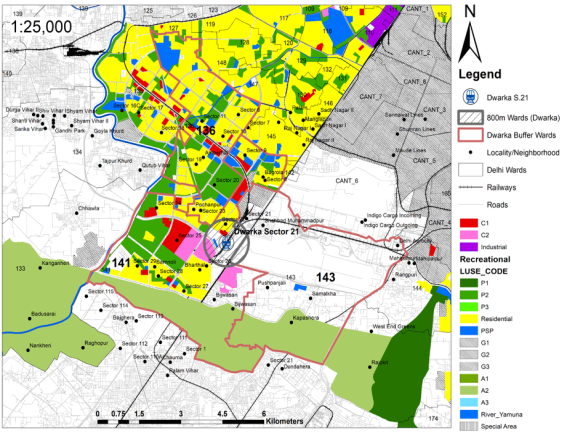
Analysis of the study area, defined by an 800-meter radius from the Sector 21 metro station, reveals a dramatic land-use transition. Data synthesized from on ground surveys shows a sharp decline in vacant land and a significant increase in built-up area between 2003 and 2023. The most prominent growth is observed in high-density residential and commercial plots, indicating a decisive shift from a low-density, planned residential sector to a mixed-use, high-density urban node, physically manifesting the intensification of land use driven by transit accessibility (Figure 2).


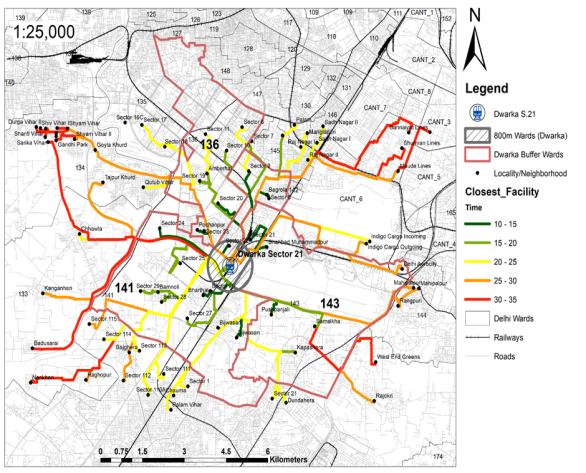
A network analysis confirms the pivotal role of the Sector 21 metro station, particularly the Airport Express Line. Its function as a terminal station creates a unique "gateway" effect, concentrating commercial and residential development within its sphere of influence (Figure 3). The station's provision of direct, high-speed access to major employment hubs makes the surrounding area highly attractive for high-income commuters and corporations seeking premium office space, directly fuelling the gentrification process.
6.3. Findings from the Primary SurveyThe survey data reveals a clear demographic shift. The mean age of property owners is 52 years, while the mean age of renters is significantly lower at 34 years. A substantial 42% of the sample is renters, and of these, 85% reported that their landlords do not reside within Sector 21, indicating a trend of absentee ownership. A striking 83% of respondents hold a college degree, and 52% cited employment opportunities as their primary reason for moving to Sector 21, confirming the influx of a highly educated, economically driven migrant population (Figure 4).

Despite the metro being the catalyst for the area's transformation, current usage among the surveyed residents is varied. Only 30% of respondents reported using the metro weekly, and a mere 12% use it daily, suggesting that for a significant portion of the local population, the metro's impact is more ecological shaping the local economy and real estate market than a daily functional utility.
Among the 57 local property owners surveyed, 70% reported that the number of housing units in their buildings or plots had increased, indicating a likely increase in permissible Floor Area Ratio (FAR). This policy-enabled densification is a direct physical response to the development pressures catalysed by the metro infrastructure.
The physical transformation of Dwarka Sector 21, driven by metro infrastructure, is coupled with a significant socio-demographic restructuring. The area is demonstrably attracting a younger, highly educated, and predominantly migrant population, a hallmark of gentrification processes 5, 8, 15. The analysis reveals noticeable gendered disparities in educational attainment, suggesting that the benefits of the new knowledge economy are not distributed equally, with women facing a relative disadvantage that potentially impacts their access to high-value employment opportunities. This pattern, when combined with resident narratives of cultural erosion and economic anxiety, underscores the complex and often inequitable social costs of rapid, infrastructure-led urban development 10, 12.
The metamorphosis of Dwarka Sector 21 into a high-density, mixed-use transit hub epitomizes the profound impact of strategic infrastructure on urban form and social composition. The findings confirm a process of gentrification characterized by a marked influx of a younger, highly educated populace, escalating property values, and a decisive shift in land use. The observed social disparities, particularly along gender lines, reveal underlying structural inequities that are exacerbated by the rapid urban transformation. This, combined with the poignant resident narratives of displacement and social fragmentation, underscores the urgent need for urban development strategies that are not only efficient but also inclusive and equitable.
To mitigate the negative externalities of gentrification and foster more equitable urban growth, the following policy measures are recommended:
1. Inclusionary Housing Policies: Implement mandates for affordable housing units in all new high-density residential projects to preserve socio-economic diversity.
2. Rental Regulation and Support: Explore mechanisms for rent stabilization and provide targeted rental vouchers or support for vulnerable long-term residents.
3. Gender-Sensitive Urban Planning: Develop and fund skill-building programs, career support services, and safe public spaces targeted at empowering women in the community.
4. Participatory Governance: Establish formal, transparent community engagement forums to ensure long-term residents have a meaningful voice in the planning processes that shape their neighbourhoods.
This study is limited by its cross-sectional design and its focus on a single sector, which restricts the generalizability of findings and the ability to track causal relationships over time. Future research should employ longitudinal studies to monitor the long-term effects of gentrification. Expanding the scope to compare multiple metro stations across Delhi would yield a more robust typology of transit-induced urban change. Furthermore, incorporating an intersectional analysis that includes caste, class, and ethnicity would provide a deeper, more nuanced understanding of displacement and inequality in the contemporary Indian city.
The authors would like to thank the residents of Dwarka Sector 21 for their participation and time. We also acknowledge the support provided by our respective institutions.
| [1] | S. Saha, A geospatial analysis of land use and land cover change in Dwarka Sector 12, Delhi: Assessing urban sprawl and its impact on local topography, Advanced Engineering Science, 6(2), pp. 1-8, 2024. | ||
| In article | |||
| [2] | S. Doshi, Rethinking gentrification in India, Urban Studies, 54(1), pp. 3–5, 2017. | ||
| In article | |||
| [3] | D. A. Ghertner, India's urban revolution: Geographies of displacement beyond gentrification, Environment and Planning, 46(7), pp. 1554–1571, 2014. | ||
| In article | View Article | ||
| [4] | R. Glass, Introduction: Aspects of change, in London: Aspects of Change, London, U.K.: MacKibbon & Kee, 1964, pp. xiii-xlii. | ||
| In article | |||
| [5] | L. Lees, A reappraisal of gentrification: Towards a 'geography of gentrification', Progress in Human Geography, 24(3), pp. 389–408, 2000. | ||
| In article | View Article | ||
| [6] | P. Marcuse, Gentrification, abandonment, and displacement: Connections, causes, and policy responses in New York City, Journal of Urban and Contemporary Law, 28, pp. 195–240, 1985. | ||
| In article | |||
| [7] | R. Atkinson, The evidence on the impact of gentrification: new lessons for the urban renaissance? European Journal of Housing Policy, 4(1), pp. 35–50, 2004. | ||
| In article | View Article | ||
| [8] | D. Harvey, The right to the city, New Left Review, 53, pp. 23–40, 2008. | ||
| In article | View Article | ||
| [9] | A. Rigolon and J. Németh, Toward a socio-ecological model of gentrification: How people, place, and policy shape neighborhood change, Journal of Urban Affairs, 41(7), pp. 1–22, 2019. | ||
| In article | View Article | ||
| [10] | A. Harris, From London to Mumbai and back again: Gentrification and public policy in comparative perspective, Urban Studies, 45(12), pp. 2407–2428, 2008. | ||
| In article | View Article | ||
| [11] | I. Anguelovski, J. J. T. Connolly, M. Garcia-Lamarca, H. Cole, and H. Pearsall, New scholarly pathways on green gentrification: What does the urban 'green turn' mean and where is it going?, Progress in Human Geography, 43( 6), pp. 1064–1086, 2019. | ||
| In article | View Article | ||
| [12] | J. Uribe-Toril, E. Aibar, and A. Galderisi, Gentrification and health: a narrative review, Urban Design International, 23(2), pp. 120–133, 2018. | ||
| In article | |||
| [13] | R. Varma, S. Modi, P. Sajin, M. Arif Kamal. Equity in Motion: A 3P Framework for Quantifying Gentrification along Delhi’s Metro Spectrum. Architecture Engineering and Science, 6(2), pp.148-162, 2025. | ||
| In article | View Article | ||
| [14] | S. Zukin, Naked City: The Death and Life of Authentic Urban Places. New York, NY, USA: Oxford University Press, 2010. | ||
| In article | View Article | ||
| [15] | T. Bokhad, R. Surwade, A. Bangre, M. Arif Kamal, Understanding the Transformation of Cities into Smart Cities: A Sustainable Urban Environment Perspective. Architecture Engineering and Science, 5(4), pp.177-185, 2024. | ||
| In article | View Article | ||
Published with license by Science and Education Publishing, Copyright © 2025 Rahat Varma, Suruchi Modi, Preetha Sajin and Mohammad Arif Kamal
 This work is licensed under a Creative Commons Attribution 4.0 International License. To view a copy of this license, visit
http://creativecommons.org/licenses/by/4.0/
This work is licensed under a Creative Commons Attribution 4.0 International License. To view a copy of this license, visit
http://creativecommons.org/licenses/by/4.0/
| [1] | S. Saha, A geospatial analysis of land use and land cover change in Dwarka Sector 12, Delhi: Assessing urban sprawl and its impact on local topography, Advanced Engineering Science, 6(2), pp. 1-8, 2024. | ||
| In article | |||
| [2] | S. Doshi, Rethinking gentrification in India, Urban Studies, 54(1), pp. 3–5, 2017. | ||
| In article | |||
| [3] | D. A. Ghertner, India's urban revolution: Geographies of displacement beyond gentrification, Environment and Planning, 46(7), pp. 1554–1571, 2014. | ||
| In article | View Article | ||
| [4] | R. Glass, Introduction: Aspects of change, in London: Aspects of Change, London, U.K.: MacKibbon & Kee, 1964, pp. xiii-xlii. | ||
| In article | |||
| [5] | L. Lees, A reappraisal of gentrification: Towards a 'geography of gentrification', Progress in Human Geography, 24(3), pp. 389–408, 2000. | ||
| In article | View Article | ||
| [6] | P. Marcuse, Gentrification, abandonment, and displacement: Connections, causes, and policy responses in New York City, Journal of Urban and Contemporary Law, 28, pp. 195–240, 1985. | ||
| In article | |||
| [7] | R. Atkinson, The evidence on the impact of gentrification: new lessons for the urban renaissance? European Journal of Housing Policy, 4(1), pp. 35–50, 2004. | ||
| In article | View Article | ||
| [8] | D. Harvey, The right to the city, New Left Review, 53, pp. 23–40, 2008. | ||
| In article | View Article | ||
| [9] | A. Rigolon and J. Németh, Toward a socio-ecological model of gentrification: How people, place, and policy shape neighborhood change, Journal of Urban Affairs, 41(7), pp. 1–22, 2019. | ||
| In article | View Article | ||
| [10] | A. Harris, From London to Mumbai and back again: Gentrification and public policy in comparative perspective, Urban Studies, 45(12), pp. 2407–2428, 2008. | ||
| In article | View Article | ||
| [11] | I. Anguelovski, J. J. T. Connolly, M. Garcia-Lamarca, H. Cole, and H. Pearsall, New scholarly pathways on green gentrification: What does the urban 'green turn' mean and where is it going?, Progress in Human Geography, 43( 6), pp. 1064–1086, 2019. | ||
| In article | View Article | ||
| [12] | J. Uribe-Toril, E. Aibar, and A. Galderisi, Gentrification and health: a narrative review, Urban Design International, 23(2), pp. 120–133, 2018. | ||
| In article | |||
| [13] | R. Varma, S. Modi, P. Sajin, M. Arif Kamal. Equity in Motion: A 3P Framework for Quantifying Gentrification along Delhi’s Metro Spectrum. Architecture Engineering and Science, 6(2), pp.148-162, 2025. | ||
| In article | View Article | ||
| [14] | S. Zukin, Naked City: The Death and Life of Authentic Urban Places. New York, NY, USA: Oxford University Press, 2010. | ||
| In article | View Article | ||
| [15] | T. Bokhad, R. Surwade, A. Bangre, M. Arif Kamal, Understanding the Transformation of Cities into Smart Cities: A Sustainable Urban Environment Perspective. Architecture Engineering and Science, 5(4), pp.177-185, 2024. | ||
| In article | View Article | ||