The study focuses on the physical, chemical, geotechnical, and mineralogical characterization of two clay soils from N'Djamena (NDJA) and Moundou (MOD) in Chad with a view to their use in eco-construction. This characterization is essential when selecting soils for use in the manufacture of raw earth bricks. After the soil samples were taken, the work was carried out experimentally in laboratories. The results of the physicochemical study reveal a moderate natural water content (12.5%) for the N'DJA soil, compared to a very high natural water content (30.6%) for the MOD soil. The NDJA soil has a relatively low organic matter content (2.27%) compared to the MOD soil (5.11%). However, both have a loss on ignition rate (6.03% and 6.57%, respectively) and specific density (2.35 g/cm3 and 2.34 g/cm3, respectively). The NDJA and MOD soils consist of 25.2% clay, 29.4% silt, and 45.4% sand, and 21.3% clay, 43.6% silt, and 35.1% sand, respectively. The results of the chemical analysis show that the abundant oxides are SiO₂, Al₂O₃, and Fe₂O₃, whereas K₂O, CaO, BaO, MgO, Na₂O, TiO₂, and P₂O₅ are present in low quantities in the NDJA and MOD soils. The results of mineralogical analysis by X-ray diffraction (XRD) reveal that the clay in N'Djamena (NDJA) consists mainly of quartz (Q), kaolinite (ka), K-feldspar (K-f), smectite (sm), and hematite (Ha), while the clay in Moundou (MOD) also contains illite (Il) in addition to these minerals. The study showed that both soils have properties that make them suitable for use in eco-construction.
In most low-income countries, earth has been one of the most widely used local materials in construction. Not only it is available locally everywhere, but it is also a sustainable alternative material, particularly in sub-Saharan Africa, in the face of global climate change challenges. However, earth-based constructions are recyclable, environmentally friendly, generate little energy, and protect the environment 1, 2. Eco-construction favors materials with a lower carbon footprint that are locally available and appropriate for climatic and socio-economic conditions 3.
Chad, a landlocked Sahelian country with a wide variety of soils that are little used or exploited on a small scale in the construction industry. The two cities of Chad (N'Djamena and Moundou) have different soil conditions but are rich in soil materials that can be used in brick manufacturing. Therefore, knowledge of the characteristics of these soils is essential in order to promote them as basic eco-materials.
The objective of this study is to determine the physicochemical, geotechnical, and mineralogical properties of these two soils in order to assess their suitability use as base materials in house construction. These characterizations will be carried out through a series of laboratory tests. The results of this study will make it possible to predict the behavior of the material and guide the choice of soils with physico-chemical, geotechnical, and mineralogical characteristics that are more or less suitable for the production of adobe and compressed earth blocks (CEB), which depend on them for their use in eco-construction.
Soil samples were collected from brickworks in the economic city of Moundou, Chad, at geographical coordinates 8°34'0.001'‘N 16°4'59.999’'E, designated MOD, and from N'Djamena, capital of the Republic of Chad, at geographical coordinates 12°6 '47.001'‘N 15°2'57.002’'E, designated NDJA 4, 5.
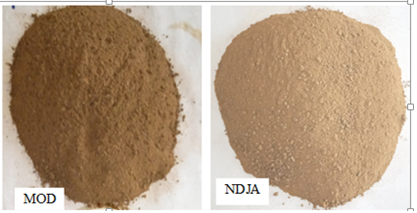
2.2. Visual Appearance of Soil SamplesFigure 1 shows the crushed and sieved samples of two soils, distinguished by their colors.

The water content (w) of a moist material (soil) corresponds to the mass of liquid water in a soil sample that can be removed by drying. The water content is determined in accordance with standard NF P 94-050 6. The water content is calculated using (1).
 (1)
(1)
mh+r: mass of the wet soil sample with the container in grams (g) before drying;
ms+r: mass of the dry soil sample with the container in grams (g) after drying at 105°C for 24 hours;
mr: mass of the empty container in grams (g).
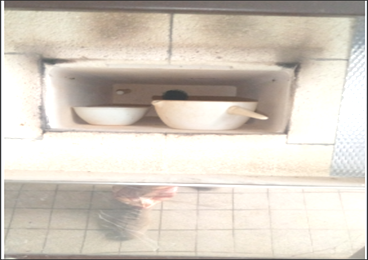
The organic matter content CMOC (%) is measured by calcination according to standard XP P94-047 7. The test consists of determining the loss in mass of a soil sample (passed through a 2 mm sieve) previously dried in an oven at 105°C for 24 hours. The dry sample is placed in a ceramic crucible with a mass m0 and placed in an electric furnace (Figure 2). The oven temperature is gradually increased to 500°C. For each soil type, there is one test sample.

The arithmetic mean of these test samples, rounded to the nearest whole number, gives the organic matter content CMOC (%) in accordance with equation (2).
 (2)
(2)
n = 2, number of test samples;
m0: Mass of empty crucible (g); m1: Mass of crucible + soil dried at 105°C
m2: Mass of empty crucible + soil calcined (g) at 500°C.
Loss on ignition (LOI) (%) was measured by placing a quantity of clay in a pre-weighed porcelain crucible. The crucible was placed in a furnace, with the temperature gradually increased to 1000 °C over 1 hour. The crucible was then removed and placed in a desiccator to cool and weighed 8.The authors 5, 9 used equation (3) to determine the loss on ignition.
 (3)
(3)
m1: mass of soil dried at 105°C; m2: mass of soil after calcination at 1000°C.
The specific or actual density of a soil sample Ps is determined using the water pycnometer method in accordance with standard NF EN ISO 17892-3 10. The density of the solid particles in the soil is determined using equation (4) 11. The value of Ps is the average of two measurements taken on two test samples of the same soil sample. The value rounded to 0.01 g/cm³ is used.
 (4)
(4)
: density of water, conventionally taken to be 1 g/m3;
: actual density of a soil sample;
m1: mass of the empty pycnometer with its stopper;
m2: mass of the pycnometer with its stopper containing a quantity of soil;
m3: mass of the pycnometer with its stopper filled with distilled water up to the calibration mark containing the same amount of soil;
m4: mass of the pycnometer with its stopper filled with distilled water up to the calibration mark.
The apparent density of a material is the density of one cubic meter of that material taken as a pile, including both permeable and impermeable voids within the particles as well as voids between particles 12. The bulk density was measured in accordance with NF EN 1097 13;
Particle size analysis is a test designed to determine the proportions of different grain sizes in the soil. It is carried out by sieving for soil grains larger than 80 microns and by sedimentation for soil grains smaller than 80 microns 14, 15. The NDJA and MOD soils were subjected to this test. nce the complete particle size analysis has been carried out, the particle size curve for each soil is plotted.
Atterberg limits are weight percentages of water content that relate to specific conditions of clay soil. They serve as necessary basis for classifying fine-grained soils. Soil fractions smaller than 400 µm are used to determine these limits in accordance with the standard NF P94 – 051 16. The liquid limit (LL) and plastic limit (LP) were determined using the Casagrande method. The plasticity index (PI), which represents the extent of the plastic range, is obtained by the difference between LL and LP using equation (5) 5, 17.
 (5)
(5)
Skempton activity is used to estimate the presence or predominance of clay minerals in a soil sample. It is derived from the plasticity index (PI) and the proportion of clay in the soil (c) expressed as a percentage and determined by equation (6) 1, 17:
 (6)
(6)
The methylene blue value (MBV) of a soil measures the ion absorption capacity of soils on a fraction smaller than 5 mm of soil sample. It is one of the soil identification parameters described by the standard NF P94 - 068 18. The test result depends entirely on both the mineralogical nature and the quantity of the clay fraction. The methylene blue value is determined by equation (7).
 (7)
(7)
B: the mass in grams of methylene blue added to the solution;
mh: mass in grams of the wet soil with initial water content w used to perform the test.
Knowing MBV allows us to deduce the blue activity index (ACB) of the soil given by equation (8). This index defines the degree of affinity for water linked to the types of clay minerals in a soil 11.
 (8)
(8)
The specific area is the ratio between the surface of a solid and its mass (m²/g or m²/kg) or its volume. The total specific surface area (SS) is determined by equation (9) 17.
SS = 20.93 x MBV (9)
The cation exchange capacity (CEC) is equivalent to the number of monovalent cations that can be replaced by so-called compensating cations to counterbalance the negative charge of 100 grams. It is deduced from the methylene blue value (MBV) using equation (10) 1, 17.
 (10)
(10)
The elemental chemical analysis of the two soils was performed by ICP-AES (inductively coupled plasma atomic emission spectrometry). This analysis made it possible to measure qualitatively and quantitatively almost all the elements of the periodic table in various matrices 9, 12.
Knowing the percentages in the samples, the chemical alteration index (CIA) is determined by formula (11) 19. In geochemistry, this index is used to assess the degree of chemical alteration of soils and their suitability for use in construction.
 (11)
(11)
The mineralogical composition of the samples was determined using X-ray diffraction. This technique has been used by a large number of researchers 4, 12, 20 to identify the different crystallized mineral phases present in soil samples. This identification of crystallized phases is carried out by comparison with a Joint Committee Powder Diffraction Standard reference file, which is updated annually 11. The X-ray diffraction (XRD) spectral analyses of the samples were performed at the Spectrum Facility at the University of Johannesburg, South Africa.
This analysis was performed by combining chemical analysis and X-ray diffraction to determine the percentage of mineral phases present in a soil sample based on the calculation method proposed by Yvon et al 21.
T (a) = ∑ MiPi (a) (12)
 (13)
(13)
 (14)
(14)
 (15)
(15)
 (16)
(16)
 (17)
(17)
 (18)
(18)
 (19)
(19)
% Hematite = % Fe2O3 - % Goethite(20)
814: molar mass of illite (K₂O)(SiO₂)₆(Al₂O₃)₃(H₂O)₃ in g/mol
557: molar mass of k-feldspar (K₂O)(SiO₂)₆(Al₂O₃) in g/mol
278: molar mass of plagioclase (CaO)(SiO2)2(Al2O3) in g/mol
258: molar mass of kaolinite (SiO2)2(Al2O3)(H2O)2 in g/mol
89: molar mass of goethite (FeO(OH)) in g/mol
60: molar mass of quartz (SiO2) in g/mol
94: molar mass of K2O in g/mol
56: molar mass of CaO in g/mol
60: molar mass of SiO2 in g/mol
160: molar mass of Fe2O3 in g/mol
249: molar mass of Fe2O3 and molar mass of goethite in g/mol
102: molar mass of Al2O3 in g/mol
Table 1 shows the results of the natural water content of clay soils in N'Djamena (NDJA) and Moundou (MOD).
Both samples have fairly high natural water content. However, the MOD soil's water content of 30.6% is extremely high compared to that of NDJA, which is 12.05%.
The water content values show that these soils contain clay minerals that absorb water. Clay minerals called smectites or phyllosilicates have a strong affinity for water due to their interlayer spaces, which increase and could be contained in these soils 12. The value of 12.05% is relatively close to the clay content of 11.33% obtained by Abakar 22 However, it is significantly higher than the 4.78% obtained by Bodian et al 12.
This natural MOD content value of 30.6% could be explained by the fact that the sample was taken a few hours after rainfall.
Variations in natural water content may be related to the quantity or type of clay minerals contained in the soil samples analyzed.
Table 2 shows the results for organic matter content (CMOC) and loss on ignition (LOI). The organic matter content values are low. According to standard NF EN ISO 14688-2 23 the samples studied are low in organic matter.
The relatively low fire losses of 6.03% for NDJA and 6.57% for MOD are linked to dehydration and/or dehydroxylation or decarboxylation reactions of the clay minerals present in the soil samples 24.
Table 3 presents the results of the tests to determine specific and bulk densities. The densities of 2.35 g/cm³ for NDJA soil and 2.34 g/cm³ for MOD soil shown in Table 3 are of the same order of magnitude. The two specific density values obtained are well within the range of 2.2 to 3.0 g/cm³ recommended for brick manufacturing 25.
The bulk density of 1.28 g/cm³ of NDJA soil differs significantly from the bulk density of 1.03 g/cm³ of MOD soil, with a difference of 0.25 g/cm³, indicating that NDJA soil is slightly denser than MOD soil. These values are close to those of four soils obtained by 11 in his thesis work, which are 1.363 g/cm³, 1.160 g/cm³, 1.033 g/cm³, and 1.155 g/cm³, respectively.
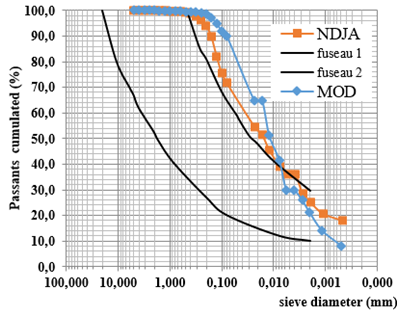
3.2. Geotechnical CharacterizationFigure 3 shows the complete granulometric distribution of the NDJA and MOD soil samples. These two curves were obtained using dry sieving methods for grains larger than 0.08 mm 14 and sedimentation for grains smaller than 0.08 mm 15.
The particle size curves do not fully cover the range but are close to the upper limit. The curves for soils suitable for earth bricks must fall within this range 26, 27. However, this recommendation is often criticized, especially when it comes to heritage adobe, as the grain size curves of these materials do not always fall within the recommended range 28.
The soil constituents are clay (size ≤ 2µm), silt (size 2µm ≤ 20µm), sand (size 20µm ≤ 2 mm), and gravel (size 2mm ≤ 20 mm). The proportions contained in these soils are deduced from these grain size curves and are recorded in Table 4.

According to the recommendation of standard NF XP P13-901 29 soils suitable for adobe and BTC must have an average of 10-30% clay and at least 30% sand. The clay and sand proportions of NDJA and MOD soils are well within the recommended ranges.
Analysis of these grain size curves shows that NDJA and MOD soils contain 71.6% and 90.0% of particles passant through a 0.080 mm sieve, respectively, which are fine soils according to standard NF P 11-300 30. Consequently, their classification depends on the Casagrande diagram.
The results of the Atterberg limits and Skempton activity are presented in Table 5.
Atterberg limit values provide information on the degree of plasticity of a soil as well as its degree of clay content. For both soils, the Atterberg limits are similar. Using the Casagrange diagram, these moderately clayey, low-plasticity soils 31, 32.
Table 6 gives the methylene blue values (MBV) 18, the clay fraction activity index, the specific surface area, and the cation exchange capacity (CEC 18. of NDJA and MOD soils. The methylene blue values of the two soils allow for an overall measurement of the quantity and activity index of the clay fractions (ACB) and determine their classification. The specific surface area and cation exchange capacity values are used to detect the presence of clay minerals in a soil sample.
According to standard NF P 11-300 30, NDJA soil and MOD soil are classified as class A and belong to subclass A2 (fine clayey sands, clayey silts, and slightly plastic marls).
The cation exchange capacity of kaolinites is between 5 and 15 9. From the above, the soils (NDJA and MOD soil) contain kaolinites and are moderately active according to CEC values between 5 and 13 33
3.3. Chemical Analysis of SoilsThe results of the elemental chemical analysis of NDJA and MOD soils are shown in Table 7.
These results showed that the soils studied consist mainly of silica (SiO₂), alumina (Al₂O₃), and iron oxides (Fe₂O₃), while oxides such as K₂O, CaO, BaO, MgO, Na₂O, TiO₂, and P₂O₅ are present in small quantities. The high SiO2 content (70.14% and 57.54%), the acceptable A Al2O3 content (14.31% and 18.27%) and the significant Fe2O3 content (4.85% and 8.09%) in NDJA and MOD soils reveal the presence of quartz, kaolinite (SiO2)2(Al2O3)(H2O)2. smectite or montmorillonite (Ca0,33(Al1,67,Mg0,33)Si4O10(OH)2),hematite (Fe2O3) or goethite (FeOOH) and The low amount of K2O (2.20% and 3.35%) may indicate the significant presence of illite (K2O)(SiO2)6(Al2O3)3(H2O)3 or k-feldspars (K2O)(SiO2)6(Al2O3) in these samples 9, 34. The low amount of CaO could indicate the presence of plagioclase (CaO)(SiO2)2(Al2O3) and smectites.
The SiO2/Al2O3 ratio (4.90) of NDJA, which is greater than 3.5, highlights the presence of smectite or montmorillonite in this sample 35. Meanwhile, the MOD ratio (3.15), which is between 3 and 3.5, confirms the presence of illites, which are low-swelling elements in clays.
The values of the sum of Al2O3 + SiO2 + Fe2O3 (89.7% and 83.90%) of the soils studied are greater than 75%, meaning that these soils can be stabilized for brick making 36.
The CAI index values (Table 7) of these soil samples, ranging from 75% to 100%, reveal that they contain clay minerals such as quartz, kaolinite, and gibbsite 11. These clay soils are highly weathered, stable, and have low swelling properties, making them suitable for bricks used in construction.
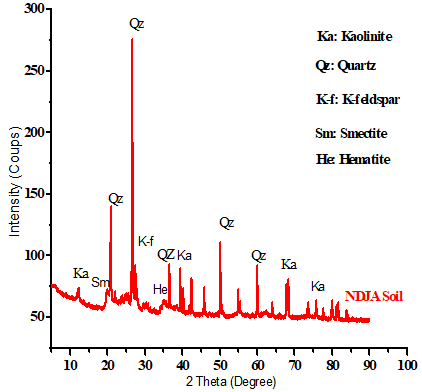
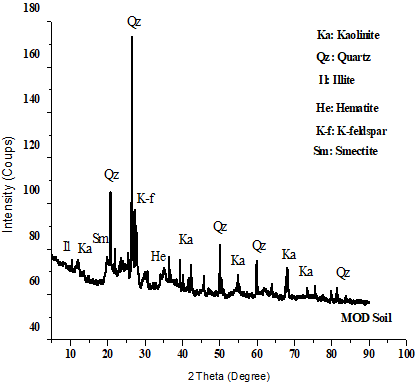
3.4. Mineralogical AnalysisFigures 4 and 5 show the diffractograms of the soils from N'Djamena (NDJA) and Moundou (MOD), respectively.


The results obtained from X-ray diffraction (XRD) showed that N'Djamena clay (NDJA) consists mainly of quartz (Q), kaolinite (ka), feldspar (K-f), smectite (sm), and hematite (Ha), while Moundou clay (MOD) also contains illite (Il) in addition to these minerals. The diffractograms of these two soils each show peaks of varying intensity (in counts) depending on the values of the 2θ angle between 5° and 100°. These different peaks relate to characteristic crystal planes indicating the various minerals listed above that exist in the soil samples studied. Le quartz (Q) ou silice (SiO2) apparait à travers ces diffractogrammes abondant, ce qui corrobore l’analyse chimique.results obtained from X-ray diffraction (XRD) showed that N'Djamena clay (NDJA) consists mainly of quartz (Q), kaolinite (ka), feldspar (K-f), smectite (sm), and hematite (Ha), while Moundou clay (MOD) also contains illite (Il) in addition to these minerals. The diffractograms of these two soils each show peaks of varying intensity (in counts) depending on the
The results of the semi-quantitative analysis are based on a combination of chemical analysis, mineralogical analysis, and the relationship described by 21. These results are shown in Table 8.
These show that quartz, illite, and feldspar are significantly present in both soils studied. Kaolinite, hematite, smectite, plagioclase, and goethite have a relatively low percentage. Kaolinite and illite are highly cohesive phases but absorb little water, which makes these two soils less expansive and stable 1, 9. Quartz, goethite, and feldspar, on the other hand, have no cohesive strength 37. Quartz improves the mechanical strength of raw bricks and facilitates their drying 9. Smectite is a swelling clay mineral that could undermine the stability of bricks, but its very low quantity will combine with the other clay minerals present in both soils.
The objective of this study is to determine the physico-chemical, geotechnical, and mineralogical characteristics of soils in N'Djamena (NDJA) and Moundou (MOD) in Chad with a view to their use in eco-construction. The study revealed that NDJA soil has a relatively low organic matter content (2.27%) compared to MOD soil (5.11%). However, both have similar loss on ignition (6.03% and 6.57%, respectively) and specific density (2.35 g/cm3 and 2.34 g/cm3, respectively) values. These specific density values are close to those recommended for brick manufacturing. The results of this study showed that both soils are moderately clayey, low plasticity, class A2, with geotechnical characteristics similar to those of soils suitable for the manufacture of adobe and BTC bricks.
The results of the study show that these two clay soils are highly altered, stable, and mediocre in terms of swelling, making them suitable for bricks intended for eco-construction.
In the future, we plan to stabilize bricks made from these soils and vegetal fibers, then study their mechanical and thermal resistance as well as their durability in water.
We would like to express our gratitude to the leaders of our institution, ENSTP, in particular the Director General. We would also like to thank the technicians at the ENSTP Civil Engineering Laboratory and the teaching staff for their sincere collaboration during this work.
|
| [1] | Mbairangone S, Contribution a la caracterisation de sols argileux renforces par des fibres vegetales « balles de riz », Université de N’Djamena, Thèse de doctorat, 2024. | ||
| In article | |||
| [2] | Houben H., Guillaud H. Traité de construction en terre, Edition parenthèses, Marseille (France) ,355p, 2006. | ||
| In article | |||
| [3] | Morel J.C., Pkla A., and Walker P. compressive strength testing of compressed earth blocks. Construction and Building Materials, 15(5-6), 301-309,2001. | ||
| In article | |||
| [4] | Mbairangone, S., Natmack, G. E., Bianzeube, T., Bozabe, R. K. and O. Kinet, O. Effect of rice husk on adobes in clay soils. Research Journal of Engineering Sciences,11(3), 12-21, 2022 | ||
| In article | |||
| [5] | Taïpabé D., Doko K. V., Datchossa T. A, Abdourahamane A. I.,Mandela T., Sanou A., Gibigaye M. Characterization of a lateritic soil in Chad with a view to its use in eco-construction. J. Mater. Environ.Sci.(16) 7, 1189-1209, 2025. | ||
| In article | |||
| [6] | NF P 94-050: Reconnaissance et essais- Détermination de la teneur en eau pondérale des matériaux- méthode par étuvage. AFNOR, 1995 | ||
| In article | |||
| [7] | XP P 94-047. (Reconnaissance et essais - Déterminations de la teneur en matière organique d’un matériau - Méthode par calcination. 1998. | ||
| In article | |||
| [8] | Qlihaa A., Dhimni S., Melrhaka F., Hajjaji N., Srhiri A. (2016). Caractérisation physico-chimique d’une argile Marocaine [Physico-chemical characterization of a morrocan clay]. J. Mater. Environ. Sci. 7 (5) 1741-1750, 2016 | ||
| In article | |||
| [9] | Bobet, O. Elaboration et caractérisation de matériaux bio-sourcés à base d’argile de Lougouri et coques d’arachide. Université OUAGA I Pr Joseph KI – ZERBO, Thèse de Doctorat, 2020. | ||
| In article | |||
| [10] | NF EN ISO 17892-3Reconnaissance et essais géotechniques - Essais de laboratoire sur les sols - Partie 3: détermination de la masse volumique des particules solides, . 2015. | ||
| In article | |||
| [11] | Togdjim J. Elaboration et caractérisation d’un composite issu de sols argileux et de diatomite pour son utilisation dans l’écoconstruction. Université de N’Djamena, Thèse de doctorat, 2025. | ||
| In article | |||
| [12] | Bodian S. Faye M., Sambou V., Séne N A., Diaw I., Faye K. Caractérisation physico-chimique des matières premières argileuses de la carrière de thicky (sénégal) pour lafabrication de briques en terre. Journal de physique de la SOAPHYS,2021 | ||
| In article | |||
| [13] | NF EN 1097-3.. Part3 - Méthode pour la détermination la masse volumique en vrac et la porosité intergranulaire, 20 p.1998. | ||
| In article | |||
| [14] | NF P 94-056. Analyse granulométrique. Méthode par tamisage à sec après lavage, AFNOR. 1996 | ||
| In article | |||
| [15] | NF P 94-057. Analyse granulométrique des sols. Méthode par sédimentation, AFNOR, 1992) | ||
| In article | |||
| [16] | NF P 94-051. Reconnaissance et essais- Détermination des limites d’Atterberg. AFNOR, 16 p, 1993. | ||
| In article | |||
| [17] | Ahouet, L., Dzaba, S., Elenga, B.D.M., Okina, S.N. and Kimbatsa, F.T. Characterization of the Activity, Mineralogy and Correlations between the Properties of Clayey Soils. Jou rnal of Minerals and Materials Characteriz ation and Engineering, 10, 410-428, 2022. | ||
| In article | View Article | ||
| [18] | NF P 94-068. (1998). Reconnaissance et essais-Détermination de la valeur de bleu de méthylène d’un sol ou d’un matériau rocheux par l’essai à la tâche. AFNOR, 8p. | ||
| In article | |||
| [19] | Togdjim J., Malloum S., Abderahman A. O., Abakar A., Alexis M. N., Danala S., Michel Q. Geotechnical, physicochemical and mineralogical characterizations of soil quarries in Chad with a view to their valorization in eco-construction, J. Mater. Environ. Sci., 14(2), 255-267.2023. | ||
| In article | |||
| [20] | Bobet, O., Seynou, M., Zerbo, L., Bamogo, H., Sanou, I., Sawadogo, M.,. Mechanical, hydric and thermal properties of raw earth bricks amended with peanut shells. Journal of the West African Chemical Society 49, 54–64, 2020 | ||
| In article | |||
| [21] | Yvon, J., Liétard, O., Cases, J.-M., Delon, J.-F. Mineralogy of kaolinic clays from the Charentes. bulmi 105, 431–437, 1982. | ||
| In article | View Article | ||
| [22] | Abakar A. Caractérisations mécaniques et thermiques de l’argile stabilisée par la gomme arabique et renforcée par la paille de riz. Université de Lorraine, Thèse de Doctorat, 2018. | ||
| In article | |||
| [23] | NF EN ISO 14688-2. Reconnaissance et essais géotechniques – Identification et classification des sols - part 2: principe pour une classification. AFNOR, 21 p, 2018. | ||
| In article | |||
| [24] | Baccour Zghal, H., Medihoud, M. & Mhiri , M. Caractérisation physicochimique et mécanique de matériaux céramiques obtenus à partir des argiles tusiennes verres céramiques & composites, 1 (2), 25‐33, 2011. | ||
| In article | |||
| [25] | Seed, H., Woodward, R., & Lundgren, R Prediction of Swelling Potential for Compacted Clays. Journal of the Soil Mechanics and Foundations Division, 88, 107-131, 1962. | ||
| In article | View Article | ||
| [26] | Lavie Arsène, M. I. Valorisation des gisements argileux pour la fabrication des blocs de terre comprimée. Université de Liège, thèse de doctorat, 157, 2019. | ||
| In article | |||
| [27] | Sayouba, K., François, O., Bétaboalé, N., Adamah, M., Jean Claude, B. et François, Z. Evaluation des propriétés thermo-hydro-mécaniques des briques en terre comprimées (BTC) issues de la carrière de Matourkou, au Burkina- Faso. Afrique Science,vol. 15(3), 12-22, 2019. | ||
| In article | |||
| [28] | Aubert, J.-E., Marcom, A., Oliva, P., Segui, P. (2015). Chequered earth construction in south-western France. J. Cult. Herit., 16, 293-298, 2015. | ||
| In article | View Article | ||
| [29] | NF XP P 13- 901. . Ed. Blocs de terre comprimée pour murs et cloison. Nor 01. Association française de normalisation, 2001, Paris, AFNOR, 35p. | ||
| In article | |||
| [30] | NF P 11-300. (1992). Classification des matériaux utilisables dans la construction des remblais et couches de forme d’infrastructures routière, 1992, AFNOR, 21 p | ||
| In article | |||
| [31] | Abakar Ali, Riad BENELMIR, Jean-Louis TANGUIER et Abdoulaye Saleh TODJIBEL, Caractérisation de l’argile de N’djamena stabilisée par la gomme arabique, Afrique SCIENCE, 13, 330-341, 2017. | ||
| In article | |||
| [32] | Magnan, J. P. Description, identification et classification des sols. Ed. Ingénieur Technique, 1997. | ||
| In article | View Article | ||
| [33] | Chrétien, M., Fabre, R., Denis, A., Marache, A. Recherche de paramètres d’identification géotechnique optimaux pour une classification des sols sensibles au retrait- gonflement. Rev.Fr Géotechnique, 91-106, 2007. | ||
| In article | View Article | ||
| [34] | Ouedraogo M. Stabilisation des adobes par des fibres végétales. Université OUAGA I Pr Joseph KI – ZERBO, Thèse de Doctorat, 187 p, 2018. | ||
| In article | |||
| [35] | Hidalgo, C., Thiry, M., Elsass, F., & Quantin, P. Caractérisation minéralogique des argiles des sols volcaniques indurés (tepetates) de la Vallée de Mexico, pp 20- 26, janvier 1998 | ||
| In article | |||
| [36] | Murmu, A. L., Jain, A., & Patel, A. Mechanical Properties of Alkali Activated Fly Ash Geopolymer Stabilized Expansive Clay. KSCE Journal of Civil Engineering, 23(9), 3875‑3888, 2019. | ||
| In article | View Article | ||
| [37] | Sen, A., Yokokura, T., Kankel, M.W., Dimlich, D.N., Manent, J., Sanyal, S., Artavanis-Tsakonas, S. Modeling spinal muscular atrophy in Drosophila links Smn to FGF signaling. J. Cell Biol. 192 481-495, 2011 | ||
| In article | View Article PubMed | ||
Published with license by Science and Education Publishing, Copyright © 2025 Mbairangone Samson, Togdjim Jonas, Sara Galléboui and Kinet Ouinra
 This work is licensed under a Creative Commons Attribution 4.0 International License. To view a copy of this license, visit
http://creativecommons.org/licenses/by/4.0/
This work is licensed under a Creative Commons Attribution 4.0 International License. To view a copy of this license, visit
http://creativecommons.org/licenses/by/4.0/
| [1] | Mbairangone S, Contribution a la caracterisation de sols argileux renforces par des fibres vegetales « balles de riz », Université de N’Djamena, Thèse de doctorat, 2024. | ||
| In article | |||
| [2] | Houben H., Guillaud H. Traité de construction en terre, Edition parenthèses, Marseille (France) ,355p, 2006. | ||
| In article | |||
| [3] | Morel J.C., Pkla A., and Walker P. compressive strength testing of compressed earth blocks. Construction and Building Materials, 15(5-6), 301-309,2001. | ||
| In article | |||
| [4] | Mbairangone, S., Natmack, G. E., Bianzeube, T., Bozabe, R. K. and O. Kinet, O. Effect of rice husk on adobes in clay soils. Research Journal of Engineering Sciences,11(3), 12-21, 2022 | ||
| In article | |||
| [5] | Taïpabé D., Doko K. V., Datchossa T. A, Abdourahamane A. I.,Mandela T., Sanou A., Gibigaye M. Characterization of a lateritic soil in Chad with a view to its use in eco-construction. J. Mater. Environ.Sci.(16) 7, 1189-1209, 2025. | ||
| In article | |||
| [6] | NF P 94-050: Reconnaissance et essais- Détermination de la teneur en eau pondérale des matériaux- méthode par étuvage. AFNOR, 1995 | ||
| In article | |||
| [7] | XP P 94-047. (Reconnaissance et essais - Déterminations de la teneur en matière organique d’un matériau - Méthode par calcination. 1998. | ||
| In article | |||
| [8] | Qlihaa A., Dhimni S., Melrhaka F., Hajjaji N., Srhiri A. (2016). Caractérisation physico-chimique d’une argile Marocaine [Physico-chemical characterization of a morrocan clay]. J. Mater. Environ. Sci. 7 (5) 1741-1750, 2016 | ||
| In article | |||
| [9] | Bobet, O. Elaboration et caractérisation de matériaux bio-sourcés à base d’argile de Lougouri et coques d’arachide. Université OUAGA I Pr Joseph KI – ZERBO, Thèse de Doctorat, 2020. | ||
| In article | |||
| [10] | NF EN ISO 17892-3Reconnaissance et essais géotechniques - Essais de laboratoire sur les sols - Partie 3: détermination de la masse volumique des particules solides, . 2015. | ||
| In article | |||
| [11] | Togdjim J. Elaboration et caractérisation d’un composite issu de sols argileux et de diatomite pour son utilisation dans l’écoconstruction. Université de N’Djamena, Thèse de doctorat, 2025. | ||
| In article | |||
| [12] | Bodian S. Faye M., Sambou V., Séne N A., Diaw I., Faye K. Caractérisation physico-chimique des matières premières argileuses de la carrière de thicky (sénégal) pour lafabrication de briques en terre. Journal de physique de la SOAPHYS,2021 | ||
| In article | |||
| [13] | NF EN 1097-3.. Part3 - Méthode pour la détermination la masse volumique en vrac et la porosité intergranulaire, 20 p.1998. | ||
| In article | |||
| [14] | NF P 94-056. Analyse granulométrique. Méthode par tamisage à sec après lavage, AFNOR. 1996 | ||
| In article | |||
| [15] | NF P 94-057. Analyse granulométrique des sols. Méthode par sédimentation, AFNOR, 1992) | ||
| In article | |||
| [16] | NF P 94-051. Reconnaissance et essais- Détermination des limites d’Atterberg. AFNOR, 16 p, 1993. | ||
| In article | |||
| [17] | Ahouet, L., Dzaba, S., Elenga, B.D.M., Okina, S.N. and Kimbatsa, F.T. Characterization of the Activity, Mineralogy and Correlations between the Properties of Clayey Soils. Jou rnal of Minerals and Materials Characteriz ation and Engineering, 10, 410-428, 2022. | ||
| In article | View Article | ||
| [18] | NF P 94-068. (1998). Reconnaissance et essais-Détermination de la valeur de bleu de méthylène d’un sol ou d’un matériau rocheux par l’essai à la tâche. AFNOR, 8p. | ||
| In article | |||
| [19] | Togdjim J., Malloum S., Abderahman A. O., Abakar A., Alexis M. N., Danala S., Michel Q. Geotechnical, physicochemical and mineralogical characterizations of soil quarries in Chad with a view to their valorization in eco-construction, J. Mater. Environ. Sci., 14(2), 255-267.2023. | ||
| In article | |||
| [20] | Bobet, O., Seynou, M., Zerbo, L., Bamogo, H., Sanou, I., Sawadogo, M.,. Mechanical, hydric and thermal properties of raw earth bricks amended with peanut shells. Journal of the West African Chemical Society 49, 54–64, 2020 | ||
| In article | |||
| [21] | Yvon, J., Liétard, O., Cases, J.-M., Delon, J.-F. Mineralogy of kaolinic clays from the Charentes. bulmi 105, 431–437, 1982. | ||
| In article | View Article | ||
| [22] | Abakar A. Caractérisations mécaniques et thermiques de l’argile stabilisée par la gomme arabique et renforcée par la paille de riz. Université de Lorraine, Thèse de Doctorat, 2018. | ||
| In article | |||
| [23] | NF EN ISO 14688-2. Reconnaissance et essais géotechniques – Identification et classification des sols - part 2: principe pour une classification. AFNOR, 21 p, 2018. | ||
| In article | |||
| [24] | Baccour Zghal, H., Medihoud, M. & Mhiri , M. Caractérisation physicochimique et mécanique de matériaux céramiques obtenus à partir des argiles tusiennes verres céramiques & composites, 1 (2), 25‐33, 2011. | ||
| In article | |||
| [25] | Seed, H., Woodward, R., & Lundgren, R Prediction of Swelling Potential for Compacted Clays. Journal of the Soil Mechanics and Foundations Division, 88, 107-131, 1962. | ||
| In article | View Article | ||
| [26] | Lavie Arsène, M. I. Valorisation des gisements argileux pour la fabrication des blocs de terre comprimée. Université de Liège, thèse de doctorat, 157, 2019. | ||
| In article | |||
| [27] | Sayouba, K., François, O., Bétaboalé, N., Adamah, M., Jean Claude, B. et François, Z. Evaluation des propriétés thermo-hydro-mécaniques des briques en terre comprimées (BTC) issues de la carrière de Matourkou, au Burkina- Faso. Afrique Science,vol. 15(3), 12-22, 2019. | ||
| In article | |||
| [28] | Aubert, J.-E., Marcom, A., Oliva, P., Segui, P. (2015). Chequered earth construction in south-western France. J. Cult. Herit., 16, 293-298, 2015. | ||
| In article | View Article | ||
| [29] | NF XP P 13- 901. . Ed. Blocs de terre comprimée pour murs et cloison. Nor 01. Association française de normalisation, 2001, Paris, AFNOR, 35p. | ||
| In article | |||
| [30] | NF P 11-300. (1992). Classification des matériaux utilisables dans la construction des remblais et couches de forme d’infrastructures routière, 1992, AFNOR, 21 p | ||
| In article | |||
| [31] | Abakar Ali, Riad BENELMIR, Jean-Louis TANGUIER et Abdoulaye Saleh TODJIBEL, Caractérisation de l’argile de N’djamena stabilisée par la gomme arabique, Afrique SCIENCE, 13, 330-341, 2017. | ||
| In article | |||
| [32] | Magnan, J. P. Description, identification et classification des sols. Ed. Ingénieur Technique, 1997. | ||
| In article | View Article | ||
| [33] | Chrétien, M., Fabre, R., Denis, A., Marache, A. Recherche de paramètres d’identification géotechnique optimaux pour une classification des sols sensibles au retrait- gonflement. Rev.Fr Géotechnique, 91-106, 2007. | ||
| In article | View Article | ||
| [34] | Ouedraogo M. Stabilisation des adobes par des fibres végétales. Université OUAGA I Pr Joseph KI – ZERBO, Thèse de Doctorat, 187 p, 2018. | ||
| In article | |||
| [35] | Hidalgo, C., Thiry, M., Elsass, F., & Quantin, P. Caractérisation minéralogique des argiles des sols volcaniques indurés (tepetates) de la Vallée de Mexico, pp 20- 26, janvier 1998 | ||
| In article | |||
| [36] | Murmu, A. L., Jain, A., & Patel, A. Mechanical Properties of Alkali Activated Fly Ash Geopolymer Stabilized Expansive Clay. KSCE Journal of Civil Engineering, 23(9), 3875‑3888, 2019. | ||
| In article | View Article | ||
| [37] | Sen, A., Yokokura, T., Kankel, M.W., Dimlich, D.N., Manent, J., Sanyal, S., Artavanis-Tsakonas, S. Modeling spinal muscular atrophy in Drosophila links Smn to FGF signaling. J. Cell Biol. 192 481-495, 2011 | ||
| In article | View Article PubMed | ||