The aim of this work is to understand the behaviour of foundations on the heterogeneous basalts of Dakar. The methodology consists of collecting field and laboratory data and then processing them by Monte Carlo simulation to study the variability of the Rci, mi and GSI characteristics. The Hoek-Brown and Goodman methods are used for the probabilistic calculation of the bearing capacity and the settlement as well as their probability of failure for footings of dimensions 1x1 m², 1x2 m² and 2x2 m² considering a safety factor of 2. The respective average settlements of these footings are 0.523 mm, 0.343 mm and 0.261 mm with a coefficient of variation of the settlements of 15.5% around the average value. For the Hoek-Brown method, we have a probability of failure of 2.5.10-4 for the 1x1 m footing above the reference limit. Whereas the 1x2 m² and 2x2 m² footings show reliability indices and failure probabilities of 3.9 and 4.8.10-5 and 4.28 and 9.3.10-6 respectively, which are admissible for the target values. For the Goodman method, the probabilistic values of all the footings studied are admissible for the target values. The probabilities of failure of the footings are given as 7.1.10-8 for the 1x1 m²; 4.9.10-12 for the 1x2 m² and 1.7.10-14 for the 2x2. A probabilistic calculation guarantees better reliability for the foundations than a deterministic calculation.
The first, a volcanic unit formed in the Tertiary and Quaternary eras, outcrops in the western part of the Cap-Vert peninsula 1, 2 The second group comprises sedimentary terrain with limestone formations from the Tertiary and sand, silt and clay formations from the Quaternary 1, 2. The site lies in the Inchirien domain, characterized mainly by basaltic formations at depth.
Foundation calculations are an important step in ensuring the stability of structures. It consists essentially in determining the bearing capacity of the massifs and/or the settlements associated with the structure. These calculations are classically deterministic and, when applied to rock masses, they raise problem due to the heterogeneity of these materials 3 4, which can be evaluated by their variability. The variability of rock properties and measurement uncertainties are not rigorously taken into account. To take these into account, a stochastic modelling approach called Monte Carlo simulation could be used. This involves taking into account the natural dispersion of the rock characteristics to be included in the calculations 5. Monte Carlo simulation, because of its ability to take random variables into account in the calculations 6, will be the focus of this work. Due to the heterogeneous nature of the rock mass, its characteristics will be considered as random variables for which a mean and a standard deviation are defined. The natural dispersion of the results of several geomechanical tests of the material carried out in the laboratory and in situ will be incorporated into the calculations in the form of random variables 7. The parameters of the rock mass will be determined using the formulae of Hoek and Brown (1997). The bearing capacity and settlement of this foundation will then be assessed using a number of formulae found in the literature 8, 9, 10.
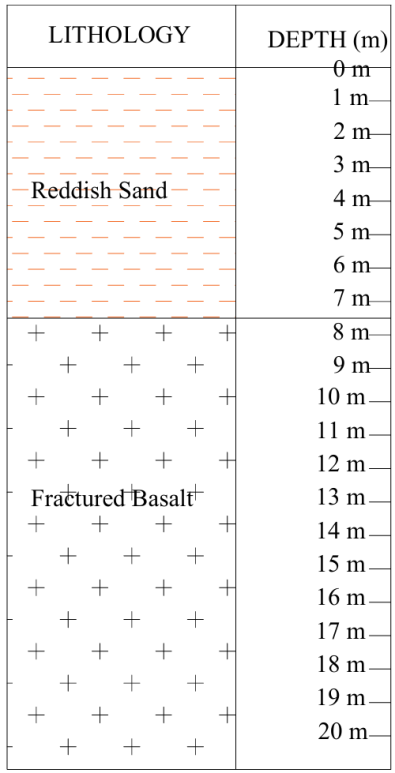
Drilling operations were carried out by an Apafor 330 in accordance with standard XP P 94-202 11. A double core drill with an external diameter of 116 mm was used. Investigations were carried out to a depth of 10 meters. Samples were taken for laboratory testing. Identification and characterization tests were carried out on the materials in the layers encountered in the core holes 12. The identification of the core samples enabled the lithology of the ground to be highlighted (Figure 1).

In 1980, Hoek and Brown proposed a relationship between the maximum and minimum principal stresses to determine the strength of intact rocks and rock masses under isotropic conditions. The expression of this generalized criterion 8 is as follows:
 | (1) |
Where  is the maximum effective stress at break;
 is the minimum effective stress at break;
 is the compressive strength of the intact rock matrix;
 is the value of Hoek and Brown's constant m for the rock mass; s and a are dimensionless constants that depend on the state and degree of fracturing of the rock mass.
The parameters  , s and a are calculated from the Geological Strength Index (GSI) using the relationships:
 | (2) |
 | (3) |
 | (4) |
D is a factor that depends on the degree of disturbance to which the rock mass has been subjected by the damage caused by blasting and stress relaxation 13. Relation (1) is used to define the compressive strength of the rock mass, assuming that σ3 is zero. The modulus of deformation of the rock mass proposed by 13 will be used in this work in order to take into account not only the disturbance due to the attack on the rock but also its ground properties expressed by D and GSI (5).
 | (5) |
The Hoek and Brown criterion can be approximated by a Mohr-Coulomb line and the characteristics c, ϕ of the homogenized massif can be determined.
The values of the parameters c' and φ' are defined by the Mohr-Coulomb line tangent to these two circles. These parameters c and φ are defined by plotting the Mohr-coulomb equivalent of the Hoek-Brown criterion whose models are expressed by expressions (6) and (7a) 13.
 | (6) |
 | (7a) |
with  (7b)
(7b)
For a vertical load exerted by a surface foundation, it is assumed that the fracture stress  is obtained from a triaxial state in which the lateral stress σ3 is equal to the uniaxial compressive strength (
 ) of the mass according to equation (8) 8.
 | (8) |
Where the factor  9 is applied to the bearing pressure calculated to take account of the shape of the foundation.
For a rock mass with open vertical discontinuities at a spacing S less than or equal to the foundation width B, the probable mode of failure is uniaxial compression of the blocks. The ultimate capacity is defined from Mohr Coulomb's criterion according to equation 9 14.
 | (9) |
The load-bearing capacity is calculated from the ultimate capacity and the safety factor set at 2 in our work.
When the rock mass is homogeneous and isotropic, the vertical settlement  is given by equation (10) 15:
 | (10) |
Where q is the uniformly distributed bearing pressure; B is the characteristic dimension of the loaded surface, which is the diameter for a circular surface and the smallest dimension for a rectangular surface; Cd is a parameter that takes into account the shape of the loaded zone; υ is Poisson's ratio and E is Young's modulus.
2.3. Fundamental Equations of Statistics for Probabilistic MethodFor any random variable X of function of: , where
  is the set of outcomes of a random experiment, each outcome of the experiment in question is associated with a single real number. P (X) = x is the probability that the variable X takes the value x. The use of these statistical methods has now become a means of circumventing the many uncertainties associated with rock structure in rock engineering 16, particularly for foundations that have to rest on a fractured rock mass 9.
The mathematical expression of the arithmetic average  of a sample in a population is given by the expression of its expectation E(X):
 | (11) |
While its estimated standard deviation is given by 17.
 | (12) |
Where n is the number of elements in a population
Probabilistic analyses of geomechanical structures are generally divided into 2 categories: sensitivity analysis and reliability analysis. In a reliability analysis, the aim is to determine the probability that the system under study will fail 18.
The safety coefficient Fs of a structure is conventionally defined as the ratio of the resistance to failure (capacity) R to the applied stress S: . In the calculation using the probabilistic reliability approach, R and S are considered as two random variables, each with a mean and standard deviation (
 ,
,  ) and (
 ,
,  ). The difference between the two random variables G = R - S is called the safety margin. Reliability theory therefore consists, on the basis of a limit state function G and the probability distributions associated with the various project parameters (the normal distribution in our case), in assessing the probability of being in the failure domain:
 | (13) |
Where  is the probability of failure.
A limit state is reached when G = R - S = 0. This equation is called the limit state or performance equation. A break occurs when S becomes greater than or equal to R, i.e. G ≤ 0.
We assume that the variables R and S follow Gaussian normal distributions, so that the safety margin G = R - S also follows a normal distribution of density (14).
 | (14) |
The parameters used to calculate G have uncertainties that can be expressed in probabilistic form (µ average value and σ standard deviation), which makes the above function of variables random. Rupture is associated with the portion of the probability density of the safety margin corresponding to a negative value of this margin, i.e. G < 0. The probability of rupture or ruin  calculated using the integral 19:
 | (15) |
In order to optimize the calculations, we will carry out a Monte Carlo simulation using Excel. The input parameters (Rci, mi and GSI) are inserted as probability density functions and the equations for the output parameters (mb, s, a, c and φ) are established. After an iterative simulation, the output parameters are collected, each with its average and standard deviation. These initial outputs are used as input parameters in the bearing capacity simulation. The input parameters for calculating the bearing capacity have ranges of variation linked to the properties of the rock, which are taken into account in the probabilistic calculation using a normal distribution. The ultimate bearing capacity will be a result variable 20. In this way, we no longer consider the natural dispersion of the data as a genuine measurement uncertainty, but as additional information to be included in the calculation.
Firstly, a field and laboratory study to determine the geotechnical characteristics of the massif. These will be incorporated into a model to define the properties of the rock mass.
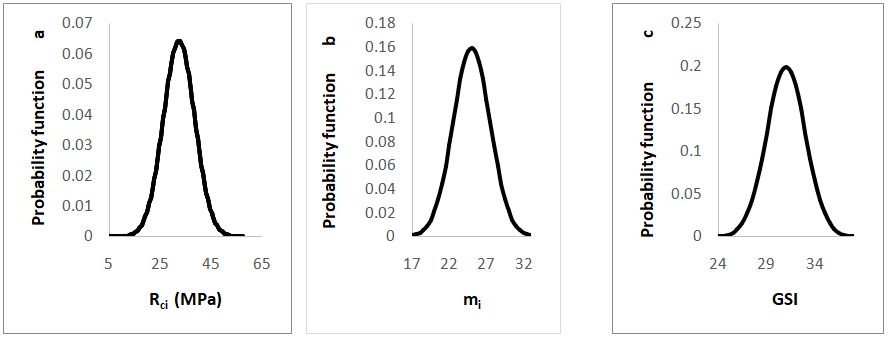
The input parameters of the rock mass are determined from Monte Carlo modelling. We then calculated the output parameters (a, s, mb, c, φ, and E). The characteristic values of these parameters are summarized in Table 1 and their probability distribution functions are shown in the figures (Figure2.a, Figure 2.b and Figure 2.c).


For the input parameters, we found a significant dispersion of the compressive strength Rci for a coefficient of variation of 19.07%. The value of the COV of the GSI is 6.4% which is less than 10% with the lowest dispersion of these input values.
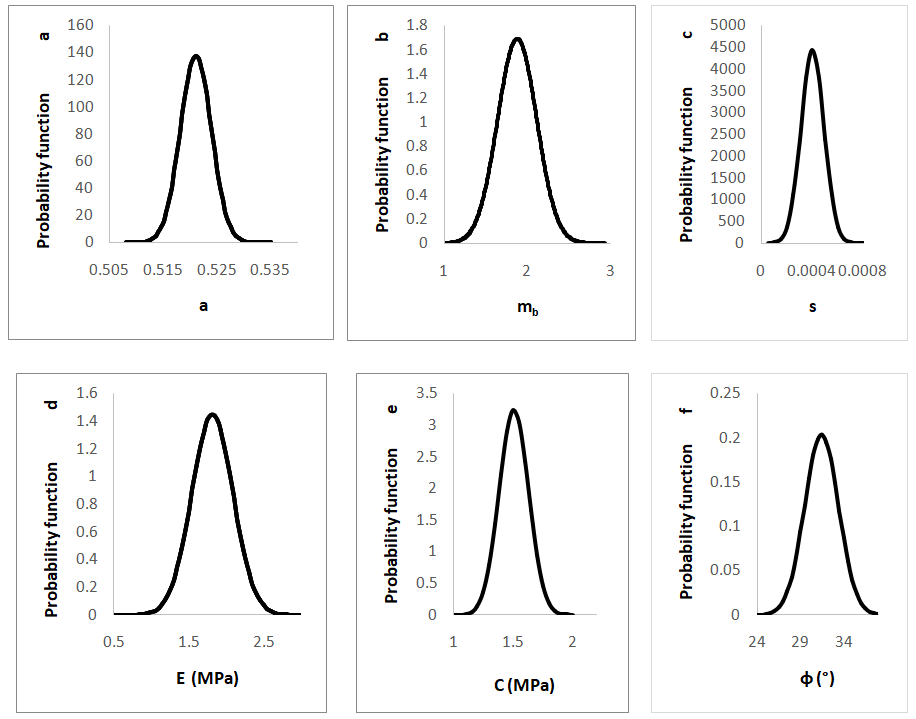
The results of the output values are determined from the input values Rci, mi and GSI. We present the results in Table 2 and the probability distribution curves in Figure 3.
After the Monte carlo simulation, the values of the dimensionless parameters a, mb and s are summarized in Table 2. We found a dispersion of 22.5% for the constant s and 12.59% for mb. For the constant a, we have a low coefficient of variation of 0.56% representing a low dispersion of the normal curve in Figure 3a. COV's value for the deformation modulus E is 15.2%, showing a dispersion of the normal curve in Figure 3d. For cohesion and friction angle, the coefficient of variation is less than 10%.
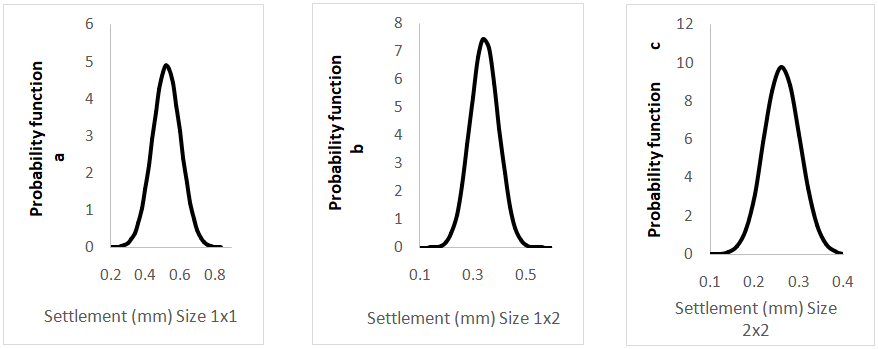
Settlement is calculated using formula 10 by Monte Carlo simulation. The Poisson coefficient is fixed at ν = 0.25. The results obtained are presented in Table 3 and the distribution functions in Figure 4.
The settlements calculated for different foundation dimensions give very low values compared with the permissible foundation settlements 21. The largest settlement value of 0.523 mm is noted for the 1x1 m2 dimension, while the smallest one of 0.261 mm for the 2x2 m2 dimension (Table 3). The coefficient of variation of the settlements of the different dimensions is 15.5%, i.e. a dispersion around the averages of the settlements found to be fairly independent of the dimension considered.
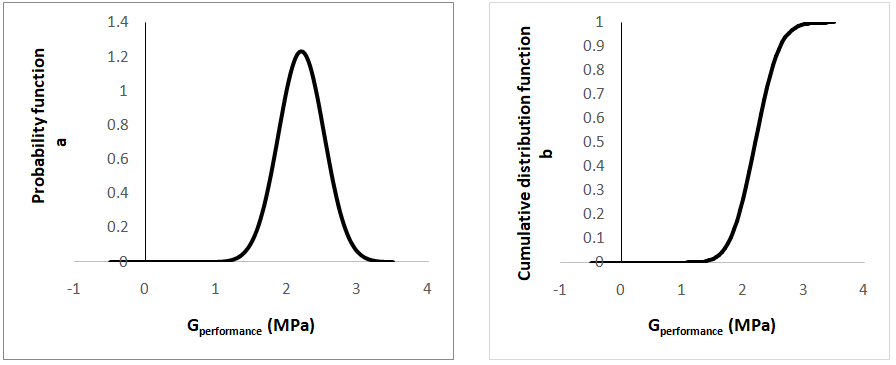
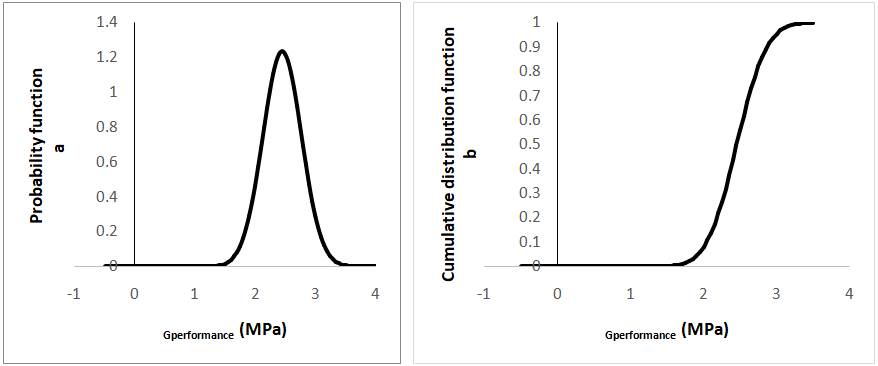
3.2. Assessing the Probability of Failure Using Monte Carlo AnalysisThe probability of failure of these foundations is analyzed using Monte Carlo simulations. In this case, the bearing capacity calculations are based on the Hoek-Brown and Goodman approaches. The bearing capacity performance is assigned to a probability distribution and a cumulative probability function.
We calculated the load-bearing capacity of the rock mass using the Hoek-Brown and Goodman methods. According to the load descent, a maximum load of 1000 KN is applied to calculate the performance of our foundations.
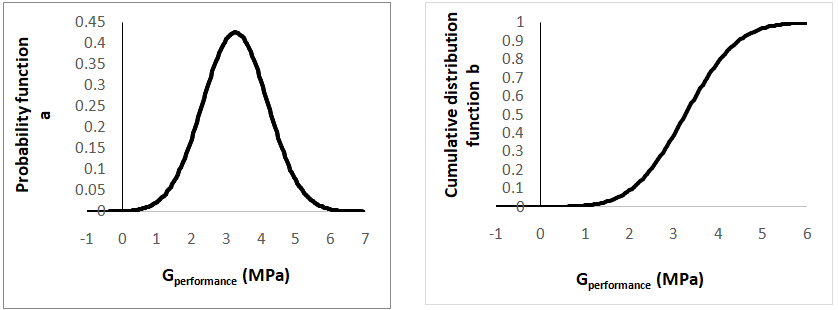
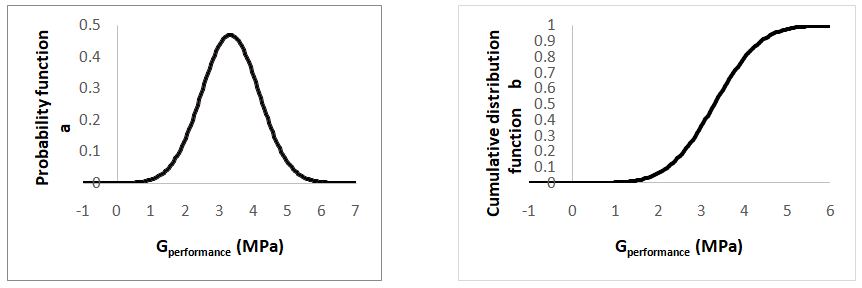
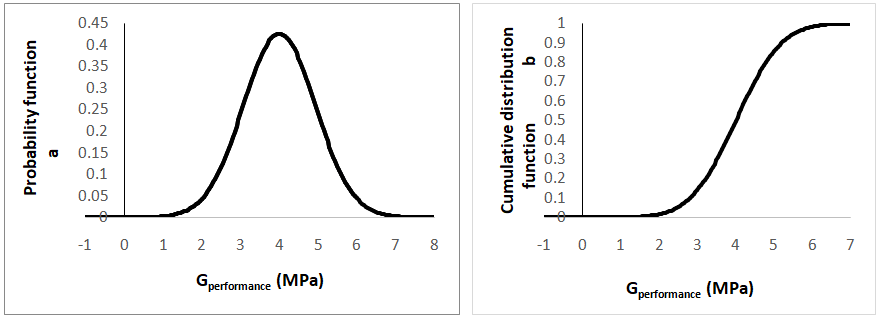
For the Hoek-Brown method, the results of the probability functions of performance as a function of foundation dimensions are shown in the figures (Figure 5, Figure 6, and Figure 7).
The probabilistic results of the bearing capacity performance using the Hoek-Brown method are summarized in Table 4.
The probability values found for the 1x1 m2 footing (Table 4) are not acceptable compared to the target probability values set by Eurocode 0 with a reliability index of 3.479 lower than the target value of 3.8 and a probability of failure of 2.5.10-4 higher than the target value of 10-4. An increase in the dimensions of the foundations shows reliability and probability of failure indices of 3.9 and 4.8.10-5 for 2x1 m2 and 4.28 and 9.3.10-6 for 2x2. These values are acceptable compared to the Eurocode target values of 3.8 and 10-4.
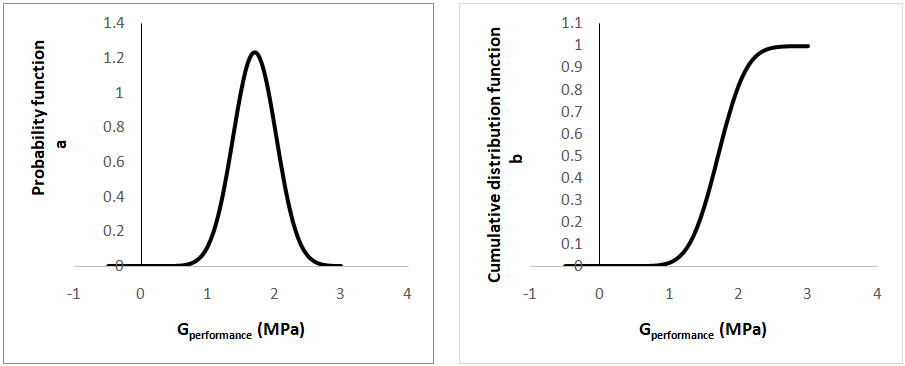
For the Goodman method, the results of the performance probability functions as a function of the dimensions of the foundations are shown in Figure 8, Figure 9 and Figure 10.
The probabilistic results of the load-bearing capacity performance using the Goodman method are summarized in Table 5.
The probability values found with foundations of dimensions 1x1 m2, 2x1 m2 and 2x2 m2 (Table 5) are admissible to the target probability values set by the Eurocode with respective failure probabilities of 7.1.10-8; 4.9.10-12 and 1.7.10-14.
Taking into account the variability of the rock mass, we carried out a Monte Carlo analysis of the various parameters of the rock mass. Using these parameters, we found the results for foundation settlements with a coefficient of variation of 15.5%. The settlement values (in mm) are very low, at 0.523, 0.343 and 0.261 respectively for the 1x1 m2, 1x2 m2 and 2x2 m2 footings, compared with the limit value of 50 mm. Using the Hoek-Brown approach, we found probabilistic results for the bearing capacity performance of the 1x1 m2 footing with a reliability index value of 3.479 and a probability of failure value of 2.5.10-4, which are not acceptable because they differ from the values recommended by the Eurocode. We then increased the dimensions of the footings by 1x2 m2 and 2x2 m2. We found the results of a reliability index β of 3.9 and a probability of failure Pf of 4.8.10-5 for 1x2 m2 and a reliability index β of 4.28 and a probability of failure Pf of 9.3.10-6 for 2x2 m2, which are safe compared with the Eurocode target values of βc of 3.8 and a probability of failure of 10-4. For the Goodman method, we have the results of a reliability index of 5.264 and a probability of failure of 7.1.10-8 for the 1x1 m2 footing, a reliability index of 6.814 and a probability of failure of 4.9.10-12 for the 1x2 m2 footing and β of 7.583 and probability of failure of 1.7.10-14 for the 2x2 m2 footing, which are admissible for the target values of the Eurocode for a 50-year RC class βc of 3.8 and probability of failure of 10-4. The Goodman method presents lower deterministic values of load-bearing capacity performance than the Hoek-Brown method. On the other hand, the probabilistic approach gives higher reliability values for the Goodman method than for the Hoek-Brown method. This is due to the fact that with the Goodman load-bearing capacity calculation, the formula presents input parameters (φ and c) with lower coefficients of variability than the input parameters of the Hoek-Brown method. This shows that simply using standards without taking into account the variability of rock properties could be a source of disorder in structures. The lower indicator values for the Hoek-Brown method are due to the fact that heterogeneities are taken into account. This reduces the values of acceptable evaluation indices such as the probability of failure and the reliability index.


The geomechanical study of the rock mass enabled us to characterize the rock parameters of our foundation. Laboratory and in situ tests were carried out on the rock mass to its properties. Using this data, we carried out Monte Carlo simulations of the input parameters for calculating the bearing capacity. The bearing capacity was calculated using two methods, Hoek-Brown and Goodman, using a probabilistic approach. It was used to determine the reliability index of the bearing capacity performance and the probability of failure of the rock foundations. The results show that taking structures into account (Hoek-Brown model compared with Goodman) has a negative impact on the safety of foundations, and introducing their variability (probabilistic and reliability methods) also reduces their performance. It is still important to take variability into account when calculating foundations. It is important to know which parameters play a major role in controlling the performance of rock foundations.
| [1] | Roger, J., and al. (2009). Note explicative des cartes géologiques à 1/200 000 du Bassin sédimentaire sénégalais. Republic du Senegal, Ministère des Mines, de l'Industrie et des PME, Dakar. | ||
| In article | |||
| [2] | Crevala, G., Cantagrel, J.M., and Moreau, C. (1994). “Le volcanisme cénozoïque de la presqu'île du Cap-Vert (Sénégal): cadre chronologique et géodynamique”, Bull. Soc. Géol. France. 1994, t. 165, n° 5, pp. 437-446. | ||
| In article | |||
| [3] | Sarr, D., Sall, O.A., Kebe, H., Cissé, I.K. and Ndour, M. (2020). “Foundation on Rock Mass Calculation. Using Geomechanical and Finite Element Model on Western Senegal Massifs”, American Journal of Civil Engineering and Architecture. 8, 1-11. | ||
| In article | |||
| [4] | Sawadogo, M., Sarr, D., Sall, O.A. (2024). “Bearing Capacity Analysis of Spread Footing on Massif in the "Corniche Ouest" of the Dakar Peninsula (Senegal, West Africa)”,Open Journal of Civil Engineering. 2024, 14, 421-434 https://www.scirp.org/journal/ojce ISSN Online: 2164-3172 ISSN Print: 2164-3164. | ||
| In article | View Article | ||
| [5] | Selmi, M., Ltif, M. and Ali, N.B.H. (2006). “Application of the Monte Carlo method in the analysis of slope stability”, Journées Nationales de Géotechnique et de Géologie de l'Ingénieur JNGG2006. Lyon 2006. | ||
| In article | |||
| [6] | Gidon, J.S, and Dey, A.K. (2015).“Reliability Analysis of Stability of Sonapur Slope”,Journal of Civil Engineering and Environmental Technology Print ISSN: 2349-8404; Online ISSN: 2349-879X; Volume2, Number 7; April-June, 2015 pp. 560-564 © Krishi Sanskriti Publications http:// www.krishisanskriti.org/ jceet.html. | ||
| In article | |||
| [7] | Fouché, O., and Alfonsi, P. (2005). “Stochastic simulation of fractures to assess geotechnical uncertainty in the case of a tunnel in a rock mass”, Géoline 2005 - Lyon, France - 23rd - 25th, May/Mai 2005. | ||
| In article | |||
| [8] | Hoek, E., and Brown, E.T. (1997). “Practical estimates of rock mass strength”, Published in the International Journal of Rock Mechanics and Mining Sciences, Vol 34, No 8, 1997, pages 1165-1186. | ||
| In article | View Article | ||
| [9] | Wyllie, D.C. (1999). Foundations on rock - Second edition published 1999 by E & FN Spon, 11 New Fetter Lane, London EC4P 4EE. | ||
| In article | |||
| [10] | Khulhawy, F.H., and Goodman, R.E. (1880). “Design of foundations on discontinuous rock”. International Conference on Structural Foundations on Rock, Sydney, 7-9 may 1980. | ||
| In article | |||
| [11] | AFNOR, XP P 94-202 (December 1995). "Sols: reconnaissance et essais. Sampling of soils and rocks". Classification index: P 94-202 ICS: 93.020 ISSN 0335-3931 | ||
| In article | |||
| [12] | Goodman, R.E. (1980). Introduction to Rock Mechanics, Wiley, New York, pp. 305-8. | ||
| In article | |||
| [13] | Hoek, E., Carranza-Torres, C., and Corkum, B. (2002). “Hoek-Brown failure criterion”. Proc. NARMS-TAC Conference, Toronto - 9 pages. | ||
| In article | |||
| [14] | Prakoso, W.A. and Kulhawy, F.H. (2006). “Capacity of Foundations on Discontinuous Rock”. American Rock Mechanics Association, Sydney, The 41st U.S. Symposium on Rock Mechanics (USRMS): "50 Years of Rock Mechanics. | ||
| In article | |||
| [15] | Schleicher, F. (1926). Zur théorie des Baugrundes. On the theory of the subsoil. Der Bauingenieur, 48, 49. | ||
| In article | |||
| [16] | Gidon, J.S., and Dey, A.K. (2015). “Reliability Analysis of Stability of Sonapur Slope”. Journal of Civil Engineering and Environmental Technology, Print ISSN: 2349-8404; Online ISSN: 2349-879X; Volume 2, Number 7; April-June, 2015 pp. 560-564. | ||
| In article | |||
| [17] | Rouanet, H. and Leclerc, B. (1970). Le rôle de la distribution normale en statistique Mathématiques et sciences humaines, tome 32 (1970), p. 57-74. | ||
| In article | |||
| [18] | Hamrounia, A., Diasb, D., Sbartaid, B. (2019). “Probability analysis of shallow circular tunnels in homogeneous soil using the surface response methodology optimized by a genetic algorithm”, Tunnelling and Underground Space Technology, 86 (2019) 22-33. | ||
| In article | View Article | ||
| [19] | Belabed, L. and Bencheikh, M. (2008). “Analyse semi-probabiliste de la capacité portante des fondations superficielles”, revue française de géotechnique, N°124 3er trimestres 2008. | ||
| In article | View Article | ||
| [20] | Babu, S., Srivastava, A., and Murthy, D.S.N. (2006). “Reliability analysis of the bearing capacity of a shallow foundation resting on cohesive soil”, G.L. Can. Geotech. J. 43: 217-223. | ||
| In article | View Article | ||
| [21] | Eurocode 7. (2005). “Geotechnical calculation. Part 1: General rules, NF EN 1997-1 June 2005”, Boutique AFNOR, pour: CSTB 12/4/2006 - 11:08 FA045423 ISSN 0335-3931 146p. | ||
| In article | |||
Published with license by Science and Education Publishing, Copyright © 2025 Déthié Sarr, Hamed Fall and Mouhamedine Wade
 This work is licensed under a Creative Commons Attribution 4.0 International License. To view a copy of this license, visit
http://creativecommons.org/licenses/by/4.0/
This work is licensed under a Creative Commons Attribution 4.0 International License. To view a copy of this license, visit
http://creativecommons.org/licenses/by/4.0/
| [1] | Roger, J., and al. (2009). Note explicative des cartes géologiques à 1/200 000 du Bassin sédimentaire sénégalais. Republic du Senegal, Ministère des Mines, de l'Industrie et des PME, Dakar. | ||
| In article | |||
| [2] | Crevala, G., Cantagrel, J.M., and Moreau, C. (1994). “Le volcanisme cénozoïque de la presqu'île du Cap-Vert (Sénégal): cadre chronologique et géodynamique”, Bull. Soc. Géol. France. 1994, t. 165, n° 5, pp. 437-446. | ||
| In article | |||
| [3] | Sarr, D., Sall, O.A., Kebe, H., Cissé, I.K. and Ndour, M. (2020). “Foundation on Rock Mass Calculation. Using Geomechanical and Finite Element Model on Western Senegal Massifs”, American Journal of Civil Engineering and Architecture. 8, 1-11. | ||
| In article | |||
| [4] | Sawadogo, M., Sarr, D., Sall, O.A. (2024). “Bearing Capacity Analysis of Spread Footing on Massif in the "Corniche Ouest" of the Dakar Peninsula (Senegal, West Africa)”,Open Journal of Civil Engineering. 2024, 14, 421-434 https://www.scirp.org/journal/ojce ISSN Online: 2164-3172 ISSN Print: 2164-3164. | ||
| In article | View Article | ||
| [5] | Selmi, M., Ltif, M. and Ali, N.B.H. (2006). “Application of the Monte Carlo method in the analysis of slope stability”, Journées Nationales de Géotechnique et de Géologie de l'Ingénieur JNGG2006. Lyon 2006. | ||
| In article | |||
| [6] | Gidon, J.S, and Dey, A.K. (2015).“Reliability Analysis of Stability of Sonapur Slope”,Journal of Civil Engineering and Environmental Technology Print ISSN: 2349-8404; Online ISSN: 2349-879X; Volume2, Number 7; April-June, 2015 pp. 560-564 © Krishi Sanskriti Publications http:// www.krishisanskriti.org/ jceet.html. | ||
| In article | |||
| [7] | Fouché, O., and Alfonsi, P. (2005). “Stochastic simulation of fractures to assess geotechnical uncertainty in the case of a tunnel in a rock mass”, Géoline 2005 - Lyon, France - 23rd - 25th, May/Mai 2005. | ||
| In article | |||
| [8] | Hoek, E., and Brown, E.T. (1997). “Practical estimates of rock mass strength”, Published in the International Journal of Rock Mechanics and Mining Sciences, Vol 34, No 8, 1997, pages 1165-1186. | ||
| In article | View Article | ||
| [9] | Wyllie, D.C. (1999). Foundations on rock - Second edition published 1999 by E & FN Spon, 11 New Fetter Lane, London EC4P 4EE. | ||
| In article | |||
| [10] | Khulhawy, F.H., and Goodman, R.E. (1880). “Design of foundations on discontinuous rock”. International Conference on Structural Foundations on Rock, Sydney, 7-9 may 1980. | ||
| In article | |||
| [11] | AFNOR, XP P 94-202 (December 1995). "Sols: reconnaissance et essais. Sampling of soils and rocks". Classification index: P 94-202 ICS: 93.020 ISSN 0335-3931 | ||
| In article | |||
| [12] | Goodman, R.E. (1980). Introduction to Rock Mechanics, Wiley, New York, pp. 305-8. | ||
| In article | |||
| [13] | Hoek, E., Carranza-Torres, C., and Corkum, B. (2002). “Hoek-Brown failure criterion”. Proc. NARMS-TAC Conference, Toronto - 9 pages. | ||
| In article | |||
| [14] | Prakoso, W.A. and Kulhawy, F.H. (2006). “Capacity of Foundations on Discontinuous Rock”. American Rock Mechanics Association, Sydney, The 41st U.S. Symposium on Rock Mechanics (USRMS): "50 Years of Rock Mechanics. | ||
| In article | |||
| [15] | Schleicher, F. (1926). Zur théorie des Baugrundes. On the theory of the subsoil. Der Bauingenieur, 48, 49. | ||
| In article | |||
| [16] | Gidon, J.S., and Dey, A.K. (2015). “Reliability Analysis of Stability of Sonapur Slope”. Journal of Civil Engineering and Environmental Technology, Print ISSN: 2349-8404; Online ISSN: 2349-879X; Volume 2, Number 7; April-June, 2015 pp. 560-564. | ||
| In article | |||
| [17] | Rouanet, H. and Leclerc, B. (1970). Le rôle de la distribution normale en statistique Mathématiques et sciences humaines, tome 32 (1970), p. 57-74. | ||
| In article | |||
| [18] | Hamrounia, A., Diasb, D., Sbartaid, B. (2019). “Probability analysis of shallow circular tunnels in homogeneous soil using the surface response methodology optimized by a genetic algorithm”, Tunnelling and Underground Space Technology, 86 (2019) 22-33. | ||
| In article | View Article | ||
| [19] | Belabed, L. and Bencheikh, M. (2008). “Analyse semi-probabiliste de la capacité portante des fondations superficielles”, revue française de géotechnique, N°124 3er trimestres 2008. | ||
| In article | View Article | ||
| [20] | Babu, S., Srivastava, A., and Murthy, D.S.N. (2006). “Reliability analysis of the bearing capacity of a shallow foundation resting on cohesive soil”, G.L. Can. Geotech. J. 43: 217-223. | ||
| In article | View Article | ||
| [21] | Eurocode 7. (2005). “Geotechnical calculation. Part 1: General rules, NF EN 1997-1 June 2005”, Boutique AFNOR, pour: CSTB 12/4/2006 - 11:08 FA045423 ISSN 0335-3931 146p. | ||
| In article | |||