Green walls (GWs), which involve breathing walls and natural facades, are commonly promoted as ecologically beneficial architectural design elements. GWs may be practical in all aspects of sustainability; they offer various economic, social, and environmental advantages to inhabitants of buildings. Although this is true, the popularity rate of GW remains in its early stages, and the extant research on the barriers to GW adoption is minimal. Accordingly, 17 barriers were determined through a comprehensive review of the available literature, followed by semi-structured interviews with 13 experts. With the help of 72 field practitioners, the factor analysis approach (EFA) is used to refine and analyse the correlation among the barriers. A mean and standard deviation scatter plot analysis followed to prioritize the identified impediments. The most notable obstacles to the implementation of GW are conservation expenses, high cost of installation, difficulty in maintenance, technical implementation, and the potential danger of fire. The findings encourage researchers to examine ways to enhance GW installation techniques and methodologies to eliminate barriers and give lessons to policymakers, therefore promoting the larger-scale implementation of GW. Given the scarcity of research on barriers to using GWs, this study presents a complete overview of the topic, offering knowledge that may be utilized as a foundation for future academics.
The rapid expansion of urban areas and population, combined with rising building practices, has revolutionized downtown regions' features, substituting plants with concrete and various building materials. This has led to the existence of the urban heat island effect (UHI) 1. Due to the global increase in temperatures caused by climate change, the impact of heat waves are notably more intense in urban areas 2. For example, buildings in urban residential areas commonly cool down much more slowly at night compared to natural environments, which can have severe implications for inhabitants' health 3 and result in increased energy needs for cooling 4. Urban green infrastructure (UGI), encompassing green roofs, green walls, and urban tree covers, can greatly minimize the negative consequences of UHI in urban regions 5.
Green walls (GWs), defined as vertical structures covered with vegetation and plant life 6, are applied as an inactive proposal solution in scenarios where other forms of UGI are impractical due to spatial or technical limitations 7, 8. Furthermore, GWs favorably contribute to all sustainability aspects by bringing benefits, including water management, reducing UHI, enhancing air quality, adding aesthetic appeal, energy savings, and supporting biodiversity, among others 7, 9. The advantages of GWs vary and are determined by elements such as climatic conditions, plant type, and care style. However, the advantages of GWs lack a deterministic value 10. For example, it has been stated that the extra expenses for maintenance and repairs differ according to the type used 11. Regarding sustainable development, GWs hold great potential for broad installation in both new structures and renovated buildings 1. GWs have a far bigger surface area and less technological complexity than green roofs, making them an efficient solution for existing structures 12.
Despite the preceding, GW implementation has some barriers 13. An overview of the literature indicated a scarcity of studies that extensively investigate the barriers to GW adoption. Furthermore, current research on this issue has restricted scopes and focused on specific barriers that may not be relevant in other contexts (e.g., climatic and governmental settings) 14, 15, 16, 17. Given the impact of UHI on the comfort of residents and the atmosphere, mainly in city areas, as well as the scarcity of research on the barriers to GW implementation, identifying and analyzing the barriers to GW implementation becomes vital. Explanations cannot be developed unless the challenge is appropriately recognized; hence, examining these barriers may create the framework for upcoming studies on how to address them; besides, it is a step toward expanding the implementation of GWs. To address the current gap, this study aims to investigate and examine the barriers to GW implementation within the context of Saudi Arabia, which has a proven track record of accepting GWs, a fortunate climate, and various tall buildings 13. The study questions that this research paper has addressed for the initial time in the figure of pertinent literature are as follows:
1). What are the current barriers to the implementation of GWs? How might all these barriers be recognized entirely, with the most significant ones retained in the context of Saudi Arabia? To answer this research question, this study uses the triangulation approach, which results in a complete list of deterrents refined with local experts' support.
2). How can identified barriers be prioritized in Saudi Arabia, considering contextual factors and decision-maker's subjectivity? To get a sensible response to this study question, exploratory factor analysis (EFA) and scatter plot analysis are proposed, which result in a precise prioritization of the identified barriers.
The remainder of this paper is structured on the study questions that need to be achieved and the related aims. Section 2 presents the literature on research to investigate the barriers to GW implementation and highlights potential barriers. Section 3 thoroughly explains the methodologies used and their application in this research. Section 4 presents and discusses the results, while Section 5 provides conclusions, limits, and directions for further study.
GWs are methods used to vegetate the vertical exteriors of a building (such as walls, blind walls, partition walls, and façade) with a variety of plants 18. GWs are divided into green facades and living walls 19. Traditional green facades employ plants with roots that raise promptly against the vertical surface and are classified as green facades 18. On the other hand, green facades comprise persistent controllers and integrated provision structures like grills or cable nets 20. Continuous guides have a single support structure directing plant growth throughout the surface. In contrast, facades of greenery with modular trellises include many modular parts (vessels for plant anchored) and an individual support frame along the surface 21.
In relation to supplementary UGI strategies utilized in structures, such as green roofs 25, various barriers influence GW implementation. High installation cost is considered one of the most substantial barriers to GW adoption 26. Similarly, the expenses involved with GW adoption are viewed as a critical obstacle to their popularity 16 since installed GWs must be watered and trimmed regularly. The maintenance processes for GWs are complicated; thus, maintenance personnel and building managers need to thoroughly grasp GWs to effectively plan and supervise the process 27. A lack of regular care may result in additional severe difficulties, such as numerous dried leaves, which might put the entire structure on fire, or degradation of the behind walls of green facades 19.
Excessive drinking water use is another barrier to using green façade; however, the application of modern technologies has alleviated this issue 28. Weather conditions and sunlight are two further barriers to the implementation of GWs. The previous is linked with three significant variables in creating buildings’ green walls: moisture, direction, and airstream, whereas the last stresses the accessibility of adequate well-lit for plants 29, 30. Likewise, the presence of flies on green walls of buildings such as fungus and insects, is regarded as a noteworthy barrier to GW implementation, significantly influencing clients' choice to apply them 31. Although GW is regarded as a sustainable choice and an alternative to unadventurous walls in the design of various categories of structures (e.g., housing, commercial, etc.), the absence of encouragements and procedures mandated by relevant policymakers has been conveyed to impede wider adoption of GWs 8. This is especially problematic in unfortunate nations, as project participants and governments prioritize short-term concerns above planned and long-standing goals when developing and implementing projects.
Stakeholders are hesitant to pick GWs over traditional ways that they are highly comfortable with, much as barriers to accepting other UGI approaches 15. This is due partly to the challenges pertaining to GW as a new technology, highlighting the necessity of government support in changing stakeholder perceptions when balancing the benefits and drawbacks of traditional techniques vs. GWs. On the other side, designers' lack of competence and practice, as well as restricted access to practical tools, have been noted as barriers to GW implementation 14. Given the complicated implementation strategies necessary for a practical GW application (i.e., supplemental supporting buildings), workers may be exposed to new potential dangers 32. A review of existing research on the barriers to the implementation of GWs was conducted, and a summary of significant barriers discovered in the literature review is shown in Table 1.
According to the list of barriers in Table 1, there has been relatively little study on this topic. Moreover, current studies are scattered and consist of individual articles. There has been a noticeable lack of studies; studies that entirely detect and examine current barriers are missing. As a result, additional research into this fertile field appears justifiable and unquestionable. In practice, such a study will enable and pave the road for greater use of green-based elements in the construction sector, as well as promote awareness among influential individuals and policymakers.
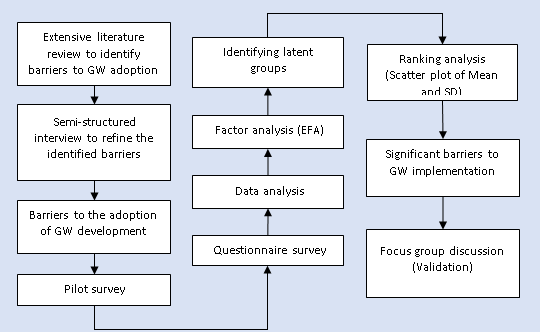
Figure 1 shows the phases of the research steps. This study used exploratory progressive mixed-method analysis. A diverse study method is significant since no single methodology is appropriate for all analyses 37. Mixed techniques for investigating the same subject have been shown to assist in the discovery of specific frequent patterns or consistent links between variables 38. As a result, this study was done across two phases: a qualitative stage, which included a detailed review of the literature and expert insight into green walls, and a quantitative phase, which involved surveying industry practitioners via questionnaires.

Green wall barriers were explored through information obtained from numerous research on green walls in the building sector. Alongside this, a qualitative technique comprising 13 interviews with local experts in the field was executed to determine the barriers that might affect embracing green walls in Saudi Arabia, employing purpose sampling 39 40. This strategy assists researchers in meeting study objectives and monitoring the degree of variation among respondents 41. Although 13 interviews might be considered modest samples, Mason 42 asserts that sample size is not critical to qualitative research since its significance is based on the accuracy of the outcomes.
Given the diverse roles in construction projects, the questioned individuals demonstrate that several entities contribute to the research 43. Furthermore, organizations are represented equally throughout various building activities. It was stated that such a talented pool would contain a wide range of competence, experience, and significant discrepancies 44. As a result of interviews with experts, the GW barriers identified in the previous study were revised and adjusted.
3.2. Quantitative StageTo confirm the GW barriers uncovered by previous research and the experts’ interviews, a survey set was utilized to examine these stages and their goals using an EFA technique 45. The available studies produced a preliminary list of GW barriers included in the pretested questionnaire. A pilot study was then carried out with 12 specialists to assess the survey's content 5. Professionals were asked to assess the exhaustiveness of all questions, as well as the sufficiency and suitability of the impediments limited in the pretested survey, particularly in the Saudi context. The findings from the research review, experts’ interviews, and pilot study tests confirmed that the 17 barriers to GW adoption are significant in the building sector. A total of three sections were distributed through the survey. The initial section gathered respondents' background/demographic information, as well as their level of comprehension of GW barriers and frequency of engagement in GW implementation. The second part assessed the importance of the determined barriers. The last part of the survey is an open-ended question that motivates respondents to give any additional barriers that may impact GW adoption but are not mentioned in the survey given. The barriers were assessed employing a Likert scale of one to five (1=least agree to 5=extremely agree), which has been frequently utilized in prior research 5.
3.3. Data CollectionThe survey respondents desired to be varied to create a homogeneous and appropriate individual sample. The convenience sampling technique was used in this study, which focused on gathering accurate and sufficient data from specialists in GW implementation, such as contractors, designers, and architects. The surveys have been distributed to various firms in Saudi's building sector. A total of 205 surveys were circulated. A notice was given to complete the survey to increase responses. Following the removal of invalid replies, 81 surveys were returned. The analysis was then conducted using 72 valid replies, resulting in a 35.1% response rate. As a result, the response rate was acknowledged by most questionnaire surveys distributed in the building sector, which agreed on a usual rate of 20% to 30% 38.
3.4. Data Analysis MethodThe collected data were evaluated using the Statistics Package for Social Sciences (SPSS). The validity check was initially performed by applying the Kaiser approach. This approach produces a value known as an eigenvalue, which needs to be above one. The equivalent number of less than one is insufficient and hence inappropriate for analysis of factors 46. After the principal variable analysis, the varimax rotational approach was used to determine the linear ratio between the original components to maximize the loading variance. Cronbach's coefficient alpha was used to analyze the reliability rating range (1-5) alternatively. Cronbach's α value ranges from 0 to 1, with higher values demonstrating more internal coherence. Lastly, an analysis was performed by plotting mean and standard deviation values on a scatter plot to determine the criticality of GW implementation barriers 5.
3.5. Focus Group DiscussionFor validation, this study adheres to employing discussions in focus groups as an effective technique for determining the feasibility of generalizing the outcomes. For the sake of simplicity, readers interested in learning more about the stages involved in focus group discussions are encouraged to review the next references 47 48. One of the researchers served as a moderator for the discussion with the invited specialists. To get concrete and sensible outcomes, five experts from firms other than those that participated in the main study round were selected based on their experience to select qualified professionals. The discussion began with an overview of this subject, followed by an invitation to the nominated qualified experts to share their insights and their perceptions of the barriers given to them.
According to the data obtained from this study's questionnaire survey, most respondents (30%) have 15 to 20 years of experience, 25% have more than twenty years of experience, and 21% have 5 to 10 years of expertise. Regarding professions, designers and facilities managers had the highest percentages, at 36% and 31% respectively. Master's degrees in construction management and architecture account for 30% and 26% of their total education. It is worth noting that each contributor has completed at least one to two GW projects. Furthermore, the majority of them are aware of the GW challenges. The participants' profiles indicate they have extensive expertise and have played a vital role in GW projects. As a result, the perspectives of these professionals are both crucial and reliable in assessing the GW implementation barriers, refer to Table 2.
The Following the expert interviews, an EFA analysis was performed to affirm the themes, and the measures were based on the previous research and interviews. The relationship and order among the GW barriers have been examined through factor analysis.
Prior to factor analysis, a validity test is executed using Kaiser's approach to quantify the similarity of factor(s), and it is often used to determine whether partially correlated relationships of variables are attainable 49. This approach considers an eigenvalue less than one inadequate and inappropriate for factor analysis. A KMO index value over 0.5 and a spherical check of Bartlett (p<0.05) indicate suitable data for the factor analysis 7. The findings revealed that the coefficient KMO sample sufficiency value was 0.853, more than 0.5. The Bartlett sphericity test and its related significance level were 8341,392 and 0.000. Accordingly, the EFA appeared appropriate, and the findings were consistent with previous studies 7 50. The analysis identified four latent groups: environmental, economic, social, and technical challenges. The latent groupings explained 79.68% of the overall variance. Cronbach's α values for environmental, economic, social, and technological categories are 0.897, 0.877, 0.928, and 0.957, respectively. When the α value approaches one, the internal consistency of accuracy improves on the scale parameter, as the allowable lower limit is α=0.7 51. It was concluded that all α values are appropriate, and the consistency of the internal scale is outstanding. Every variable was significantly given considerable weight within one of the datasets independently. The preceding view of the four primary groups emphasizes the need to mention these limitations.
In contrast, there is no set technique for factor identification. As a result, the meditative classification of these categories or groups was judged appropriate for this research. Table 3 shows the discovered and inferred barriers.
The following part discusses the images of these hidden sets:
Environmental group: The first category addressed barriers which directly influence the atmosphere, such as climatic adaptation, the substantial environmental impact of particular materials, excessive nutrients and water use, and insufficient plant illumination. The building industry has a significant impact on the atmosphere 52. Because building materials affect the environment, GW implementation is becoming progressively vital. The building sector is trying to embrace sustainable practices like GW installation and is looking for innovative approaches 53. As a result, addressing environmental obstacles is essential for guiding design decisions and selecting the appropriate building materials for GW utilization.
Economic group: The second category presented barriers directly related to costs associated with implementation, such as costly repairs, high installation costs, and a lack of published costs stipulated in guidelines that assist stakeholders in making decisions when choosing materials, taking into account the concept of life cycle expenses and the projected cost of the project. In light of the rising demand for green buildings, stakeholders are concentrating on the initial valuation of the economic viability of building projects. Enlightening building cost efficiency is deemed to be of crucial relevance to all stakeholders 54. The building industry's sustainability philosophy promotes optimal output at the lowest possible financial cost 55. The building project budget is regarded as a key factor 56. However, it is crucial to remember that green building evaluation prioritizes quality of life, which leads to long-term economic development 57. Comfort and convenience are two life-quality concepts characterized by pleasant bonds to nature. As a result, to accomplish economically viable targets, the life quality of materials shall be considered. This component's elements are involved in satisfying stakeholder demands and material lifespan.
Social group: The third category covers ambiguity in the acceptability of novel technology, absence of regulation and standards (such as design ideals), and no/limited encouragement from regulators. A single element of building design is the pursuit of balance while meeting several performance goals. The social variables provide a rational context for planning, building, being dynamic, and adapting to changes 58. A building disregarding the relevance of scheme interface and performance capabilities may result in system unsuitability, failures, and obsolescence hazards. As a result, overcoming social barriers is a necessary step toward GW installation.
Technical group: This group considered the technical challenges of GW execution, such as sophisticated implementation, potential harm to the back wall, a scarcity of technical tools, and difficulties in maintenance. Losing tenants harms the building's liquidity, leading to maintenance costs and potential future faults 16. Therefore, it is crucial to evaluate these challenges to GW implementation. Considering these constraints during the design phase helps stakeholders reach the aim of maximizing functionality.
4.3. The Relative Importance of GW Adoption Barriers
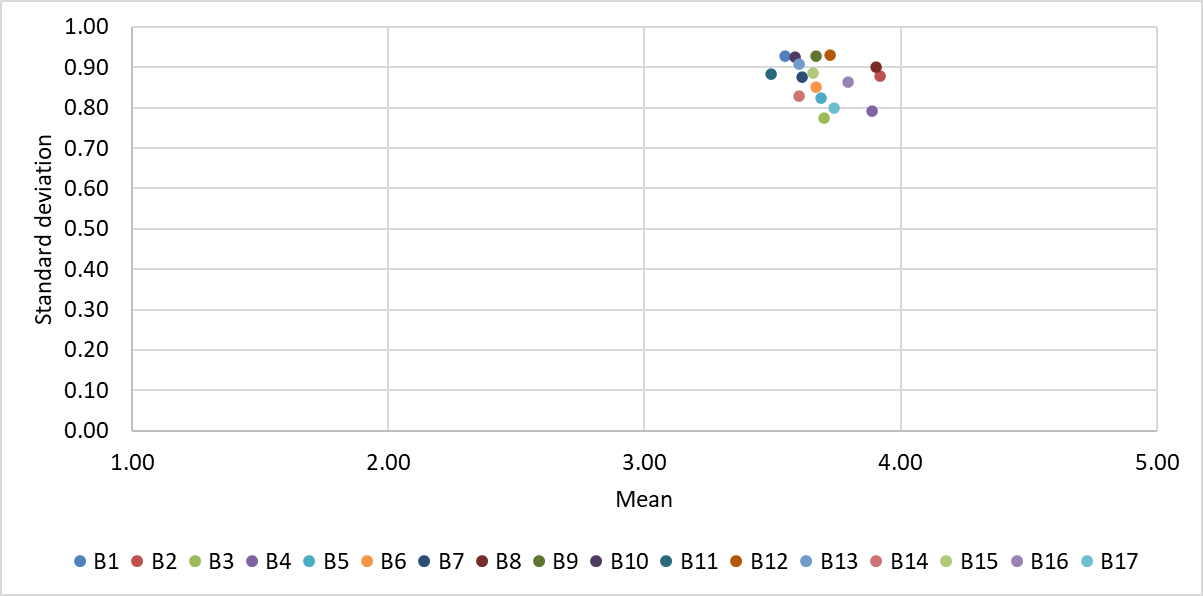
The scatter plot analysis showed that the most vital barriers to GW implementation are economically associated barriers (B3 and B4), tailed by the technical challenges and difficulty in upkeep and fixing (B17 and B5). These outcomes compare to prior research on GW and green roofing implementation. Although these extra expenses are most likely offset by the long-term economic advantages of their adoption, the total present value and return on investment are associated with uncertainties, resulting in the lack of GW adoption by clients/developers.
In terms of installation and maintenance challenges, since there are several kinds of GWs with unique features and specifications, specific proficiency is necessary for implementation. Furthermore, owing to GWs' extended lifetime, continuous maintenance is necessary, which has been viewed as a further duty during their entire life. The performance of GWs is influenced by the condition and quality of the plants and their arrangement, emphasizing the significance of frequent and effective maintenance.
The fifth primary barrier is connected to the environmental division ‘inducement to fire’ (B14); since vegetation is fragile and can bring fire, professionals feel that placing GWs in a structure increases the fire probability, which entails well-being and economic risk. It may be demanded that the maintenance complexity could lead to B14 because adequate care (such as frequently cleaning fallen leaves and irrigation) could considerably minimize the fire dangers associated with GWs. Regarding needed irrigation for GWs (B6), considering Saudi Arabia is a seasonal place, there would be a significant demand for water to cure the facade plants.
Governments often provide financial incentives for adopting UGIs, such as tax exemptions and incentives covering some installation expenses. Although GW implementation helps to achieve green building credentials, which bring economic advantages to developers, GW builders are not fit for financial incentives when a certificate of green building is not obtained. Consequently, B16 might be viewed as a hindrance to GW implementation. It is important to note that GWs may have a detrimental influence on the atmosphere, particularly when polyethene is applied in the vessels that house the vegetation. If these polymers are disposed of after the GW's lifespan, they have a variety of detrimental environmental consequences (similar to green roofs, as researched by Perini, et al. 4.
In regards to the acceptance of new technology barriers, innovation and authorization processes for green technologies are loaded with dangers and ambiguities and need a substantial buffer in the given budget 59. Similarly, research conducted in the United States and Hong Kong found that the early cost remained the greatest critical determinant in green projects 1. Typically, investors decide on traditional structures since green projects have a more extended return on investment 60.
Table 4 shows that certain additional deterrents are listed as the least important, including B11, B15, B8, and B13. Damage to the rear wall may occur because of waterproofing concerns and moistness absorption; roots and branches may negatively damage the structure, and the wall is susceptible to unwanted insects. Nevertheless, harms are avoidable if the GW is frequently cured; their low priority compared to other barriers is understandable. Regarding the skill required for engineers to include GW in their projects, the widespread accessibility of advice and instructions has remained a minor impediment.
As stated in the method part, once the findings were acquired, a virtual conference with skilled specialists utilizing a focus group discussion mode was organized to ensure that the outcomes obtained are generalizable. Table 5 demonstrates the engaged specialists' viewpoints on the relevance of the indicated barriers. As shown in the related tabulation, there is an acceptable agreement among the primary findings achieved as well as those of validation; a majority of the selected specialists agreed that B3, B4, and B14 are critical to the implementation of GWs, which is consistent with the outcomes obtained through the collaboration of 72 professionals who participated in the primary survey.
Although some research efforts have considered barriers to GW implementation, the work reported here is the initial holistic attempt to determine the barriers to the general implementation of GWs. More precisely, the present body of literature requires a cohesive method for determining and evaluating the influence of barriers to future GW implementation, especially in Saudi Arabia, where this critical subject field has yet to be examined. The EFA was first utilized to determine the link between the obstacles investigated in the literature review and expert interviews. The refined barriers were then ranked using the scatter plot. In addition, the group discussion process was employed to verify the findings. Considering this, the uniqueness of the current study is three-fold: it identifies a comprehensive list of barriers to the implementation of GW and refines it by considering the context of Saudi Arabia, resulting in the first empirically verified list of its kind; second, it examines these refined barriers and identifies the most prioritized barriers to implementing GW; and third, it employs a blend of methods that boosts the effectiveness and precision of the outcomes. The research discovered that cost-related barriers and challenges with GW maintenance and installation are among the most crucial. These barriers deserve to be given priority since their presence can breed additional barriers, and omitting them has the potential to eliminate other substantial impediments. The simple point of view is to propose a way forward that addresses the difficulties of implementation, maintenance, and cost uncertainties by focusing on new technologies that will transform the present procedures of implementing and upkeeping GWs, making people eager to incorporate them into their buildings.
This study has several kinds of theoretical and practical applications. Given the scarcity of studies on discouragements of GWs’ implementation, this research offers a thorough list of barriers identified in the previous literature that may be valuable to other researchers. Furthermore, this study indicates the current status in Saudi Arabia and might serve as a foundation for further studies. Across light of practical implications, the research presented provides significant information for investors in the building sector regarding the barriers to the implementation of GWs, allowing them to focus their efforts on improving their adoption. The findings of this study also suggest that researchers should devote resources to improving GW installation and maintenance techniques, as well as strategies for overcoming key stakeholders' hesitation to utilize them. This includes prioritizing the use of improved technologies to address these concerns.
Furthermore, the study's findings will aid officials in permitting the large-scale deployment of GWs by introducing new regulations and promotions in Saudi Arabia to promote environmentally friendly growth. Finally, the findings of this research benefit other construction team members (i.e., people who contributed to the planning, construction, and maintenance) since it clarifies the barriers in practice, supporting them with understanding and establishing novel strategies in the design, maintenance, and operation of GW-equipped buildings. These novel ideas might be targeted at relieving operating and maintenance loads while lowering the cost and difficulty of building and maintaining them.
This Regardless of the contributions, the research's results are needed to be interpreted in light of some significant limitations. The main point is that the direct applicability of findings across nations other than Saudi Arabia should be approached with care owing to contextual variations. It is worth noting that this study approach may be used to rank the barriers to GW adoption in any country/region; however, the efforts should be reassessed based on expert perspectives in their related environments. Furthermore, the conclusions are based on the opinions of verified specialists in the area within Saudi Arabia rather than an examination of effectiveness figures or a numerical evaluation of GW endpoints and numerous influences. However, this opens up potential for future studies on the topic. Further research can be directed towards the following streams:
- Examine the findings' suitability for other nations and circumstances, particularly in places/regions with climates distinct from those previously studied. Thus, the outcomes of the findings may be compared to one another.
- Investigate the causal relationships between the determined barriers to provide creative ways for tackling them and their core causes.
- Figure out potential values of the possible causes of GW failures using simulation-based techniques.
Test the reliability of GWs using complex figures and analytical techniques, such as utilizing artificial intelligence-based algorithms to anticipate the efficiency of made structures on building facades.
| [1] | R. C. Feitosa and S. J. J. J. o. C. P. Wilkinson, "Small-scale experiments of seasonal heat stress attenuation through a combination of green roof and green walls," vol. 250, p. 119443, 2020. | ||
| In article | View Article | ||
| [2] | M. Imran, W. u. Hameed, and A. u. J. S. S. Haque, "Influence of industry 4.0 on the production and service sectors in Pakistan: Evidence from textile and logistics industries," vol. 7, no. 12, p. 246, 2018. | ||
| In article | View Article | ||
| [3] | K. M. Gabriel and W. R. J. E. p. Endlicher, "Urban and rural mortality rates during heat waves in Berlin and Brandenburg, Germany," vol. 159, no. 8-9, pp. 2044-2050, 2011. | ||
| In article | View Article PubMed | ||
| [4] | K. Perini, P. J. B. Rosasco, and Environment, "Cost–benefit analysis for green façades and living wall systems," vol. 70, pp. 110-121, 2013. | ||
| In article | View Article | ||
| [5] | E. A. Al-Atesh, Y. Rahmawati, N. A. W. A. Zawawi, and C. J. I. J. o. C. M. Utomo, "A decision-making model for supporting selection of green building materials," vol. 23, no. 5, pp. 922-933, 2023. | ||
| In article | View Article | ||
| [6] | J. Coma et al., "Vertical greenery systems for energy savings in buildings: A comparative study between green walls and green facades," vol. 111, pp. 228-237, 2017. | ||
| In article | View Article | ||
| [7] | E. Al-Atesh, Y. Rahmawati, N. Zawawi, A. J. I. J. o. A. S. Elmansoury, Engineering, and I. Technology, "Developing the green building materials selection criteria for sustainable building projects," vol. 11, no. 5, pp. 2112-2120, 2021. | ||
| In article | View Article | ||
| [8] | T. Liberalesso, C. O. Cruz, C. M. Silva, and M. J. L. u. p. Manso, "Green infrastructure and public policies: An international review of green roofs and green walls incentives," vol. 96, p. 104693, 2020. | ||
| In article | View Article | ||
| [9] | M. Radić, M. Brković Dodig, and T. J. S. Auer, "Green facades and living walls—a review establishing the classification of construction types and mapping the benefits," vol. 11, no. 17, p. 4579, 2019. | ||
| In article | View Article | ||
| [10] | A. Mahdiyar et al., "Probabilistic private cost-benefit analysis for green roof installation: A Monte Carlo simulation approach," vol. 20, pp. 317-327, 2016. | ||
| In article | View Article | ||
| [11] | M. J. J. o. H. Ahmed, "Sustainable management scenarios for northern Africa’s fossil aquifer systems," vol. 589, p. 125196, 2020. | ||
| In article | View Article | ||
| [12] | S. Tabatabaee et al., "Deterrents to the adoption of green walls: a hybrid fuzzy-based approach," vol. 29, no. 9, pp. 3460-3479, 2022. | ||
| In article | View Article | ||
| [13] | O. M. Morakinyo, M. I. Mokgobu, M. S. Mukhola, T. J. I. J. o. E. R. Godobedzha, and P. Health, "Biological composition of respirable particulate matter in an industrial vicinity in South Africa," vol. 16, no. 4, p. 629, 2019. | ||
| In article | View Article PubMed | ||
| [14] | F. Ascione, R. F. De Masi, M. Mastellone, S. Ruggiero, and G. P. J. J. o. C. P. Vanoli, "Improving the building stock sustainability in European Countries: A focus on the Italian case," vol. 365, p. 132699, 2022. | ||
| In article | View Article | ||
| [15] | J. J. U. T. Duda, University of New South Wales, Bachelor of Planning, "Incentives and barriers impacting the implementation of green building exteriors," 2009. | ||
| In article | |||
| [16] | B. J. B. Riley and Environment, "The state of the art of living walls: Lessons learned," vol. 114, pp. 219-232, 2017. | ||
| In article | View Article | ||
| [17] | P. Rosasco, K. J. B. Perini, and Environment, "Evaluating the economic sustainability of a vertical greening system: A Cost-Benefit Analysis of a pilot project in mediterranean area," vol. 142, pp. 524-533, 2018. | ||
| In article | View Article | ||
| [18] | M. Manso, I. Teotónio, C. M. Silva, C. O. J. R. Cruz, and S. E. Reviews, "Green roof and green wall benefits and costs: A review of the quantitative evidence," vol. 135, p. 110111, 2021. | ||
| In article | View Article | ||
| [19] | M. Manso, J. J. R. Castro-Gomes, and s. e. reviews, "Green wall systems: A review of their characteristics," vol. 41, pp. 863-871, 2015. | ||
| In article | View Article | ||
| [20] | G. Vox, I. Blanco, E. J. B. Schettini, and Environment, "Green façades to control wall surface temperature in buildings," vol. 129, pp. 154-166, 2018. | ||
| In article | View Article | ||
| [21] | J. Laurenz, I. Paricio, J. Alvarez, and F. Ruiz, "Natural envelope. The green element as a boundary limit," in Proceedings of the 2005 World Sustainable Building Conference, Tokyo, Japan, 2005, pp. 27-29. | ||
| In article | |||
| [22] | S. Farooq, M. J. C. E. Kamal Arif, and Architecture, "Analysis of green living walls: Individual awareness about its functional value and aesthetical quality," vol. 8, no. 4, pp. 444-449, 2020. | ||
| In article | View Article | ||
| [23] | C. Bribach and D. Rossomano, "US Patent No. 8,141,294," ed: US Patent and Trademark Office Washington, DC, 2012. | ||
| In article | |||
| [24] | N. Dunnett and N. Kingsbury, Planting green roofs and living walls. Timber press Portland, OR, 2008. | ||
| In article | |||
| [25] | S. M. H. Zakeri and A. J. S. Mahdiyar, "The hindrances to green roof adoption in a semi-arid climate condition," vol. 12, no. 22, p. 9542, 2020. | ||
| In article | View Article | ||
| [26] | K. Perini, M. Ottelé, A. Fraaij, E. Haas, R. J. B. Raiteri, and environment, "Vertical greening systems and the effect on air flow and temperature on the building envelope," vol. 46, no. 11, pp. 2287-2294, 2011. | ||
| In article | View Article | ||
| [27] | G. Pérez, J. Coma, I. Martorell, L. F. J. R. Cabeza, and s. e. reviews, "Vertical Greenery Systems (VGS) for energy saving in buildings: A review," vol. 39, pp. 139-165, 2014. | ||
| In article | View Article | ||
| [28] | R. Terblanche, "Barriers of implementing green walls in the urban environment in developing countries," in WABER Conference Proceedings, 2019, pp. 229-241. | ||
| In article | |||
| [29] | G. Hopkins and C. Goodwin, Living architecture: green roofs and walls. Csiro Publishing, 2011. | ||
| In article | View Article | ||
| [30] | A. Smith et al., "Plant biology (New York: Garland Science)," ed: Taylor & Francis, 664p, 2010. | ||
| In article | |||
| [31] | R. Fleck et al., "Characterisation of fungal and bacterial dynamics in an active green wall used for indoor air pollutant removal," vol. 179, p. 106987, 2020. | ||
| In article | View Article | ||
| [32] | G. Perez, L. Rincon, A. Vila, J. M. Gonzalez, and L. F. J. A. e. Cabeza, "Green vertical systems for buildings as passive systems for energy savings," vol. 88, no. 12, pp. 4854-4859, 2011. | ||
| In article | View Article | ||
| [33] | M. Ottelé, K. Perini, A. Fraaij, E. Haas, R. J. E. Raiteri, and Buildings, "Comparative life cycle analysis for green façades and living wall systems," vol. 43, no. 12, pp. 3419-3429, 2011. | ||
| In article | View Article | ||
| [34] | S. Tabatabaee, A. Mahdiyar, S. Durdyev, S. R. Mohandes, and S. J. J. o. C. P. Ismail, "An assessment model of benefits, opportunities, costs, and risks of green roof installation: A multi criteria decision making approach," vol. 238, p. 117956, 2019. | ||
| In article | View Article | ||
| [35] | F. Ascione, R. F. De Masi, M. Mastellone, S. Ruggiero, and G. P. J. E. Vanoli, "Green walls, a critical review: Knowledge gaps, design parameters, thermal performances and multi-criteria design approaches," vol. 13, no. 9, p. 2296, 2020. | ||
| In article | View Article | ||
| [36] | K. Kontoleon, E. J. B. Eumorfopoulou, and environment, "The effect of the orientation and proportion of a plant-covered wall layer on the thermal performance of a building zone," vol. 45, no. 5, pp. 1287-1303, 2010. | ||
| In article | View Article | ||
| [37] | P. O. Akadiri, P. O. J. E. Olomolaiye, Construction, and A. Management, "Development of sustainable assessment criteria for building materials selection," vol. 19, no. 6, pp. 666-687, 2012. | ||
| In article | View Article | ||
| [38] | A. F. Kineber, I. Othman, A. E. Oke, N. Chileshe, and M. K. J. S. Buniya, "Identifying and assessing sustainable value management implementation activities in developing countries: The case of Egypt," vol. 12, no. 21, p. 9143, 2020. | ||
| In article | View Article | ||
| [39] | I. Othman, A. Kineber, A. Oke, N. Khalil, and M. Buniya, "Drivers of value management implementation in building projects in developing countries," in Journal of Physics: Conference Series, 2020, vol. 1529, no. 4, p. 042083: IOP Publishing. | ||
| In article | View Article | ||
| [40] | I. Othman, M. Kamil, R. Y. Sunindijo, M. Alnsour, and A. F. Kineber, "Critical success factors influencing construction safety program implementation in developing countries," in Journal of physics: conference series, 2020, vol. 1529, no. 4, p. 042079: IOP Publishing. | ||
| In article | View Article | ||
| [41] | P. J. I. J. o. S. R. M. Bazeley, "The evolution of a project involving an integrated analysis of structured qualitative and quantitative data: From N3 to NVivo," vol. 5, no. 3, pp. 229-243, 2002. | ||
| In article | View Article | ||
| [42] | M. Mason, "Sample size and saturation in PhD studies using qualitative interviews," in Forum qualitative Sozialforschung/Forum: qualitative social research, 2010, vol. 11, no. 3. | ||
| In article | |||
| [43] | I. Othman, A. Kineber, A. Oke, T. Zayed, and M. J. A. S. E. J. Buniya, "Barriers of value management implementation for building projects in Egyptian construction industry," vol. 12, no. 1, pp. 21-30, 2021. | ||
| In article | View Article | ||
| [44] | E. G. Ochieng and A. D. J. I. J. o. P. M. Price, "Managing cross-cultural communication in multicultural construction project teams: The case of Kenya and UK," vol. 28, no. 5, pp. 449-460, 2010. | ||
| In article | View Article | ||
| [45] | M. K. Buniya et al., "Safety program elements in the construction industry: the case of Iraq," vol. 18, no. 2, p. 411, 2021. | ||
| In article | View Article PubMed | ||
| [46] | H. F. J. p. Kaiser, "An index of factorial simplicity," vol. 39, no. 1, pp. 31-36, 1974. | ||
| In article | View Article | ||
| [47] | K. Koc and A. P. J. J. o. M. i. E. Gurgun, "Stakeholder-associated life cycle risks in construction supply chain," vol. 37, no. 1, p. 04020107, 2021. | ||
| In article | View Article | ||
| [48] | Q. Liang, M.-y. Leung, C. J. J. o. c. e. Cooper, and management, "Focus group study to explore critical factors for managing stress of construction workers," vol. 144, no. 5, p. 04018023, 2018. | ||
| In article | View Article | ||
| [49] | S. Sharma, Applied multivariate techniques. John Wiley & Sons, Inc., 1995. | ||
| In article | |||
| [50] | A. F. Kineber, I. Othman, A. E. Oke, N. Chileshe, and M. K. Buniya, "Identifying and Assessing Sustainable Value Management Implementation Activities in Developing Countries: The Case of Egypt," Sustainability, vol. 12, no. 21, p. 9143, 2020. | ||
| In article | View Article | ||
| [51] | A. K. M. J. A. S. E. J. Shamseldin, "Including the building environmental efficiency in the environmental building rating systems," vol. 9, no. 4, pp. 455-468, 2018. | ||
| In article | View Article | ||
| [52] | K. Mathiyazhagan, A. Gnanavelbabu, and B. J. J. o. A. i. M. R. Lokesh Prabhuraj, "A sustainable assessment model for material selection in construction industries perspective using hybrid MCDM approaches," vol. 16, no. 2, pp. 234-259, 2019. | ||
| In article | View Article | ||
| [53] | K. Govindan, K. M. Shankar, D. J. R. Kannan, and S. E. Reviews, "Sustainable material selection for construction industry–A hybrid multi criteria decision making approach," vol. 55, pp. 1274-1288, 2016. | ||
| In article | View Article | ||
| [54] | K. Goh and J. Yang, "Developing a life-cycle costing analysis model for sustainability enhancement in road infrastructure project," in Proceedings of The Second Infrastructure Theme Postgraduate Conference: Rethinking Sustainable Development-Planning, Infrastructure Engineering, Design and Managing Urban Infrastructure, 2009, pp. 324-331: Queensland University of Technology. | ||
| In article | |||
| [55] | J.-T. S.-J. Lombera, J. C. J. C. Rojo, and B. Materials, "Industrial building design stage based on a system approach to their environmental sustainability," vol. 24, no. 4, pp. 438-447, 2010. | ||
| In article | View Article | ||
| [56] | M. A. Musarat, W. S. Alaloul, and M. J. A. S. E. J. Liew, "Impact of inflation rate on construction projects budget: A review," vol. 12, no. 1, pp. 407-414, 2021. | ||
| In article | View Article | ||
| [57] | M. Masri, R. M. Yunus, S. S. J. P.-S. Ahmad, and B. Sciences, "Underlying concerns of socio-cultural aspects in green building rating systems towards improving quality of life," vol. 222, pp. 710-719, 2016. | ||
| In article | View Article | ||
| [58] | J.-J. Wang, Y.-Y. Jing, C.-F. Zhang, J.-H. J. R. Zhao, and s. e. reviews, "Review on multi-criteria decision analysis aid in sustainable energy decision-making," vol. 13, no. 9, pp. 2263-2278, 2009. | ||
| In article | View Article | ||
| [59] | A. Aidy, M. Rady, I. M. Mashhour, and S. Y. J. B. Mahfouz, "Structural design optimization of flat slab hospital buildings using genetic algorithms," vol. 12, no. 12, p. 2195, 2022. | ||
| In article | View Article | ||
| [60] | H. M. Imran, J. Kala, A. Ng, and S. J. J. o. C. P. Muthukumaran, "Effectiveness of green and cool roofs in mitigating urban heat island effects during a heatwave event in the city of Melbourne in southeast Australia," vol. 197, pp. 393-405, 2018. | ||
| In article | View Article | ||
Published with license by Science and Education Publishing, Copyright © 2024 Abdulhafeez Ahmad M. Alwafi
 This work is licensed under a Creative Commons Attribution 4.0 International License. To view a copy of this license, visit
http://creativecommons.org/licenses/by/4.0/
This work is licensed under a Creative Commons Attribution 4.0 International License. To view a copy of this license, visit
http://creativecommons.org/licenses/by/4.0/
| [1] | R. C. Feitosa and S. J. J. J. o. C. P. Wilkinson, "Small-scale experiments of seasonal heat stress attenuation through a combination of green roof and green walls," vol. 250, p. 119443, 2020. | ||
| In article | View Article | ||
| [2] | M. Imran, W. u. Hameed, and A. u. J. S. S. Haque, "Influence of industry 4.0 on the production and service sectors in Pakistan: Evidence from textile and logistics industries," vol. 7, no. 12, p. 246, 2018. | ||
| In article | View Article | ||
| [3] | K. M. Gabriel and W. R. J. E. p. Endlicher, "Urban and rural mortality rates during heat waves in Berlin and Brandenburg, Germany," vol. 159, no. 8-9, pp. 2044-2050, 2011. | ||
| In article | View Article PubMed | ||
| [4] | K. Perini, P. J. B. Rosasco, and Environment, "Cost–benefit analysis for green façades and living wall systems," vol. 70, pp. 110-121, 2013. | ||
| In article | View Article | ||
| [5] | E. A. Al-Atesh, Y. Rahmawati, N. A. W. A. Zawawi, and C. J. I. J. o. C. M. Utomo, "A decision-making model for supporting selection of green building materials," vol. 23, no. 5, pp. 922-933, 2023. | ||
| In article | View Article | ||
| [6] | J. Coma et al., "Vertical greenery systems for energy savings in buildings: A comparative study between green walls and green facades," vol. 111, pp. 228-237, 2017. | ||
| In article | View Article | ||
| [7] | E. Al-Atesh, Y. Rahmawati, N. Zawawi, A. J. I. J. o. A. S. Elmansoury, Engineering, and I. Technology, "Developing the green building materials selection criteria for sustainable building projects," vol. 11, no. 5, pp. 2112-2120, 2021. | ||
| In article | View Article | ||
| [8] | T. Liberalesso, C. O. Cruz, C. M. Silva, and M. J. L. u. p. Manso, "Green infrastructure and public policies: An international review of green roofs and green walls incentives," vol. 96, p. 104693, 2020. | ||
| In article | View Article | ||
| [9] | M. Radić, M. Brković Dodig, and T. J. S. Auer, "Green facades and living walls—a review establishing the classification of construction types and mapping the benefits," vol. 11, no. 17, p. 4579, 2019. | ||
| In article | View Article | ||
| [10] | A. Mahdiyar et al., "Probabilistic private cost-benefit analysis for green roof installation: A Monte Carlo simulation approach," vol. 20, pp. 317-327, 2016. | ||
| In article | View Article | ||
| [11] | M. J. J. o. H. Ahmed, "Sustainable management scenarios for northern Africa’s fossil aquifer systems," vol. 589, p. 125196, 2020. | ||
| In article | View Article | ||
| [12] | S. Tabatabaee et al., "Deterrents to the adoption of green walls: a hybrid fuzzy-based approach," vol. 29, no. 9, pp. 3460-3479, 2022. | ||
| In article | View Article | ||
| [13] | O. M. Morakinyo, M. I. Mokgobu, M. S. Mukhola, T. J. I. J. o. E. R. Godobedzha, and P. Health, "Biological composition of respirable particulate matter in an industrial vicinity in South Africa," vol. 16, no. 4, p. 629, 2019. | ||
| In article | View Article PubMed | ||
| [14] | F. Ascione, R. F. De Masi, M. Mastellone, S. Ruggiero, and G. P. J. J. o. C. P. Vanoli, "Improving the building stock sustainability in European Countries: A focus on the Italian case," vol. 365, p. 132699, 2022. | ||
| In article | View Article | ||
| [15] | J. J. U. T. Duda, University of New South Wales, Bachelor of Planning, "Incentives and barriers impacting the implementation of green building exteriors," 2009. | ||
| In article | |||
| [16] | B. J. B. Riley and Environment, "The state of the art of living walls: Lessons learned," vol. 114, pp. 219-232, 2017. | ||
| In article | View Article | ||
| [17] | P. Rosasco, K. J. B. Perini, and Environment, "Evaluating the economic sustainability of a vertical greening system: A Cost-Benefit Analysis of a pilot project in mediterranean area," vol. 142, pp. 524-533, 2018. | ||
| In article | View Article | ||
| [18] | M. Manso, I. Teotónio, C. M. Silva, C. O. J. R. Cruz, and S. E. Reviews, "Green roof and green wall benefits and costs: A review of the quantitative evidence," vol. 135, p. 110111, 2021. | ||
| In article | View Article | ||
| [19] | M. Manso, J. J. R. Castro-Gomes, and s. e. reviews, "Green wall systems: A review of their characteristics," vol. 41, pp. 863-871, 2015. | ||
| In article | View Article | ||
| [20] | G. Vox, I. Blanco, E. J. B. Schettini, and Environment, "Green façades to control wall surface temperature in buildings," vol. 129, pp. 154-166, 2018. | ||
| In article | View Article | ||
| [21] | J. Laurenz, I. Paricio, J. Alvarez, and F. Ruiz, "Natural envelope. The green element as a boundary limit," in Proceedings of the 2005 World Sustainable Building Conference, Tokyo, Japan, 2005, pp. 27-29. | ||
| In article | |||
| [22] | S. Farooq, M. J. C. E. Kamal Arif, and Architecture, "Analysis of green living walls: Individual awareness about its functional value and aesthetical quality," vol. 8, no. 4, pp. 444-449, 2020. | ||
| In article | View Article | ||
| [23] | C. Bribach and D. Rossomano, "US Patent No. 8,141,294," ed: US Patent and Trademark Office Washington, DC, 2012. | ||
| In article | |||
| [24] | N. Dunnett and N. Kingsbury, Planting green roofs and living walls. Timber press Portland, OR, 2008. | ||
| In article | |||
| [25] | S. M. H. Zakeri and A. J. S. Mahdiyar, "The hindrances to green roof adoption in a semi-arid climate condition," vol. 12, no. 22, p. 9542, 2020. | ||
| In article | View Article | ||
| [26] | K. Perini, M. Ottelé, A. Fraaij, E. Haas, R. J. B. Raiteri, and environment, "Vertical greening systems and the effect on air flow and temperature on the building envelope," vol. 46, no. 11, pp. 2287-2294, 2011. | ||
| In article | View Article | ||
| [27] | G. Pérez, J. Coma, I. Martorell, L. F. J. R. Cabeza, and s. e. reviews, "Vertical Greenery Systems (VGS) for energy saving in buildings: A review," vol. 39, pp. 139-165, 2014. | ||
| In article | View Article | ||
| [28] | R. Terblanche, "Barriers of implementing green walls in the urban environment in developing countries," in WABER Conference Proceedings, 2019, pp. 229-241. | ||
| In article | |||
| [29] | G. Hopkins and C. Goodwin, Living architecture: green roofs and walls. Csiro Publishing, 2011. | ||
| In article | View Article | ||
| [30] | A. Smith et al., "Plant biology (New York: Garland Science)," ed: Taylor & Francis, 664p, 2010. | ||
| In article | |||
| [31] | R. Fleck et al., "Characterisation of fungal and bacterial dynamics in an active green wall used for indoor air pollutant removal," vol. 179, p. 106987, 2020. | ||
| In article | View Article | ||
| [32] | G. Perez, L. Rincon, A. Vila, J. M. Gonzalez, and L. F. J. A. e. Cabeza, "Green vertical systems for buildings as passive systems for energy savings," vol. 88, no. 12, pp. 4854-4859, 2011. | ||
| In article | View Article | ||
| [33] | M. Ottelé, K. Perini, A. Fraaij, E. Haas, R. J. E. Raiteri, and Buildings, "Comparative life cycle analysis for green façades and living wall systems," vol. 43, no. 12, pp. 3419-3429, 2011. | ||
| In article | View Article | ||
| [34] | S. Tabatabaee, A. Mahdiyar, S. Durdyev, S. R. Mohandes, and S. J. J. o. C. P. Ismail, "An assessment model of benefits, opportunities, costs, and risks of green roof installation: A multi criteria decision making approach," vol. 238, p. 117956, 2019. | ||
| In article | View Article | ||
| [35] | F. Ascione, R. F. De Masi, M. Mastellone, S. Ruggiero, and G. P. J. E. Vanoli, "Green walls, a critical review: Knowledge gaps, design parameters, thermal performances and multi-criteria design approaches," vol. 13, no. 9, p. 2296, 2020. | ||
| In article | View Article | ||
| [36] | K. Kontoleon, E. J. B. Eumorfopoulou, and environment, "The effect of the orientation and proportion of a plant-covered wall layer on the thermal performance of a building zone," vol. 45, no. 5, pp. 1287-1303, 2010. | ||
| In article | View Article | ||
| [37] | P. O. Akadiri, P. O. J. E. Olomolaiye, Construction, and A. Management, "Development of sustainable assessment criteria for building materials selection," vol. 19, no. 6, pp. 666-687, 2012. | ||
| In article | View Article | ||
| [38] | A. F. Kineber, I. Othman, A. E. Oke, N. Chileshe, and M. K. J. S. Buniya, "Identifying and assessing sustainable value management implementation activities in developing countries: The case of Egypt," vol. 12, no. 21, p. 9143, 2020. | ||
| In article | View Article | ||
| [39] | I. Othman, A. Kineber, A. Oke, N. Khalil, and M. Buniya, "Drivers of value management implementation in building projects in developing countries," in Journal of Physics: Conference Series, 2020, vol. 1529, no. 4, p. 042083: IOP Publishing. | ||
| In article | View Article | ||
| [40] | I. Othman, M. Kamil, R. Y. Sunindijo, M. Alnsour, and A. F. Kineber, "Critical success factors influencing construction safety program implementation in developing countries," in Journal of physics: conference series, 2020, vol. 1529, no. 4, p. 042079: IOP Publishing. | ||
| In article | View Article | ||
| [41] | P. J. I. J. o. S. R. M. Bazeley, "The evolution of a project involving an integrated analysis of structured qualitative and quantitative data: From N3 to NVivo," vol. 5, no. 3, pp. 229-243, 2002. | ||
| In article | View Article | ||
| [42] | M. Mason, "Sample size and saturation in PhD studies using qualitative interviews," in Forum qualitative Sozialforschung/Forum: qualitative social research, 2010, vol. 11, no. 3. | ||
| In article | |||
| [43] | I. Othman, A. Kineber, A. Oke, T. Zayed, and M. J. A. S. E. J. Buniya, "Barriers of value management implementation for building projects in Egyptian construction industry," vol. 12, no. 1, pp. 21-30, 2021. | ||
| In article | View Article | ||
| [44] | E. G. Ochieng and A. D. J. I. J. o. P. M. Price, "Managing cross-cultural communication in multicultural construction project teams: The case of Kenya and UK," vol. 28, no. 5, pp. 449-460, 2010. | ||
| In article | View Article | ||
| [45] | M. K. Buniya et al., "Safety program elements in the construction industry: the case of Iraq," vol. 18, no. 2, p. 411, 2021. | ||
| In article | View Article PubMed | ||
| [46] | H. F. J. p. Kaiser, "An index of factorial simplicity," vol. 39, no. 1, pp. 31-36, 1974. | ||
| In article | View Article | ||
| [47] | K. Koc and A. P. J. J. o. M. i. E. Gurgun, "Stakeholder-associated life cycle risks in construction supply chain," vol. 37, no. 1, p. 04020107, 2021. | ||
| In article | View Article | ||
| [48] | Q. Liang, M.-y. Leung, C. J. J. o. c. e. Cooper, and management, "Focus group study to explore critical factors for managing stress of construction workers," vol. 144, no. 5, p. 04018023, 2018. | ||
| In article | View Article | ||
| [49] | S. Sharma, Applied multivariate techniques. John Wiley & Sons, Inc., 1995. | ||
| In article | |||
| [50] | A. F. Kineber, I. Othman, A. E. Oke, N. Chileshe, and M. K. Buniya, "Identifying and Assessing Sustainable Value Management Implementation Activities in Developing Countries: The Case of Egypt," Sustainability, vol. 12, no. 21, p. 9143, 2020. | ||
| In article | View Article | ||
| [51] | A. K. M. J. A. S. E. J. Shamseldin, "Including the building environmental efficiency in the environmental building rating systems," vol. 9, no. 4, pp. 455-468, 2018. | ||
| In article | View Article | ||
| [52] | K. Mathiyazhagan, A. Gnanavelbabu, and B. J. J. o. A. i. M. R. Lokesh Prabhuraj, "A sustainable assessment model for material selection in construction industries perspective using hybrid MCDM approaches," vol. 16, no. 2, pp. 234-259, 2019. | ||
| In article | View Article | ||
| [53] | K. Govindan, K. M. Shankar, D. J. R. Kannan, and S. E. Reviews, "Sustainable material selection for construction industry–A hybrid multi criteria decision making approach," vol. 55, pp. 1274-1288, 2016. | ||
| In article | View Article | ||
| [54] | K. Goh and J. Yang, "Developing a life-cycle costing analysis model for sustainability enhancement in road infrastructure project," in Proceedings of The Second Infrastructure Theme Postgraduate Conference: Rethinking Sustainable Development-Planning, Infrastructure Engineering, Design and Managing Urban Infrastructure, 2009, pp. 324-331: Queensland University of Technology. | ||
| In article | |||
| [55] | J.-T. S.-J. Lombera, J. C. J. C. Rojo, and B. Materials, "Industrial building design stage based on a system approach to their environmental sustainability," vol. 24, no. 4, pp. 438-447, 2010. | ||
| In article | View Article | ||
| [56] | M. A. Musarat, W. S. Alaloul, and M. J. A. S. E. J. Liew, "Impact of inflation rate on construction projects budget: A review," vol. 12, no. 1, pp. 407-414, 2021. | ||
| In article | View Article | ||
| [57] | M. Masri, R. M. Yunus, S. S. J. P.-S. Ahmad, and B. Sciences, "Underlying concerns of socio-cultural aspects in green building rating systems towards improving quality of life," vol. 222, pp. 710-719, 2016. | ||
| In article | View Article | ||
| [58] | J.-J. Wang, Y.-Y. Jing, C.-F. Zhang, J.-H. J. R. Zhao, and s. e. reviews, "Review on multi-criteria decision analysis aid in sustainable energy decision-making," vol. 13, no. 9, pp. 2263-2278, 2009. | ||
| In article | View Article | ||
| [59] | A. Aidy, M. Rady, I. M. Mashhour, and S. Y. J. B. Mahfouz, "Structural design optimization of flat slab hospital buildings using genetic algorithms," vol. 12, no. 12, p. 2195, 2022. | ||
| In article | View Article | ||
| [60] | H. M. Imran, J. Kala, A. Ng, and S. J. J. o. C. P. Muthukumaran, "Effectiveness of green and cool roofs in mitigating urban heat island effects during a heatwave event in the city of Melbourne in southeast Australia," vol. 197, pp. 393-405, 2018. | ||
| In article | View Article | ||