Twiddler syndrome is a rare complication of cardiac implantable electronic devices (CIEDs) typically caused by patient manipulation of the generator, leading to lead dislodgement. We present a unique case of a patient with a biventricular implantable cardioverter-defibrillator (ICD) who developed atrial and ventricular lead dislodgement without evidence of device manipulation. The patient experienced six consecutive inappropriate ICD shocks due to oversensing and double counting of atrial and ventricular signals by the right ventricular (RV) lead. This case highlights a variant of Twiddler syndrome occurring in the absence of twiddling, underscoring the importance of vigilance for device malfunction even without patient-induced factors.
Cardiac implantable electronic devices (CIEDs), including pacemakers and implantable cardioverter defibrillators (ICDs), are life-saving therapies in patients with bradyarrhythmias, tachyarrhythmias, and advanced heart failure. Twiddler syndrome is a well-documented but rare complication, first described in 1968, characterized by rotation or manipulation of the device generator within its pocket, leading to lead retraction, dislodgement, or fracture 1. Consequences include device malfunction, failure to pace or defibrillate, inappropriate shocks, and life-threatening arrhythmias 2. Here we describe a rare case of lead dislodgement consistent with Twiddler syndrome in the absence of conscious or unconscious generator manipulation, a phenomenon we term Twiddler syndrome without twiddling.
Investigations
A 52-year-old female with a history of nonischemic cardiomyopathy and prior biventricular ICD implantation 3-months prior presented with recurrent inappropriate shocks. The patient denied any manipulation, rotation, or trauma to the device pocket. On examination, blood pressure (BP) was 140/83 mmHG, heart rate was 91 bpm with an estimated respiratory rate of 18 breaths per minute. She was afebrile. BMI at the time of exam was 21.0 kg/m2. Tender to palpation, a finding that further supports the patient’s report of not manipulating the device, as such manipulation would have caused marked discomfort. No evidence of pocket erosion or swelling was observed. She reported experiencing six consecutive shocks from her ICD, which were later confirmed during device interrogation to have been inappropriate.
Diagnosis & Treatment
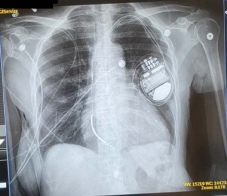
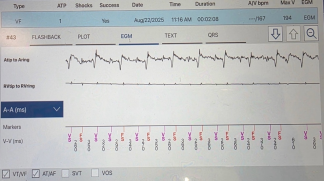
Chest radiograph (Figure 1) demonstrated a left-sided biventricular implantable cardioverter-defibrillator (ICD). The generator is in the left pre-pectoral pocket. Both the right atrial and right ventricular leads are displaced, whereas the left ventricular lead via the coronary sinus remains in position. Lead dislodgement was likely facilitated by post-procedural lead-sleeve suture laxity, absence of generator fixation to the underlying muscle, and inferior migration of the device within the pocket, influenced by surrounding breast tissue. These findings illustrate a variant of Twiddler syndrome occurring without patient manipulation of the device.Intracardiac electrogram (EGM) was obtained during device interrogation, with the tracing demonstrating sinus rhythm with double counting of atrial and ventricular depolarizations by the dislodged RV lead. Both atrial and ventricular signals are being detected as ventricular events, fulfilling ventricular fibrillation detection criteria.
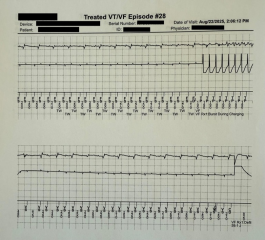
Figure 3 demonstrates stored device electrogram (EGM) from one treated episode. The ICD misclassified sinus rhythm as ventricular tachycardia due to double counting, resulting in delivery of antitachycardia pacing (ATP) followed by shock therapy. This inappropriate therapy 2 American Journal of Cardiovascular Disease Research highlights the potential for oversensing to cause erroneous rhythm classification and unnecessary treatment.


American Journal of Cardiovascular Disease Research 3 A clinical photograph of the ICD pocket was taken, showing downward migration of the device into the breast tissue (Figure 4). The pocket is located lower than the standard pre-pectoral position, consistent with generator migration. This malposition contributed to lead dislodgement in the absence of patient manipulation, supporting the diagnosis of Twiddler syndrome without twiddling.

Follow-up & Outcomes
The patient subsequently underwent lead revision and generator repositioning with reinforcement of the device pocket. Post-procedural interrogation confirmed stable sensing, capture thresholds, and appropriate lead positions. She was discharged without further inappropriate therapies.
Twiddler syndrome is typically attributed to patient manipulation of the generator, often seen in elderly or obese individuals with lax subcutaneous tissue 1, 3. However, this case illustrates that similar lead dislodgement and device malfunction may occur in the absence of generator manipulation.
In this patient, several mechanical factors may have contributed to lead dislodgement over time. Progressive laxity of the lead-sleeve sutures may have permitted gradual lead retraction. In addition, the generator was not affixed to the underlying pectoral muscle, which may have allowed increased pocket mobility and subsequent device migration. The device subsequently migrated downward within the pocket, a process facilitated by surrounding breast tissue, which likely created additional slack and tension on the leads. These factors together resulted in displacement of the right atrial and right ventricular leads while the left ventricular lead remained in situ.
The inappropriate shocks in this case were due to oversensing and double counting by the dislodged RV lead. The delivery of six consecutive inappropriate shocks underscores the significant physical and psychological burden of such device malfunctions. Inappropriate ICD therapies are not only distressing but are also associated with increased morbidity, unnecessary myocardial injury, and even mortality risk 4, 5.
The inappropriate therapies were multifactorial: the dislodged RV lead oversensed atrial and ventricular signals, and the device misclassified sinus rhythm as VT. This resulted in delivery of both ATP and shock therapy (Figure 3). Such misclassification underscores how oversensing can mimic high-rate ventricular arrhythmias on device diagnostics, leading to erroneous treatment.
This case broadens the understanding of Twiddler syndrome by demonstrating that its mechanical consequences—lead displacement and inappropriate therapies—may occur even without twiddling behaviour. We propose the term Twiddler syndrome without twiddling for this entity.
We describe a rare case of Twiddler syndrome without twiddling leading to lead dislodgement and inappropriate ICD shocks. Even in the hands of experienced operators, mechanical factors such as inadequate sleeve fixation, lack of generator anchoring, and device migration within the pocket may predispose to this complication. Importantly, in this patient the malfunction resulted in six consecutive inappropriate shocks, highlighting both the physical and psychological consequences of device failure. Clinicians should maintain a high index of suspicion for device malfunction in patients presenting with inappropriate therapies, even when patient manipulation is denied. Careful device pocket construction, secure fixation of leads, and anchoring of the generator are essential preventive strategies.
| [1] | Bayliss CE, Beanlands DS, Baird RJ. The pacemaker-twiddler’s syndrome: a new complication of implantable transvenous pacemakers. Can Med Assoc J. 1968; 99(8): 371–373. | ||
| In article | |||
| [2] | Ellenbogen KA, Wood MA, Shepard RK. Delayed complications following pacemaker implantation. Pacing Clin Electrophysiol. 2002; 25(8): 1155–1158. | ||
| In article | View Article PubMed | ||
| [3] | Nicholson WJ, Tuohy KA, Tilkemeier P. Twiddler’s syndrome. N Engl J Med. 2003; 348(17): 1726–1727. | ||
| In article | View Article PubMed | ||
| [4] | Li A, Kaura A, Sunderland N, Dhillon PS, Scott PA. The Significance of Shocks in Implantable Cardioverter Defibrillator Recipients. Arrhythm Electrophysiol Rev. 2016 Aug; 5(2): 110-6. | ||
| In article | View Article PubMed | ||
| [5] | van Rees, J, Borleffs, C, de Bie, M. et al. Inappropriate Implantable Cardioverter-Defibrillator Shocks: Incidence, Predictors, and Impact on Mortality. JACC. 2011 Feb, 57(5) 556–562. | ||
| In article | View Article PubMed | ||
Published with license by Science and Education Publishing, Copyright © 2025 Resha Reya Ganthan, Rayna Isber, Joud Fahed and Nidal Isber
 This work is licensed under a Creative Commons Attribution 4.0 International License. To view a copy of this license, visit
http://creativecommons.org/licenses/by/4.0/
This work is licensed under a Creative Commons Attribution 4.0 International License. To view a copy of this license, visit
http://creativecommons.org/licenses/by/4.0/
| [1] | Bayliss CE, Beanlands DS, Baird RJ. The pacemaker-twiddler’s syndrome: a new complication of implantable transvenous pacemakers. Can Med Assoc J. 1968; 99(8): 371–373. | ||
| In article | |||
| [2] | Ellenbogen KA, Wood MA, Shepard RK. Delayed complications following pacemaker implantation. Pacing Clin Electrophysiol. 2002; 25(8): 1155–1158. | ||
| In article | View Article PubMed | ||
| [3] | Nicholson WJ, Tuohy KA, Tilkemeier P. Twiddler’s syndrome. N Engl J Med. 2003; 348(17): 1726–1727. | ||
| In article | View Article PubMed | ||
| [4] | Li A, Kaura A, Sunderland N, Dhillon PS, Scott PA. The Significance of Shocks in Implantable Cardioverter Defibrillator Recipients. Arrhythm Electrophysiol Rev. 2016 Aug; 5(2): 110-6. | ||
| In article | View Article PubMed | ||
| [5] | van Rees, J, Borleffs, C, de Bie, M. et al. Inappropriate Implantable Cardioverter-Defibrillator Shocks: Incidence, Predictors, and Impact on Mortality. JACC. 2011 Feb, 57(5) 556–562. | ||
| In article | View Article PubMed | ||