Many studies examining the physical activity (PA) guidelines (PAG) use the least active participants as a reference for all group comparisons. Moreover, participants not meeting PAG may suffer from health conditions that confound the PA and outcome relationship. Purpose: The first aim of this study was to examine the extent to which initially healthy adults in different PAGgroups vary in their risk of heart disease (HD) mortality. The second aim was to determine if combined PAG groups differ when predicting HD mortality risk. Methods: A total of 405,994 participants from the 1997-2018 National Health Interview Survey (NHIS) were used and linked to the National Center for Health Statistics (NCHS) 2019 public-use mortality files. Only adults 18+ years of age, free from disease, eligible for linkage, with complete data were included. Four different PAG groups were created to include 1) those not meeting either aerobic PA or muscle strengthening (MS) guidelines (PAG1), 2) those meeting MS guidelines only (PAG2), 3) those meeting aerobic PAG only (PAG3), and 4) those meeting both aerobic PA and MS guidelines (PAG4). The analysis strategy included three goals: 1) examine the association between PAG groups and HD mortality risk using the conventional PAG1 as the reference category, 2) perform all PAG group comparisons in relation to HD mortality risk, and 3) test for differences in combined PAG groups using linear contrasts. The Kaplan-Meier (KM) method with log-rank (LR) test was used to compare survival curves between the PAG groups.Cox regression was used to address the above goals and estimate the hazard ratio (HR) and its 95% confidence interval (CI). Control variables included age, sex, race, income, BMI categories, and smoking status. Results: The median follow-up was 11.4 (SE=0.02) years with 7,849 (1.9%) HD-related deaths in the sample. Among HD survivors, 47.4% (SE=0.20), 3.5% (SE=0.04), 28.3% (SE=0.14), and 20.8% (SE=0.14) were categorized at baseline as PAG1, PAG2, PAG3, and PAG4, respectively. Whereas among those experiencing HD death, 69.4% (SE=0.68), 3.1% (SE=0.24), 20.3% (SE=0.54), and 7.3% (SE=0.40) were categorized at baseline as PAG1, PAG2, PAG3, and PAG4, respectively. Survival curves were significantly (KM LR p < .0001) different across the four PAG groups. The initial hazards model showed PAG2 (HR=0.75, 0.64-0.88), PAG3 (HR=0.65, 0.61-0.70), and PAG4 (HR=0.52, 0.46-0.59) with lower risk of HD mortality as compared to PAG1 (p for trend <0.0001). In multiple comparison analysis, PAG4 had lower risk of HD mortality as compared to PAG2 (HR=0.69, adj 0.54-0.90) and PAG3 (HR=0.80, adj 0.68-0.95). While PAG2 and PAG3 did not see significantly different (adj p=0.6811) HD mortality risk. Tests of linear contrasts showed that PAG4 had significantly lower (HR=0.29, adj 0.18-0.48) risk of HD mortality as compared to the other three groups combined. Additionally, PAG2, PAG3, and PAG4 combined had significantly lower (HR=0.25, adj 0.19-0.35) risk of HD mortality as compared to PAG1. Conclusion: These findings indicate that meeting any PAG may protect against HD mortality but meeting both could provide optimal benefit.
Participating in leisure time physical activity (PA) has several benefits that attenuate illness and increase longevity 1. The health benefits of PA also include the prevention of heart disease (HD) andlowering of HD-related mortality risk 2, 3.Current PA guidelines (PAG) suggest that adults accumulate 150+ minutes per week of moderate-intensity PA, 75+ minutes per week of vigorous-intensity PA, or an equivalent combination of moderate-to-vigorous PA (MVPA) each week 4. The PAG also recommend participating in 2+ days per week of muscle strengthening (MS) activities that include all major muscle groups. The promotion of these PAGprovides a weekly goal for adults and has been shown to be enough to elicit the aforementionedmedical benefits 5, 6. However, many studies examining the recommended amounts of PA use the least active participants as a reference for all group comparisons 7, 8, 9. The primary purpose of this study was to examine the extent to which initially healthy adults in different PAG groups vary in their risk of heart disease (HD) mortality. The second purpose was to determine if combined PAG groups differ when predicting HD mortality risk.
Study design
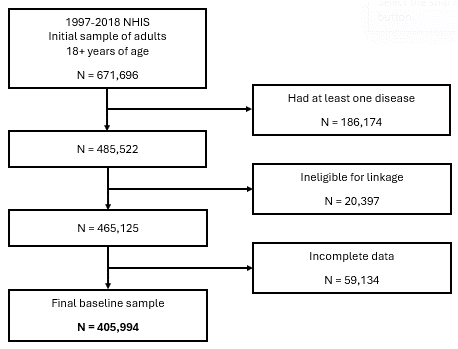
This study usedNational Health Interview Survey (NHIS)data along withNational Center for Health Statistics (NCHS) 2019 public-use linked mortality files 10, 11. NHIS is an annual survey that uses personal interviews to collect data onhealth-related topics. The current study used NHIS data from 1997 to 2018. The initial poolconsisted of671,696adults 18+ years of age and, after exclusions, resulted in a final baseline sample of 405,994 adults (Figure 1).

Physical activity (PA) and muscle strengthening (MS) guidelines
Four different PAG groups were created to include 1) those not meeting either aerobic PA or muscle strengthening (MS) guidelines (PAG1), 2) those meeting MS guidelines only (PAG2), 3) those meeting aerobic PAG only (PAG3), and 4) those meeting both aerobic PA and MS guidelines (PAG4). The PAG variable was created by first computing a moderate-to-vigorous PA (MVPA) status variable. MVPA was formed by computing two preliminary variables of time spent in vigorous (VPA) and moderate (MPA) intensity PA per week. The MVPA variable was calculated by adding MPA to twice VPA. A meeting MVPA status variable was created by assigning a “yes” to those participating in at least 150 minutes of MVPA each week with a “no” assigned otherwise. The PAG variable also required anMS guidelines status variable and was computed by assigning a “yes” to those participating in at least 2 days per week of MS and a “no” otherwise. Thus, the four PAG groups were formed using the two sets of “yes” and “no” conditions.
Disease status
Disease status was used to delimit the population and analyze only adults initially healthy at baseline. Nine different chronic conditions were used to exclude participants and included1) coronary heart disease, 2) angina pectoris, 3) heart attack, 4) other heart conditions or diseases, 5) a stroke, 6) emphysema, 7) chronic bronchitis, 8) diabetes, and 9) cancer.If a participant indicated they were told by a doctor or other health professional that they had any of these conditions, they were excluded from the study.
Assessment of covariates
For descriptive and statistical adjustment purposes, body mass index (BMI) category, smoking status, age, sex, race, and income variables were created.BMI was measured using the standard formula yielding units of kg/m2 with standard groups of underweight (BMI < 18.5), normal weight (18.5 ≤BMI <25.0), overweight (25.0 ≥BMI <30.0), and obese (BMI ≥30.0). Smoking status was assessed using a series of questions asking participants about their smoking habits, smoking frequency, smoking quantity, and smoking history. From these responses, a smoking status variable was created that assigned participants to one of three groups of either current smoker, former smoker, or never smoker. A sex variable was used that included the conventional groups of male or female. An age group variable was created with ranges of 18 to 44 years, 45 to 64 years, and 65 to 85+ years. The race/ethnicity variable categorized adults into groups of either White, Black, or Other. Finally, a crude income variable was created that assigned each participant into one of three ordinal groups of low, middle, or high income.
Statistical analyses
The sample was described using percentages (%s) and 95% confidence intervals (CIs). Tests of association were also conducted for descriptive purposes using the Rao-Scott chi-square statistic. The Kaplan-Meier (KM) method with log-rank (LR) test was used to compare survival curves between the PAG groups.Cox regression with hazard ratios (HRs) and 95% confidence intervals (CIs)was used toexamine the association between PAG groups and HD mortality risk using the conventional PAG1 as the reference category. Additionally, all PAG group comparisons were made in relation to HD mortality risk using Bonferroni adjustments. Finally, tests for differences in combined PAG groups were made using linear contrasts and Bonferroni adjustments. Control variables included age, sex, race, income, BMI categories, and smoking status. SAS version 9.4 survey procedures were used for all analyses 12, 13.
The median follow-up was 11.4 (SE=0.02) years with 7,849 (1.9%) HD-related deaths in the sample. Among HD survivors, 47.4% (SE=0.20), 3.5% (SE=0.04), 28.3% (SE=0.14), and 20.8% (SE=0.14) were categorized at baseline as PAG1, PAG2, PAG3, and PAG4, respectively. Whereas among those experiencing HD death, 69.4% (SE=0.68), 3.1% (SE=0.24), 20.3% (SE=0.54), and 7.3% (SE=0.40) were categorized at baseline as PAG1, PAG2, PAG3, and PAG4, respectively. In the overall baseline sample, rates of PAG4 were greater among male, younger (18 to 44 years), White, high-income, normal-weight, and neversmokeradults (Table 1).Furthermore, adults in PAG2 (OR=0.60, 0.51-0.70), PAG3 (OR=0.49, 0.46-0.52), and PAG4 (OR=0.24, 0.21-0.27) had significantly lower odds of dying during follow-up compared to their counterparts in PAG1 (Table 2).
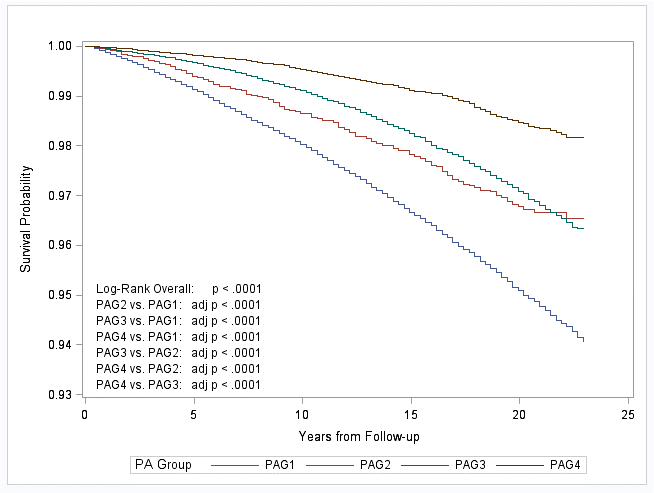
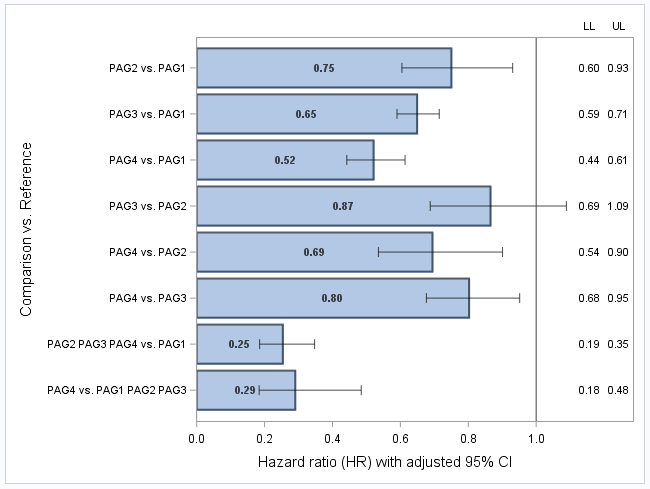
Survival curves were significantly (KM LR p < .0001) different across the four PAG groups (Figure 2). The initial hazards model showed PAG2 (HR=0.75, 0.64-0.88), PAG3 (HR=0.65, 0.61-0.70), and PAG4 (HR=0.52, 0.46-0.59) with lower risk of HD mortality as compared to PAG1 (p for trend <0.0001) (Table 3). In multiple comparison analysis, PAG4 had lower risk of HD mortality as compared to PAG2 (HR=0.69, adj 0.54-0.90) and PAG3 (HR=0.80, adj 0.68-0.95) (Table 4). While PAG2 and PAG3 did not see significantly different (adj p=0.6811) HD mortality risk. Tests of linear contrasts showed that PAG4 had significantly lower (HR=0.29, adj 0.18-0.48) risk of HD mortality as compared to the other three groups combined. Additionally, PAG2, PAG3, and PAG4 combined had significantly lower (HR=0.25, adj 0.19-0.35) risk of HD mortality as compared to PAG1 (Figure 3).


The initial findings of this study showed what was to be expected in that the four PAG groups saw a dose-response association with HD mortality risk. Specifically, mortality risk continually decreased as PAG group membership moved from neither MS nor aerobic PA (PAG1) to MS only (PAG2) to aerobic PA only (PAG3) to both MS and aerobic PA (PAG4).Again, these findings were expected and have been shown by others for all-cause and cause-specific mortality 14, 15. Thus, the primary findings of this study were those showing that meeting aerobic PA alone (PAG3) was not associated with any different HD mortality risk than meeting MS alone (PAG2). As well, meeting both aerobic PA and MS guidelines (PAG4) was associated with lower risk than meeting aerobic PA alone (PAG3). These findings might be assumed anecdotally and even assumed when examining linear trends in joint effects; however, direct comparisons from this study are necessary to make the appropriate generalizations.
The secondary findings of this study were those showing the more complex comparisons between groupings of PAG groups. That is, membership in a PAG group that meets any guideline (PAG2, PAG3, PAG4) saw lower risk of HD mortality as compared to meeting none (PAG1). Less obvious, though, was the finding that meeting both aerobic PA and MS guidelines (PAG4) was related to lower risk of HD mortality as compared to not (PAG1, PAG2, PAG3). These findings are notable because the reference group not only includes the obvious less active adults but also the less obvious adults who meet aerobic PA only (PAG3) as well as those who meet MS only (PAG2). Some data have been reported comparing adults meeting both PAG to groups not, however, the extent to which those reference groups contain adults meeting aerobic PA aloneor MS guidelines aloneappears vague and inconsistent 16, 17, 18.
The results from this study should be considered along with their limitations 19. Specifically, publicly available NHIS data are limited to national-level generalizations and cannot be used for state-based analyses.NHIS data are cross-sectional and cannot be used to imply cause-and-effect associations between exposures and outcomes. Finally, NHIS data are gathered using self-report interviews and are limited to recall bias and potential misclassification. Therefore, the findings from this study should be interpreted with caution.
These findings showed a dose-response association with HD mortality risk across the four PAG groups, with the lowest risk seen in healthy adults meeting both PAG. More notable was that meeting aerobic PA alone was not associated with any different HD mortality risk than meeting MS alone. Also notable, meeting both aerobic PA and MS guidelines was associated with lower risk than meeting aerobic PA alone. Promoting both aerobic PA and MS to healthy adults is essential for the optimal reduction in HD mortality.
| [1] | Piercy KL, Troiano RP, Ballard RM, et al. The Physical Activity Guidelines for Americans. JAMA. 2018; 320(19): 2020-2028. | ||
| In article | View Article PubMed | ||
| [2] | Ho FK, Zhou Z, Petermann-Rocha F, et al. Association Between Device-Measured Physical Activity and Incident Heart Failure: A Prospective Cohort Study of 94 739 UK Biobank Participants. Circulation. 2022; 146(12): 883-891. | ||
| In article | View Article PubMed | ||
| [3] | Choi Y, Kim G, Yoon J, Kim YS. Association of resting heart rate and physical activity with cardiovascular mortality: A population-based cohort study of Korean adults. J Sports Sci. 2024; 42(16): 1529-1537. | ||
| In article | View Article PubMed | ||
| [4] | U.S. Department of Health and Human Services. Physical Activity Guidelines for Americans 2nd Edition.; 2018. https:// odphp.health.gov/ sites/default/files/2019-09/ Physical_ Activity_ Guidelines_ 2nd_ edition.pdf. | ||
| In article | |||
| [5] | Dai W, Albrecht SS. Sitting Time and Its Interaction With Physical Activity in Relation to All-Cause and Heart Disease Mortality in U.S. Adults With Diabetes. Diabetes Care. 2024; 47(10): 1764-1768. | ||
| In article | View Article PubMed | ||
| [6] | Freene N, Lönn A, Carroll S, et al. Dose-Response Independent and Joint Associations of Physical Activity and Sedentary Behavior With Mortality Risk in 40 156 Australian Adults With Coronary Heart Disease. J Am Heart Assoc. 2024; 13(21): e035803. | ||
| In article | View Article PubMed | ||
| [7] | Nie J, Haberstroh M, Acosta T, Huang W, Wang Y, Barengo NC. Independent and Joint Associations Between Leisure Time Physical Activity and Strength Activities With Mortality Outcomes in Older Adults At least 65 Years of Age: A Prospective Cohort Study. J Gerontol A Biol Sci Med Sci. 2021; 76(12): 2122-2131. | ||
| In article | View Article PubMed | ||
| [8] | Fan B, Ren K, Li L. The joint effect of weight-adjusted waist index and physical activity on all-cause mortality in Chinese elderly patients with multimorbidity: A study based on the CLHLS from 2011 to 2018. PLoS One. 2025; 20(6): e0325886. Published 2025 Jun 9. | ||
| In article | View Article PubMed | ||
| [9] | Zhu Y, Chen B, Qin M, et al. Joint effects of physical activity and sleep quality on all-cause and cardiovascular disease mortality in stroke survivors: a population-based cohort study from the UK-Biobank. BMC Public Health. 2025; 25(1): 1502. Published 2025 Apr 23. | ||
| In article | View Article PubMed | ||
| [10] | National Center for Health Statistics. CDC. About NHIS. National Health Interview Survey. Published November 21, 2024. https://www.cdc.gov/nchs/nhis/about/index.html. | ||
| In article | |||
| [11] | National Center for Health Statistics. Public-Use Linked Mortality Files. National Center for HealthStatistics. Updated May 2022. https://www.cdc.gov/nchs/data/datalinkage/public-use-linked-mortality-file-description.pdf. | ||
| In article | |||
| [12] | Allison PD. Survival analysis using SAS: a practical guide. Sas Institute; 2010 Mar 29. | ||
| In article | |||
| [13] | SAS Institute Inc. 2013. Introduction to Survival Analysis Procedures. SAS/STAT® 13.1 User’s Guide.Cary, NC: SAS Institute Inc. | ||
| In article | |||
| [14] | Dai J, Dai W, Li WQ. Association of Muscle-Strengthening and Aerobic Physical Activity With All-Cause, Cardiovascular Disease, and Cancer Mortality in U.S. Adults With Diabetes. Eur J Prev Cardiol. Published online February 6, 2025. | ||
| In article | View Article PubMed | ||
| [15] | Song W, Zou M, Zheng W, Hu X, Gao H, Cheng Z. Associations of different combinations of moderate-vigorous physical activity and muscle-strengthening activity with mortality among US lung cancer survivors. BMC Pulm Med. 2024; 24(1): 326. Published 2024 Jul 5. | ||
| In article | View Article PubMed | ||
| [16] | Lee S, Choi Y, Kim YS. Adherence to physical activity guidelines and all-cause and cardiovascular disease mortality in individuals with and without type 2 diabetes. J Diabetes Metab Disord. 2025; 24(2): 181. Published 2025 Jul 31. | ||
| In article | View Article PubMed | ||
| [17] | Webber BJ, Piercy KL, Hyde ET, Whitfield GP. Association of Muscle-Strengthening and Aerobic Physical Activity With Mortality in US Adults Aged 65 Years or Older. JAMA Netw Open. 2022; 5(10): e2236778. Published 2022 Oct 3. | ||
| In article | View Article PubMed | ||
| [18] | Cho Y, Jang H, Kwon S, Oh H. Aerobic, muscle-strengthening, and flexibility physical activity and risks of all-cause and cause-specific mortality: a population-based prospective cohort of Korean adults. BMC Public Health. 2023; 23(1): 1148. Published 2023 Jun 14. | ||
| In article | View Article PubMed | ||
| [19] | Kindratt TB. Big Data for Epidemiology: Applied Data Analysis Using National Health Surveys. Arlington, TX: Mavs Open Press; 2022. | ||
| In article | |||
Published with license by Science and Education Publishing, Copyright © 2025 Peter D. Hart
 This work is licensed under a Creative Commons Attribution 4.0 International License. To view a copy of this license, visit
http://creativecommons.org/licenses/by/4.0/
This work is licensed under a Creative Commons Attribution 4.0 International License. To view a copy of this license, visit
http://creativecommons.org/licenses/by/4.0/
| [1] | Piercy KL, Troiano RP, Ballard RM, et al. The Physical Activity Guidelines for Americans. JAMA. 2018; 320(19): 2020-2028. | ||
| In article | View Article PubMed | ||
| [2] | Ho FK, Zhou Z, Petermann-Rocha F, et al. Association Between Device-Measured Physical Activity and Incident Heart Failure: A Prospective Cohort Study of 94 739 UK Biobank Participants. Circulation. 2022; 146(12): 883-891. | ||
| In article | View Article PubMed | ||
| [3] | Choi Y, Kim G, Yoon J, Kim YS. Association of resting heart rate and physical activity with cardiovascular mortality: A population-based cohort study of Korean adults. J Sports Sci. 2024; 42(16): 1529-1537. | ||
| In article | View Article PubMed | ||
| [4] | U.S. Department of Health and Human Services. Physical Activity Guidelines for Americans 2nd Edition.; 2018. https:// odphp.health.gov/ sites/default/files/2019-09/ Physical_ Activity_ Guidelines_ 2nd_ edition.pdf. | ||
| In article | |||
| [5] | Dai W, Albrecht SS. Sitting Time and Its Interaction With Physical Activity in Relation to All-Cause and Heart Disease Mortality in U.S. Adults With Diabetes. Diabetes Care. 2024; 47(10): 1764-1768. | ||
| In article | View Article PubMed | ||
| [6] | Freene N, Lönn A, Carroll S, et al. Dose-Response Independent and Joint Associations of Physical Activity and Sedentary Behavior With Mortality Risk in 40 156 Australian Adults With Coronary Heart Disease. J Am Heart Assoc. 2024; 13(21): e035803. | ||
| In article | View Article PubMed | ||
| [7] | Nie J, Haberstroh M, Acosta T, Huang W, Wang Y, Barengo NC. Independent and Joint Associations Between Leisure Time Physical Activity and Strength Activities With Mortality Outcomes in Older Adults At least 65 Years of Age: A Prospective Cohort Study. J Gerontol A Biol Sci Med Sci. 2021; 76(12): 2122-2131. | ||
| In article | View Article PubMed | ||
| [8] | Fan B, Ren K, Li L. The joint effect of weight-adjusted waist index and physical activity on all-cause mortality in Chinese elderly patients with multimorbidity: A study based on the CLHLS from 2011 to 2018. PLoS One. 2025; 20(6): e0325886. Published 2025 Jun 9. | ||
| In article | View Article PubMed | ||
| [9] | Zhu Y, Chen B, Qin M, et al. Joint effects of physical activity and sleep quality on all-cause and cardiovascular disease mortality in stroke survivors: a population-based cohort study from the UK-Biobank. BMC Public Health. 2025; 25(1): 1502. Published 2025 Apr 23. | ||
| In article | View Article PubMed | ||
| [10] | National Center for Health Statistics. CDC. About NHIS. National Health Interview Survey. Published November 21, 2024. https://www.cdc.gov/nchs/nhis/about/index.html. | ||
| In article | |||
| [11] | National Center for Health Statistics. Public-Use Linked Mortality Files. National Center for HealthStatistics. Updated May 2022. https://www.cdc.gov/nchs/data/datalinkage/public-use-linked-mortality-file-description.pdf. | ||
| In article | |||
| [12] | Allison PD. Survival analysis using SAS: a practical guide. Sas Institute; 2010 Mar 29. | ||
| In article | |||
| [13] | SAS Institute Inc. 2013. Introduction to Survival Analysis Procedures. SAS/STAT® 13.1 User’s Guide.Cary, NC: SAS Institute Inc. | ||
| In article | |||
| [14] | Dai J, Dai W, Li WQ. Association of Muscle-Strengthening and Aerobic Physical Activity With All-Cause, Cardiovascular Disease, and Cancer Mortality in U.S. Adults With Diabetes. Eur J Prev Cardiol. Published online February 6, 2025. | ||
| In article | View Article PubMed | ||
| [15] | Song W, Zou M, Zheng W, Hu X, Gao H, Cheng Z. Associations of different combinations of moderate-vigorous physical activity and muscle-strengthening activity with mortality among US lung cancer survivors. BMC Pulm Med. 2024; 24(1): 326. Published 2024 Jul 5. | ||
| In article | View Article PubMed | ||
| [16] | Lee S, Choi Y, Kim YS. Adherence to physical activity guidelines and all-cause and cardiovascular disease mortality in individuals with and without type 2 diabetes. J Diabetes Metab Disord. 2025; 24(2): 181. Published 2025 Jul 31. | ||
| In article | View Article PubMed | ||
| [17] | Webber BJ, Piercy KL, Hyde ET, Whitfield GP. Association of Muscle-Strengthening and Aerobic Physical Activity With Mortality in US Adults Aged 65 Years or Older. JAMA Netw Open. 2022; 5(10): e2236778. Published 2022 Oct 3. | ||
| In article | View Article PubMed | ||
| [18] | Cho Y, Jang H, Kwon S, Oh H. Aerobic, muscle-strengthening, and flexibility physical activity and risks of all-cause and cause-specific mortality: a population-based prospective cohort of Korean adults. BMC Public Health. 2023; 23(1): 1148. Published 2023 Jun 14. | ||
| In article | View Article PubMed | ||
| [19] | Kindratt TB. Big Data for Epidemiology: Applied Data Analysis Using National Health Surveys. Arlington, TX: Mavs Open Press; 2022. | ||
| In article | |||