Background: The current research aimed to assess the outcome of dissimilar cement types on the strength of zirconium crowns fabricated by a computer-aided design and manufacturing (CAD/CAM) system at varying occlusal cement gap widths for primary molars. Methods: A total of 40 extracted mandibular deciduous 2nd. molars were prepared and randomly allocated into two main sets and two subgroups, totaling 4 groups according to the cement type and occlusal gap width. After preparation, the deciduous molars were implanted in methyl methacrylate blocks. The restorations were made-up from zirconium (InCoris TZI C, Sirona Dental Systems, GmbH, Bensheim, Germany) using CAD/CAM system, with occlusal cement gap widths of 100 µm and 200 µm, and were then glass ionomer cement and adhesive resin cements were used to cement the crowns. Fracture strength was measured for all samples at a crossheading speed of 10 mm/min, and the values were verified in Newtons (N). statistical analysis of results were done through the Shapiro–Wilk normality test and independent t-tests. A significance level of p < 0.05 was used for all analyses. Results: Cement type and cement gap width had statistically insignificant effect on the zirconium fracture strength of (p > 0.05). The greatest fracture resistance was detected in the 100 µm cement gap and adhesive resin cement group (3847±984,74 N). Conclusions: Zirconia crowns fabricated using CAD/CAM technology demonstrated high fracture strength when placed on primary teeth. Different cement types and gap widths may be considered clinically acceptable alternatives in pediatric applications.
Teeth decay is a common chronic disease worldwide, resulting from the interaction of bacteria and carbohydrates, and it can particularly affect primary teeth during early childhood 1. Due to structural differences, deciduous teeth may be more susceptible to decay more than permanent teeth due to structural differences. However, they should be retained in the mouth until their natural exfoliation to preserve space for the erupting permanent teeth and to maintain essential functions such as aesthetics and nutrition, thereby contributing to the child’s overall health and quality of life 2. Crown restorations are recommended for primary teeth with multisurface carious lesions. The most commonly used type of restorative crown for primary teeth has been the stainless steel crown (SSC), which has been successfully utilized for over 70 years 3. However, these restorations often do not meet the aesthetic expectations of both children and their parents. To address this limitation, more visually acceptable alternatives, such as aesthetic SSCs and prefabricated zirconia crowns (PZCs), have been developed. Due to their preparation requirements despite their aesthetic advantages PZCs may result in too much loss of tooth structure, prompting development of alternative approaches 4, 5. In response, computer-aided design and manufacturing (CAD/CAM) methods were introduced in recent years. CAD/CAM systems offer considerable potential for delivering high-quality oral healthcare and customized restorations for children 6. Durable and aesthetic restorations can be fabricated using CAD/CAM and 3D printing technologies, effectively reducing treatment time 7. In addition, selecting the appropriate cement is crucial to ensure that the fabricated crowns can withstand intraoral forces. The physical and chemical properties of each luting cement vary. There is no single ideal cement suitable for all clinical applications. Cements should be selected by evaluating their advantages and limitations based on the clinical conditions 8. An ideal cement should exhibit high fracture resistance, strong adhesion, and resistance to oral fluids 9. Although no definitive guidelines exist regarding the materials used for cementing zirconia restorations, zirconia can be cemented with conventional glass ionomer (GI), resin-modified GI, zinc phosphate, polycarboxylate, or adhesive resin cements 10, 11. Additionally, the cement gap is a significant parameter that influences the restoration retention. An increased cement gap may result in suboptimal crown placement, potentially causing elevated occlusion and marginal fit discrepancies 12. The purpose of the present laboratory investigation was to investigate the outcome of two dissimilar cement materials and two occlusal gap widths on the fracture strength of CAD/CAM-fabricated zirconium crowns placed on primary molars. The first proposition of this investigation said that fracture strength would vary based on the cement material. The second would be the increase in occlusal cement gap width would lead to a decrease in fracture strength.
Study Design and Sample Size
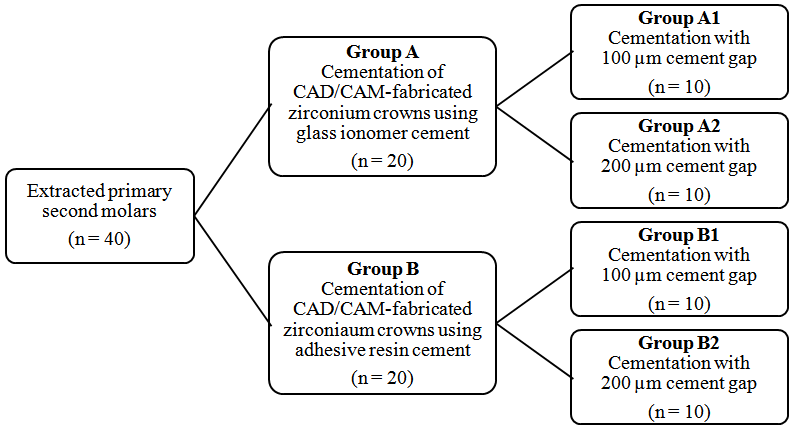
Power analysis was performed to determine the required sample size. Based on a reference study 13, it was determined using the NCSS (Number Cruncher Statistical System) 2007 Statistical Software (Utah, USA) that a total of 36 samples were needed to achieve 95% power. Considering potential technical limitations, the study was designed with 10 samples per group, totaling 40 samples. Mandibular primary second molar teeth extracted from pediatric patients who presented to Taif University Dental Hospital, were utilized in this research, following acquisition the informed consent from the parents. Teeth that were expected to exfoliate within six months or had extraction indications due to orthodontic or periodontal reasons, and teeth with either no caries or caries limited to the enamel layer were included in the study. The exclusion criterion was physiological root resorption extending to the bifurcation region.
Sample Preparation

After removal of soft tissue remnants, the samples were stockpiled in thymol solutions (0.1%) for one week and subsequently maintained in filtered water at 4°C till testing. The samples then embedded in pre-prepared plastic tubes using auto polymerizing acrylic resin (Imicryl, Konya, Turkey) such that the cementoenamel junctions were visible and the occlusal surfaces were parallel to the horizontal plane (Figure 1). Tooth preparations were performed by the same researcher (XXXX) under water cooling using diamond fissure bur. A 0.5 mm occlusal preparation depth was marked at the central fossa. Subsequently, all remaining occlusal surfaces and cusp tips were reduced by 0.5–1.5 mm to expose dentin. A 0.5mm–1 mm-wide chamfer finish line was created circumferentially.
Production and Cementation of CAD/CAM Zirconia Crowns
After preparation of tooth samples, they were allocated into groups. CEREC Primescan (Sirona Dental Systems GmbH, Bensheim, Germany) were used to scan the samples. The CEREC AC Acquisition Unit and CEREC 5.2.2 software (Sirona Dental Systems GmbH, Bensheim, Germany) were used to design the zirconia crown restorations. Digital impressions of each prepared tooth were obtained, and zirconia crown samples were fabricated from In Coris- TZI C blocks based on these impressions. Since the CEREC system software does not currently support primary teeth, mandibular first molars were selected as reference teeth. Due to the in vitro design of this study and the absence of adjacent or opposing teeth, the Biogeneric Individual option was selected during crown design. Digital impressions of each prepared tooth were captured using an optical scanner positioned 3–5 mm away from occlusal surfaces, and the resulting digital images were subsequently transferred into the CAD software. The crown morphology was designed to have a 0.5 mm occlusal fossa thickness. Radial cement gaps were set to 120 µm for all crowns, as recommended by the software, while the occlusal cement gaps were adjusted to 100 µm (Groups A1 and B1) and 200 µm (Groups A2 and B2) according to the study design (Figure 2). These values were selected because the software-recommended occlusal cement spacing for monolithic zirconia crowns is 100 µm, and 200 µm represents the maximum limit permitted by the system. Each crown was fabricated within 13–17 minutes approximately. After the milling process was completed, the blocks were removed from the unit, and the milled crowns were separated from the sprues using a cylindrical diamond bur. The samples that were separated from the die segments were subjected to the sintering process. The fit of the fabricated crowns on the sample teeth was checked, and then, in accordance with the manufacturer's instructions, the inner surfaces of the crowns were sandblasted with 50 µm aluminum oxide at a pressure of 2.5 bar. Prior to cementation, the prepared molars were dressed in pumice and a brush, then cleaned with water and dried. Subsequently, zirconia crowns were cemented onto the samples according to their designated groups, following the manufacturers’ recommendations. GIC (Meron, VOCO, Cuxhaven, Germany) were used for cementation of Group A, and adhesive resin cements (Calibra, Sirona Dental Systems GmbH, Caulk, USA) were used for cementation Group B (Figure 2). All samples were kept in 37 °C distilled water until the fracture testing.

Fracture Resistance Test
The fracture load values of the prepared samples were measured using a universal testing machine (LR 10K Plus, Lloyd Instruments, Farnham, England). The samples were placed so that the applied forces were transmitted parallel to the long axis of crowns and secured with screws to prevent movement. In this orientation, the force application device contacted the crown through the central fossa to apply the load. The force application tip had a diameter of 5 mm and was programmed to stop applying force upon detection of crown fracture. The determined loads at the fracture moment were verified in both Newtons (N) and stress (MPa).
Statistical Analysis
Number Cruncher Statistical System (NCSS) 2007 software was used for Statistical analyses of the results. Descriptive statistical methods were used to evaluate the data, and the distribution of variables was examined using the Shapiro–Wilk normality test. For variables with a normal distribution, independent t-tests were used to compare the two groups. The significance level of p < 0.05 was considered statistically significant.
The fracture strength values of the 40 zirconia crowns on primary molars were evaluated. The mean, standard deviation, maximum, and minimum values for each group are presented in Table 1.
Table 2 shows the results of intra-group and inter-group comparisons of fracture load values. In intra-group comparisons, statistically insignificant difference was observed amongst Groups A1 and A2 ( p = 0.715), or between Groups B1 and B2 ( p = 0.218). In inter-group comparisons, no statistically significant differences were found between Groups A1 and B1 ( p = 0.781), or between Groups A2 and B2 (p = 0.074).
Since introduction of zirconia into dentistry, PZCs have been used in pediatric dentistry beginning in the early 2000s 14. In recent years, CAD/CAM systems which offer a variety of restorative material options for adult patients have also begun to be utilized in pediatric dental applications 15. Researchers have emphasized that the mechanical advantages of these restorations depends on several factors, including material selection, crown thickness, tooth preparation, type of cement, and cement gap width 16. The interaction between the cement layer and dentin can influence the stress distribution, thereby affecting both the strength and fracture form of the crown. Furthermore, if masticatory forces exceed the elastic limit of the cementation material, the strength of the crown may be compromised 17, 18.
The impact of several cementation materials on the clinical success of crowns has been widely studied, yielding differing results. Hussien etal. 19 studied the fracture resistance of monolithic zirconium crown cemented to extracted teeth utilizing dissimilar forms of cement. They described that adhesive resin cement exhibited improved strength values compared to resin-modified GIC. D’Addazio et al. 20 evaluated zirconia-reinforced lithium disilicate crowns cemented on tooth replicas with GIC and self-adhesive resin cement. Their results indicated that self-adhesive resin cement achieved significantly higher strength values, with fracture loads of 3712 N and 2227 N, respectively. In a study by Pengpue et al. 21, thirty extracted primary incisors were cemented with prefabricated zirconia crowns using three different luting materials. Bioactive cement demonstrated higher tensile bond strength than both adhesive resin cement and resin-modified GIC. In an in vivo study 22, primary molars restored with PZCs were cemented utilizing GIC, resin-modified GIC, or adhesive resin cement. PZCs cemented with traditional GIC exhibited superior retention related to those cemented with the other materials after three years of clinical service. Walia et al. 23 evaluated the retention of 3 types of GIC used with manufactured deciduous zirconia crowns in vitro. Resin-based GIC showed greater retention than conventional glass ionomer cements. In another study, Alrashdi et al. 24 investigated the retention of 162 PZCs cemented to primary teeth using two different cements. Crowns cemented with self-adhesive resin cement demonstrated 95.1% retention at both 12 and 24 months, while those cemented withGIC showed retention values of 90.9% after one year and 84.0% after two years follow up. separate investigations assessing the effect of 4 dissimilar cements on the fracture resistance of readymade zirconium crown in deciduous teeth, significantly higher fracture resistance values were observed in samples cemented with resin cement and GIC 25.
Contrary to the findings of the aforementioned studies, other research has reported that the material of cement does not have a important effect on the clinical success of zirconium crowns. Efe etal. 26, evaluated the influence of dissimilar cement materials on the bond strength of zirconium crowns fabricated by CAD/CAM for extracted primary teeth, found statistically insignificant variations among the bond strengths of resin cement and traditional GIC. Nakamura etal. 18 investigated the impact of various cement materials on the fracture resistance of 0.5 mm thickness CAD/CAM monolithic zirconium crown. The crowns were cemented using four types of luting agents glass ionomer cement, self-adhesive resin cement, dual cure resin cement, and chemically cured resin cement and it was reported that material of cementation had statistically insignificant impact on fracture resistance. In a systematic review, survival rates following the cementation of zirconia crowns with adhesive cements were reported to range from 83.3% to 100%, while those cemented with conventional cements (glass ionomer, resin-modified glass ionomer, or zinc phosphate) showed survival rates ranging from 82.0% to 100% 27. Another review study reported that PZCs applied to primary teeth exhibited good retention and high fracture resistance; however, the evidence regarding the effect of cementation materials remained inconclusive 28. Consistent with these findings, the current research likewise confirmed that different types of cement did not significantly affect the fracture resistance of zirconium crowns.
The influence of different cement gap widths on crown performance has also been explored in various studies. Gressler etal. 29 did a laboratory investigation in which 50 μm and 500 μm occlusal cement spacings were applied to feldspathic crowns fabricated using CAD/CAM technology. Their findings indicated that ceramic crowns with 50 μm occlusal cement spacing exhibited better performance. Prakkie etal. 30 assessed fracture strength of ceramic plates with thicknesses of 1 mm and 2 mm at different cement gap widths (100, 200, and 300 µm). They reported that in plates with a ceramic thickness of 1 mm, fracture resistance increased with greater cement spacing, whereas in plates with a thickness, cement gap width showed insignificant effect on fracture resistance. Although, Venturini etal. 31 reported statistically insignificant variations in the fracture resistance of restorations cemented with resin cement at cement spacing widths of 50, 100, and 300 µm. Similarly, Liu et al. 32 investigated cement spacings of 60, 90, 120, and 150 µm on permanent first molars. While they found that a 90 µm cement spacing was most effective in reducing stress within ceramic crowns, they concluded that cement gap width had minimal influence on the overall functional integrity of all-ceramic restorations. Only under excessive loading conditions did shear stress in the cement layer contribute to potential decementation. In agreement with these results, the current laboratory research also demonstrated that both two occlusal cement gap widths evaluated did not result in statistically significant differences in the fracture resistance of zirconium crowns. In this current research, all samples across the different groups exhibited fracture load values ranging from 2070 N to 5600 N. These values exceed the typical bite forces observed in children 33. Based on the findings, the use of 0.5 mm-thick monolithic zirconia crowns cemented with either GIC or resin cement at occlusal cement gap widths of 100 μm or 200 µm appears to be clinically appropriate for pediatric patients. Although the maximum strength were recorded in the group with a 100 µm cement gap width and adhesive resin cement, the differences were t statistically insignificant. So, the null hypotheses of this study were not rejected. One limitation of this study is the absence of artificial aging processes such as thermal cycling or simulated mastication, which could better replicate intraoral conditions involving temperature fluctuations and mechanical loading. Results may vary in studies incorporating such aging protocols.
In the present study, no statistically significant difference was observed between glass ionomer cement and adhesive resin cement regarding the fracture resistance of monolithic zirconium restorations, nor among two occlusal cement gap widths of 100 µm and 200 µm. These findings suggest that both types of cement exhibit comparable mechanical performance, and that cement gap width does not significantly influence fracture strength under the conditions tested. Furthermore, 0.5 mm thickness CAD/CAM-fabricated monolithic zirconium crowns demonstrated adequate fracture resistance to withstand masticatory forces encountered in the pediatric oral environment supporting their clinical viability. This evidence highlights their potential for minimally invasive treatment, particularly by preserving hard tissue in primary teeth, which naturally have reduced enamel and dentin thickness.
| [1] | Selwitz RH, Ismail AI, Pitts NB. Dental caries. Lancet. 2007; 369(9555): 51-9. | ||
| In article | View Article PubMed | ||
| [2] | Goldberg M. Deciduous tooth and dental caries. Ann Pediatr Child Health. 2017; 5: 1120. | ||
| In article | |||
| [3] | Kindelan SA, Day P, Nichol R, Willmott N, Fayle SA; British Society of Paediatric Dentistry. UK National Clinical Guidelines in Paediatric Dentistry: stainless steel preformed crowns for primary molars. Int J Paediatr Dent. 2008; 18 Suppl 1: 20-8. | ||
| In article | View Article PubMed | ||
| [4] | Beattie S, Taskonak B, Jones J, Chin J, Sanders B, Tomlin A, Weddell J. Fracture resistance of 3 types of primary esthetic stainless steel crowns. J Can Dent Assoc. 2011; 77: b90. | ||
| In article | |||
| [5] | Townsend JA, Knoell P, Yu Q, Zhang JF, Wang Y, Zhu H, Beattie S, Xu X. In vitro fracture resistance of three commercially available zirconia crowns for primary molars. Pediatr Dent. 2014; 36(5): 125-9. | ||
| In article | |||
| [6] | Pathak P. CAD-CAM in pediatric dentistry. Journal of the Indian Society of Pedodontics & Preventive Dentistry. 2024, 42. | ||
| In article | |||
| [7] | Mourouzis P, Arhakis A, Tolidis K. Computer-aided Design and Manufacturing Crown on Primary Molars: An Innovative Case Report. Int J Clin Pediatr Dent. 2019; 12(1): 76-79. | ||
| In article | View Article PubMed | ||
| [8] | Diaz-Arnold AM, Vargas MA, Haselton DR. Current status of luting agents for fixed prosthodontics. J Prosthet Dent. 1999; 81(2): 135-41. | ||
| In article | View Article PubMed | ||
| [9] | Pegoraro TA, da Silva NR, Carvalho RM. Cements for use in esthetic dentistry. Dent Clin North Am 2007; 51(2): 453-71, x. | ||
| In article | View Article PubMed | ||
| [10] | O’Brien, W. J. Dental materials and their selection. 3 rd ed. USA: Qintessence Publishing; 2002. | ||
| In article | |||
| [11] | Ha SR. Biomechanical three-dimensional finite element analysis of monolithic zirconia crown with different cement type. J Adv Prosthodont. 2015; 7(6): 475-83. | ||
| In article | View Article PubMed | ||
| [12] | Ushiwata O, de Moraes JV. Method for marginal measurements of restorations: accessory device for toolmakers microscope. J Prosthet Dent. 2000; 83(3): 362-6. | ||
| In article | View Article PubMed | ||
| [13] | Rojpaibool T, Leevailoj C. Fracture Resistance of Lithium Disilicate Ceramics Bonded to Enamel or Dentin Using Different Resin Cement Types and Film Thicknesses. J Prosthodont. 2017; 26(2): 141-149. | ||
| In article | View Article PubMed | ||
| [14] | Holsinger DM, Wells MH, Scarbecz M, Donaldson M. Clinical Evaluation and Parental Satisfaction with Pediatric Zirconia Anterior Crowns. Pediatr Dent. 2016; 38(3): 192-197. | ||
| In article | |||
| [15] | Zaruba M, Mehl A. Chairside systems: a current review. Int J Comput Dent. 2017; 20(2): 123-149. | ||
| In article | |||
| [16] | Qualtrough AJ, Piddock V. Ceramics update. J Dent. 1997; 25(2): 91-95. | ||
| In article | View Article PubMed | ||
| [17] | Kamposiora P, Papavasiliou G, Bayne SC, Felton DA. Predictions of cement microfracture under crowns using 3D-FEA. J Prosthodont. 2000 Dec; 9(4): 201-209. | ||
| In article | View Article PubMed | ||
| [18] | Nakamura K, Mouhat M, Nergård JM, Lægreid SJ, Kanno T, Milleding P, Örtengren U. Effect of cements on fracture resistance of monolithic zirconia crowns. Acta Biomater Odontol Scand. 2016; 2(1): 12-19. | ||
| In article | View Article PubMed | ||
| [19] | Hussien I M, Ibraheem A F. The effect of differentmarginal cement space thickness on the fracture strength of monolithic zirconia crowns using different luting agents. J res med dent sci. 2020; 10(04): 48-52. | ||
| In article | |||
| [20] | D’Addazio G, Santilli M, Rollo M L., Cardelli P, Rexhepi I, Murmura G, Al-Haj Husain N, Sinjari B, Traini T, Özcan M, Caputi S. Fracture resistance of Zirconia-reinforced lithium silicate ceramic crowns cemented with conventional or adhesive systems: An in vitro study. Materials. 2020; 13(9): 2012. | ||
| In article | View Article PubMed | ||
| [21] | Pengpue P, Sirimaharaj V, Chaijareenont P, Chinadet W. Tensile bond strength between paediatric prefabricated zirconia crowns and primary maxillary incisors when using various types of luting cements: an in vitro study. Eur Arch Paediatr Dent. 2024; 25(4): 471-479. | ||
| In article | View Article PubMed | ||
| [22] | Srinivasan SR, Mathew MG, Jayaraman J. Comparison of Three Luting Cements for Prefabricated Zirconia Crowns in Primary Molar Teeth: a 36-month Randomized Clinical Trial. Pediatr Dent. 2023; 45(2): 117-124. | ||
| In article | |||
| [23] | Walia T, Brigi C, Ziadkhani MM, Khayat AA, Tabibzadeh Z. Retention Force of Glass Ionomer Based Luting Cements with Posterior Primary Zirconium Crowns - A Comparative in Vitro Study. J Clin Pediatr Dent. 2021; 45(4): 259-264. | ||
| In article | View Article PubMed | ||
| [24] | Alrashdi M, Alhunti A. Clinical Outcome of Prefabricated Zirconia Crowns Cemented with Self-Adhesive Resin and Pure Glass Ionomer on Primary Teeth: A Retrospective Cohort Study. Children (Basel). 2024; 11(8): 991. | ||
| In article | View Article PubMed | ||
| [25] | Sahin I, Karayilmaz H, Çiftçi ZZ, Kirzioglu Z. Fracture Resistance of Prefabricated Primary Zirconium Crowns Cemented with Different Luting Cements. Pediatr Dent. 2018; 40(7): 443-448. | ||
| In article | |||
| [26] | Zekiye EFE, Güçlü ZA. In Vitro Evaluation of the Shear Bond Strength of Different Luting Cements on Zirconium Oxide Specimens in Primary Teeth. Bezmialem Science 2021; 9(2): 177-184. | ||
| In article | View Article | ||
| [27] | Maroulakos G, Thompson GA, Kontogiorgos ED. Effect of cement type on the clinical performance and complications of zirconia and lithium disilicate tooth-supported crowns: A systematic review. Report of the Committee on Research in Fixed Prosthodontics of the American Academy of Fixed Prosthodontics. J Prosthet Dent. 2019; 121(5): 754-765. | ||
| In article | View Article PubMed | ||
| [28] | Alrashdi M, Ardoin J, Liu JA. Zirconia crowns for children: A systematic review. Int J Paediatr Dent. 2022; 32(1): 66-81. | ||
| In article | View Article PubMed | ||
| [29] | Gressler May L, Kelly JR, Bottino MA, Hill T. Influence of the resin cement thickness on the fatigue failure loads of CAD/CAM feldspathic crowns. Dent Mater. 2015; 31(8): 895-900. | ||
| In article | View Article PubMed | ||
| [30] | Prakki A, Cilli R, Da Costa AU, Gonçalves SE, Mondelli RF, Pereira JC. Effect of resin luting film thickness on fracture resistance of a ceramic cemented to dentin. J Prosthodont. 2007; 16(3): 172-178. | ||
| In article | View Article PubMed | ||
| [31] | Venturini AB, Wandscher VF, Marchionatti AME, Evangelisti E, Ramos GF, Melo RM, May LG, Baldissara P, Valandro LF. Effect of resin cement space on the fatigue behavior of bonded CAD/CAM leucite ceramic crowns. J Mech Behav Biomed Mater. 2020; 110: 103893. | ||
| In article | View Article PubMed | ||
| [32] | Liu B, Lu C, Wu Y, Zhang X, Arola D, Zhang D. The effects of adhesive type and thickness on stress distribution in molars restored with all-ceramic crowns. J Prosthodont. 2011; 20(1): 35-44. | ||
| In article | View Article PubMed | ||
| [33] | Owais AI, Shaweesh M, Abu Alhaija ES. Maximum occusal bite force for children in different dentition stages. Eur J Orthod. 2013; 35(4): 427-433. | ||
| In article | View Article PubMed | ||
Published with license by Science and Education Publishing, Copyright © 2025 Nouf Al Humayyani
 This work is licensed under a Creative Commons Attribution 4.0 International License. To view a copy of this license, visit
http://creativecommons.org/licenses/by/4.0/
This work is licensed under a Creative Commons Attribution 4.0 International License. To view a copy of this license, visit
http://creativecommons.org/licenses/by/4.0/
| [1] | Selwitz RH, Ismail AI, Pitts NB. Dental caries. Lancet. 2007; 369(9555): 51-9. | ||
| In article | View Article PubMed | ||
| [2] | Goldberg M. Deciduous tooth and dental caries. Ann Pediatr Child Health. 2017; 5: 1120. | ||
| In article | |||
| [3] | Kindelan SA, Day P, Nichol R, Willmott N, Fayle SA; British Society of Paediatric Dentistry. UK National Clinical Guidelines in Paediatric Dentistry: stainless steel preformed crowns for primary molars. Int J Paediatr Dent. 2008; 18 Suppl 1: 20-8. | ||
| In article | View Article PubMed | ||
| [4] | Beattie S, Taskonak B, Jones J, Chin J, Sanders B, Tomlin A, Weddell J. Fracture resistance of 3 types of primary esthetic stainless steel crowns. J Can Dent Assoc. 2011; 77: b90. | ||
| In article | |||
| [5] | Townsend JA, Knoell P, Yu Q, Zhang JF, Wang Y, Zhu H, Beattie S, Xu X. In vitro fracture resistance of three commercially available zirconia crowns for primary molars. Pediatr Dent. 2014; 36(5): 125-9. | ||
| In article | |||
| [6] | Pathak P. CAD-CAM in pediatric dentistry. Journal of the Indian Society of Pedodontics & Preventive Dentistry. 2024, 42. | ||
| In article | |||
| [7] | Mourouzis P, Arhakis A, Tolidis K. Computer-aided Design and Manufacturing Crown on Primary Molars: An Innovative Case Report. Int J Clin Pediatr Dent. 2019; 12(1): 76-79. | ||
| In article | View Article PubMed | ||
| [8] | Diaz-Arnold AM, Vargas MA, Haselton DR. Current status of luting agents for fixed prosthodontics. J Prosthet Dent. 1999; 81(2): 135-41. | ||
| In article | View Article PubMed | ||
| [9] | Pegoraro TA, da Silva NR, Carvalho RM. Cements for use in esthetic dentistry. Dent Clin North Am 2007; 51(2): 453-71, x. | ||
| In article | View Article PubMed | ||
| [10] | O’Brien, W. J. Dental materials and their selection. 3 rd ed. USA: Qintessence Publishing; 2002. | ||
| In article | |||
| [11] | Ha SR. Biomechanical three-dimensional finite element analysis of monolithic zirconia crown with different cement type. J Adv Prosthodont. 2015; 7(6): 475-83. | ||
| In article | View Article PubMed | ||
| [12] | Ushiwata O, de Moraes JV. Method for marginal measurements of restorations: accessory device for toolmakers microscope. J Prosthet Dent. 2000; 83(3): 362-6. | ||
| In article | View Article PubMed | ||
| [13] | Rojpaibool T, Leevailoj C. Fracture Resistance of Lithium Disilicate Ceramics Bonded to Enamel or Dentin Using Different Resin Cement Types and Film Thicknesses. J Prosthodont. 2017; 26(2): 141-149. | ||
| In article | View Article PubMed | ||
| [14] | Holsinger DM, Wells MH, Scarbecz M, Donaldson M. Clinical Evaluation and Parental Satisfaction with Pediatric Zirconia Anterior Crowns. Pediatr Dent. 2016; 38(3): 192-197. | ||
| In article | |||
| [15] | Zaruba M, Mehl A. Chairside systems: a current review. Int J Comput Dent. 2017; 20(2): 123-149. | ||
| In article | |||
| [16] | Qualtrough AJ, Piddock V. Ceramics update. J Dent. 1997; 25(2): 91-95. | ||
| In article | View Article PubMed | ||
| [17] | Kamposiora P, Papavasiliou G, Bayne SC, Felton DA. Predictions of cement microfracture under crowns using 3D-FEA. J Prosthodont. 2000 Dec; 9(4): 201-209. | ||
| In article | View Article PubMed | ||
| [18] | Nakamura K, Mouhat M, Nergård JM, Lægreid SJ, Kanno T, Milleding P, Örtengren U. Effect of cements on fracture resistance of monolithic zirconia crowns. Acta Biomater Odontol Scand. 2016; 2(1): 12-19. | ||
| In article | View Article PubMed | ||
| [19] | Hussien I M, Ibraheem A F. The effect of differentmarginal cement space thickness on the fracture strength of monolithic zirconia crowns using different luting agents. J res med dent sci. 2020; 10(04): 48-52. | ||
| In article | |||
| [20] | D’Addazio G, Santilli M, Rollo M L., Cardelli P, Rexhepi I, Murmura G, Al-Haj Husain N, Sinjari B, Traini T, Özcan M, Caputi S. Fracture resistance of Zirconia-reinforced lithium silicate ceramic crowns cemented with conventional or adhesive systems: An in vitro study. Materials. 2020; 13(9): 2012. | ||
| In article | View Article PubMed | ||
| [21] | Pengpue P, Sirimaharaj V, Chaijareenont P, Chinadet W. Tensile bond strength between paediatric prefabricated zirconia crowns and primary maxillary incisors when using various types of luting cements: an in vitro study. Eur Arch Paediatr Dent. 2024; 25(4): 471-479. | ||
| In article | View Article PubMed | ||
| [22] | Srinivasan SR, Mathew MG, Jayaraman J. Comparison of Three Luting Cements for Prefabricated Zirconia Crowns in Primary Molar Teeth: a 36-month Randomized Clinical Trial. Pediatr Dent. 2023; 45(2): 117-124. | ||
| In article | |||
| [23] | Walia T, Brigi C, Ziadkhani MM, Khayat AA, Tabibzadeh Z. Retention Force of Glass Ionomer Based Luting Cements with Posterior Primary Zirconium Crowns - A Comparative in Vitro Study. J Clin Pediatr Dent. 2021; 45(4): 259-264. | ||
| In article | View Article PubMed | ||
| [24] | Alrashdi M, Alhunti A. Clinical Outcome of Prefabricated Zirconia Crowns Cemented with Self-Adhesive Resin and Pure Glass Ionomer on Primary Teeth: A Retrospective Cohort Study. Children (Basel). 2024; 11(8): 991. | ||
| In article | View Article PubMed | ||
| [25] | Sahin I, Karayilmaz H, Çiftçi ZZ, Kirzioglu Z. Fracture Resistance of Prefabricated Primary Zirconium Crowns Cemented with Different Luting Cements. Pediatr Dent. 2018; 40(7): 443-448. | ||
| In article | |||
| [26] | Zekiye EFE, Güçlü ZA. In Vitro Evaluation of the Shear Bond Strength of Different Luting Cements on Zirconium Oxide Specimens in Primary Teeth. Bezmialem Science 2021; 9(2): 177-184. | ||
| In article | View Article | ||
| [27] | Maroulakos G, Thompson GA, Kontogiorgos ED. Effect of cement type on the clinical performance and complications of zirconia and lithium disilicate tooth-supported crowns: A systematic review. Report of the Committee on Research in Fixed Prosthodontics of the American Academy of Fixed Prosthodontics. J Prosthet Dent. 2019; 121(5): 754-765. | ||
| In article | View Article PubMed | ||
| [28] | Alrashdi M, Ardoin J, Liu JA. Zirconia crowns for children: A systematic review. Int J Paediatr Dent. 2022; 32(1): 66-81. | ||
| In article | View Article PubMed | ||
| [29] | Gressler May L, Kelly JR, Bottino MA, Hill T. Influence of the resin cement thickness on the fatigue failure loads of CAD/CAM feldspathic crowns. Dent Mater. 2015; 31(8): 895-900. | ||
| In article | View Article PubMed | ||
| [30] | Prakki A, Cilli R, Da Costa AU, Gonçalves SE, Mondelli RF, Pereira JC. Effect of resin luting film thickness on fracture resistance of a ceramic cemented to dentin. J Prosthodont. 2007; 16(3): 172-178. | ||
| In article | View Article PubMed | ||
| [31] | Venturini AB, Wandscher VF, Marchionatti AME, Evangelisti E, Ramos GF, Melo RM, May LG, Baldissara P, Valandro LF. Effect of resin cement space on the fatigue behavior of bonded CAD/CAM leucite ceramic crowns. J Mech Behav Biomed Mater. 2020; 110: 103893. | ||
| In article | View Article PubMed | ||
| [32] | Liu B, Lu C, Wu Y, Zhang X, Arola D, Zhang D. The effects of adhesive type and thickness on stress distribution in molars restored with all-ceramic crowns. J Prosthodont. 2011; 20(1): 35-44. | ||
| In article | View Article PubMed | ||
| [33] | Owais AI, Shaweesh M, Abu Alhaija ES. Maximum occusal bite force for children in different dentition stages. Eur J Orthod. 2013; 35(4): 427-433. | ||
| In article | View Article PubMed | ||