Background: Chronic disease, emotional health, and functional ability are known predictors of mortality in elderly populations. However, the extent to which healthy lifestyle characteristics such as alcohol use, smoking, physical activity (PA), and healthy weight collectively and independently influence mortality in these populations is unclear. Purpose: The aim of this study was to examine the association between a healthy lifestyle index (HLI) and risk of all-cause mortality while controlling for health status commonly seen in older adults (i.e., psychological distress, chronic conditions, and functional limitations). Methods: A total of 22 consecutive years (1997 to 2018) of National Health Interview Survey (NHIS) data were combined (N=671,696) and linked to National Center for Health Statistics (NCHS) 2019 mortality files. A baseline sample of 113,547 adults met inclusion criteria of 65+ years of age, linkageeligible, and complete data. The HLI was created using four health metrics (alcohol use, smoking, PA, and BMI), each on a 3-point intensity scale. The HLI was created by summing the metric variableswith total score between 0 and 8. Psychological distress was assessed using the Kessler 6-item scale. Functional limitations wereassessed using the FL12 scale of functional limitation severity. Finally, a chronic conditions score was created as the number suffered out of 9 conditions. Multiple linear regression was used with least squares means to examine the sex-specific relationship between the HLI and age. Cox proportional hazards modeling was employed to estimate hazard ratio (HR) statistics and 95% confidence intervals (CIs). Fully adjusted HR statistics were adjusted for the above variables as well as age, sex, race, and income. Results: A total of 51,607 deaths by all causes were observed during a median follow-up of 10.4 (SE=0.05) years. The HLI increased linearly (p<0.0001) across the three different age groups (65-74 yr, 75-84 yr, and 85+ yr) in both males (means: 3.31, 3.57, and 3.89) and females (means: 3.82, 4.10, and 4.41), respectively. In the fully adjusted hazards model, risk of all-cause mortality decreased linearly (p<0.0001) for participants having an HLI of 0 (HR=2.10, 1.83-2.40), 1 (HR=1.44, 1.32-1.57), 2 (HR=1.39, 1.29-1.49), 3 (HR=1.27, 1.19-1.36), 4 (HR=1.20, 1.12-1.28), 5 (HR=1.12, 1.04-1.20), 6 (HR=1.15, 1.07-1.24), and 7+ (HR=1.00, reference). Conclusion: The HLI used in this study predicted all-cause mortality riskina dose-response manner, independent of psychological distress, chronic conditions, functional limitations, and demographic covariates. Adopting a healthy lifestyle may contribute to survival irrespective of health status and age.
Several healthy lifestyle factors are known correlates of mortality in older adult populations,such as low body weight, obesity, sedentary behavior, smoking, and alcohol use 1, 2, 3. These associations have led to research examining the influence of combined measures of healthy lifestyle. One such study used diet, physical activity (PA), smoking, and alcohol consumption as healthy lifestyle variables and created a score using weights from a regression analysis predicting mortality risk 4. Another study used smoking, alcohol, sleep, diet, PA, and sedentary timeas healthy lifestyle variables,with a score resulting from unweighted summing across indicator variables 5. Many studies with older adultshave used a similar approach, including variables like smoking, alcohol, PA, diet, sleep, and BMI,resulting in combined healthy lifestyle scores from unweighted summing 6, 7.
In terms of longevity, studies have used similar combined healthy lifestyle scores to predict mortality in older populations 8, 9, 10. However, most of these studies lacked adequate control for confounding health status factors commonly seen in older populations, such as chronic disease, emotional health, and functional ability. Thus, data examiningthe extent to which healthy lifestyle characteristics collectively and independently influence mortality are sparse. Therefore, the purpose of this study was to examine the association between a healthy lifestyle index (HLI) and all-cause mortality while controlling for health status commonly seen in older adults (i.e., psychological distress, chronic conditions, and functional limitations).
Study design
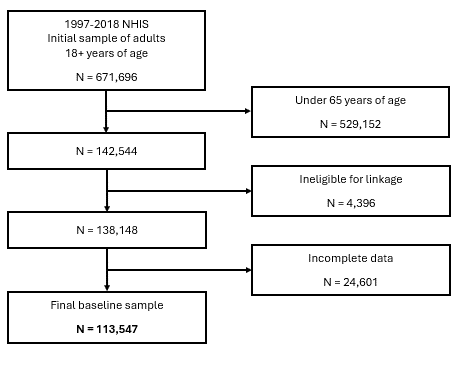
This study usedNational Health Interview Survey (NHIS)data along withNational Center for Health Statistics (NCHS) 2019 public-use linked mortality files 11, 12. NHIS is an annual survey that uses personal interviews to collect data onhealth-related topics. The current study used NHIS data from 1997 to 2018. The initial datasetconsisted of671,696 adults65+ years of age and, after exclusions, resulted in a final baseline sample of 113,547 adults (Figure 1).

Healthy lifestyle index (HLI)
The HLI was created using four health metrics that included alcohol use, smoking, PA, and BMI categories. Each health metric was converted to a 3-point intensity scale as discussed next. Alcohol use was assessed using a series of questions asking participants about their alcohol consumption history, alcohol consumption frequency, and alcohol consumption quantity. From these responses, an alcohol use metric variable was created that assigned participants to one of three score categories: lifetime abstainer (2), former drinker (1), or current drinker (0). Smoking status was assessed using a series of questions asking participants about their smoking history, smoking frequency, and smoking quantity. From these responses, a smoking metric variable was created that assigned participants to one of three score categories: never smoker (2), former smoker (1), or current smoker (0). PA was assessed by first computing a joint PA guidelines variable consisting of four groups: 1) those not meeting either aerobic PA or muscle strengthening (MS) guidelines (PAG1), 2) those meeting MS guidelines only (PAG2), 3) those meeting aerobic PAG only (PAG3), and 4) those meeting both aerobic PA and MS guidelines (PAG4). From these groups, a PA metric variable was created that assigned participants to one of three score categories of PAG4 (2), PAG2/PAG3 (1), or PAG1 (0). BMI (kg/m2) was assessed by first creating categories consisting of four groups: 1) those underweight (BMI < 18.5), 2) those normal weight (18.5 ≤ BMI < 25.0), 3) those overweight (25.0 ≥ BMI < 30.0), and 4) those obese (BMI ≥ 30.0). From these groups, a BMI metric variable was created that assigned participants to one of three score categories: normal weight (2), overweight (1), or underweight/obese (0). Finally, the HLI was created by summing across the four health metric variables, yielding a total score from 0 to 8, with larger values indicating better health.
Psychological distress
Psychological distress was assessed using the Kessler 6-item scale (K6) 13. Each K6 item had a similar stem of “During the past 30 days, how often did you feel…” and had a 5-point rating scale ranging from “all of the time (1)” to “none of the time (5).” The specific items targeted feelings of worthlessness, tiredness, hopelessness, fidgetiness, nervousness, and sadness. After reversing the scales, item responses were summed with total scores ranging from 6 to 30. Acategorical variable was finally created with groups consisting of no distress (6 to 13), mild-moderate distress (14 to 18), and serious distress (19 to 30) 14.
Functional limitations
A measure of functional limitations was assessed using the FL12 scale of functional limitation severity 15.The FL12 consists of 12 items assessing 6 areas of functional limitations. Briefly, the FL12 targets difficulties related to walking, stepping, standing, sitting, stooping, overhead reaching, grasping, lifting/carrying, pushing, relaxing, socializing, and going to events.Rating scale responses ranged from “Not at all difficult (0)” to “Can’t do at all (5)” with a total sum score ranging from 0 to 48. For this study, respondents were categorized as having any functional limitation if their FL12 score was greater than 0.
Chronic conditions
A chronic conditions variable was created from nine different disease conditions that included 1) coronary heart disease, 2) angina pectoris, 3) heart attack, 4) other heart conditions or diseases, 5) a stroke, 6) emphysema, 7) chronic bronchitis, 8) diabetes, and 9) cancer. If a participant indicated they were told by a doctor or other health professional that they had the condition, they were assigned a ‘1’, otherwise a ‘0’. A final chronic conditions variable was created where participants were assigned to groups of either none (0), one (1), two (2), or three plus (3+) conditions.
Assessment of covariates
For descriptive and statistical adjustment purposes, age, sex, race, and income variables were created.An age group variable was created with ranges of 65 to 74 years, 75 to 84 years, and 85+ years. A sex variable was used that included the conventional groups of male or female.The race/ethnicity variable categorized adults into groups of either White, Black, or Other. Finally, a crude income variable was created that assigned each participant into one of three ordinal groups of low, middle, or high income.
Statistical analyses
The sample was described using weighted percentages with 95% confidence intervals (CI). Additionally, the Rao-Scott chi-square (X²) statistic was used to test for differences in percentages across demographic and health status characteristics. Mean values of HLI with 95% CIs were displayed across age groups by sex with tests for linear trend in means. Cox proportional hazard models were employed to estimate the hazard ratios (HR) and 95% CL. Linear contrasts were included to test for linear trends in HR across HLI categories. Three different types of models were run: 1) four unadjusted models, each with a single categorical predictor variable (HLI, psychological distress, chronic conditions, and functional limitations); 2) a predictor-adjusted model with the four categorical predictor variables; and 3) a fully adjusted model with the four predictors as well as sex, age group, race, and income. SAS version 9.4 survey procedures were used for all analyses 16, 17.
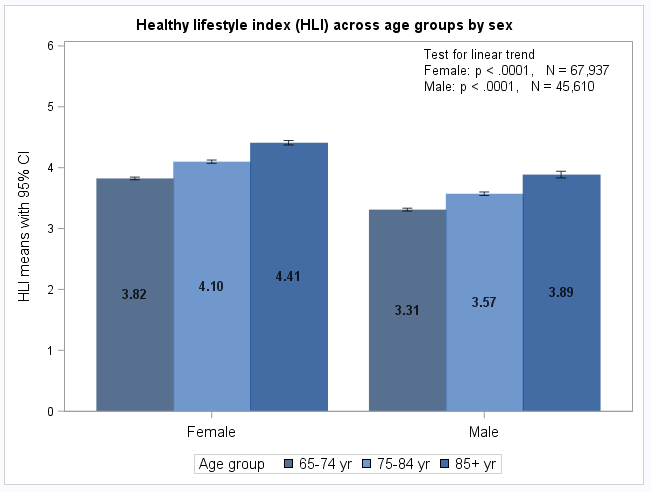
The median follow-up was 10.4 (SE=0.05) years, with a total of 51,607 deaths observed from all causes. A larger percentage of female (37.7%), 85+ years (42.9%), and Other race (49.4%) adults were categorized in the high HLI (HLI 5-8) group, as compared to their respective counterparts (Table 1). Additionally, a larger percentage of adults categorized with no psychological distress (31.9%), no chronic conditions (36.3%), and no functional limitations (38.2%) were categorized in the high HLI (HLI 5-8) group, as compared to their respective counterparts (Table 2). The HLI increased linearly (p<0.0001) across the three different age groups (65-74 yr, 75-84 yr, and 85+ yr) in both males (means: 3.31, 3.57, and 3.89) and females (means: 3.82, 4.10, and 4.41), respectively (Figure 2).
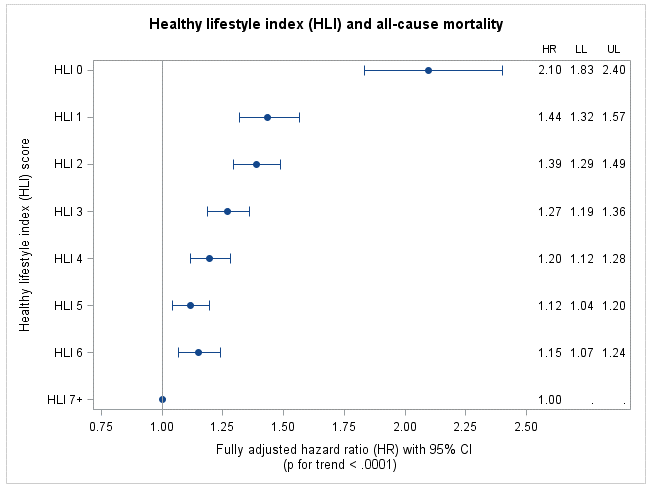
The unadjusted hazard model showed a significant (p<.0001) linear trend in HR across HLI score groups (Table 3). In the predictor-adjusted hazards model, risk of all-cause mortality decreased linearly (p<0.0001) for participants having an HLI of 0 (HR=1.58, 1.38-1.81), 1 (HR=1.17, 1.08-1.27), 2 (HR=1.23, 1.15-1.32), 3 (HR=1.23, 1.15-1.32), 4 (HR=1.19, 1.11-1.28), 5 (HR=1.16, 1.08-1.24), 6 (HR=1.26, 1.17-1.36), and 7+ (HR=1.00, reference) (Table 3). Finally, in the fully adjusted hazards model, risk of all-cause mortality decreased linearly (p<0.0001) for participants having an HLI of 0 (HR=2.10, 1.83-2.40), 1 (HR=1.44, 1.32-1.57), 2 (HR=1.39, 1.29-1.49), 3 (HR=1.27, 1.19-1.36), 4 (HR=1.20, 1.12-1.28), 5 (HR=1.12, 1.04-1.20), 6 (HR=1.15, 1.07-1.24), and 7+ (HR=1.00, reference) (Figure 3).


There are at least three findings from this study worthy of brief discussion. One is the fact that older females saw significantly higher HLI values than older males. When examining the literature regarding the individual healthy lifestyle factors, sex differences in risky behaviors appears to be mixed. That is, older females generally are found to have a greater prevalence of obesity, lower prevalence of alcohol use, lower prevalence of smoking, and lower prevalence of meeting PA guidelines, as compared to older males 18, 19, 20, 21, 22, 23. Thus, these results underscore the potential use of the HLI as a cumulative healthy lifestyle predictor for health outcomes. A future direction could be to examine the extent to which the HLI explainssex differentials in life expectancy at age 65 years 24. Another noteworthy finding is the fact that HLI scores climbed with increasing age. This was observed both in the prevalence of high HLI (HLI 5-8), from the descriptive portion of the study, as well as in mean HLI using formal tests of linear trend. As such, these findings may appear counterintuitive given the oldest of the old (i.e., 85+ years) have a much greater risk of mortality yet higher HLI on average. Two phenomena, however,may contribute to this paradox. One is that many health risk behaviors naturally decrease as older adults move to the oldest age groups 25. Two is that many older adults that died before reaching the oldest age groups may likely have participated in more risky behavior than their surviving counterparts 26. This in turn would create a more homogenous population of older surviving adults with a greater prevalence of healthy behaviors. The last noteworthy finding is that the risk of all-cause mortality maintained a linear trend across the HLI score groups in all three model types. Furthermore, each of the eight HLI score groups significantly predicted mortality risk in all three model types. These findings highlight the HLI as a sensitive measure for predicting mortality in older adult populations.
This study does have limitations. NHIS data are cross-sectional, and thus findings here can only be considered correlational. NHIS data are gathered using self-report interviews and thus are subject to recall bias and misclassification. Finally, the main measures used in this study are of subjective nature and subject to measurement error. Therefore, the findings from this study should be interpreted with these limitations in mind.
The HLI used in this study was found to be associated with all-cause mortality risk in older adults, independent of psychological distress, chronic conditions, functional limitations, and demographic covariates. Furthermore, the HLI was found to be sensitive enough to predict mortality across all score values and detect a dose-response. Adopting a healthy lifestyle may provide survival benefits even among the oldest age groups.
| [1] | Livingstone KM, Abbott G, Ward J, Bowe SJ. Unhealthy Lifestyle, Genetics and Risk of Cardiovascular Disease and Mortality in 76,958 Individuals from the UK Biobank Cohort Study. Nutrients. 2021; 13(12): 4283. Published 2021 Nov 27. | ||
| In article | View Article PubMed | ||
| [2] | Fried LP, Kronmal RA, Newman AB, et al. Risk factors for 5-year mortality in older adults: the Cardiovascular Health Study. JAMA. 1998; 279(8): 585-592. | ||
| In article | View Article PubMed | ||
| [3] | Chakravarty EF, Hubert HB, Krishnan E, Bruce BB, Lingala VB, Fries JF. Lifestyle risk factors predict disability and death in healthy aging adults. Am J Med. 2012; 125(2): 190-197. | ||
| In article | View Article PubMed | ||
| [4] | Chudasama YV, Khunti K, Gillies CL, et al. Healthy lifestyle and life expectancy in people with multimorbidity in the UK Biobank: A longitudinal cohort study. PLoS Med. 2020; 17(9): e1003332. Published 2020 Sep 22. | ||
| In article | View Article PubMed | ||
| [5] | Qiao L, Wang Y, Deng Y, et al. Combined healthy lifestyle behaviors and all-cause mortality risk in middle-aged and older US adults: A longitudinal cohort study. Arch Gerontol Geriatr. 2025; 130: 105702. | ||
| In article | View Article PubMed | ||
| [6] | Zhang J, Liu J, Feng Y, Meng H, Wang Y, Wang J. Disparities in lifestyle among community-dwelling older adults with or without mild cognitive impairment: a population-based study in north-western China. Front Public Health. 2025; 13: 1533095. Published 2025 May 8. | ||
| In article | View Article PubMed | ||
| [7] | Qi Y, Zhang Z, Fu X, et al. Adherence to a healthy lifestyle and its association with cognitive impairment in community-dwelling older adults in Shanghai. Front Public Health. 2023; 11: 1291458. Published 2023 Dec 18. | ||
| In article | View Article PubMed | ||
| [8] | Yang JM, Hwang J. Effect of healthy lifestyle score trajectory on all-cause mortality in the late middle-aged and older population: Finding from 17-year retrospective cohort study. Exp Gerontol. 2025; 200: 112681. | ||
| In article | View Article PubMed | ||
| [9] | Delgado-Velandia M, Maroto-Rodríguez J, Ortolá R, Rodríguez-Artalejo F, Sotos-Prieto M. The role of lifestyle in the association between frailty and all-cause mortality amongst older adults: a mediation analysis in the UK Biobank. Age Ageing. 2023; 52(6): afad092. | ||
| In article | View Article PubMed | ||
| [10] | Jin S, Li C, Cao X, Chen C, Ye Z, Liu Z. Association of lifestyle with mortality and the mediating role of aging among older adults in China. Arch Gerontol Geriatr. 2022; 98: 104559. | ||
| In article | View Article PubMed | ||
| [11] | National Center for Health Statistics. CDC. About NHIS. National Health Interview Survey. Published November 21, 2024. https://www.cdc.gov/nchs/nhis/about/index.html | ||
| In article | |||
| [12] | National Center for Health Statistics. Public-Use Linked Mortality Files. National Center for HealthStatistics. Updated May 2022. https://www.cdc.gov/nchs/data/datalinkage/public-use-linked-mortality-file-description.pdf. | ||
| In article | |||
| [13] | Kessler RC, Barker PR, Colpe LJ, et al. Screening for serious mental illness in the general population. Arch Gen Psychiatry. 2003; 60(2): 184-189. | ||
| In article | View Article PubMed | ||
| [14] | Choi NG, Sullivan JE, DiNitto DM, Kunik ME. Associations between psychological distress and health-related behaviors among adults with chronic kidney disease. Prev Med. 2019; 126: 105749. | ||
| In article | View Article PubMed | ||
| [15] | Jones GC, Crews JE. Health disparities among workers and nonworkers with functional limitations: implications for improving employment in the United States. Disabil Rehabil. 2013; 35(17): 1479-1490. | ||
| In article | View Article PubMed | ||
| [16] | Allison PD. Survival analysis using SAS: a practical guide. Sas Institute; 2010 Mar 29. | ||
| In article | |||
| [17] | SAS Institute Inc. 2013. Introduction to Survival Analysis Procedures. SAS/STAT® 13.1 User’s Guide. Cary, NC: SAS Institute Inc. | ||
| In article | |||
| [18] | Emmerich SD, Fryar CD, Stierman B, Ogden CL. Obesity and severe obesity prevalence in adults: United States, August 2021–August 2023. NCHS Data Brief, no 508. Hyattsville, MD: National Center for Health Statistics. 2024. | ||
| In article | View Article | ||
| [19] | White AM. Gender Differences in the Epidemiology of Alcohol Use and Related Harms in the United States. Alcohol Res. 2020; 40(2): 01. Published 2020 Oct 29. | ||
| In article | View Article PubMed | ||
| [20] | Bares CB, Kennedy A. Alcohol use among older adults and health care utilization. Aging Ment Health. 2021; 25(11): 2109-2115. | ||
| In article | View Article PubMed | ||
| [21] | Kirkland S, Greaves L, Devichand P. Gender Differences in Smoking and Self Reported Indicators of Health. BMC Womens Health. 2004; 4 Suppl 1(Suppl 1): S7. Published 2004 Aug 25. | ||
| In article | View Article PubMed | ||
| [22] | Syamlal G, Mazurek JM, Dube SR. Gender differences in smoking among U.S. working adults. Am J Prev Med. 2014; 47(4): 467-475. | ||
| In article | View Article PubMed | ||
| [23] | Elgaddal N, Kramarow EA, Reuben C. Physical activity among adults aged 18 and over: United States, 2020. NCHS Data Brief, no 443. Hyattsville, MD: National Center for Health Statistics. 2022. | ||
| In article | View Article PubMed | ||
| [24] | Murphy SL, Kochanek KD, Xu JQ, Arias E. Mortality in the United States, 2023. NCHS Data Brief, no 521. Hyattsville, MD: National Center for Health Statistics. 2024. | ||
| In article | |||
| [25] | Kamimoto LA, Easton AN, Maurice E, Husten CG, Macera CA. Surveillance for five health risks among older adults--United States, 1993-1997. MMWR CDC Surveill Summ. 1999; 48(8): 89-130. | ||
| In article | |||
| [26] | Løvsletten O, Brenn T. Healthy Choices in Midlife Predict Survival to Age 85 in Women: The Tromsø Study 1979-2019. Int J Environ Res Public Health. 2022; 19(9): 5219. Published 2022 Apr 25. | ||
| In article | View Article PubMed | ||
Published with license by Science and Education Publishing, Copyright © 2025 Peter D. Hart
 This work is licensed under a Creative Commons Attribution 4.0 International License. To view a copy of this license, visit
http://creativecommons.org/licenses/by/4.0/
This work is licensed under a Creative Commons Attribution 4.0 International License. To view a copy of this license, visit
http://creativecommons.org/licenses/by/4.0/
| [1] | Livingstone KM, Abbott G, Ward J, Bowe SJ. Unhealthy Lifestyle, Genetics and Risk of Cardiovascular Disease and Mortality in 76,958 Individuals from the UK Biobank Cohort Study. Nutrients. 2021; 13(12): 4283. Published 2021 Nov 27. | ||
| In article | View Article PubMed | ||
| [2] | Fried LP, Kronmal RA, Newman AB, et al. Risk factors for 5-year mortality in older adults: the Cardiovascular Health Study. JAMA. 1998; 279(8): 585-592. | ||
| In article | View Article PubMed | ||
| [3] | Chakravarty EF, Hubert HB, Krishnan E, Bruce BB, Lingala VB, Fries JF. Lifestyle risk factors predict disability and death in healthy aging adults. Am J Med. 2012; 125(2): 190-197. | ||
| In article | View Article PubMed | ||
| [4] | Chudasama YV, Khunti K, Gillies CL, et al. Healthy lifestyle and life expectancy in people with multimorbidity in the UK Biobank: A longitudinal cohort study. PLoS Med. 2020; 17(9): e1003332. Published 2020 Sep 22. | ||
| In article | View Article PubMed | ||
| [5] | Qiao L, Wang Y, Deng Y, et al. Combined healthy lifestyle behaviors and all-cause mortality risk in middle-aged and older US adults: A longitudinal cohort study. Arch Gerontol Geriatr. 2025; 130: 105702. | ||
| In article | View Article PubMed | ||
| [6] | Zhang J, Liu J, Feng Y, Meng H, Wang Y, Wang J. Disparities in lifestyle among community-dwelling older adults with or without mild cognitive impairment: a population-based study in north-western China. Front Public Health. 2025; 13: 1533095. Published 2025 May 8. | ||
| In article | View Article PubMed | ||
| [7] | Qi Y, Zhang Z, Fu X, et al. Adherence to a healthy lifestyle and its association with cognitive impairment in community-dwelling older adults in Shanghai. Front Public Health. 2023; 11: 1291458. Published 2023 Dec 18. | ||
| In article | View Article PubMed | ||
| [8] | Yang JM, Hwang J. Effect of healthy lifestyle score trajectory on all-cause mortality in the late middle-aged and older population: Finding from 17-year retrospective cohort study. Exp Gerontol. 2025; 200: 112681. | ||
| In article | View Article PubMed | ||
| [9] | Delgado-Velandia M, Maroto-Rodríguez J, Ortolá R, Rodríguez-Artalejo F, Sotos-Prieto M. The role of lifestyle in the association between frailty and all-cause mortality amongst older adults: a mediation analysis in the UK Biobank. Age Ageing. 2023; 52(6): afad092. | ||
| In article | View Article PubMed | ||
| [10] | Jin S, Li C, Cao X, Chen C, Ye Z, Liu Z. Association of lifestyle with mortality and the mediating role of aging among older adults in China. Arch Gerontol Geriatr. 2022; 98: 104559. | ||
| In article | View Article PubMed | ||
| [11] | National Center for Health Statistics. CDC. About NHIS. National Health Interview Survey. Published November 21, 2024. https://www.cdc.gov/nchs/nhis/about/index.html | ||
| In article | |||
| [12] | National Center for Health Statistics. Public-Use Linked Mortality Files. National Center for HealthStatistics. Updated May 2022. https://www.cdc.gov/nchs/data/datalinkage/public-use-linked-mortality-file-description.pdf. | ||
| In article | |||
| [13] | Kessler RC, Barker PR, Colpe LJ, et al. Screening for serious mental illness in the general population. Arch Gen Psychiatry. 2003; 60(2): 184-189. | ||
| In article | View Article PubMed | ||
| [14] | Choi NG, Sullivan JE, DiNitto DM, Kunik ME. Associations between psychological distress and health-related behaviors among adults with chronic kidney disease. Prev Med. 2019; 126: 105749. | ||
| In article | View Article PubMed | ||
| [15] | Jones GC, Crews JE. Health disparities among workers and nonworkers with functional limitations: implications for improving employment in the United States. Disabil Rehabil. 2013; 35(17): 1479-1490. | ||
| In article | View Article PubMed | ||
| [16] | Allison PD. Survival analysis using SAS: a practical guide. Sas Institute; 2010 Mar 29. | ||
| In article | |||
| [17] | SAS Institute Inc. 2013. Introduction to Survival Analysis Procedures. SAS/STAT® 13.1 User’s Guide. Cary, NC: SAS Institute Inc. | ||
| In article | |||
| [18] | Emmerich SD, Fryar CD, Stierman B, Ogden CL. Obesity and severe obesity prevalence in adults: United States, August 2021–August 2023. NCHS Data Brief, no 508. Hyattsville, MD: National Center for Health Statistics. 2024. | ||
| In article | View Article | ||
| [19] | White AM. Gender Differences in the Epidemiology of Alcohol Use and Related Harms in the United States. Alcohol Res. 2020; 40(2): 01. Published 2020 Oct 29. | ||
| In article | View Article PubMed | ||
| [20] | Bares CB, Kennedy A. Alcohol use among older adults and health care utilization. Aging Ment Health. 2021; 25(11): 2109-2115. | ||
| In article | View Article PubMed | ||
| [21] | Kirkland S, Greaves L, Devichand P. Gender Differences in Smoking and Self Reported Indicators of Health. BMC Womens Health. 2004; 4 Suppl 1(Suppl 1): S7. Published 2004 Aug 25. | ||
| In article | View Article PubMed | ||
| [22] | Syamlal G, Mazurek JM, Dube SR. Gender differences in smoking among U.S. working adults. Am J Prev Med. 2014; 47(4): 467-475. | ||
| In article | View Article PubMed | ||
| [23] | Elgaddal N, Kramarow EA, Reuben C. Physical activity among adults aged 18 and over: United States, 2020. NCHS Data Brief, no 443. Hyattsville, MD: National Center for Health Statistics. 2022. | ||
| In article | View Article PubMed | ||
| [24] | Murphy SL, Kochanek KD, Xu JQ, Arias E. Mortality in the United States, 2023. NCHS Data Brief, no 521. Hyattsville, MD: National Center for Health Statistics. 2024. | ||
| In article | |||
| [25] | Kamimoto LA, Easton AN, Maurice E, Husten CG, Macera CA. Surveillance for five health risks among older adults--United States, 1993-1997. MMWR CDC Surveill Summ. 1999; 48(8): 89-130. | ||
| In article | |||
| [26] | Løvsletten O, Brenn T. Healthy Choices in Midlife Predict Survival to Age 85 in Women: The Tromsø Study 1979-2019. Int J Environ Res Public Health. 2022; 19(9): 5219. Published 2022 Apr 25. | ||
| In article | View Article PubMed | ||