sciepub.com
 Quick Submission

The Moment Approximation of the First–Passage Time for the Birth–Death Diffusion Process with Immigraton to a Moving Linear Barrier
Basel M. Al-Eideh
Abstract
Today, the the development of a mathematical models for population growth of great importance in many fields. The growth and decline of real populations can in many cases be well approximated by the solutions of a stochastic differential equations. However, there are many solutions in which the essentially random nature of population growth should be taken into account. In this paper, we approximating the moments of the first – passage time for the birth and death diffusion process with immigration to a moving linear barriers. This was done by approximating the differential equations by an equivalent difference equations. A simulation study is considered and applied to some values of parameters which showed the capability of the technique.
Keywords: first passage time, birth-death diffusion process, immigration, difference equations
Received April 06, 2015; Revised September 01, 2015; Accepted September 20, 2015
Copyright © 2015 Science and Education Publishing. All Rights Reserved.Cite this article:
- Basel M. Al-Eideh. The Moment Approximation of the First–Passage Time for the Birth–Death Diffusion Process with Immigraton to a Moving Linear Barrier. American Journal of Applied Mathematics and Statistics. Vol. 3, No. 5, 2015, pp 184-189. http://pubs.sciepub.com/ajams/3/5/2
- Al-Eideh, Basel M.. "The Moment Approximation of the First–Passage Time for the Birth–Death Diffusion Process with Immigraton to a Moving Linear Barrier." American Journal of Applied Mathematics and Statistics 3.5 (2015): 184-189.
- Al-Eideh, B. M. (2015). The Moment Approximation of the First–Passage Time for the Birth–Death Diffusion Process with Immigraton to a Moving Linear Barrier. American Journal of Applied Mathematics and Statistics, 3(5), 184-189.
- Al-Eideh, Basel M.. "The Moment Approximation of the First–Passage Time for the Birth–Death Diffusion Process with Immigraton to a Moving Linear Barrier." American Journal of Applied Mathematics and Statistics 3, no. 5 (2015): 184-189.
| Import into BibTeX | Import into EndNote | Import into RefMan | Import into RefWorks |
At a glance: Figures
1. Introduction
First – passage time play an important rule in the area of applied probability theory especially in stochastic modeling. Several examples of such problems are the extinction time of a branching process, or the cycle lengths of a certain vehicle actuated traffic signals. Actually the the first – passage times to a moving barriers for diffusion and other markov processes arises im biological modeling (Cf. Ewens [8]), in statistics (Cf. Darling and Siegert [6] and Durbin [7]) and in engineering (Cf. Blake and Lindsey [4]).
Many important results related to the first – passage time have been studied from different points of view of different authors. For example, McNeil [13] has derived the distribution of the integral functional
 |
where  is the first – passage time to the origin in a general birth – death process with X(0) = x and g(.) is an arbitrary function. Also, Iglehart [10], McNeil and Schach [14] have been shown a number of classical birth and death processes upon taking diffusion limits to asympotically approach the Ornstein – Uhlenbeck (O.U.).
Many properties such as a first – passage time to a barrier, absorbing or reflecting, located some distance from an initial starting point of the O.U. process and the related diffusion process and the related diffusion process such as the case of the first passage time of a Wiener process to a linear barrier is a closed form expression for the density available is discussed in Cox and Miller [5]. Also, others such as, Karlin and Taylor [11], Thomas [15], Ferebee [9], Tuckwell and Wan [16], Alawneh and Al-Eideh [1], Al-Eideh [2, 3] etc. have been discussed the first passage time from different points of view.
In particular, Thomas (1975) describes some mean first – passage time approximation for the Ornstein – Uhlendeck process. Tuckwell and Wan [16] have studied the first-passage time of a Markov process to a moving barriers as a first-exit time for a vector whose components include the process and the barrier.
Alawneh and Al-Eideh [1] have discussed the problem of finding the moments of the first passage time distribution for the Ornstien-Uhlenbeck process with a single absorbing barrier using the method of approximating the differential equations by difference equations.
Also, Al-Eideh [2, 3] has discussed the problem of finding the moments of the first passage time distribution for the birth-death diffusion and the Wright-Fisher diffusion processes to a moving linear barriers and to a single absorbing barrier, respectively using the method of approximating the differential equations by difference equations.
In this paper, we consider the birth and death diffusion process with immigration and study the first – passage time for such a process to a moving linear barrier. More specifically, the moment approximations are derived using the method of difference equations used in Al-Eideh [3] considering the immigration rate  .
.
2. First – Passage Time Moment Approximations
Consider the birth and death diffusion Process with immigration  with infinitesimal mean
  and variance
  starting at some
  > 0, where
  and
and  are the drift and the diffusion coefficients respectively and
 is the constant immigration rate. Also,
  is a Markov process with state space
  and satisfies the Ito stochastic differential equation
 | (1) |
Where  is a standard Wiener process with zero mean and variance t. Assume that the existence and uniqueness conditions are satisfied (Cf. Gihman and Skorohod). Let
  be a moving linear barrier equation such that
  , with
  . Or equivalently
  .
.
Now, denote the first – passage time of a process  to a moving linear barrier
  by the random variables
 | (2) |
with probability density function
 |
Here p ( , x ; t) is the probability density function of X (t) conditional on X (0) =
Let  ; n = 1,2,3,……, be the n-th moment of the first – passage time
  , i.e.
 | (3) |
It follows from the forward Kolmogorov equation that the n-th moment of  must satisfy the ordinary differential equation
 | (4) |
Or equivalently
 | (5) |
Where  and
and  are the first derivatives of
  with respect to
 , with appropriate boundary conditions for n=1,2,3,……. Note that
Now, rewrite the equation in (5), we obtain
 | (6) |
Let  be the difference operator. Then we defined the first order difference of
  as follows:
 | (7) |
(Cf. Kelly and Peterson [12]).
Note that equation (6) can be approximated by
 | (8) |
By applying equation (7) to equation (8) we get :
 | (9) |
Now, we will use the matrix theory to solve the differential equation defined in equation (9). If we let
 |
Then we get
 | (10) |
Where
 |
Now let
 | (11) |
This imply
 | (12) |
Apply to equation (10), we get
 | (13) |
Where I is the identity matrix and 0 is the zero matrix.
Thus, the solution of the system of equation in (13) is then given by
 | (14) |
Where  = [
= [ ] ;
] ;  is the diagonal matrix with entries
 | (15) |
And  is the matrix with entries
 | (16) |
Note that the matrix  where
where  is defined by
 |
This series is convergent since it is a cauchy operator of equation (2.6) (Cf. Zeifman [17]).
3. Simmulation Study
In this section we will consider the simmulating the birth and death diffusion process with immigration  as considered in equation (1) as well as approximating the moments of the first-passage time for such a process using the first and the second order difference operators to the differential equation in (9).
For simulation of the process  we used the following discrete approximation.
For integer values  , and
, and  , define
 | (17) |
where  is an independent sequence of standard normal random variables.
For each set of positive integers  the sequence of random vecrors
  converges in distribution to
  . As an example
  is chosen to be 50, i.e. each unit of time is broken into 50 steps for the purpose of simulating
  , with
  . Therefore, the following graph, Figure 1, represents the simulated process when
  and the parameters are set to
  ,
,  and
and  .
.

 Download as

Now for approximating the moments of the first-passage time for such a process using the first and the second order difference operators to the differential equation in (9), we define the operators as follows:
Let  be the second order difference operators. Then we defined the second order differences of
  and as follows:
 | (18) |
(Cf. Kelley and Peterson [12]).
Note that equation (9) can be approximated by
 | (19) |
By applying equation (18) to equation (19) we get:
 | (20) |
Now rewriting equation (20) we get:
 | (21) |
Through equation (21), the first moment  and the second moment
  of the first –passage time can be approximated by
 | (22) |
and
 | (23) |
Following the above example of such a process shown in Figure 1 assuming different values for the parameter  where
where  , we set the following Figures for the first moment
  and the second moment
  of the first –passage time.
 Download as
 Download as
 Download as
 Download as
 Download as
 Download as
 Download as
 Download as
 Download as
 Download as
 Download as
 Download as
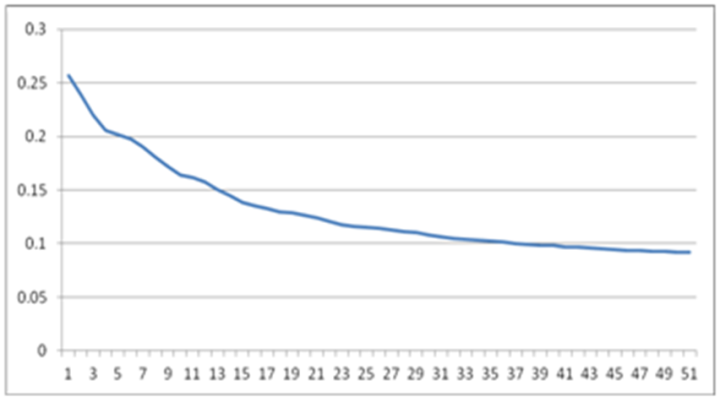
The above figures of the first monent  of the first-passage time of the process show the growth exponentially for the suggested values of the parameter
  even when
  and converges as the time increased. But on the contrary the second moment
  of the first-passage time of the process show decline for the same suggested values of
  even when
  and converges as time increased too.
4. Conclusion
In conclusion the advantage of this technique is to use the difference equation to approximate the ordinary differential equation since it is the discretization of the ODE. Also, the system of the solutions in equation (14) gives an explicit solution to the first – passage time moments for the birth and death diffusion process with immigration to a moving linear barriers. This increases the applicability of the diffusion process in stochastic modeling or in all area of applied probability theory. For further study I think it is possible to set up an exact or an approximated technique to predict the parameters of the suggested process and the open a possibility to be applied to a real life problem.
Support
This work was supported by Kuwait University, Research Grant No. [IQ 03/12].
References
| [1] | A. J. Alawneh and B. M. Al-Eideh, Moment approximation of the first-passage time for the Ornstein-Uhlenbeck process. Intern. Math. J. Vol.1 (2002), No.3, 255-258. | ||
 In article In article | |||
| [2] | B. M. Al-Eideh, First-passage time moment approximation for the Right-Fisher diffusion process with absorbing barriers. Intern. J. Contemp Math. Sciences, Vol.5 (2010), No.27, 1303-1308. | ||
| In article | |||
| [3] | B. M. Al-Eideh, First-passage time moment approximation for the birth-death diffusion process to a moving linear barriers. J. Stat. & Manag. Systems, Vol.7 (2004), No.1, 173-181. | ||
| In article | |||
| [4] | I. F. Blake and W. C. Lindsey, Level crossing problems for random processes. IEEE Trans. Information Theory 19 (1973), 295-315. | ||
| In article | View Article | ||
| [5] | D. R. Cox and H. D. Miller, The theory of stochastic processes. Methuen, London (1965). | ||
| In article | |||
| [6] | D. Darling and A. J. F. Siegert, The first - passage problem for a continuos Markov process. Ann. Math. Statist. 24 (1953), 624-639. | ||
| In article | View Article | ||
| [7] | J.Durbin, Boundary - crossing probabilities for the Brownian motion and Poisson processes and techniques for computing the power of the Kolmogorov-Smirnov test. J. Appl. Prob. 8 (1971), 431-453. | ||
| In article | View Article | ||
| [8] | W. J. Ewens, Mathematical Population Genetics. Springer-Verlag, Berlin (1979). | ||
| In article | |||
| [9] | B. Ferebee, The tangent approximation to one-sided Brownian exit densities. Z. Wahrscheinlichkeitsth 61 (1982), 309-326. | ||
| In article | View Article | ||
| [10] | D. L. Iglehart, Limiting diffusion approximation for the many server queueand the repairman problem. J. Appl. Prob. 2 (1965), 429-441. | ||
| In article | View Article | ||
| [11] | S. Karlin and H. M. Taylor, A Second Course in Stochastic Processes. Academic press. New York (1981). | ||
| In article | |||
| [12] | W.G. Kelly and A.C. Peterson, Difference Equations : An Introduction with Applications. Academic Press, New York (1991). | ||
| In article | |||
| [13] | D. R. McNeil, Integral functionals of birth and death processes and related limiting distributions. Ann. Math. Statist. 41 (1970), 480-485. | ||
| In article | View Article | ||
| [14] | D. R. McNeil and S. Schach, Central limit analogues for Markov population processes. J. R. Statist. Soc. B, 35 (1973), 1-23. | ||
| In article | |||
| [15] | M. U. Thomas, Some mean first passage time approximations for the Ornstein – Uhlenbeck process.J. Appl. Prob. 12 (1975), 600-604. | ||
| In article | View Article | ||
| [16] | H. C. Tuchwell and F. Y. M. Wan, First-passage time of Markov processes to moving barriers. J. Appl. Prob. Vol. 21 (1984), 695-709. | ||
| In article | View Article | ||
| [17] | A. I. Zeifman, Some estimates of the rate of convergence for birth and death processes. J. Appl. Prob. 28 (1991), 268-277. | ||
| In article | View Article | ||
 CiteULike
 Mendeley
 StumbleUpon
 Delicious
 Facebook
 Twitter
 LinkedIn
 when a=0.5, b=0.02 and ε=0.02)
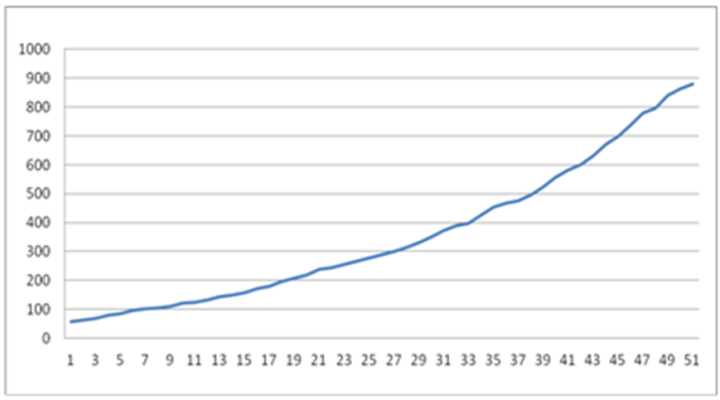
 of the Process X(t) when a=0.5, b=0.02, ε=0.02 and c=0)
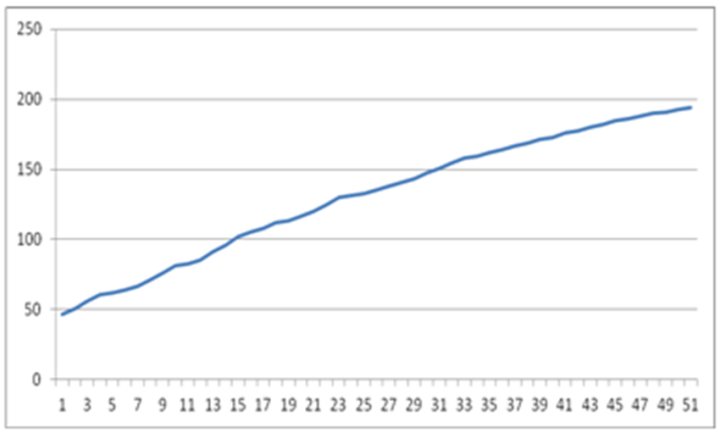
 of the Process X(t) when a=0.5, b=0.02, ε=0.02 and c=0)
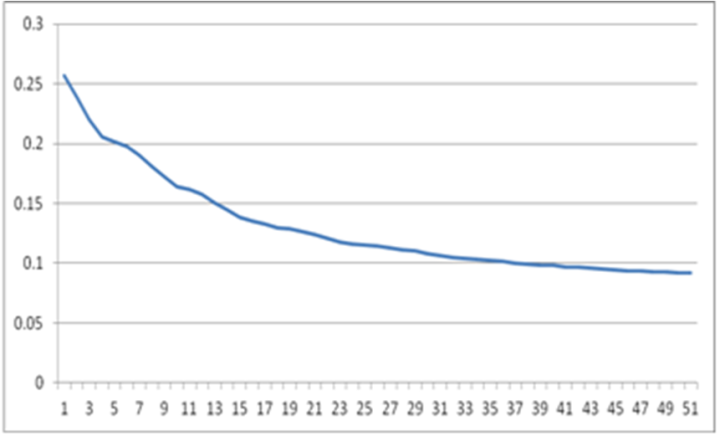
 of the Process X(t) when a=0.5, b=0.02, ε=0.02 and c=0.02)
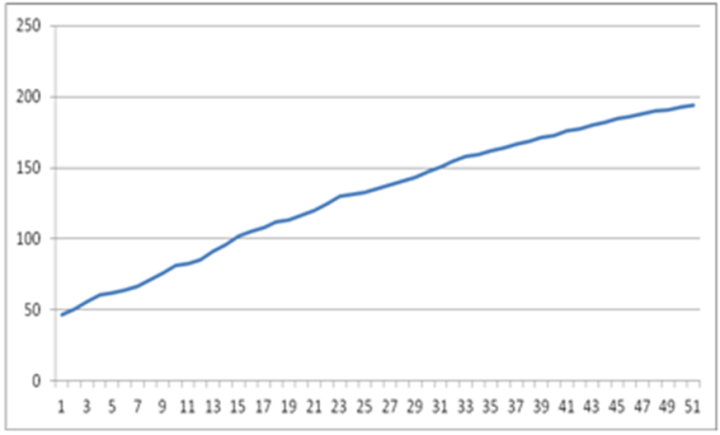
 of the Process X(t) when a=0.5, b=0.02, ε=0.02 and c=0.02)
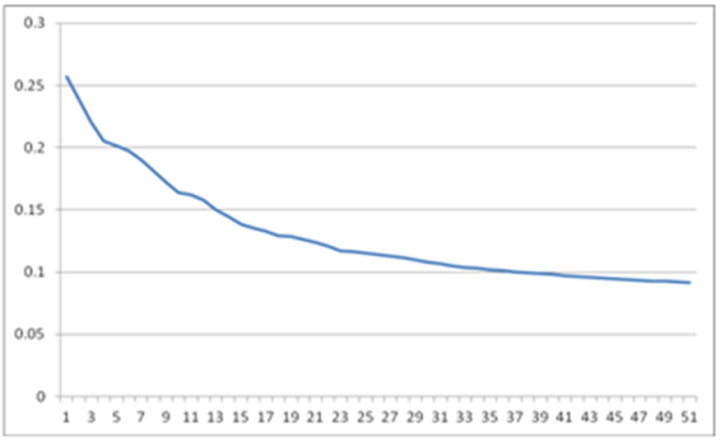
 of the Process X(t) when a=0.5, b=0.02, ε=0.02 and c=0.1)
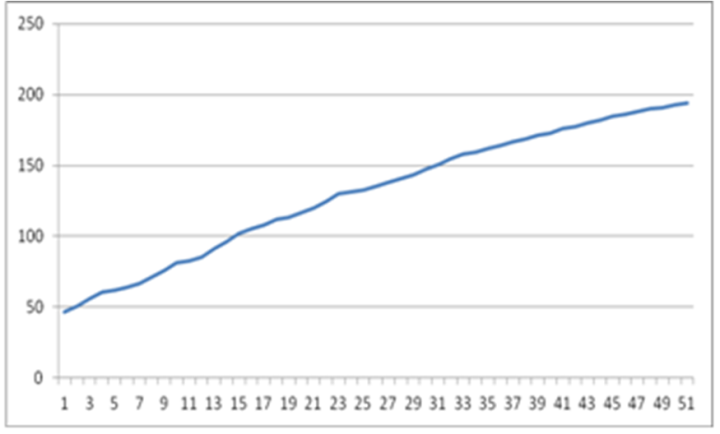
 of the Process X(t) when a=0.5, b=0.02, ε=0.02 and c=0.1)
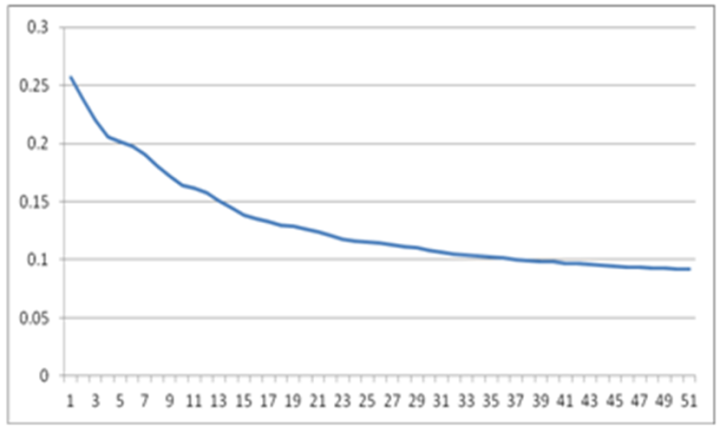
 of the Process X(t) when a=0.5, b=0.02, ε=0.02 and c=0.5)
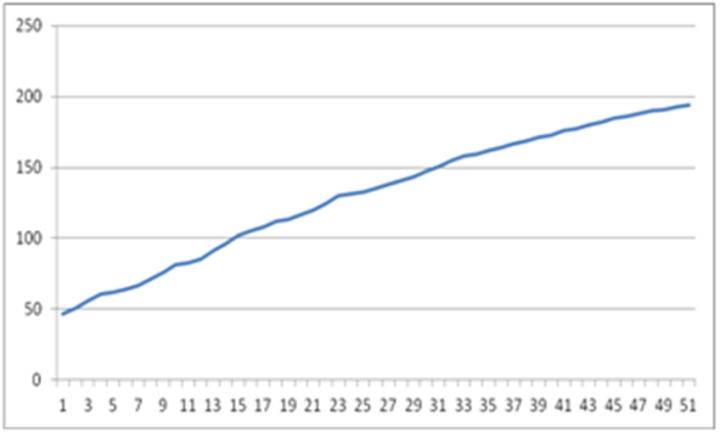
 of the Process X(t) when a=0.5, b=0.02, ε=0.02 and c=0.5)
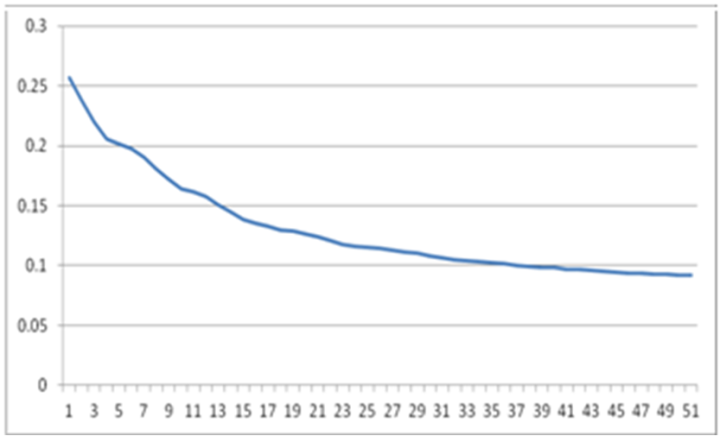
 of the Process X(t) when a=0.5, b=0.02, ε=0.02 and c=1)
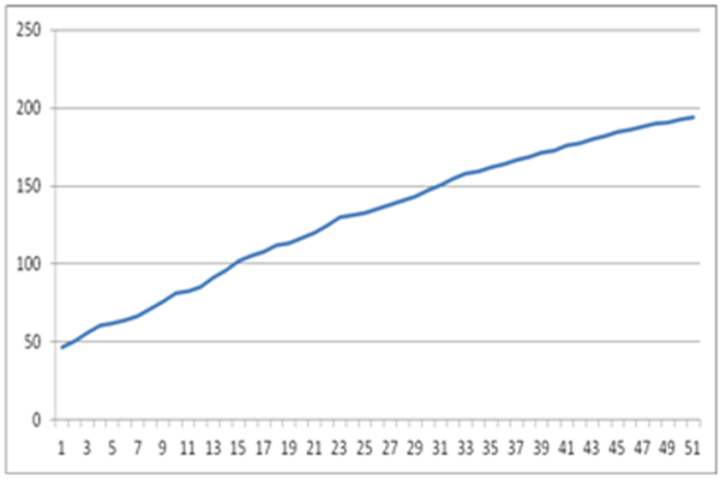
 of the Process X(t) when a=0.5, b=0.02, ε=0.02 and c=1)
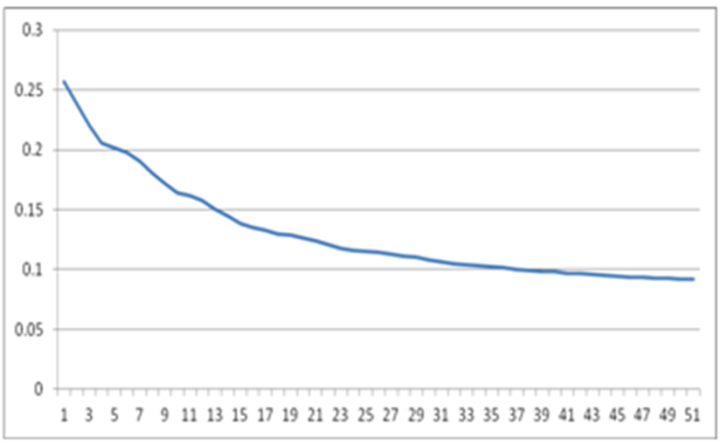
 of the Process X(t) when a=0.5, b=0.02, ε=0.02 and c=5)
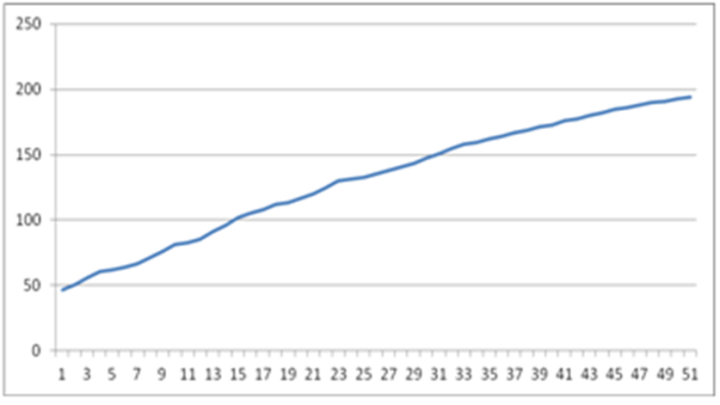
 of the Process X(t) when a=0.5, b=0.02, ε=0.02 and c=5)