 OPEN ACCESS
  PEER-REVIEWED
Total Domination Subdivision Number in Strong Product Graph
P. Jeyanthi1, , G. Hemalatha2, B. Davvaz3
1Department of Mathematics, Govindammal Aditanar College for Women, Tiruchendur, Tamil Nadu, India
2Department of mathematics, Shri Andal Alagar College of Engineering, Mamandur, Kancheepuram, Tamil Nadu, India
3Department of Mathematics, Yazd University, Yazd, Iran
Abstract
A set D of vertices in a graph G(V,E) is called a total dominating set if every vertex v∈V is adjacent to an element of D. The domination subdivision number of a graph G is the minimum number of edges that must be subdivided in order to increase the domination number of a graph. In this paper, we determine the total domination number for strong product graph and establish bounds on the total domination subdivision number for strong product graph.
At a glance: Figures
Keywords: total dominating set, strong product graph, total domination number
American Journal of Applied Mathematics and Statistics, 2014 2 (4),
pp 216-219.
DOI: 10.12691/ajams-2-4-7
Received June 03, 2014; Revised July 25, 2014; Accepted July 28, 2014
Copyright © 2013 Science and Education Publishing. All Rights Reserved.Cite this article:
- Jeyanthi, P., G. Hemalatha, and B. Davvaz. "Total Domination Subdivision Number in Strong Product Graph." American Journal of Applied Mathematics and Statistics 2.4 (2014): 216-219.
- Jeyanthi, P. , Hemalatha, G. , & Davvaz, B. (2014). Total Domination Subdivision Number in Strong Product Graph. American Journal of Applied Mathematics and Statistics, 2(4), 216-219.
- Jeyanthi, P., G. Hemalatha, and B. Davvaz. "Total Domination Subdivision Number in Strong Product Graph." American Journal of Applied Mathematics and Statistics 2, no. 4 (2014): 216-219.
| Import into BibTeX | Import into EndNote | Import into RefMan | Import into RefWorks |
1. Introduction
Let  be a simple graph on the vertex set V. In a graph G, a set
  is a dominating set of G if every vertex in
  is adjacent to some vertex in D. The domination number of a graph G is the minimum size of a dominating set of vertices in G, denoted by
  . A thorough study of fundamental domination appears in [2]. The concept of total domination in graphs was introduced by Cokayne, Dawes and Hedetemini [1]. A set of vertices in a graph
  is called a total dominating set if every vertex
  is adjacent to an element of S. The total domination number of some cartesian products of two paths
  and
and  , are investigated in [8, 9]. The values of
  for n = 2, 3, 4 are determined in [8], and for n = 5, 6 are determined in [9].
Let G and H be the two graphs with the set of vertices  and
and  respectively. The strong product of G and H is the graph
  formed by the vertices
  and two vertices
  and
and  are adjacent in
  if and only if
 or
or  Domination number is rather difficult to construct graphs with large value of
  and the first conjecture on this subject was that
  for every G [10]. The concept of total domination subdivision number
  was due to Haynes et al [3]. Haynes et.al [4] studied the total domination subdivision number of graphs, for instance, they showed that
  holds for a graph having three or more pair wise adjacent simplicial vertices. In [5] the authors proved the total domination subdivision number of trees. Constant upper bounds on the total domination number for several families of graphs were determined in [3]. Nasrin Soltankhah showed that for any
 [7]. The behaviour of several graph parameters in product graphs has become an interesting topic of research [6]. G. Yero and J. A. Rodr´ıguez-Vel´azquez [11] proved that for any
  In this paper is to establish a bound of this type on
2. Main Result
In this section, we first determine the value of the total domination number of  for
for  Since
Since  we have:
Proposition 2.1. For any  we have
 |
Lemma 2.2. We have 
Proof: To obtain totally dominate the vertices  and
and  we need two vertices
  and
and  Therefore,
  . Last column of
  is totally dominated by
  Hence,
  Let us consider
  as block B. The last three columns of
  is block B. The first column of
  can be totally dominated by B. Hence,
  In
In  , to totally dominate a vertex
  we need one vertex among
  Hence,
  The first three columns of
  is block B and also the last column of
  is totally dominated by the fourth column. This completes the proof.
Proposition 2.3. For any  , we have
 |
Proof:


 PowerPoint Slide
 Larger image(png format)


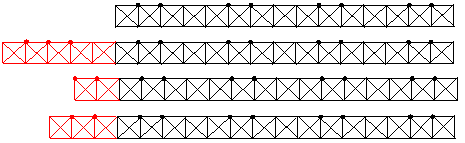
Figure 1. 
Let S be a total dominating set of  Since
Since  Suppose that
  and
and  are four consecutive columns of
  To totally dominate the vertices
  and
and  we need one vertex among
  and one more vertex among
  Now, to describe the total dominating set S, we consider block
  and
and  If
If  then
then  can be partitioned with
  number of blocks B. If
  then
then  can be partitioned with
  number of blocks B, plus a block
  and
and  . If
. If  then
then  can be partitioned with
  number of blocks B, plus a block
  and
and  . If
. If  then
then  can be partitioned with
  number of blocks B, plus a block
  and
and  This completes the proof.
Proposition 2.4. For  the total domination number of
  and
and  are same.
Proof: Last two rows of  is considered as blocks
  and the first row of
  is totally dominated by B, which completes the proof.
Observation 2.5. For  , we have
Proposition 2.6. For any  we have
Proof:


 PowerPoint Slide
 Larger image(png format)
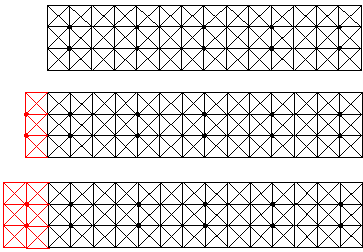
Suppose that S is a total dominating set of  . Let us consider
  as block. Since the total domination number of
  is 2. We have
  . Let
. Let  and
and  be three consecutive columns of
  To totally dominate the vertices
  and
and  we need one vertex among
  and one more vertex among
 |
Now, to describe our total dominating set S, we consider block  . If
. If  then
then  can be partitioned with
  number of blocks B. If
  then
then  can be partitioned with
  number of blocks B, plus a block
  and
and  If
If  then
then  can be partitioned with
  number of blocks B, plus a block
  and
and  This completes the proof.
Theorem 2.7. We have
 |
Proof:


 PowerPoint Slide
 Larger image(png format)
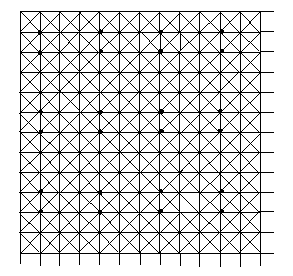
Let S be a total dominating set of  Since each column of
  is isomorphic to
  By Proposition 2.1 and Observation 2.5, we have
 |
Let us consider  as block. Now to describe our total dominating set S, we consider block
  If
If  then
then  can be partitioned with
  number of blocks B. By Proposition 2.1 and Observation 2.5, we obtain
  If
If  then
then  can be partitioned with
  number of blocks B. By Proposition 2.1 and Observation 2.5, we obtain
  This completes the proof.
3. Subdivision Number for the Strong Product Graph
Proposition 2.8. For  we have
Proof: Let  be a total dominating set of
  and
and  Let
Let  be obtain from
  by subdividing an edge
  and adding new vertex called
  Now, there is no change in total domination number, i.e,
Let  be obtain from
  by subdividing the edges
 and adding new vertices respectively called
  and
and  So, we need three vertices for totally domination. Therefore,
Thus,  By Lemma.2.2, we obtain that the total domination number of
  is greater than the total domination number of
  This completes the proof.
Proposition 2.9. For  , we have
Proof: To describe our total dominating set S, we consider block  and
and  Since
Since  Thus, we have
Proposition 2.10. For  we have
Proof: Let  be a total dominating set of
  and
and  Let
Let  be obtain from
  by subdividing an edge
  and adding new vertex called
  To totally dominate
  we need one vertex among
  Therefore,
  Thus,
Thus, 
By Lemma 2.2, we obtain that the total domination number of  is greater than the total domination number of
  This completes the proof.
Proposition 2.11. For  we have
Proof: Let  be a total dominating set of
  and
and  Let
Let  be obtain from
  by subdividing an edge
  and adding new vertex called
  To totally dominate
  we need one vertex among
  Therefore,
  Thus,
Thus,  By Lemma 2.2, we obtain that the total domination number of
  is greater than the total domination number of
  This completes the proof.
Theorem 2.8. For  we have
Proof: To describe our total dominating set S, we consider block  and
and  Since
Since  and by Proposition 2.3, we have
Theorem 2.9. For  subdivision number of
  and
and  are same.
Proof: Last two rows of  is considered as blocks
  and the first row of
  is totally dominated by B, which completes the proof.
Theorem 2.10. For  we have
Proof: To describe our total dominating set S, we consider block  and
and  By Theorem 2.9, we have
  Thus,
Thus, 
Theorem 2.11. For  we have
Proof: To describe our total dominating set S, we consider block  By Theorem 2.10, we have
  Thus,
Thus, 
References
| [1] | E.J. Cockayne, R.M. Dawes and S.T. Hedetniemi, Total dominations in graphs, Networks, 10 (1980), 211-219. | ||
 In article In article | CrossRef | ||
| [2] | T.W. Haynes, S. T. Hedetniemi and P. J. Slater, Fundamentals of Domination in Graphs, Marcel Dekker, New York, 1997. | ||
| In article | |||
| [3] | T.W. Haynes, S.T. Hedetniemi and L.C. van der Merwe, Total domination subdivision numbers, J. Combin. Math. Combin. Comput., 44 (2003), 115-128. | ||
| In article | |||
| [4] | W. Haynes and Michael A. Henning, Total domination subdivision numbers of graphs, Discussiones Mathematicae Graph Theory 24(2004), 457-467. | ||
| In article | CrossRef | ||
| [5] | Teresa W. Haynes, Michael A. Henning and Lora Hopkins, Total domination subdivision numbers of trees, Discrete Mathematics 286(2004), 195-202. | ||
| In article | CrossRef | ||
| [6] | W. Imrich, S. Klavˇzar, D. F. Rall, Topics in Graph Theory. A. K. Peters Ltd., Wellesley, MA, 2008. | ||
| In article | |||
| [7] | N.Soltankhah, On total domination subdivision number of grid graphs, Int.J.Contemp.Math.Sciences, 5(49) (2010), 2419-2432. | ||
| In article | |||
| [8] | N. Soltankhah, Results on total domination and total restrained domination in grid graphs, International Mathematical Forum, 5(7) (2010), 319-332. | ||
| In article | |||
| [9] | S. Gravier, Total domination number of grid graphs, Discrete Applied Mathematics, 121 (2002) 119-128. | ||
| In article | CrossRef | ||
| [10] | S. Velammal, “Studies in Graph Theory”, Ph.D. Thesis (Manonmaniam Sundaranar University, Tirunelveli, 1997. | ||
| In article | |||
| [11] | G. Yero, J. A. Rodr´ıguez-Vel´azquez, Roman domination in Cartesian product graphs and Strong product graph, Discrete Math., 7(2013), 262-274. | ||
| In article | |||

 CiteULike
 Mendeley
 StumbleUpon
 Delicious
 Facebook
 Twitter
 LinkedIn
 Print
Print