This paper presents an intuitive method for proving the Riemann Hypothesis. It begins by deriving the relationship equation at the zeros of the Riemann zeta function from Riemann's functional equation. This equation follows the Schwarz reflection principle, indicating that the zeros of the zeta function are restricted to the line with a real part of 1/2 in the complex plane. Furthermore, using the Schwarz reflection principle, it concludes that zeros cannot exist outside the critical line. Therefore, the Riemann Hypothesis is true.
In 1792 and 1793, at the age of 15, Carl Friedrich Gauss approximately discovered a function describing the distribution of prime numbers, as shown in equation (1-1), while investigating patterns within the primes:
 (1-1)
(1-1)
Later, in 1859, Gauss’s protégé, the mathematician Riemann, published a paper detailing a method to rigorously and accurately describe the distribution of primes that Gauss had found by transforming Euler’s function 1. In this work, Riemann constructs a three-dimensional graph, where, intriguingly, the four nontrivial zeros he calculated all lie on the same line in the complex plane. This led to what is now known as the Riemann Hypothesis, where Riemann conjectured, “Are all other zeros also on this same line?”
The connections between the Riemann Hypothesis and the underlying laws of nature are gradually being uncovered. Historically, the mathematician Euler discovered a connection between primes and  2. In modern times, it has been found that there are areas in which the Riemann Hypothesis and quantum mechanics align perfectly 3.
The zeta function defined in equation (1-2) converges for Re(s)>1, establishing an analytic function. Riemann demonstrated that this zeta function can be uniquely extended as a rational function defined for all points except  , The zeta function referenced in the Riemann Hypothesis is this extended Riemann zeta function, where
  is extended to complex numbers 1, 4.
 (1-2)
(1-2)
The functional equation using (1-2) is as follows 1, 4.
 (1-3)
(1-3)
The functional equation reveals that the Riemann zeta function has zeros at  , 5, 6, known as the trivial zeros. These zeros arise from the fact that
  being zero in the functional equation. However, the nontrivial zeros have attracted much greater interest, as their distribution is not only less understood but also yields profound results in number theory, particularly in relation to prime numbers and related structures 7. It is known that all nontrivial zeros lie within the strip
  , referred to as the critical strip. The subset
  is known as the critical line. The Riemann Hypothesis can be concisely stated in terms of these definitions.
HYPOTHESIS 1.1. The Riemann hypothesis is that all nontrivial zeros of the Riemann zeta function have a real part equal to 1/2.
In addition to the trivial zeros discussed in the previous chapter, there are zeros at other points, known as nontrivial zeros. From this point onward, "zeros" will specifically refer to these nontrivial zeros. We will first examine the fundamental properties of these nontrivial zeros. The coefficient section of  in equation (1-3) is defined as follows:
 (2-1)
(2-1)
Hence, we can express (1-3) more succinctly as:

Alternatively, (2-2) can be formulated as 8:
 (2-3)
(2-3)
Based on (2-2) and (2-3), we can make the following proposition.
PROPOSITION 2.1. For a given,  if and only if
  :
:

Proof: If  , then
  (by equation (2-2)). Conversely, if
  , then
  (by equation (2-3)). Therefore, we conclude that
  and
and  at
at  are both necessary and sufficient conditions for each other.
 and
and  Occur At
 By utilizing Proposition 2.1, we can obtain the following Lemma:
LEMMA 3.1. For some  which satisfy the zero point of zeta function:

Proof: Generally, necessary and sufficient conditions do not always refer to the same set, but here, since both yield the same result of 0 at the same  , they can be considered equivalent.
We can derive Theorem 3.1 using Lemma 3.1.
THEOREM 3.1. For any  that is a zero point of the zeta function, the following is true

Proof: Let  be a zero of
  ; that is,
  . By Lemma 3.1,
  . Taking the complex conjugate of both sides, we get
  , and using the property of the complex conjugate,
  . Therefore,
Meanwhile, for any complex function  , there exists a principle that always holds, known as the Schwarz reflection principle(SRP) 9, 10. It is defined as follows.
PRINCIPLE 3.1. Schwarz Reflection Principle
Let F(z) be a function that is holomorphic (analytic) on a domain D in the complex plane, except for a boundary segment on the real axis. Assume that F(z) satisfies the following conditions: F(z) is holomorphic in D. F(z) is continuous up to the boundary of D. On the boundary segment on the real axis, F(z) takes real values. Under these conditions, F(z) can be extended to a function that is holomorphic on the reflection of D across the real axis by defining:

where z denotes the complex conjugate of z.
Applying the logic of LEMMA 3.1, and considering that  is a complex function, we can similarly apply this principle to express it in the same form.
LEMMA 3.2. According to Principle 3.1, for zero points  , zeta function has a relation that holds

Proof: The Riemann zeta function is holomorphic on the entire complex plane except at  11. This satisfies the conditions for the Schwarz Reflection Principle as stated in Principle 3.1, thereby allowing the zeta function to be expressed by this principle
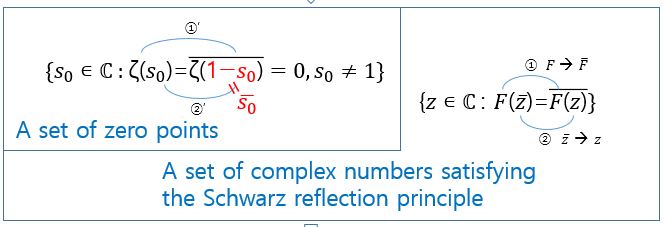
By employing Theorem 3.1 and Lemma 3.2, we can ascertain a relationship as shown in Figure 1.
Lemma 3.2 applies to all values of  defined in the Riemann zeta function, and thus Theorem 3.1 falls within the scope of Lemma 3.2. When Theorem 3.1 fully conforms to the structure of Lemma 3.2, it always holds. This relationship is illustrated in Figure 1. We observe that forms ① and ①’ indicate that the zeta function exhibits a complex conjugate relationship on both sides. Similarly, forms ② and ②’ should also exhibit a complex conjugate relationship. Based on this, we can establish the following theorem concerning the zeros of the zeta function.
THEOREM 3.2. At the zero point for  , if Lemma 3.2 holds, then the following is necessary

Proof: The set  belongs to the set
as illustrated in Figure 1. To match the form of the superset, the subset must align. Therefore, the subset, represented by 1 - so in Figure 1, must be the complex conjugate of so.
If we set  , and substitute it into Theorem 3.2, we can immediately see that
  . Therefore,
  can be expressed as follows.

COROLLARY 3.1. If  is a zero point of the zeta function then:

Proof: Assume  , substituting this into Theorem 3.2 yields
  .Therefore 2
According to Corollary 3.1 and Theorem 3.1, we can make the following Corollary.
COROLLARY 3.2. If  is a zero point of the zeta function, then
  is also a zero point


COROLLARY 3.3. From Corollary 3.1 and 3.2, we can get the following equation

Here, we intend to create the following definition.
DEFINITION 3.1. For any complex equation EQ, we denote the application of the Schwarz reflection principle as SRP(EQ).
Therefore, summarizing Corollary 3.1 and Corollary 3.2, the nontrivial zeros of the Riemann zeta function on the critical line take the form of  as their inputs.
PROPOSITION 3.1. From Corollary 3.1, Corollary 3.2, and Theorem 3.1, we can make the following proposition :

Some of the values of  found as the zero points of the zeta function so far are shown in Table 1 12, 13, 14, which is consistent with Corollary 3.3
Through the calculations so far, it has been demonstrated that the nontrivial zeros of the zeta function have a real part of 1/2, and the sign of the imaginary part is  .
.
In Theorem 3.1, if the Riemann zeta function equation vanishes at a specific point, the general expression that does not require the Riemann zeta function to be zero is given as follows.
PROPOSITION 4.1. If the zeta function satisfies  at its zeros, then the general set, including the zero points, is given by the following equation, which represents the critical line:

Proof: Fo r to hold, it must satisfy the Schwarz Reflection Principle (SRP). Currently, the zeta functions on the left-hand side and right-hand side are conjugate complex values. Excluding this relationship, the input values
  on the left-hand side and
  on the right-hand side must themselves be conjugate complex values. Therefore,
  must hold. If
  , then
  means
means  , which implies
  . This shows that any imaginary part b can take any value, but the real part
  is always
  Hence, this defines the critical line.
 . This is precisely the critical line. It can be expressed as follows when decomposed into real and imaginary parts.
COROLLARY 4.1. According to the Proposition 4.1, the real part of it has the following relation:

Proof:  . According to Lemma 3.2,
 , then
  . Therefore
  ,
,
COROLLARY 4.2. According to the Proposition 4.1, the imaginary part of it has the following relation:

Proof:  According to Lemma 3.2, if
  then
then  . Therefore,
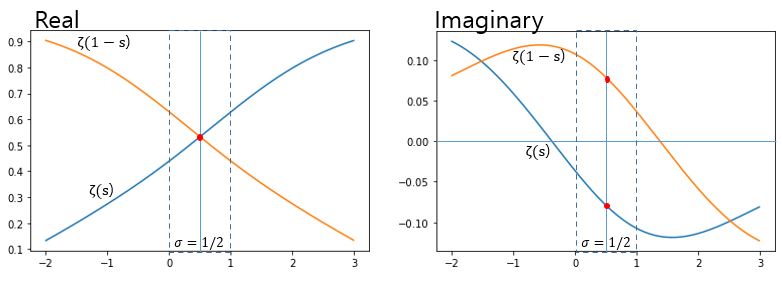
Figure 2 shows an example of Im . It adheres to the properties defined in Corollary 4.1 and Corollary 4.2 We can see that real part of both
  always meet, regardless of the value of
  , when
  . Figure 2 is created using Python software that imported the zeta function.
The special case of Proposition 4.1, specifically, the zero points as discussed in Theorem 3.1, can be examined by separating the real and imaginary parts as follows.
COROLLARY 4.3. According to Corollary 3.3, the real part of it has the following relation


COROLLARY 4.4. According to Corollary 3.3, the imaginary part of it has the following relation

By placing Corollaries 4.1, 4.2, 4.3, and 4.4 together in Table 2 and comparing them, we can see their relationships.
In Table 2, the left side represents the form where  and
and  satisfy the SRP, while the right side represents the form when the zeta function has zeros. By comparing the set of
  satisfying the left side and the set of
  satisfying the right side, we can observe that they are in the form of the following relation.
Remark 4.1. The set of all values in the complex plane  , that satisfy Proposition 4.1, is known as the critical line.
The Riemann zeta function is not generally monotonic; it only exhibits monotonicity on certain intervals under specific conditions 15.
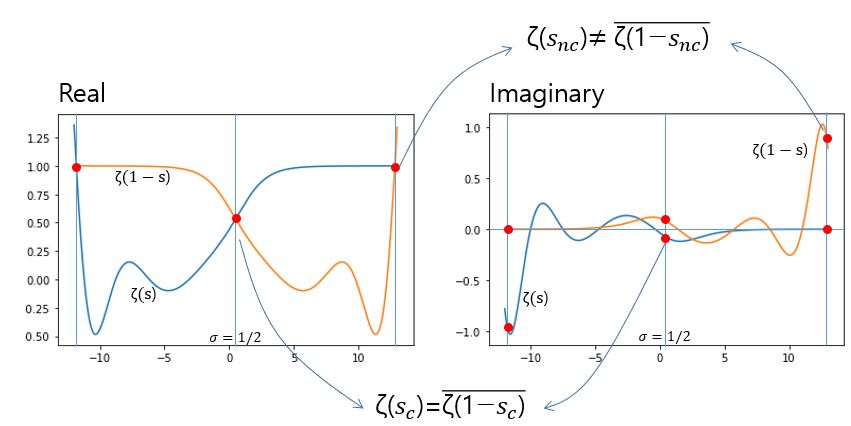
The Riemann Hypothesis posits that all nontrivial zeros lie precisely on the critical line. If this is true, it raises the question of why there are no zeros outside the critical line, despite the zeta function’s observed non-monotonicity. This aspect requires careful consideration in any proof of the Riemann Hypothesis. For example, in Figure 3, we can see that the zeta function is non-monotonic outside the critical strip when  . Thus, there may be instances where
  as in Corollary 3.1, but
  , as in Corollary 3.2, does not hold for the same value of
  . The reverse can also occur. This is because if
  is outside the critical line,
  cannot equal
  and therefore the SRP does not hold, as stated in Proposition 4.1.
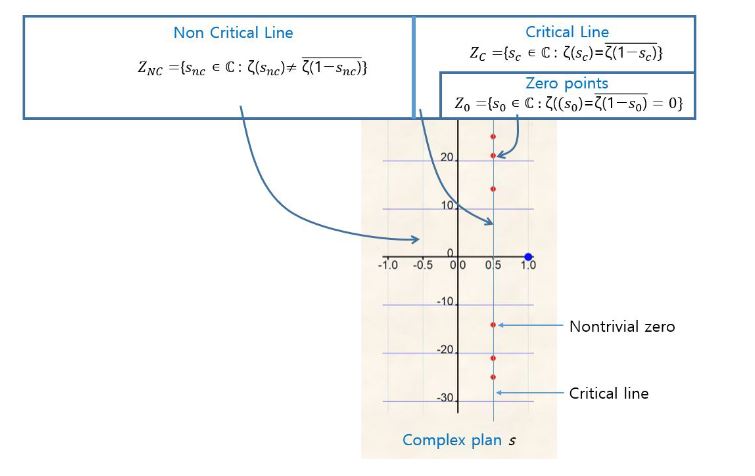
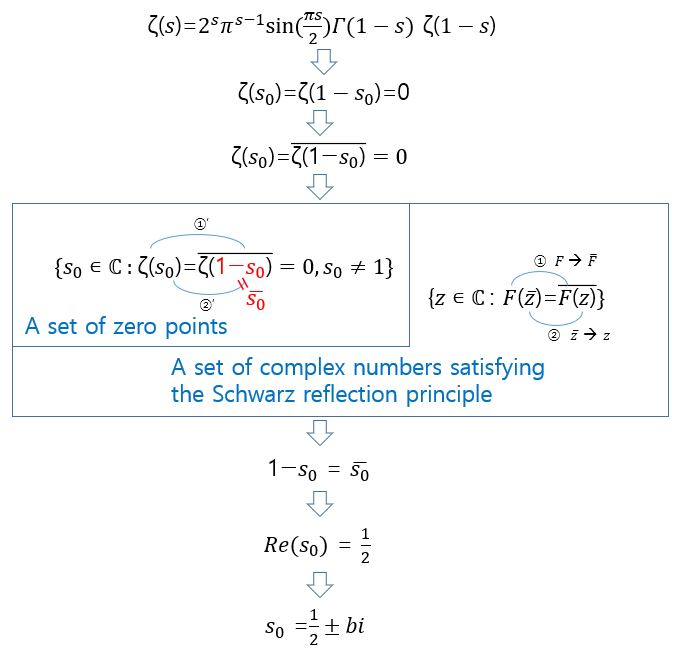
As previously mentioned, the nontrivial zeros of the zeta function satisfy  , thus maintaining validity while adhering to the SRP. Consequently, the nontrivial zeros of the Riemann zeta function lie exclusively on the critical line. Figure 4 illustrates this relationship.


THEOREM 5.1. Outside the critical line, there are no nontrivial zeros
Proof: Considering that  , then
  Therefore, for
  , we have
  . On the other hand, for
  we have
  . By examining Figure 4,
  (the law of excluded middle) and
  , this implies
  Thus, there are no zeros of the zeta function outside the critical line.
We want to verify further whether the real part of the input value of the zeta function remains 1/2 even if we generalize the real part of the critical line. Here, we will also perform the verification work while satisfying the SRP. The first generalization is to shift the real part by using 
 (6-1)
(6-1)
The inputs are complex conjugate numbers to each other, as depicted in Theorem 3.2.
 (6-2)
(6-2)
If we substitute  into
into  , we get the following:
 (6-3)
(6-3)
If we remove both  it becomes as follows:
 (6-4)
(6-4)
 (6-5)
(6-5)
(6-5) aligns with what was mentioned in Corollary 3.3, asserting that the real part equals 1/2. Therefore (6-1) becomes
 (6-6)
(6-6)
Ultimately, the real part of inputs becomes 1/2.
THEOREM 6.1. No matter how much the input of the zeta function shifts, After applying SRP algorithm, the real part of its nontrivial zeros remains 1/2

As a second generalization step, if (6-1) holds, we can expand it to equations like (6-7). However, just like before, there is a process that needs to satisfy the SRP.
 (6-7)
(6-7)
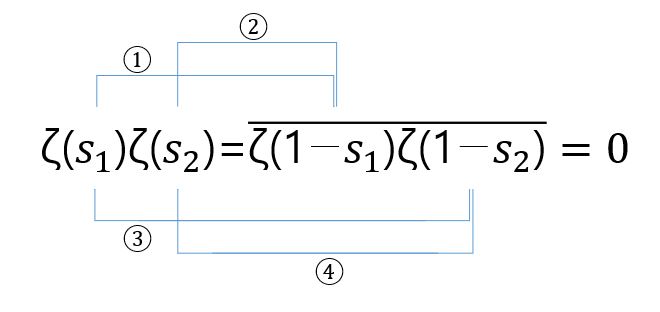
To satisfy the SRP, the input terms on both sides must follow complex conjugate relationships. If there are  arguments,
  equations is required. For simplicity, we will explain the case with two arguments, as shown in Figure 5. Thus, we define
  and
and  for
for  , respectively.

All four equations in Table 3 must be satisfied. If even one of these equations is not satisfied, the SRP will be violated. However, as shown in the table,  assume two distinct values. Specifically, for
  , the values are 1/2 and
  , and for
  , they are 1/2 and
  . This occurs because there are two variables and four equations, making it impossible to satisfy all conditions for the roots in Table 3. Consequently, Equation (6-7) cannot hold unless.
  , which implies
  . From this, it can be inferred that the real part at zero is fixed at
  . This conclusion was drawn by calculating only two types of factors, but the same holds true for three or more. Thus, the only way for Equation (6-7) to hold is if all input variables are equal, i.e.,
  .
.
 (6-8)
(6-8)
For  to hold for any arbitrary
  it must be satisfied that
  and therefore, the following proposition holds between the two.
 (6-9)
(6-9)
For (6-9) to hold, according to the logic developed in Chapter 3, SRP must be satisfied, and ultimately the following proposition arises.
 (6-10)
Ultimately, applying SRP in the second generalization leads to the same outcome as the first generalization, allowing us to formulate the following proposition.
THEOREM 6.2. After applying SRP to the multi-product of , it changes to

Through the generalization of the functional equation, an expanded equation was formulated. However, upon applying the symmetry property, known as SRP, it was observed to converge to Corollary 3.3 ultimately. In other words, the real part of the variable  , in the case of
  , becomes 1/2.
In this paper, rather than providing a detailed mathematical proof, we have shown an intuitive approach to the Riemann Hypothesis. Below, we summarize the process undertaken so far.
The Riemann zeta function,  , is non-holomorphic at
  but holomorphic in the region excluding
  . However, since it diverges at
  , there is no zero at this point. Thus, all nontrivial zeros of the Riemann zeta function must lie within its regular domain, which is the set of all complex numbers
  where the function is holomorphic. At any nontrivial zero
  , the Riemann zeta function satisfies the functional equation
  . From both sides of the equation, we obtain
  . If we substitute
  , then
  . If a specific
  is a zero of the zeta function, then
  is also a zero. Therefore, the zero
  is of the form
  .
.
The general form of equation  . If
. If  , then
  . Thus, we can observe that
  does not hold outside the critical line. Therefore, the nontrivial zeros exist only on the critical line. The process is summarized in Figure 6.
To further analyze the equation  we shifted the variable
  and applied the SRP, yielding that the real part of any nontrivial zero is always
  . Even when expressing the zeta function as a product of multiple terms, such as
  , applying the SRP reveals that for this to hold, it requires
  . Therefore it means
  This confirms that
  is the unique equation representing the zeros of the zeta function. Thus, this paper concludes that the Riemann Hypothesis is true.
I want to express my gratitude to Professor Kang Guk-hee for guiding me through the presentation of this paper in a seminar and enabling me to receive valuable feedback. I am also thankful to Professor Choi Seol-hee for encouraging me to submit the paper to the journal and providing advice on how to do so. Additionally, I thank Professor Ahn Jung-ho for his guidance on submitting my paper to the journal and for his advice on other matters.
| [1] | Riemann, Bernhard. die Hypothesen, welche der Geometrie zu Grunde liegen.Abhandlungen der Königlichen Gesellschaft der Wissenschaften zu Göttingen. Mathematisch-Physikalische Klasse 13 (1861): 236-252. | ||
| In article | |||
| [2] | Euler, Leonhard (1740). De Summis Serierum Reciprocarum. Commentarii academiae scientiarum Petropolitanae. Vol. 7, pp. 123-134. | ||
| In article | |||
| [3] | Odlyzko, A. M. (1987), ‘On the distribution of spacings between zeros of the zeta function’, Mathematics of Computation 48(177), 273-308. | ||
| In article | View Article | ||
| [4] | Czerwik, Stephan (2002). Functional Equations and Inequalities in Several Variables. P O Box 128, Farrer Road, Singapore 912805: World Scientific Publishing Co. p. 410. ISBN 981-02-4837-7. | ||
| In article | View Article | ||
| [5] | A. (2003). The Riemann Zeta-Function: Theory and Applications. Dover Publications. | ||
| In article | |||
| [6] | Titchmarsh, E. C. (1986). The Theory of the Riemann Zeta-Function. Oxford University Press. | ||
| In article | |||
| [7] | Derbyshire, J. "The Prime Number Theorem." Ch. 3 Prime Obsession: Bernhard Riemann and the Greatest Unsolved Problem in Mathematics New York: Penguin, pp. 32-47, 2004. | ||
| In article | View Article | ||
| [8] | https://brilliant.org/wiki/riemann-zeta-function. | ||
| In article | |||
| [9] | Ahlfors, L. V. Complex Analysis: An Introduction to the Theory of Analytic Functions of One Complex Variable. McGraw-Hill, 1979. | ||
| In article | |||
| [10] | "Riemann-Schwarz principle", Encyclopedia of Mathematics, EMS Press, 2001 [1994]. | ||
| In article | |||
| [11] | E. C. Titchmarsh, "The Theory of the Riemann Zeta-Function", Oxford University Press; 2nd edition (February 5, 1987). | ||
| In article | |||
| [12] | Eric Weisstein. Riemann Zeta Function Zeros. Retrieved 24 April 2021. | ||
| In article | |||
| [13] | Bui, H. Q., & Keating, J. P. (2019). The first 10 billion zeros of the Riemann zeta function, and zeros computation at very large height. Research in the Mathematical Sciences, 6(1), 10. | ||
| In article | |||
| [14] | Hardy, G. H.; Littlewood, J. E. (1921), The zeros of Riemann's zeta-function on the critical line, Math. Z., 10 (3-4): 283-317. | ||
| In article | View Article | ||
| [15] | Alzer, H.Monotonicity Properties of the Riemann Zeta Function. Mediterr. J. Math. 9, 439–452 (2012). | ||
| In article | View Article | ||
Published with license by Science and Education Publishing, Copyright © 2024 Young Hwan Yun
 This work is licensed under a Creative Commons Attribution 4.0 International License. To view a copy of this license, visit
http://creativecommons.org/licenses/by/4.0/
This work is licensed under a Creative Commons Attribution 4.0 International License. To view a copy of this license, visit
http://creativecommons.org/licenses/by/4.0/
| [1] | Riemann, Bernhard. die Hypothesen, welche der Geometrie zu Grunde liegen.Abhandlungen der Königlichen Gesellschaft der Wissenschaften zu Göttingen. Mathematisch-Physikalische Klasse 13 (1861): 236-252. | ||
| In article | |||
| [2] | Euler, Leonhard (1740). De Summis Serierum Reciprocarum. Commentarii academiae scientiarum Petropolitanae. Vol. 7, pp. 123-134. | ||
| In article | |||
| [3] | Odlyzko, A. M. (1987), ‘On the distribution of spacings between zeros of the zeta function’, Mathematics of Computation 48(177), 273-308. | ||
| In article | View Article | ||
| [4] | Czerwik, Stephan (2002). Functional Equations and Inequalities in Several Variables. P O Box 128, Farrer Road, Singapore 912805: World Scientific Publishing Co. p. 410. ISBN 981-02-4837-7. | ||
| In article | View Article | ||
| [5] | A. (2003). The Riemann Zeta-Function: Theory and Applications. Dover Publications. | ||
| In article | |||
| [6] | Titchmarsh, E. C. (1986). The Theory of the Riemann Zeta-Function. Oxford University Press. | ||
| In article | |||
| [7] | Derbyshire, J. "The Prime Number Theorem." Ch. 3 Prime Obsession: Bernhard Riemann and the Greatest Unsolved Problem in Mathematics New York: Penguin, pp. 32-47, 2004. | ||
| In article | View Article | ||
| [8] | https://brilliant.org/wiki/riemann-zeta-function. | ||
| In article | |||
| [9] | Ahlfors, L. V. Complex Analysis: An Introduction to the Theory of Analytic Functions of One Complex Variable. McGraw-Hill, 1979. | ||
| In article | |||
| [10] | "Riemann-Schwarz principle", Encyclopedia of Mathematics, EMS Press, 2001 [1994]. | ||
| In article | |||
| [11] | E. C. Titchmarsh, "The Theory of the Riemann Zeta-Function", Oxford University Press; 2nd edition (February 5, 1987). | ||
| In article | |||
| [12] | Eric Weisstein. Riemann Zeta Function Zeros. Retrieved 24 April 2021. | ||
| In article | |||
| [13] | Bui, H. Q., & Keating, J. P. (2019). The first 10 billion zeros of the Riemann zeta function, and zeros computation at very large height. Research in the Mathematical Sciences, 6(1), 10. | ||
| In article | |||
| [14] | Hardy, G. H.; Littlewood, J. E. (1921), The zeros of Riemann's zeta-function on the critical line, Math. Z., 10 (3-4): 283-317. | ||
| In article | View Article | ||
| [15] | Alzer, H.Monotonicity Properties of the Riemann Zeta Function. Mediterr. J. Math. 9, 439–452 (2012). | ||
| In article | View Article | ||