Although Benin is known as one of the most prolific exporting countries of python and where the two native species are highly traded for local consumption and traditional medicine, their conservation remains uncertain in the country. This study used a LEK-based survey with hunters in 224 villages and occurrence data from Global Biodiversity Information Facility database to delineate the spatial density distribution, habitat correlation and climatic influences in Python regius and Python sebae across Benin. The two species showed wide distributions extending across central Benin, with higher densities in the south. Analysis of the size of the occurrence area revealed that Python sebae had relatively the largest range (39,415.67 km²). Density estimates and multiple correspondence analysis in the occurrence areas indicated a relatively high probability of encountering multiple individuals within a single 1 km² grid and a preference of open habitats by the two species. A downward trend in species abundance was observed, highlighting potential conservation concerns. Generalised linear model analysis indicated that rainfall and temperature significantly influenced the presence of Python regius and Python sebae. These results underline the need for targeted conservation strategies to reverse the declining trends for long-term and effective conservation of these pythons in Benin.
Reptile rank among the most heavily threatened taxonomic groups globally, largely driven by the expansion of unregulated international trade 1. They constitute the second most targeted class in global wildlife trade 2 with a substantial proportion of species estimated at 10,316 (21%) currently listed as threatened with extinction on the IUCN Red List. Alarmingly, nearly half of the threatened and Near Threatened reptile species are directly impacted by international trade 3, underscoring the scale and urgency of this conservation challenge. Among these, pythons represent a particularly vulnerable group. The Ball python (Python regius) is most traded reptile species globally 4, while both the Ball and African Rock python (Python sebae) dominate domestic wildlife trade markets 5.
These two Pythonidae species face intense harvesting pressure, with specimens obtained from both wild populations and captive-breeding facilities to meet international demand in the United States, Europe, and Asia 6. At the regional scale, Benin, Ghana, and Togo constitute the principal reptile export hubs in West Africa 7, 8, 9.
In parallel with international demand, local exploitation remains substantial. Both Python regius and Python sebae are extensively harvested for bushmeat consumption and for use in traditional medicine, where they hold high cultural and economic value 5, 9, despite their classification as Near Threatened on the IUCN Red List. A nationwide survey of traditional markets in Benin revealed a high diversity of traded reptiles (46 species) across the country’s three climatic zones, with squamates accounting for 46% of the trade and the Ball python emerging as the most frequently traded species 10. Long-term analyses combining IUCN threat status and export indices further highlight the prominence of these species, with Python sebae (Ie = 0.90) and Python regius (Ie = 0.81) ranking as the two most exploited reptiles over the period 1982–2022. Given their importance for food, medicinal, and spiritual uses locally, as well as their strong appeal in international markets 6, increasing evidence points to significant population declines in the wild, as reported both by scientific studies 9 and by vendors in traditional medicine markets (BS, pers. obs.).
Despite these mounting pressures, critical gaps persist in our understanding of the ecological adaptability and spatial ecology of these species. The combined effects of overexploitation, habitat fragmentation, ecosystem degradation, and climate change are likely to drive complex spatio-temporal dynamics affecting their distribution, abundance, genetic structure, and ecological requirements 11, 12, 13. Such information is essential for informed decision-making and for designing sustainable management strategies that balance local use, international trade, and long-term conservation of python populations in the wild.
In data-limited contexts where conventional large-scale ecological surveys remain challenging, Local Ecological Knowledge (LEK) offers a valuable and cost-effective alternative. Derived from the experiential knowledge of primary resource users such as hunters, LEK provides detailed insights into species distribution, abundance, and ecological characteristics 14. Rooted in long-term interactions between communities and their environment, this knowledge encompasses perceptions of species composition, population trends, and habitat use 15, 16, 17. When integrated with environmental and spatial datasets, LEK represents a powerful tool for modeling species distributions and predicting their persistence 18, 19. Such modeling approaches are widely used to identify key climatic and environmental drivers shaping species distribution patterns and population dynamics across landscapes 18, 19, 20, 21.
Against this backdrop, the combined pressures of overexploitation, habitat heterogeneity and pronounced climatic gradients across Benin are expected to shape the spatial ecology of Python regius and Python sebae. Benin spans distinct ecological zones ranging from humid southern forests to drier northern savannas, which are known to influence species distribution patterns through variations in temperature, precipitation and habitat structure. In addition, both species share ecological traits but may exhibit differential habitat preferences and adaptive responses to environmental conditions. Furthermore, increasing anthropogenic pressures particularly in southern regions characterised by higher human densities and trade intensity may lead to spatially uneven population distributions. Based on these ecological and socio-environmental considerations, we hypothesise that: (i) both species exhibit higher population densities in southern Benin; (ii) their habitat use is significantly correlated, reflecting both ecological overlap and niche differentiation; and (iii) climatic variables play a key role in determining their occurrence and spatial distribution. To test these hypotheses, this study provides novel insights into the spatial population dynamics of Python regius and Python sebae at the national scale in Benin. Specifically, it aims to: (i) map the spatial density distribution of both species, (ii) assess their habitat associations, and (iii) analyse the climatic factors influencing their occurrence.
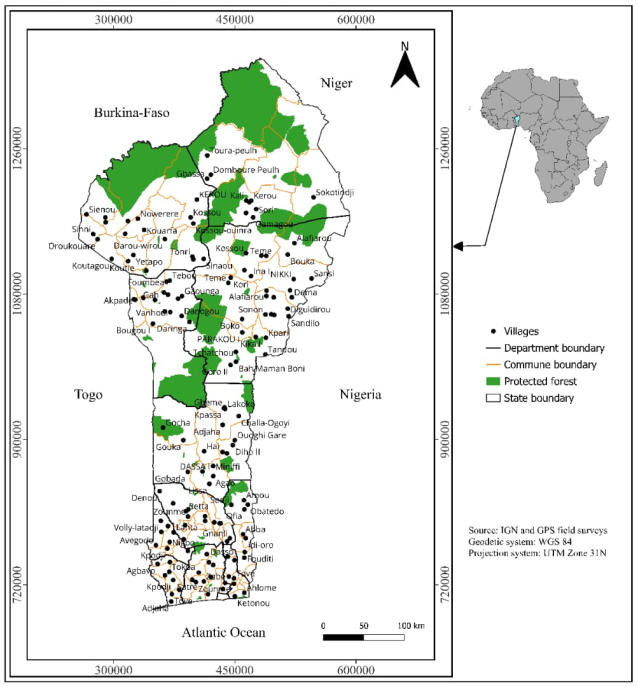
The study was conducted in Benin (Figure 1) from August to December 2024. Benin is a West African country situated within the Dahomey Gap, an interruption of the Guinean rainforest corridor, and administratively divided into 77 districts from a biogeographical prospective, the country spans three major ecological regions defined by climatic and vegetation gradients. The southern part of the country (6°10′–7°15′ N) belongs to the Guineo-Congolian region and characterised by a humid climate with bimodal rainfall whereas the Sudano-Guinean and Sudanian regions characterised by unimodal rainfall. This transitions northward into the Sudano-Guinean zone (7°15′–9°45′ N), followed by the Sudanian region (9°45′–12°25′ N), both of which experience a unimodal rainfall regime. These latitudinal gradients generate marked variations in temperature, precipitation, and vegetation structure, thereby shaping habitat diversity across the country. Benin covers an area of 114,673 km2 and hosts an estimated population of approximately 13 million inhabitants 22. Natural vegetation accounts for about 26% of the national territory, including a network of protected areas covering 23.3% of the country, which support a rich diversity of wildlife encompassing most major taxonomic groups found in West Africa 23. According to national forestry legislation, forests are categorised into two main types: (i) state-managed forest reserves under the responsibility of public forestry authorities, and (ii) community forests managed by local populations 23. In addition to these natural ecosystems, a widespread network of wildlife markets operates across the country, supplying bushmeat and animal-derived products for traditional medicine, and contributing significantly to pressures on wildlife populations 5.

A spatially explicit sampling framework was developed using a grid-based approach. A total of 228 grid cells (sampling units) of 25 × 25 km were generated across Benin using ArcMap. This spatial resolution was selected to ensure that each sampling unit encompassed sufficient areas of natural or semi-natural vegetation (i.e., potential hunting zones) alongside human settlements, thereby facilitating the collection of Local Ecological Knowledge (LEK) 18.
From the initial grid, 94 cells were excluded from the sampling scheme. These included 46 cells lacking villages therefore unsuitable for LEK collection—and 48 incomplete cells located along the national boundaries, which were too small and lacked representative habitats. In addition, 12 grid cells located in and around the Pendjari and W National Parks were excluded due to prevailing security concerns in northern Benin. Ultimately, 122 grid cells were retained for the LEK-based survey, with at least one village sampled per grid cell.
LEK data were collected through focus group discussions conducted in 224 villages. Each focus group consisted of 8–10 participants, primarily local hunters selected based on the following criteria: age ≥ 30 years, residency of at least 10 years in the area, and voluntary participation 18, 24. Participants were recruited using a snowball sampling approach, and informed consent was obtained prior to each discussion. During each session, presence/absence data of Python regius and Python sebae were recorded. In addition, the geographic coordinates of surveyed villages and identified potential occurrence habitats were collected using a GPS device in collaboration with participants.
A total of 54 occurrence records for Python regius and 48 for Python sebae were obtained from field surveys. To strengthen the robustness of the spatial analyses, these data were complemented with occurrence records from the Global Biodiversity Information Facility 25 at the national scale, without temporal filtering to avoid underestimating the species’ ecological range. This resulted in an additional 287 records for P. regius and 350 records for P. sebae.
Information on habitat use and ecological preferences of Python regius and Python sebae was collected during field surveys through Local Ecological Knowledge (LEK) provided by experienced local hunters. A semi-structured questionnaire was used to guide discussions, allowing both standardised data collection and flexibility for in-depth responses. The questionnaire addressed key aspects including perceived population trends, habitat types associated with species occurrence, major threats, ethnozoological uses, and the commercial value of the species. This approach enabled the integration of detailed, experience-based ecological insights into habitat characterization.
Climatic variables potentially influencing species occurrence were obtained from the WorldClim database 26 using the geodata package 27. The dataset included monthly temperature and precipitation variables covering the entire territory of Benin.
To reduce multicollinearity among predictors, a variable selection procedure was conducted using the nimo package 28, which provides the variance inflation factor (VIF) routine used here for collinearity screening. Variables exhibiting a variance inflation factor (VIF) greater than 10 were excluded, ensuring that only independent climatic predictors were retained for subsequent analyses. To incorporate absence data into the modeling framework, pseudo-absence points were randomly generated outside the estimated home range of each species. Restricting the background to the area lying beyond the kernel-based home range is a deliberate design choice: because our occurrence data combine opportunistic LEK and GBIF records that lack reliable true absences, the home range delineates the portion of Benin where the species is known to occur, and sampling pseudo-absences strictly outside it provides ecologically defensible non-occurrence locations while avoiding the contamination of the absence set with unrecorded presences (false absences) that would arise if background points were drawn across the entire study area, including within occupied range. This approach therefore characterises the environmental conditions that distinguish occupied from unoccupied portions of the country rather than merely tracing a geographic outline, since the climatic gradients of Benin vary continuously and are not aligned with the home-range boundary; the contrast captured by the model is environmental, not purely spatial. The number of absence points was scaled to the spatial extent of each species using a function that increases the relative number of pseudo-absences for species with a small home range and reduces it for species with a large home range, on the rationale that a wide-ranging species is expected to have proportionally fewer genuine absences across Benin. The resulting count was thus proportional to the spatial extent of the species’ distribution, allowing for a balanced representation of presence and absence data. These datasets were then combined into a single analytical dataset. Geographic coordinates of both presence and pseudo-absence points were used to extract values from the selected non-collinear climatic raster layers, forming the basis for subsequent spatial modeling.
2.3. Data Analysis and Processingv Estimation of spatial density
Occurrence data derived from field surveys and GBIF were merged into a unified dataset and exported as a shapefile for spatial analyses. All visualizations were produced using the ggplot2 package 29. Spatial density patterns were analysed using point pattern analysis implemented in the spatstat package 30, 31, 32. The study area, defined by the national boundaries of Benin, was projected into the Universal Transverse Mercator (UTM) Zone 31N coordinate reference system using the sf package. The country boundary was then converted into an observation window, defining the spatial domain for the analysis. For each species, occurrence points were extracted and converted into point pattern objects. Kernel density estimation (KDE) was applied to quantify the spatial intensity of occurrence across the study area. The resulting density surfaces were converted into raster format using the terra package 33 and resampled to a spatial resolution of 1 × 1 km to enhance spatial detail. Final density maps were produced using ggplot2 and cowplot 34. All analyses were conducted in R 35.
v Estimation of the area of occurrence using Kernel density
Occurrence data were imported using the readxl package 36. Geographic coordinates were provided in both degrees-minutes-seconds (DMS) and Universal Transverse Mercator (UTM) formats and were processed separately before being harmonised. All coordinates were converted into spatial objects using the sf package 37, 38.
Species’ areas of occurrence (home range proxies) were estimated using kernel utilization distributions implemented in the adehabitatHR package 39. The smoothing parameter was determined using the least-squares cross-validation (LSCV) method, ensuring an optimal balance between over- and under-smoothing of the utilization distribution.
The 95% utilization distribution was used to delineate the core area of occurrence for each species. Resulting polygons were clipped to the national boundary of Benin to restrict analyses to the study area. The area of each polygon was then calculated and expressed in square kilometres.
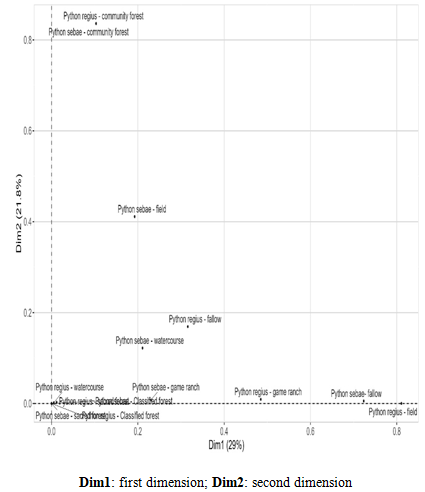
To investigate the relationships between species occurrence and habitat types, a Multiple Correspondence Analysis (MCA) was conducted using the FactoMineR package 40. MCA is particularly suited for exploring associations among categorical variables, making it appropriate for analysing species–habitat relationships derived from LEK data.
The results were visualised using the factoextra package 41. Habitat categories were projected into a two-dimensional ordination space, allowing interpretation of their contribution to the principal dimensions and their association with each species.
To assess the influence of climatic variables on species occurrence, Generalised Linear Models (GLMs) with a binomial error distribution and a logit link function were fitted for each species. The initial models included all selected non-collinear climatic predictors. A stepwise model selection procedure was applied to remove non-significant variables and identify the most parsimonious model. Final models retained only climatic variables that significantly influenced species presence, allowing the identification of key environmental drivers shaping species distribution.
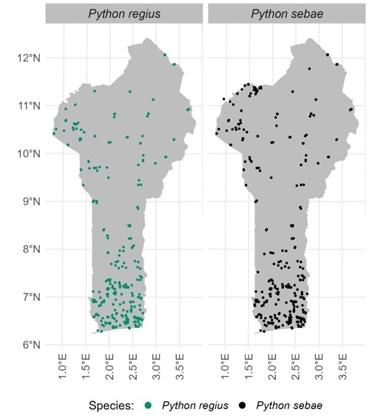
The spatial distribution of Python regius and Python sebae across Benin (Figure 2) was mapped using combined occurrence data from field surveys (P. regius: n = 54; P. sebae: n = 48) and the Global Biodiversity Information Facility (P. regius: n = 350; P. sebae: n = 287). Both species exhibited broadly similar distribution patterns, suggesting comparable spatial structuring and potential overlap in population distribution. Their ranges extended across much of the country, with a marked concentration in southern Benin and a gradual decline in occurrence toward northern latitudes. Central regions also showed relatively high occurrence densities, indicating their importance as core areas within the species’ distribution range. A clear pattern of co-occurrence was observed, with records of P. regius and P. sebae frequently located in close spatial proximity, suggesting potential habitat overlap or shared environmental preferences. However, P. sebae displayed a broader spatial distribution compared to P. regius, with occurrences recorded throughout most of the country. Its distribution was particularly pronounced in the southern and central regions, as well as along the eastern corridor, where higher densities were observed.

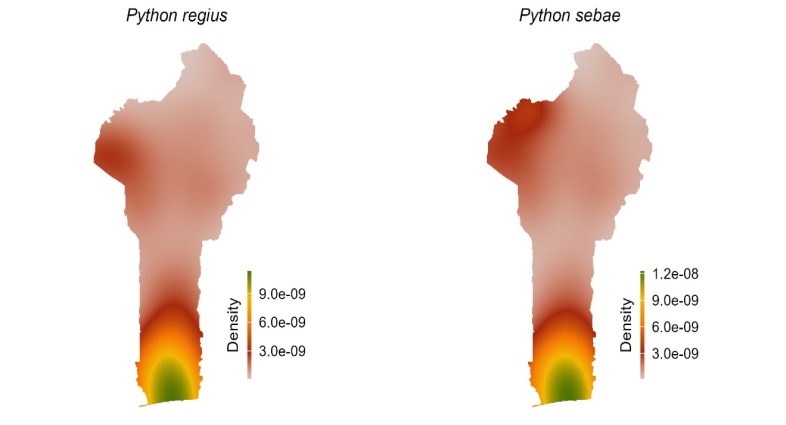
The spatial density distribution of Python regius and Python sebae across Benin shows pronounced heterogeneity at the 1 km² resolution (Figure 3). Both species exhibit peak densities in the southernmost regions, indicating a high likelihood of encountering multiple individuals within a single grid cell. Moving northwards, density values decline progressively across the central regions and become markedly low in northern Benin. In these areas, occurrence is sparse, with grid cells typically supporting few individuals or, in some cases, none at all.

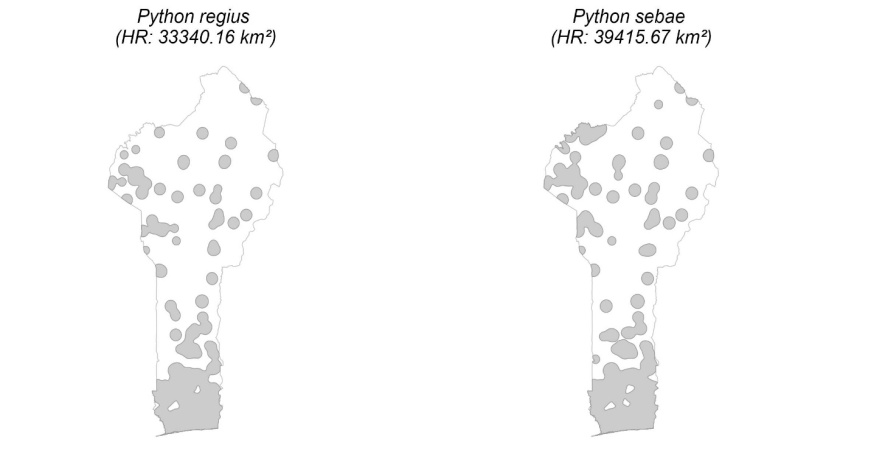
Figure 4 presents the estimated home range distribution of both species. Python regius occupies a home range of 33,340.16 km², primarily concentrated in the southern part of Benin. In contrast, Python sebae exhibits a larger home range of 39,415.67 km², also centred in the south but extending further northward. This broader spatial extent indicates that P. sebae occupies a wider range of habitats compared to P. regius, while both species maintain a strong distributional focus in southern Benin.

Multiple Correspondence Analysis (MCA) (Figure 5) highlights the relationships between habitat types and the occurrence of P. regius and P. sebae. The first dimension (Dim1), explaining 29% of the total variance, primarily discriminates between open habitats such as fields, fallows, and game ranches and more structured or protected environments, including sacred forests, classified forests, and community forests. The second dimension (Dim2), accounting for 21% of the variance, further differentiates habitats based on more specific ecological features, notably watercourses and community forests. Both P. regius and P. sebae exhibit strong associations with a range of habitat types, including open landscapes as well as forested environments, particularly classified and sacred forests along Dim1, and community forests along Dim2.

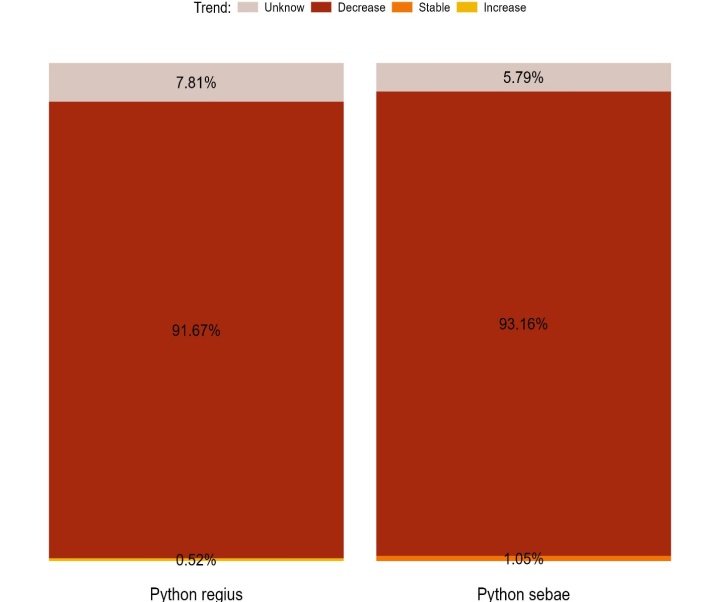
Figure 6 shows trends in species abundance. The dominant trend is a decrease in abundance, representing 91.67% and 93.16% for P. regius and P. sebae respectively.

The results of the Generalised Linear Models (GLMs) highlight the influence of climatic variables, particularly temperature and precipitation, on the occurrence of Python regius and Python sebae across Benin (Table 1). The final binomial logit models showed an acceptable fit, with an Akaike Information Criterion (AIC) of 518.75 for the Python regius model and 546.77 for the Python sebae model.
For Python regius, precipitation emerged as a key positive driver of occurrence. Rainfall in June (prec_6: estimate = 0.0334, p = 0.003) and September (prec_9: estimate = 0.0583, p < 0.001) significantly increased the probability of presence. Temperature effects were more variable. Average temperatures in February (tavg_2: estimate = −2.88, p = 0.002) and minimum temperatures in June (tmin_6: estimate = −3.70, p < 0.001) showed significant negative effects, indicating reduced occurrence under cooler conditions. In contrast, maximum temperatures in April (tmax_4: estimate = 1.22, p = 0.006) and August (tmax_8: estimate = 3.18, p < 0.001) had significant positive effects, suggesting that warmer conditions during these periods favour species presence.
For Python sebae, similar patterns were observed, although with some distinct seasonal responses. Precipitation in June (prec_6: estimate = 0.0453, p < 0.001) positively influenced species occurrence. Average temperatures in February (tavg_2: estimate = −3.53, p < 0.001) had a significant negative effect, whereas average temperatures in September (tavg_9: estimate = 4.02, p < 0.001) and December (tavg_12: estimate = 5.37, p < 0.001) showed strong positive effects. In addition, maximum temperature in April (tmax_4: estimate = 2.48, p < 0.001) significantly increased the likelihood of occurrence.
Overall, these results indicate that both species are positively associated with increased precipitation during the rainy season and higher temperatures during the warm periods, while cooler conditions tend to limit their occurrence. However, Python sebae appears to exhibit a stronger association with warmer conditions later in the year, suggesting subtle differences in climatic sensitivity and ecological responses between the two species.
This study highlighted (i) the spatial distribution of the population densities of Python regius and Python sebae at a 1 km² resolution across the entire territory of Benin; (ii) the relationships between these species and habitat types in Benin; and (iii) the influence of climatic variables, notably temperature and precipitation, on the probability of occurrence of these species.
4.1. Spatial Population Trends of P. regius and P. sebaeOur work extends the research of Sinsin and Kampmann (2010) 42, which primarily focused on southern Benin. Knowledge of the spatial distribution of species is a fundamental component for guiding conservation strategies and biodiversity management 20, 43. Our results indicate that the occurrence zones of Python regius and Python sebae show substantial similarities, with relatively high densities in certain regions of Benin. This confirms the findings of Luiselli et al. (2001), Luiselli (2006) and Bolnick and Fitzpatrick (2007) 44, 45, 46, who report a sympatry characterised by an interspecific relationship between snake species, where their distribution overlap. Moreover, this distribution suggests that these species possess a considerable capacity to adapt to varied environmental conditions. Similar observations have been reported in several West and Central African countries, where both species occupy a wide range of natural and human-modified habitats 47, 48, 49. The high presence of these species in certain areas may also reflect their ecological plasticity and ability to exploit habitats altered by human activities. Several studies have shown that some reptile species can persist in fragmented or disturbed landscapes provided that ecological conditions remain favorable for their survival 50, 51.
In this study, Python regius and Python sebae were frequently observed in open or semi-open environments. This finding corroborates the results of Segniagbeto et al. (2024) 52, which showed that these species display a high tolerance to degraded environments, particularly in agricultural and fallow areas. Studies conducted in Nigeria and Ghana also indicate that the royal python is often found in savannas, forest–savanna mosaics, and agricultural areas, exploiting the availability of prey such as small mammals 49, 53. However, extensive distribution alone does not necessarily reflect the conservation status of a species. Certain species may maintain relatively abundant populations in degraded habitats while undergoing long-term declines due to anthropogenic pressures 54, 55.
In Benin, both species are present across almost the entire national territory. Nevertheless, the highest densities are observed in the southern part of the country, likely linked to more favorable climatic conditions and greater habitat diversity. Parameters related to vegetation structure and land use generally become more significant at finer spatial scales. Therefore, understanding the spatial distribution of Python regius and Python sebae is essential for informing conservation strategies and habitat management planning at national and regional levels.
4.2. Species Habitats and ThreatsOur findings indicate that Python regius and Python sebae are strongly associated with open habitats, particularly fallows and cultivated areas, demonstrating their ability to persist in human-modified environments. This pattern agrees with previous studies that reported frequent occurrence of both species in degraded savannas, agricultural lands, and fallows 56, 57. The broad habitat ranges of P. regius and P. sebae, spanning savannas, forest–savanna mosaics, agricultural areas, forests, rocky habitats, and riparian zones, further illustrate their ecological adaptability 48, 49, 58.
Nevertheless, this adaptability does not protect them from the growing impacts of human activities. Across tropical regions, habitat conversion, ecosystem degradation, climate change, and unsustainable harvesting are recognized as major threats to reptile populations 59, 60. In Benin, additional pressure arises from hunting for consumption, traditional medicine, and cultural purposes 61, 62. International trade, particularly involving P. regius, further intensifies exploitation of wild populations, with thousands of individuals collected annually in Benin, Ghana, and Togo to supply the global pet market 1, 6, 7, 63. The ongoing expansion of commercial agriculture, especially cotton cultivation in northern Benin, is likely to exacerbate these pressures through continued habitat transformation 64
4.3. Climatic Factors Influencing the Distribution of P. regius and P. sebaeSpecies distribution modeling is an essential tool for understanding species–environment relationships and predicting the potential effects of climate change on future distributions 43, 65. Results from the generalised linear model (GLM) indicate that precipitation and temperature significantly influence the presence of Python regius and Python sebae. This finding aligns with numerous studies showing that reptiles, as ectothermic organisms, are highly dependent on climatic conditions for thermoregulation, reproduction, and survival 66, 67. Climatic variables, particularly temperature and precipitation, play a major role in determining reptiles’ geographic distribution and habitat suitability 68, 69, 70. These results corroborate the work of Kpéra et al. (2020) 71, who demonstrated that P. regius distribution is influenced by climatic and environmental gradients between northern and southern Benin. Several studies have also shown that climatic variables are critical determinants of reptile distribution at large spatial scales 43, 65. Vegetation structure and land use become more relevant at finer spatial scales.
Model projections indicate that central and southern Benin are the most suitable areas for the studied species. These results are consistent with Sinsin and Kampmann (2010) 42, which reported high herpetological diversity in these regions. The climate in these areas is subequatorial, characterised by a bimodal rainfall regime with two wet seasons alternating with two dry seasons 72. Such climatic conditions favor resource availability and habitats suitable for reptiles. Our results also align with Segniagbeto et al. (2024) 52, who reported that Python regius is abundant in multiple West African ecosystems, including humid savannas, swamp forests, and gallery forests. These regions are also key sources for international reptile trade. Benin, Ghana, and Togo are among the main exporters of live reptiles for the global pet trade 6, 7, 73.
These findings are particularly relevant for conservation, as they identify bioclimatic zones favorable to species persistence. They provide a foundation for developing sustainable management strategies for python populations in Benin. Given the risks of overexploitation and local population declines, it is crucial to strengthen community awareness programs and promote sustainable wildlife management practices. In practical terms, the high-density areas identified in southern and central Benin largely coincide with the existing network of protected areas, state-managed forest reserves, and community forests described in the study area. This spatial overlap highlights the critical role of protected areas as core refuges for biodiversity conservation, particularly for species subjected to anthropogenic pressures such as habitat loss and exploitation. Numerous studies have demonstrated that protected areas contribute significantly to maintaining viable wildlife populations by reducing habitat degradation and limiting unsustainable harvesting 74, 75.
The density and home-range maps generated in this study provide valuable spatially explicit information that can support evidence-based conservation planning. Spatial prioritization approaches have been widely recognized as effective tools for identifying areas where conservation interventions can maximize ecological benefits while optimizing limited management resources 76. In this context, the high-occurrence cells identified for Python regius and Python sebae should be considered priority zones for strengthening the regulation of harvesting and trade activities, enhancing law enforcement, and implementing long-term monitoring programs.
Furthermore, several of these priority areas encompass community-managed forests, underscoring the importance of involving local communities in conservation strategies. Community-based natural resource management has been shown to improve conservation outcomes when local stakeholders are actively engaged in decision-making and benefit-sharing mechanisms 77.Given the socio-economic importance of pythons in Benin, particularly through trade and traditional uses, collaborative governance approaches could contribute to balancing species conservation with local livelihoods. Integrating conservation actions within the existing legal and territorial framework offers a practical and cost-effective pathway for translating the spatial patterns identified in this study into management interventions. Such an approach is consistent with contemporary conservation strategies that advocate the alignment of species management with established protected-area networks and landscape-scale conservation planning to ensure long-term population persistance 78, 79.Overall, the data generated in this study offer a valuable baseline for future research on python distribution and conservation across West Africa, taking into account seasonal trade patterns and potential climate change impacts.
In this study, Python regius and Python sebae showed wide distributions extending across central Benin, with higher densities in the south. These results are useful for targeting the occurrences to be studied on a finer scale. The habitats of these species need to be integrated into development plans, and maps showing their distribution will help to guide surveys as part of inventories or monitoring. The study also revealed that ecological factors, in particular temperature, play a determining role in the presence and spatial distribution of P. regius and P. sebae. Despite the adaptability of pythons to open habitats, these two species, which are the most widely exported in international trade, could suffer local extinctions. Finally, this study could help redefine the status of these species, so that they are better taken into account in protection and conservation projects. As a consequence, human activities should be considerably regulated in the areas of high concentration of the occurrences collected as part of this study.
B. Sossa: Conceptualization, data collection, data analysis, and manuscript drafting; R. B. Badou: Data analysis and interpretation, contribution to manuscript writing. S. Zanvo: Methodological support and review of the manuscript; G.N. Kpéra: Data interpretation and critical revision of the manuscript. G. Nobimè: Contribution to data analysis and manuscript revision; A.E. Assogbadjo: Scientific supervision, methodological guidance, and critical review of the manuscript; C.A.M.S. Djagoun: Conceptualization, scientific supervision, validation of results, and final revision of the manuscript. All authors read and approved the final version of the manuscript.
We are grateful to all the stakeholders interviewed in the traditional medicine markets of Benin. We also grateful Kadjogbé Venceslas TAÏWO whom greatly facilitated our access to the markets and Stanislas GANDAHO for data analysis. We thank all authors for their useful comments on the manuscript.
The author(s) of this article declare that they received no funding or financial support for this research.
The authors declare no conflicts of interest.
The data that support the findings of this study are available from the corresponding author upon reasonable request.
| [1] | Marshall, B.M.; Strine, C.; Hughes, A.C. Des milliers d'espèces de reptiles menacées par un commerce mondial sous-réglementé. Nature Communications 2020, 11(1), 1-12. | ||
| In article | |||
| [2] | UNODC. World Wildlife Crime Report: Illegal trade in protected species. 2020. Available online at: https:// www.unodc.org/ unodc/en/ data-and-analysis/wildlife.html. | ||
| In article | |||
| [3] | Challender, D.W.S.; Cremona, P.J ; Malsch, K.; Robinson, J.E.; Pavitt, A.T.; Scott, J.; et al. Identifying species likely threatened by international trade on the IUCN Red List can inform CITES trade measures. Nat. Ecol. Evol. 2023, 7, 1211–1220. | ||
| In article | View Article PubMed | ||
| [4] | D’Cruze, N.; Harrington, L.A.; Assou, D.; Ronfot, D.; Macdonald, D.W.; Segniagbeto, G.H.; Auliya, M. Searching for snakes: ball python hunting in southern Togo, West Africa. Nature Conservation 2020, 38, 13. | ||
| In article | View Article | ||
| [5] | Zanvo, S.; Dognimon, S.; Djagoun, C.A.M.S.; Akpatchémè, J.; Azihou, A.F.; Djossa, B.; Sogbohossou, E.A.; Sinsin, B. Wildlife trade at the interface between deeply-rooted animal-based traditional medicine and unregulated harvesting of wild animals in West Africa. Front. Conserv. Sci. 2024, 5, 1481791. | ||
| In article | View Article | ||
| [6] | Harrington, L.A.; Green, J.; Muinde, P.; Macdonald, D.W.; Auliya, M.; D'Cruze, N. Snakes and ladders: A review of ball python production in West Africa for the global pet market. Nature Conservation 2020, 41, 1. | ||
| In article | View Article | ||
| [7] | Luiselli, L.; Starita, A.; Carpaneto, G.M.; Segniagbeto, G.; Amori, G. Conservation implications of the international trade in West African pythons. Animal Conservation 2016, 19, 1–10. | ||
| In article | |||
| [8] | Jensen, T.J.; Auliya, M.; Burgess, N.D.; Aust, P.W.; Pertoldi, C.; Strand, J. Exploring the inter- national trade in African snakes not listed on CITES: Highlighting the role of the internet and social media. Biodiversity and Conservation 2018, 28, 1–19. | ||
| In article | View Article | ||
| [9] | Toudonou, C.; Elwin, A.; Penner, J.; Coulthard, E.; Norrey, J.; Megson, D.; Rödel, M.-O.; Sinsin, B.; Harrington, L.A.; Auliya, M.; D'Cruze, N. Seeking serpents: Ball python trade in Benin, West Africa. Nature Conservation 2022, 50, 85–114. | ||
| In article | View Article | ||
| [10] | Taïwo, K.V. Quantification des espèces de reptiles objet du commerce national et international au Bénin. 2024. Mémoire de Master. FSA, UAC, Bénin. | ||
| In article | |||
| [11] | Brook, B.W.; Sodhi, N.S.; Bradshaw, C.J.A. Synergies among extinction drivers under global change. Science 2008, 321, 1515–1518. | ||
| In article | |||
| [12] | Bellard, C.; Bertelsmeier, C.; Leadley, P.; Thuiller, W.; Courchamp, F. Impacts of climate change on the future of biodiversity. Ecology Letters 2012, 15, 365-377. | ||
| In article | View Article PubMed | ||
| [13] | Mantyka‐Pringle, C.S.; Martin, T.G.; Rhodes, J.R. Interactions between climate and habitat loss effects on biodiversity: a systematic review and meta-analysis. Global Change Biology 2015, 21, 3906-3921. | ||
| In article | |||
| [14] | Anadon, J.D.; Gimenez, A.; Ballestar, R. Linking local ecological knowledge and habitat modelling to predict absolute species abundance on large scales. Biodivers Conserv. 2009. | ||
| In article | View Article | ||
| [15] | Giglio, V.J.; Bornatowski, H. Fishers' ecological knowledge of smalleye hammerhead, Sphyrna tudes, in a tropical estuary. Neotropical Ichthyology 2016, 14(2). | ||
| In article | View Article | ||
| [16] | Pereira, S.A.; da Silva, R.G.A.; Campos-Silva, J.V.; da Silva, B.V.; Arantes, C.C. Assessing biological traits of Amazonian high-value fishes through Local Ecological Knowledge of urban and rural fishers. Hydrobiologia 2021, 848, 2483-2504. | ||
| In article | View Article | ||
| [17] | Zanvo, S.; Djagoun, C.A.M.S.; Azihou, A.F.; Sinsin, B.; Gaubert, P. Preservative chemicals as a new health risk related to traditional medicine markets in western Africa. One Health 2021, 13, 100268. | ||
| In article | View Article PubMed | ||
| [18] | Zanvo, S.; Gaubert, P.; Djagoun, C.A.; Azihou, A.F.; Djossa, B.; Sinsin, B. Assessing the spatiotemporal dynamics of endangered mammals through local ecological knowledge combined with direct evidence: The case of pangolins in Benin (West Africa). Global Ecology and Conservation 2020, 23, e01085. | ||
| In article | View Article | ||
| [19] | Zanvo, S.; Djagoun, C.A.M.S.; Gaubert, P.; Azihou, A.F.; Jézéquel, C.; Djossa, B.; Sinsin, B.; Hugueny, B. Modeling population extirpation rates of white-bellied and giant pangolins in Benin using validated local ecological knowledge. Conservation Science and Practice 2023, e12986. | ||
| In article | View Article | ||
| [20] | Guisan, A.; Thuiller, W. Predicting Species Distribution: Offering More than Simple Habitat Models. Ecology Letters 2005, 8(9), 9931009. | ||
| In article | View Article PubMed | ||
| [21] | Elith, J.; Graham, C.H.; Anderson, R.P.; Dudík, M.; Ferrier, S.; Guisan, A.; Hijmans, R.J.; et al. Novel Methods Improve Prediction of Species’ Distributions from Occurrence Data. Ecography 2006, 29(2), 12951. | ||
| In article | View Article | ||
| [22] | INStaD. Projections démographiques de 2014 à 2063 et perspectives de la demande Sociale de 2014 à 2030 au Bénin. 2022. | ||
| In article | |||
| [23] | CENAGREF/PAPE. Analyse de mise en œuvre de la catégorisation actuelle des Aires Protégées du Bénin et proposition d’une nouvelle catégorisation des Aires Protégées de la République du Bénin selon les nouvelles lignes directrices de l’UICN. 2013. http://www.cenagref.net/. | ||
| In article | |||
| [24] | Logan, S.W.; Webster, E.K.; Getchell, N.; Pfeiffer, K.A.; Robinson, L.E. Relationship between Fundamental Motor Skill Competence and Physical Activity during Childhood and Adolescence: A Systematic Review. Kinesiology Review 2015, 4, 416-426. | ||
| In article | View Article | ||
| [25] | GBIF. GBIF Occurrence Download. 2025. | ||
| In article | |||
| [26] | Fick, S.E.; Hijmans, R.J. WorldClim 2: new 1‐km spatial resolution climate surfaces for global land areas. International Journal of Climatology 2017, 37(12), 4302-4315. | ||
| In article | View Article | ||
| [27] | Hijmans, R.J.; Barbosa, M.; Ghosh, A.; Mandel, A. geodata: Download Geographic Data. 2024. | ||
| In article | |||
| [28] | Gandaho, S.M.; Sogbohossou, E.A.; Thompson, L.J. NIMO: A graphical user interface‐based R package for species distribution modelling. Ecological Solutions and Evidence 2024, 5(3). | ||
| In article | View Article | ||
| [29] | Wickham, H. ggplot2: Elegant Graphics for Data Analysis. Springer-Verlag New York. 2016. https://ggplot2.tidyverse.org | ||
| In article | View Article | ||
| [30] | Baddeley, A.; Turner, R. {spatstat}: An {R} Package for Analyzing Spatial Point Patterns. Journal of Statistical Software 2005, 12(6), 1-42. | ||
| In article | View Article PubMed | ||
| [31] | Baddeley, A.; Turner, R.; Mateu, J.; Bevan, A. Hybrids of Gibbs Point Process Models and Their Implementation. Journal of Statistical Software 2013, 55(11), 1-43. | ||
| In article | View Article | ||
| [32] | Baddeley, A.; Rubak, E.; Turner, R. Spatial Point Patterns: Methodology and Applications with {R}. Chapman and Hall/CRC Press. 2015. https://www.routledge.com/Spatial-Point-Patterns-Methodology-and-Applications-with-R/Baddeley-Rubak-Turner/p/book/9781482210200/ | ||
| In article | View Article | ||
| [33] | Hijmans, R.J. Terra: Spatial Data Analysis. 2025. https://cran.r-project.org/package=terra | ||
| In article | |||
| [34] | Wilke, C.O. Cowplot: Streamlined Plot Theme and Plot Annotations for “ggplot2.” 2024. https://cran.r-project.org/ package = cowplot. | ||
| In article | |||
| [35] | R Core Team. R: A Language and Environment for Statistical Computing. 2024. https://www.r-project.org/ | ||
| In article | |||
| [36] | Wickham, H.; Bryan, J. readxl: Read Excel Files (1.4.3). 2023. https://cran.r-project.org/package=readxl | ||
| In article | |||
| [37] | Pebesma, E. Simple Features for R: Standardized Support for Spatial Vector Data. The R Journal 2018, 10(1), 439. | ||
| In article | View Article | ||
| [38] | Pebesma, E.; Bivand, R. Spatial Data Science. Chapman and Hall/CRC. 2023. | ||
| In article | View Article PubMed | ||
| [39] | Calenge, C. adehabitatHR: Home Range Estimation. 2024. | ||
| In article | |||
| [40] | Lê, S.; Josse, J.; Husson, F. FactoMineR: An R Package for Multivariate Analysis. Journal of Statistical Software 2008, 25(1). | ||
| In article | View Article | ||
| [41] | Kassambara, A.; Mundt F. factoextra: Extract and Visualize the Results of Multivariate Data Analyses (1.0.7). 2020. https://cran.r-project.org/package=factoextra | ||
| In article | |||
| [42] | Sinsin, B.; Kampmann, D. Atlas de la Biodiversité de l’Afrique de l’Ouest, Tome I : Bénin. 2010. Cotonou & Frankfurt/Main, 425p. | ||
| In article | |||
| [43] | Elith, J.; Leathwick, J.R. Species distribution models: Ecological explanation and prediction across space and time. Annual Review of Ecology, Evolution, and Systematics 2009, 40, 677-697. | ||
| In article | View Article | ||
| [44] | Luiselli, L.; Akani, G.C.; Politano, E. Ecological relationships between sympatric snake species in West Africa. Journal of Zoology 2001, 253, 393-402. | ||
| In article | |||
| [45] | Luiselli, L. Resource partitioning and interspecific competition in snakes: The search for general geographical and guild patterns. Oikos 2006, 114(2), 193-211. | ||
| In article | View Article PubMed | ||
| [46] | Bolnick, D.I.; Fitzpatrick, B.M. Sympatric Speciation: Models and Empirical Evidence. Annual Review of Ecology, Evolution, and Systematics 2007, 38, 459-487. | ||
| In article | View Article | ||
| [47] | Luiselli, L.; Akani, G.C. An ecological study of sympatric populations of the snakes Python regius and Python sebae in West Africa. Journal of Zoology 2002, 258, 225-232. | ||
| In article | |||
| [48] | Branch, B. Field guide to snakes and other reptiles of Southern Africa. Struik Publishers 2004. Cape Town. | ||
| In article | |||
| [49] | Spawls, S.; Howell, K.; Drewes, R.; Ashe, J. A field guide to the reptiles of East Africa (2nd ed.). Bloomsbury Publishing 2018. | ||
| In article | |||
| [50] | Gardner, T.A.; Barlow, J.; Parry, L.; Peres, C.A. Predicting the uncertain future of tropical forest species in a data vacuum. Biotropica 2007, 39, 25-30. | ||
| In article | View Article | ||
| [51] | Newbold, T.; Hudson, L.N.; Hill, S.L.; Contu, S.; Lysenko, I.; Senior, R.; Börger, L.; Bennett, D.; Choimes, A.; Collen, B.; et al. Global effects of land use on local terrestrial biodiversity. Nature 2015, 520, 45-50. | ||
| In article | View Article PubMed | ||
| [52] | Segniagbeto, G.H.; Assou, D.; Idrissou, D.; Mawougnigna, V.K. Python regius CITES Report, Togo. 2024. 24 p. | ||
| In article | |||
| [53] | Luiselli, L.; Petrozzi, F.; Akani, G.C.; Amadi, N.; Eniang, E.; Politano, E. Ecology of West African pythons in human-modified habitats. African Journal of Ecology 2012, 50, 1-9. | ||
| In article | |||
| [54] | Devictor, V.; Julliard, R.; Jiguet, F. Distribution of specialist and generalist species along spatial gradients of habitat disturbance. Ecography 2008, 31, 1-10. | ||
| In article | |||
| [55] | Valladares, F.; Matesanz, S.; Guilhaumon, F.; Araújo, M.B.; Balaguer, L.; Benito-Garzón, M.; Cornwell, W.; Gianoli, E.; et al. The effects of phenotypic plasticity and local adaptation on forecasts of species range shifts under climate change. Ecology Letters 2014, 17, 1351-1364 | ||
| In article | View Article PubMed | ||
| [56] | Toudonou, A.S.C. Exploitation et conservation du python royal (Python regius) au Bénin. Thèse de maîtrise en sciences. Faculté des sciences agronomiques (FSA), Université d'Abomey Calavi. 2007. 53p. | ||
| In article | |||
| [57] | Sossa, B.; Djagoun, C.A.M.S.; Badou, R.B.; Zinkpe, T.J.L.; Assogbadjo, A.E. Ethno-zoological knowledge of reptile species involved in international trade: implications for sustainable conservation in Benin. Moroccan Journal of Agricultural Sciences 2025, 6(1), 13-27. | ||
| In article | |||
| [58] | Chippaux, J.P.; Jackson, K. Snakes of Central and Western Africa. Johns Hopkins University Press, Baltimore. 2019. | ||
| In article | View Article | ||
| [59] | Böhm, M.; Collen, B.; Baillie, J.E.M.; Bowles, P.; Chanson, J.; Cox, N.; Hammerson, G.; Hoffmann, M.; Livingstone, S.; Ram, M.; et al. The conservation status of the world’s reptiles. Biological Conservation 2013, 157, 372-385. | ||
| In article | |||
| [60] | Cox, N.; Young, B.E.; Bowles, P.; Fernandez, M.; Marin, J.; Rapacciuolo, G.; Böhm, M.; Brooks, T. A global reptile assessment highlights shared conservation needs of tetrapods. Nature 2022, 605, 285-290. | ||
| In article | View Article PubMed | ||
| [61] | Sinsin, B.; Zannou, A.; Djego, J.; Djossa, B.; Kpera, N.G.; Tchibozo, S. Biologie des principaux spécimens de la Convention Internationale sur le Commerce des Espèces en Danger (CITES) au Bénin cas des varans, tortues, caméléons et scorpions. Laboratoire d’Ecologie Appliquée (LEA) & Programme de Gestion des Forêts et des Terroirs Riverains (PGFTR). Cotonou Bénin. 2008. 76p. | ||
| In article | |||
| [62] | Ladle, R.J.; Whittaker, R.J. Conservation Biogeography. Wiley-Blackwell, Chichester. 2011. | ||
| In article | View Article | ||
| [63] | Auliya, M.; Altherr, S.; Ariano-Sánchez, D.; Baard, E.H.; Brown, C.; Brown, R.M.; Cantu, J.C.; Gentile, G.; Gildenhuys, P.; Henningheim, E.; Hintzmann, J.; Kanari, K.; Krvavac, M.; Lettink, M.; Lippert, J.; Luiselli, L.; Nilson, G.; Nguyen, T.Q.; Nijman, V.; … Ziegler, T. Trade in live reptiles, its impact on wild populations, and the role of the European market. Biological Conservation 2016, 204, 103-119. | ||
| In article | View Article | ||
| [64] | Kouta, S.; Imorou, I.T. Forest landscape dynamics in the cotton basin of North Benin. International Journal of Forest, Animal and Fisheries Research 2019, 3(6). | ||
| In article | View Article | ||
| [65] | Peterson, A.T.; Soberón, J.; Pearson, R.; Anderson, R.; Martínez-Meyer, E.; Nakamura, M.; Araújo, M. Ecological niches and geographic distributions. Princeton University Press. 2011. | ||
| In article | View Article | ||
| [66] | Huey, R.B.; Deutsch, C.A.; Tewksbury, J.J.; Vitt, L.J.; Hertz, P.E.; Pérez, H.J.A.; Garland, T. Why tropical forest lizards are vulnerable to climate warming. Proceedings of the Royal Society B 2010, 276, 1939-1948. | ||
| In article | View Article PubMed | ||
| [67] | Sinervo, B.; Méndez-de-la-Cruz, F.; Miles, D.; Heulin, B.; Bastiaans, E.; Cruz, M.; Lara-Reséndiz, R.; Martínez-Méndez, N.; Calderón-Espinosa, M.; Meza-Lázaro, R.; et al. Erosion of lizard diversity by climate change and altered thermal niches. Science 2016, 328, 894-899. | ||
| In article | View Article PubMed | ||
| [68] | Thuiller, W.; Lavorel, S.; Araújo, M.B.; Sykes, M.T.; Prentice, I.C.; Mooney, H.A. Climate Change Threats to Plant Diversity in Europe. Proceedings of the National Academy of Sciences of the United States of America 2005, 102(23), 824550. | ||
| In article | View Article PubMed | ||
| [69] | Blach-Overgaard, A.; Svenning, J.-C.; Dransfield, J.; Greve, M.; Balslev, H. Determinants of Palm Species Distributions across Africa: The Relative Roles of Climate, Non-Climatic Environmental Factors, and Spatial Constraints. Ecography 2010, 33, 380-391. | ||
| In article | View Article | ||
| [70] | Busby, J.R.; Ferrier, S.; Carter, O.; Keith, D.; Ferrier, S.; Pressey, R. Representing biodiversity: A case study of species distribution modelling. Biological Conservation 2010, 143, 175-184. | ||
| In article | |||
| [71] | Kpéra, G.N.; Djagoun, C.A.M.S.; Akoton, A.P.; Bio Ouré, R.; Adounkè, M.G.R.; Toudonou, C.A.S.; Kassa, B.D.; Mensah, G.A. Current and future distributions of the ball python under climate scenarios in Benin (West Africa). Nigerian Journal of Agriculture, Food and Environment 2020, 16(4), 1-10. | ||
| In article | |||
| [72] | Akoègninou, A.; Van der Burg, W.J.; Van der Maesen, L.J.G. Flore analytique du Bénin. Backhuys Publishers, Wageningen 2006. 1034p. | ||
| In article | |||
| [73] | Robinson, J.E.; Griffiths, R.A.; St. John, F.A.V.; Roberts, D.L. Dynamics of the global trade in live reptiles. Biological Conservation 2015, 184, 42-50. | ||
| In article | View Article | ||
| [74] | Leverington, F., Costa, K. L., Pavese, H., Lisle, A., & Hockings, M. (2010). A global analysis of protected area management effectiveness. Environmental Management, 46, 685–698. | ||
| In article | View Article PubMed | ||
| [75] | Geldmann, J., Barnes, M., Coad, L., Craigie, I. D., Hockings, M., & Burgess, N. D. (2013). Effectiveness of terrestrial protected areas in reducing habitat loss and population declines. Biological Conservation, 161, 230–238 | ||
| In article | View Article | ||
| [76] | Moilanen, A., Wilson, K. A., & Possingham, H. P. (2009). Spatial Conservation Prioritization: Quantitative Methods and Computational Tools. Oxford University Press. | ||
| In article | View Article | ||
| [77] | Brooks, J. S., Waylen, K. A., & Mulder, M. B. (2013). Assessing community-based conservation projects: A systematic review and multilevel analysis of attitudinal, behavioral, ecological, and economic outcomes. Environmental Evidence, 2(1), 2. | ||
| In article | View Article | ||
| [78] | Watson, J. E. M., Dudley, N., Segan, D. B., & Hockings, M. (2014). The performance and potential of protected areas. Nature, 515, 67–73. | ||
| In article | View Article PubMed | ||
| [79] | Maxwell, S. L., Cazalis, V., Dudley, N., Hoffmann, M., Rodrigues, A. S. L., Stolton, S., Visconti, P., Woodley, S., Kingston, N., Lewis, E., et al. (2020). Area-based conservation in the twenty-first century. Nature, 586, 217–227. | ||
| In article | View Article PubMed | ||
Published with license by Science and Education Publishing, Copyright © 2026 Barnabé Sossa, Stanislas Zanvo, Romaël B. Badou, Nathalie Kpera, Georges Nobime, Achille Assogbadjo and Chabi A.M.S. Djagoun
 This work is licensed under a Creative Commons Attribution 4.0 International License. To view a copy of this license, visit
http://creativecommons.org/licenses/by/4.0/
This work is licensed under a Creative Commons Attribution 4.0 International License. To view a copy of this license, visit
http://creativecommons.org/licenses/by/4.0/
| [1] | Marshall, B.M.; Strine, C.; Hughes, A.C. Des milliers d'espèces de reptiles menacées par un commerce mondial sous-réglementé. Nature Communications 2020, 11(1), 1-12. | ||
| In article | |||
| [2] | UNODC. World Wildlife Crime Report: Illegal trade in protected species. 2020. Available online at: https:// www.unodc.org/ unodc/en/ data-and-analysis/wildlife.html. | ||
| In article | |||
| [3] | Challender, D.W.S.; Cremona, P.J ; Malsch, K.; Robinson, J.E.; Pavitt, A.T.; Scott, J.; et al. Identifying species likely threatened by international trade on the IUCN Red List can inform CITES trade measures. Nat. Ecol. Evol. 2023, 7, 1211–1220. | ||
| In article | View Article PubMed | ||
| [4] | D’Cruze, N.; Harrington, L.A.; Assou, D.; Ronfot, D.; Macdonald, D.W.; Segniagbeto, G.H.; Auliya, M. Searching for snakes: ball python hunting in southern Togo, West Africa. Nature Conservation 2020, 38, 13. | ||
| In article | View Article | ||
| [5] | Zanvo, S.; Dognimon, S.; Djagoun, C.A.M.S.; Akpatchémè, J.; Azihou, A.F.; Djossa, B.; Sogbohossou, E.A.; Sinsin, B. Wildlife trade at the interface between deeply-rooted animal-based traditional medicine and unregulated harvesting of wild animals in West Africa. Front. Conserv. Sci. 2024, 5, 1481791. | ||
| In article | View Article | ||
| [6] | Harrington, L.A.; Green, J.; Muinde, P.; Macdonald, D.W.; Auliya, M.; D'Cruze, N. Snakes and ladders: A review of ball python production in West Africa for the global pet market. Nature Conservation 2020, 41, 1. | ||
| In article | View Article | ||
| [7] | Luiselli, L.; Starita, A.; Carpaneto, G.M.; Segniagbeto, G.; Amori, G. Conservation implications of the international trade in West African pythons. Animal Conservation 2016, 19, 1–10. | ||
| In article | |||
| [8] | Jensen, T.J.; Auliya, M.; Burgess, N.D.; Aust, P.W.; Pertoldi, C.; Strand, J. Exploring the inter- national trade in African snakes not listed on CITES: Highlighting the role of the internet and social media. Biodiversity and Conservation 2018, 28, 1–19. | ||
| In article | View Article | ||
| [9] | Toudonou, C.; Elwin, A.; Penner, J.; Coulthard, E.; Norrey, J.; Megson, D.; Rödel, M.-O.; Sinsin, B.; Harrington, L.A.; Auliya, M.; D'Cruze, N. Seeking serpents: Ball python trade in Benin, West Africa. Nature Conservation 2022, 50, 85–114. | ||
| In article | View Article | ||
| [10] | Taïwo, K.V. Quantification des espèces de reptiles objet du commerce national et international au Bénin. 2024. Mémoire de Master. FSA, UAC, Bénin. | ||
| In article | |||
| [11] | Brook, B.W.; Sodhi, N.S.; Bradshaw, C.J.A. Synergies among extinction drivers under global change. Science 2008, 321, 1515–1518. | ||
| In article | |||
| [12] | Bellard, C.; Bertelsmeier, C.; Leadley, P.; Thuiller, W.; Courchamp, F. Impacts of climate change on the future of biodiversity. Ecology Letters 2012, 15, 365-377. | ||
| In article | View Article PubMed | ||
| [13] | Mantyka‐Pringle, C.S.; Martin, T.G.; Rhodes, J.R. Interactions between climate and habitat loss effects on biodiversity: a systematic review and meta-analysis. Global Change Biology 2015, 21, 3906-3921. | ||
| In article | |||
| [14] | Anadon, J.D.; Gimenez, A.; Ballestar, R. Linking local ecological knowledge and habitat modelling to predict absolute species abundance on large scales. Biodivers Conserv. 2009. | ||
| In article | View Article | ||
| [15] | Giglio, V.J.; Bornatowski, H. Fishers' ecological knowledge of smalleye hammerhead, Sphyrna tudes, in a tropical estuary. Neotropical Ichthyology 2016, 14(2). | ||
| In article | View Article | ||
| [16] | Pereira, S.A.; da Silva, R.G.A.; Campos-Silva, J.V.; da Silva, B.V.; Arantes, C.C. Assessing biological traits of Amazonian high-value fishes through Local Ecological Knowledge of urban and rural fishers. Hydrobiologia 2021, 848, 2483-2504. | ||
| In article | View Article | ||
| [17] | Zanvo, S.; Djagoun, C.A.M.S.; Azihou, A.F.; Sinsin, B.; Gaubert, P. Preservative chemicals as a new health risk related to traditional medicine markets in western Africa. One Health 2021, 13, 100268. | ||
| In article | View Article PubMed | ||
| [18] | Zanvo, S.; Gaubert, P.; Djagoun, C.A.; Azihou, A.F.; Djossa, B.; Sinsin, B. Assessing the spatiotemporal dynamics of endangered mammals through local ecological knowledge combined with direct evidence: The case of pangolins in Benin (West Africa). Global Ecology and Conservation 2020, 23, e01085. | ||
| In article | View Article | ||
| [19] | Zanvo, S.; Djagoun, C.A.M.S.; Gaubert, P.; Azihou, A.F.; Jézéquel, C.; Djossa, B.; Sinsin, B.; Hugueny, B. Modeling population extirpation rates of white-bellied and giant pangolins in Benin using validated local ecological knowledge. Conservation Science and Practice 2023, e12986. | ||
| In article | View Article | ||
| [20] | Guisan, A.; Thuiller, W. Predicting Species Distribution: Offering More than Simple Habitat Models. Ecology Letters 2005, 8(9), 9931009. | ||
| In article | View Article PubMed | ||
| [21] | Elith, J.; Graham, C.H.; Anderson, R.P.; Dudík, M.; Ferrier, S.; Guisan, A.; Hijmans, R.J.; et al. Novel Methods Improve Prediction of Species’ Distributions from Occurrence Data. Ecography 2006, 29(2), 12951. | ||
| In article | View Article | ||
| [22] | INStaD. Projections démographiques de 2014 à 2063 et perspectives de la demande Sociale de 2014 à 2030 au Bénin. 2022. | ||
| In article | |||
| [23] | CENAGREF/PAPE. Analyse de mise en œuvre de la catégorisation actuelle des Aires Protégées du Bénin et proposition d’une nouvelle catégorisation des Aires Protégées de la République du Bénin selon les nouvelles lignes directrices de l’UICN. 2013. http://www.cenagref.net/. | ||
| In article | |||
| [24] | Logan, S.W.; Webster, E.K.; Getchell, N.; Pfeiffer, K.A.; Robinson, L.E. Relationship between Fundamental Motor Skill Competence and Physical Activity during Childhood and Adolescence: A Systematic Review. Kinesiology Review 2015, 4, 416-426. | ||
| In article | View Article | ||
| [25] | GBIF. GBIF Occurrence Download. 2025. | ||
| In article | |||
| [26] | Fick, S.E.; Hijmans, R.J. WorldClim 2: new 1‐km spatial resolution climate surfaces for global land areas. International Journal of Climatology 2017, 37(12), 4302-4315. | ||
| In article | View Article | ||
| [27] | Hijmans, R.J.; Barbosa, M.; Ghosh, A.; Mandel, A. geodata: Download Geographic Data. 2024. | ||
| In article | |||
| [28] | Gandaho, S.M.; Sogbohossou, E.A.; Thompson, L.J. NIMO: A graphical user interface‐based R package for species distribution modelling. Ecological Solutions and Evidence 2024, 5(3). | ||
| In article | View Article | ||
| [29] | Wickham, H. ggplot2: Elegant Graphics for Data Analysis. Springer-Verlag New York. 2016. https://ggplot2.tidyverse.org | ||
| In article | View Article | ||
| [30] | Baddeley, A.; Turner, R. {spatstat}: An {R} Package for Analyzing Spatial Point Patterns. Journal of Statistical Software 2005, 12(6), 1-42. | ||
| In article | View Article PubMed | ||
| [31] | Baddeley, A.; Turner, R.; Mateu, J.; Bevan, A. Hybrids of Gibbs Point Process Models and Their Implementation. Journal of Statistical Software 2013, 55(11), 1-43. | ||
| In article | View Article | ||
| [32] | Baddeley, A.; Rubak, E.; Turner, R. Spatial Point Patterns: Methodology and Applications with {R}. Chapman and Hall/CRC Press. 2015. https://www.routledge.com/Spatial-Point-Patterns-Methodology-and-Applications-with-R/Baddeley-Rubak-Turner/p/book/9781482210200/ | ||
| In article | View Article | ||
| [33] | Hijmans, R.J. Terra: Spatial Data Analysis. 2025. https://cran.r-project.org/package=terra | ||
| In article | |||
| [34] | Wilke, C.O. Cowplot: Streamlined Plot Theme and Plot Annotations for “ggplot2.” 2024. https://cran.r-project.org/ package = cowplot. | ||
| In article | |||
| [35] | R Core Team. R: A Language and Environment for Statistical Computing. 2024. https://www.r-project.org/ | ||
| In article | |||
| [36] | Wickham, H.; Bryan, J. readxl: Read Excel Files (1.4.3). 2023. https://cran.r-project.org/package=readxl | ||
| In article | |||
| [37] | Pebesma, E. Simple Features for R: Standardized Support for Spatial Vector Data. The R Journal 2018, 10(1), 439. | ||
| In article | View Article | ||
| [38] | Pebesma, E.; Bivand, R. Spatial Data Science. Chapman and Hall/CRC. 2023. | ||
| In article | View Article PubMed | ||
| [39] | Calenge, C. adehabitatHR: Home Range Estimation. 2024. | ||
| In article | |||
| [40] | Lê, S.; Josse, J.; Husson, F. FactoMineR: An R Package for Multivariate Analysis. Journal of Statistical Software 2008, 25(1). | ||
| In article | View Article | ||
| [41] | Kassambara, A.; Mundt F. factoextra: Extract and Visualize the Results of Multivariate Data Analyses (1.0.7). 2020. https://cran.r-project.org/package=factoextra | ||
| In article | |||
| [42] | Sinsin, B.; Kampmann, D. Atlas de la Biodiversité de l’Afrique de l’Ouest, Tome I : Bénin. 2010. Cotonou & Frankfurt/Main, 425p. | ||
| In article | |||
| [43] | Elith, J.; Leathwick, J.R. Species distribution models: Ecological explanation and prediction across space and time. Annual Review of Ecology, Evolution, and Systematics 2009, 40, 677-697. | ||
| In article | View Article | ||
| [44] | Luiselli, L.; Akani, G.C.; Politano, E. Ecological relationships between sympatric snake species in West Africa. Journal of Zoology 2001, 253, 393-402. | ||
| In article | |||
| [45] | Luiselli, L. Resource partitioning and interspecific competition in snakes: The search for general geographical and guild patterns. Oikos 2006, 114(2), 193-211. | ||
| In article | View Article PubMed | ||
| [46] | Bolnick, D.I.; Fitzpatrick, B.M. Sympatric Speciation: Models and Empirical Evidence. Annual Review of Ecology, Evolution, and Systematics 2007, 38, 459-487. | ||
| In article | View Article | ||
| [47] | Luiselli, L.; Akani, G.C. An ecological study of sympatric populations of the snakes Python regius and Python sebae in West Africa. Journal of Zoology 2002, 258, 225-232. | ||
| In article | |||
| [48] | Branch, B. Field guide to snakes and other reptiles of Southern Africa. Struik Publishers 2004. Cape Town. | ||
| In article | |||
| [49] | Spawls, S.; Howell, K.; Drewes, R.; Ashe, J. A field guide to the reptiles of East Africa (2nd ed.). Bloomsbury Publishing 2018. | ||
| In article | |||
| [50] | Gardner, T.A.; Barlow, J.; Parry, L.; Peres, C.A. Predicting the uncertain future of tropical forest species in a data vacuum. Biotropica 2007, 39, 25-30. | ||
| In article | View Article | ||
| [51] | Newbold, T.; Hudson, L.N.; Hill, S.L.; Contu, S.; Lysenko, I.; Senior, R.; Börger, L.; Bennett, D.; Choimes, A.; Collen, B.; et al. Global effects of land use on local terrestrial biodiversity. Nature 2015, 520, 45-50. | ||
| In article | View Article PubMed | ||
| [52] | Segniagbeto, G.H.; Assou, D.; Idrissou, D.; Mawougnigna, V.K. Python regius CITES Report, Togo. 2024. 24 p. | ||
| In article | |||
| [53] | Luiselli, L.; Petrozzi, F.; Akani, G.C.; Amadi, N.; Eniang, E.; Politano, E. Ecology of West African pythons in human-modified habitats. African Journal of Ecology 2012, 50, 1-9. | ||
| In article | |||
| [54] | Devictor, V.; Julliard, R.; Jiguet, F. Distribution of specialist and generalist species along spatial gradients of habitat disturbance. Ecography 2008, 31, 1-10. | ||
| In article | |||
| [55] | Valladares, F.; Matesanz, S.; Guilhaumon, F.; Araújo, M.B.; Balaguer, L.; Benito-Garzón, M.; Cornwell, W.; Gianoli, E.; et al. The effects of phenotypic plasticity and local adaptation on forecasts of species range shifts under climate change. Ecology Letters 2014, 17, 1351-1364 | ||
| In article | View Article PubMed | ||
| [56] | Toudonou, A.S.C. Exploitation et conservation du python royal (Python regius) au Bénin. Thèse de maîtrise en sciences. Faculté des sciences agronomiques (FSA), Université d'Abomey Calavi. 2007. 53p. | ||
| In article | |||
| [57] | Sossa, B.; Djagoun, C.A.M.S.; Badou, R.B.; Zinkpe, T.J.L.; Assogbadjo, A.E. Ethno-zoological knowledge of reptile species involved in international trade: implications for sustainable conservation in Benin. Moroccan Journal of Agricultural Sciences 2025, 6(1), 13-27. | ||
| In article | |||
| [58] | Chippaux, J.P.; Jackson, K. Snakes of Central and Western Africa. Johns Hopkins University Press, Baltimore. 2019. | ||
| In article | View Article | ||
| [59] | Böhm, M.; Collen, B.; Baillie, J.E.M.; Bowles, P.; Chanson, J.; Cox, N.; Hammerson, G.; Hoffmann, M.; Livingstone, S.; Ram, M.; et al. The conservation status of the world’s reptiles. Biological Conservation 2013, 157, 372-385. | ||
| In article | |||
| [60] | Cox, N.; Young, B.E.; Bowles, P.; Fernandez, M.; Marin, J.; Rapacciuolo, G.; Böhm, M.; Brooks, T. A global reptile assessment highlights shared conservation needs of tetrapods. Nature 2022, 605, 285-290. | ||
| In article | View Article PubMed | ||
| [61] | Sinsin, B.; Zannou, A.; Djego, J.; Djossa, B.; Kpera, N.G.; Tchibozo, S. Biologie des principaux spécimens de la Convention Internationale sur le Commerce des Espèces en Danger (CITES) au Bénin cas des varans, tortues, caméléons et scorpions. Laboratoire d’Ecologie Appliquée (LEA) & Programme de Gestion des Forêts et des Terroirs Riverains (PGFTR). Cotonou Bénin. 2008. 76p. | ||
| In article | |||
| [62] | Ladle, R.J.; Whittaker, R.J. Conservation Biogeography. Wiley-Blackwell, Chichester. 2011. | ||
| In article | View Article | ||
| [63] | Auliya, M.; Altherr, S.; Ariano-Sánchez, D.; Baard, E.H.; Brown, C.; Brown, R.M.; Cantu, J.C.; Gentile, G.; Gildenhuys, P.; Henningheim, E.; Hintzmann, J.; Kanari, K.; Krvavac, M.; Lettink, M.; Lippert, J.; Luiselli, L.; Nilson, G.; Nguyen, T.Q.; Nijman, V.; … Ziegler, T. Trade in live reptiles, its impact on wild populations, and the role of the European market. Biological Conservation 2016, 204, 103-119. | ||
| In article | View Article | ||
| [64] | Kouta, S.; Imorou, I.T. Forest landscape dynamics in the cotton basin of North Benin. International Journal of Forest, Animal and Fisheries Research 2019, 3(6). | ||
| In article | View Article | ||
| [65] | Peterson, A.T.; Soberón, J.; Pearson, R.; Anderson, R.; Martínez-Meyer, E.; Nakamura, M.; Araújo, M. Ecological niches and geographic distributions. Princeton University Press. 2011. | ||
| In article | View Article | ||
| [66] | Huey, R.B.; Deutsch, C.A.; Tewksbury, J.J.; Vitt, L.J.; Hertz, P.E.; Pérez, H.J.A.; Garland, T. Why tropical forest lizards are vulnerable to climate warming. Proceedings of the Royal Society B 2010, 276, 1939-1948. | ||
| In article | View Article PubMed | ||
| [67] | Sinervo, B.; Méndez-de-la-Cruz, F.; Miles, D.; Heulin, B.; Bastiaans, E.; Cruz, M.; Lara-Reséndiz, R.; Martínez-Méndez, N.; Calderón-Espinosa, M.; Meza-Lázaro, R.; et al. Erosion of lizard diversity by climate change and altered thermal niches. Science 2016, 328, 894-899. | ||
| In article | View Article PubMed | ||
| [68] | Thuiller, W.; Lavorel, S.; Araújo, M.B.; Sykes, M.T.; Prentice, I.C.; Mooney, H.A. Climate Change Threats to Plant Diversity in Europe. Proceedings of the National Academy of Sciences of the United States of America 2005, 102(23), 824550. | ||
| In article | View Article PubMed | ||
| [69] | Blach-Overgaard, A.; Svenning, J.-C.; Dransfield, J.; Greve, M.; Balslev, H. Determinants of Palm Species Distributions across Africa: The Relative Roles of Climate, Non-Climatic Environmental Factors, and Spatial Constraints. Ecography 2010, 33, 380-391. | ||
| In article | View Article | ||
| [70] | Busby, J.R.; Ferrier, S.; Carter, O.; Keith, D.; Ferrier, S.; Pressey, R. Representing biodiversity: A case study of species distribution modelling. Biological Conservation 2010, 143, 175-184. | ||
| In article | |||
| [71] | Kpéra, G.N.; Djagoun, C.A.M.S.; Akoton, A.P.; Bio Ouré, R.; Adounkè, M.G.R.; Toudonou, C.A.S.; Kassa, B.D.; Mensah, G.A. Current and future distributions of the ball python under climate scenarios in Benin (West Africa). Nigerian Journal of Agriculture, Food and Environment 2020, 16(4), 1-10. | ||
| In article | |||
| [72] | Akoègninou, A.; Van der Burg, W.J.; Van der Maesen, L.J.G. Flore analytique du Bénin. Backhuys Publishers, Wageningen 2006. 1034p. | ||
| In article | |||
| [73] | Robinson, J.E.; Griffiths, R.A.; St. John, F.A.V.; Roberts, D.L. Dynamics of the global trade in live reptiles. Biological Conservation 2015, 184, 42-50. | ||
| In article | View Article | ||
| [74] | Leverington, F., Costa, K. L., Pavese, H., Lisle, A., & Hockings, M. (2010). A global analysis of protected area management effectiveness. Environmental Management, 46, 685–698. | ||
| In article | View Article PubMed | ||
| [75] | Geldmann, J., Barnes, M., Coad, L., Craigie, I. D., Hockings, M., & Burgess, N. D. (2013). Effectiveness of terrestrial protected areas in reducing habitat loss and population declines. Biological Conservation, 161, 230–238 | ||
| In article | View Article | ||
| [76] | Moilanen, A., Wilson, K. A., & Possingham, H. P. (2009). Spatial Conservation Prioritization: Quantitative Methods and Computational Tools. Oxford University Press. | ||
| In article | View Article | ||
| [77] | Brooks, J. S., Waylen, K. A., & Mulder, M. B. (2013). Assessing community-based conservation projects: A systematic review and multilevel analysis of attitudinal, behavioral, ecological, and economic outcomes. Environmental Evidence, 2(1), 2. | ||
| In article | View Article | ||
| [78] | Watson, J. E. M., Dudley, N., Segan, D. B., & Hockings, M. (2014). The performance and potential of protected areas. Nature, 515, 67–73. | ||
| In article | View Article PubMed | ||
| [79] | Maxwell, S. L., Cazalis, V., Dudley, N., Hoffmann, M., Rodrigues, A. S. L., Stolton, S., Visconti, P., Woodley, S., Kingston, N., Lewis, E., et al. (2020). Area-based conservation in the twenty-first century. Nature, 586, 217–227. | ||
| In article | View Article PubMed | ||