Numerous studies have established a link between the Normalized Difference Vegetation Index (NDVI) and rainfall. However, the influence of different ecological zones on this relationship over large regions has often been underestimated. In this study, correlation analyses conducted in Sudan and Southern Sudan indicated that, although NDVI and rainfall demonstrate a strong positive annual correlation, NDVI values during dry years are unexpectedly higher than those recorded in wet or normal years for equivalent rainfall amounts. Several researchers have suggested that such findings may be due to a lag between precipitation events and vegetation response. The present study’s analysis of growing seasons further substantiated these seemingly contradictory patterns between rainfall and NDVI dynamics. To clarify these contrasts, we examined seasonal rainfall distribution in conjunction with major ecological zones. The results demonstrated that the north-south movement of the rainfall front between dry and wet years within the Sudano-Sahelian region, which encompasses diverse ecological zones, produces season-specific NDVI-rainfall relationships. Specifically, in dry years, rainfall events tend to shift southward into areas dominated by perennial vegetation types such as woodlands and thickets, where high NDVI values are typical. Conversely, in wet years, rainfall expands northward into semi-desert grasslands, which are characterized by low water use efficiency and correspondingly low NDVI values.
Vegetation is a fundamental element of Earth's ecosystems, supporting human societies by providing food, fiber, fuel, and vital ecosystem services. Monitoring vegetation dynamics is particularly critical in drought-prone regions such as the Sudano-Sahelian zone, owing to their direct influence on livelihoods and food security. Satellite remote sensing, which delivers spatially comprehensive and temporally consistent data, serves as a crucial tool for this monitoring 1, 2, 3, 4 5, 6, 7, 8, 9 10, 11, 12 13, 14, 15. This study employs the satellite-derived Normalized Difference Vegetation Index (NDVI) to analyze changes in vegetation cover across Sudan and South Sudan (considered here as “Sudan” the unified geographical area pre- 2011 separation) from 1982 to 1994. The primary objective is to examine the spatiotemporal relationship between NDVI and rainfall during this interval, with special attention to the role of ecological zonation in mediating this relationship. This study assesses how effective rainfall influences the relationship between rainfall and NDVI, with emphasis on growing seasons and varying ecological zones. It builds on a methodology from the Sudanese NDDU 16, correlating rainfall data and NOAA AVHRR NDVI images to analyze vegetation dynamics and drought risk.
A substantial body of research has examined the relationship between NDVI and rainfall 10 17, 18, 19 20, 21, 22 23, 24, 25. This relationship is multifaceted and exhibits variability across regions and environmental conditions. The variability in rainfall is crucial for agriculture and water resources, impacting socio-economic activities in the region 11, 26. NDVI serves as a widely recognized metric for assessing vegetation health and productivity; however, its association with rainfall is modulated by factors such as climatic events, vegetation types, and both temporal and spatial scales 19, 27. The literature elucidates these complexities, documenting both positive and negative correlations between NDVI and rainfall depending on the specific context. The variability observed in NDVI–rainfall relationships across regions and conditions indicates that comprehensive research is necessary to fully elucidate these dynamics, as they are influenced by a wide array of climate-related factors. For instance, it was observed that in Peninsular Malaysia the NDVI-rainfall relationship is highly influenced by El Niño-Southern Oscillation (ENSO), as contrasting during El Niño, and positive correlation La Niña event are observed 20. Whereas in Ukraine it was found no or weak correlation between NDVI and rainfall in the steppe zone, with air temperature showing a stronger influence on NDVI values 28. In the monsoon core region of India, NDVI showed a strong dependence on surface soil moisture and groundwater storage, with a weaker correlation with rainfall, indicating the importance of water availability beyond direct precipitation 19. The influence of soil type is also noted in a study in Botswana 29. In Argentina significant NDVI responses to Antecedent Accumulated Precipitation (AAP) over 3 months for different vegetation types in the drylands of Mendoza ( 2, 3 reported that a lag exists between rainfall and vegetation response, which is characterised as complex, spatially non-stationary, non-linear, and scale-dependent. Similar lag but with different magnitude was in other studies 18, 30, 31. This study includes analysis of the growing season and effective rainfall. Previous research has utilized growing season analysis 6, 32, 33, 34 7, 12, 13, 14, 15, 16, 17, 18, with particular focus on the spatial distribution of rainfall. This approach relies on NDVI values and rainfall statistics for the plant-growing season, considering only effective rainfall during that period. By examining how shifts in rainfall belts across ecological zones affect this region, we aim to clarify vegetation-climate interactions and provide insights into patterns that may seem counterintuitive in broader temporal or spatial analyses.
This paper is divided into two sections. Section one discusses the NDDU study, and the methodology adopted. The NDDU analysis was based on the integration of NDVI over each year. The analysis used the relationship between the annual integrated NDVI and total annual rainfall to produce drought risk assessment maps for the Sudan 16. Section two of the paper discusses the new analysis of the current study and the developments in the methodology. The concept of the growing season is introduced.
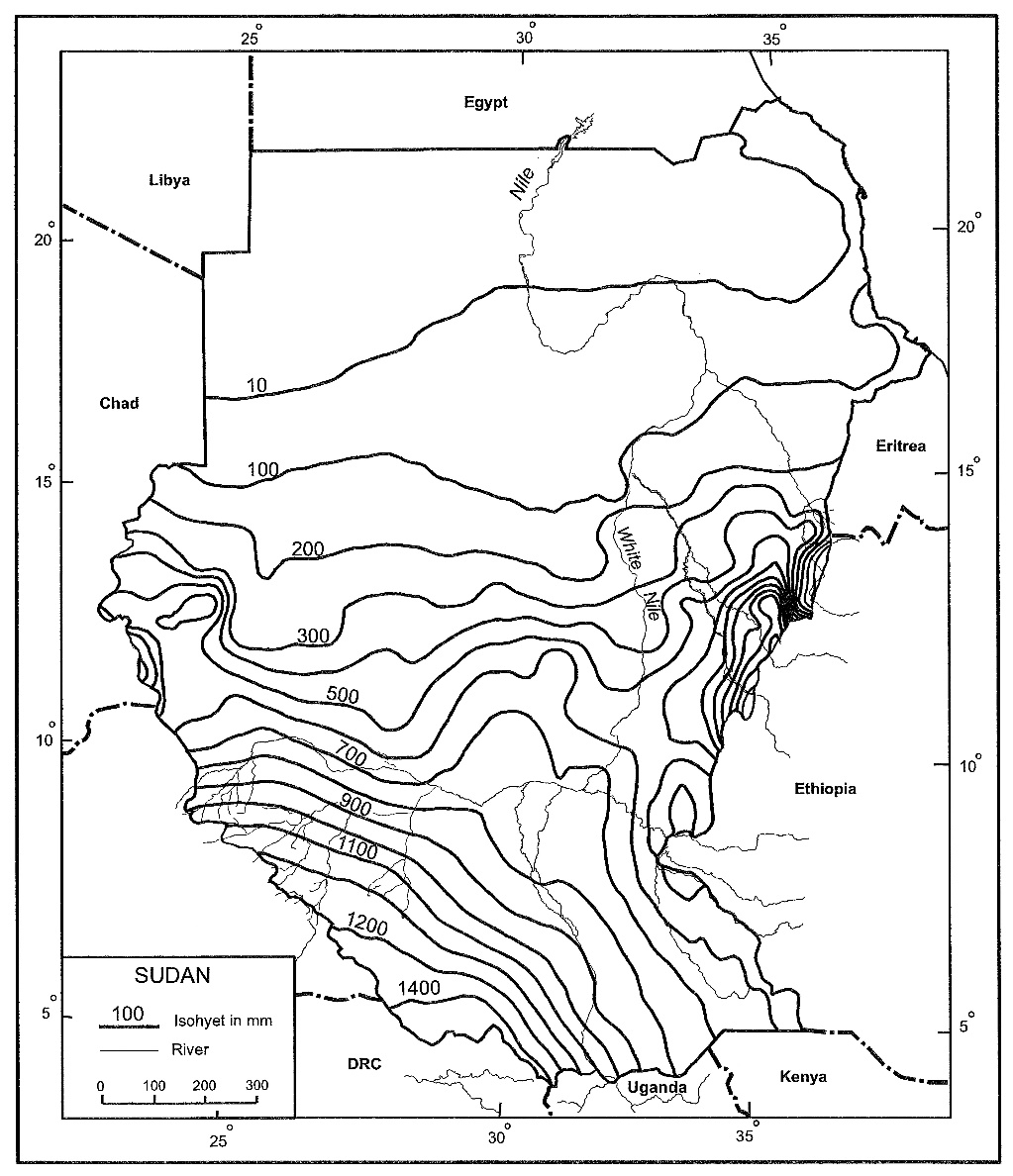
This study focuses on the years 1982 to 1994 in the territory that comprised both Sudan and South Sudan prior to 2011. Throughout this paper, "Sudan" refers to the unified entity before its division into the Republic of Sudan and the Republic of South Sudan in 2011, as indicated in Figure 1.


In 1994, NDDU implemented a methodology that utilised two primary datasets: a 12-year time series of annual integrated ARTEMIS NOAA AVHRR NDVI imagery spanning 1982 to 1994, and annual rainfall data collected from up to 76 meteorological stations nationwide.
The NOAA AVHRR NDVI is defined as:
NDVI = (NIR – R)/(NIR+R) 21, 35
Where: NIR is the near infra-red wavelength band; R is the red wavelength
Research indicates that Absorbed Photosynthetically Active Radiation (APAR) is influenced by variables such as Leaf Area Index (LAI), Incoming Shortwave Radiation (ISR), and canopy geometry. Additionally, the Normalised Difference Vegetation Index (NDVI) is dependent on both APAR and LAI. As different biomes exhibit distinct canopy structures, they may yield varying NDVI values despite having identical LAIs. When relating Net Primary Productivity (NPP) to the seasonal integration of APAR, it is evident that NPP is a function of APAR absorbed over the growing period.
Therefore,
NPP = f[ APAR] x ε
Where ε = energy-conversion efficiency in g/MJ. 36
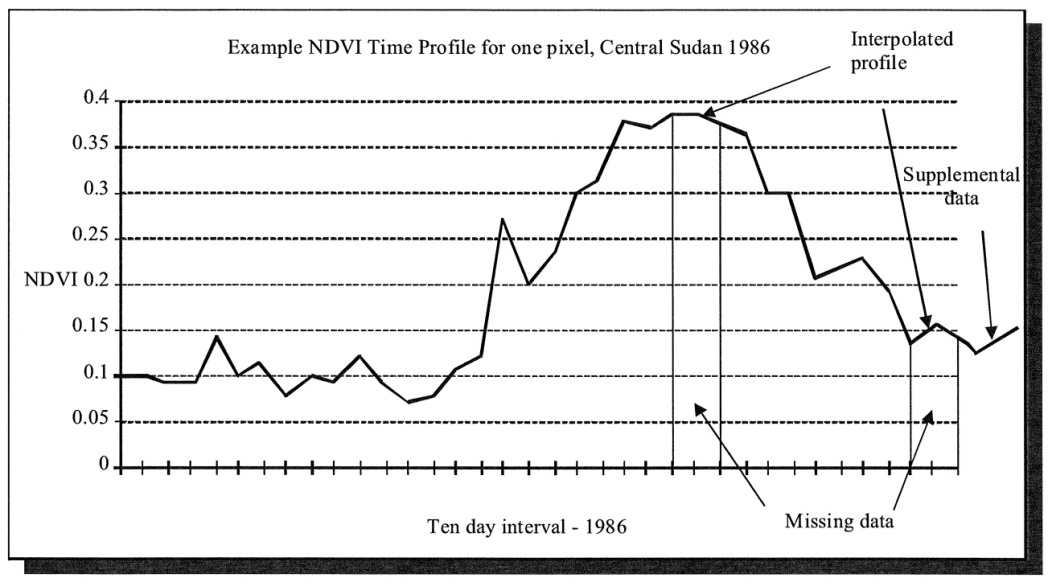
2.3. Integrating ARTEMIS Time Series NDVI ImageryThe FAO ARTEMIS project delivers calibrated NDVI imagery every ten days (dekadely), using Maximum Value Composite (MVC) methods. Each composite is created by selecting the highest NDVI value for each pixel over a ten-day period, with a spatial resolution of 7.5 km. Annual integrated NDVI images are then generated by calculating the area under the annual NDVI profile for each pixel, as shown in Figure 2 for a location in central Sudan 16.
However, because of the short composite period of ten days, MVC images are not always free of cloudy pixels. Serious errors in the annual integrated NDVI can arise if cloudy pixels occur in the time series, leading to gaps in the profile. The ARTEMIS data are masked for clouds using the thermal channel of AVHRR, and cloudy pixels are marked as cloudy rather than giving them a low NDVI value. Missing or cloudy pixels are catered for, in this study by interpolating the missing NDVI values from the true NDVI values on either side of the missing value using software specially developed for this purpose (Figure 2). Standard GIS and image processing packages do not generally address the problems encountered in such time-series analyses.
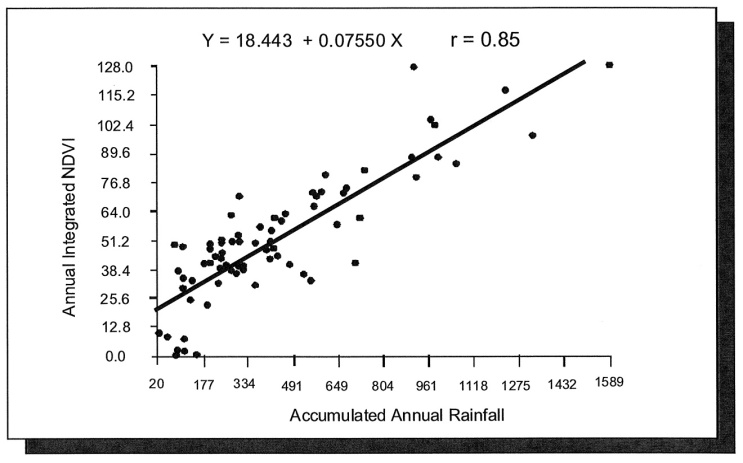
2.4. The NDDU AnalysisThe NDDU methodology assessed the link between annual rainfall and integrated yearly NDVI using regression analyses based on rainfall station data. Because these stations are usually located in populated areas with cleared land and high animal stocking rates, their data may not represent the entire region 37. To reduce this effect, the mean NDVI from a 3 × 3 pixel block surrounding the rainfall stations was used in the regression analysis. Rainfall stations located within irrigated areas were omitted from the regression, as these locations showed high NDVI values regardless of rainfall. Irrigated areas were identified with a digital version of the National Land Use Map of Sudan. The analysis utilised IDRISI GIS software. Figure 3 presents the regression analysis of rainfall (X-axis) and annual integrated NDVI (Y-axis) for 1982. The regression outcomes for the years 1982-91 are provided in Table 1.

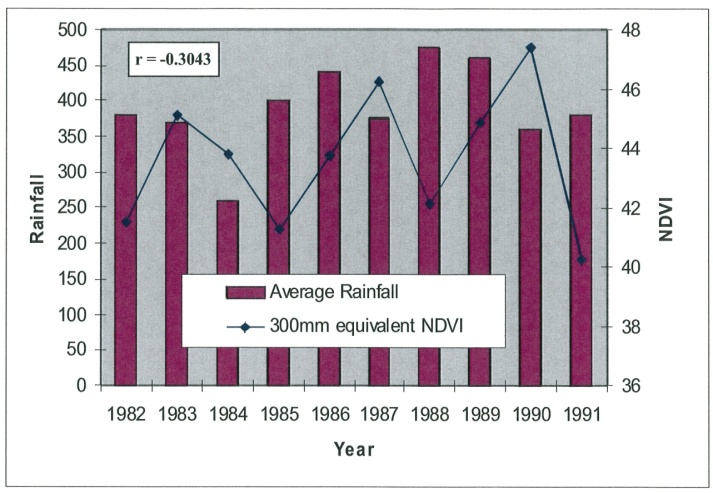
After establishing the annual relationship between rainfall and NDVI, and recognising the significance of the 300 mm rainfall threshold for rainfed agriculture, NDVI values corresponding to 300 mm of rainfall were calculated for each year. These threshold NDVI values were subsequently employed to mask regions experiencing drought annually. The resulting masked areas were aggregated to create a comprehensive drought risk assessment map for Sudan. High correlation coefficients in the data set demonstrate a robust association between rainfall and NDVI within Sudan. However, when comparing national annual average rainfall with the NDVI equivalent for 300 mm rainfall, as presented in Table 1, a weak negative correlation was observed (r of -0.3043) as shown in Figure 4). Notably, NDVI values for equivalent rainfall amounts were higher during dry years (such as 1984) compared to wet or average years (e.g., 1988 and 1982). The year 1984 was identified as an extremely dry period across the entire Sahelo-Sudanian region, while 1988 represented an exceptionally wet year.

These results suggest that water-use efficiency in wet years is lower than that in normal and dry years. These results contradict the findings of previous studies. For instance, a study on Sudan noted that, for the same amount of rainfall, higher values of NDVI occurred in a year of normal precipitation, while in drought years, lower values of NDVI were recorded from the same amount of rainfall 5. These low NDVI values reflect a lower water-use efficiency of vegetation in dry years, which could be attributed to increased runoff due to lower vegetation cover. A lower water-use efficiency in dry years was also observed in a study in Senegal 38. The significance of the predominant plant life forms in determining water-use efficiency, and hence the primary productivity of vegetation, has been emphasized by many scientists 5, 39, 40:
In tropical Savannas that receive between 200 and 1000 mm rainfall, vegetation’s primary production and rainfall are closely related 40. However, in higher rainfall areas this strong close relationship declines, and factors other than rainfall tend to control primary production. 5.
Areas in which there are differences in the predominant plant life-forms, particularly with respect to rooting depth, differ in the amount of primary production per unit of rainfall 39.
The relationship between rainfall and NDVI is influenced by both the timing and intensity of precipitation. In Kassala city of Sudan, it was observed that rainfall during the 1980 growing season resulted in higher NDVI values compared to 238 mm received in fewer events in 1983 5. This suggests that NDVI reflects effective rainfall within the growing season rather than total annual precipitation. The findings were based on data from a single rainfall station with limited spatial coverage and similar vegetation types. The sufficiency of rainfall stations in this study warrants consideration, especially given the spatial variability of rainfall in semi-arid regions. The study also showed that, in Sudan, the correlation between rainfall and NDVI can indicate localized changes. For instance, irrigated areas in Sudan displayed higher NDVI values than would be expected from rainfall data alone 5. This study addresses conflicting findings from the NDDU study by analysing only NDVI and rainfall data from the growing season, thus minimizing off-season rainfall effects. It is emphasized that defining the growing season to correlate relevant rainfall and NDVI accurately 6 is very critical to the link between the two. Therefore, the analysis focuses on rainy season data and growing season.
A comprehensive analysis of rainfall data has delineated the timing of Sudan’s rainy season. In most regions, precipitation typically begins in early May and ends by late October. Notable exceptions include certain northeastern areas, where winter rainfall occurs from November to February amidst semi-desert vegetation, and southern regions, where rains usually commence in April and perennial vegetation is prevalent. For the purpose of this analysis, both the winter rains along the Red Sea coast (which are associated with limited vegetation) and the earliest March rains in the south (where abundant precipitation sustains high NDVI values year-round) were excluded. In these specific areas, vegetation is either sparse or consistently verdant throughout the year.
Analysis of NDVI imagery shows that the vegetation growing season occurs from June to November. The imagery also indicates that, during the dry season (December to April), bare soil has higher NDVI values, suggesting some degree of vegetation cover compared to surrounding areas, especially in the northern desert regions of the study area. These elevated NDVI readings in dry bare soils are explained by the index’s sensitivity to the soil’s optical properties 17. As a result, this study omits images from the dry season each year to reduce the impact of soil brightness on the analysis.
Integrated seasonal rainfall data (May–October) and growing season NDVI imagery (June–November) were generated for the analysis. The accumulated NDVI images from the growing season and the seasonal rainfall data were subsequently correlated. Table 2 presents the results of the correlation and regression analysis between annual seasonal rainfall and accumulated NDVI values during the growing season. Additionally, the table includes data for areas where NDVI values exceed the 300 mm-equivalent threshold.
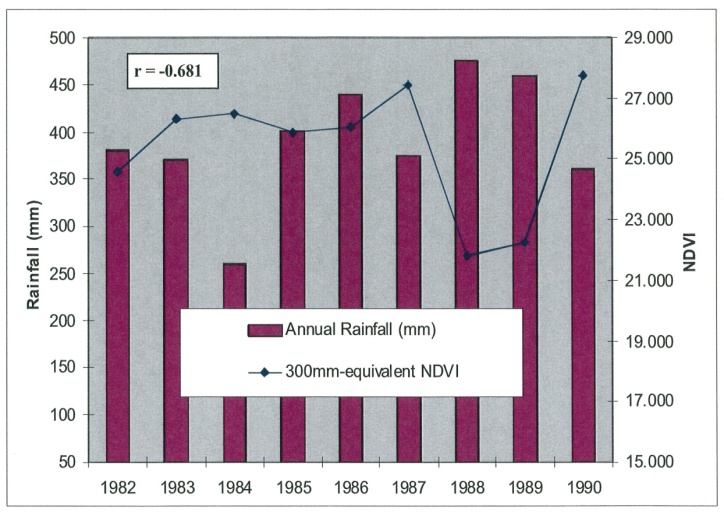
The relationship between the national average rainfall and the growing season’s 300mm-equivalent NDVI is shown in Figure 5.

Table 2 and Figure 5 show that growing season analysis confirms the NDDU findings that: there is a relatively high negative correlation between the 300mm rainfall and its equivalent NDVI values for every year. It shows that in wet years (e.g 1988 and 1989), for the same amount of rainfall, NDVI values are relatively lower compared to NDVI values of years of average rainfall. At the same time, for years of poor rainfall (1984, 1987 & 1990), the 300mm-equivalent NDVIs show relatively high values. This negative relation is indicated by the correlation coefficient (-0.0681). This result further confirms the apparent negative relation between water-use efficiency and the amount of rainfall, interpreted from the integrated annual data analysis in the NDDU study.
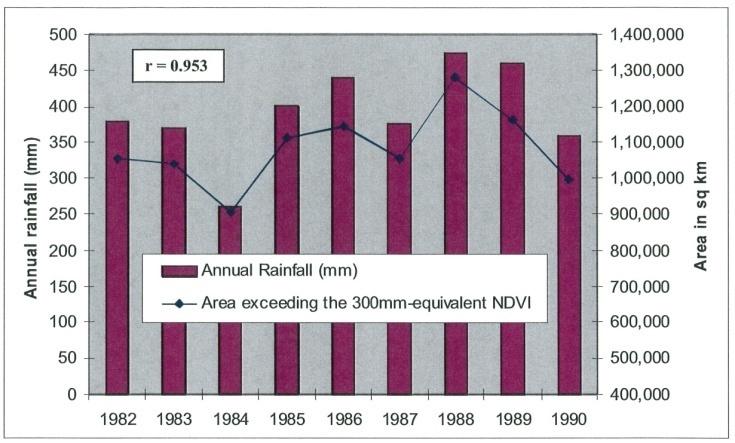
However, the high correlation coefficient (0.953) between the national average rainfall and the area exceeding the 300mm-equivalent NDVI threshold (shown in Figure 6) further suggests that there is a clear north-south movement of rainfall between wet and dry years, and that during wet years the 300mm area extends further north such that the total area exceeding the 300mm threshold is bigger in wet years than in dry ones.

The spatial distribution of rainfall in the Sahel corresponds to the north-south movement of the Inter-Tropical Convergence Zone (ITCZ) 5, 6. This distribution is indicated by the regions that surpass the 300mm NDVI equivalent threshold. The analysis of the growing season provides additional evidence consistent with the results from the integrated annual data analysis in the NDDU study. There is a notable negative correlation between the 300mm-equivalent NDVI and rainfall (see Figure 5 and Table 2), which implies greater water-use efficiency during dry years compared to wet or normal years. In contrast, a strong positive relationship exists between the areal extent and rainfall (see Figure 6 and Table 2), reflecting the north-south oscillation of the rainfall front between different years.
2.6. Identification of the Main Ecological Zones in Sudan from NDVI Time-series ImagesPlant water-use efficiency in a given area depends on the predominant plant life-forms present 39. Different plant life-forms are found in different ecological zones. To analyze the spatial distribution of water-use efficiency, the principal ecological zones in Sudan were identified. Seasonal variations in NDVI values served to distinguish these ecological zones through unsupervised classification of time series NDVI images.
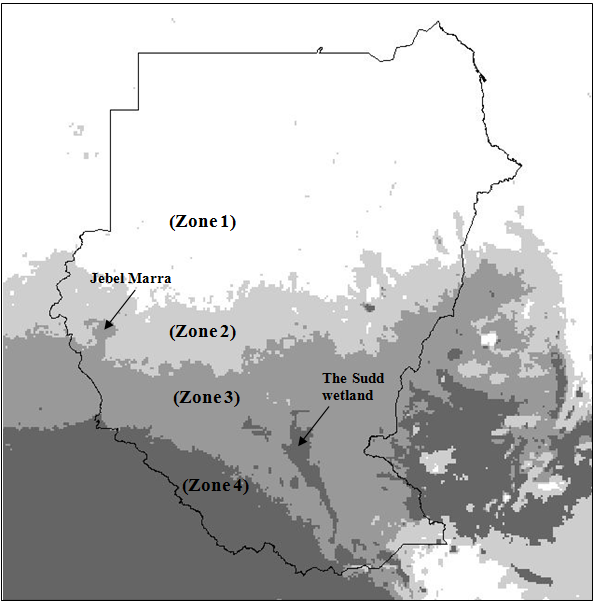
Monthly NDVI images from each year between 1982 and 1990 (totaling 108 images) were used in an unsupervised classification analysis to determine the primary ecological zones in Sudan. By varying the number of classes in the classification process, four main ecological zones were delineated. These include a northern zone with low biomass and correspondingly low NDVI values, two intermediate zones, and a southern zone. For clarity, the zones are numbered sequentially from north to south as 1, 2, 3, and 4. Figure 7 below illustrates the four identified ecological zones.
These ecological zones display varying vegetation covers and differing responses to rainfall. For example, zone 4 consists primarily of perennial trees, whereas zones 3 and 2 feature mixtures of grasses, shrubs, and trees in different proportions. Zone 3 has a greater ratio of trees to grasses compared to zone 2. Areas with less vegetation cover generally exhibit lower water-use efficiency than those with denser vegetation, which may be due to increased run-off associated with sparse vegetation 5. Based on these observations, zone 1 demonstrates lower water-use efficiency than zone 2, and zone 2 is less efficient than zone 3. In this study area, vegetation water-use efficiency appears to increase toward the south.

To investigate why 300 mm-equivalent NDVI values are higher in dry years compared to wet and normal years, it is necessary to analyse the spatial distribution of rainfall relative to the primary ecological zones for each year. Rainfall isohyet maps were generated using station records from each rainy season to determine annual rainfall patterns.
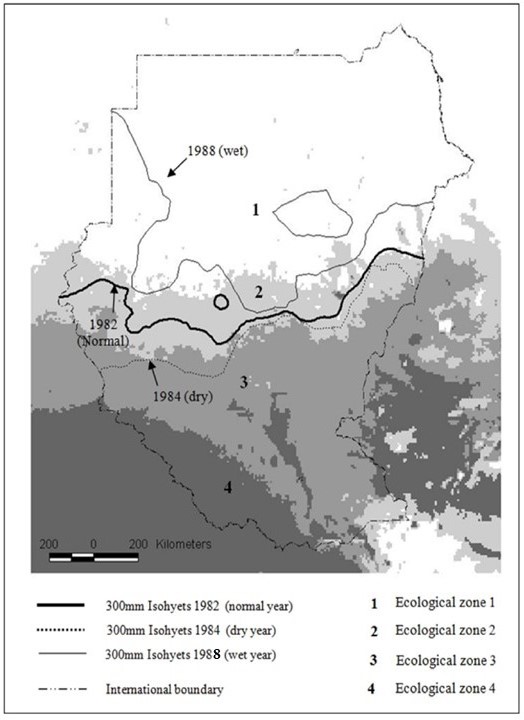
Figure 8 illustrates the 300 mm isohyets for specific years: an average rainfall year (1982), a dry year (1984), and a wet year (1988). The maps reveal that Sahelian rainfall oscillates along a north-south axis between dry and wet periods. In dry years, rainfall shifts southward, whereas in wet years, it moves northward. In 1988, a notably wet year, the 300 mm rainfall line shifted north into areas typically characterised by sparse vegetation cover (zone 1), where low water-use efficiency—driven by high runoff due to minimal vegetation—results in correspondingly low NDVI values. This phenomenon explains the observed decrease in 300 mm-equivalent NDVI values during wet years ( Figure 5 and Table 2). Conversely, in dry years such as 1984, the 300 mm isohyet migrates southward into regions with denser vegetation (zone 3 and southern zone 2), where increased water-use efficiency, facilitated by dense plant cover and deep-rooted flora, minimises runoff and consequently produces elevated NDVI values. As such, there is a pronounced negative correlation between average rainfall and the 300 mm-equivalent NDVI, as demonstrated in Figure 8 and Table 2 above.

The lag between rainfall and NDVI identified by the previous Kassa’s study has been attributed to shifts in the spatial distribution of rainfall isohyets within a given season 7, as they relate to various ecological zones and the corresponding vegetation responses to comparable rainfall amounts in different areas. This phenomenon is further associated with the variation in water-use efficiency across ecosystems.
This study provides a comprehensive reassessment of the relationship between NDVI and rainfall in Sudan and South Sudan from 1982 to 1994, incorporating an analysis of spatiotemporal rainfall distribution across distinct ecological zones based on available data. Findings demonstrate that ecological zonation plays a critical role in shaping both spatial and temporal vegetation responses to rainfall variability within the Sudano-Sahelian region. Variations in vegetation types, soil properties, and hydrological processes among these zones contribute to unique response patterns. The observed tendency for higher NDVI values during drier years for equivalent rainfall amounts is explained by the shifting of rainfall belts and varying response efficiencies across ecological zones. These results are consistent with previous research conducted in Jordan over ten growing seasons (1981–1992), where linear regression revealed clear differences in NDVI-rainfall relationships among ecological zones 41, as well as a study in the Mediterranean that underscores the importance of ecological zoning in analyses of vegetation dynamics 15. Effectively characterizing these dynamic, zone-specific relationships necessitates analytical approaches that account for spatiotemporal interactions. This study highlights the value of such methodologies in avoiding oversights related to spatial heterogeneity. Enhanced understanding of ecological zone responses to rainfall over time and space is essential for improving drought monitoring, climate change adaptation, and land management strategies in semi-arid ecosystems.
The study received support from several scientists and consultants. Climatological data were supplied by Professor Michael Hulme of the Climate Research Unit at the University of East Anglia, and by Clive English of Hunting Technical Services. Timothy Richards of Conservation Technology, the NDDU, and the National Remote Sensing Centre of Sudan also contributed to this work.
| [1] | Anyamba, A. and C.J. Tucker, Analysis of Sahelian vegetation dynamics using NOAA-AVHRR NDVI data from 1981–2003. Journal of arid environments, 2005. 63(3): p. 596-614. | ||
| In article | View Article | ||
| [2] | Brieva, C., et al. NDVI and Accumulated Antecedent Precipitation (APP) in four different vegetation types in drylands of Mendoza, Argentina. in EGU General Assembly Conference Abstracts. 2023. | ||
| In article | View Article | ||
| [3] | Brieva, C., et al., NDVI Response to Satellite-Estimated Antecedent Precipitation in Dryland Pastures. Remote Sensing, 2023. 15(14): p. 3615. | ||
| In article | View Article | ||
| [4] | Jones, H.G. and R.A. Vaughan, Remote sensing of vegetation: principles, techniques, and applications. 2010: OUP Oxford. | ||
| In article | |||
| [5] | Hielkema, J., S. Prince, and W. Astle, Rainfall and vegetation monitoring in the savanna zone of the Democratic Republic of Sudan using the NOAA Advanced Very High Resolution Radiometer. International Journal of Remote Sensing, 1986. 7(11): p. 1499-1513. | ||
| In article | View Article | ||
| [6] | Justice, C. and P.H. Hiernaux, Monitoring the grasslands of the Sahel using NOAA AVHRR data: Niger 1983. International Journal of Remote Sensing, 1986. 7(11): p. 1475-1497. | ||
| In article | View Article | ||
| [7] | Kassa, A., Drought risk monitoring for the Sudan using NDVI 1982-1993. Geographic Information Systems, University College London, 1999: p. 2-41. | ||
| In article | |||
| [8] | Lang, M., H. Mahyou, and B. Tychon, Estimation of rangeland production in the arid oriental region (Morocco) combining remote sensing vegetation and rainfall indices: challenges and lessons learned. Remote Sensing, 2021. 13(11): p. 2093. | ||
| In article | View Article | ||
| [9] | Lo, A., et al., Remote sensing-based assessment of dry-season forage quality for improved rangeland management in Sahelian ecosystems. Rangeland Ecology & Management, 2024. 96: p. 94-104. | ||
| In article | View Article | ||
| [10] | Mallick, J., et al., Evaluating the NDVI–rainfall relationship in Bisha watershed, Saudi Arabia using non-stationary modeling technique. Atmosphere, 2021. 12(5): p. 593. | ||
| In article | View Article | ||
| [11] | Masunga, D.J., et al., Spatial and Temporal Trends of Extreme Precipitation in Eastern Africa during January 1981-2023. Journal of Geoscience and Environment Protection, 2025. 13(4): p. 49-79. | ||
| In article | View Article | ||
| [12] | Zhang, H., et al., Winter wheat yield prediction using integrated Landsat 8 and Sentinel-2 vegetation index time-series data and machine learning algorithms. Computers and Electronics in Agriculture, 2023. 213: p. 108250. | ||
| In article | View Article | ||
| [13] | Gong, Z., et al., Satellite remote sensing of vegetation phenology: Progress, challenges, and opportunities. ISPRS Journal of Photogrammetry and Remote Sensing, 2024. 217: p. 149-164. | ||
| In article | View Article | ||
| [14] | Justice, C., et al., Synergism between NOAA-AVHRR and Meteosat data for studying vegetation development in semi-arid West Africa. International Journal of Remote Sensing, 1991. 12(6): p. 1349-1368. | ||
| In article | View Article | ||
| [15] | Shoshany, M., Satellite remote sensing of natural Mediterranean vegetation: a review within an ecological context. Progress in Physical Geography, 2000. 24(2): p. 153-178. | ||
| In article | View Article | ||
| [16] | HTS, Technical notes on maps and database; Republic of Sudan , National Drought and Desertification Unit (NDDU)- Ministry of Agriculture, Natural Resources and Animal Wealth, Sudan., N.D.a.D.U. (NDDU, Editor. 1994, HTS: Sudan. | ||
| In article | |||
| [17] | Purevdorj, T., et al., Relationships between percent vegetation cover and vegetation indices. International journal of remote sensing, 1998. 19(18): p. 3519-3535. | ||
| In article | View Article | ||
| [18] | Propastin, P. and M. Kappas, Spatio-temporal drifts in AVHRR/NDVI-precipitation relationships and their linkage to land use change in central Kazakhstan. EARSeL eProceedings, 2008. 7(1): p. 30-45. | ||
| In article | View Article | ||
| [19] | Naga Rajesh, A., et al., Long-term relationships of MODIS NDVI with rainfall, land surface temperature, surface soil moisture and groundwater storage over monsoon core region of India. Arid Land Research and Management, 2023. 37(1): p. 51-70. | ||
| In article | View Article | ||
| [20] | Sa’adi, Z., et al. Examining the NDVI-Rainfall Relationship Under High Enso Event Influence Using Geographically Weighted Regression in Peninsular Malaysia. in IGARSS 2024-2024 IEEE International Geoscience and Remote Sensing Symposium. 2024. IEEE. | ||
| In article | View Article | ||
| [21] | Zhang, H., et al., Changes in vegetation NDVI and its response to climate change and human activities in the Ferghana Basin from 1982 to 2015. Remote Sensing, 2024. 16(7): p. 1296. | ||
| In article | View Article | ||
| [22] | Dutta, S., et al., Analyzing seasonal variation in the vegetation cover using NDVI and rainfall in the dry deciduous forest region of Eastern India, in Forest Resources Resilience and Conflicts. 2021, Elsevier. p. 33-48. | ||
| In article | View Article | ||
| [23] | Thanabalan, P., et al., Time-series analysis of MODIS (LST and NDVI) and TRMM rainfall for drought assessment over India. Applied Geomatics, 2023. 15(2): p. 383-405. | ||
| In article | View Article | ||
| [24] | Mao, X., H.-L. Ren, and G. Liu, Primary interannual variability patterns of the growing-season NDVI over the Tibetan plateau and main climatic factors. Remote Sensing, 2022. 14(20): p. 5183. | ||
| In article | View Article | ||
| [25] | Felegari, S., et al., Investigation of the relationship between ndvi index, soil moisture, and precipitation data using satellite images. Sustainable Agriculture Systems and Technologies, 2022: p. 314-325. | ||
| In article | View Article | ||
| [26] | Ahmad, U.A., Rainfall Spatio-Temporal Variability in Kano Region, Nigeria. 2024. | ||
| In article | |||
| [27] | Moussa, S., et al., Analysis of the Dynamics of Vegetation in the Sudan-Sahelian Zone: Case of the Moutourwa Agricultural Production Basin, Far-North Cameroon. Int. J. Environ. Clim. Change, 2024. 14(4): p. 644-654. | ||
| In article | View Article | ||
| [28] | Lykhovyd, P., et al., The link between the normalized difference vegetation index in major crops and meteorological factors. Agrology, 2024. 7(2): p. 39-45. | ||
| In article | View Article | ||
| [29] | Farrar, T., S. Nicholson, and A. Lare, The influence of soil type on the relationships between NDVI, rainfall, and soil moisture in semiarid Botswana. II. NDVI response to soil oisture. Remote sensing of Environment, 1994. 50(2): p. 121-133. | ||
| In article | View Article | ||
| [30] | Liu, M., et al., Time-lag and accumulation responses of vegetation growth to average and extreme precipitation and temperature events in China between 2001 and 2020. Science of The Total Environment, 2024. 945: p. 174084. | ||
| In article | View Article PubMed | ||
| [31] | Liu, X.B.X. Lag Analysis of Vegetation NDVI and Precipitation in Liaoning Province. 2019. Atlantis Press. | ||
| In article | |||
| [32] | Bonifacio, R., G. Dugdale, and J. Milford. Using meteosat rainfall estimates for the prediction of growing season status and vegetation production over Sahelian Africa–principles and operational perspective. in 25th International Symposium on Remote Sensing and Global Environmental Change. Graz, Austria. 1993. | ||
| In article | |||
| [33] | Bonifacio, R., G. Dugdale, and J. Milford, Sahelian rangeland production in relation to rainfall estimates from Meteosat. International Journal of Remote Sensing, 1993. 14(14): p. 2695-2711. | ||
| In article | View Article | ||
| [34] | Bonifacio, R., G. Dugdale, and J. Milford. Combination of METEOSAT data with NOAA AVHRR VIS and NIR data and with SSM/I microwave data for studies of vegetation and soil moisture over Sahelian West Africa. in 9th Meteosat Scientific Users, Meeting at Locarno, Switzerland. 1992. | ||
| In article | |||
| [35] | D’Ercole, R., et al., A high temporal resolution NDVI time series to monitor drought events in the Horn of Africa. International Journal of Applied Earth Observation and Geoinformation, 2024. 135: p. 104264. | ||
| In article | View Article | ||
| [36] | Goward, S.N., G.D. Cruickshanks, and A.S. Hope, Observed relation between thermal emission and reflected spectral radiance of a complex vegetated landscape. Remote sensing of Environment, 1985. 18(2): p. 137-146. | ||
| In article | View Article | ||
| [37] | Cracknell, A.P., The Advanced Very High Resolution Radiometer AVHRR. 1997: Taylor and Francis. | ||
| In article | |||
| [38] | Tucker, C.J., et al., Satellite remote sensing of total herbaceous biomass production in the Senegalese Sahel: 1980–1984. Remote sensing of environment, 1985. 17(3): p. 233-249. | ||
| In article | View Article | ||
| [39] | Le Houerou, H.N. and C.H. Hoste, Rangeland production and annual rainfall relations in the Mediterranean Basin and in the African Sahelo Sudanian zone. Rangeland Ecology & Management/Journal of Range Management Archives, 1977. 30(3): p. 181-189. | ||
| In article | View Article | ||
| [40] | Lamotte, M. and F. Bourlière, Energy flow and nutrient cycling in tropical Savannas. 1983. | ||
| In article | |||
| [41] | Al-Bakri, J. and A. Suleiman, NDVI response to rainfall in different ecological zones in Jordan. International Journal of Remote Sensing, 2004. 25(19): p. 3897-3912. | ||
| In article | View Article | ||
Published with license by Science and Education Publishing, Copyright © 2025 Yasir E. Mohieldeen and Mohammed Mahgoub Hassan
 This work is licensed under a Creative Commons Attribution 4.0 International License. To view a copy of this license, visit
http://creativecommons.org/licenses/by/4.0/
This work is licensed under a Creative Commons Attribution 4.0 International License. To view a copy of this license, visit
http://creativecommons.org/licenses/by/4.0/
| [1] | Anyamba, A. and C.J. Tucker, Analysis of Sahelian vegetation dynamics using NOAA-AVHRR NDVI data from 1981–2003. Journal of arid environments, 2005. 63(3): p. 596-614. | ||
| In article | View Article | ||
| [2] | Brieva, C., et al. NDVI and Accumulated Antecedent Precipitation (APP) in four different vegetation types in drylands of Mendoza, Argentina. in EGU General Assembly Conference Abstracts. 2023. | ||
| In article | View Article | ||
| [3] | Brieva, C., et al., NDVI Response to Satellite-Estimated Antecedent Precipitation in Dryland Pastures. Remote Sensing, 2023. 15(14): p. 3615. | ||
| In article | View Article | ||
| [4] | Jones, H.G. and R.A. Vaughan, Remote sensing of vegetation: principles, techniques, and applications. 2010: OUP Oxford. | ||
| In article | |||
| [5] | Hielkema, J., S. Prince, and W. Astle, Rainfall and vegetation monitoring in the savanna zone of the Democratic Republic of Sudan using the NOAA Advanced Very High Resolution Radiometer. International Journal of Remote Sensing, 1986. 7(11): p. 1499-1513. | ||
| In article | View Article | ||
| [6] | Justice, C. and P.H. Hiernaux, Monitoring the grasslands of the Sahel using NOAA AVHRR data: Niger 1983. International Journal of Remote Sensing, 1986. 7(11): p. 1475-1497. | ||
| In article | View Article | ||
| [7] | Kassa, A., Drought risk monitoring for the Sudan using NDVI 1982-1993. Geographic Information Systems, University College London, 1999: p. 2-41. | ||
| In article | |||
| [8] | Lang, M., H. Mahyou, and B. Tychon, Estimation of rangeland production in the arid oriental region (Morocco) combining remote sensing vegetation and rainfall indices: challenges and lessons learned. Remote Sensing, 2021. 13(11): p. 2093. | ||
| In article | View Article | ||
| [9] | Lo, A., et al., Remote sensing-based assessment of dry-season forage quality for improved rangeland management in Sahelian ecosystems. Rangeland Ecology & Management, 2024. 96: p. 94-104. | ||
| In article | View Article | ||
| [10] | Mallick, J., et al., Evaluating the NDVI–rainfall relationship in Bisha watershed, Saudi Arabia using non-stationary modeling technique. Atmosphere, 2021. 12(5): p. 593. | ||
| In article | View Article | ||
| [11] | Masunga, D.J., et al., Spatial and Temporal Trends of Extreme Precipitation in Eastern Africa during January 1981-2023. Journal of Geoscience and Environment Protection, 2025. 13(4): p. 49-79. | ||
| In article | View Article | ||
| [12] | Zhang, H., et al., Winter wheat yield prediction using integrated Landsat 8 and Sentinel-2 vegetation index time-series data and machine learning algorithms. Computers and Electronics in Agriculture, 2023. 213: p. 108250. | ||
| In article | View Article | ||
| [13] | Gong, Z., et al., Satellite remote sensing of vegetation phenology: Progress, challenges, and opportunities. ISPRS Journal of Photogrammetry and Remote Sensing, 2024. 217: p. 149-164. | ||
| In article | View Article | ||
| [14] | Justice, C., et al., Synergism between NOAA-AVHRR and Meteosat data for studying vegetation development in semi-arid West Africa. International Journal of Remote Sensing, 1991. 12(6): p. 1349-1368. | ||
| In article | View Article | ||
| [15] | Shoshany, M., Satellite remote sensing of natural Mediterranean vegetation: a review within an ecological context. Progress in Physical Geography, 2000. 24(2): p. 153-178. | ||
| In article | View Article | ||
| [16] | HTS, Technical notes on maps and database; Republic of Sudan , National Drought and Desertification Unit (NDDU)- Ministry of Agriculture, Natural Resources and Animal Wealth, Sudan., N.D.a.D.U. (NDDU, Editor. 1994, HTS: Sudan. | ||
| In article | |||
| [17] | Purevdorj, T., et al., Relationships between percent vegetation cover and vegetation indices. International journal of remote sensing, 1998. 19(18): p. 3519-3535. | ||
| In article | View Article | ||
| [18] | Propastin, P. and M. Kappas, Spatio-temporal drifts in AVHRR/NDVI-precipitation relationships and their linkage to land use change in central Kazakhstan. EARSeL eProceedings, 2008. 7(1): p. 30-45. | ||
| In article | View Article | ||
| [19] | Naga Rajesh, A., et al., Long-term relationships of MODIS NDVI with rainfall, land surface temperature, surface soil moisture and groundwater storage over monsoon core region of India. Arid Land Research and Management, 2023. 37(1): p. 51-70. | ||
| In article | View Article | ||
| [20] | Sa’adi, Z., et al. Examining the NDVI-Rainfall Relationship Under High Enso Event Influence Using Geographically Weighted Regression in Peninsular Malaysia. in IGARSS 2024-2024 IEEE International Geoscience and Remote Sensing Symposium. 2024. IEEE. | ||
| In article | View Article | ||
| [21] | Zhang, H., et al., Changes in vegetation NDVI and its response to climate change and human activities in the Ferghana Basin from 1982 to 2015. Remote Sensing, 2024. 16(7): p. 1296. | ||
| In article | View Article | ||
| [22] | Dutta, S., et al., Analyzing seasonal variation in the vegetation cover using NDVI and rainfall in the dry deciduous forest region of Eastern India, in Forest Resources Resilience and Conflicts. 2021, Elsevier. p. 33-48. | ||
| In article | View Article | ||
| [23] | Thanabalan, P., et al., Time-series analysis of MODIS (LST and NDVI) and TRMM rainfall for drought assessment over India. Applied Geomatics, 2023. 15(2): p. 383-405. | ||
| In article | View Article | ||
| [24] | Mao, X., H.-L. Ren, and G. Liu, Primary interannual variability patterns of the growing-season NDVI over the Tibetan plateau and main climatic factors. Remote Sensing, 2022. 14(20): p. 5183. | ||
| In article | View Article | ||
| [25] | Felegari, S., et al., Investigation of the relationship between ndvi index, soil moisture, and precipitation data using satellite images. Sustainable Agriculture Systems and Technologies, 2022: p. 314-325. | ||
| In article | View Article | ||
| [26] | Ahmad, U.A., Rainfall Spatio-Temporal Variability in Kano Region, Nigeria. 2024. | ||
| In article | |||
| [27] | Moussa, S., et al., Analysis of the Dynamics of Vegetation in the Sudan-Sahelian Zone: Case of the Moutourwa Agricultural Production Basin, Far-North Cameroon. Int. J. Environ. Clim. Change, 2024. 14(4): p. 644-654. | ||
| In article | View Article | ||
| [28] | Lykhovyd, P., et al., The link between the normalized difference vegetation index in major crops and meteorological factors. Agrology, 2024. 7(2): p. 39-45. | ||
| In article | View Article | ||
| [29] | Farrar, T., S. Nicholson, and A. Lare, The influence of soil type on the relationships between NDVI, rainfall, and soil moisture in semiarid Botswana. II. NDVI response to soil oisture. Remote sensing of Environment, 1994. 50(2): p. 121-133. | ||
| In article | View Article | ||
| [30] | Liu, M., et al., Time-lag and accumulation responses of vegetation growth to average and extreme precipitation and temperature events in China between 2001 and 2020. Science of The Total Environment, 2024. 945: p. 174084. | ||
| In article | View Article PubMed | ||
| [31] | Liu, X.B.X. Lag Analysis of Vegetation NDVI and Precipitation in Liaoning Province. 2019. Atlantis Press. | ||
| In article | |||
| [32] | Bonifacio, R., G. Dugdale, and J. Milford. Using meteosat rainfall estimates for the prediction of growing season status and vegetation production over Sahelian Africa–principles and operational perspective. in 25th International Symposium on Remote Sensing and Global Environmental Change. Graz, Austria. 1993. | ||
| In article | |||
| [33] | Bonifacio, R., G. Dugdale, and J. Milford, Sahelian rangeland production in relation to rainfall estimates from Meteosat. International Journal of Remote Sensing, 1993. 14(14): p. 2695-2711. | ||
| In article | View Article | ||
| [34] | Bonifacio, R., G. Dugdale, and J. Milford. Combination of METEOSAT data with NOAA AVHRR VIS and NIR data and with SSM/I microwave data for studies of vegetation and soil moisture over Sahelian West Africa. in 9th Meteosat Scientific Users, Meeting at Locarno, Switzerland. 1992. | ||
| In article | |||
| [35] | D’Ercole, R., et al., A high temporal resolution NDVI time series to monitor drought events in the Horn of Africa. International Journal of Applied Earth Observation and Geoinformation, 2024. 135: p. 104264. | ||
| In article | View Article | ||
| [36] | Goward, S.N., G.D. Cruickshanks, and A.S. Hope, Observed relation between thermal emission and reflected spectral radiance of a complex vegetated landscape. Remote sensing of Environment, 1985. 18(2): p. 137-146. | ||
| In article | View Article | ||
| [37] | Cracknell, A.P., The Advanced Very High Resolution Radiometer AVHRR. 1997: Taylor and Francis. | ||
| In article | |||
| [38] | Tucker, C.J., et al., Satellite remote sensing of total herbaceous biomass production in the Senegalese Sahel: 1980–1984. Remote sensing of environment, 1985. 17(3): p. 233-249. | ||
| In article | View Article | ||
| [39] | Le Houerou, H.N. and C.H. Hoste, Rangeland production and annual rainfall relations in the Mediterranean Basin and in the African Sahelo Sudanian zone. Rangeland Ecology & Management/Journal of Range Management Archives, 1977. 30(3): p. 181-189. | ||
| In article | View Article | ||
| [40] | Lamotte, M. and F. Bourlière, Energy flow and nutrient cycling in tropical Savannas. 1983. | ||
| In article | |||
| [41] | Al-Bakri, J. and A. Suleiman, NDVI response to rainfall in different ecological zones in Jordan. International Journal of Remote Sensing, 2004. 25(19): p. 3897-3912. | ||
| In article | View Article | ||