World is threatened by many diseases in the past years mainly due to the Communicable disease. But now a day due to the sedentary life style Non – Communicable diseases are also increasing at higher level than other Flues. Non – Communicable diseases are easily spreading in the urban centres where the ancient cookery methods, physical activities are submerging and increase in the prevalence of risk factors. Hence the present study is focused on the non – communicable diseases in Chennai. As Chennai is one of the metropolitan centres in India, and a Major IT centre in the world, the people are tending to change their life styles. A survey was conducted in all the zones of Chennai and statistical methods were applied to analyse the result. Chi square test was carried to find out the result. The result clearly states that Non – communicable diseases are increasing day by day and the prevalence is high among the females and old age people.
Non – Communicable diseases are becoming a largest burden in the world, next to communicable diseases and NCD is the major cause for the high proportion of death. “Non – Communicable diseases like Cardio vascular disease, Chronic respiratory diseases, Diabetes, Hyper tension, Cancer and Alzheimer's disease are reaching the epidemic proportions throughout the world and they mainly affect the people of all ages and nationalities” 1. In the urban slum, Non- communicable diseases in all age groups reveals a high burden in future due to the prevalence of risk factors 2. The overall problems like Diabetes, Hypertension, Obesity and Dyslipidemia are more common among the females mainly in older age group and urban females. Females have a higher prevalence of risk factors. 3. The risk factors like smoking, tobacco use and alcohol consumption were high in the urban area when compared to rural area in TamilNadu and it causes for the higher rate of the diseases like Diabetes, hypertension, Physical inactivity and overweight. The main problem is the low awareness of the individuals about the NCD, which reflects in the high prevalence of diabetes and hypertension 4. The declaration of United Nations states that Poverty, illiteracy, uneven distribution of wealth, economic imbalance, environmental determinants of health contribute the high prevalence of NCD 3. India is facing a growing burden of Non –communicable diseases because of industrialization, Socio- Economic development, Urbanization and changing life styles 5. In developing countries like India, the urbanization, Industrialization etc have significant impact on the health and nutritional status of populations 6. The life style and behavioural patterns which are the result of practices adopted from young age itself are associated with the major risk factors of the NCD. NCD cause significant resources of low income families in Tamilnadu due to the lengthy course and expensive treatment 7. Today’s urban lifestyle where one doesn’t stop and take time for themselves is causing more harm than good when it comes to physical and emotional health. Lack of healthy eating options has contributed to obesity in many individuals of all age groups today 8. Employment, education, and the working environment served as important factors for the development of risk factors for NCDs like overweight and alcohol/tobacco usage 9.
In Tamil Nadu, the urban population are projecting more than 35% of the total population. Chennai, the capital of TamilNadu and also one of the metropolitan cities of India has more percentage of urban population. There is a vast difference in the socio- economic condition of the people living Chennai. Chennai city has more percentage of migrants almost from all parts of India. Hence Chennai has all types of cultures mingled within it, especially food, life style etc., Apart from this, Chennai is dominated by the Foreign invested companies like IT companies and BPO centres which are administrated by the European and Western countries. Hence most of the people in Chennai are tend to change their life style. The traditional life styles were given up and sedentary life style is adopted which reflects in the increase of exponential rate of NCD. NCD are emerging as predominant health problem along with the Economic development in wealthy countries and hence NCD is labelled as “Disease of Urbanization” 10. Hence the research is proposed to explore these various types of diseases in Chennai city through a field work. The aim of the survey was to study the prevalence of Diabetes, Hypertension and Obesity among the various zones within an urban environment and also to look for the differences on the risk factors. In the survey, almost all the zones were selected in Chennai. The study was framed to analyse the increasing level of Diabetes, Blood Pressure, Heart disease, Cancer and the study also observes the physical activity, food habit etc, of the people. The study clearly states that the prevalence is high among the ladies and old age people.
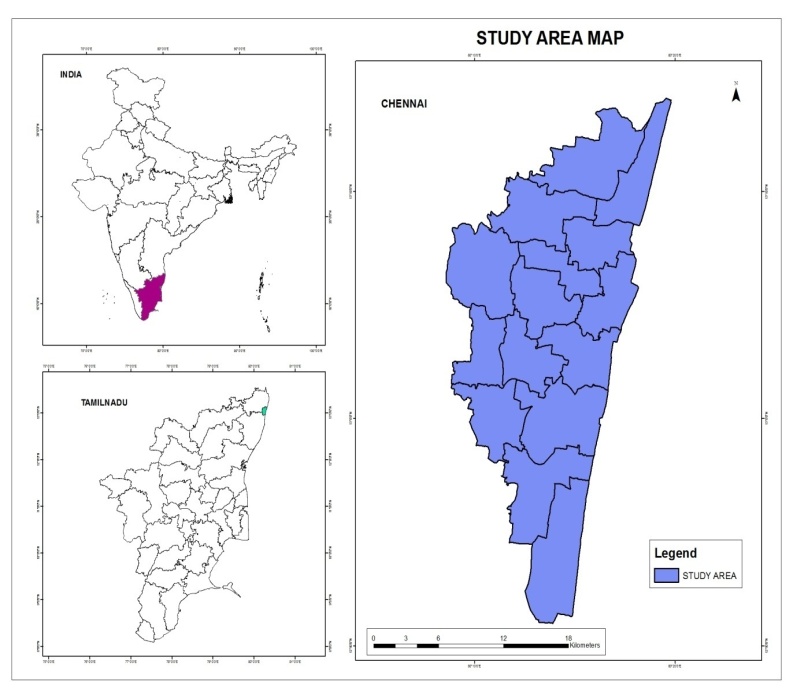
The present study deals with the prevalence of Non - Communicable diseases in Chennai. Hence the survey was taken in all 15 zones of Chennai. Chennai city is the capital of Tamil Nadu district. It is bounded by Thiruvanmiyur in the South and Thiruvottiyur in North. The area is 438Sq.Km. Chennai is located with the latitude of 13°4’ N and the longitude is 80°15’E. The altitude is 16M above the Sea level. Chennai city has a long shore line bordering Bay of Bengal. Chennai city is the 38th largest city in the world and the 4th largest city in India. Figure 1 shows the Study area. Table 1 shows the zones of Chennai city.
The main aim of the study is to analyse the prevalence of Non – Communicable diseases in Chennai. Hence a survey was taken and it also examines the Physical and regular activities of the people in Chennai. 500 samples were collected randomly in almost all the zones of Chennai. The questionnaire was framed to analyse the prevalence of NCD and the risk factors in Chennai city. The data analyses include Statistical and Geospatial analysis methods. SPSS was used to analyse the Primary data. Pearson’s Chi square test was applied to find the proportion of the risk factors and diseases. ArcGIS was applied to describe the data analysis.
In the analysis of prevalence of Non – Communicable diseases and the risk factors causing NCD among the people in Chennai. The Statistical tools SPSS was used and the Chi-Square was carried out for analyses part.
The samples were collected almost in all the Zones. The maximum of 28% of the respondents belongs to the age-group of 20-30 years and the minimum of 3% in the age group of 70-80 years. 56% of the respondents were Males and 44% were females. On the basis of Occupation, 24% of the respondents are Office going people and others were 29%. 31% of the people of the sample unit fall below the annual income of below 1 lakh. On the basis of Educational Qualification 28% of the samples were Post Graduate, 22% of the samples were Graduate.
On the basis of Factor causing the Non – Communicable Diseases, the factors related Food habits, Physical Activity etc., were analyzed. The food habits includes Non-veg consumption, Intake of Fruits, vegetables, Green leaves etc., and the Physical activity includes the Walking, Jogging, doing exercises daily and the physical activity related to Job were analysed. Apart from the above BMI level was also analyzed. In the analysis, it is stated that 37% of the people walk everyday while doing their daily work. Only 14% of the samples go for walking or jogging daily and 11% of the people exercise every day. Almost 36% of the people work more than 8 hours and 18% of the samples work for 12 hours. The mode of transport was also analyzed to identify the physical activity of the samples while travelling.
33% of the samples prefer Bus, 22% of the samples prefer Two- wheeler, 19% of the samples prefer train and only 14% of the samples prefer walk. Height and Weight for BMI level was also analysed. 55% of the people are in the height of 4.5-5.5ft while 39% of the people are in the height of 5.5-6ft and above 6 ft are 6%. 28% of the samples are in 60-70kgs and 28% of the samples are in 70-80kgs, 22% of the samples belong to 50-60kgs and 17% of the samples are in 40-50kgs.
Non-Communicable Diseases account for more than 50% of all deaths in India. Among the NCDs, Cardiovascular Diseases account for 52% of mortality followed by Chronic Obstructive Pulmonary Disease, Cancer, Diabetes and Injuries. Health- damaging behaviours such as smoking, drinking, consuming unhealthy diets (rich in salt, sugar and fats, and low in vegetables and fruits) are also found to be common among the prevalence of entire socioeconomic group and “Type 2 Diabetes is the risk factor for Coronary Heart disease” 11. Among the many diseases, Diabetes, Heart diseases and cancer are discussed below.
India is called as the Diabetes capital of the world. Chennai is also not exempted from that. Due to the sedentary life style, now a day’s Diabetics is increasing day by day even at the age of 25 – 30 itself. In the present study, Diabetics has been discussed at almost all the age group of people of Chennai. From the survey, it is obviously seen that more number of patients belongs to the age group of 55-64 in both male and female. The prevalence of Diabetics is high in the urban centre and it is high among the female than the males.
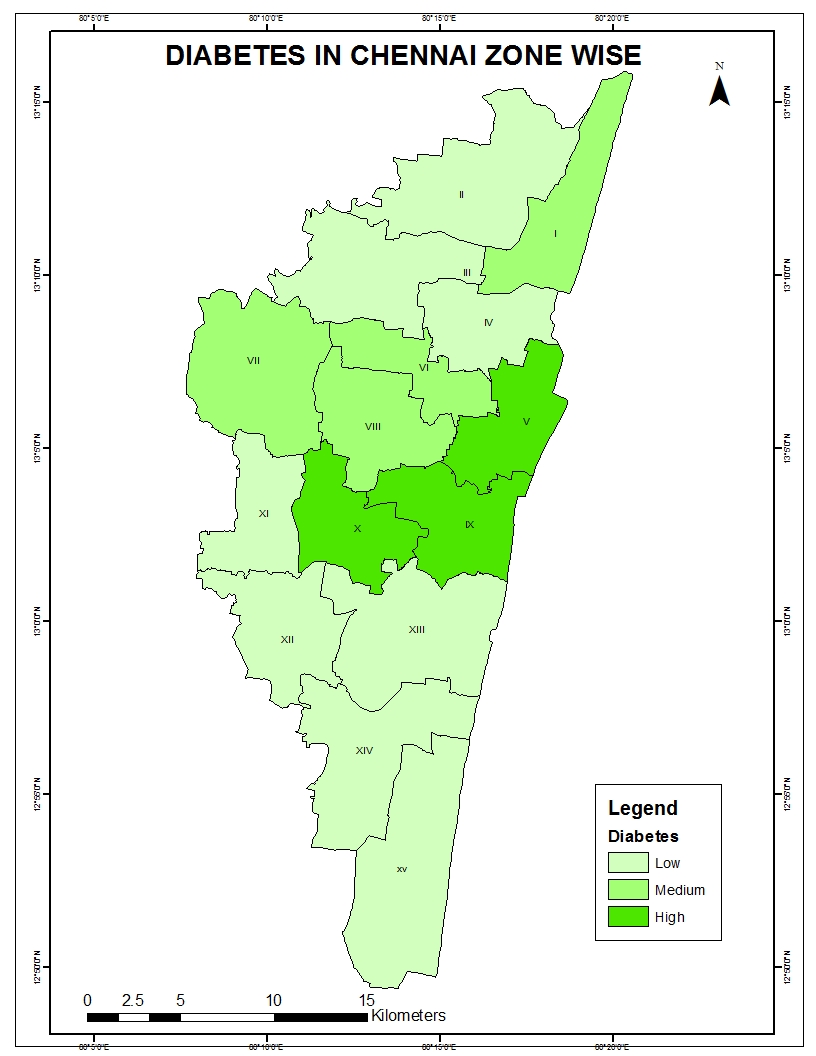
The Teenage people are also highly affected by the Diabetics. It may be due to the intake of Fast food and Junk food and among the old age, the percentage of Diabetics patients is high in the urban centres, due to the lack of care at the age of 60 and above. In the areas present in the fringe of Chennai, the prevalence of Diabetics is low due to the availability of homemade foods, physical activity at regular work etc... The survey focuses on the Type-II diabetes, but the respondents also have Diabetes caused by Genetics as well as food habit. And most of the respondents are taking treatment in the private hospitals. Among the respondents, the diabetic patients are highly present in the Northern zone especially Tondiarpet Zone and it is moderate in the Manali and Madhavaram Zone and Thiruvottiyur zone and it is low in the Thiru-vi-ka-Nagar, Ambattur, Anna Nagar, and Sholinganallur Zone. The male Patients are high in the Tondiarpet Zone. While comparing the North and South zones, the female diabetic patients are high in the North Zones. “In the developing nations and industrialized countries, diabetics are one of the major factors in disease in the Socio- Economic status of the people” 12. Figure 2 shows the Number of Diabetic patients in Chennai by zone wise.
Next to Diabetes, Chennai people are highly affected by Coronary Heart Disease. The level of Heart disease is high in the Chennai due to many reasons like (i) increase of calorie intake (ii) Work Stress (iii) Deprivation of sleep (iv) Intake of fast food and Junk food (v) Decrease in the level of Physical Activity (vi) Alcohol Consumption, Smoking, and Tobacco intake etc., and they mainly increasing among the youngsters. There is a causal link between cholesterol and coronary heart disease. “The treatment of elevated cholesterol in high risk individual has been shown to decrease the total Mortality, Coronary Mortality and overall health care cost” Jacques Genest 13. Cardiac arrest is the most common cause of death worldwide, and early intervention with high quality BLS improves a victim’s chances of survival 14 Preventing heart disease through a healthy lifestyle is important because science has proven that heart disease is caused by a passive physical life, poor diet and bad habits 15.
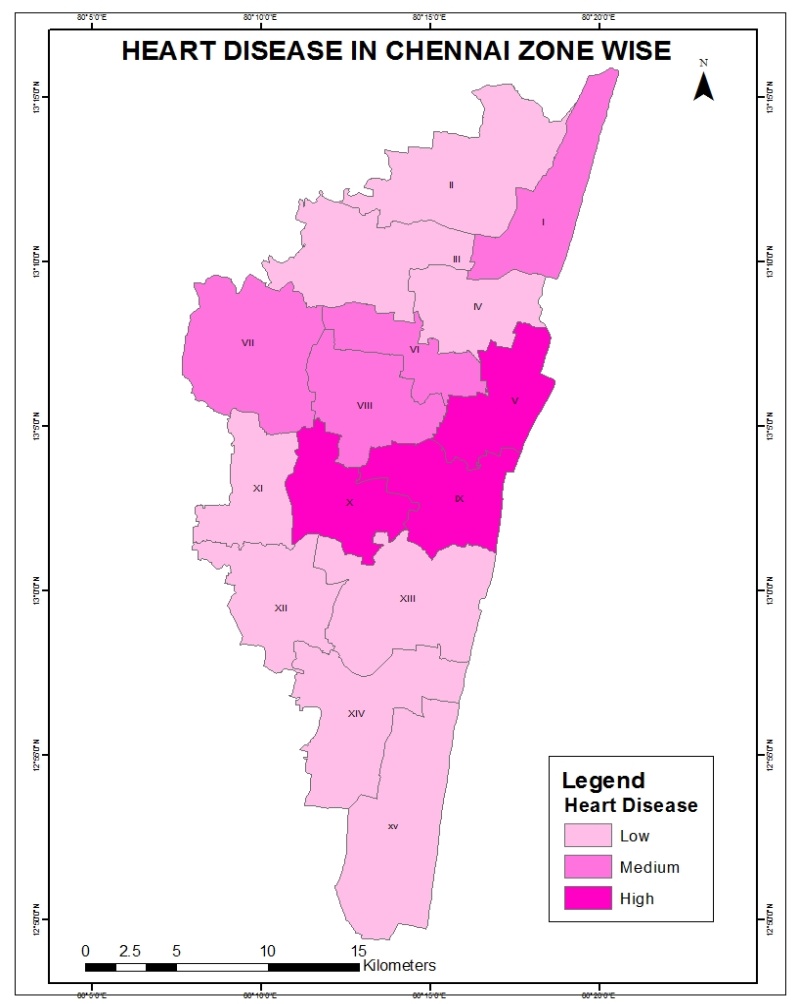
In the present survey, among the respondents more number of heart patients is present in the Sholinganallur Zone and more number of Diabetic cases has been registered in the zones namely Manali, Royapuram, Thiru- Vi- ka Nagar and Anna Nagar zones and it is low in the other zones. The male patients are high in the Sholinganallur Zone and the female patients are high in the Manali Zone. The Heart diseases are high in the Southern zone when compared to North zone. IT companies and BPO centres are present which are mostly functioned by the foreign countries and it reflects in the change in the lifestyle. And it is the main cause for the Heart disease and Diabetics. In Northern zone the middle income group of people and low income group of people are high. Hence they are forced to work more hours, which leads the sedentary lifestyle. They also prefer the Fast food, Junk food which is unhygienic. Figure 3 shows Number of Heart Diseases in Chennai by Zone wise.
In the survey, the level of Blood Pressure was also taken among the male and female respondents to identify the increase in the prevalence in Diabetics and Heart disease because the dynamic level of BP in the human body may cause for the Coronary Heart diseases. From the survey it is analysed that, 30%of the males have the low Blood Pressure, 15% of the males have moderate level of BP and 17% of the males have high BP. Among the female respondents, 25.25 % of them have low BP, 15% have moderate level of BP and 10% of the females have high BP. The level of Blood pressure is high among the people in the Northern Zones especially in the Manali. And it is followed by Tondiarpet and Thiru – Vi- Ka nagar. The Blood pressure level is moderate in the zones like Royapuram, and Sozhinganallur and the remaining zones show the low level of Blood Pressure.
The Cancer is the other major Non-communicable disease in Chennai. The estimated cancer Deaths in Chennai may be projected to increase to more than 5,000 by 2025 as per the record of cancer institute in Adyar, Chennai. The burden of Cancer is expected to further increase due to the increase in populations especially due to the migrants from other region.
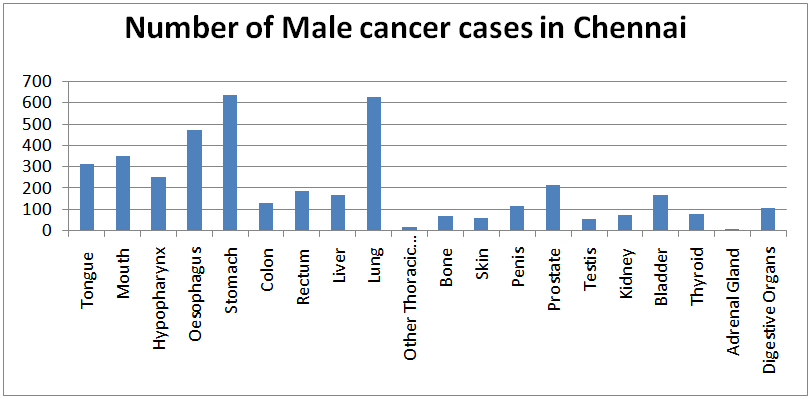
The major cause for the increase in Cancer is the effects of Tobacco and other risk factors. 50% of Cancer is caused due to the usage of Tobacco. According to the Chennai Cancer institute, the leading sites of Cancer are the Oral Cavity, Lungs, Oesophagus and Stomach among Men and Cervix, Breast and Oral Cavity amongst Women. The leading sites of Cancer for male are Stomach, Oesophagus, Mouth, Tongue, Lung, Digestive Organs etc., The level of Stomach Cancer is high with the value of 10.22%. Next to that the Lung Cancer account for 10.02% proportionate to the other Cancers. The level of Tongue, Mouth, Colon, and Rectum Cancer are in the moderate level.


In the Tongue Cancer, the number of patients is high in the age group of 45-49, and in the Mouth Cancer the numbers of patients are high in the age group of 60-64, and it is moderate in the age group of 20-35. The prevalence of Stomach Cancer and Lung Cancer are high between the age group of 50-69 and it is moderate among the age group of 25-34. Rather than the above major Cancer diseases the site off Cancer like Leukaemia, Brain Cancer, Urinary Organs, Testis, Penis, Liver, Hypopharunx are registered between the age group of 40-60. Among Males, most of the Cancer is highly registered in the age group of 55-65. It may be due to the late diagnosis of the diseases.
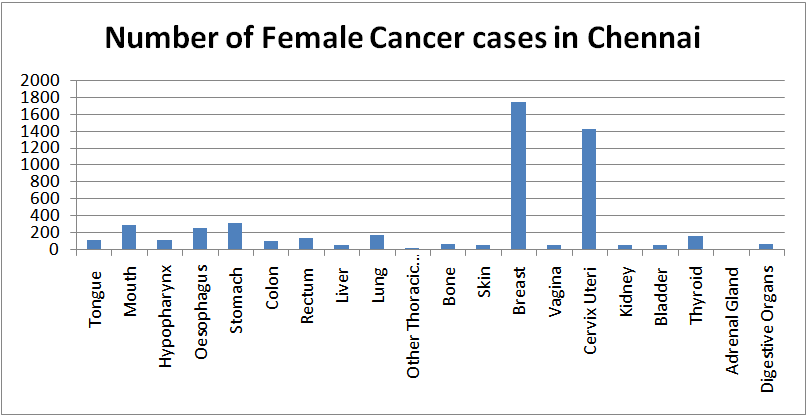
The leading sites of Cancer for Female are Breast and Cervix Uteri. The level of Breast Cancer patients is high with the value of 26.07% and the Cervix Uteri follows it with 21.21% proportionate to other Cancers. The people between the age group of 50-54 are highly affected by the Breast cancer. Next to Breast Cancer and Cervix Uteri, Stomach, Cancer, Oesophagus, Ovary Cancer, Tongue Cancer, Month Cancer also has been registered moderately among the Females. Rather than the above Cancers, the other sites of Cancer are Tonsil, Thyroid, Skin, Lung, Leukaemia also registered at low level. Most of the Cancer among Females occurs at the age group of 35-65 and mainly between the age group of 50-54. Figure 4 shows the Number of Male Cancer cases in Chennai. Figure 5 shows the Number of Female Cancer cases in Chennai.
Risk factor refers to an attribute of an individual whose presence or absence raises the probability of an adverse outcome. More than 50% of premature deaths and 40% of total diseases result from the combined effects of the risk factors. As Chennai is the gate way in South India, more than 85% of the people are migrants. The rate of migrants is growing exponentially in Chennai, not only from South India but almost from all parts of India mainly from North East India. Hence Chennai has more prevalence of risk factors. The major risk factors are Tobacco, Alcohol use, inappropriate diet, Physical inactivity, Obesity. In Chennai these risk factors are common in almost all the Socio – Economic status of the people.
Tobacco and Alcohol
Tobacco use is one of the leading risk factor for Non-communicable Diseases. 35.9% of males and 20% of females are in taking Tobacco. The intake of tobacco is high than Smoking. The Alcohol consumption is high almost in all the Socio-Economic conditions. The Alcohol use among Women is less than 5% and more than 55% of men consumes alcohol.
Diet and Nutrition
Diet is a major risk factor of Non-communicable diseases. Due to the foreign invested or foreign based companies, most of the people in Chennai tend to work in un time and to adopt the Western and European culture. Hence Chennai people have the Nutritional transition which is characterized by the increase in the consumption of fats and simple Sugars and decrease in the level of Fruit and Vegetable intake. The Calorie consumption is declining but the Nutritional status of the Chennai people are increasing. Among the Body Mass Index value between the age group of 15-24 is 18.5 and the BMI value is 25 between 21-24 age group. Among Females the Body Mass Index Value is 18.5 between the age group of 15-24 and it is 24-27 in the age above 25. The BMI value of Women is higher than the Men. Among the diet components Fruits and Vegetables are protective against several diseases. But their intake is adequate among Chennai people.
Apart from the personal details, the risk factors of NCD were analysed. Mainly the factors like Non-veg consumption, intake of vegetables, fruits and green leaves and the diseases like Diabetes, Heart Diseases, stroke, cancer was also analysed. Hence the factors like Regular breakfast, Regular dinner, Hotel visit, Drinking carbonated water, Alcohol consumption, Consuming Tobacco etc were also analysed. In this analysis, of the total samples 41% are consuming fruits regularly, 7.5% of in taking Fruits 4-6 days in a week while 36.1% of the samples never consumes fruit and the remaining samples are in taking only 1 to 2 days per week. High income people may skip but the low income people cannot offer to buy some nutrient fruits, hence there is variation in the intake of Fruits. Only 55.5% of the samples are in taking Vegetables regularly in Chennai respectively. Many of the samples skip the Vegetables, and most of the people in Chennai prefer the Vegetables mainly based on the religious occasions or days. 40% of the samples consume green leaves often. The skipping of Breakfast is one of the reasons for many diseases. 64% of the samples take their breakfast regularly, 48% of the samples take their dinner regularly and 36% of the respondents consume Non-veg items often. 32% of the respondents consume carbonated drink often, 42% of the samples prefer outside foods in Hotel or street side shops.
Physical Inactivity
Physical activity plays a vital role in energy balance and control obesity. In the metropolitan cities like Chennai, the physical inactivity has been increased due to the mechanized life. The number of migrants is increasing at rapid rate and they are forced to work more hours to earn more for their family. Hence the Physical activity has been decreasing on one side, but on the other side due to the awareness among the educated and urban people about the various diseases, simple activities like Jogging, Walking etc., are increasing in the beaches and parks to reduce the body sugar level and Obesity. The Job related Physical activity is more than 95% due the sedentary Jobs. But it is vigorous in sub urban centres than the urban areas. The Job related Physical activity is high between the age group of 35-50 among Males and 30-45 among Females.
Obesity
Physical inactivity and inappropriate Nutrition leads to Obesity and it is predominated in urban centres. Almost 60% of the adults in Chennai are either overweight or obese and it indicates that the BMI level is above the normal. In Chennai the prevalence of obesity is 35.3% where the mean BMI is 23.2 and the prevalence of Abdominal Obesity is 41.5%. The major reason for the Obesity in Chennai is consuming refined Carbohydrates, fatty substances, inhaling Tobacco, Smoking, Alcohol consumption, in taking carbonated drink, fast food, Junk food etc., To inculcate Obesity these things should be avoided. “Abdominal obesity and an accompanying constellation of risk factors have been shown to increase likelihood of Chronic Heart Disease as much as 20 fold over normal back ground risk” 16.
In this part of the analysis food habit of the samples have been analyzed by correlating with the non- communicable diseases. The cross tab has been assorted using SPSS to find the prevalence of diseases with food habits. A good understanding of the chi-square test will help researchers conduct categorical data studies and increase accuracy in result interpretation 17. Pearson’s Chi square value of cross tabs between the various factors causing NCD is discussed below.
94% of the people believe that no heart disease occur due to the consumption of Non- Veg food items. The χ² value is 0.315 at 5% significance level showing that there is no significant association between the heart disease and Non-veg items. 84% of the people believe that no Diabetes occur due to the consumption of Non- Veg food items. The χ² value is 0.298 at 5% significance level showing that there is no significant association. The cross tab between the vegetable consumption and the prevalence of diseases shows the χ² value of is 1.549 at 5% significance level showing that there is low level of significant association which states that the intake of Vegetables in daily life has no relation with the prevalence of diseases.
15% of the people have health problem even they intake fruits often and 28% of the people have health problem those who intake fruits rarely. The χ² value is 1.989 at 5% significance level showing that there is low level of significant association which states that the intake of fruits in daily life has no relation with the prevalence of diseases. 40% of the people consume greens often, 44% of the samples rarely and only 16% of the samples never intake green leaves. 13% of the people have health problem even they consume green leaves often. The χ² value is 4.307 at 5% significance level showing that there is significant association which states that the avoiding the green leaves in daily life has relation with the prevalence of diseases. The χ² value between the breakfast and disease is 0.568 at 5% significance level showing that there is no significant association between the regular breakfast and the prevalence of diseases.
The χ² value for taking dinner and disease is 1.017 at 5% significance level showing that there is low level of significant association which states that the intake of dinner regularly in daily life has no relation with the prevalence of diseases. 32% of the people are drink carbonated water often, 44% of the samples rarely and 24% of the samples never intake carbonated drinks. The χ² value is 0.157 at 5% significance level showing that there is no significant association which states that the intake of carbonated drinks in daily life has no relation with the prevalence of diseases. 27% of the people consume alcohol often, 25% of the samples rarely and 38% of the samples never consume alcohol. The χ² value is 1.954 at 5% significance level showing that there is significant association which states that the consumption of alcohol in daily life has relation with the prevalence of diseases. 24% of the people are consuming Tobacco. The χ² value is 11.549 at 5% significance level showing that there is high level of significant association which states that the consuming Tobacco in daily life has relation with the prevalence of diseases.
In this part of the analysis the 15 zones of Chennai and the factors have been analyzed by correlating with the non- communicable diseases to make a comparative study. 20% of the total samples have diabetes. The χ² value is 31.796 at 5% significance level; hence there is no association between the location of zones and diabetes. For the level of blood pressure and zone, the χ² value is 14.747 at 5% significance level. Out of the total the χ² value is 15.675 for the prevalence of Heart diseases at 5% significance level.
Out of 500 samples the prevalence of Gastric problem is high in the Royapuram zone. And it is moderate in the zones namely Valasaravakkam and Perungudi. The prevalence of Gastric problem is low in the zone namely Madhavaram, Tondiarpet, Ambattur, Teynampet, Kodambakkam and Alandur Zones. The χ² value is 12.741 at 5% significance level. 46% of the samples are taking the Treatment regularly for the NCD. In this 46% of the samples, the samples belong to the zones like Thiruvottiyur, Manali, Madhavaram, Tondiarpet are under the treatment are more in percentage when compared to the other zones. The percentage of samples under the treatment is moderate in the zones like Royapuram, Thiru vi ka Nagar, Ambattur, Teynampet, Kodambakkam, Valasaravakkam, Perungudi and Sholinganallur. The samples under the treatment are low in the zones like Anna Nagar, Alandur and Perungudi. The remaining samples are not that much aware of NCD.
From the above survey, it is concluded that most of the people have low level of awareness about the prevalence of NCD like heart diseases, Diabetics etc., mainly the low income group and illiterate people. People are also not aware of risk factors and they are giving up their traditional life and adopting sedentary life style. It should be effectively addressed by health care professionals. Hence, Health education, New Health schemes and Health programs should be implemented by the mandatory prevention methods in the form of lifestyle interventions targeting diet, physical activity, smoking and alcohol in all the regions to inculcate the Non – communicable diseases.
| [1] | Abdallah, S.Daar, Peter A.Singer, Deepa Leah Persad, Stig K.Pramming, David R.Matthews, Robert Beaglehole, Alan Bernstein, Leszek.KBorysiewicz, Stephen Colagiuri, Nirmal Ganguly, Roger I .Glass, Diane T.Finegood, Jeffrey Koplan, Elizabeth G.Nabel, George Sarna, Nizal Sarrafzadegan, Richard Smith, Derek Yach and John Bell (2007),”Grand Challenges in Chronic Non-Communicable diseases”, A Nature Research Journal, 450, 494-496, November 2007. | ||
| In article | |||
| [2] | Anand.K, Bela Shah, Kapil Yadav, Ritesh Singh, Prashant, Mathur, Eidhopaul, S.K. Kapool (2007), “Are the Urban Poor Vulnerable to Non- Communicable diseases? A study of Risk factors for Non – Communicable diseases in Urban slums of Faridabad. The National Medical Journal of India Vol 20 No 3, 2007. | ||
| In article | |||
| [3] | Ahmad Raza Hosseinpoor, Nicole Bergen, Anton Kunst, Sam harper, Regina Guthold, Dag Rekve, Edourd Tursan’D’Espaignet, Nirmala Naidoo and Somanth Chatterji (2012),” Socio – Economic inequalities in risk factors for Non- Communicable diseases in low income and middle income countries results from the world Health survey”, BMC Public health 2012, 12: 912. | ||
| In article | |||
| [4] | Anu Mary Oommen, Vinod Joseph Abraham, Kuryan George and V.Jacob Jose (2016), “Prevalence of risk factors for Non- Communicable diseases in rural and Urban Tamil Nadu”. Indian Journal of Medical research 2016 Sep: 144(3): 460-471. | ||
| In article | |||
| [5] | Prakash Upadhyay.R (2012), “An over view of the Burden of Non- Communicable Diseases in India”. Iranian Journal of Public Health 2012; 41(3): 1–8. | ||
| In article | |||
| [6] | Alireza Esteghamati, Alierza Delavani Mohammed M.Gouya, Mershed Abbasi, Farishid Alaedini, S.Aimak Alikhani, Afshin Safaie, Mehrdad Forou Zanfar, Edward W.Gregg(2008), “Prevalence of Diabetes and impaired fasting Glucose in the adult population of Iran”, Diabetes care, Volume 31, Number 1, January 2008. | ||
| In article | |||
| [7] | Alireza Esteghamati, Mershed Abbasi, Saimak Alikhani, Mohammad Mehdi, Gowya, A. Delavari (2008), “Prevalence, Awareness, Treatment and risk factors associated with hypertension in the Iranian Population: The National Survey of risk factors for Non –Communicable diseases of Iran” American Journal of Hypertension 21(6), 620-626. | ||
| In article | |||
| [8] | Bettena Kurian, Amin Qurieshi, Rajini Ganesh, Kamalamma Leelamoni (2016), “A Community based study on knowledge of diabetes mellitus among adults in a rural population of Kerala”, International Journal of Non – communicable diseases. July – September 2016, 1(2): 59-64. | ||
| In article | |||
| [9] | David J.Hunter and K.Srinath Reddy (2013), “Non – Communicable diseases”, New England Journal of Medicine, 369(14):1336-1343, Oct- 2013. | ||
| In article | |||
| [10] | Deepa.M, R.Pradeepa, RM Anjana, V.Mohan (2011), “Non communicable diseases Risk factor surveillance: Experience and challenge from India”, Indian Journal of Community Medicine, 2011, Volume: 36, Issue: 5, Page: 50-56. | ||
| In article | |||
| [11] | Divakaran.B, Muttapillymyalil.J, J.Sreedharan, K.Shalini (2010), “Life style risk factors of Non – Communicable disease: Awareness among school children”. Indian Journal of Cancer. Kids and Adolescents, 2010, Volume: 47, Issue: 5, Page: 9-13. | ||
| In article | |||
| [12] | Jalolov,N.N; Sobirov, O.G; Kabilzhonova, Sh.R. Imamova A.O(2023), “The Role of a healthy Life style in the Prevention of Myocardial Infarction. | ||
| In article | |||
| [13] | Kalaivani Annadurai, Nithiya Balan, Karnaboopathy Ranganathan(2018), “Non- Communicable diseases risk factors profile among Fisherman community of Kancheepuram district, TamilNadu: a cross sectional study”, International Journal of community Medicine and Public health 2018, Feb: 5(2):708-713. | ||
| In article | |||
| [14] | Lonzzozu Kpanake, Jean – Pierre Leno, Paul Clay Sorum and Etienne Mullet (2019), “Acceptability of Community Quarantine in contexts of Communicable diseases epidemics: perspectives of literate lay people living in Clieonakry, Guinea”, Epidemology and infection August 2019 Volume 147 E 248 PMCID:PMC6805739. | ||
| In article | |||
| [15] | Marc Suhrcke, David Stuckler, Jonathan E.Suk, Monica Desai, Michaela Senek, Boika Rechal and Jan C.Semenza (2011), “The impact of Economic Crises on Coomunicable Disease Transmission and Control: A systematic Review of the Evidence”, PLOS One: V6(6): June 2011 PMC3112201. | ||
| In article | |||
| [16] | Nirman Kanna, Nandhini, Sasikumar Arumugam, Tamilvanan (2022), “Study on Knowledge of Cardiac Arrest and Its Management Among Health Care Professional Students in Chennai and Kanchipuram, Research Square, October 2022. | ||
| In article | |||
| [17] | Prasanth, Balan Krishna, Eashwar, Virudhunagar Muthuprakash, Anantha: Mahalakshmi, Karthikeyan (2023),” Epidemiology of Non - Communicable diseases among Transgender population residing in Chennai district, Tamil Nadu. Journal of Fmaily Medicine and Primary care 12(4): p 762-767, April 2022. | ||
| In article | |||
Published with license by Science and Education Publishing, Copyright © 2022 S.M. Kumar, Dr. P.Thirumalai and Dr. P. Manivel
 This work is licensed under a Creative Commons Attribution 4.0 International License. To view a copy of this license, visit
https://creativecommons.org/licenses/by/4.0/
This work is licensed under a Creative Commons Attribution 4.0 International License. To view a copy of this license, visit
https://creativecommons.org/licenses/by/4.0/
| [1] | Abdallah, S.Daar, Peter A.Singer, Deepa Leah Persad, Stig K.Pramming, David R.Matthews, Robert Beaglehole, Alan Bernstein, Leszek.KBorysiewicz, Stephen Colagiuri, Nirmal Ganguly, Roger I .Glass, Diane T.Finegood, Jeffrey Koplan, Elizabeth G.Nabel, George Sarna, Nizal Sarrafzadegan, Richard Smith, Derek Yach and John Bell (2007),”Grand Challenges in Chronic Non-Communicable diseases”, A Nature Research Journal, 450, 494-496, November 2007. | ||
| In article | |||
| [2] | Anand.K, Bela Shah, Kapil Yadav, Ritesh Singh, Prashant, Mathur, Eidhopaul, S.K. Kapool (2007), “Are the Urban Poor Vulnerable to Non- Communicable diseases? A study of Risk factors for Non – Communicable diseases in Urban slums of Faridabad. The National Medical Journal of India Vol 20 No 3, 2007. | ||
| In article | |||
| [3] | Ahmad Raza Hosseinpoor, Nicole Bergen, Anton Kunst, Sam harper, Regina Guthold, Dag Rekve, Edourd Tursan’D’Espaignet, Nirmala Naidoo and Somanth Chatterji (2012),” Socio – Economic inequalities in risk factors for Non- Communicable diseases in low income and middle income countries results from the world Health survey”, BMC Public health 2012, 12: 912. | ||
| In article | |||
| [4] | Anu Mary Oommen, Vinod Joseph Abraham, Kuryan George and V.Jacob Jose (2016), “Prevalence of risk factors for Non- Communicable diseases in rural and Urban Tamil Nadu”. Indian Journal of Medical research 2016 Sep: 144(3): 460-471. | ||
| In article | |||
| [5] | Prakash Upadhyay.R (2012), “An over view of the Burden of Non- Communicable Diseases in India”. Iranian Journal of Public Health 2012; 41(3): 1–8. | ||
| In article | |||
| [6] | Alireza Esteghamati, Alierza Delavani Mohammed M.Gouya, Mershed Abbasi, Farishid Alaedini, S.Aimak Alikhani, Afshin Safaie, Mehrdad Forou Zanfar, Edward W.Gregg(2008), “Prevalence of Diabetes and impaired fasting Glucose in the adult population of Iran”, Diabetes care, Volume 31, Number 1, January 2008. | ||
| In article | |||
| [7] | Alireza Esteghamati, Mershed Abbasi, Saimak Alikhani, Mohammad Mehdi, Gowya, A. Delavari (2008), “Prevalence, Awareness, Treatment and risk factors associated with hypertension in the Iranian Population: The National Survey of risk factors for Non –Communicable diseases of Iran” American Journal of Hypertension 21(6), 620-626. | ||
| In article | |||
| [8] | Bettena Kurian, Amin Qurieshi, Rajini Ganesh, Kamalamma Leelamoni (2016), “A Community based study on knowledge of diabetes mellitus among adults in a rural population of Kerala”, International Journal of Non – communicable diseases. July – September 2016, 1(2): 59-64. | ||
| In article | |||
| [9] | David J.Hunter and K.Srinath Reddy (2013), “Non – Communicable diseases”, New England Journal of Medicine, 369(14):1336-1343, Oct- 2013. | ||
| In article | |||
| [10] | Deepa.M, R.Pradeepa, RM Anjana, V.Mohan (2011), “Non communicable diseases Risk factor surveillance: Experience and challenge from India”, Indian Journal of Community Medicine, 2011, Volume: 36, Issue: 5, Page: 50-56. | ||
| In article | |||
| [11] | Divakaran.B, Muttapillymyalil.J, J.Sreedharan, K.Shalini (2010), “Life style risk factors of Non – Communicable disease: Awareness among school children”. Indian Journal of Cancer. Kids and Adolescents, 2010, Volume: 47, Issue: 5, Page: 9-13. | ||
| In article | |||
| [12] | Jalolov,N.N; Sobirov, O.G; Kabilzhonova, Sh.R. Imamova A.O(2023), “The Role of a healthy Life style in the Prevention of Myocardial Infarction. | ||
| In article | |||
| [13] | Kalaivani Annadurai, Nithiya Balan, Karnaboopathy Ranganathan(2018), “Non- Communicable diseases risk factors profile among Fisherman community of Kancheepuram district, TamilNadu: a cross sectional study”, International Journal of community Medicine and Public health 2018, Feb: 5(2):708-713. | ||
| In article | |||
| [14] | Lonzzozu Kpanake, Jean – Pierre Leno, Paul Clay Sorum and Etienne Mullet (2019), “Acceptability of Community Quarantine in contexts of Communicable diseases epidemics: perspectives of literate lay people living in Clieonakry, Guinea”, Epidemology and infection August 2019 Volume 147 E 248 PMCID:PMC6805739. | ||
| In article | |||
| [15] | Marc Suhrcke, David Stuckler, Jonathan E.Suk, Monica Desai, Michaela Senek, Boika Rechal and Jan C.Semenza (2011), “The impact of Economic Crises on Coomunicable Disease Transmission and Control: A systematic Review of the Evidence”, PLOS One: V6(6): June 2011 PMC3112201. | ||
| In article | |||
| [16] | Nirman Kanna, Nandhini, Sasikumar Arumugam, Tamilvanan (2022), “Study on Knowledge of Cardiac Arrest and Its Management Among Health Care Professional Students in Chennai and Kanchipuram, Research Square, October 2022. | ||
| In article | |||
| [17] | Prasanth, Balan Krishna, Eashwar, Virudhunagar Muthuprakash, Anantha: Mahalakshmi, Karthikeyan (2023),” Epidemiology of Non - Communicable diseases among Transgender population residing in Chennai district, Tamil Nadu. Journal of Fmaily Medicine and Primary care 12(4): p 762-767, April 2022. | ||
| In article | |||